
Life, 1921-10-27 · page 26 of 34
Life — October 27, 1921 — page 26: what you’re looking at
What you’re looking at
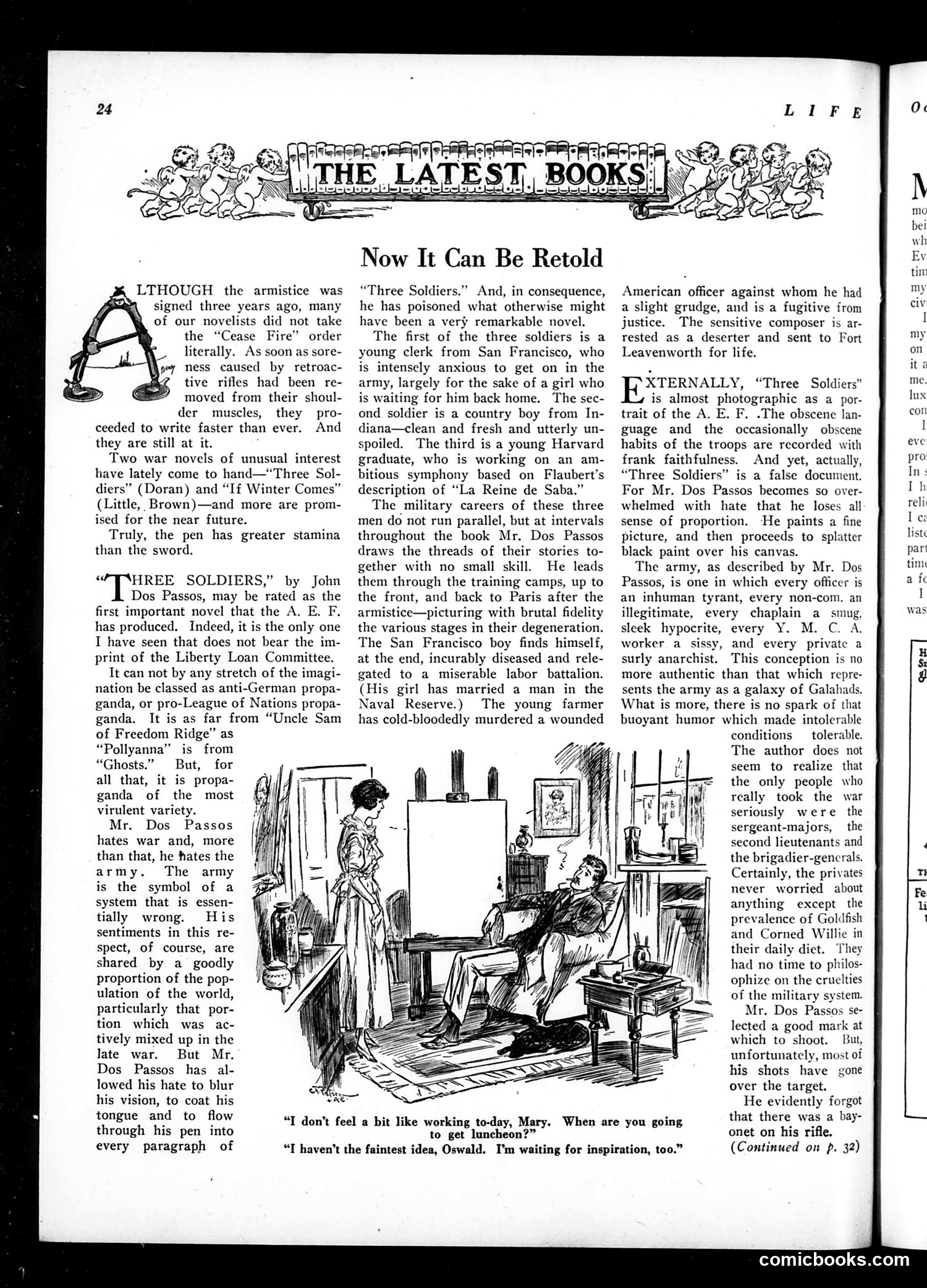
This page reviews John Dos Passos's 1921 novel *Three Soldiers*, one of the first major American literary treatments of World War I. The reviewer acknowledges Dos Passos's important achievement—a war novel free from patriotic propaganda or Liberty Loan Committee messaging—yet criticizes him for letting his hatred of war and the military corrupt his artistic vision. The review characterizes the novel as "propaganda of the most virulent variety," arguing that while Dos Passos captures army life photographically, he loses proportion by painting all officers as tyrants and non-commissioned officers as illegitimate. The three soldier protagonists meet tragic fates: disease, murder/fugitive status, and desertion. The accompanying cartoon shows two office workers (labeled Mary and Oswald) procrastinating—a lighter commentary on creative inspiration versus actual work, contrasting with Dos Passos's weighty subject matter.
📄 Transcribed text from this page (OCR, searchable)
Machine-transcribed from the original scan — historical spelling and the odd misread are preserved.
Now It Can Be Retold LTHOUGH the armistice was “Three Soldiers.” And, in consequence, American officer against whom he had signed three years ago, many of our novelists did not take the “Cease Fire” order literally. As soon as sore- \An“y ness caused by retroac- &? tive rifles had been re- = moved from their shoul- der muscles, they pro- ceeded to write faster than ever. And they are still at it. Two war novels of unusual interest have lately come to hand—“Three Sol- diers” (Doran) and “If Winter Comes” (Little, Brown)—and more are prom- ised for the near future. Truly, the pen has greater stamina than the sword. « HHREE SOLDIERS,” by John Dos Passos, may be rated as the first important novel that the A. E. F. has produced. Indeed, it is the only one I have seen that does not bear the im- print of the Liberty Loan Committee. It can not by any stretch of the imagi- nation be classed as anti-German propa- ganda, or pro-League of Nations propa- ganda. It is as far from “Uncle Sam of Freedom Ridge” as “Pollyanna” is from “Ghosts.” But, for all that, it is propa- ganda of the most virulent variety. Mr. Dos Passos hates war and, more than that, he hates the army. The army is the symbol of a system that is essen- tially wrong. His sentiments in this re- spect, of course, are shared by a goodly proportion of the pop- ulation of the world, particularly that por- tion which was ac- tively mixed up in the late war. But Mr. Dos Passos has al- lowed his hate to blur his vision, to coat his tongue and to flow through his pen into every paragraph of “I don’t feel a bit like working to-day, Mary. When are you going he has poisoned what otherwise might have been a very remarkable novel. The first of the three soldiers is a young clerk from San Francisco, who is intensely anxious to get on in the army, largely for the sake of a girl who is waiting for him back home. The sec- ond soldier is a country boy from In- diana—clean and fresh and utterly un- spoiled. The third is a young Harvard graduate, who is working on an am- bitious symphony based on Flaubert’s description of “La Reine de Saba.” The military careers of these three men do not run parallel, but at intervals throughout the book Mr. Dos Passos draws the threads of their stories to- gether with no small skill. He leads them through the training camps, up to the front, and back to Paris after the armistice—picturing with brutal fidelity the various stages in their degeneration. The San Francisco boy finds himself, at the end, incurably diseased and rele- gated to a miserable labor battalion. (His girl has married a man in the Naval Reserve.) The young farmer has cold-bloodedly murdered a wounded to get luncheon? “I haven’t the faintest idea, Oswald. I’m waiting for inspiration, too.” a slight grudge, and is a fugitive from justice. The sensitive composer is ar- rested as a deserter and sent to Fort Leavenworth for life. XTERNALLY, “Three Soldiers” is almost photographic as a por- trait of the A. E. F. .The obscene lan- guage and the occasionally obscene habits of the troops are recorded with frank faithfulness. And yet, actually, “Three Soldiers” is a false document. For Mr. Dos Passos becomes so over- whelmed with hate that he loses all sense of proportion. ‘He paints a fine picture, and then proceeds to splatter black paint over his canvas. The army, as described by Mr. Dos Passos, is one in which every officer is an inhuman tyrant, every non-com. an illegitimate, every chaplain a smug, sleek hypocrite, every Y. M. C. A. worker a sissy, and every private a surly anarchist. This conception is no more authentic than that which repre- sents the army as a galaxy of Galahads. What is more, there is no spark of that buoyant humor which made intolerable conditions _ tolerable. The author does not seem to realize that the only people who really took the war seriously were the sergeant-majors, the second lieutenants and the brigadier-gencrals. Certainly, the privates never worried about anything except the prevalence of Goldfish and Corned Willie in their daily diet. They had no time to philos- ophize on the cruelties of the military Mr. Dos Passos se- lected a good mark at which to shoot. But, unfortunately, most of his shots have gone over the target. He evidently forgot that there was a bay- onet on his rifle. (Continued on p. 32) part time a fe I was comicbooks.com