
Life, 1921-10-27 · page 24 of 34
Life — October 27, 1921 — page 24: what you’re looking at
What you’re looking at
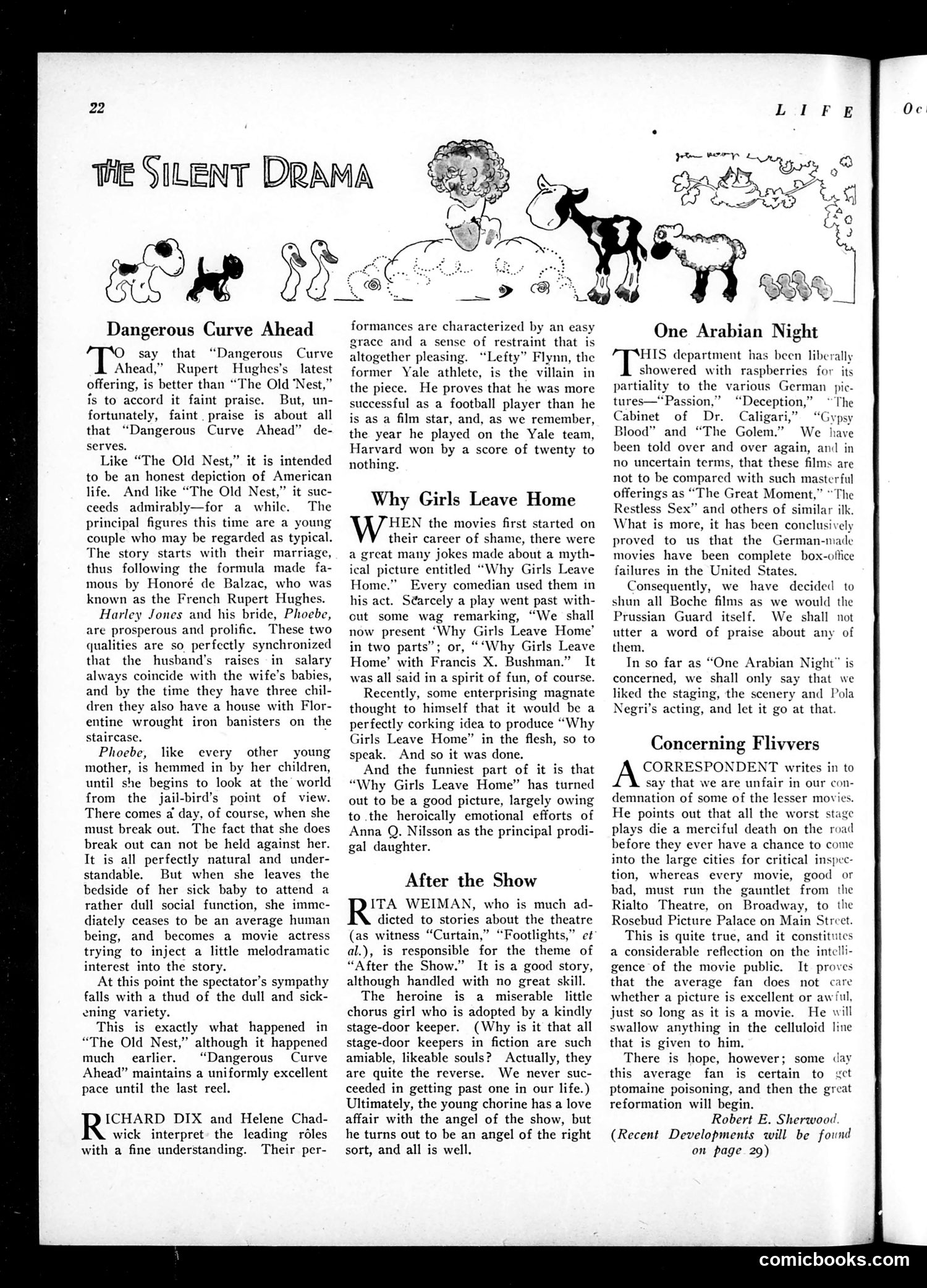
This page contains three brief film reviews from Life's entertainment section, likely from the 1920s based on the silent film references and actors mentioned (Richard Dix, Helene Chadwick, Anna Q. Nilsson). **"Dangerous Curve Ahead"** is criticized as derivative melodrama about a young married couple with children. The reviewer sarcastically compares director Rupert Hughes to French novelist Balzac. The film loses sympathy when the wife abandons her sick child for a social event—the reviewer mocks this as fake "movie actress" theatricality rather than authentic human behavior. **"Why Girls Leave Home"** ironically began as a joke title comedians used in vaudeville acts. The reviewer is pleasantly surprised the actual film succeeds, crediting actress Anna Q. Nilsson's emotional performance. **"After the Show"** critiques Rita Weiman's theatrical story about a chorus girl, noting the tired fiction trope of kind-hearted stage-door keepers, which the reviewer claims bears no resemblance to real life. The tone throughout is witty, slightly condescending toward cinema as an art form.
📄 Transcribed text from this page (OCR, searchable)
Machine-transcribed from the original scan — historical spelling and the odd misread are preserved.
22 Dangerous Curve Ahead Curve To say that ‘Dangerous Ahead,” Rupert Hughes's latest offering, is better than “The Old ‘Nest,” is to accord it faint praise. But, un- fortunately, faint. praise is about all that “Dangerous Curve Ahead” de- serves. Like “The Old Nest,” it is intended to be an honest depiction of American life. And like “The Old Nest,” it suc- ceeds admirably—for a while. The principal figures this time are a young couple who may be regarded as typical. The story starts with their marriage, thus following the formula made fa- mous by Honoré de Balzac, who was known as the French Rupert Hughes. Harley Jones and his bride, Phoebe, are prosperous and prolific. These two qualities are so perfectly synchronized that the husband’s raises in salary always coincide with the wife’s babies, and by the time they have three chil- dren they also have a house with Flor- entine wrought iron banisters on the staircase. Phoebe, like every other young mother, is hemmed in by her children, until she begins to look at the world from the jail-bird’s point of view. There comes a day, of course, when she must break out. The fact that she does break out can not be held against her. It is all perfectly natural and under- standable. But when she leaves the bedside of her sick baby to attend a rather dull social function, she imme- diately ceases to be an average human being, and becomes a movie actress trying to inject a little melodramatic interest into the story. At this point the spectator’s sympathy falls with a thud of the dull and sick- ening variety. This is exactly what happened in “The Old Nest,” although it happened much earlier. “Dangerous Curve Ahead” maintains a uniformly excellent pace until the last reel. ICHARD DIX and Helene Chad- wick interpret: the leading réles with a fine understanding. Their per- formances are characterized by an easy grace and a sense of restraint that is altogether pleasing. “Lefty” Flynn, the former Yale athlete, is the villain in the piece. He proves that he was more successful as a football player than he is as a film star, and, as we remember, the year he played on the Yale team, Harvard won by a score of twenty to nothing. Why Girls Leave Home HEN the movies first started on their career of shame, there were a great many jokes made about a myth- ical picture entitled “Why Girls Leave Home.” Every comedian used them in his act. Séarcely a play went past with- cut some wag remarking, “We shall now present ‘Why Girls Leave Home’ in two parts”; or, “‘Why Girls Leave Home’ with Francis X. Bushman.” It was all said in a spirit of fun, of course. Recently, some enterprising magnate thought to himself that it would be a perfectly corking idea to produce “Why Girls Leave Home” in the flesh, so to speak. And so it was done. And the funniest part of it is that “Why Girls Leave Home” has turned out to be a good picture, largely owing to.the heroically emotional efforts of Anna Q. Nilsson as the principal prodi- gal daughter. After the Show ITA WEIMAN, who is much ad- dicted to stories about the theatre (as witness “Curtain,” “Footlights,” et al.), is responsible for the theme of “After the Show.” It is a good story, although handled with no great skill. The heroine is a miserable little chorus girl who is adopted by a kindly stage-door keeper. (Why is it that all stage-door keepers in fiction are such amiable, likeable souls? Actually, they are quite the reverse. We never suc- ceeded in getting past one in our life.) Ultimately, the young chorine has a love affair with the angel of the show, but he turns out to be an angel of the right sort, and all is well. One Arabian Night HIS department has been liberally showered with raspberries for its partiality to the various German pic- tures—“Passion,” “Deception,” The Cabinet of Dr. Caligari,” “Gypsy Blood” and “The Golem.” We have been told over and over again, ani in no uncertain terms, that these films are not to be compared with such masterful offerings as “The Great Momen Phe Restless Sex” and others of similar ilk. What is more, it has been conclusively proved to us that the German-made movies have been complete box-oltice failures in the United States. Consequently, we have decided to shun all Boche films as we would the Prussian Guard itself. We shall not utter a word of praise about any of them. In so far as “One Arabian Night” is concerned, we shall only say that we liked the staging, the scenery and Pola Negri’s acting, and let it go at that. Concerning Flivvers CORRESPONDENT writes in to say that we are unfair in our con- demnation of some of the lesser movies. He points out that all the worst stage plays die a merciful death on the road before they ever have a chance to come into the large cities for critical inspec- tion, whereas every movie, good or bad, must run the gauntlet from the Rialto Theatre, on Broadway, to the Rosebud Picture Palace on Main Street. This is quite true, and it constitutes a considerable reflection on the intelli- gence of the movie public. It proves that the average fan does not care whether a picture is excellent or awiul, just so long as it is a movie. He will swallow anything in the celluloid line that is given to him. There is hope, however; some ( this average fan is certain to xet ptomaine poisoning, and then the great reformation will begin. Robert E. Sherwood. (Recent Developments will be found on page 29) comicbooks.com