
A complete issue · 34 pages · 1921
Life — August 25, 1921
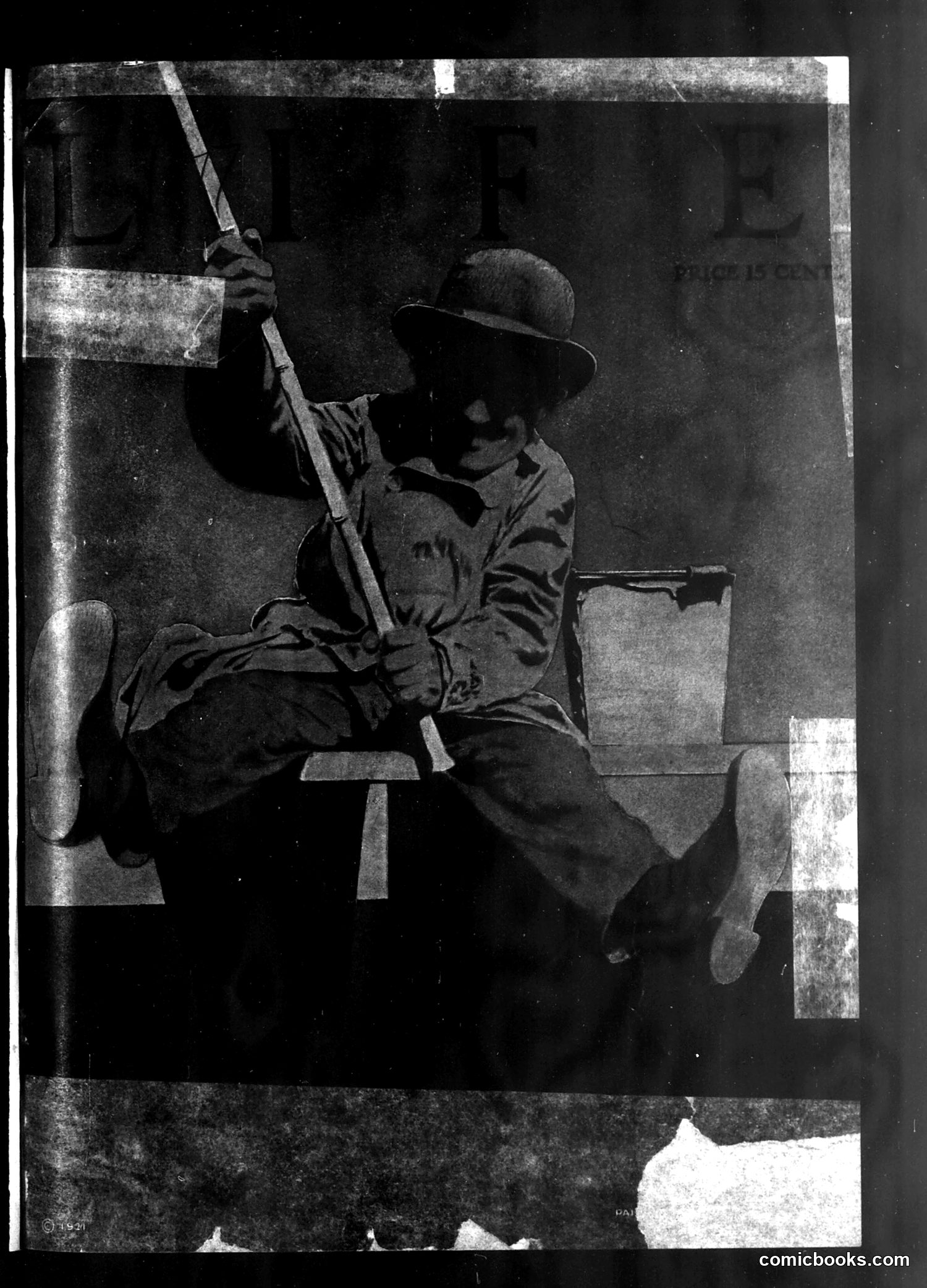
I can see this is a black and white photograph showing a man in work clothes and a hat sitting on what appears to be industrial or construction equipment, holding a long pole or tool. However, without the OCR text being legible in my view, and without additional context clues visible in the image itself, I cannot definitively identify who this figure represents or what specific political or social commentary this page is making. To accurately explain the satire or joke for a modern reader, I would need either: clearer OCR text from the page, a visible caption or title, or additional identifying marks. I can confirm this appears to be from a historical American publication, but I cannot responsibly identify the specific figure or referenced event without more concrete evidence.

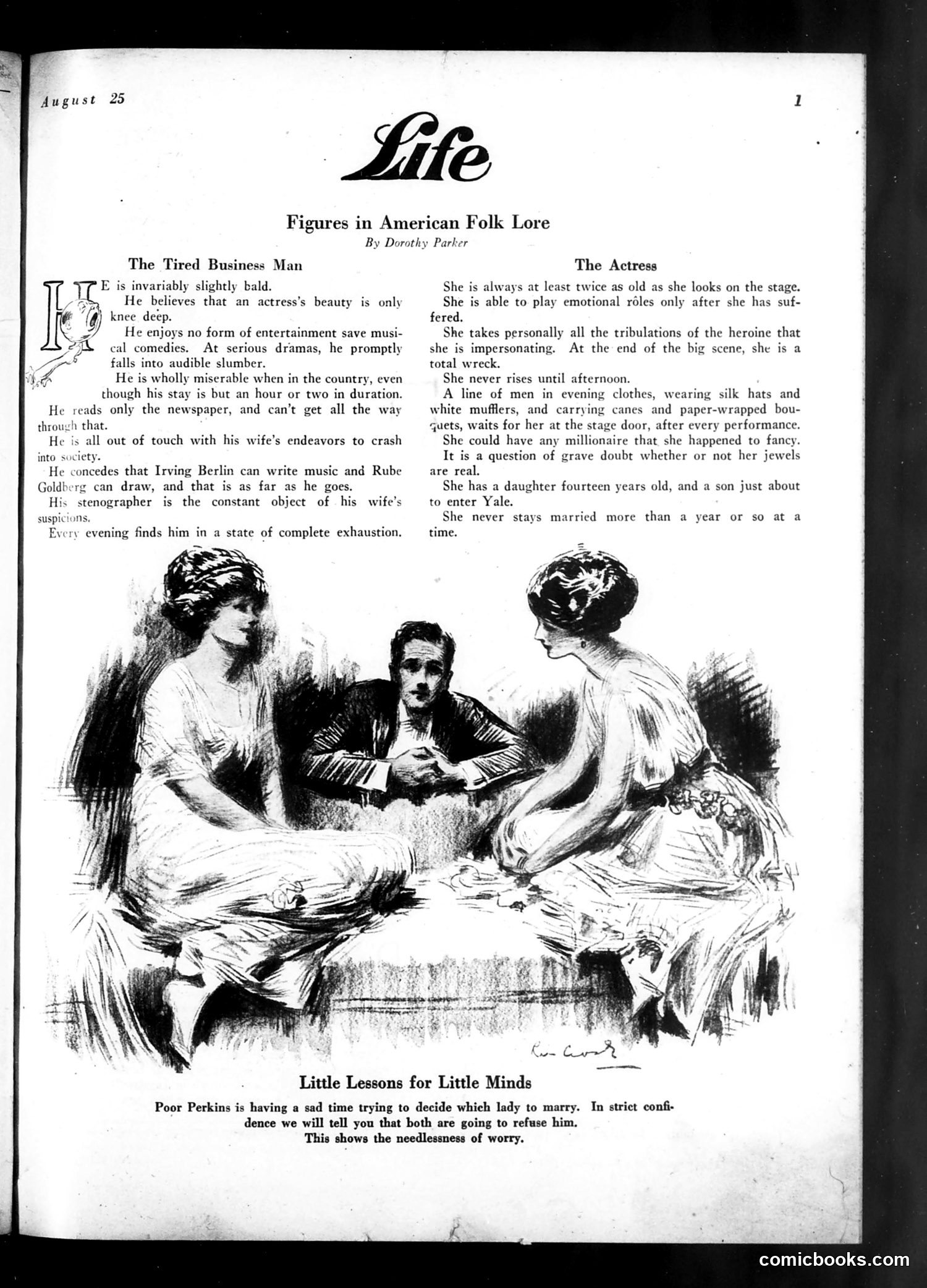
This page presents two character types as social commentary. "The Tired Business Man" mocks a specific American archetype: the exhausted urban professional who reads newspapers, whose wife suspects his infidelities, and who leaves entertainment to musicians and artists while he merely consumes culture passively. "The Actress" satirizes theatrical women as aging narcissists who exaggerate their stage personas offstage, surround themselves with male admirers, and cycle through marriages frequently. The illustration depicts her holding court with male suitors. The bottom cartoon, "Little Lessons for Little Minds," jokes that the indecisive "Poor Perkins" will be rejected by both women he's courting—a lesson that worrying accomplishes nothing. The satire targets both masculine anxiety and female capriciousness as folk wisdom.
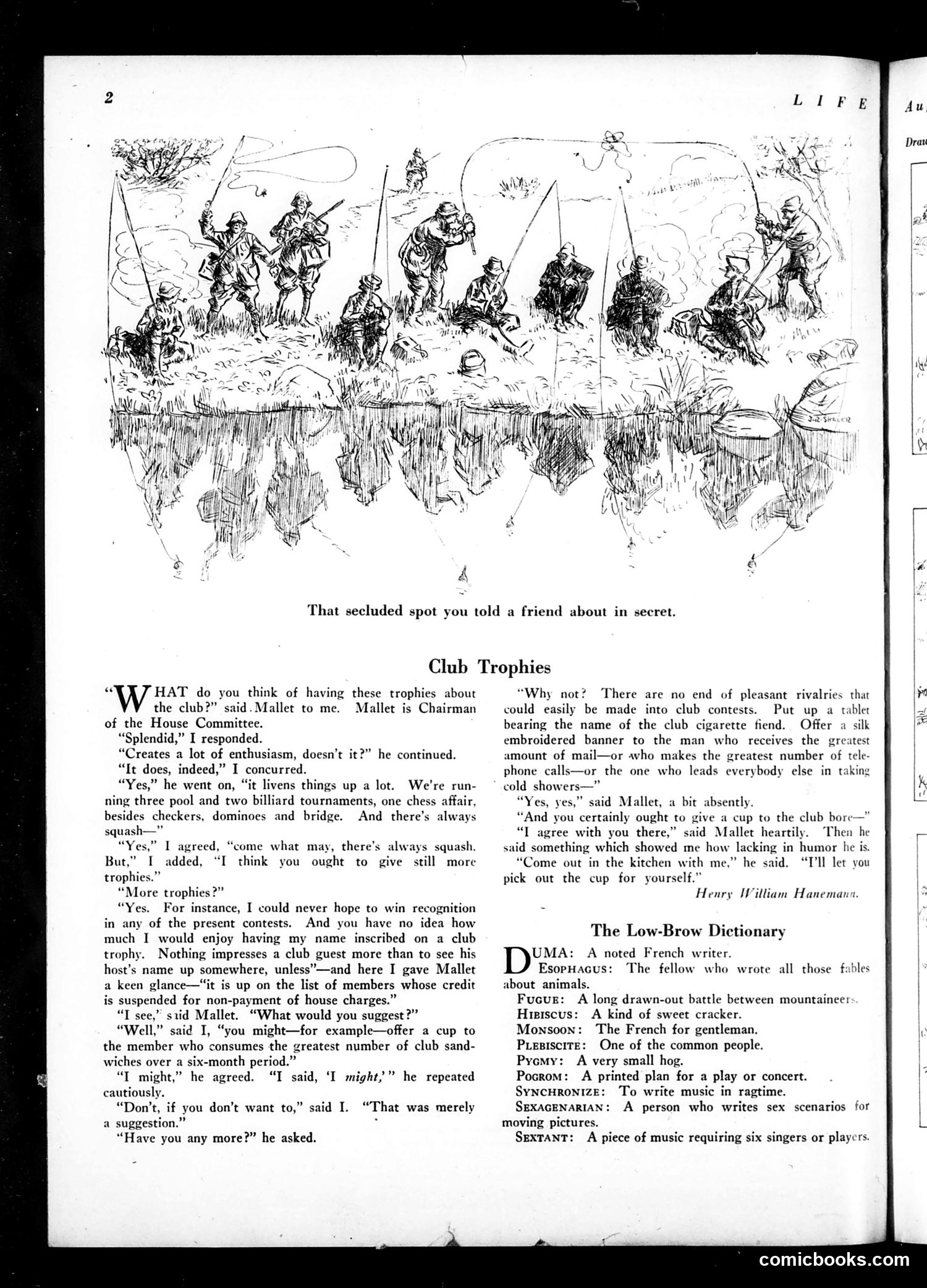
The cartoon illustrates a fishing scene captioned "That secluded spot you told a friend about in secret." It depicts multiple fishermen crowded together at what should be a private fishing location, each with their own rod and line. The humor plays on a common social frustration: when you share an exclusive spot with one person "in secret," word spreads, and soon dozens of people have discovered it, defeating the original purpose of secrecy and exclusivity. This is social satire about information leakage and the impossibility of keeping secrets in a social network—a timeless theme. The packed scene of fishermen represents how quickly private knowledge becomes public knowledge through casual word-of-mouth sharing.
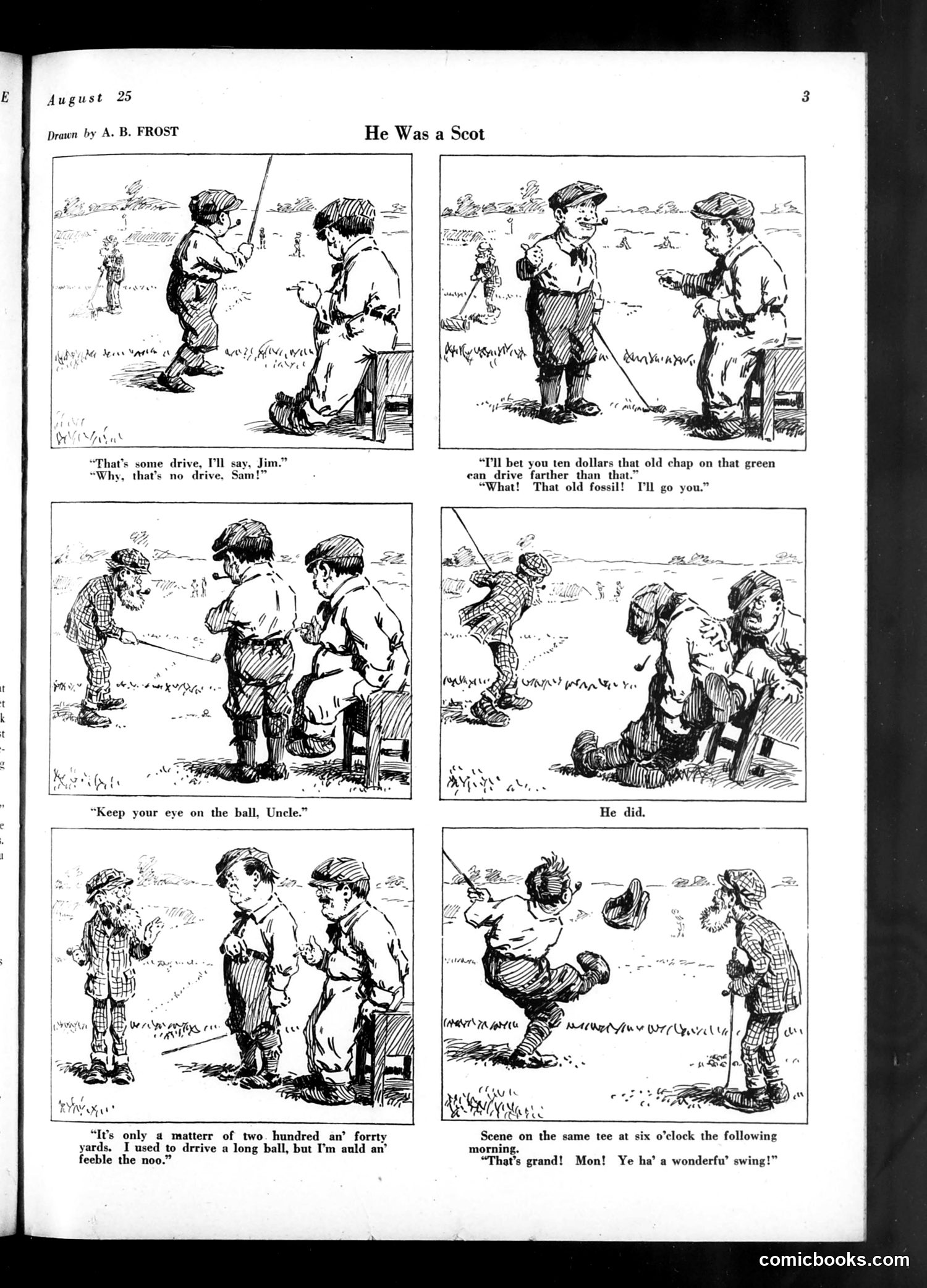
This six-panel comic by A. B. Frost depicts a golf match between two men, apparently centered on Scottish golfing stereotypes. The narrative follows a friendly wager: one character bets ten dollars that an older Scottish golfer ("that old chap") can drive farther than another player's long drive. The punchline reveals the Scot's actual skill—he hits the ball so far that it strikes the other man in the head the next morning on the same golf course. The humor relies on period stereotypes about Scottish toughness and golfing prowess, combined with physical comedy. The "Scot" proves his claim through literal proof of superior distance, albeit with unintended consequences. This represents typical early-20th-century sports humor mixing national character caricature with slapstick outcomes.
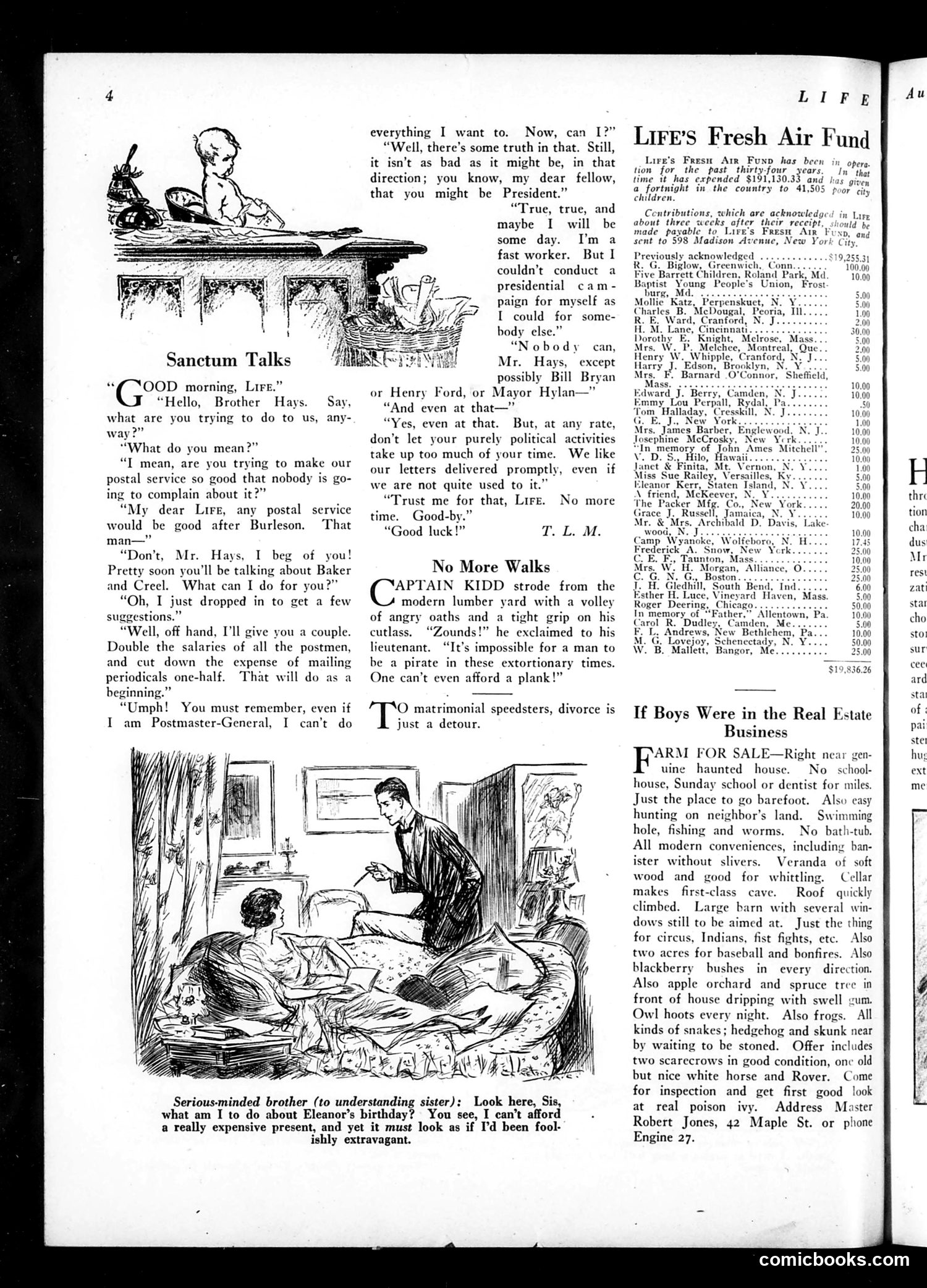
This satirical piece depicts a conversation between a postal worker and "Brother Hays" (likely referencing a public figure of the era). The postal worker complains about poor working conditions—specifically mentioning that nobody complies with postal regulations and that he's exhausted by the job's demands. When Hays suggests the worker could improve things through political activism or become Postmaster-General, the worker dismissively responds that he lacks the time and energy. The humor targets the gap between idealistic solutions proposed by authorities and the practical exhaustion facing ordinary workers. The cartoon critiques both the difficulty of the postal service's operations and the unrealistic expectations placed on workers by management, using gentle irony rather than sharp political attack.
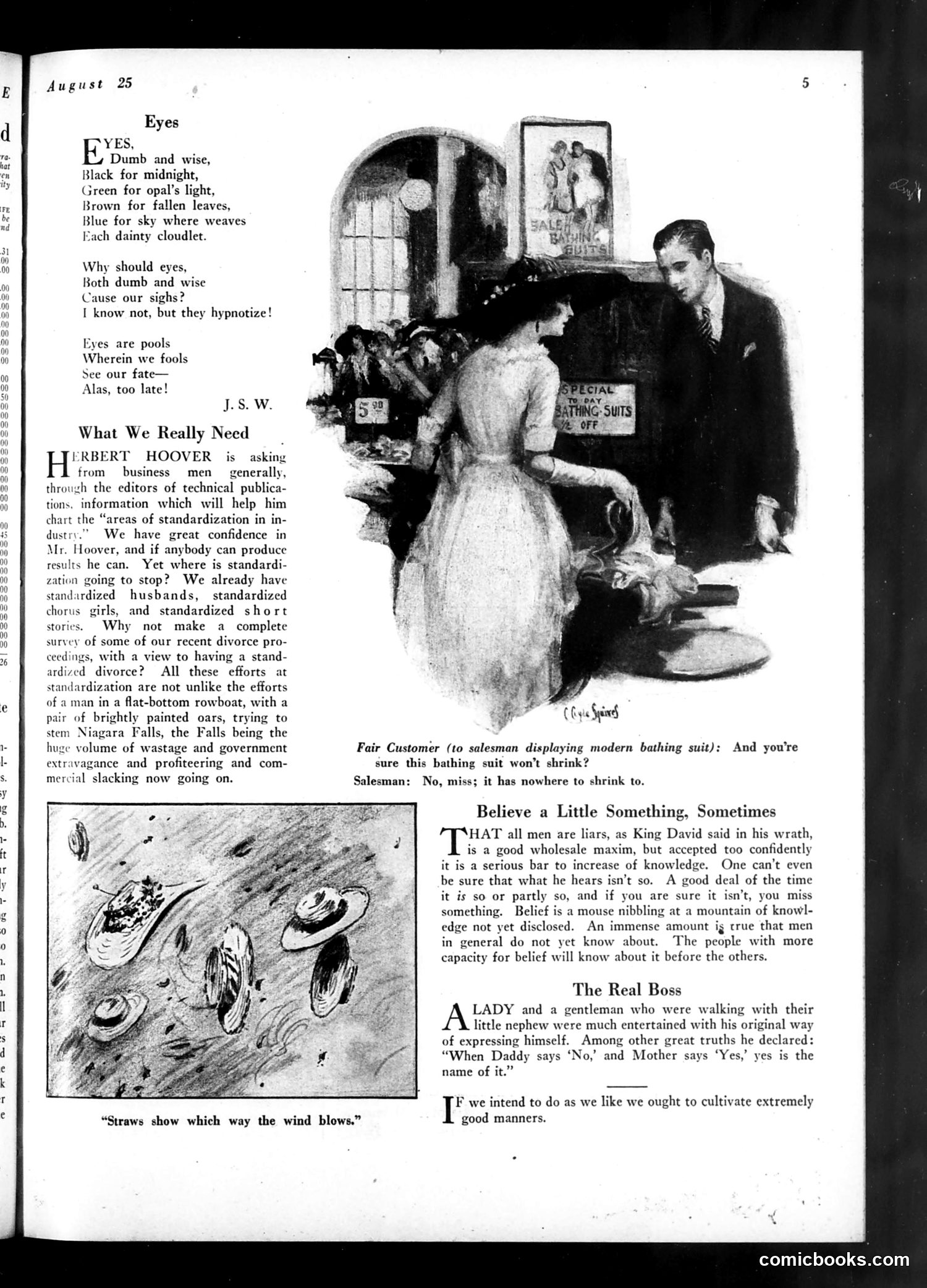
This page combines humorous commentary with satirical illustrations typical of Life's format. **"Eyes" Poem (J.S.W.):** A whimsical verse about eye colors and their symbolic meanings—dumb and wise eyes hypnotize us, and eyes are "pools wherein we fools / See our fate." **"What We Really Need":** A piece requesting Herbert Hoover's help standardizing industries. The satire mocks excessive standardization efforts by sarcastically suggesting standardized divorces and short stories—implying such standardization has already gone absurdly far. **Main Cartoon:** Shows a salesman pitching a modern bathing suit to a female customer, claiming it "won't shrink." The humor plays on common housewife concerns about garment care and product durability. **"Straws show which way the wind blows":** A simple illustration about weather prediction. Overall, the page reflects 1920s consumer culture and business standardization anxieties.
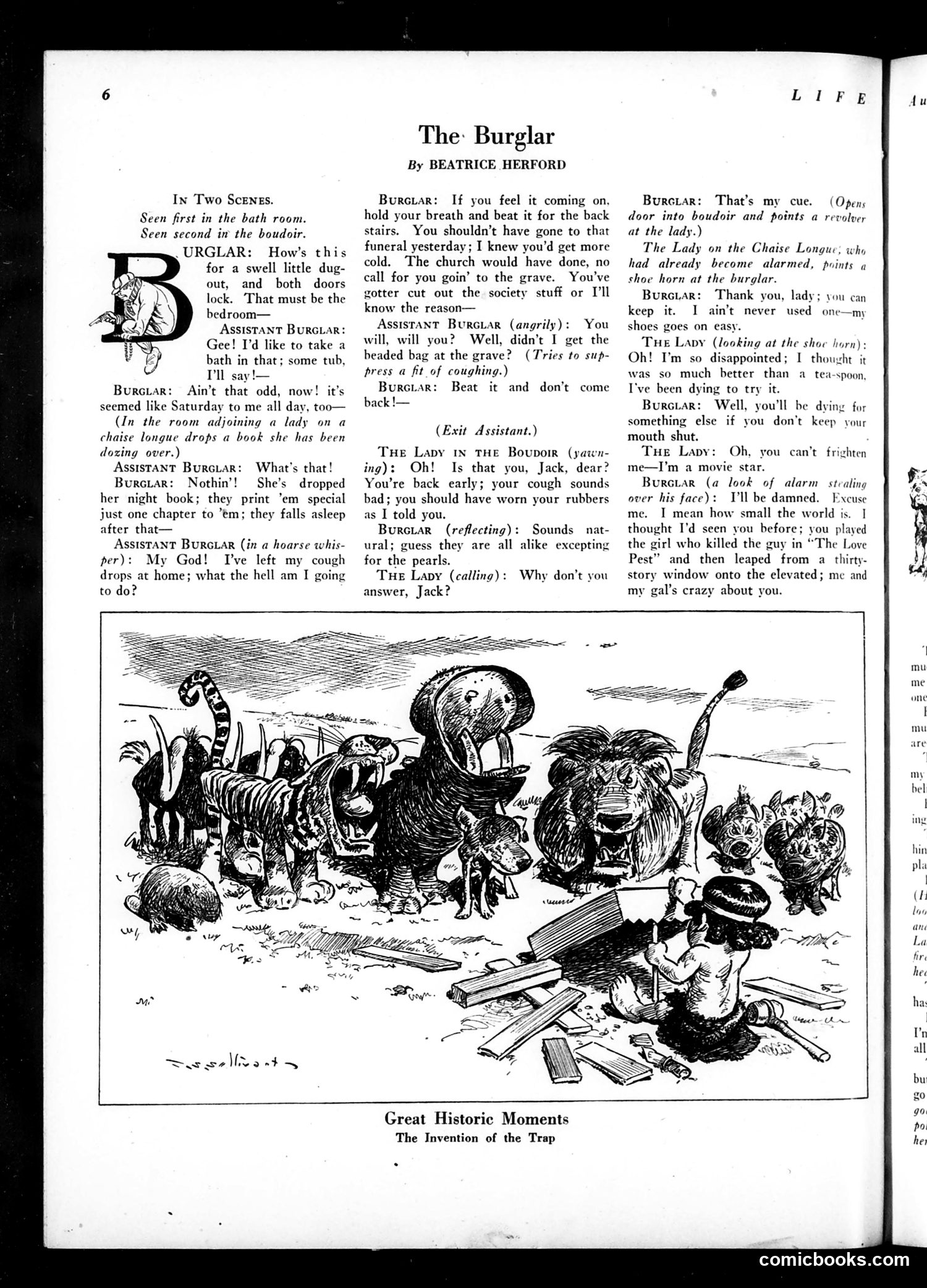
This is a two-scene theatrical comedy. The text presents dialogue between a burglar and an assistant, then the burglar and a lady of the house he's robbing. The humor relies on the burglar's incompetence and the lady's sharp wit—she's unimpressed and threatening rather than frightened. She references "The Love Pest," suggesting the burglar may have killed someone, and mocks his criminal reputation. The illustration labeled "Great Historic Moments: The Invention of the Trap" depicts whimsical, grotesque creatures examining mousetraps—a visual pun playing on the theatrical setup and the burglar's predicament of being caught or trapped. The piece satirizes both incompetent criminals and unflappable society women through absurdist humor typical of early 20th-century American comedy.
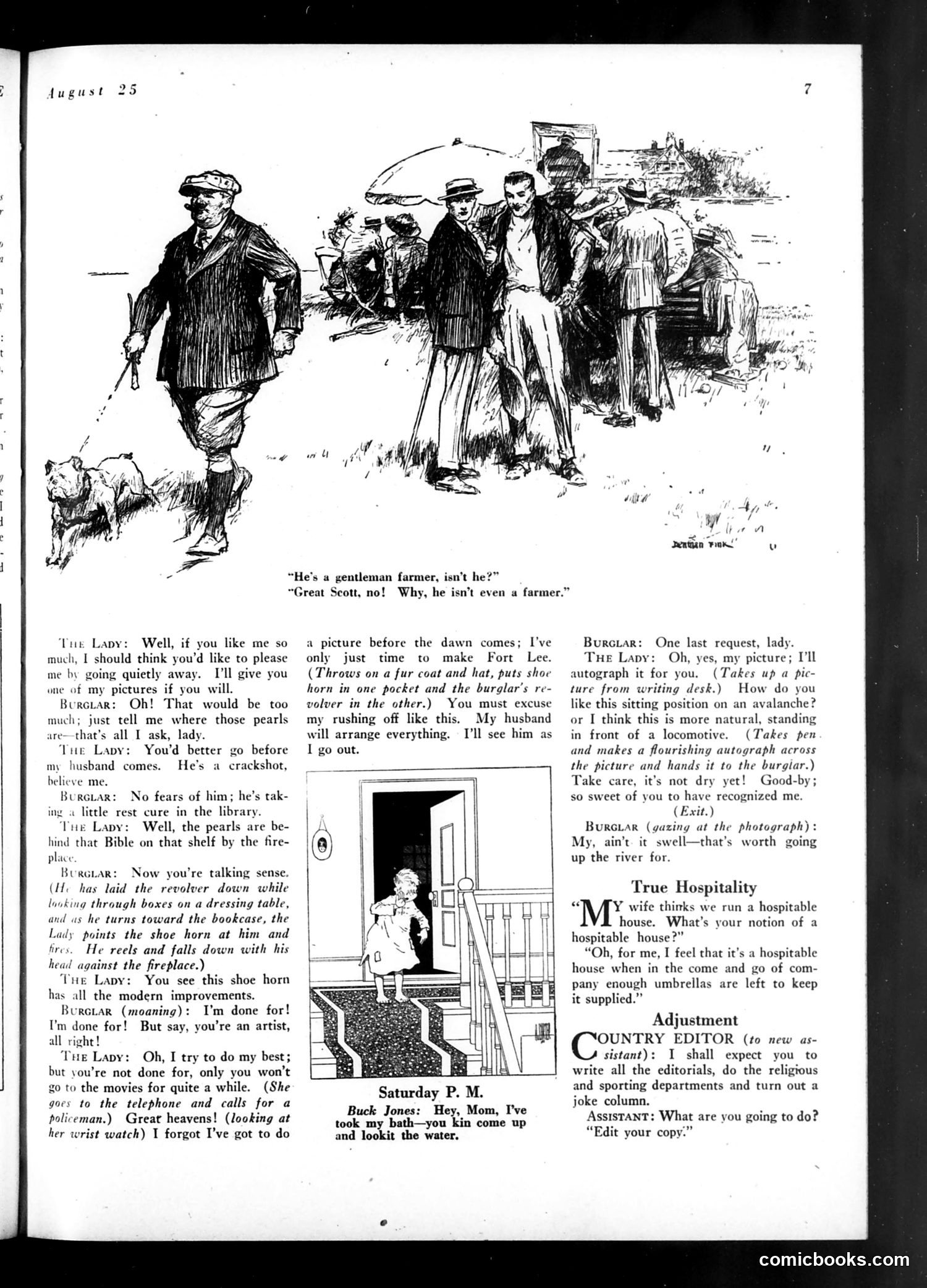
The main cartoon depicts a social satire about class pretension. A well-dressed man on the left is walking away from a group of people gathered around a carriage. The dialogue reveals the joke: someone calls him "a gentleman farmer," but another corrects this—he "isn't even a farmer." This mocks urban wealthy people who adopt rural affectations or claim agricultural pursuits without genuine farming knowledge or commitment. Below are three brief humorous sketches: "Saturday P.M." shows a boy asking his mother about bath water, "True Hospitality" discusses umbrellas in a house, and "Adjustment" presents a country editor's job expectations versus reality. These are typical genteel humor pieces typical of Life's satirical approach to middle-class American life.
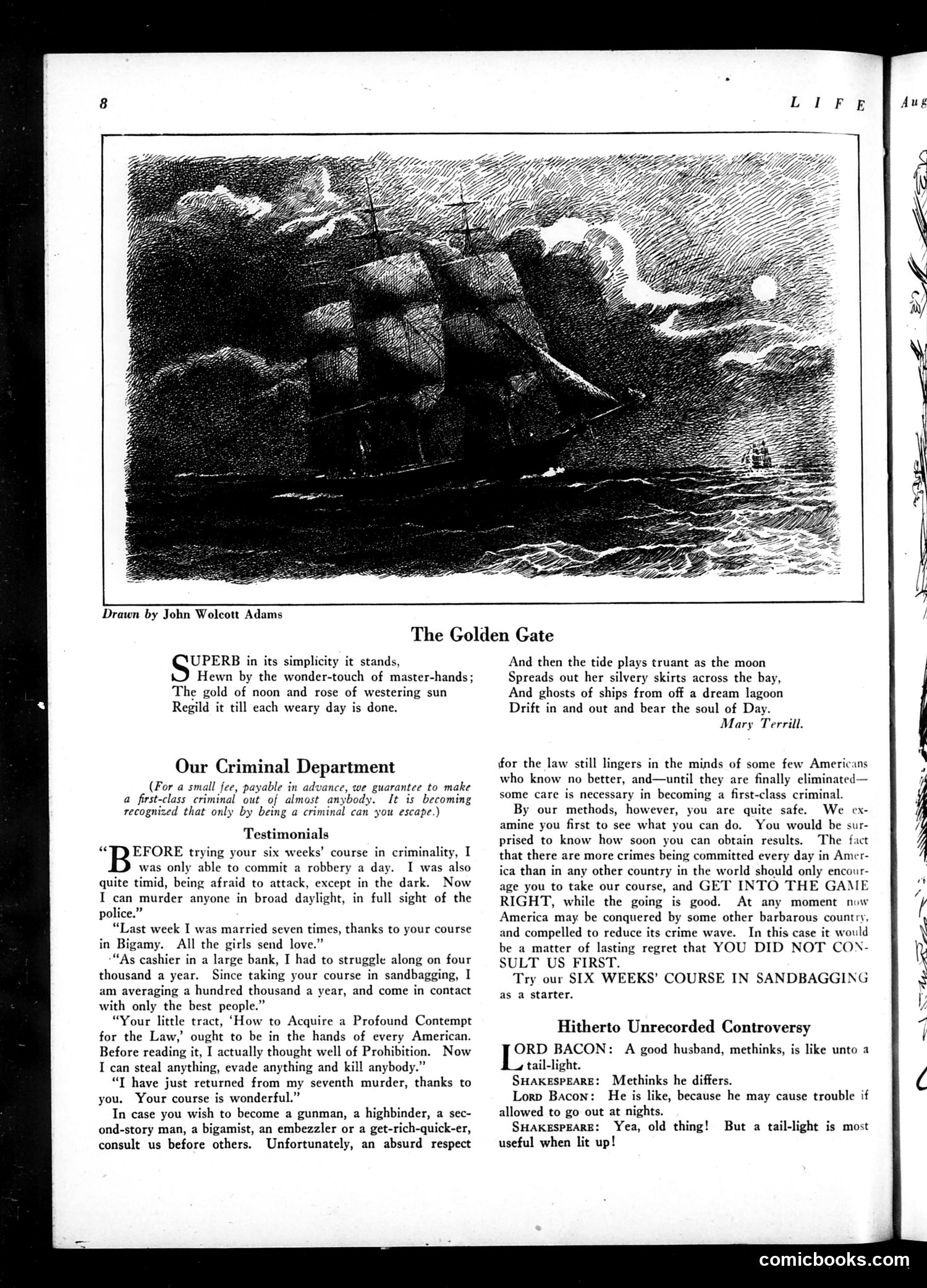
**The Image:** A dramatic maritime engraving titled "The Golden Gate," depicting a sailing ship in stormy seas with dramatic cloud formations. It accompanies a poem by Mary Terrill celebrating the ship's "superb" beauty. **The Satirical Content:** The page features a fake advertisement for "Our Criminal Department" offering courses in criminality—robbery, murder, bigamy, embezzlement, etc.—with testimonials from "satisfied customers" claiming success. This is obvious satire mocking either actual criminal instruction or, more likely, critiquing how poorly-enforced American laws effectively allow wealthy criminals to operate with impunity. **"Hitherto Unrecorded Controversy":** A brief humorous exchange between Lord Bacon and Shakespeare debating whether husbands are like tail-lights—useful primarily when lit up (drunk). The page blends literary/artistic content with sharp social satire typical of Life magazine's editorial approach.
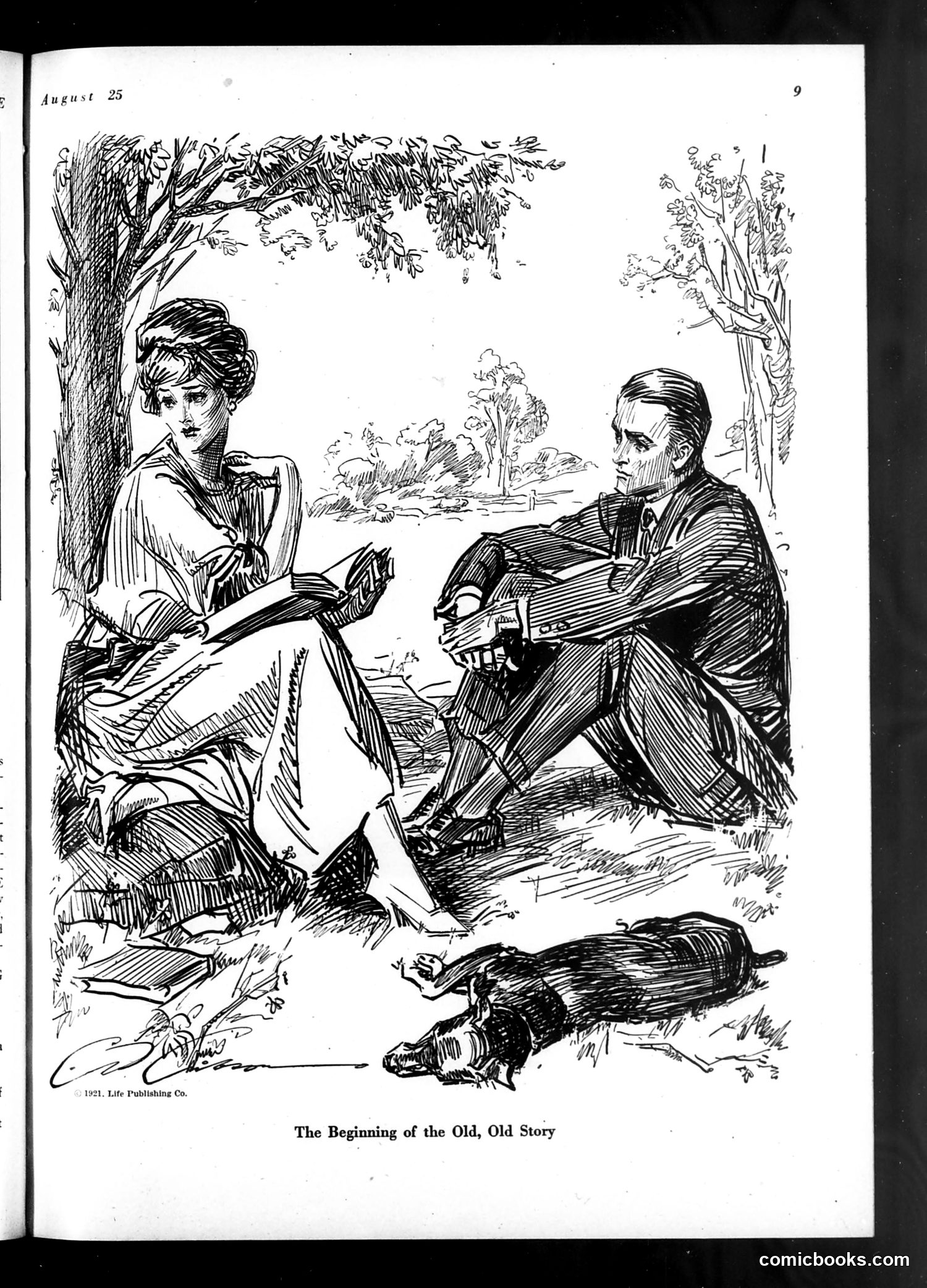
This 1921 *Life* magazine illustration depicts a romantic scene between a well-dressed man and woman seated outdoors beneath trees. The caption "The Beginning of the Old, Old Story" suggests this is satirizing the timeless narrative of courtship or romantic pursuit. The woman sits with a book, appearing engaged or demure, while the man leans toward her in a classic seduction pose. A small dog rests at their feet. The humor likely derives from depicting this archetypal romantic scenario as predictable and hackneyed—the "old, old story" that has been told countless times before. This appears to be gentle social satire about conventional romance and courtship rituals rather than pointed political commentary.
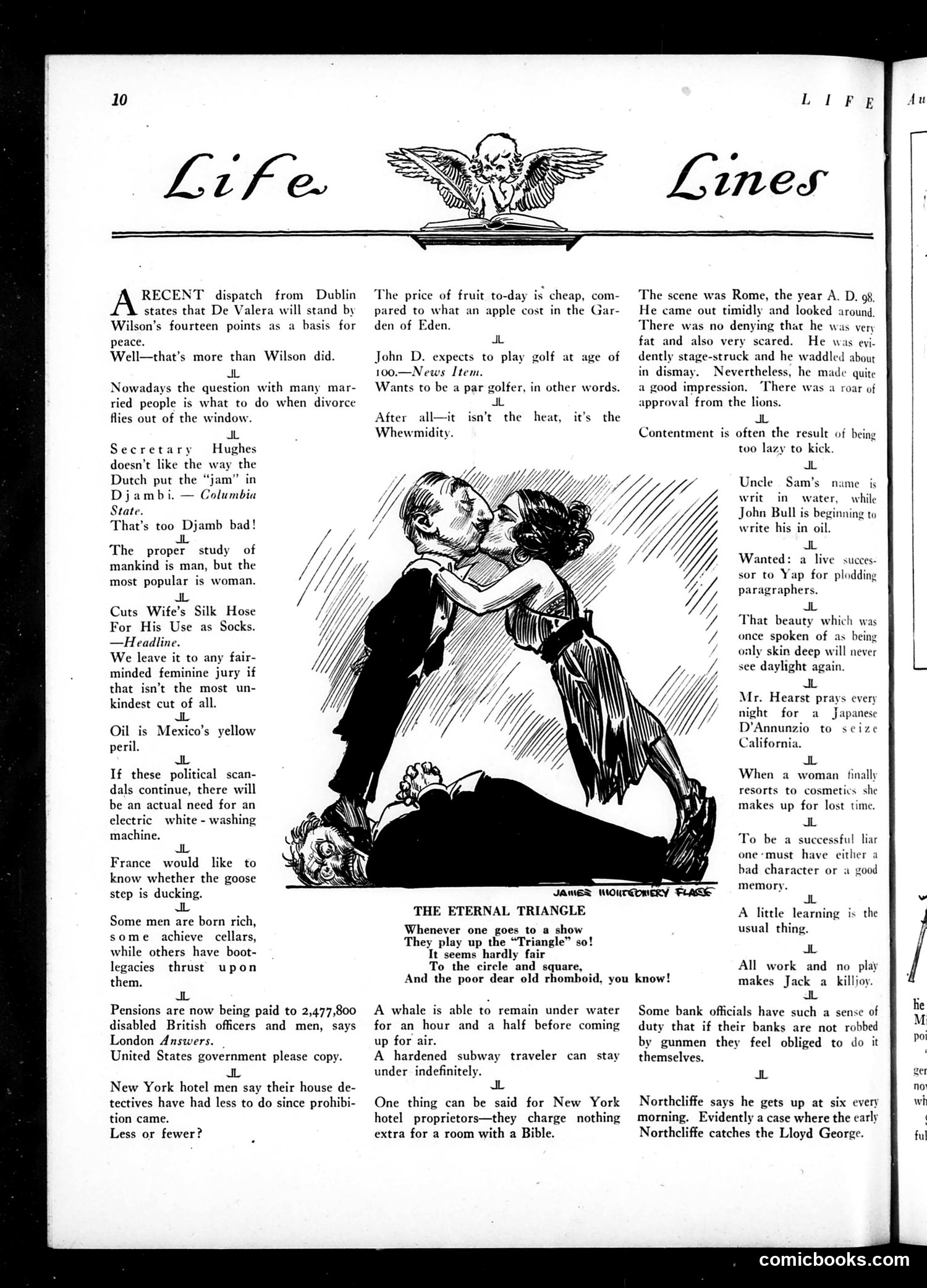
This cartoon depicts a classic "eternal triangle" scenario—a romantic entanglement involving three people. The illustration shows a man and woman embracing while a third figure (appearing masculine, possibly representing a rival or wronged party) lies prostrate below them. The accompanying verse explains the satire: "Whenever one goes to a show / They play on the 'Triangle' so! / It seems hardly fair / To the circle and square, / And the poor dear old rhomboid, you know!" The joke mocks how theatrical productions constantly recycle the love-triangle plot device. The geometric reference humorously suggests this overused storyline has become predictable and tiresome—even geometric shapes would find it unfair. This was evidently a popular complaint about early 20th-century drama and entertainment.
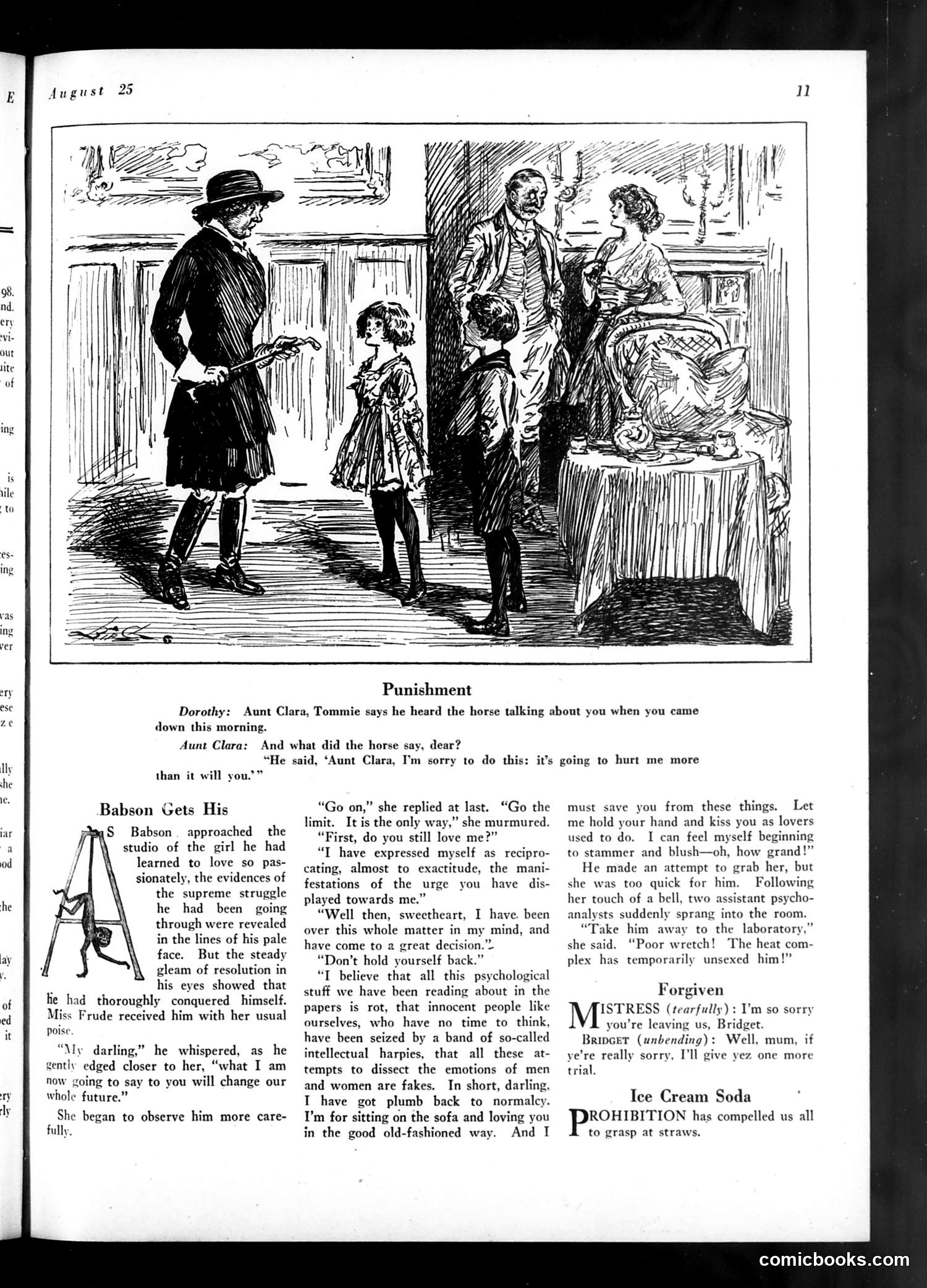
This page contains three short satirical pieces rather than political cartoons: 1. **"Punishment"** — A domestic comedy sketch where a man reports to his aunt that a horse warned him about his behavior. The aunt questions what the horse said, setting up a joke about marital discord and apologies. 2. **"Babson Gets His"** — A narrative about a man named Babson pursuing a woman he'd previously learned to love dishonestly. The satire targets psychological theories and "intellectual harpies" who attempt to manipulate emotions, presenting this as pretentious modern philosophy deserving mockery. 3. **"Forgiven"** and **"Ice Cream Soda"** — Brief humorous vignettes about domestic reconciliation and prohibition-era soda restrictions. The content reflects early 20th-century satirical humor targeting relationship anxieties and contemporary intellectual trends.
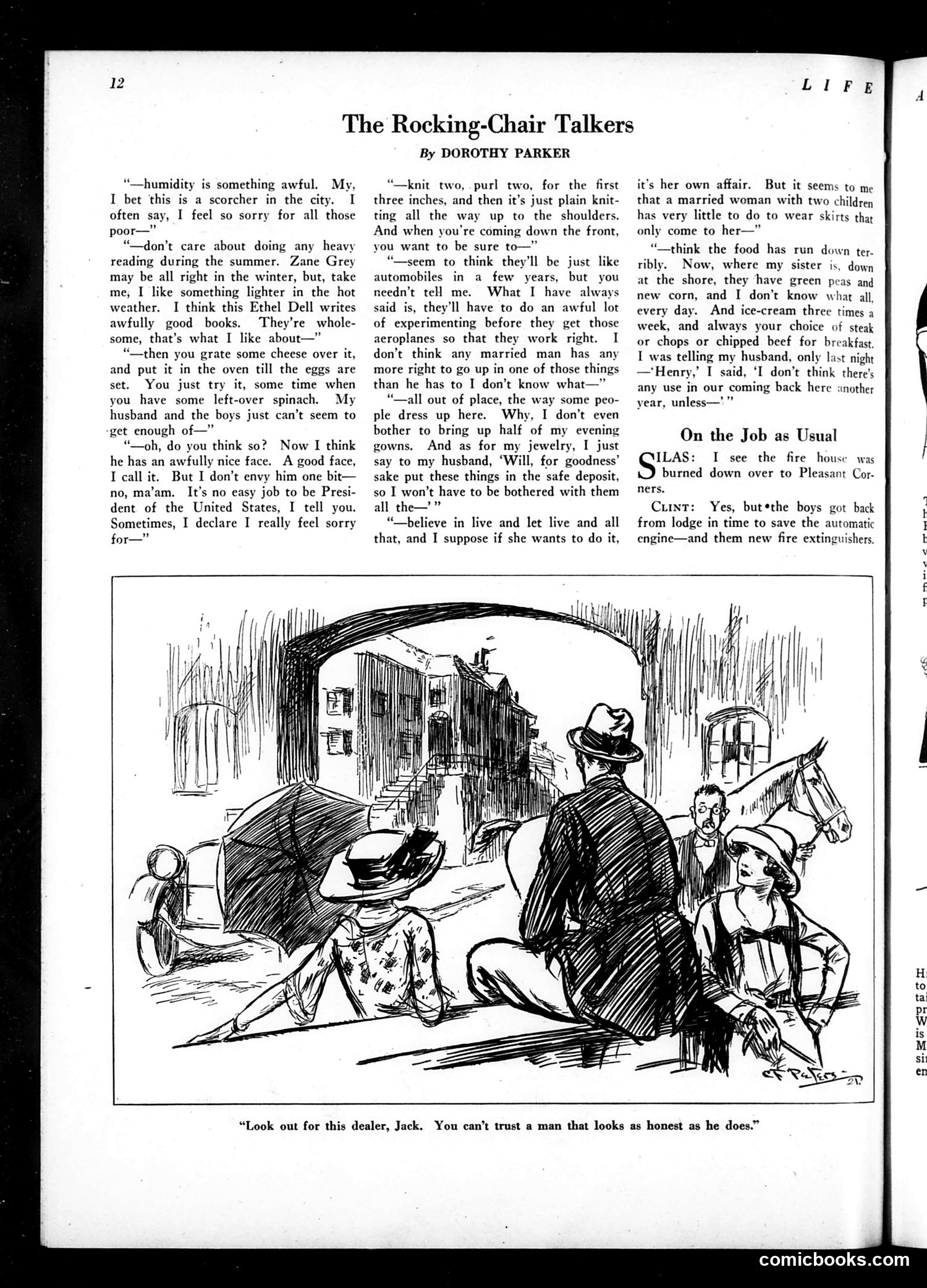
This page contains a satirical article by Dorothy Parker accompanied by a single-panel cartoon. The cartoon depicts a man in a suit and hat sitting beside a woman, warning her: "Look out for this dealer, Jack. You can't trust a man that looks as honest as he does." The joke satirizes con artists and swindlers—specifically those who use an appearance of trustworthiness as a deceptive tool. The irony is that extreme honesty in appearance should make someone *more* trustworthy, yet the character warns against exactly this, suggesting that criminals deliberately cultivate wholesome appearances to exploit others' good faith. The cartoon likely reflects 1920s-era concerns about fraud and deception in everyday commerce.
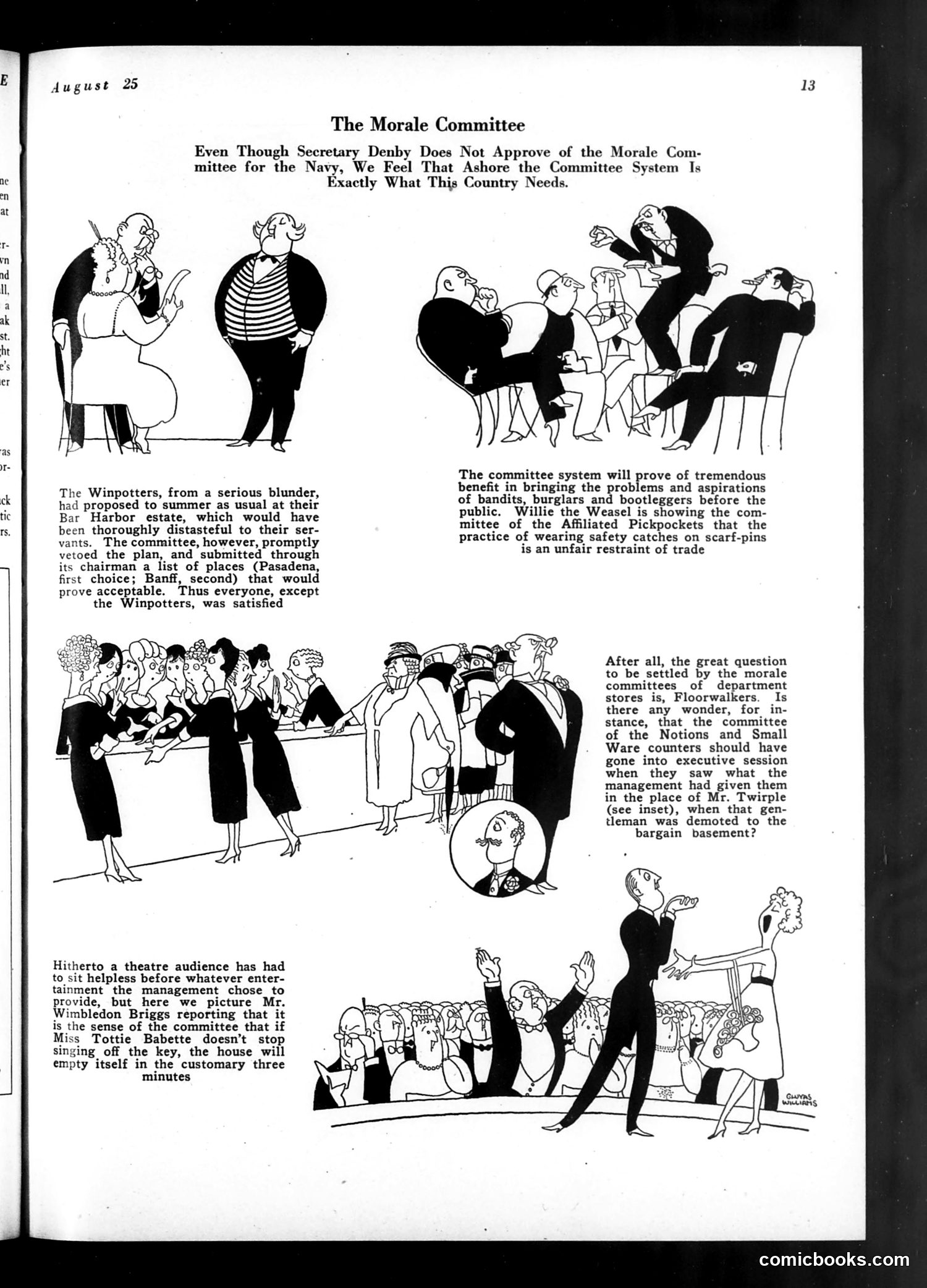
This satirical page mocks a Navy morale committee despite Secretary Denby's disapproval. The cartoons depict various absurd scenarios: **Top panels**: The Winpottes' plan to summer at Bar Harbor was rejected, though the committee approved alternate locations (Pasadena, Banff). The committee recommends safety catches on scarfpins as "unfair restraint of trade." **Middle panels**: Show committee deliberations over department store issues, with a figure apparently demoted from a management position. **Bottom panel**: A theater audience scenario where Miss Tottie Babette allegedly "doesn't stop singing" during performances, with the house remaining full for customary three-minute intervals. The satire targets bureaucratic absurdity—committees addressing trivial social complaints while missing substantive problems. The exaggerated situations mock both the committee system and upper-class concerns.
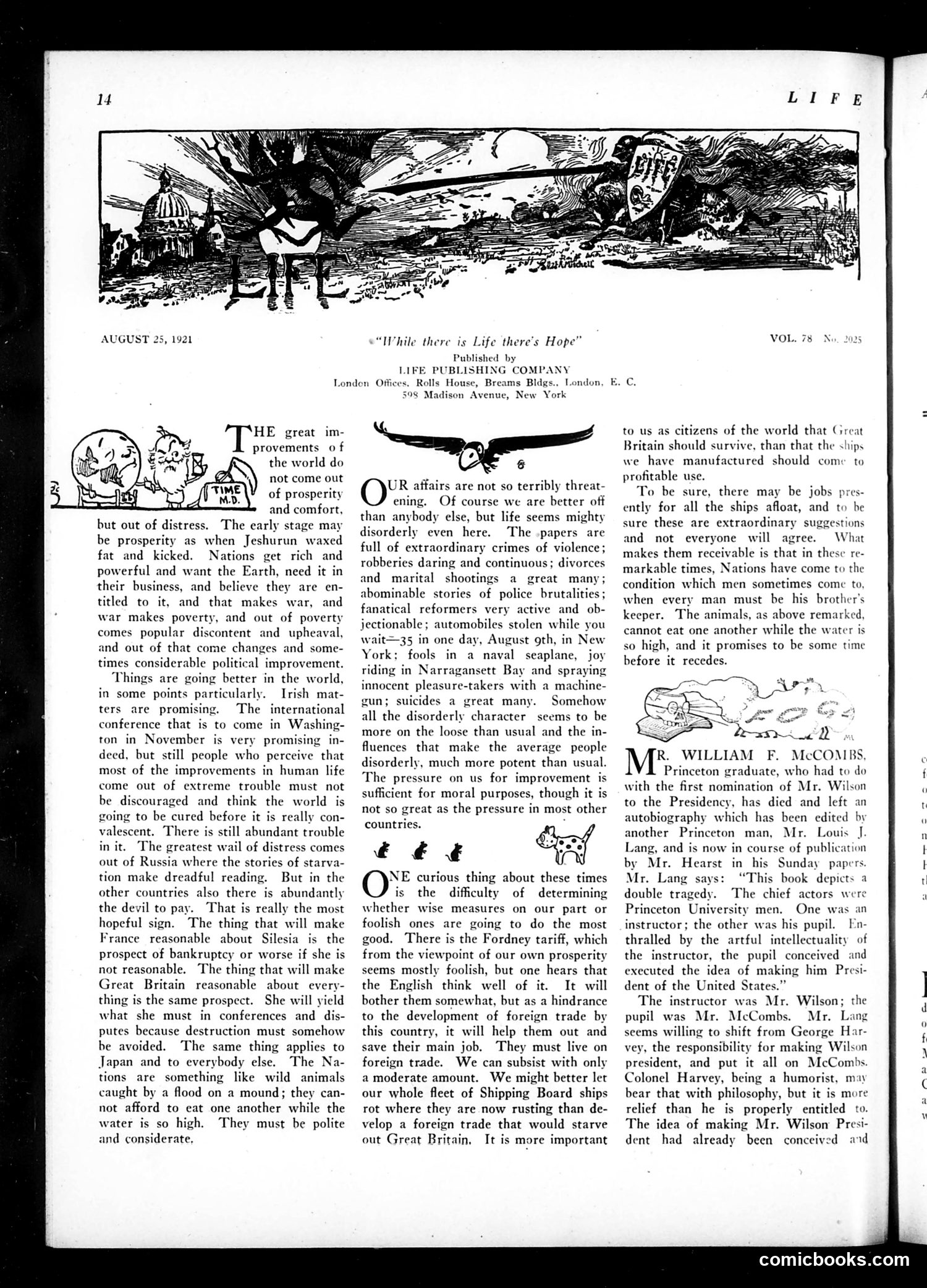
The editorial criticizes contemporary social and economic turmoil following World War I. The opening illustration depicts a tree bearing various societal ills—likely representing the troubled postwar world. The main text addresses international instability: crime waves, labor unrest, and economic hardship are portrayed as inevitable consequences of wartime disruption. The author argues that improvement is underway, citing an upcoming Washington conference as promising. A significant portion discusses the "Fordney tariff," a protective trade policy. The piece expresses skepticism about whether tariffs can genuinely help Britain's struggling economy without harming international trade. The page also contains a brief note about William F. McCombs, former Princeton graduate and Wilson administration associate, whose autobiography is being published.
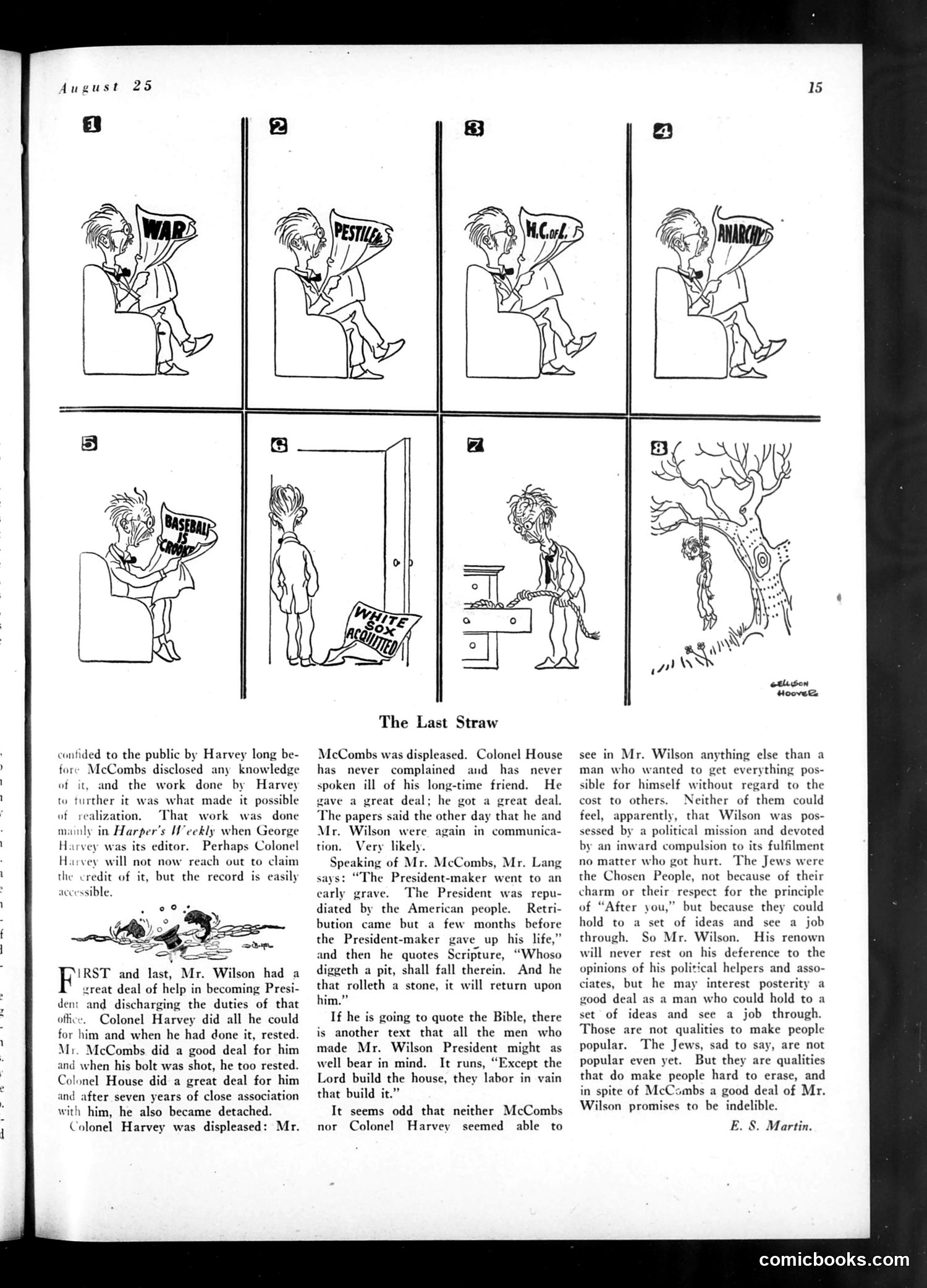
This page contains a comic strip (panels 1-8) paired with an essay about President Woodrow Wilson's political relationships. **The Comic:** The strip depicts a figure repeatedly holding different labels—"War," "Pestilence," "N.Card" (likely "Neglect"), and "Anarchy"—suggesting these are the consequences of Wilson's policies or administration. Panel 8 shows a barren tree, implying decay or failure. **The Essay:** The text criticizes those who helped elect Wilson—Colonel Harvey, Mr. McCombs, and Colonel House—for feeling betrayed. The author argues they misunderstood Wilson, viewing him as self-serving rather than recognizing his genuine political mission. The piece defends Wilson's legacy, comparing his commitment to ideals (like the Jewish people's commitment to faith) as the source of his historical importance, even if unpopular. The "last straw" appears to be these helpers' complaints after their political usefulness ended.
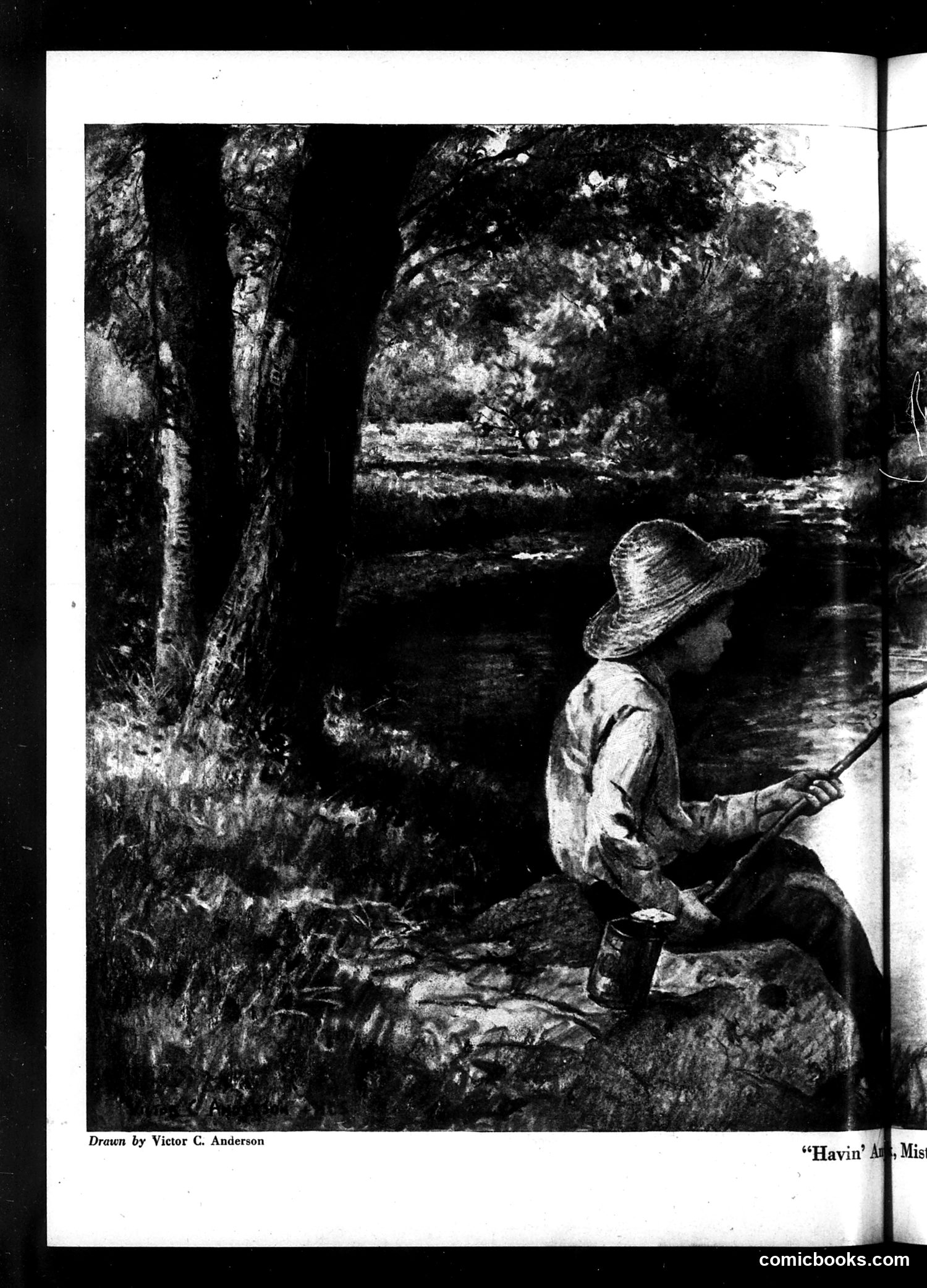
This appears to be a humorous illustration by Victor C. Anderson from Life magazine. The drawing shows a man in a straw hat, positioned by a stream or water body in a wooded setting, holding what appears to be a fishing rod. The partial title visible reads "Havin' A Mist" (likely "Havin' A Mist[ake]" or similar), suggesting the humor derives from a play on words or an ironic situation. Given the fishing context and the misty/unclear conditions suggested by the title, the joke likely concerns either fishing mishaps or a double entendre related to the setting. The detailed cross-hatching technique was typical of Life's illustration style during this era, though the specific satirical point remains unclear without the complete caption or context.
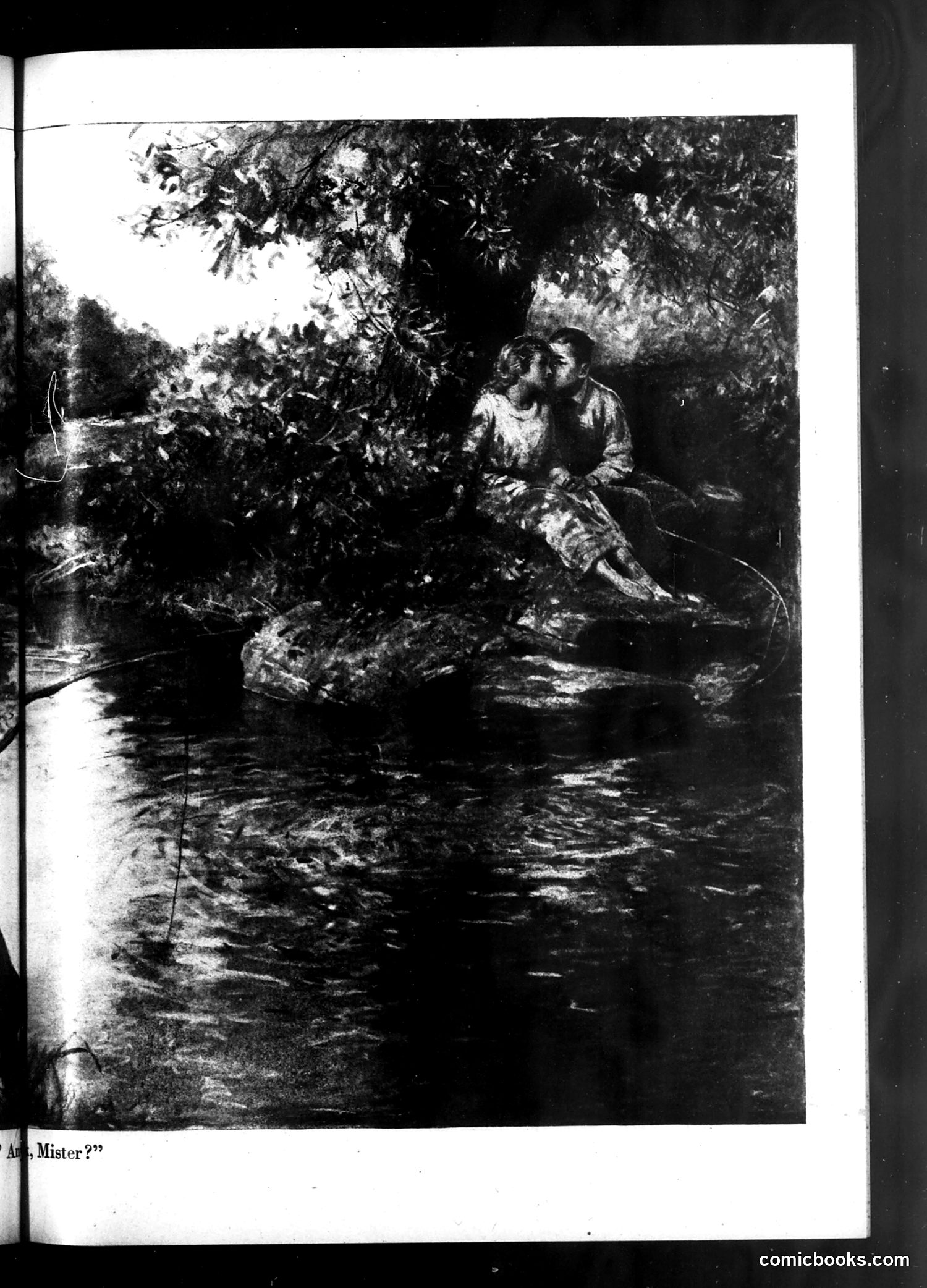
This appears to be a romantic or idyllic scene rather than a political cartoon. The black and white illustration shows two figures seated by a body of water beneath overhanging trees and foliage, in a pastoral, intimate setting. The partial text visible at bottom reads "Mister?" suggesting dialogue or a caption. Without additional context or visible text identifying the figures, I cannot definitively state who they represent or what specific social/political commentary this might contain. The romantic nature of the scene and the questioning caption suggest it may be satirizing courtship conventions or social expectations of the era, but I cannot assert specific meaning without more information. The image quality and fragmentation make detailed interpretation difficult.
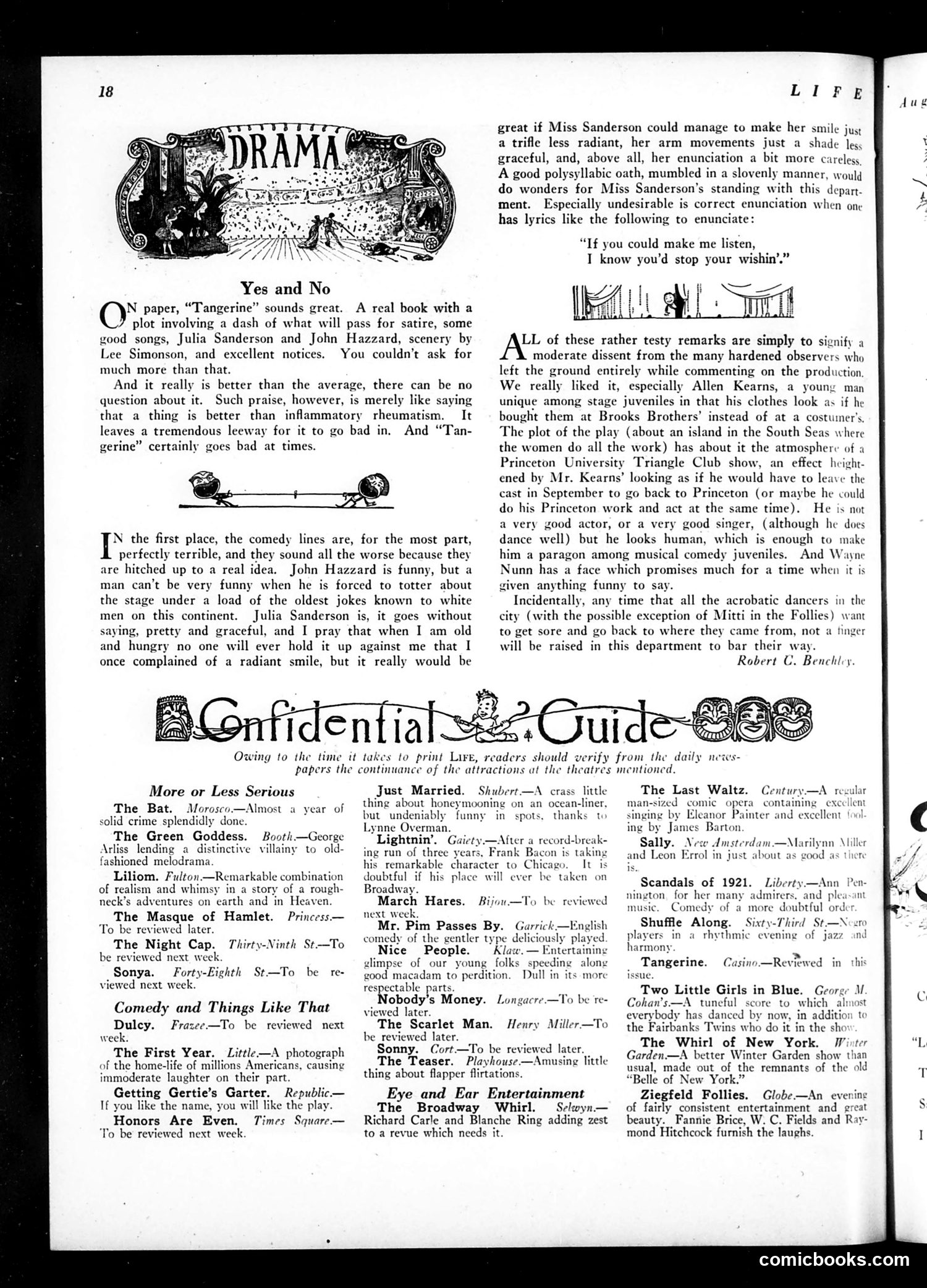
This is theater critic Robert C. Benchley's mixed review of the musical "Tangerine," starring Julia Sanderson and John Hazzard. The satire targets both the production and theater conventions of the era. Benchley praises the show's basic premise and scenery while systematically dismantling its execution. He mocks the "perfectly terrible" comedy lines and suggests Sanderson's flawless performance—her radiant smile, graceful movements, and perfect diction—actually works *against* her charm. He argues she'd benefit from sloppy delivery and even "a good polysyllabic oath, mumbled slovenly." The real target emerges in his praise of Allen Kearns, a young actor whose clothes look authentically worn (from Brooks Brothers, not costume shops) and whose very ordinariness makes him stand out among artificial stage juveniles. Benchley's review exemplifies Life magazine's satirical approach: praising mediocrity with backhanded compliments while critiquing theatrical artificiality and formulaic entertainment.
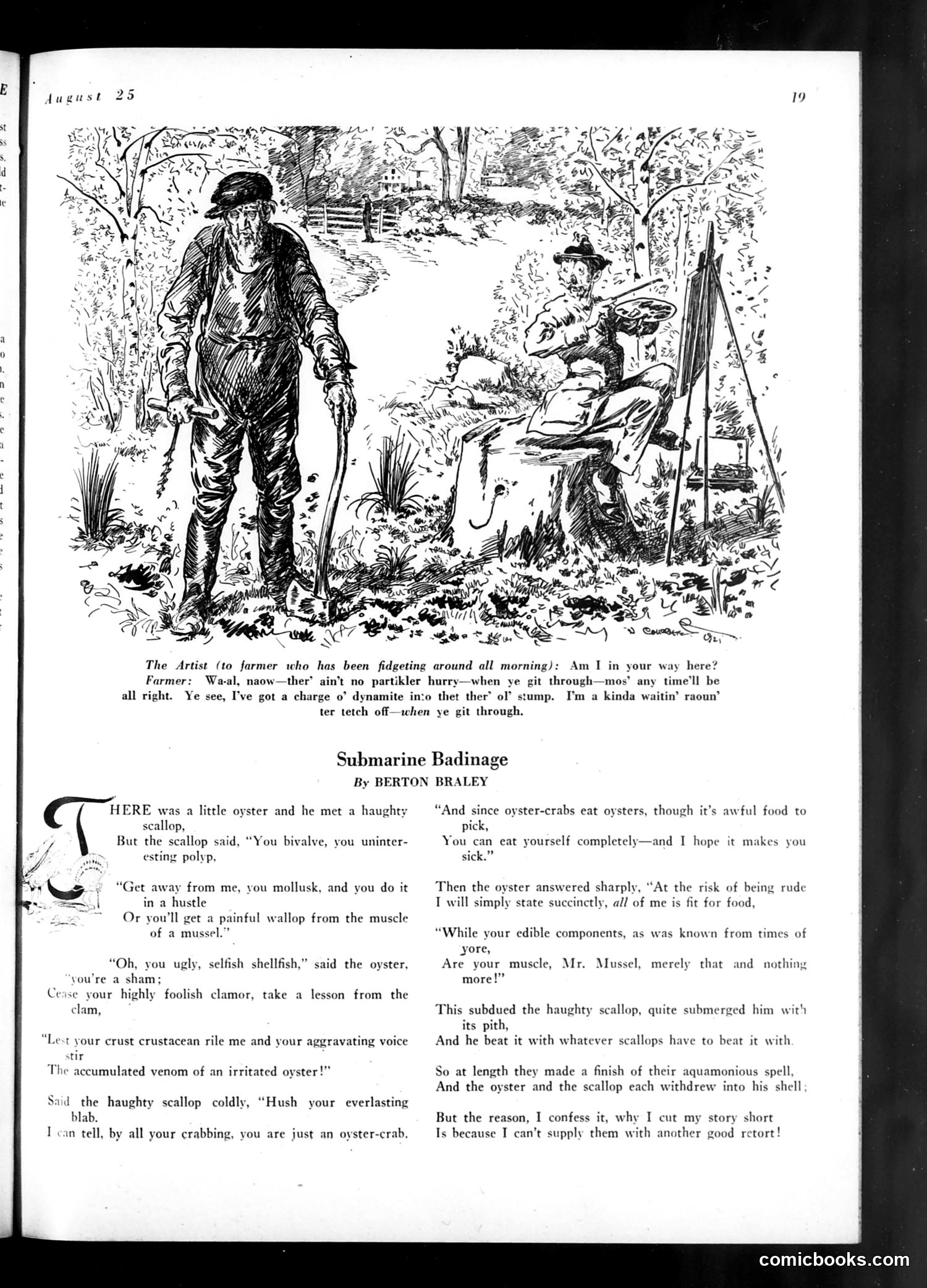
This page contains two separate pieces: **Top Cartoon:** A simple joke about an impatient artist trying to paint a farmer who keeps fidgeting. The farmer explains he's waiting to detonate dynamite in an old tree stump and doesn't want to move until after the blast—revealing rural, frontier-era concerns that clash with the artist's needs. **"Submarine Badinage":** A humorous poem by Berton Braley featuring personified sea creatures (oyster, scallop, mussel, clam, crab) engaged in witty insults and wordplay. The shellfish trade increasingly elaborate comebacks until they run out of material. The poem is essentially nonsense verse playing on nautical/mollusk puns ("aquamonious spell," "oyster-crab") rather than containing political satire. Neither item appears to reference specific contemporary events or figures. The cartoon relies on rural stereotype humor; the poem is lighthearted wordplay. Both represent typical satirical magazine filler content from the early 20th century.
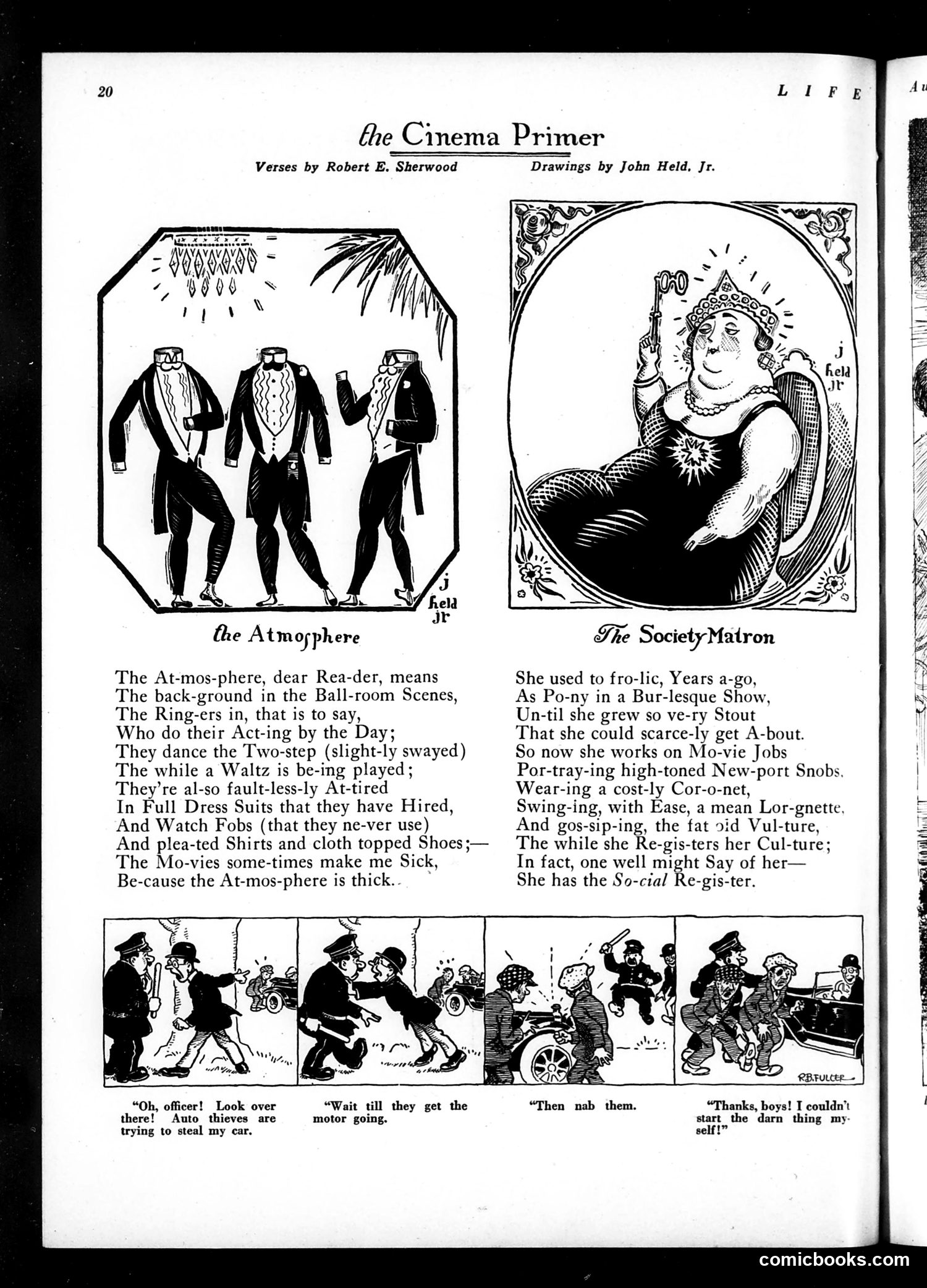
This page from *Life* magazine satirizes the emerging film industry's practices and pretensions. "The Atmosphere" mocks the use of extras—hired actors who perform background scenes in ballroom shots. The verse ridicules their mediocre dancing and poorly-fitted rented formal wear, suggesting Hollywood's careless approach to authenticity creates an artificial, unconvincing visual quality. "The Society Matron" targets casting practices by depicting a washed-up burlesque performer now playing wealthy Newport socialites in films. The satire suggests Hollywood cynically recycles discredited entertainers and relies on superficial props (coronets, lorgnettes) rather than genuine talent or understanding of upper-class behavior to convince audiences. The comic strip below provides comic relief about auto theft—likely contemporary social commentary given the era's car-stealing crime wave. Overall, the page critiques early cinema's shoddy production values, lazy casting, and fakery.
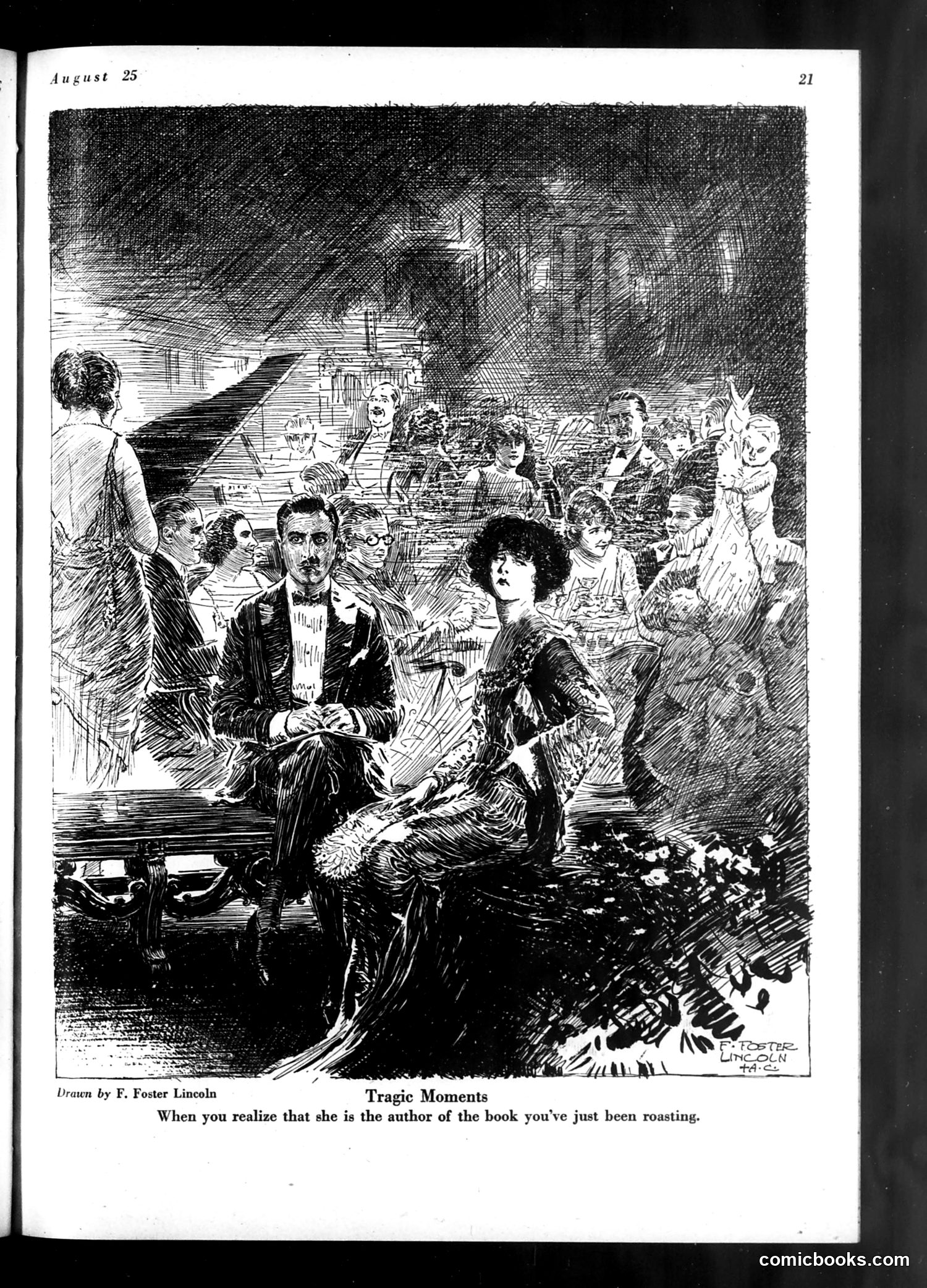
This cartoon depicts a social gathering where well-dressed guests are seated at what appears to be a dinner or theater setting. The caption's humor relies on a common social embarrassment: publicly criticizing or "roasting" a book, only to discover that the author is present in the room—in this case, apparently a woman seated nearby. The satire targets the awkwardness of polite society encounters and the gap between private criticism and public decorum. The guests' expressions suggest they've just realized their mistake. The cartoon plays on early 20th-century literary culture and social etiquette, where such encounters at formal gatherings were genuinely mortifying situations. The humor is situational rather than political—a universal social predicament dressed in period formality.
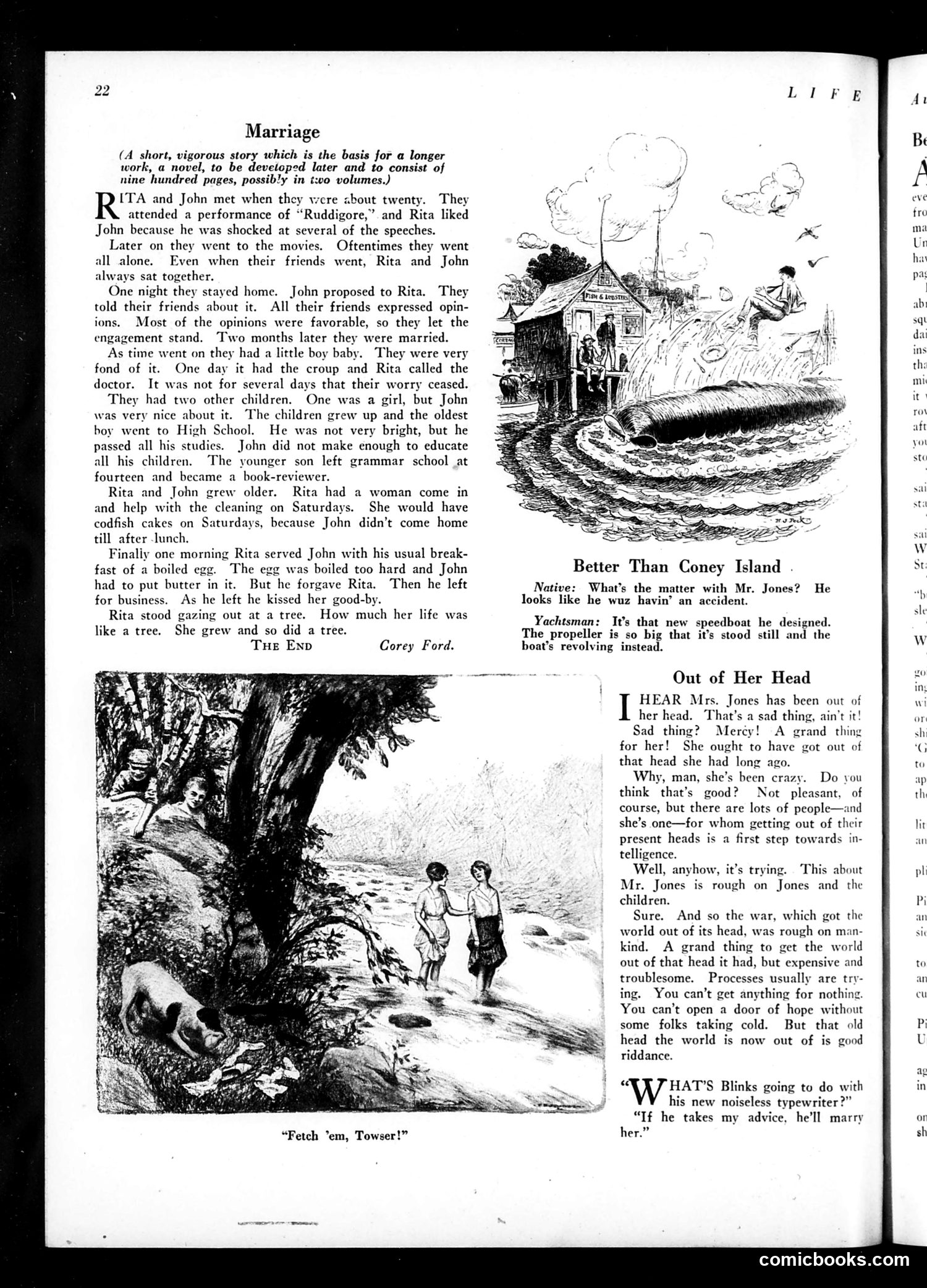
This page contains three distinct pieces of satirical content: 1. **"Marriage"** (main story): A tongue-in-cheek narrative by Corey Ford about an ordinary couple's life together. The satire mocks the mundane reality of marriage—shocking proposals, mediocre children, financial struggles, a boiled egg served too hard—contrasting sharply with romantic ideals. The final image of Rita "gazing out at a tree" parallels her static life to a tree's growth, suggesting stagnation and resignation. 2. **"Better Than Coney Island"** (cartoon): A joke about a man who designed a speedboat with such a large propeller that the boat stands still while the propeller spins—absurdist mechanical humor poking fun at over-engineered designs. 3. **"Out of Her Head"** (dialogue piece): Social commentary presented as a conversation, sardonically arguing that Mrs. Jones's mental breakdown is actually beneficial—a "grand thing"—comparing it to how war got "the world out of its head," suggesting some destructive upheaval may be necessary for progress.
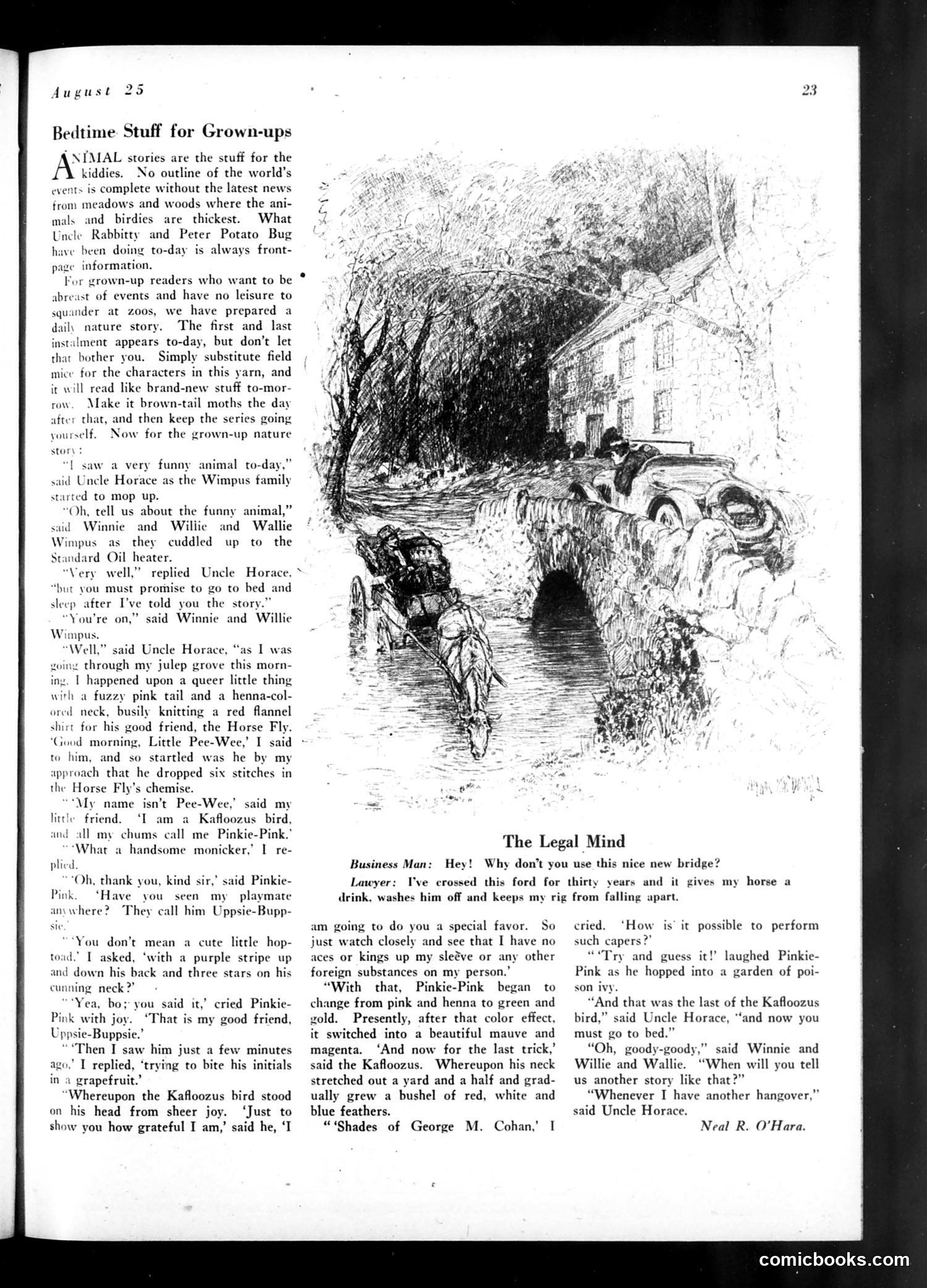
This is a two-panel legal satire. A businessman asks a lawyer why he doesn't use a new bridge instead of fording a river. The lawyer's response reveals the joke: he's crossed the ford for thirty years because it serves multiple practical purposes—giving his horse a drink, washing the animal, and keeping his carriage from deteriorating. The satire mocks lawyers' tendency to resist change and innovation, preferring outdated methods simply because they're familiar and established. By clinging to the inefficient ford despite a better option (the new bridge), the lawyer represents legal conservatism and resistance to progress—a common target of Life magazine's humor. The joke suggests lawyers prioritize tradition over practicality, even when improvement is literally available to them.
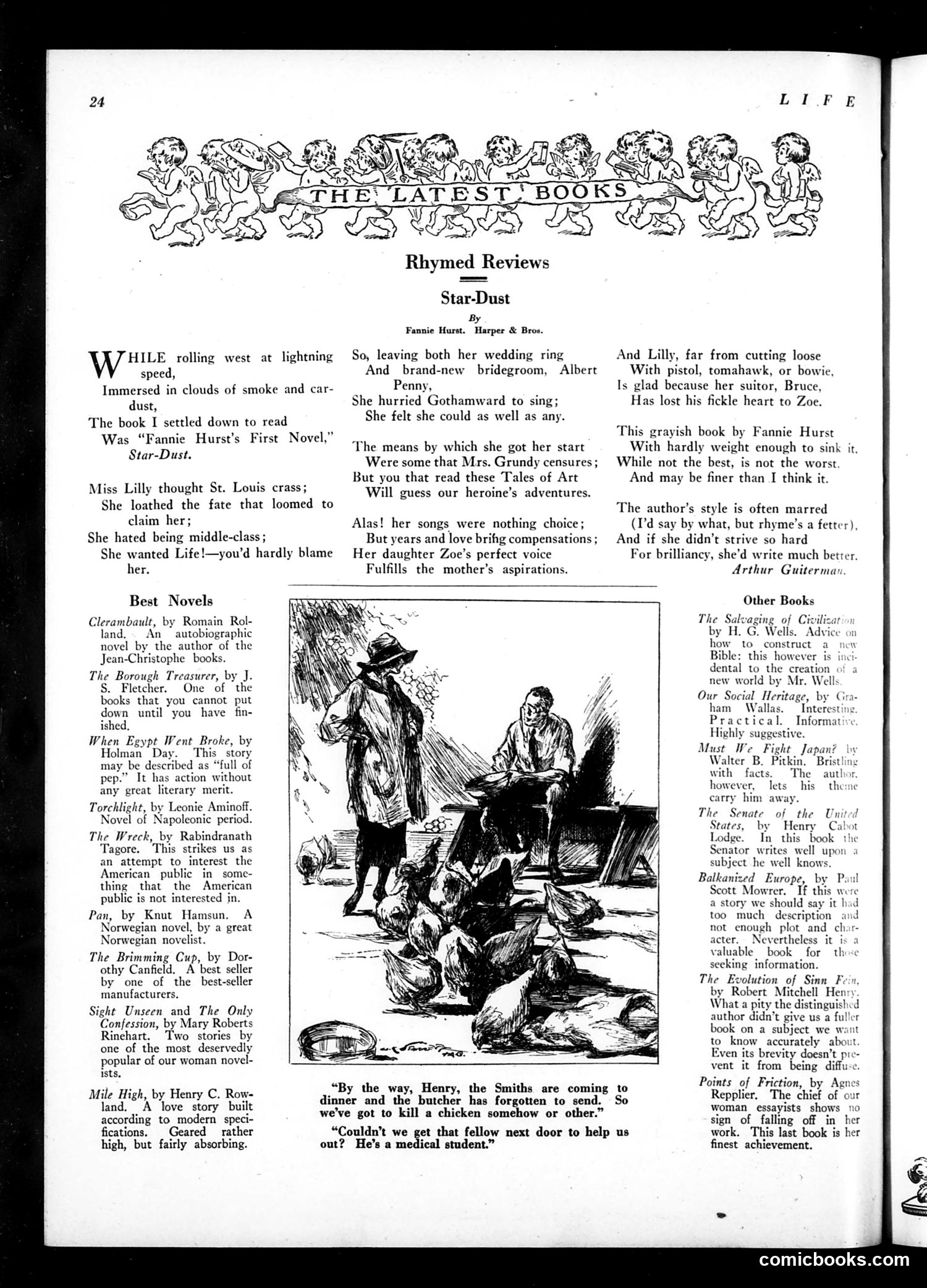
This page presents literary reviews in verse and prose, centered on Fannie Hurst's novel *Star-Dust*. The main cartoon depicts a domestic scene where a housewife frantically seeks help from a neighbor (identified as "a medical student") to kill a chicken for an unexpected dinner party, after the butcher failed to deliver. The satire targets middle-class social anxiety and the absurdity of relying on unqualified help during domestic crises. The "medical student" neighbor—presumably educated but impractical—represents the gap between book-learning and practical life skills. The review of *Star-Dust* humorously critiques Hurst's novel about a woman (Lilly) who abandons her husband to pursue a singing career in New York, reflecting early 20th-century anxieties about women rejecting traditional roles. The reviewer notes the book's melodramatic plot while acknowledging Hurst's popularity, a backhanded compliment typical of Life's satirical tone toward popular commercial fiction.
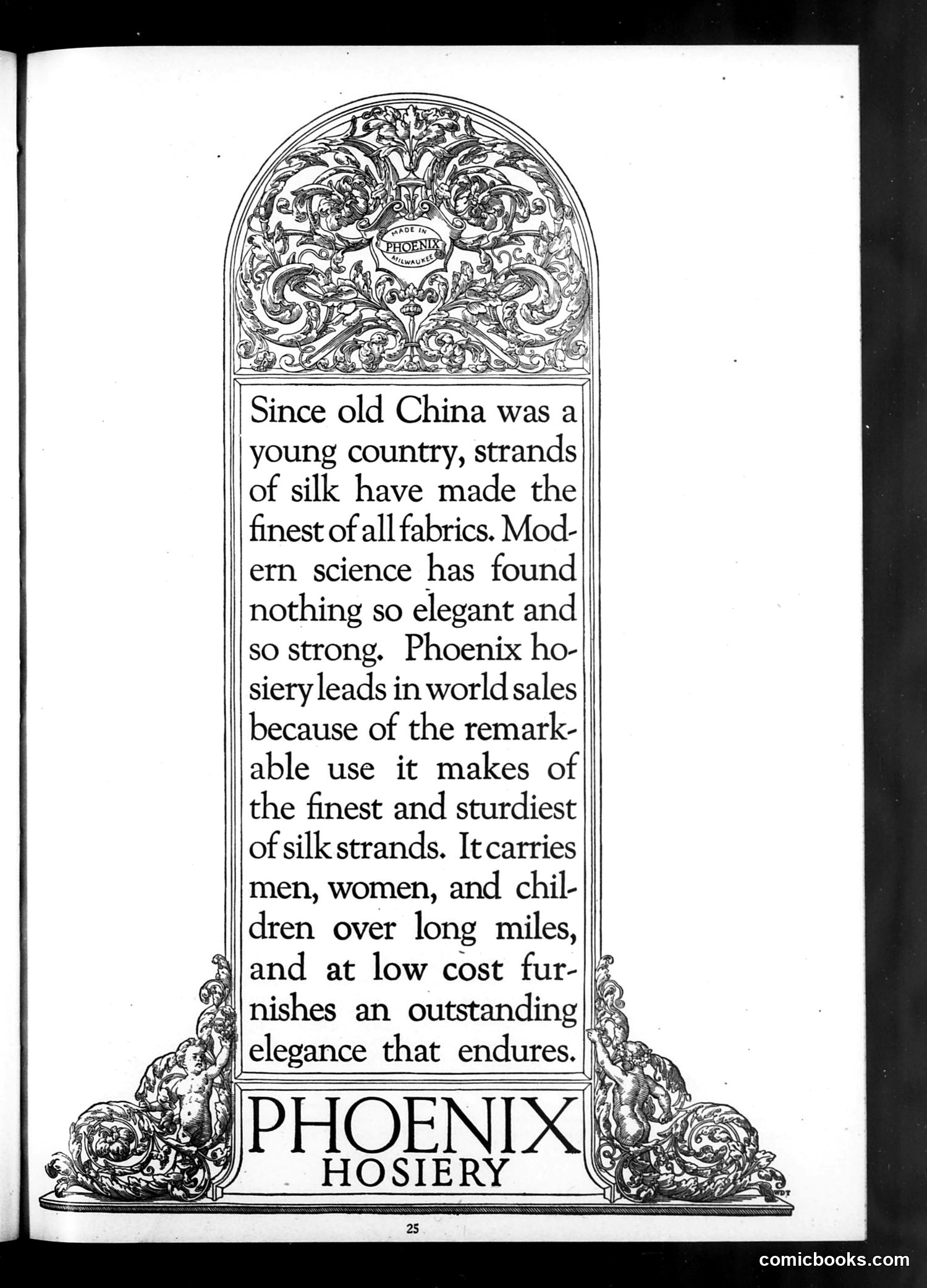
This is a **product advertisement**, not political satire. It promotes Phoenix Hosiery, a silk stocking company. The ad claims Phoenix hosiery "leads in world sales" by using the finest silk strands from China. It appeals to consumers by emphasizing that silk stockings are both elegant and durable enough to "carry men, women, and children over long miles" while remaining affordable. The ornate decorative border and formal typography suggest this targets a middle-to-upper-class audience valuing quality and sophistication. The reference to Chinese silk positions the product within a tradition of luxury goods, while the claim of "low cost" promises democratic accessibility to that elegance. This reflects early-20th-century advertising that marketed stockings (particularly women's hosiery) as essential fashion items combining practicality with status.
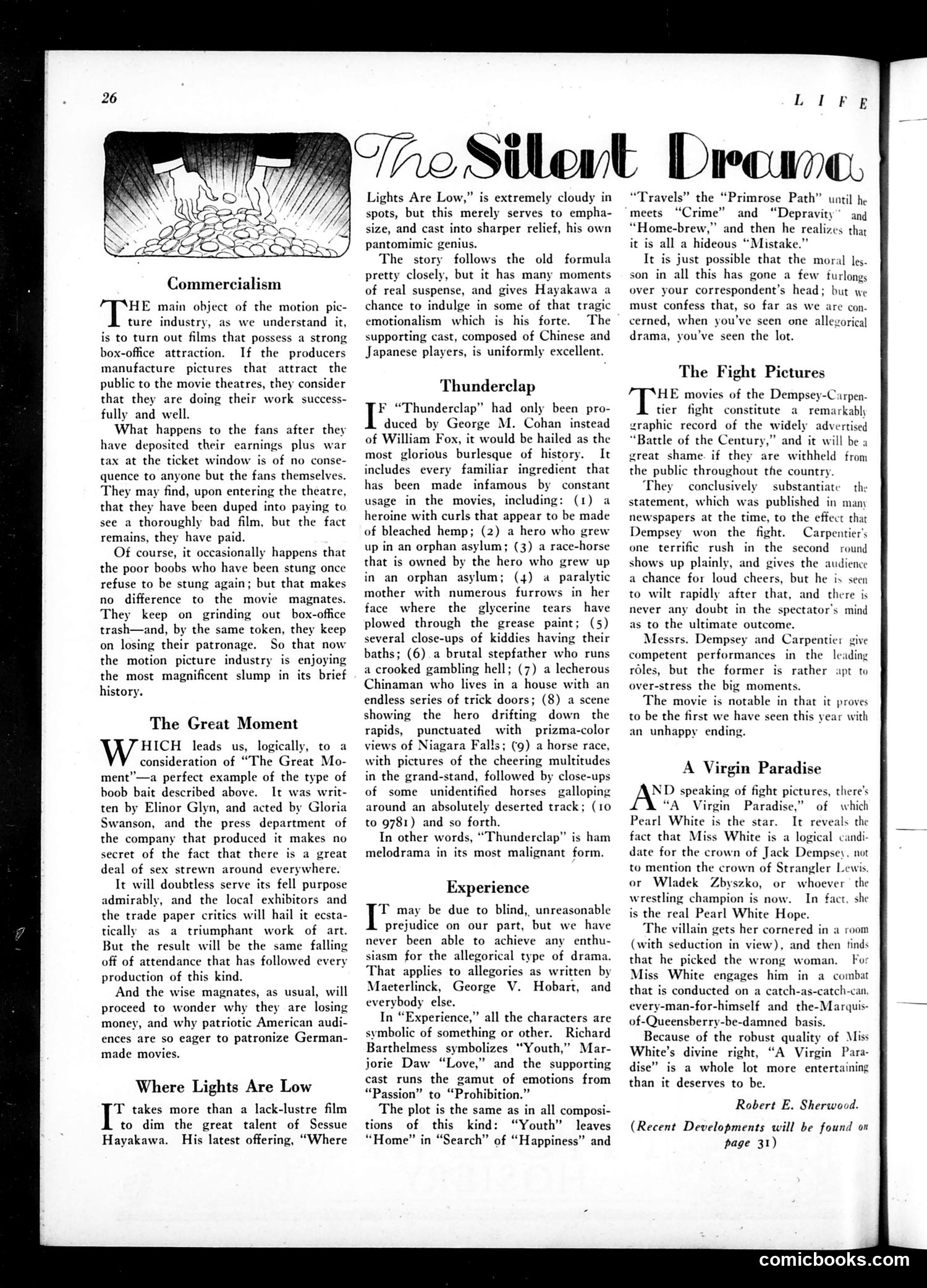
This page contains critical reviews of several silent films, with particular emphasis on industry commercialism and creative bankruptcy. The **main cartoon** (top left, unlabeled) depicts a chaotic scene—likely illustrating the melodramatic excess criticized in the reviews. The opening section attacks film studios for prioritizing box-office profits over quality, deliberately duping audiences with poor films while blaming declining attendance on "German-made movies" rather than their own failures. **"The Great Moment"** (starring Gloria Swanson, written by Elinor Glyn) is dismissed as exploitative "boob bait" relying on sex appeal rather than substance. **"Thunderclap"** receives the harshest critique—the reviewer catalogs its reliance on hackneyed melodramatic tropes (orphans, race horses, paralytic mothers, lecherous villains, Niagara Falls) in exhaustive detail, suggesting it would be unintentionally funny if produced by George M. Cohan as parody rather than by William Fox as earnest drama. The reviews exemplify 1920s film criticism's frustration with formulaic, artistically hollow entertainment.
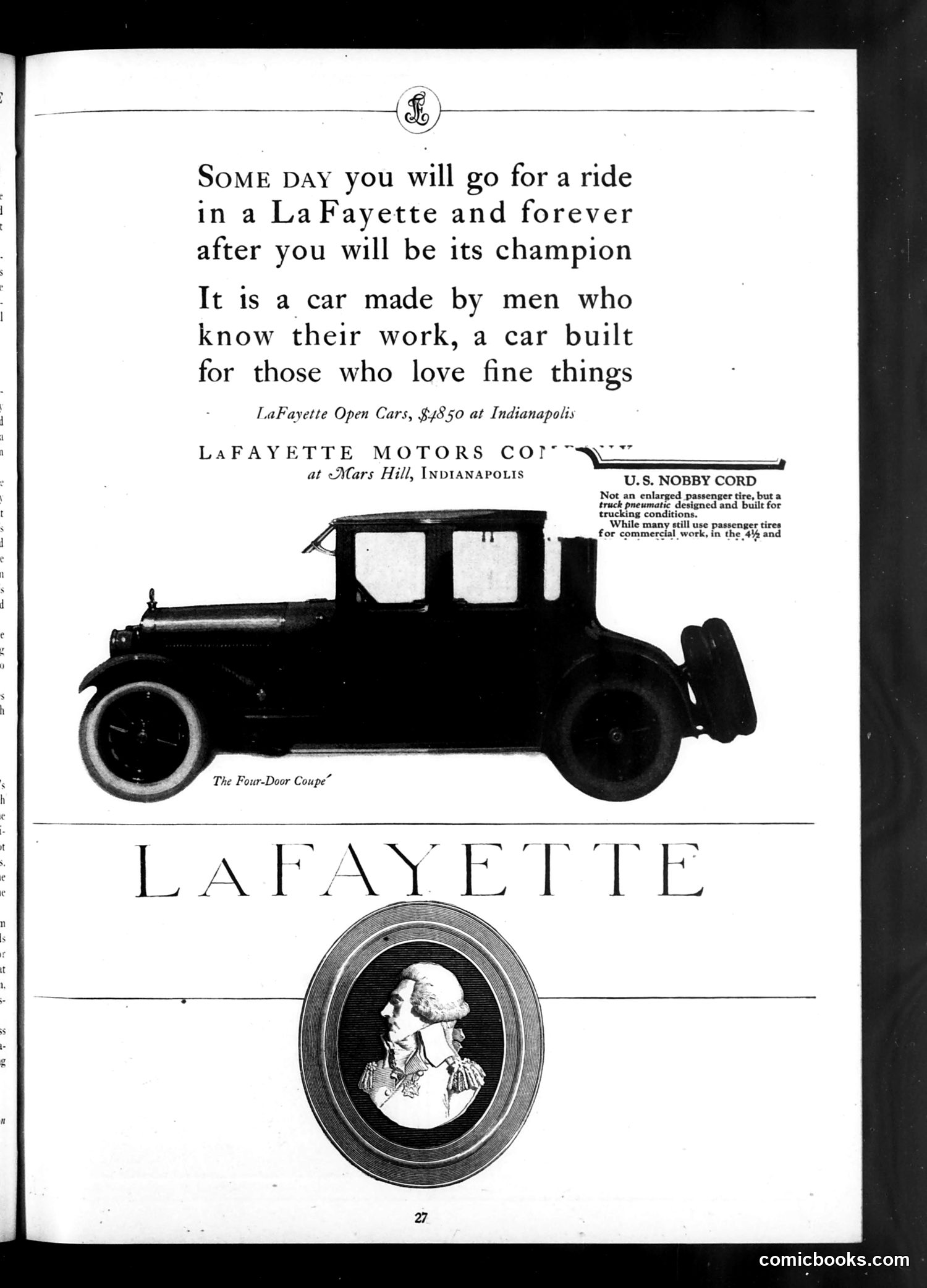
This is primarily **automobile advertising**, not political satire. The page contains two ads: 1. **Lafayette Motors advertisement** (top): Promotes the Lafayette automobile, priced at $4,850, manufactured in Indianapolis. The copy uses aspirational language ("made by men who know their work," "for those who love fine things") typical of early 20th-century luxury car marketing. The image shows a "Four-Door Coupe" in silhouette. 2. **U.S. Nobby Cord tire advertisement** (right): Promotes truck tires designed specifically for commercial use, distinguishing them from enlarged passenger tires. The portrait at bottom appears to be **Lafayette** (the Revolutionary War general), used as a brand namesake to evoke French elegance and quality—a common marketing strategy of the era. **No political satire is evident.** This is straightforward commercial content from Life magazine's advertising section.
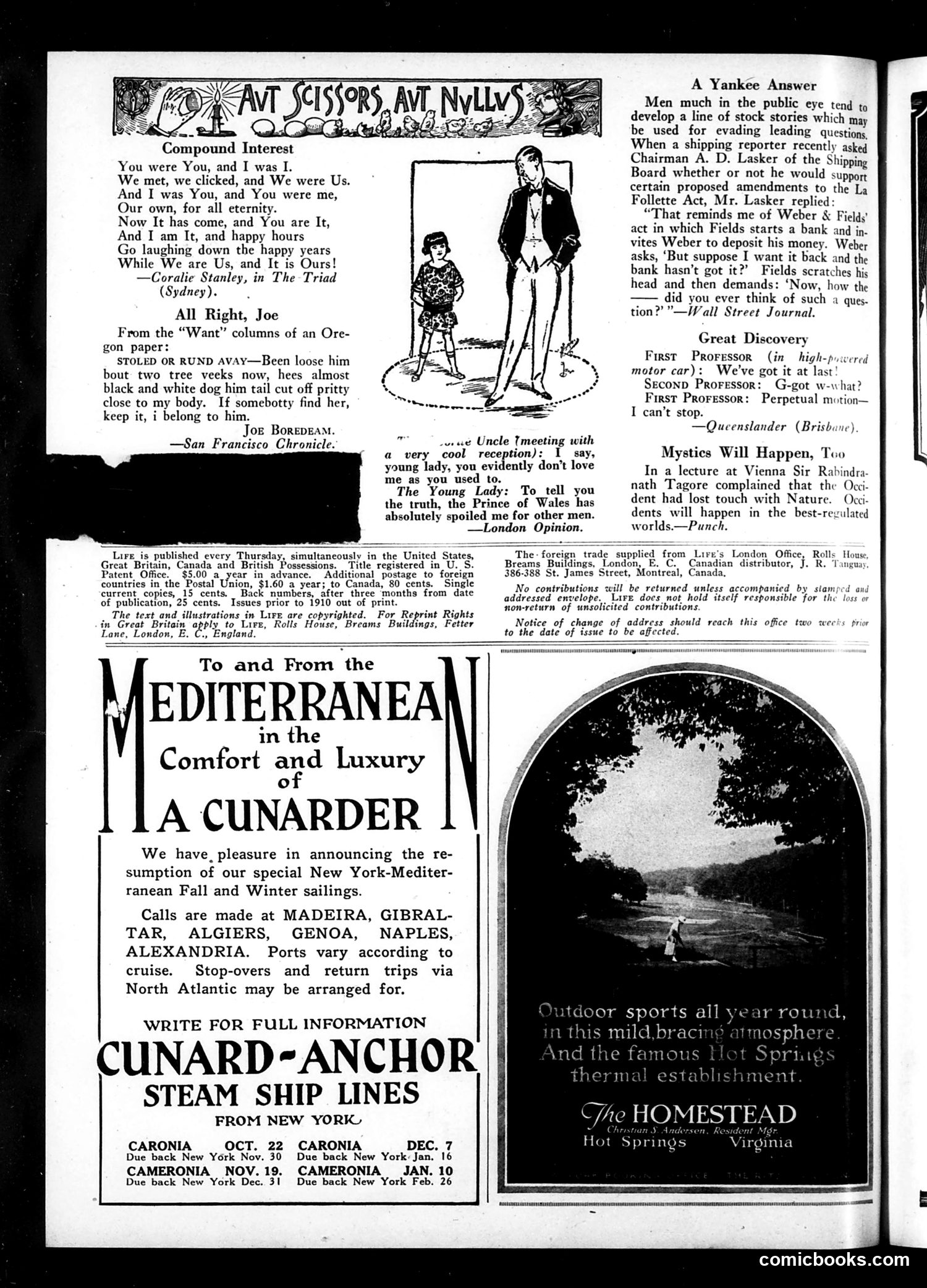
This page contains several brief satirical items typical of Life's humor section: **"Compound Interest"** and **"All Right, Joe"** are short comic verses—one playing on romantic language ("You," "I," "We," "It") becoming grammatically absurd, the other mocking a poorly-written lost-dog advertisement from an Oregon newspaper with phonetic dialect humor. **"A Yankee Answer"** satirizes evasion by public officials. A shipping board chairman (A.D. Lasker) responds to a direct policy question by telling an irrelevant joke from the vaudeville comedy team Weber & Fields, essentially dodging the issue—the joke being that Fields himself admits the question is unanswerable. **"Great Discovery"** and **"Mystics Will Happen, Too"** are one-liners: the first a pun about a professor unable to stop a motor car (no perpetual motion achieved), the second a wordplay on Tagore's complaint about the West losing touch with nature ("accidents will happen"). The page is primarily **advertising** (Cunard steamship lines, The Homestead resort), with brief humor fillers typical of period magazines.

This page is **not a cartoon or satire**—it's a straightforward **advertisement** for United States Tires (United States Rubber Company). The ad promotes a new "Truck Tire Service" offering free, impartial technical advice to truck owners about selecting proper tire equipment. Two tire products are pictured: the U.S. Mono-Twin solid truck tire and the U.S. Nobby Cord pneumatic tire. The "Perhaps Your Problem Is Solved Here" section uses a Q&A format to demonstrate the service's value, answering a specific question about proper tire equipment for a 3¾-ton truck doing heavy haulage work. The marketing pitch emphasizes that American truck owners previously lacked honest, independent advice about tire selection, and that "as much money is wasted today on wrong truck tires as on poor ones." The company positions itself as offering expert guidance motivated purely by "greater economy"—with no obligation to customers. This represents early 20th-century **B2B advertising**, targeting commercial fleet operators rather than consumers.
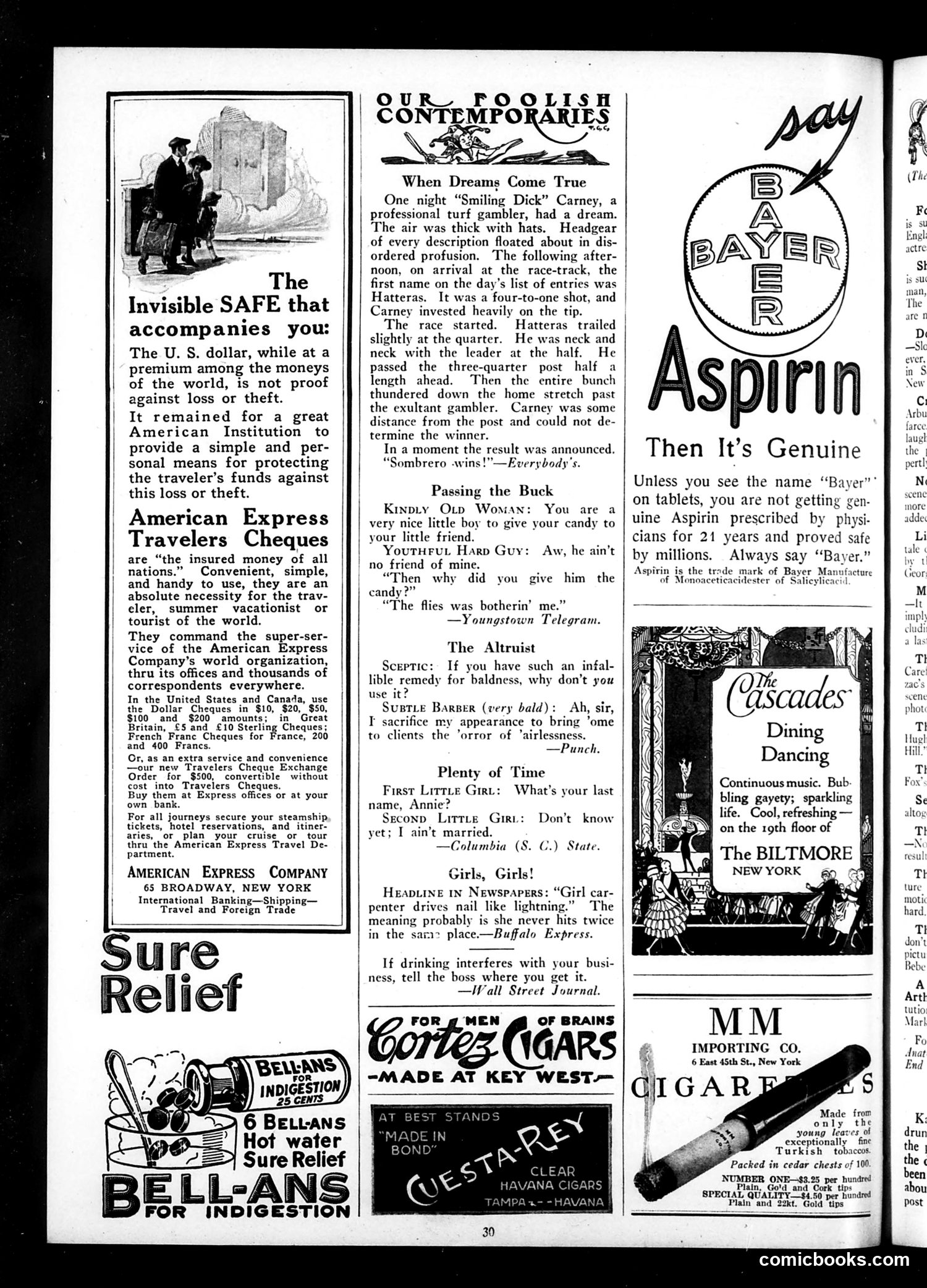
This page is predominantly **advertising**, with small satirical humor sections interspersed. The main content includes ads for American Express Travelers Cheques (emphasizing safe money transport), Bayer Aspirin, Bell-ans indigestion remedy, Cortez cigars, and The Cascades nightclub in New York. The satirical sections are brief, multi-panel jokes: - **"When Dreams Come True"**: A gambler dreams of hats, bets on a horse named "Hatteras," but loses when "Sombrero" wins instead—mocking the unreliability of gambling "systems." - **"Passing the Buck"**: A boy gives candy to another boy, claiming it's not from friendship but to stop flies bothering him—satirizing false altruism. - **"The Altruist"**: A bald barber won't use his own baldness cure, claiming he sacrifices his appearance to show clients the "horror" of hairlessness—mocking hypocritical marketing. These jokes target human foibles: magical thinking, insincere generosity, and dishonest salesmanship.
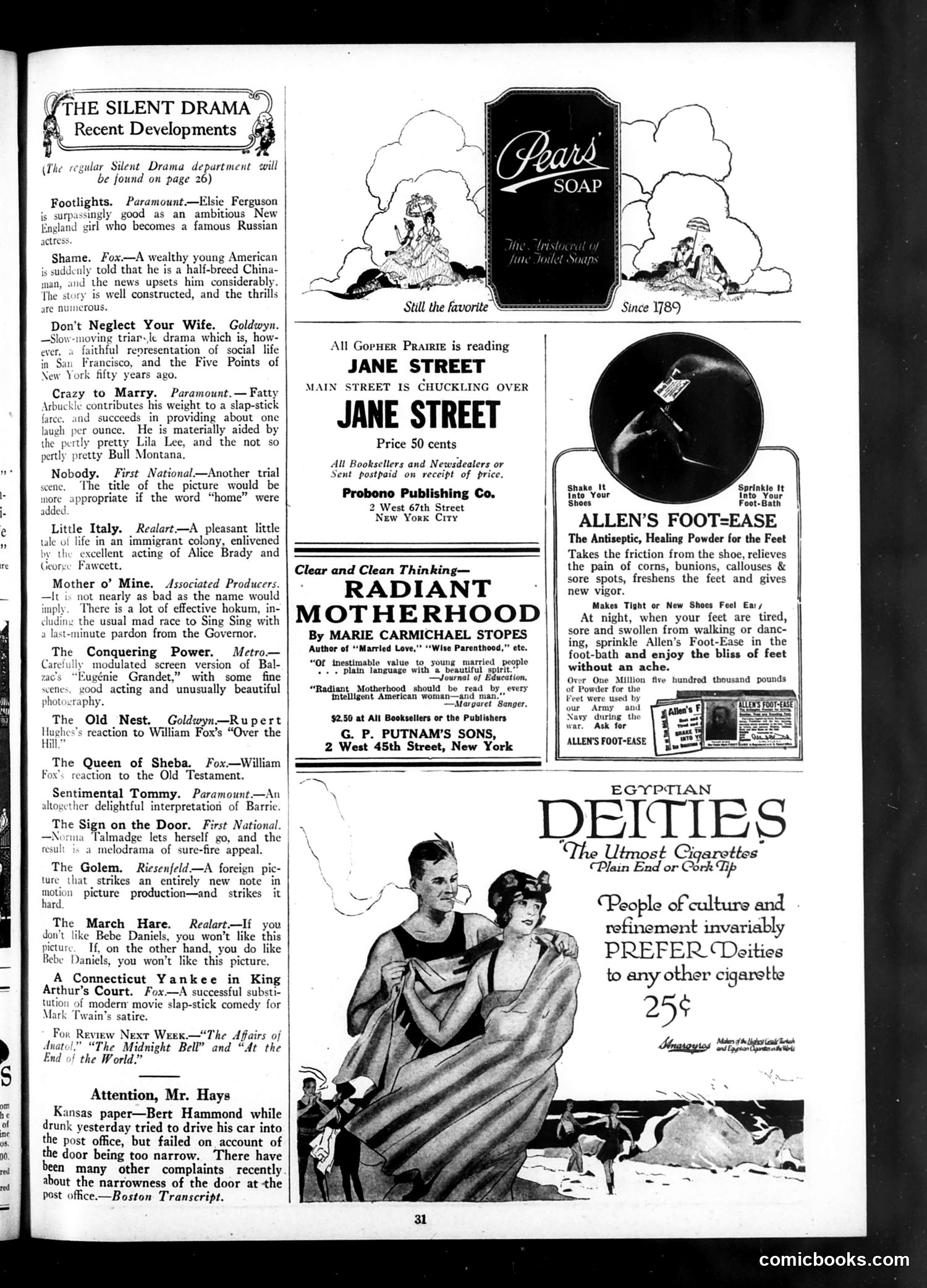
This page is primarily advertising and movie reviews, not a political cartoon. The movie reviews on the left cover silent films from various studios—Paramount, Fox, Metro, etc.—describing plots and performances with the casual tone of early cinema criticism. Notably, "Shame" addresses racial identity, referencing anxieties of the era about hidden Chinese heritage. The advertisements dominate the page: Paris Soap ("since 1789"), a book on "Radiant Motherhood" by Marie Carmichael Stopes (a famous birth-control advocate), Egyptian Deities cigarettes, and Allen's Foot-Ease powder. A small humor item at bottom mocks a Kansas newspaper's report of someone trying to drive drunk into a post office, blaming the door's narrowness—a joke about absurd local journalism priorities. There are no political cartoons here—this is a representative sample of 1920s popular culture, consumer goods, and entertainment media.
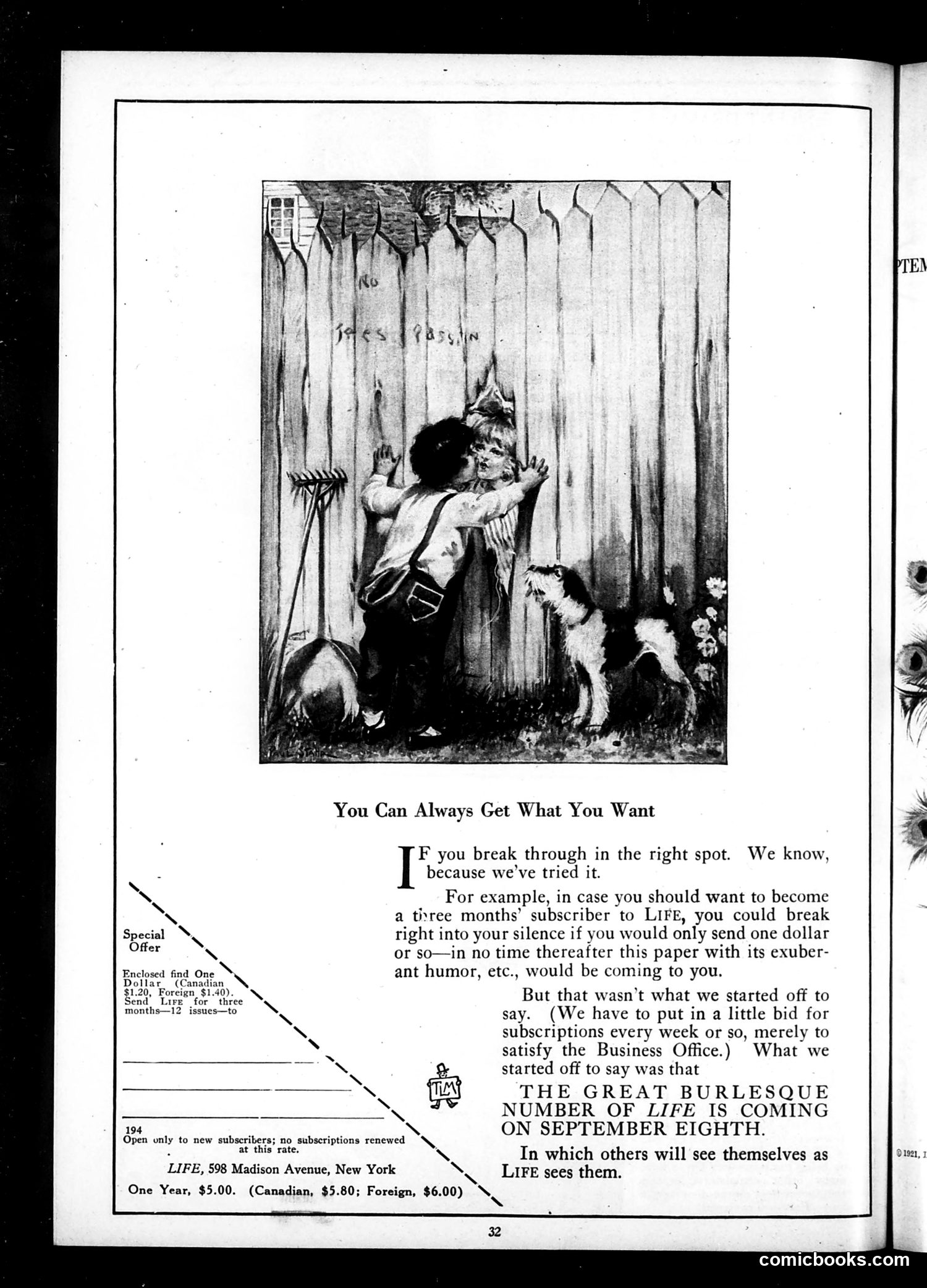
This page is primarily **advertising disguised as editorial content**—a common early 20th-century magazine practice. The illustration shows a child breaking through a fence while a dog watches, accompanying the headline "You Can Always Get What You Want." This image appears designed to convey persistence and determination, visually supporting the text's pitch. The "content" is actually a **subscription solicitation**. Life's editors humorously acknowledge they must constantly pitch subscriptions to satisfy their business office. They're offering a three-month subscription for one dollar, framed as an appeal to readers who want Life's "exuberant humor." The page also announces an upcoming "Great Burlesque Number" for September 8th, promising readers will see themselves as Life sees them—likely satirical character sketches or social commentary typical of Life's satirical mission. The tone is self-aware and playful about the act of advertising itself, characteristic of Life magazine's approach to commerce and humor.