
Life, 1921-08-25 · page 16 of 34
Life — August 25, 1921 — page 16: what you’re looking at
What you’re looking at
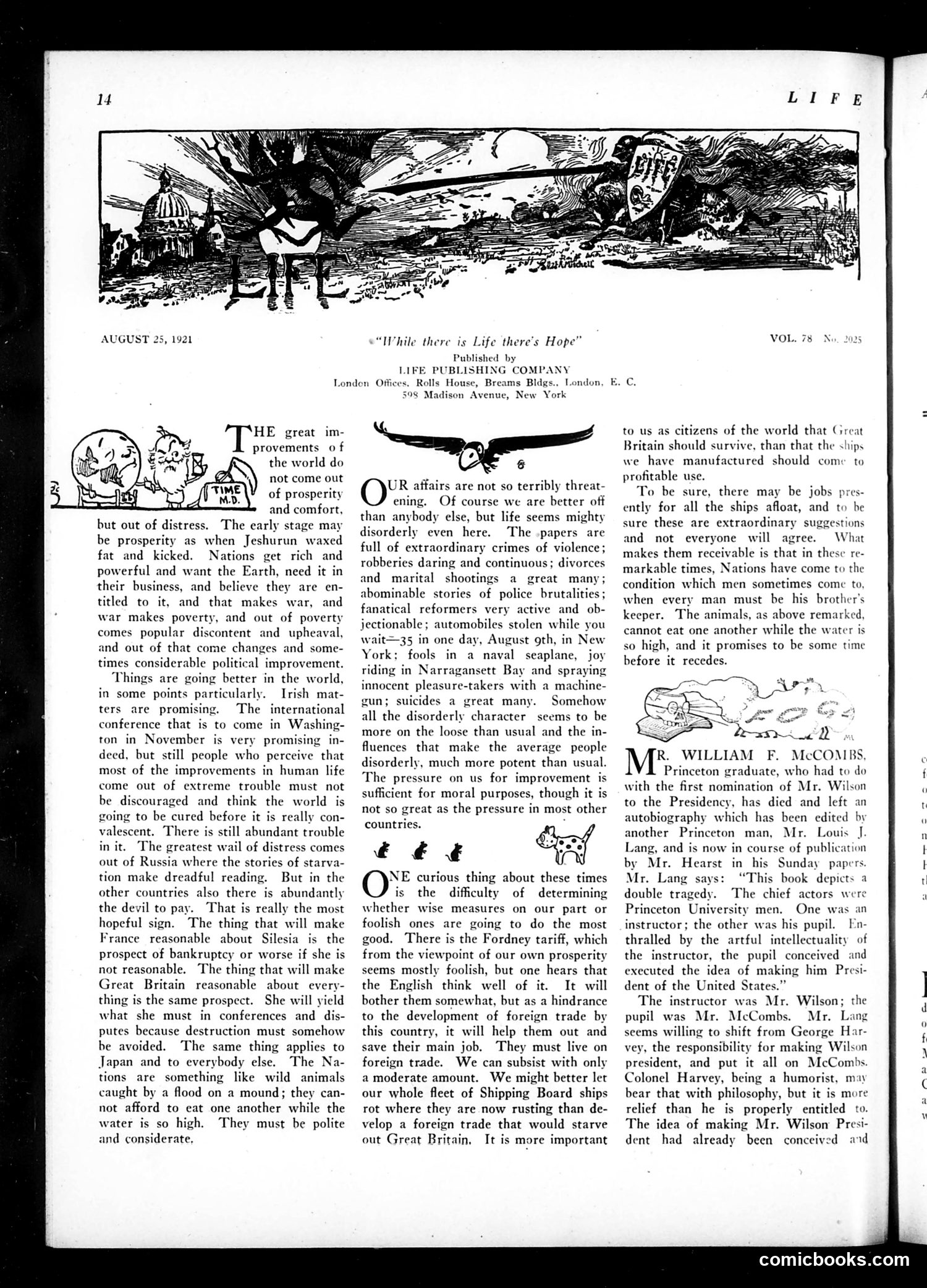
The editorial criticizes contemporary social and economic turmoil following World War I. The opening illustration depicts a tree bearing various societal ills—likely representing the troubled postwar world. The main text addresses international instability: crime waves, labor unrest, and economic hardship are portrayed as inevitable consequences of wartime disruption. The author argues that improvement is underway, citing an upcoming Washington conference as promising. A significant portion discusses the "Fordney tariff," a protective trade policy. The piece expresses skepticism about whether tariffs can genuinely help Britain's struggling economy without harming international trade. The page also contains a brief note about William F. McCombs, former Princeton graduate and Wilson administration associate, whose autobiography is being published.
📄 Transcribed text from this page (OCR, searchable)
Machine-transcribed from the original scan — historical spelling and the odd misread are preserved.
condon Offices. HE great im- provements o f the world do not come out of prosperity and comfort, but out of distress. The early stage may be prosperity as when Jeshurun waxed fat and kicked. Nations get rich and powerful and want the Earth, need it in their business, and believe they are en- titled to it, and that makes war, and war makes poverty, and out of poverty comes popular discontent and upheaval, and out of that come changes and some- times considerable political improvement. Things are going better in the world, in some points particularly. Irish mat- ters are promising. The international conference that is to come in Washing- ton in November is very promising in- deed, but still people who perceive that most of the improvements in human life come out of extreme trouble must not be discouraged and think the world is going to be cured before it is really con- valescent. There is still abundant trouble in it. The greatest wail of distress comes out of Russia where the stories of starva- tion make dreadful reading. But in the other countries also there is abundantly the devil to pay. That is really the most hopeful sign. The thing that will make France reasonable about Silesia is the prospect of bankruptcy or worse if she is not reasonable. The thing that will make Great Britain reasonable about every- thing is the same prospect. She will yield what she must in conferences and dis putes because destruction must somehow be avoided. The same thing applies to Japan and to everybody else. The Na- tions are something like wild animals caught by a flood on a mound; they can- not afford to eat one another while the water is so high. They must be polite and considerate, “While there is Life there’s Hope” Published by LIFE PUBLISHING COMPANY Rolls House, Breams Bldgs., london 98 Madison Avenue, New York 6 UR affairs are not so terribly threat- ening. Of course we are better off than anybody else, but life seems mighty disorderly even here. The .papers are full of extraordinary crimes of violence; robberies daring and continuous; divorces and marital shootings a great many; abominable stories of police brutalities; fanatical reformers very active and ob- jectionable; automobiles stolen while you wait=35 in one day, August 9th, in New York; fools in a naval seaplane, joy riding in Narragansett Bay and spraying innocent pleasure-takers with a machine- gun; suicides a great many. Somehow all the disorderly character seems to be more on the loose than usual and the in- fluences that make the average people disorderly, much more potent than usual. The pressure on us for improvement is sufficient for moral purposes, though it is not so great as the pressure in most other countries. : & € € NE curious thing about these times is the difficulty of determining whether wise measures on our part or foolish ones are going to do the most good, There is the Fordney tariff, which from the viewpoint of our own prosperity seems mostly foolish, but one hears that the English think well of it. It will bother them somewhat, but as a hindrance to the development of foreign trade by this country, it will help them out and save their main job. They must live on foreign trade. We can subsist with only a moderate amount. We might better let our whole fleet of Shipping Board ships rot where they are now rusting than de- velop a foreign trade that would starve out Great Britain, It is more important to us as citizens of the world that Great Britain should survive, than that the ships we have manufactured should come to profitable vu To be sure, there may be jobs pres- ently for all the ships afloat, and to be sure these are extraordinary suggestions and not everyone will agree. What makes them receivable is that in these re- markable times, Nations have come to the condition which men sometimes come to. when every man must be his brother's keeper. The animals, as above remarked, cannot eat one another while the water is so high, and it promises to be some time before it recedes. M* WILLIAM F. McCOMBS, Princeton graduate, who had to do with the first nomination of Mr. Wilson to the Presidency, has died and left an autobiography which has been edited by another Princeton man, Mr. Louis J Lang, and is now in course of publication by Mr. Hearst in his Sunday papers. Mr. Lang say “This book depicts a double tragedy. The chief actors were Princeton University men. One was an instructor; the other was his pupil. En- thralled by the artful intellectuality of the instructor, the pupil con ds and executed the idea of making him Presi- dent of the United States.” The instructor was Mr. Wilson; the pupil was Mr. McCombs. Mr. Lang seems willing to shift from George Har- vey, the responsibility for making Wilson president, and put it all on McCombs. Colonel Harvey, being a humorist, may bear that with philosophy, but it is more relief than he is properly entitled to. The idea of making Mr. Wilson Presi- dent had already been conceived and comicbooks.com