
Life, 1921-08-25 · page 4 of 34
Life — August 25, 1921 — page 4: what you’re looking at
What you’re looking at
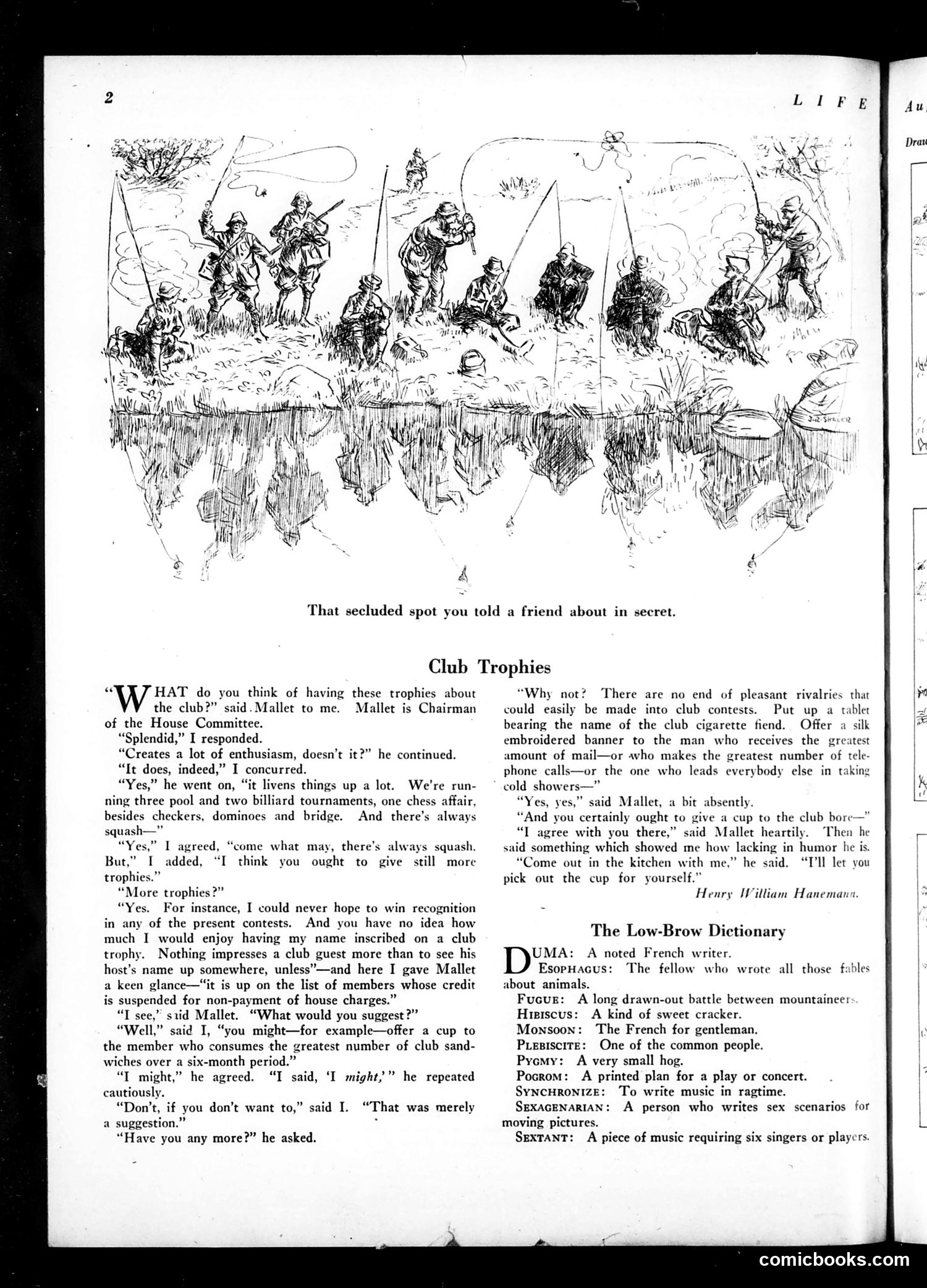
The cartoon illustrates a fishing scene captioned "That secluded spot you told a friend about in secret." It depicts multiple fishermen crowded together at what should be a private fishing location, each with their own rod and line. The humor plays on a common social frustration: when you share an exclusive spot with one person "in secret," word spreads, and soon dozens of people have discovered it, defeating the original purpose of secrecy and exclusivity. This is social satire about information leakage and the impossibility of keeping secrets in a social network—a timeless theme. The packed scene of fishermen represents how quickly private knowledge becomes public knowledge through casual word-of-mouth sharing.
📄 Transcribed text from this page (OCR, searchable)
Machine-transcribed from the original scan — historical spelling and the odd misread are preserved.
That secluded spot you told a friend about in secret. Club Trophies “ HAT do you think of having these trophies about the club?” said. Mallet to me. Mallet is Chairman of the House Committee. “Splendid,” I responded. “Creates a lot of enthusiasm, doesn’t it?” he continued. “Tt does, indeed,” I concurred. “Yes,” he went on, “it livens things up a lot. We're run- ning three pool and two billiard tournaments, one chess affair, besides checkers, dominoes and bridge. And there’s always he Yes,” I agreed, “come what may, there’s always squash. But,” I added, “I think you ought to give still more trophies.” “More trophies?” “Yes. For instance, I could never hope to win recognition in any of the present contests. And you have no idea how much I would enjoy having my name inscribed on a club trophy. Nothing impresses a club guest more than to see his host’s name up somewhere, unless”—and here I gave Mallet a keen glance—“it is up on the list of members whose credit is suspended for non-payment of house charges.” “I see,” stid Mallet. “What would you suggest?” “Well,” said I, “you might—for example—offer a cup to the member who consumes the greatest number of club sand- wiches over a six-month period.” “T might,” he agreed. “I said, ‘I might)” he repeated cautiously. “Don’t, if you don’t want to,” said I. “That was merely a suggestion.” : “Have you any more?” he asked. “Why not? There are no end of pleasant rivalries that could easily be made into club contests. Put up a tablet bearing the name of the club cigarette fiend. Offer a silk embroidered banner to the man who receives the greatest amount of mail—or aho makes the greatest number of tele- phone calls—or the one who leads everybody else in taking cold showers—” “Yes, yes,” said Mallet, a bit absently. “And you certainly ought to give a cup to the club bore—" “I agree with you there,” said Mallet heartily. Then he said something which showed me how lacking in humor he is. “Come out in the kitchen with me,” he said. “T’ll let you pick out the cup for yourself.” Henry William Hanemann. The Low-Brow Dictionary UMA: A noted French writer. EsopHacus: The fellow who wrote all those about animals. Fucus: A long drawn-out battle between mountaineer Hreiscus: A kind of sweet cracker. Monsoon: The French for gentleman. PesisciTE: One of the common people. Pycmy: A very small hog. Pocrom: A printed plan for a play or concert. SyncHRONIZE: To write music in ragtime. SEXAGENARIAN: A person who writes sex scenarios for moving pictures. Sextant: A piece of music requiring six singers or players. Aw. Draw comicbooks.com