
Life, 1921-08-25 · page 28 of 34
Life — August 25, 1921 — page 28: what you’re looking at
What you’re looking at
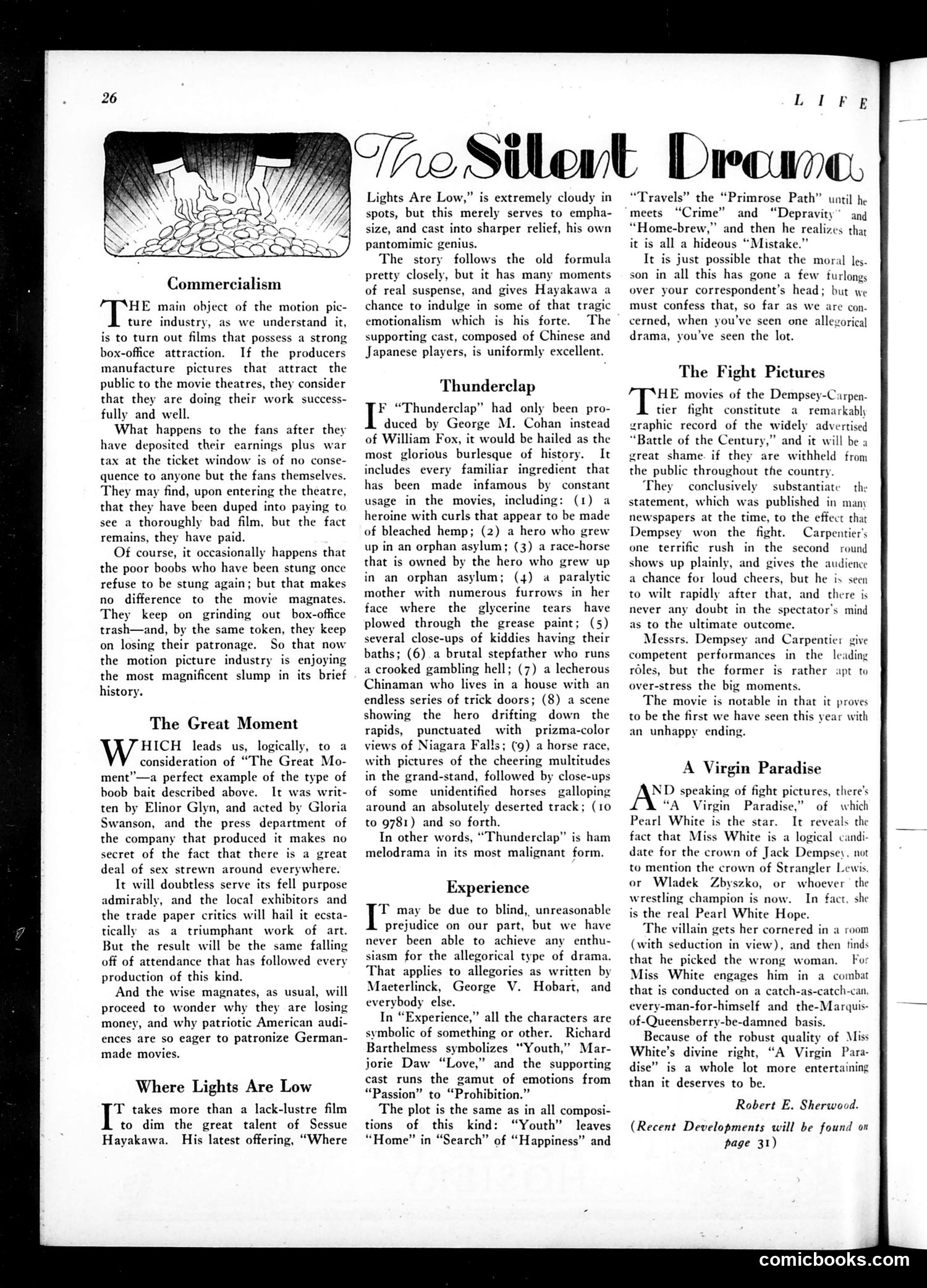
This page contains critical reviews of several silent films, with particular emphasis on industry commercialism and creative bankruptcy. The **main cartoon** (top left, unlabeled) depicts a chaotic scene—likely illustrating the melodramatic excess criticized in the reviews. The opening section attacks film studios for prioritizing box-office profits over quality, deliberately duping audiences with poor films while blaming declining attendance on "German-made movies" rather than their own failures. **"The Great Moment"** (starring Gloria Swanson, written by Elinor Glyn) is dismissed as exploitative "boob bait" relying on sex appeal rather than substance. **"Thunderclap"** receives the harshest critique—the reviewer catalogs its reliance on hackneyed melodramatic tropes (orphans, race horses, paralytic mothers, lecherous villains, Niagara Falls) in exhaustive detail, suggesting it would be unintentionally funny if produced by George M. Cohan as parody rather than by William Fox as earnest drama. The reviews exemplify 1920s film criticism's frustration with formulaic, artistically hollow entertainment.
📄 Transcribed text from this page (OCR, searchable)
Machine-transcribed from the original scan — historical spelling and the odd misread are preserved.
Commercialism HE main object of the motion pic- ture industry, as we understand it, is to turn out films that possess a strong box-office attraction. If the producers manufacture pictures that attract the public to the movie theatres, they consider that they are doing their work success- fully and well. What happens to the fans after they have deposited their earnings plus war tax at the ticket window is of no conse- quence to anyone but the fans themselves. They may find, upon entering the theatre, that they have been duped into paying to see a thoroughly bad film, but the fact remains, they have paid. Of course, it occasionally happens that the poor boobs who have been stung once refuse to be stung again; but that makes no difference to the movie magnates. They keep on grinding out box-office trash—and, by the same token, they keep on losing their patronage. So that now the motion picture industry is enjoying the most magnificent slump in its brief history. The Great Moment HICH leads us, logically, to a consideration of “The Great Mo- ment”—a perfect example of the type of boob bait described above. It was writ- ten by Elinor Glyn, and acted by Gloria Swanson, and the press department of the company that produced it makes no secret of the fact that there is a great deal of sex strewn around everywhere. It will doubtless serve its fell purpose admirably, and the local exhibitors and the trade paper critics will hail it ecsta- tically as a triumphant work of art. But the result will be the same falling off of attendance that has followed every production of this kind. And the wise magnates, as usual, will proceed to wonder why they are losing money, and why patriotic American audi- ences are so eager to patronize German- made movies. Where Lights Are Low T takes more than a lack-lustre film to dim the great talent of Sessue Hayakawa. His latest offering, “Where TAoSitllevkt Direcwne, Lights Are Low,” is extremely cloudy in spots, but this merely serves to empha- size, and cast into sharper relief, his own pantomimic genius. The story follows the old formula pretty closely, but it has many moments of real suspense, and gives Hayakav chance to indulge in some of that tragic emotionalism which is his forte. The supporting cast, composed of Chinese and Japanese players, is uniformly excellent. Thunderclap [7 “Thunderclap” had only been pro- duced by George M. Cohan instead of William Fox, it would be hailed as the most glorious burlesque of history. It includes every familiar ingredient that has been made infamous by constant usage in the movies, including: (1) a heroine with curls that appear to be made of bleached hemp; (2) a hero who grew up in an orphan asylum; (3) a race-horse that is owned by the hero who grew up in an orphan asylum; (4) a paralytic mother with numerous furrows in her face where the glycerine tears have plowed through the grease paint; (5) several close-ups of kiddies having their baths; (6). a brutal stepfather who runs a crooked gambling hell; (7) a lecherous Chinaman who lives in a house with an endless series of trick doors; (8) a scene showing the hero drifting down the rapids, punctuated with prizma-color views of Niagara Fal!s; (9) a horse race, with pictures of the cheering multitudes in the grand-stand, followed by close-ups of some unidentified horses galloping around an absolutely deserted track; (10 to 9781) and so forth. In other words, “Thunderclap” is ham melodrama in its most malignant form. Experience I [ may be due to blind, unreasonable prejudice on our part, but we have never been able to achieve any enthu- siasm for the allegorical type of drama. That applies to allegories as written by Maeterlinck, George V. Hobart, and everybody else. In “Experience,” all the characters are symbolic of something or other. Richard Barthelmess symbolizes “Youth,” Mar- jorie Daw “Love,” and the supporting cast runs the gamut of emotions from “Passion” to “Prohibition.” The plot is the same as in all composi- tions of this kind: “Youth” leaves “Home” in “Search” of “Happiness” and “Travels” the “Primrose Path” until he meets “Crime” and “Depravity’ ang “Home-brew,” and then he realizes that it is all a hideous “Mistake.” It is just possible that the moral les- son in all this has gone a few furlongs over your correspondent’s head; but we must confess that, so far as we are con- cerned, when you've seen one allegorical drama, you've seen the lot. The Fight Pictures HE movies of the Dempsey-Carpen- tier fight constitute a remarkably graphic record of the widely advertised “Battle of the Century,” and it will be a great shame. if they are withheld from the public throughout the country. They conclusively substantiate the statement, which was published in many newspapers at the time, to the effect that Dempsey won the fight. Carpentier’s one terrific rush in the second round shows up plainly, and gives the audience a chance for loud cheers, but he is seen to wilt rapidly after that, and there is never any doubt in the spectator’s mind as to the ultimate outcome. Messrs. Dempsey and Carpentier give competent performances in the leading roles, but the former is rather over-stress the big moments. The movie is notable in that it proves to be the first we have seen this year with an unhappy ending. ipt to A Virgin Paradise D speaking of fight pictures, there's Virgin Paradise,” of which Pearl White is the star. It reveals the fact that Miss White is a logical candi- date for the crown of Jack Dempse\, not to mention the crown of Strangler Lewis. or Wladek Zbyszko, or whoever the wrestling champion is now. In fact, she is the real Pearl White Hope. The villain gets her cornered in a room (with seduction in view), and then tinds that he picked the wrong woman. Fo: Miss White engages him in a combat that is conducted on a catch-as-catch-can, every-man-for-himself and the-Marquis- of-Queensberry-be-damned bas Because of the robust quality of Miss White’s divine right, “A Virgin Para- dise” is a whole lot more entertaining than it deserves to be. Robert E. Sherwood. (Recent Developments will be found on page 31) comicbooks.com