
Life, 1921-08-25 · page 20 of 34
Life — August 25, 1921 — page 20: what you’re looking at
What you’re looking at
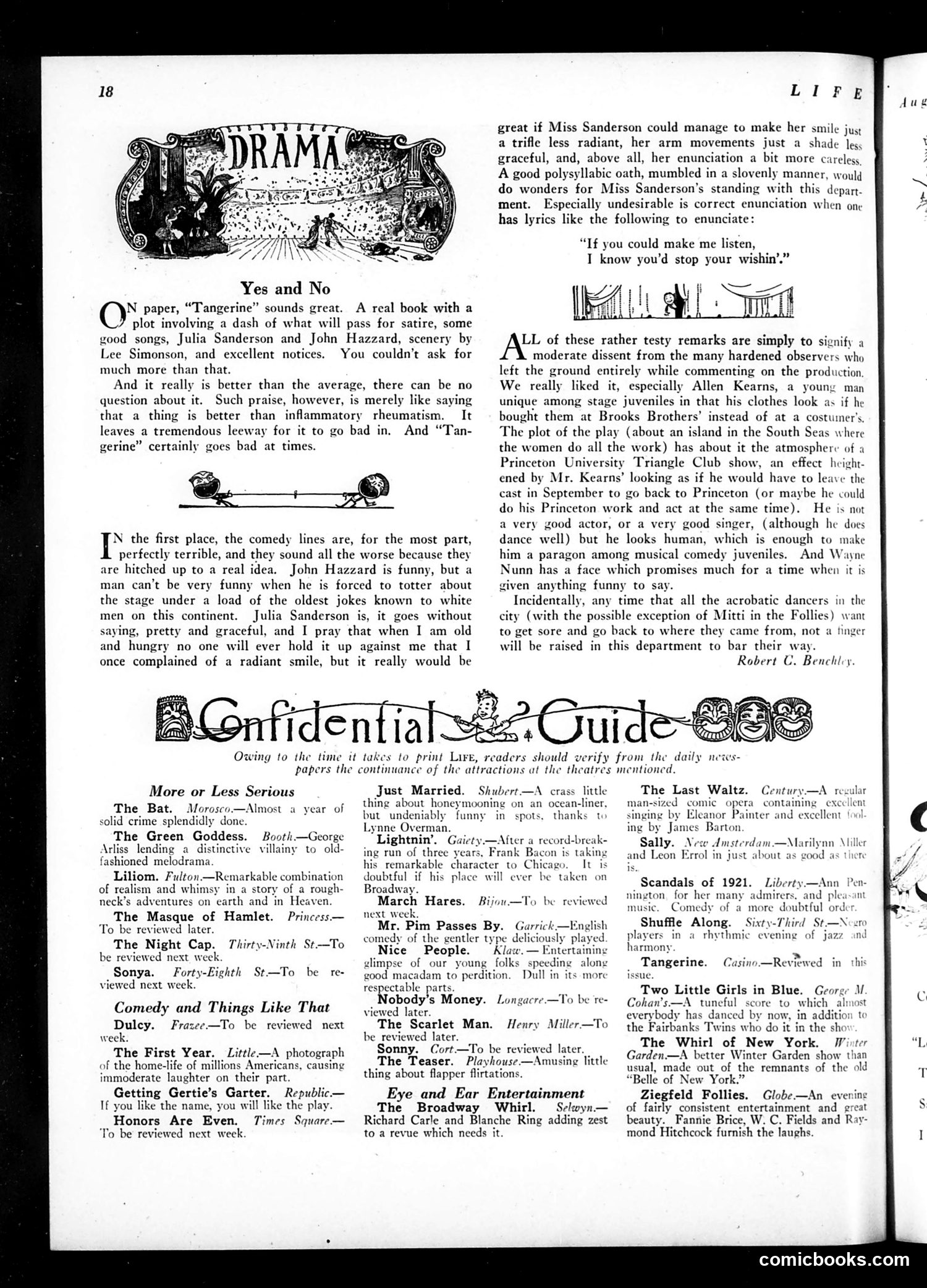
This is theater critic Robert C. Benchley's mixed review of the musical "Tangerine," starring Julia Sanderson and John Hazzard. The satire targets both the production and theater conventions of the era. Benchley praises the show's basic premise and scenery while systematically dismantling its execution. He mocks the "perfectly terrible" comedy lines and suggests Sanderson's flawless performance—her radiant smile, graceful movements, and perfect diction—actually works *against* her charm. He argues she'd benefit from sloppy delivery and even "a good polysyllabic oath, mumbled slovenly." The real target emerges in his praise of Allen Kearns, a young actor whose clothes look authentically worn (from Brooks Brothers, not costume shops) and whose very ordinariness makes him stand out among artificial stage juveniles. Benchley's review exemplifies Life magazine's satirical approach: praising mediocrity with backhanded compliments while critiquing theatrical artificiality and formulaic entertainment.
📄 Transcribed text from this page (OCR, searchable)
Machine-transcribed from the original scan — historical spelling and the odd misread are preserved.
Yes and No N paper, “Tangerine” sounds great. A real book with a plot involving a dash of what will pass for satire, some good songs, Julia Sanderson and John Hazzard, scenery by Lee Simonson, and excellent notices. You couldn’t ask for much more than that. And it really is better than the average, there can be no question about it. Such praise, however, is merely like saying that a thing is better than inflammatory rheumatism. It leaves a tremendous leeway for it to go bad in. And “Tan- gerine” certainly goes bad at times. ‘ZR GS S N the first place, the comedy lines are, for the most part, perfectly terrible, and they sound all the worse because they are hitched up to a real idea. John Hazzard is funny, but a man can’t be very funny when he is forced to totter about the stage under a load of the oldest jokes known to white men on this continent. Julia Sanderson is, it goes without saying, pretty and graceful, and I pray that when I am old and hungry no one will ever hold it up against me that I once complained of a radiant smile, but it really would be LIFE great if Miss Sanderson could manage to make her smile just a trifle less radiant, her arm movements just a shade les: graceful, and, above all, her enunciation a bit more careless, A good polysyllabic oath, mumbled in a slovenly manner, would do wonders for Miss Sanderson's standing with this depart. ment. Especially undesirable is correct enunciation when one has lyrics like the following to enunciate: “If you could make me listen, T know you’d stop your wishin’.” LL of these rather testy remarks are simply to signify a moderate dissent from the many hardened observers who left the ground entirely while commenting on the production, We really liked it, especially Allen Kearns, a young man unique among stage juveniles in that his clothes look as if he bought them at Brooks Brothers’ instead of at a costuiner's The plot of the play (about an island in the South Seas where the women do all the work) has about it the atmosphere of a Princeton University Triangle Club show, an effect height- ened by Mr. Kearns’ looking as if he would have to leave the cast in September to go back to Princeton (or maybe he could do his Princeton work and act at the same time). He is not a very good actor, or a very good singer, (although he does dance well) but he looks human, which is enough to make him a paragon among musical comedy juveniles. And Wayne Nunn has a face which promises much for a time when it is given anything funny to say. Incidentally, any time that all the acrobatic dancers in the city (with the possible exception of Mitti in the Follies) want to get sore and go back to where they came from, not a finger will be raised in this department to bar their way. Robert CU. Benchley. wing to the time it takes to print Lire, readers should verify from the daily news- papers the continuance of the attractions at the theatres mentioned. More or Less Serious The Bat. Morosco—Almost a year of solid crime splendidly done. The Green Goddess. Booth —George Arliss lending a distinctive villainy to old- fashioned melodrama Liliom. Fulton —Remarkable combination of realism and whimsy in a story of a rough- neck’s adventures on earth and in Heaven. The Masque of Hamlet. To be reviewed later. The Night Cap. be reviewed next week. Sonya. Forty-Eighth viewed next week. Comedy and Things Like That Dulcy. Frazee—To be week. The First Year. Little—A photograph of the home-life of millions Americans, causing immoderate laughter on their part. Getting Gertie’s Garter. Republic— If you like the name, you will like the play. Honors Are Even. To be reviewed next week. Princess.— Thirty-Ninth St-—To St—To be re- reviewed next Times Square— Just Married. Shubert—A crass little thing about honeymooning on an ocean-liner, but undeniably funny in spots, thanks to Lynne Overman. Lightnin’. G. ing run of three his remarkable cl ter to Chicago. doubtful if his place will ever be taken on Broadway. March Hares. next_ week, Mr. Pim Passes By. Garrick —English comedy of the gentler type deliciously played Nice People. Klaw glimpse of our young folks spe along good macadam to perdition. Dull in its more respectable parts. Nobody’s Money. Longacre.—To be re- viewed later. The Scarlet Man. be reviewed later. Sonny. Cort—To be reviewed later. The Teaser. Playhouse —Amusing little thing about flapper flirtations. reviewed Bijou—To be Henry Miller —To Eye and Ear Entertainment The Broadway Whirl. Selwyn— Richard Carle and Blanche Ring adding zest to a revue which needs it. The Last Waltz. Century—A recular man-sized comic opera containing excellent singing by Eleanor Painter and excellent ing by James Barton Sally. New dmsterdam—Marilynn \liller and Leon Errol in just about as good as there is. Scandals of 1921. Liberty—Ann Pen- nington, for her many admirers. and pleasant music. Comedy of a more doubtful ord Shuffle Along. Sixty-Third St—Nozro players in a rhythmic evening of jazz and harmony Tangerine. issue Two Little Girls in Blue. Georg Cohan’s—A tuneful score to which everybody has danced by now, in additi the Fairbanks Twins who do it in the shc The Whirl of New York. I’ Garden —A better Winter Garden show than usual, made out of the remnants of the old “Belle of New York.” Ziegfeld Follies. Globe—An ev of fairly consistent entertainment and g beauty. Fannie Brice, W. C. Fields and R mond Hitchcock furnish the laughs. Casino. —Reviewed in comicbooks.com