
Life, 1921-08-25 · page 17 of 34
Life — August 25, 1921 — page 17: what you’re looking at
What you’re looking at
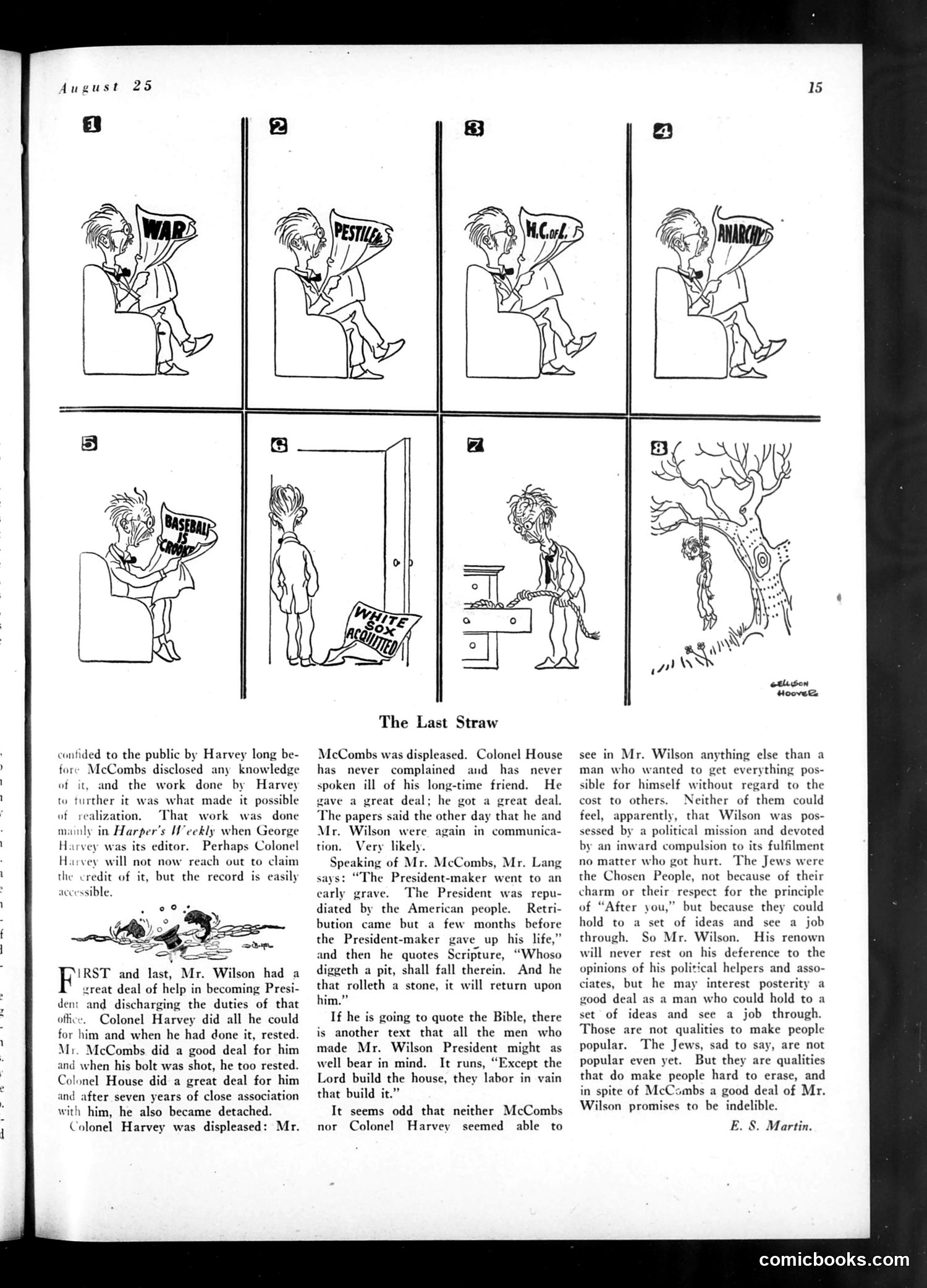
This page contains a comic strip (panels 1-8) paired with an essay about President Woodrow Wilson's political relationships. **The Comic:** The strip depicts a figure repeatedly holding different labels—"War," "Pestilence," "N.Card" (likely "Neglect"), and "Anarchy"—suggesting these are the consequences of Wilson's policies or administration. Panel 8 shows a barren tree, implying decay or failure. **The Essay:** The text criticizes those who helped elect Wilson—Colonel Harvey, Mr. McCombs, and Colonel House—for feeling betrayed. The author argues they misunderstood Wilson, viewing him as self-serving rather than recognizing his genuine political mission. The piece defends Wilson's legacy, comparing his commitment to ideals (like the Jewish people's commitment to faith) as the source of his historical importance, even if unpopular. The "last straw" appears to be these helpers' complaints after their political usefulness ended.
📄 Transcribed text from this page (OCR, searchable)
Machine-transcribed from the original scan — historical spelling and the odd misread are preserved.
25 August confided to the public by Harvey long be- fore McCombs disclosed any knowledge of it, and the work done by Harvey to turther i hat made it possible of rea That work done ainly in Harper's Weekly when George its editor. Perhaps Colonel uvey will not now reach out to claim was rvey wai F's and last, Mr. Wilson had a reat deal of help in becoming Presi- and discharging the duties of that Colonel Harvey did all he could for him and when he had done it, rested. Mr. McCombs did a good deal for him and when his bolt was shot, he too rested. Colonel House did a great deal for him and after seven years of close association with him, he also became detached. Colonel Harvey was displeased: Mr. The Last Straw McCombs was displeased. Colonel House has never complained and has never spoken ill of his long-time friend. He gave a great deal; he got a great deal. The papers said the other day that he and Mr. Wilson were again in communica- tion. Very likely. eaking of Mr. McCombs, Mr. Lang “The President-maker went to an early grave. The President was repu- diated by the American people. Retri- bution came but a few months before the President-maker gave up his life,” and then he quotes Scripture, “Whoso diggeth a pit, shall fall therein. And he that rolleth a stone, it will return upon him.” If he is going to quote the Bible, there is another text that all the men who made Mr. Wilson President might as well bear in mind. It runs, “Except the Lord build the house, they labor in vain that build it.” It seems odd that neither McCombs nor Colonel Harvey seemed able to see in Mr. Wilson anything else than a man who wanted to get everything pos- sible for himself without regard to the cost to others. Neither of them could feel, apparently, that Wilson was pos- sessed by a political mission and devoted by an inward compulsion to its fulfilment no matter who got hurt. The Jews were the Chosen People, not because of their charm or their respect for the principle of “After you,” but because they could hold to a set of ideas and see a job through. So Mr. Wilson. His renown will never rest on his deference to the opinions of his political helpers and asso- ciates, but he may interest posterity a good deal as a man who could hold to a set of ideas and a job through. Those are not qual to make people popular. The Jews, sad to say, are not popular even yet. But they are qualities that do make people hard to erase, and in spite of McCambs a good deal of Mr. Wilson promises to be indelible. E. 8. Martin. comicbooks.com