
A complete issue · 34 pages · 1921
Life — July 14, 1921
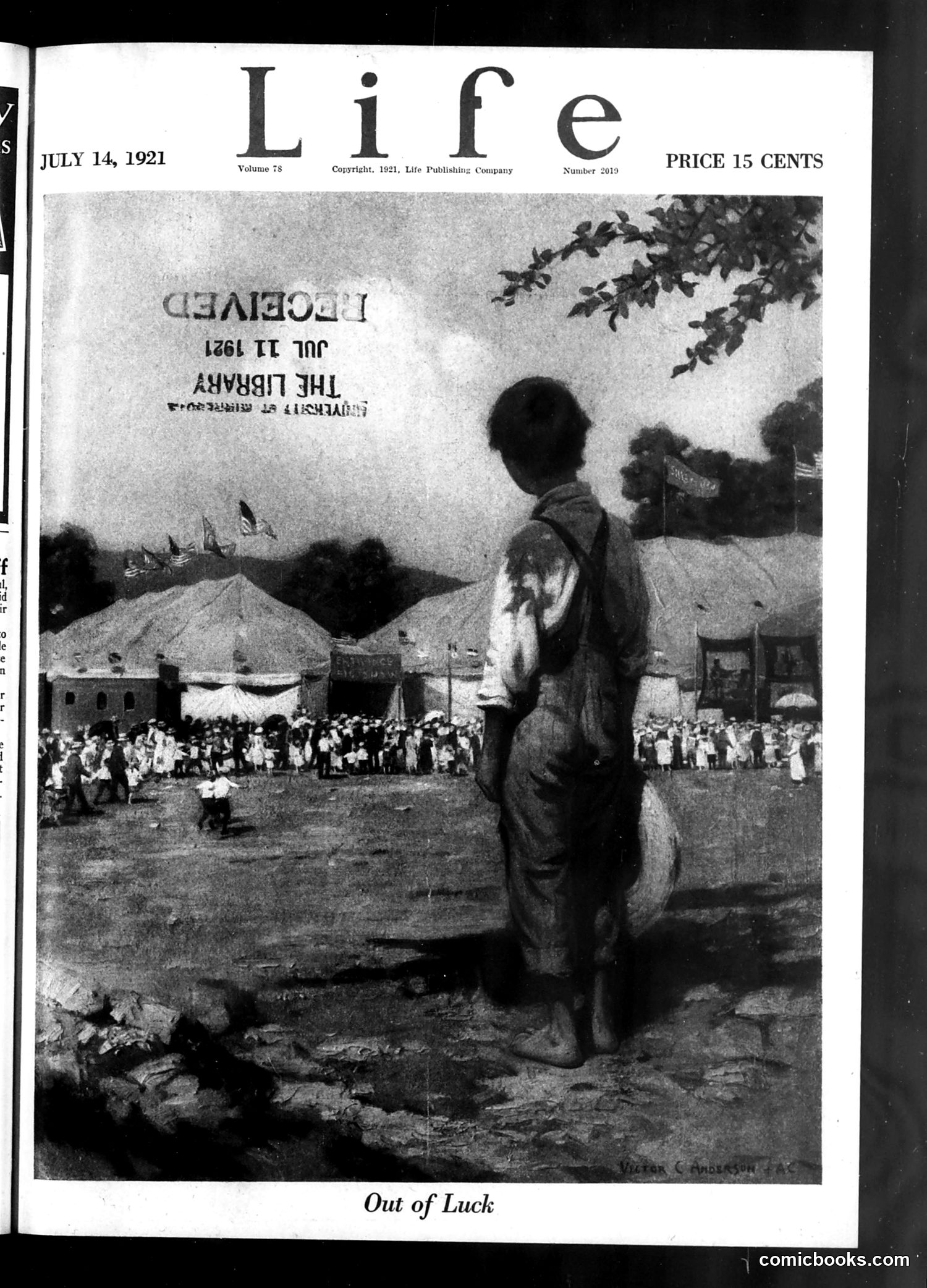
This cover depicts a barefoot boy standing at the edge of a large gathering or fair, looking in from outside. The title "Out of Luck" suggests commentary on economic hardship or social exclusion. The image likely reflects post-World War I American conditions—the early 1920s saw economic instability and inequality. The child's ragged appearance and exclusion from the festivities represent those left behind by prosperity, possibly referencing poverty among working-class families or children during this period of social transition. The photograph's sentimental approach—focusing on a sympathetic child figure—was typical of Life's satirical social commentary, using emotional imagery to critique economic disparities and social conditions of the era.
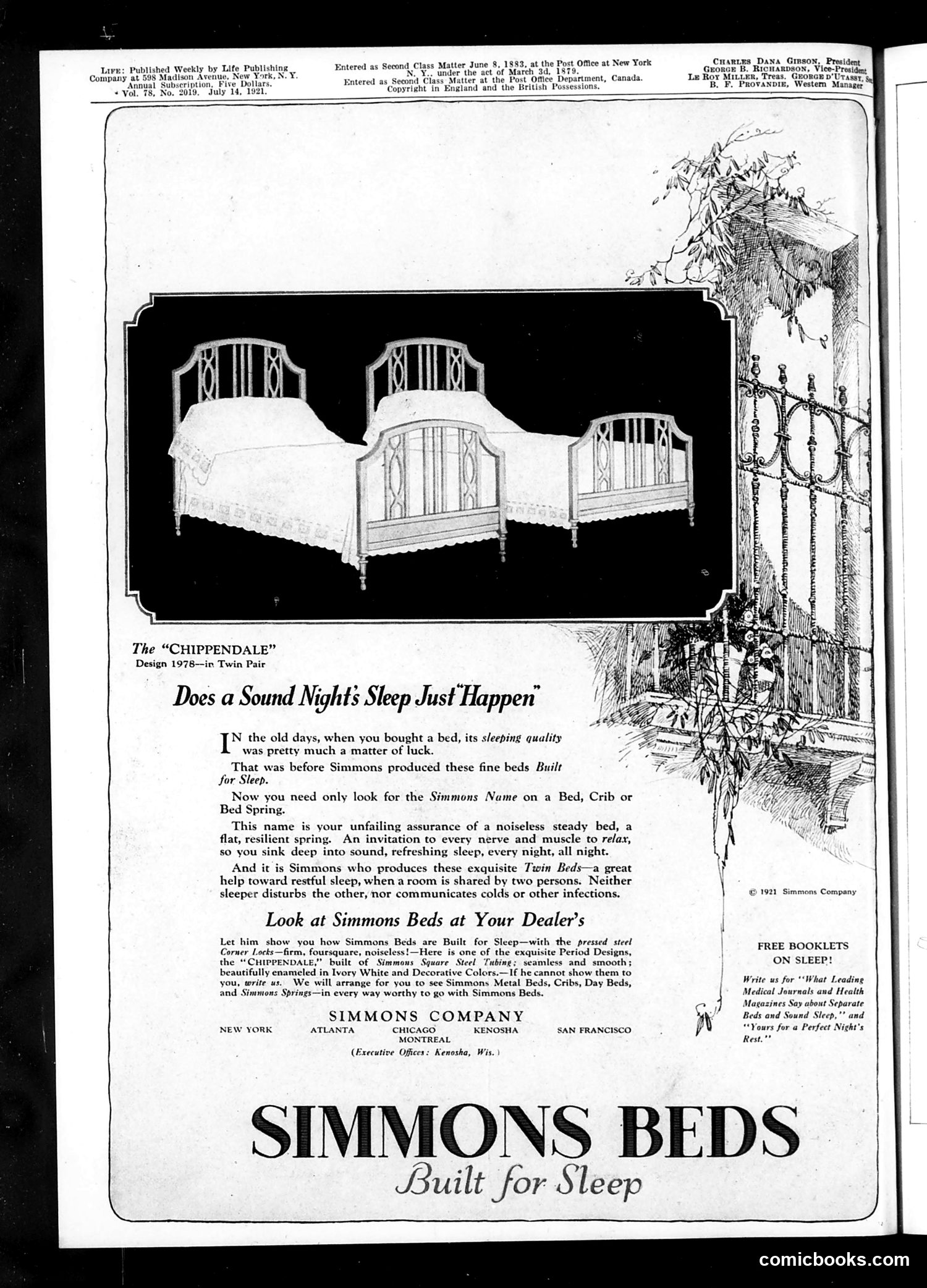
This page is **primarily a vintage advertisement**, not political satire. It advertises Simmons Beds, a major American bedding manufacturer, featuring their "Chippendale" design twin bed model. The ad uses a common marketing approach of the 1920s era: emphasizing scientific authority and health benefits. The headline "Does a Sound Night's Sleep Just Happen" suggests sleep quality is scientifically engineered rather than accidental. The text promotes Simmons' "Built for Sleep" construction with claims about "noiseless steady beds" and "resilient springs" that prevent disturbing a bedmate. The decorative illustration on the right (flowering vine and garden gate) is purely ornamental. There is **no political cartoon or social satire** on this page—it's a straightforward product advertisement typical of Life magazine's commercial content from this period.
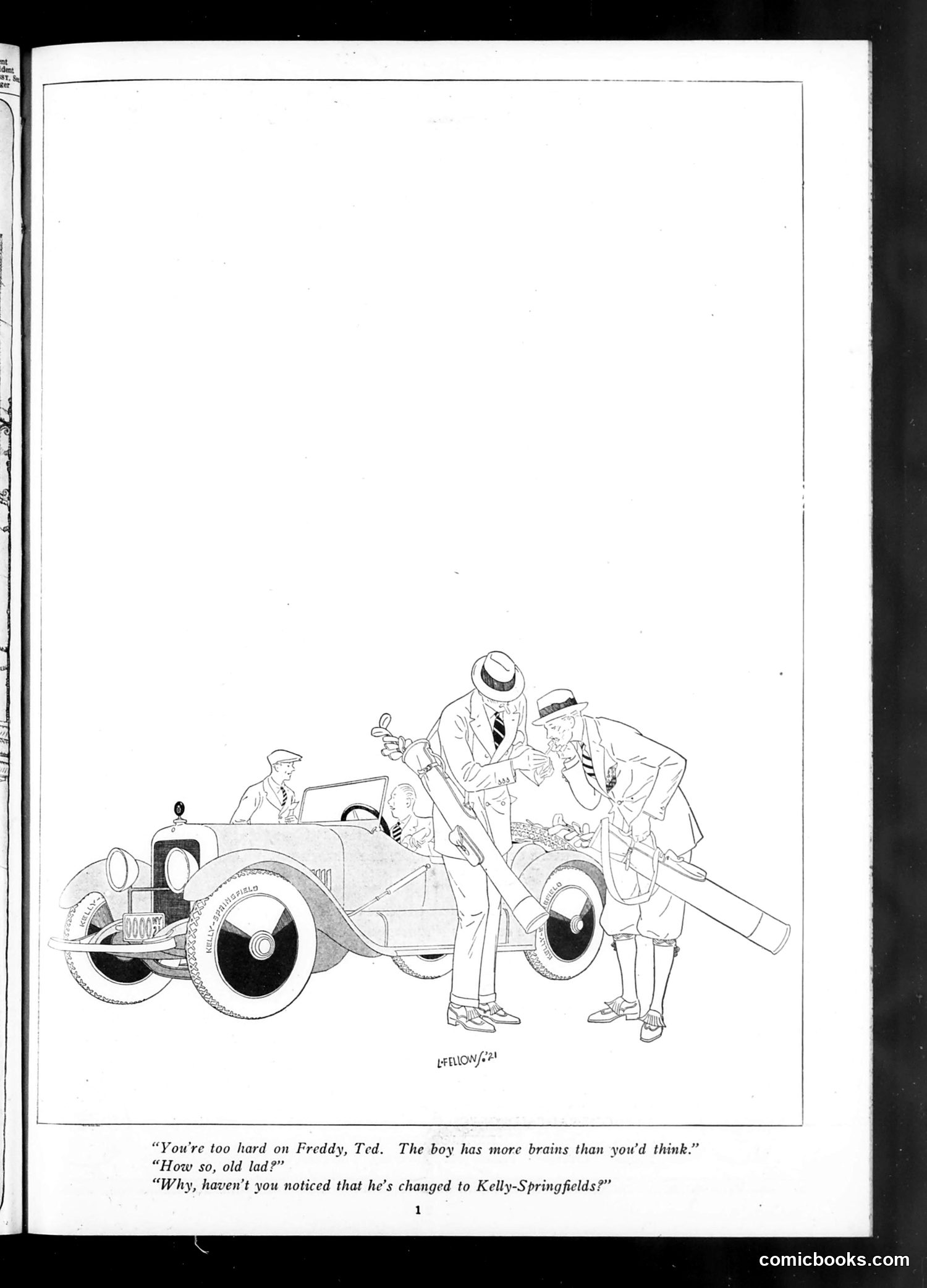
This is a cartoon from Life magazine's humor section, depicting three men in 1920s attire examining a vintage automobile. The dialogue references "Freddy" and "Ted," with one man commenting that the boy "has more brains than you'd think," followed by a reveal: "Why, haven't you noticed that he's changed to Kelly-Springfields?" The joke is an **advertisement disguised as humor**—specifically promoting Kelly-Springfield tires. The punchline suggests the young person made a smart decision by switching to this tire brand, implying superior quality or value. This is **branded content**, where the advertiser integrates product messaging into entertainment rather than using traditional ads. The cartoon's vintage car setting and the men's clothing place it roughly in the 1920s-1930s era.
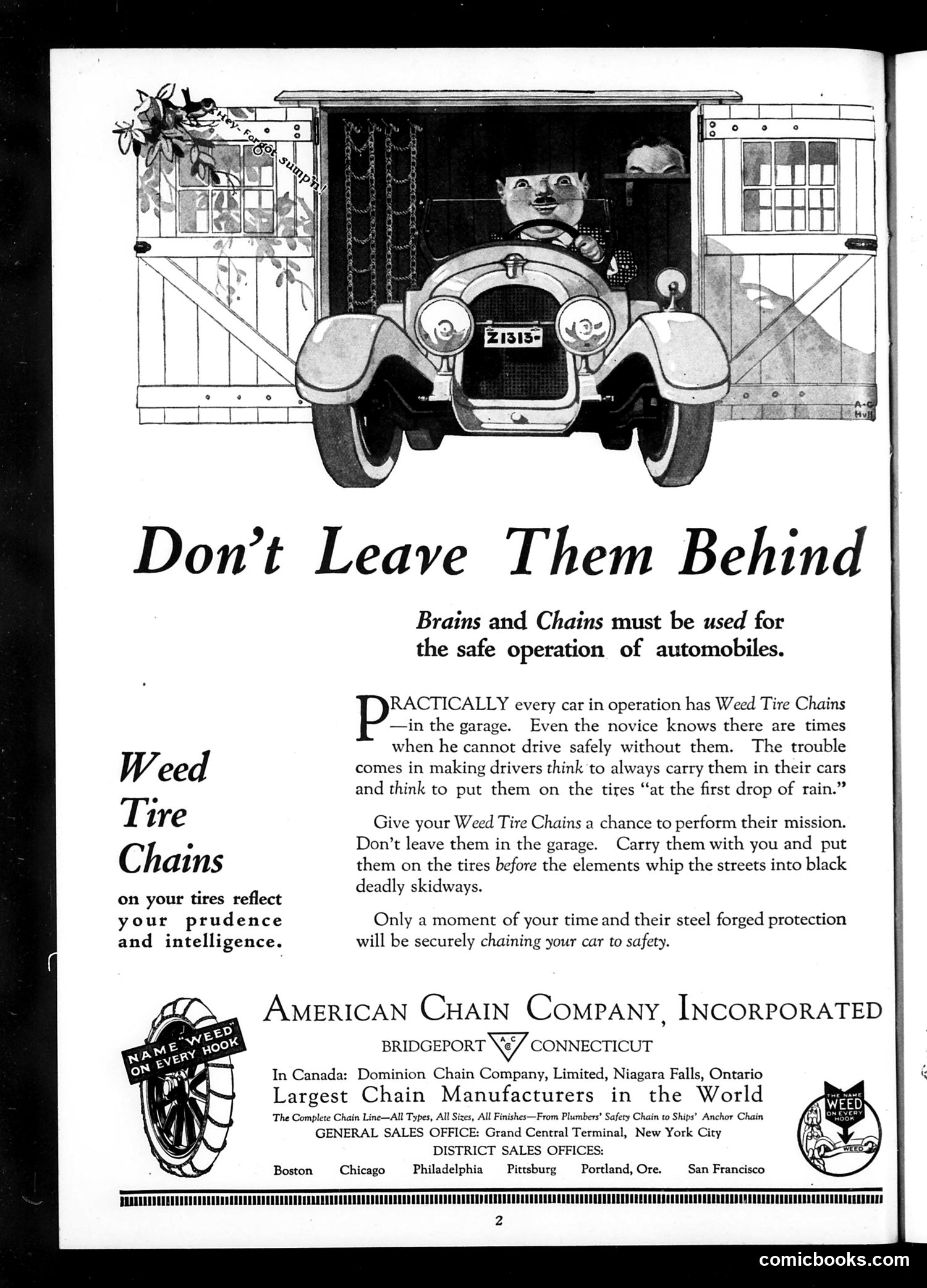
This is primarily a **product advertisement**, not political satire. The American Chain Company promotes Weed Tire Chains, which were essential winter safety equipment for early automobiles. The cartoon depicts a caricatured driver (exaggerated facial features typical of early 20th-century advertising art) departing in his car from a house. The headline "Don't Leave Them Behind" warns drivers not to leave tire chains in the garage. The ad's appeal targets both **prudence and intelligence**—suggesting responsible drivers carry chains. The text emphasizes chains prevent dangerous skidding on wet, icy roads, framing the product as a safety necessity rather than luxury. The multiple sales offices listed indicate this was a major manufacturer of the era. The message reflects genuine automotive safety concerns before modern tire technology existed.
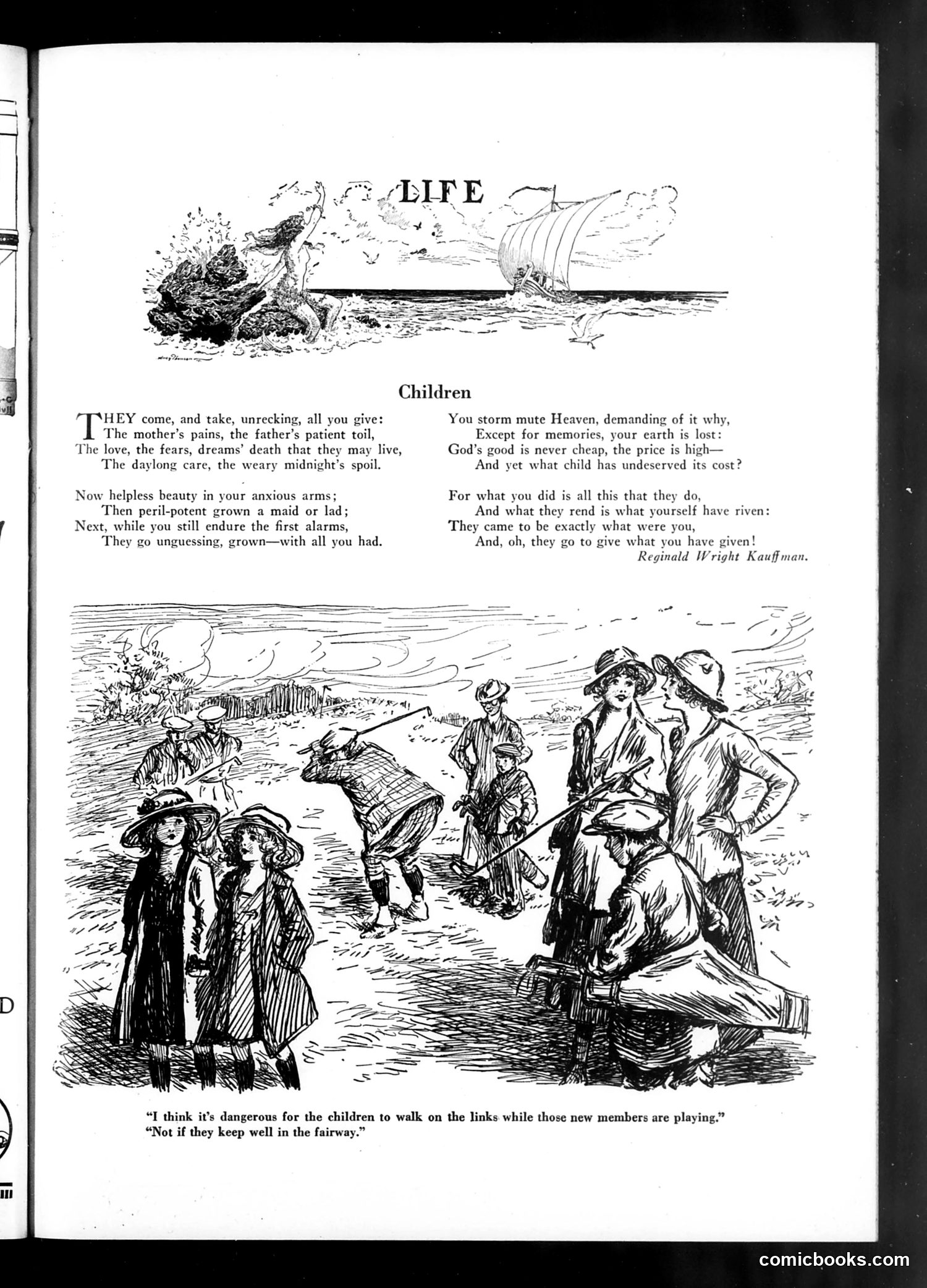
This page features a poem by Reginald Wright Kauffman titled "Children," accompanied by an illustration of adults and children at what appears to be a beach or seaside golf course. The poem reflects late 19th/early 20th-century sentimental attitudes about childhood—addressing how children inherit their parents' anxieties and sacrifices. The concluding dialogue between two figures debating whether children should walk on golf links while "new members are playing" satirizes upper-class recreational concerns and social hierarchies of the era. The satire suggests how privileged adults worried about maintaining exclusive leisure spaces (golf courses) while simultaneously expecting children to navigate these rigid social conventions. The illustration depicts this tension between childhood freedom and adult propriety.
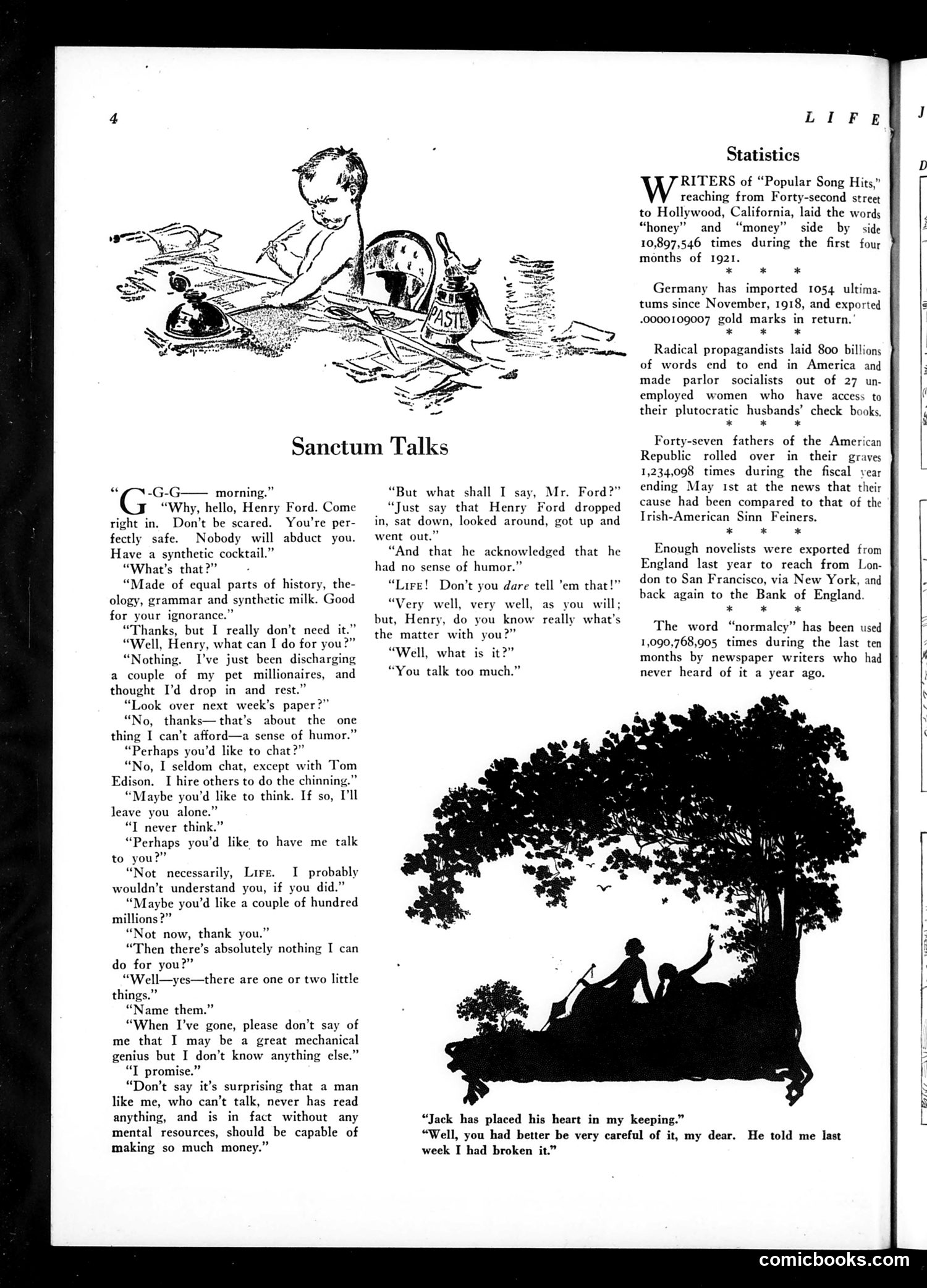
**"Sanctum Talks"** depicts a conversation between Henry Ford and the magazine *Life*, presented as satirical dialogue. Ford appears dismissive and defensive about his lack of knowledge beyond mechanics, declaring he "can't talk" and doesn't read. The joke satirizes Ford's public persona—a brilliant industrialist with limited intellectual interests outside engineering. **Statistics section** contains unrelated brief news items from 1921, including German gold imports and British propaganda efforts. **Bottom illustration** shows a silhouetted couple under a tree with the caption about "Jack" placing his heart in someone's keeping, then breaking it. This appears to be a sentimental romance illustration typical of period magazine content, unrelated to the Ford satire above.
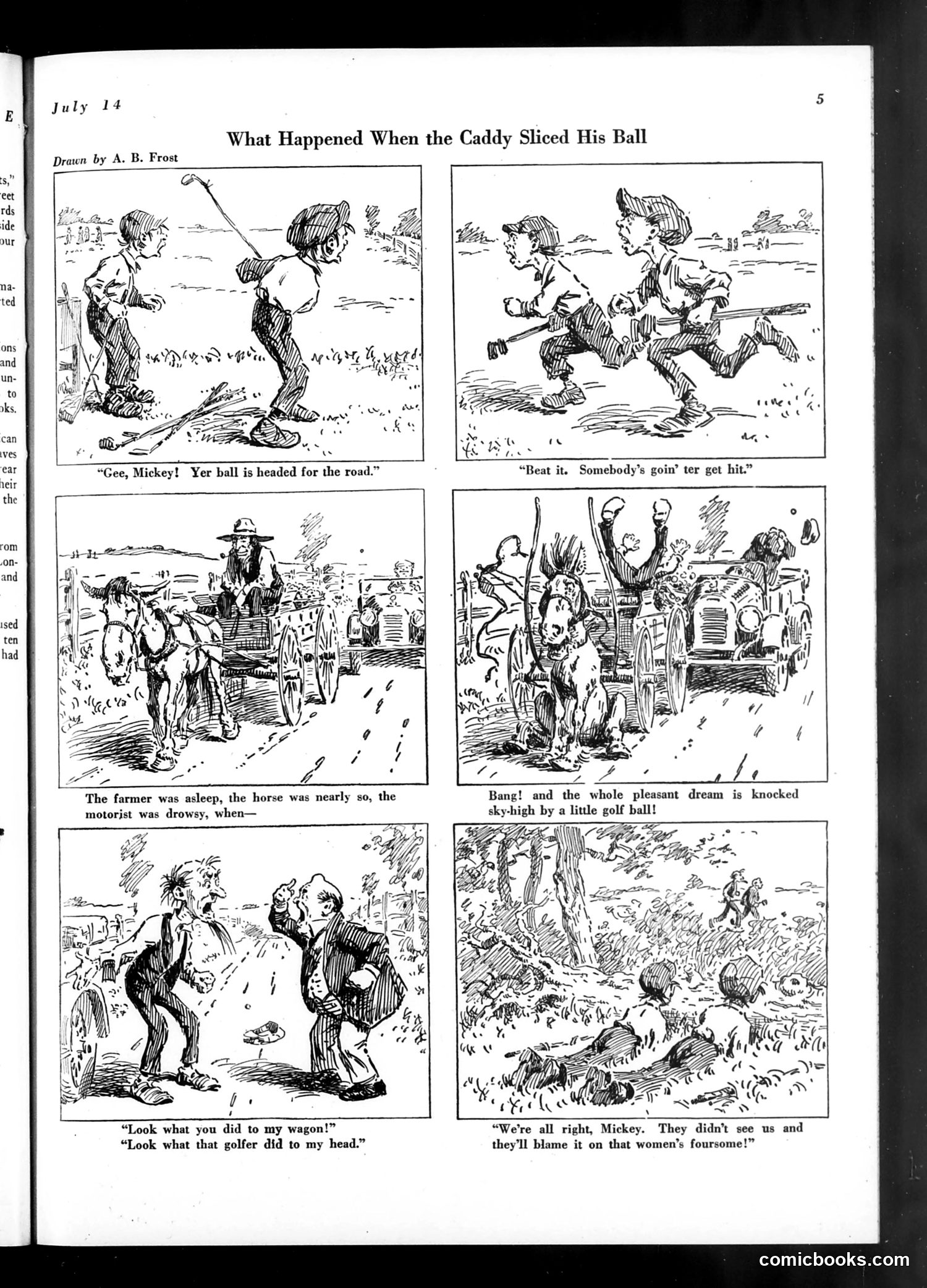
This six-panel comic by A.B. Frost depicts a golf ball's chaotic journey after a poor shot. The narrative follows the errant ball as it: 1. Flies toward the road 2. Attracts children's attention 3. Hits a sleeping farmer, dozing motorist, and horse on a country road 4. Strikes a traveling caravan of automobiles, causing a multi-vehicle collision 5. Results in arguments between the farmer and motorist over blame 6. Leaves the golfers hidden, hoping to avoid responsibility The satire mocks both the emerging automobile culture (early 1900s) and upper-class golf recreation, showing how one careless moment creates cascading chaos affecting working-class rural people. The golfers' escape while others suffer the consequences suggests class-based irresponsibility.
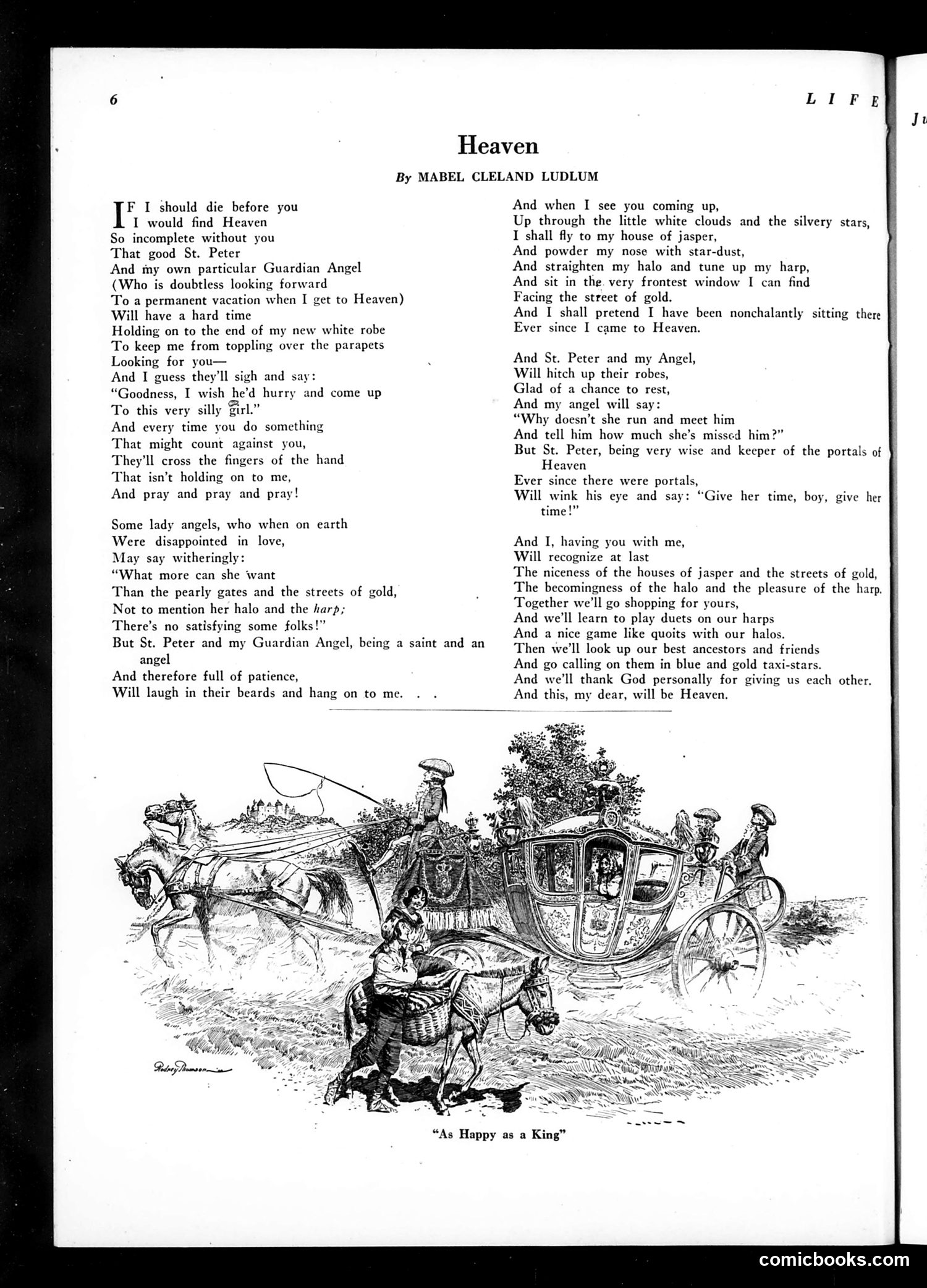
This page features a sentimental poem about dying before the reader and waiting in Heaven, with religious imagery involving St. Peter and Guardian Angels. The poem humorously depicts the speaker's impatience and mischievous behavior in Heaven—powder-dusting her nose, playing harps, and running about—while St. Peter patiently waits for the reader's arrival. The accompanying illustration titled **"As Happy as a King"** shows a whimsical rural scene: a farmer with a donkey cart alongside an ornate horse-drawn carriage. This appears to contrast simple, honest country life against wealthy urbanity—suggesting contentment comes not from riches but from humble living. The image supports the poem's theme of spiritual fulfillment over earthly concerns.
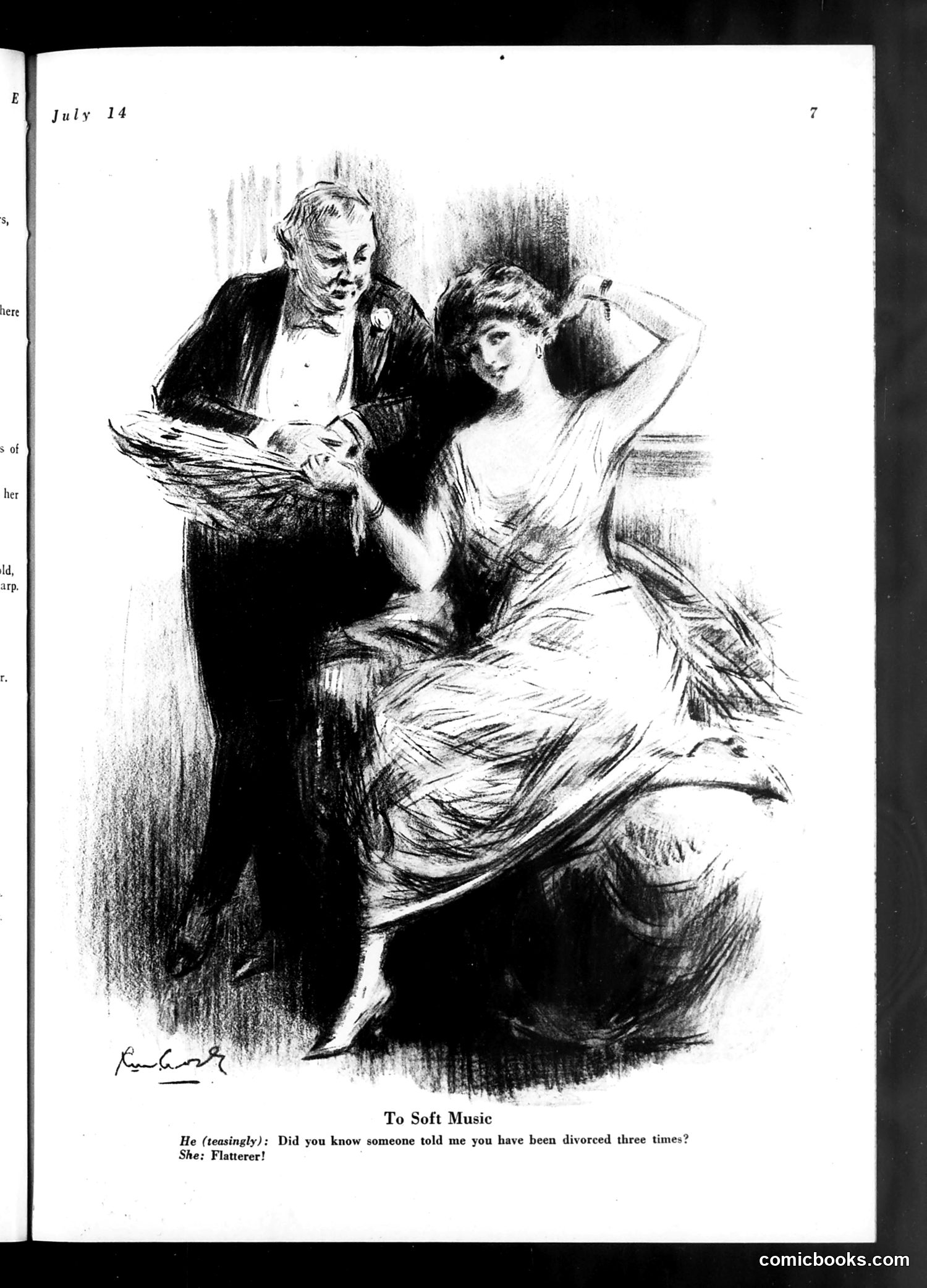
This cartoon satirizes divorce and remarriage in early 20th-century high society. A well-dressed man shows a woman what appears to be a magazine or document while they sit together in an intimate setting. His comment—"Did you know someone told me you have been divorced three times?"—is meant to be flattering rather than critical. Her response, "Flatterer!", suggests she's pleased by the implication that three divorces make her desirable or fashionable. The satire targets the apparent normalization of serial divorce among wealthy society circles, treating multiple divorces as a status symbol or mark of sophistication rather than scandal. The "soft music" in the title suggests romantic seduction, implying that even this questionable marital history doesn't diminish romantic appeal in high society.
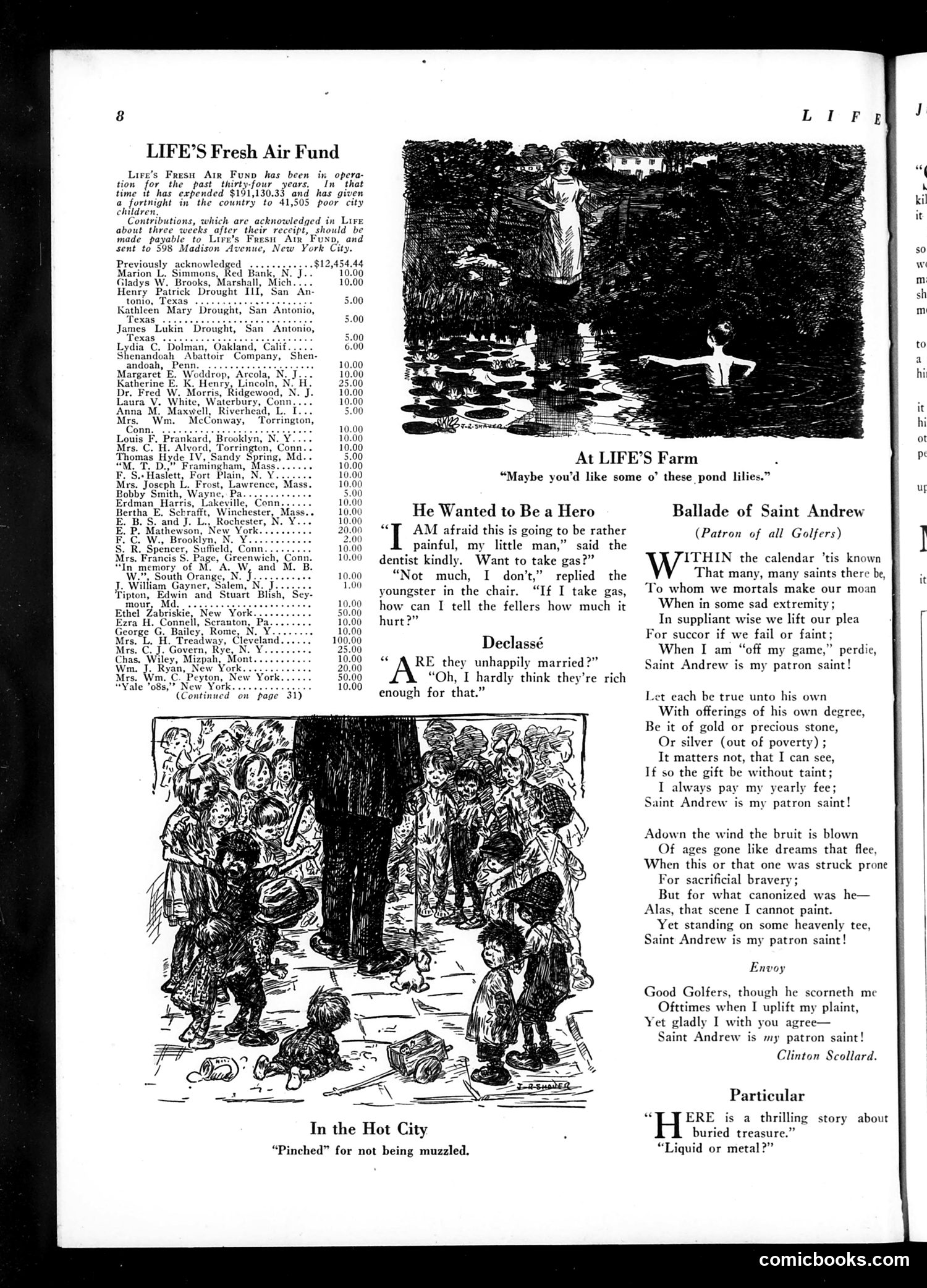
This page contains three distinct pieces: 1. **"LIFE's Fresh Air Fund"** — a charity announcement listing donors who contributed to sending poor city children to the countryside for health benefits. This reflects Progressive Era concerns about urban poverty and child welfare. 2. **"In the Hot City"** — a cartoon depicting crowded tenement life with the caption "Pinched" for not being muzzled." This satirizes urban overcrowding and possibly references muzzling laws or restrictions on dogs in poor neighborhoods — commenting on how densely packed and harsh conditions were for residents. 3. **Literary content** — including "He Wanted to Be a Hero" (a humorous anecdote about dentistry) and "Ballad of Saint Andrew" (poetry about a patron saint of golfers). The page reflects early 20th-century American concerns with urban reform and charitable causes.
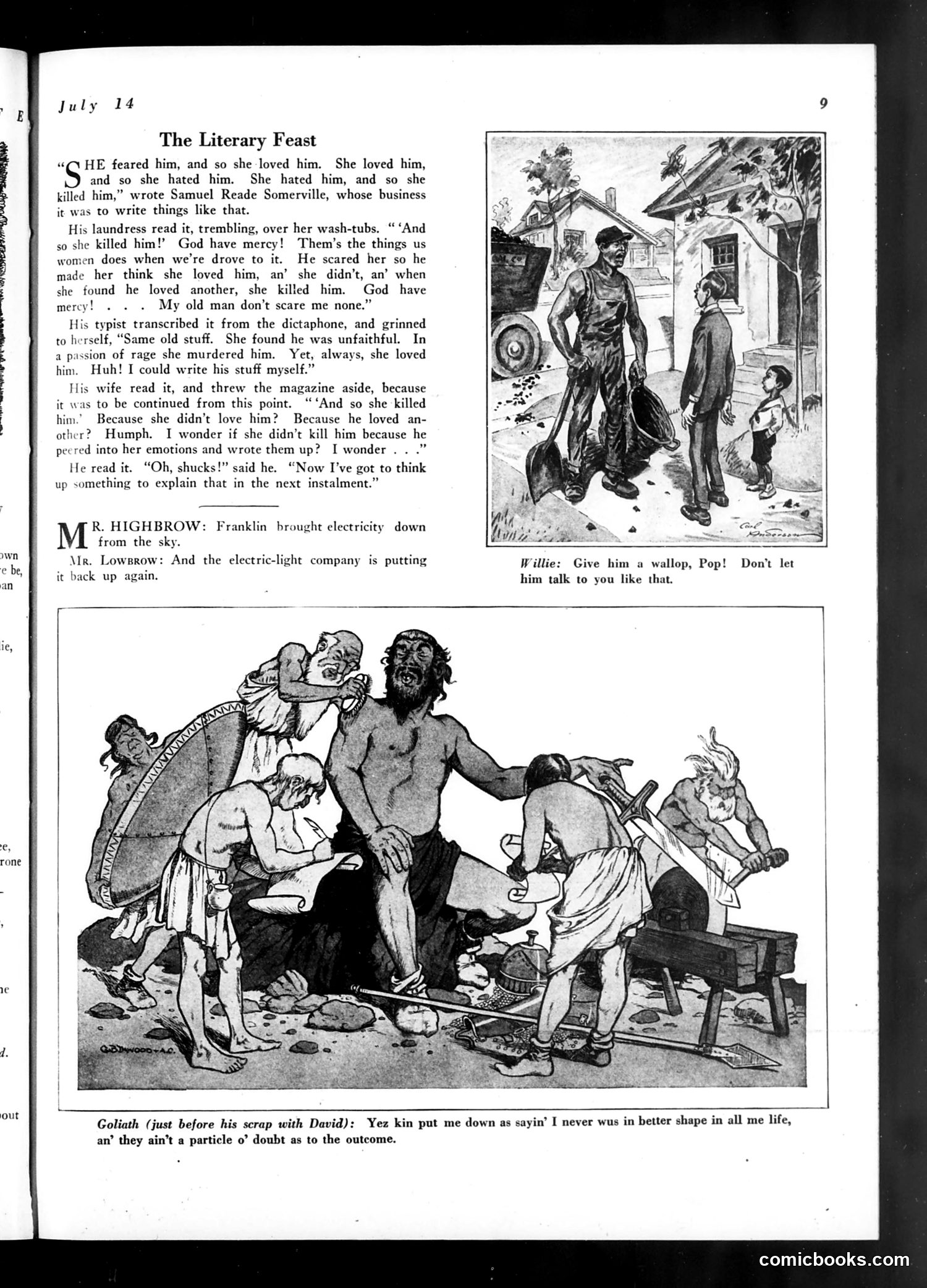
**Upper Section - "The Literary Feast":** This satirizes Samuel Reade Somerville's writing about domestic violence. The text humorously quotes a laundress's reaction to his work, suggesting his stories describe women killing unfaithful husbands. The small illustration shows a domestic scene, likely depicting the violent scenario being discussed. **Lower Section - Goliath Cartoon:** This biblical parody shows Goliath surrounded by women and children, with text claiming he's "never in better shape" and expresses doubt about David's victory. The satire appears to mock either contemporary political/social figures or general attitudes about strength and power, though the specific target remains unclear from the image alone. Both pieces use exaggeration and irony for comedic effect typical of early 20th-century satirical journalism.
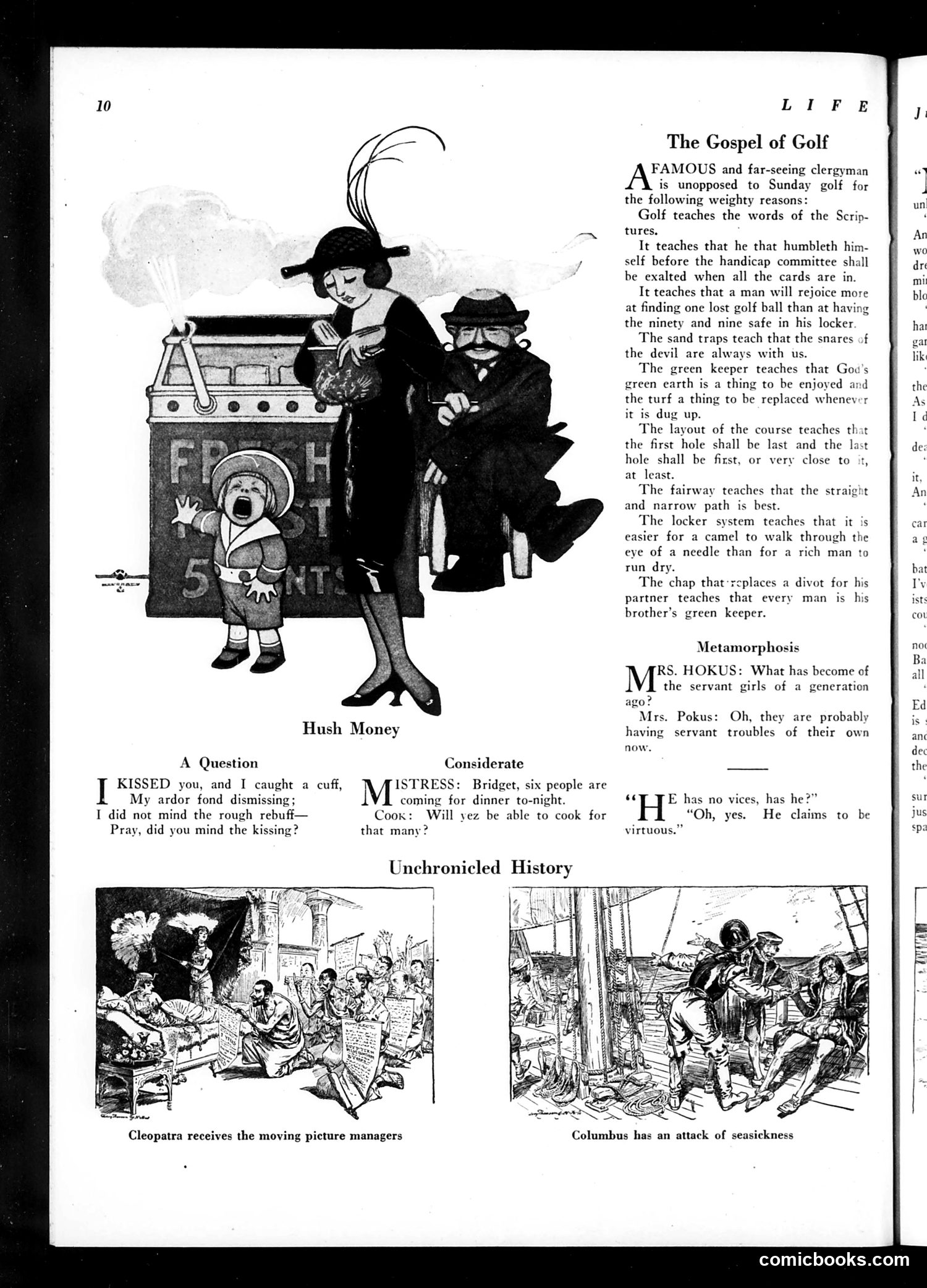
This page contains several unrelated satirical pieces typical of early 20th-century Life magazine humor. **"The Gospel of Golf"** mocks the religious reverence Americans had developed for golf, treating the sport's etiquette and rules as sacred scripture. The piece satirizes how golf culture had become almost a substitute religion for the upper classes. **"Hush Money,"** "A Question," and "Considerate"** are brief humorous snippets—likely domestic or social comedy. **"Metamorphosis"** presents a short dialogue joke about servant girls' changed circumstances. **"Unchronicled History"** offers two cartoon panels providing absurdist reimaginings of historical events: Cleopatra entertaining "moving picture managers" and Columbus experiencing seasickness—anachronistic humor inserting modern concerns (film industry, modern ailments) into history. The overall tone is light, society-focused satire aimed at educated readers.
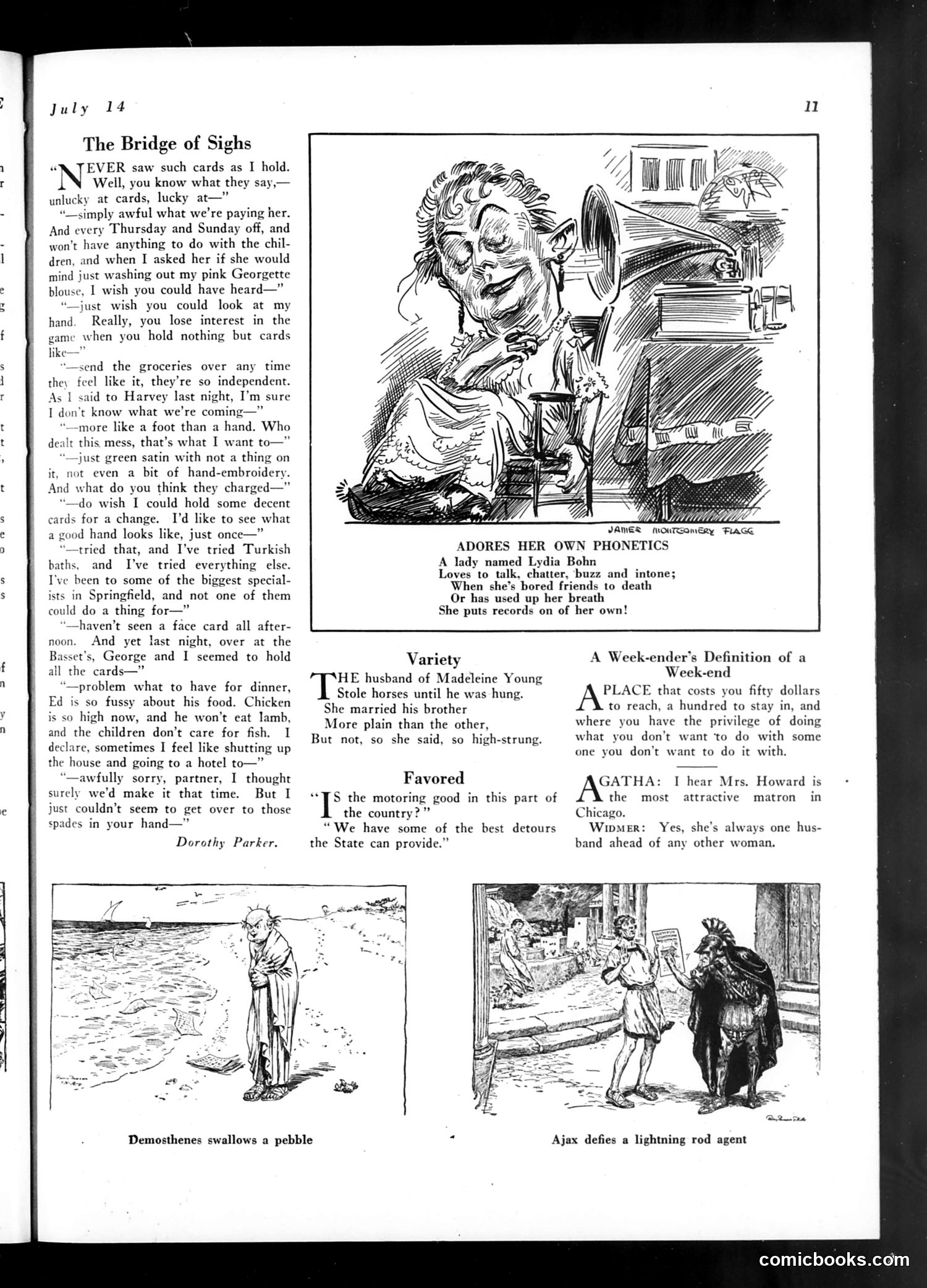
This page contains satirical commentary and humorous sketches typical of Life magazine's social satire. **"The Bridge of Sighs"** is a column by Dorothy Parker critiquing upper-class domestic life, particularly women's complaints about card games, grocery shopping independence, and marital dissatisfaction. The accompanying caricature shows a woman at a phonograph, with the caption "Adores Her Own Phonetics"—mocking a woman named Lydia Bohn for her affected, self-absorbed manner of speaking. The bottom illustrations appear to be classical references: "Demosthenes swallows a pebble" and "Ajax defies a lightning rod agent" are humorous modern reinterpretations of historical/mythological figures, using anachronistic situations (a lightning rod agent) for comedic effect. The "Variety" and "Favored" sections contain brief social observations and witticisms about upper-class leisure activities and marital dynamics.
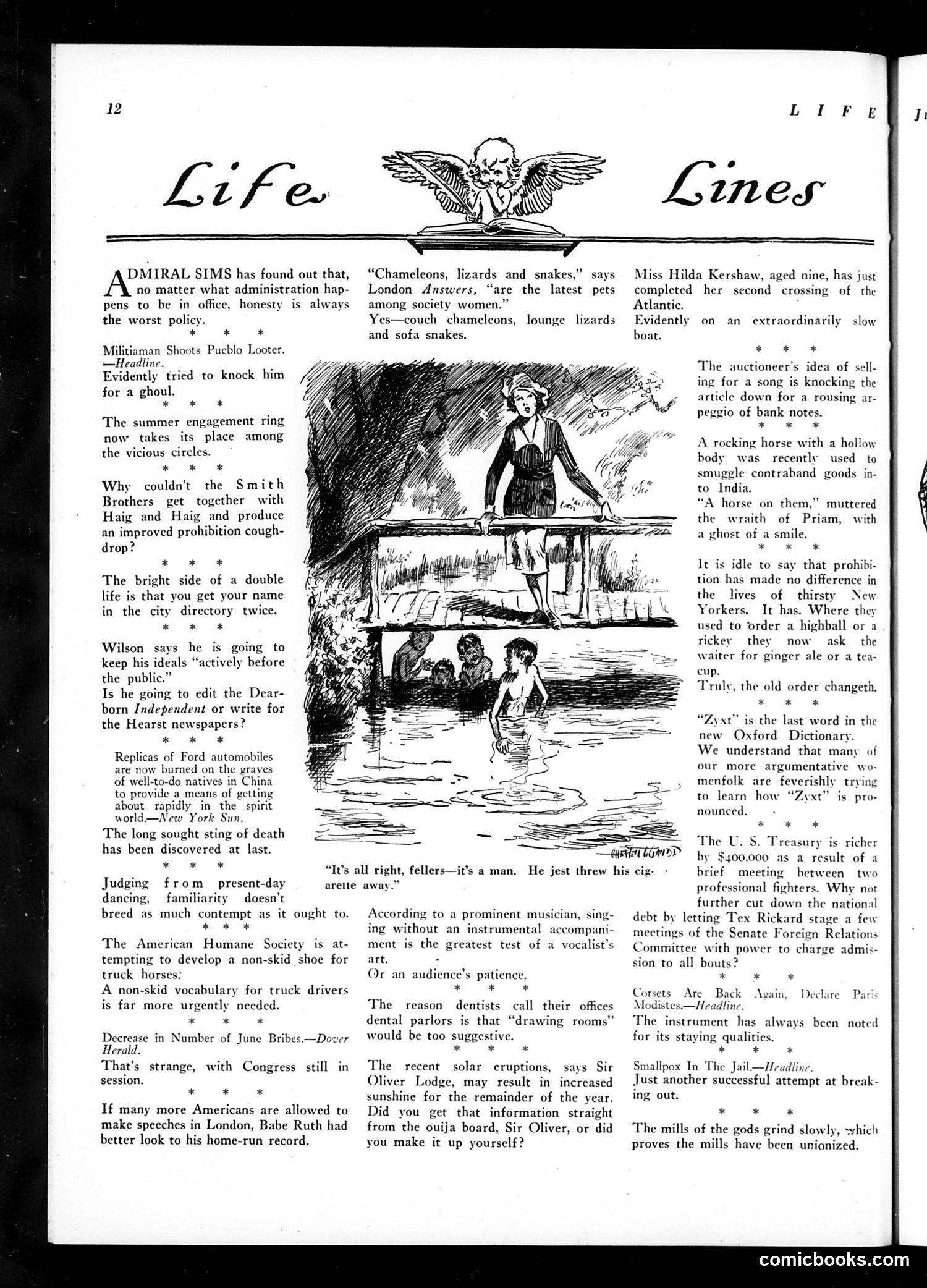
This is a "Life Lines" humor column page featuring short satirical quips and a central illustration. The cartoon depicts a man in water surrounded by others, with the caption: "It's all right, fellows—it's a man. He just threw his cigar-ette away." The joke satirizes early 20th-century concerns about litter and smoking habits—the implication being that discarding a cigarette into water was noteworthy enough to identify the person as human rather than an animal. The surrounding text contains various one-liner jokes mocking Prohibition's ineffectiveness, the Ford automobile industry, the humane treatment of horses, and social pretensions. The overall tone reflects 1920s-era American satirical commentary on contemporary politics, consumer culture, and social hypocrisy.
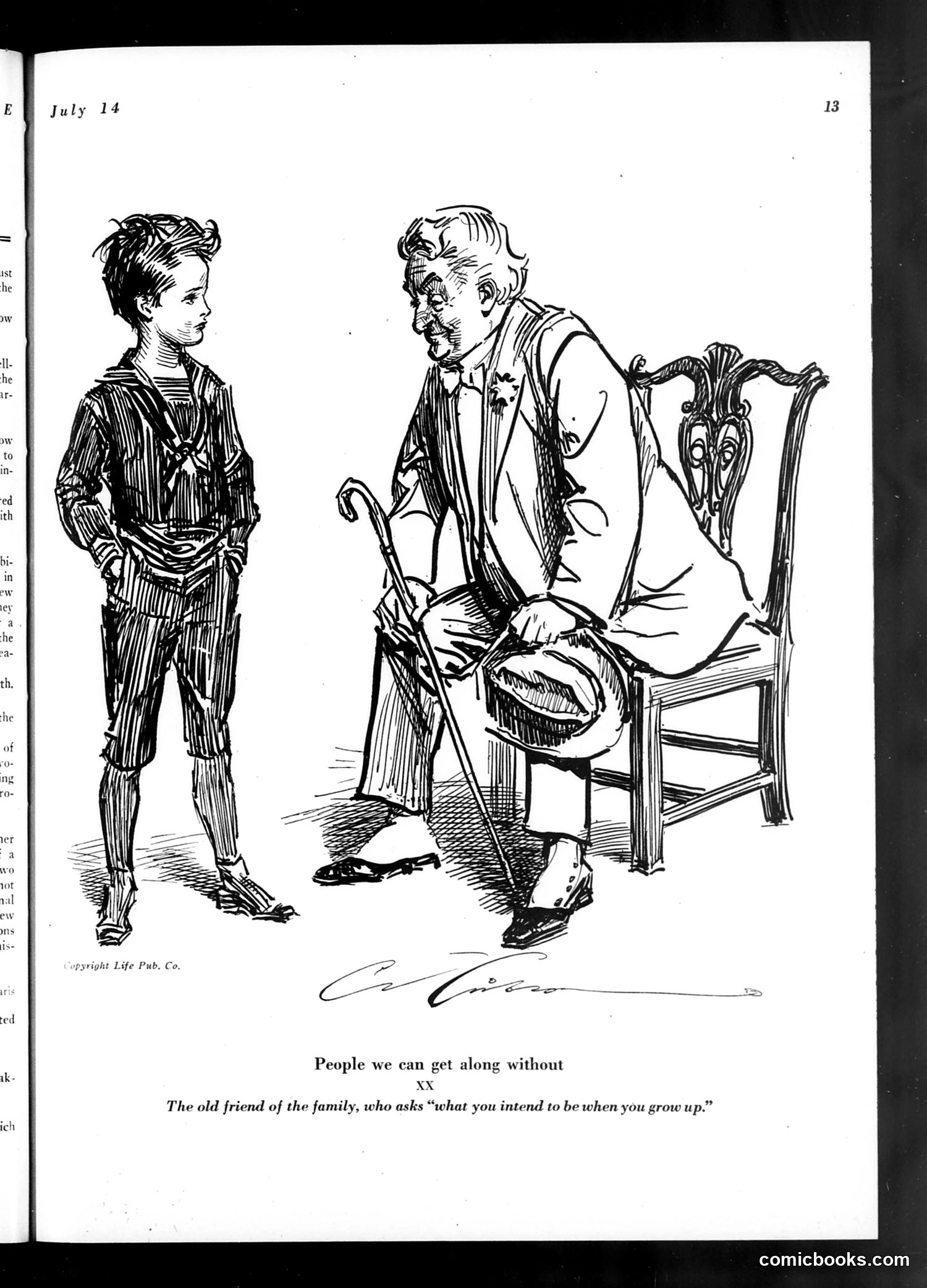
This is a satirical illustration titled "People we can get along without" (item XX), subtitled "The old friend of the family, who asks 'what you intend to be when you grow up.'" The cartoon depicts two figures: a young boy in striped clothing standing stiffly on the left, and an elderly gentleman seated on the right, leaning forward with an intrusive expression while holding a cane. The satire targets a common social irritant—the well-meaning but bothersome adult relative or family friend who asks children predictable, uncomfortable questions about their future plans. The humor relies on recognizing this as a universal, mildly annoying social interaction. The boy's stiff posture suggests discomfort with the intrusive questioning, while the old man's animated gestures emphasize his obliviousness to being unwelcome. The satire gently mocks both generational condescension and awkward family social dynamics.
This page discusses contemporary political figures and events. The text references **Lloyd George** (British Prime Minister) inviting **De Valera** (Irish independence leader) to a London peace conference on Irish independence. It also mentions **General Smuts** of South Africa as a respected figure within the British Empire. The satirical commentary critiques the **National Reformers** and references a **Dempsey-Carpenter fight** (a famous 1921 boxing match that diverted public attention). The article suggests that while interesting political developments occur, the public's attention gets diverted to sporting events instead. The small cartoon illustrations appear to depict casual figures, though their specific identities are unclear from the image alone. The overall tone mocks public distraction from serious political matters.
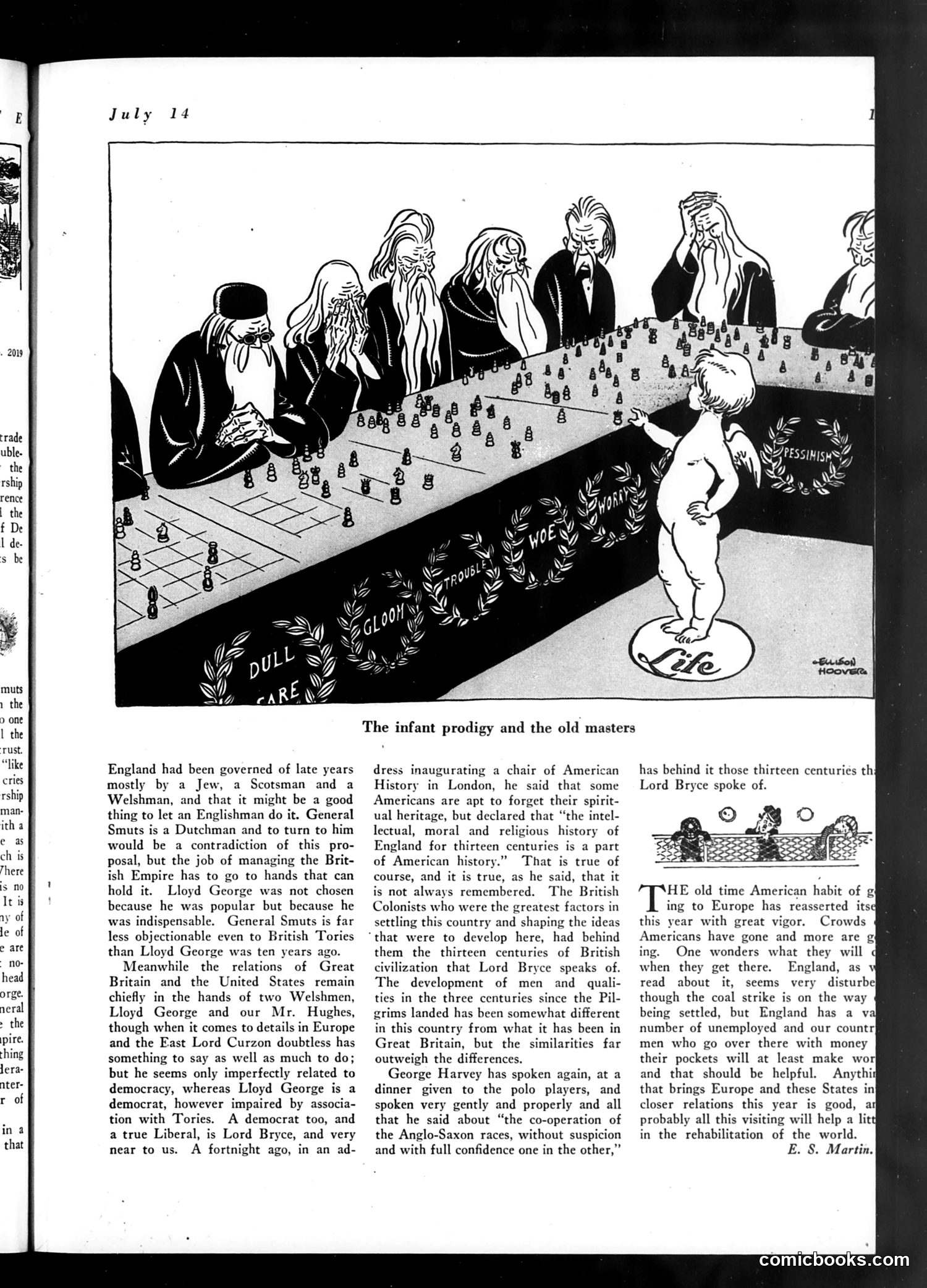
This cartoon satirizes post-WWI Anglo-American relations and generational conflict. The "old masters" are elderly British statesmen seated at a chess table labeled with phrases like "dull care" and "gloom"—representing establishment figures like Lloyd George and Lord Curzon mentioned in the text. The "infant prodigy" (labeled "Life") is a naked cherub observing their game, symbolizing American youth and vitality. The accompanying article criticizes British governance by non-English figures (Lloyd George, a Welshman; others of Jewish/Scottish origin) while praising Anglo-Saxon cultural heritage shared between Britain and America. The satirical point: aging British leadership appears paralyzed by caution and tradition, while energetic America ("the infant") watches with fresh perspective. The text references American tourists and investments arriving in post-war Britain, suggesting American vigor might revitalize the weary old empire.
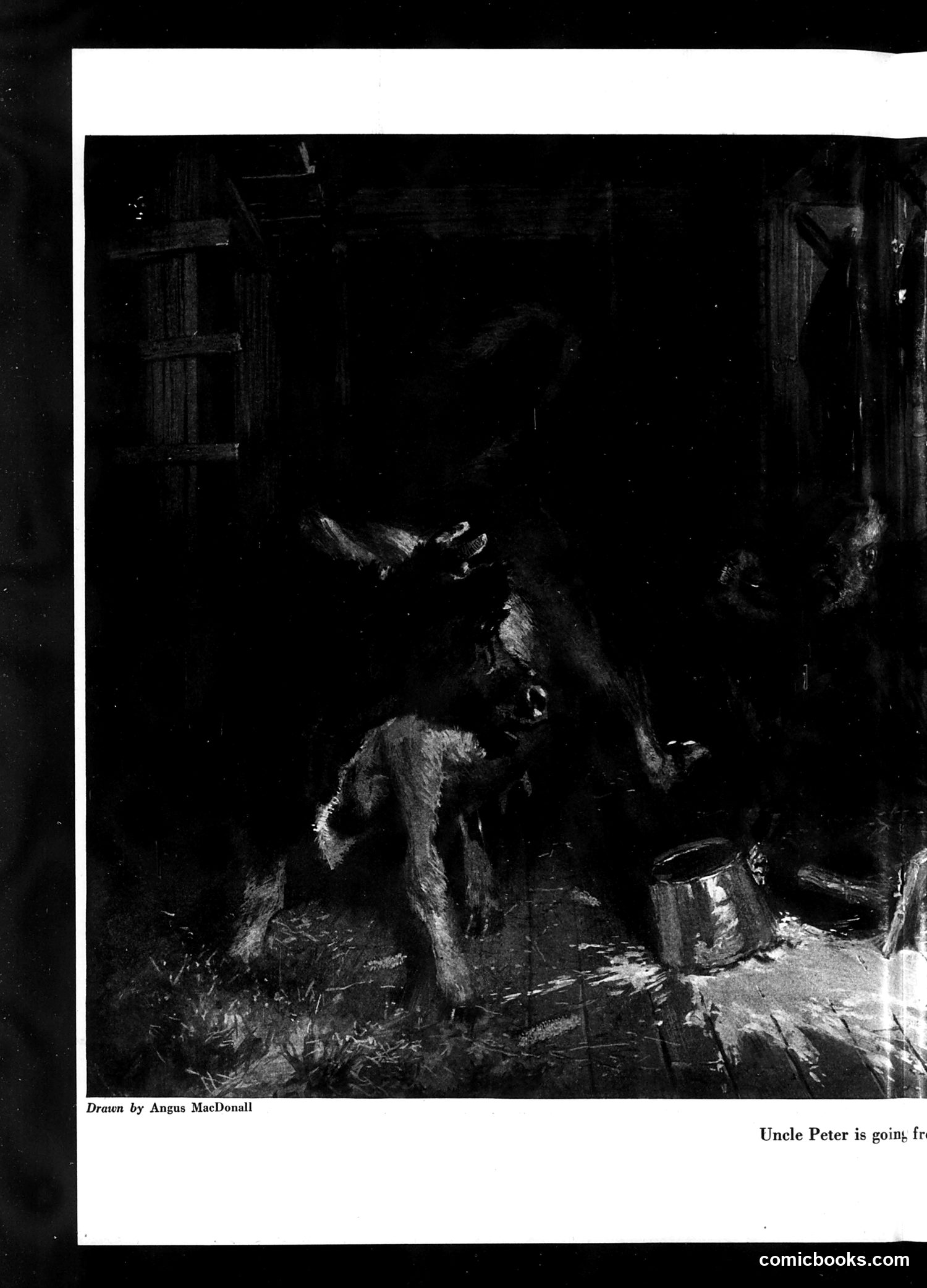
This appears to be an illustration by Angus MacDonall from Life magazine, though the image quality and partial OCR text make definitive interpretation difficult. The dark, sketchy drawing shows what appear to be figures in an interior setting with wooden structural elements visible. The caption fragment "Uncle Peter is going fr[om]..." is incomplete, preventing full understanding of the satirical point. Without the complete caption or clearer image resolution, I cannot confidently identify which historical or political figures are depicted or what specific event or social commentary is being referenced. The artistic style and presentation suggest this is meant as satirical commentary typical of Life magazine's content, but specifics remain unclear from this page fragment.
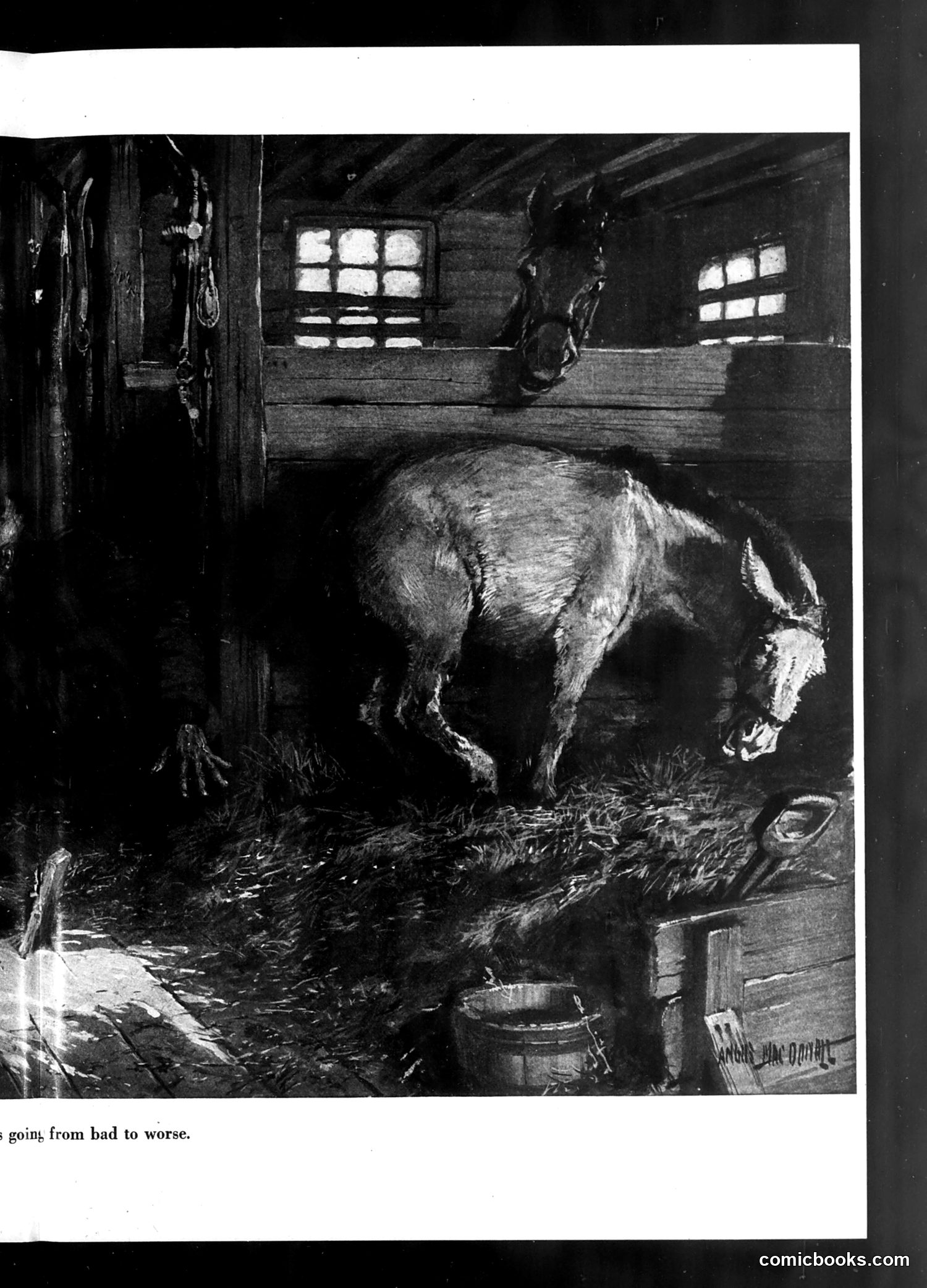
This appears to be a black and white photograph rather than a cartoon, showing the interior of a barn or stable. A goat stands in the foreground eating hay or straw, with saddles and tack visible on the walls, and other horses in the background through windows. The caption reads "going from bad to worse," suggesting this is visual commentary on deteriorating conditions—likely economic hardship during a recession or depression era when people resorted to keeping livestock in poor conditions out of necessity. Without additional context or publication date visible, I cannot identify the specific historical moment being referenced, though the photograph's style suggests early-to-mid 20th century. The satire appears to comment on rural poverty or agricultural crisis through documentary photography rather than drawn caricature.
This is a theater review by Robert C. Benchley praising the Ziegfeld Follies production. The article celebrates modern theatrical spectacle—elaborate sets, costumes, and choreography—while gently mocking certain performance conventions. **Key references:** - **Ziegfeld Follies**: The famous revue known for extravagant production numbers - **Ben Ali Haggin tableaux**: Elaborate, posed scenic tableaux (living pictures), which Benchley criticizes as overly "hammy" and artificial—reminiscent of old-fashioned "living pictures" theater - **W.C. Fields and Raymond Hitchcock**: Comedians performing in the production - **"The Birthday of the Dauphin"**: A specific elaborate number the reviewer uses as an example The satire targets the excessive, static nature of spectacular staging numbers—particularly those featuring chorus girls dressed as flowers offering themselves "to the Queen Bee." Benchley finds these lengthy, visually stunning but narratively pointless sequences tedious, though he acknowledges their technical achievement. His complaint about Ben Ali Haggin's work suggests overly theatrical, posed artificiality rather than genuine entertainment.
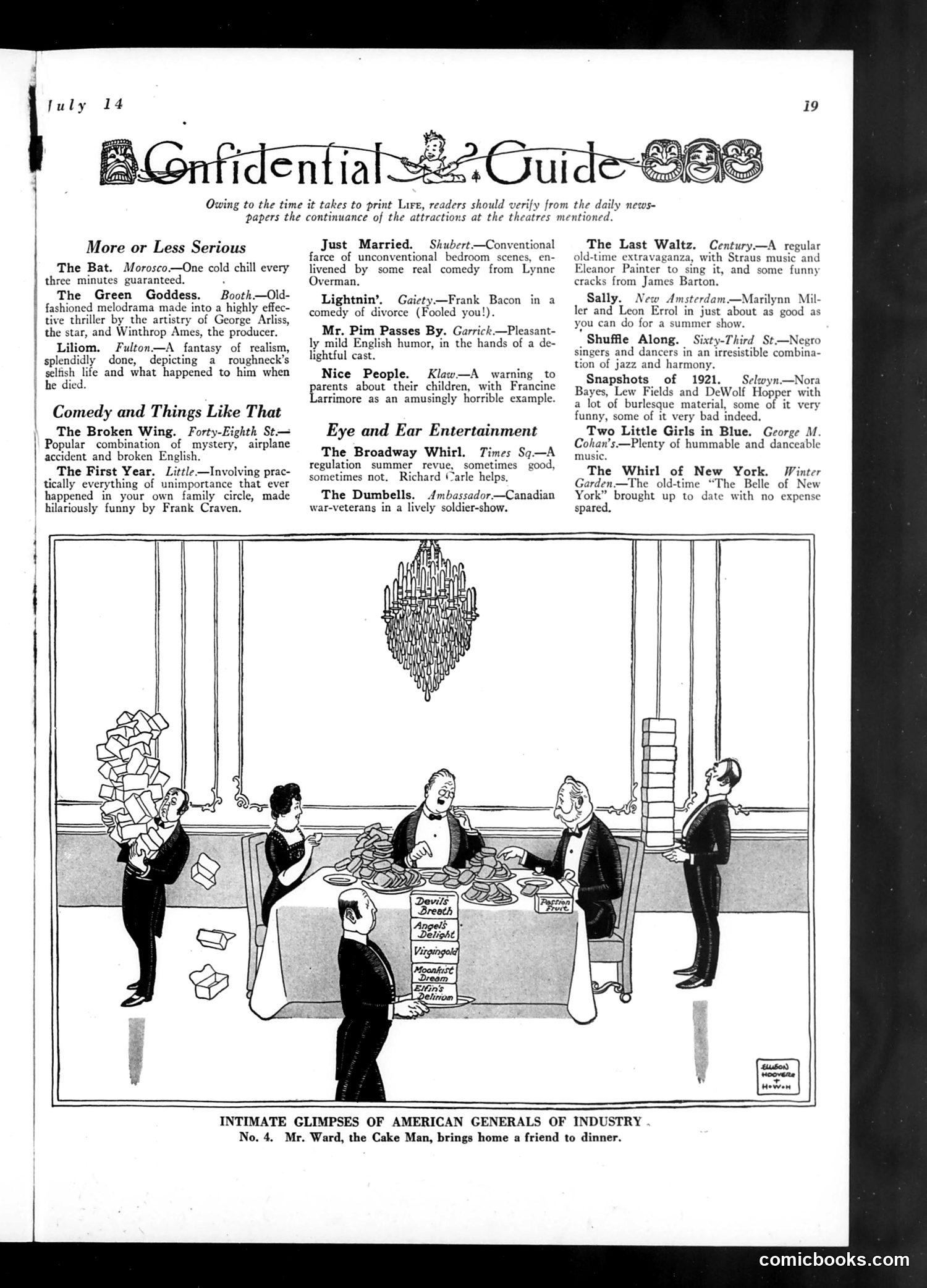
This page from *Life* magazine (dated July 14, appears to be 1921) contains theatre reviews and one cartoon titled "Intimate Glimpses of American Generals of Industry." The cartoon satirizes wealthy industrialists' conspicuous consumption. It depicts "Mr. Ward, the Cake Man" (likely a reference to a real wealthy businessman of the era) hosting a dinner where an elaborate multi-course meal is spread before guests. The exaggerated abundance—with servants holding towering stacks of dishes and food labels visible on the table—mocks the ostentatious displays of wealth by wealthy "captains of industry" during the Gilded Age/Jazz Age. The humor lies in the contrast between the guest's bewildered expression and the absurd excess surrounding him, satirizing both the wastefulness and the social pretension of the ultra-wealthy showing off their prosperity. The page's upper section simply lists current Broadway theatrical productions with brief critical descriptions—standard entertainment journalism of the period.
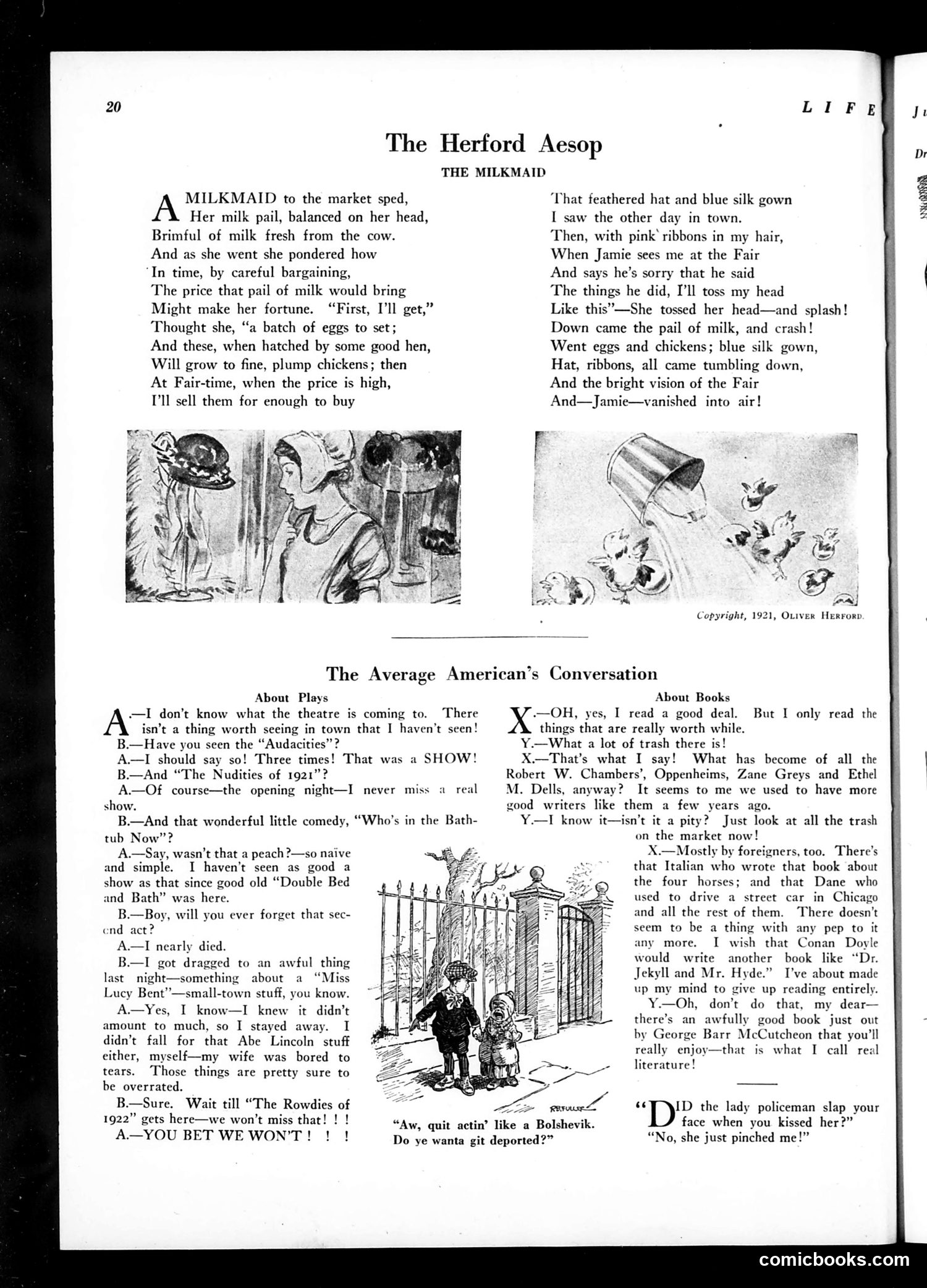
**"The Milkmaid"** illustrates Aesop's classical fable about counting chickens before they hatch. The milkmaid daydreams of selling milk for eggs, raising chickens, and buying fancy clothes to impress "Jamie" at the fair. Her distraction causes her to spill the milk, destroying her imagined fortune. The moral: idle fantasizing about future gains can cause you to lose what you already have. **"The Average American's Conversation"** satirizes shallow, pretentious talk about theater and books. Characters boast they've seen shows without remembering details, dismiss serious literature as "trash," and complain that old popular authors (Chambers, Zane Grey) no longer write. The satire targets Americans who claim cultural sophistication while admitting they avoid genuine art—preferring light entertainment and nostalgia over actual engagement with literature and theater.
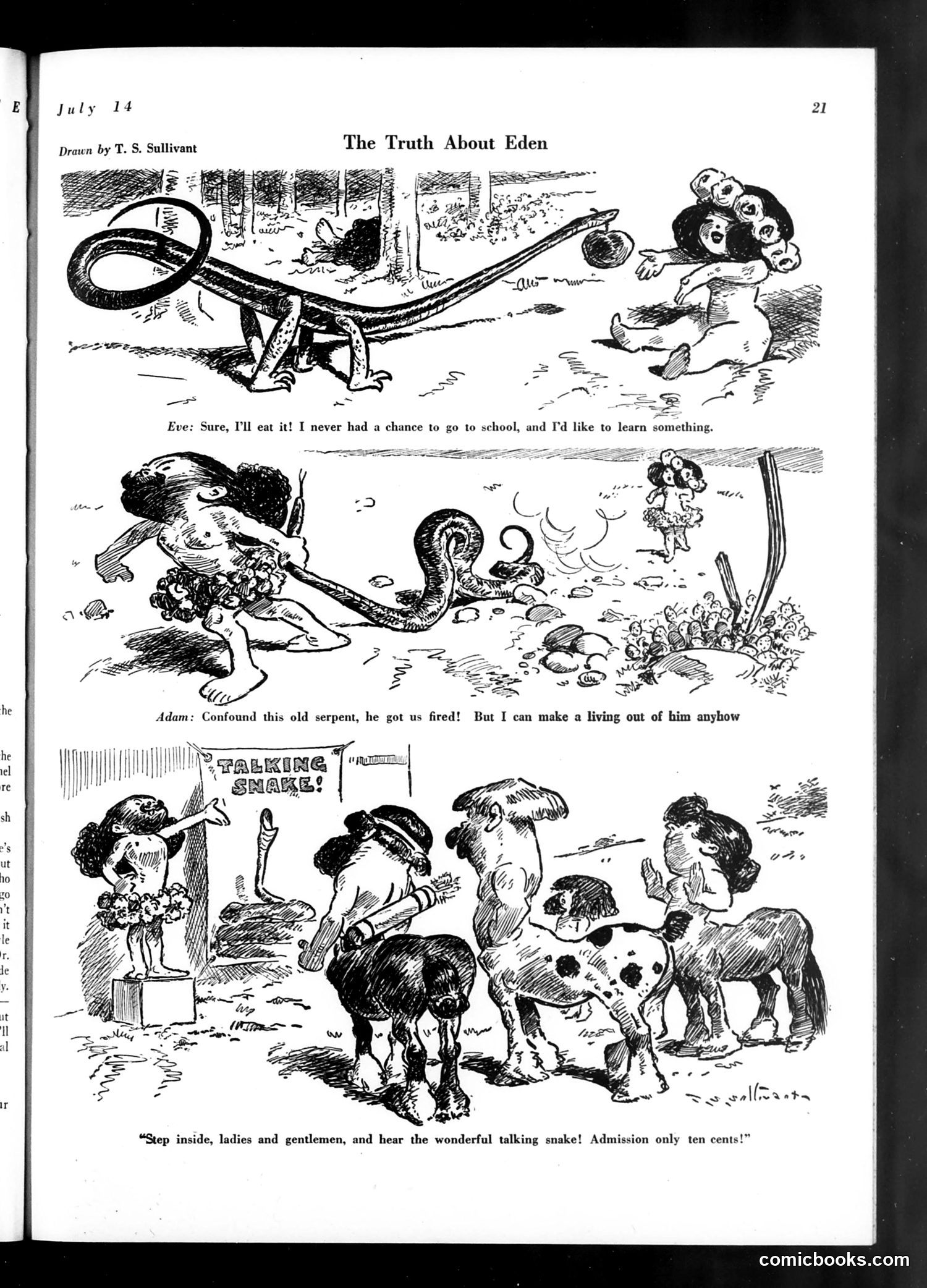
This three-panel comic satirizes the Adam and Eve creation myth. In the first panel, Eve naively accepts the serpent's offer of forbidden fruit for education. In the second, Adam curses the serpent for getting them expelled from Eden but then has an opportunistic idea. The final panel shows Adam has turned the talking snake into a carnival attraction, charging admission to gawk at it—transforming divine punishment into profit. The satire targets American entrepreneurship and hucksterism: even after catastrophic failure, Adam immediately monetizes the source of his downfall. It's a commentary on how quickly people exploit novelty for commercial gain, turning sacred narrative into cheap spectacle.
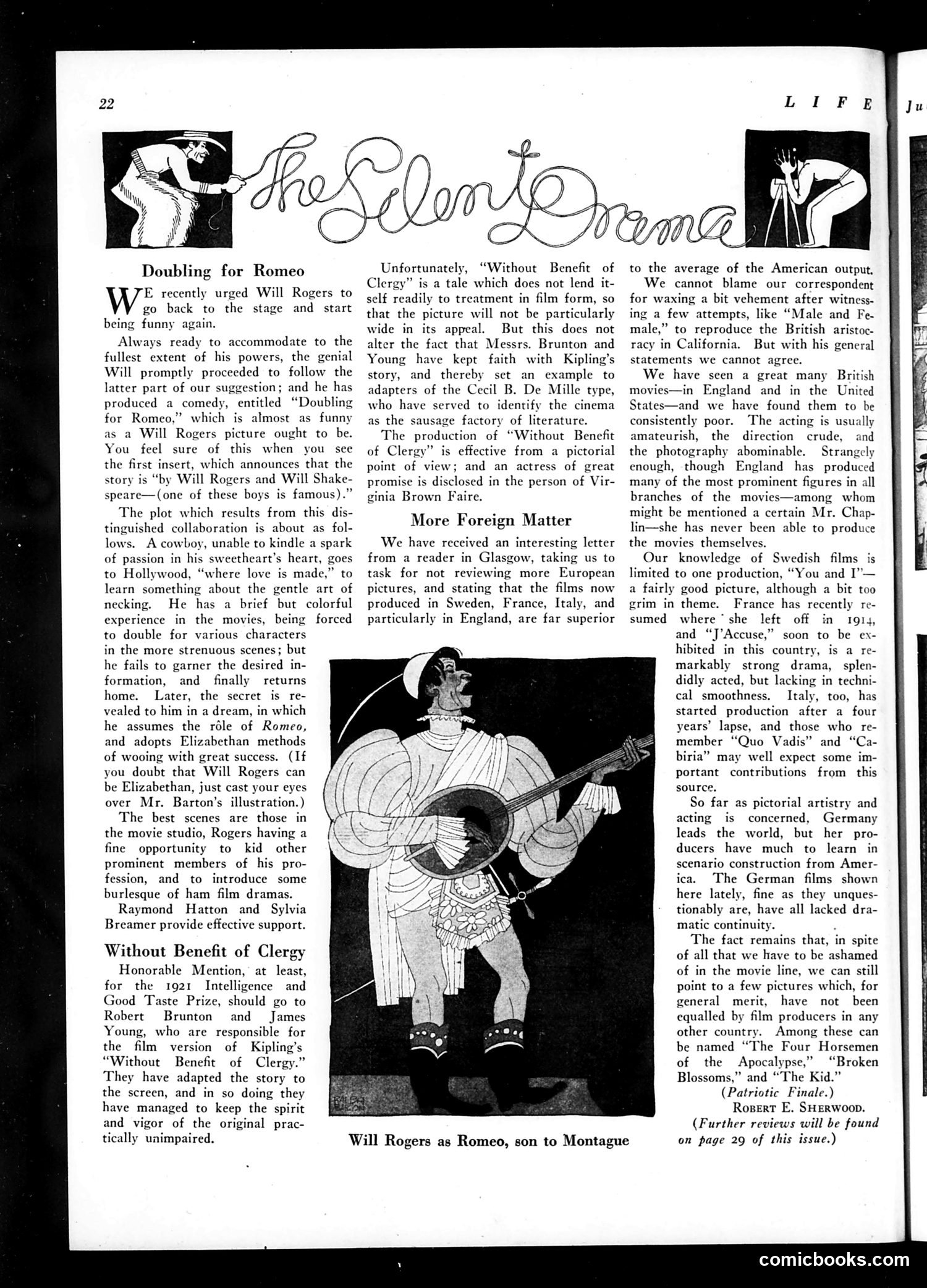
This page reviews Will Rogers' 1921 comedy film "Doubling for Romeo." The illustration shows Rogers in Elizabethan costume as Romeo, satirizing the film's premise: a cowboy goes to Hollywood to learn romance techniques, works as a stunt double in various movie scenes, then dreams himself into Shakespeare's famous role. The satire works on two levels: Rogers himself was known for stage comedy, so the article jokes that he'd "stopped being funny" in films—calling him back to theaters. The film's title credits to "Will Shakespeare—(one of these boys is famous)" mock pretentious literary adaptations, suggesting Rogers' version is frivolous compared to the Bard's original. The page also critiques British and European films, dismissing British productions as "consistently poor" despite their famous actors like Chaplin, while acknowledging superior European cinema's technical sophistication compared to American output.
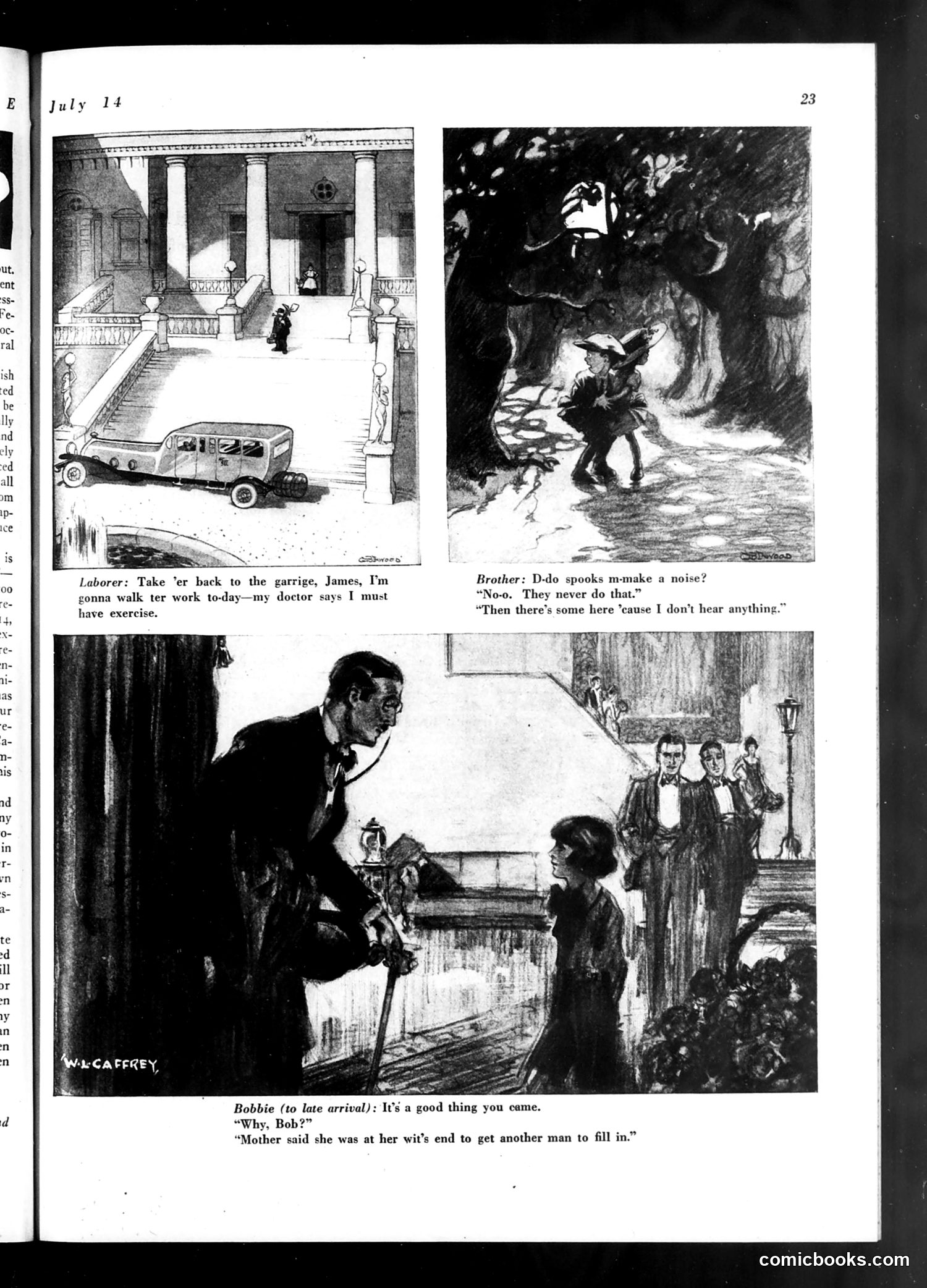
This page contains three separate comic vignettes satirizing early 20th-century social attitudes: **Top left**: A laborer's doctor prescribes walking for exercise, so he directs his chauffeur to return the car to the garage. The joke mocks the absurdity of wealthy people following medical advice while maintaining their luxuries—he'll "walk to work" but apparently still employs a driver. **Top right**: Two figures discuss whether ghosts make noise in what appears to be a spooky setting. The humor lies in the brother's illogical reasoning: since he hears nothing, there must be ghosts present (rather than concluding ghosts simply aren't there). **Bottom**: A man arriving late to what appears to be a formal gathering is welcomed because the hostess needed "another man to fill in." The satire targets upper-class social conventions where guest lists matter more than genuine connection, and women's dependence on securing male attendance for respectability. All three jokes reflect period anxieties about class pretension, superstition, and rigid social protocols.
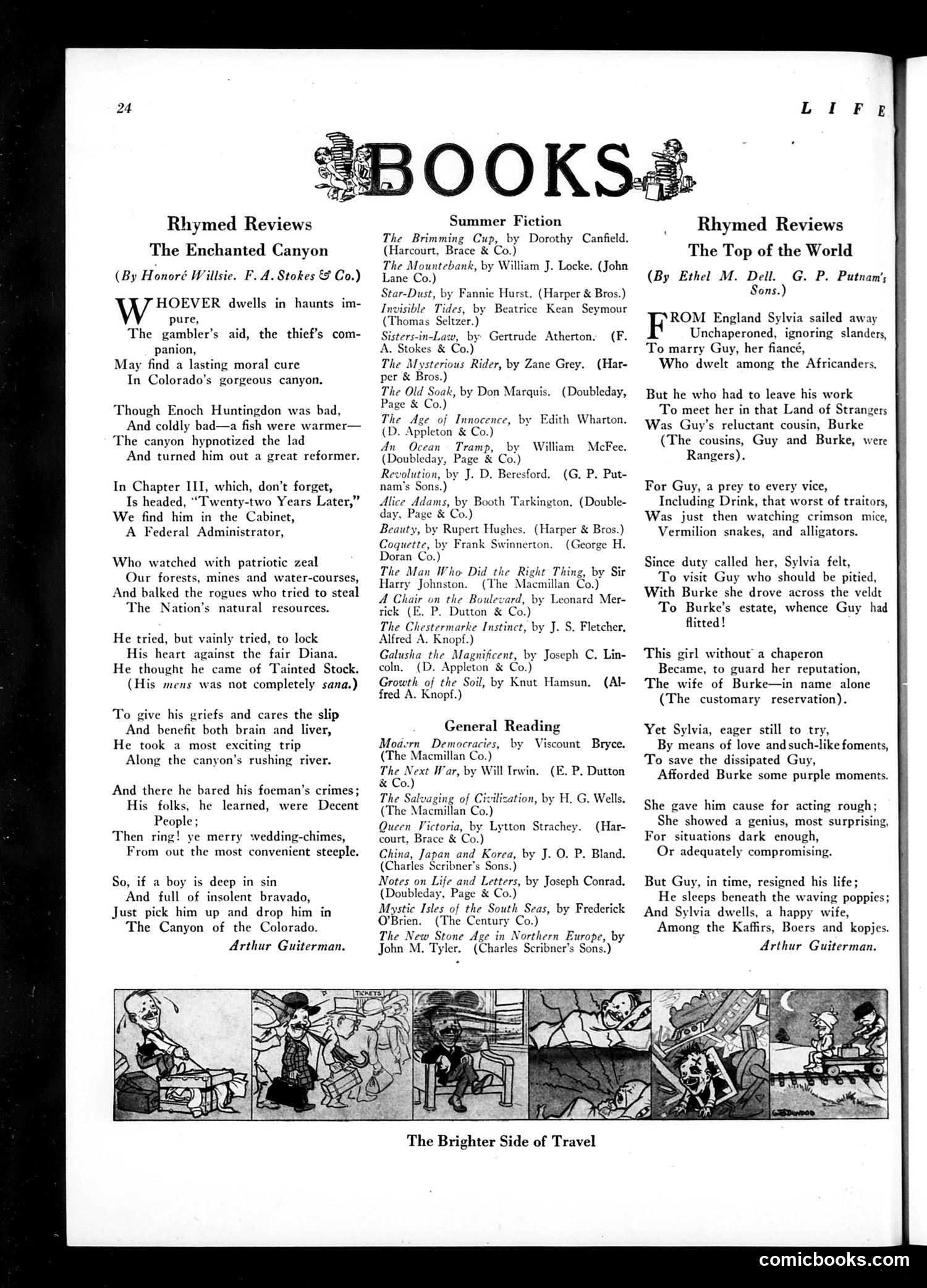
This page from *Life* magazine presents book reviews in two formats: serious rhymed poetry critiques and satirical commentary on popular fiction. **"The Enchanted Canyon"** reviews a moral redemption tale where a corrupt man named Enoch Huntingdon transforms after visiting Colorado's Grand Canyon. The reviewer mocks the melodramatic plot: a "tainted" man becomes a reformer, falls for a woman named Diana, discovers his family is actually respectable, and marries conveniently. The closing couplet sarcastically suggests simply dropping corrupt boys into the canyon as a cure-all solution. **"The Top of the World"** satirizes romantic adventure fiction. A woman travels unchaperoned to Africa to marry her fiancé Guy, who's now drinking and hallucinating exotic animals. She instead marries his cousin Burke "in name alone" for propriety—mocking the era's absurd conventions where even fake marriage supposedly protects a woman's reputation. Both reviews lampoon popular literature's implausible plotting, moralizing, and outdated social codes through exaggerated verse, targeting readers' taste for sensational, emotionally manipulative fiction.
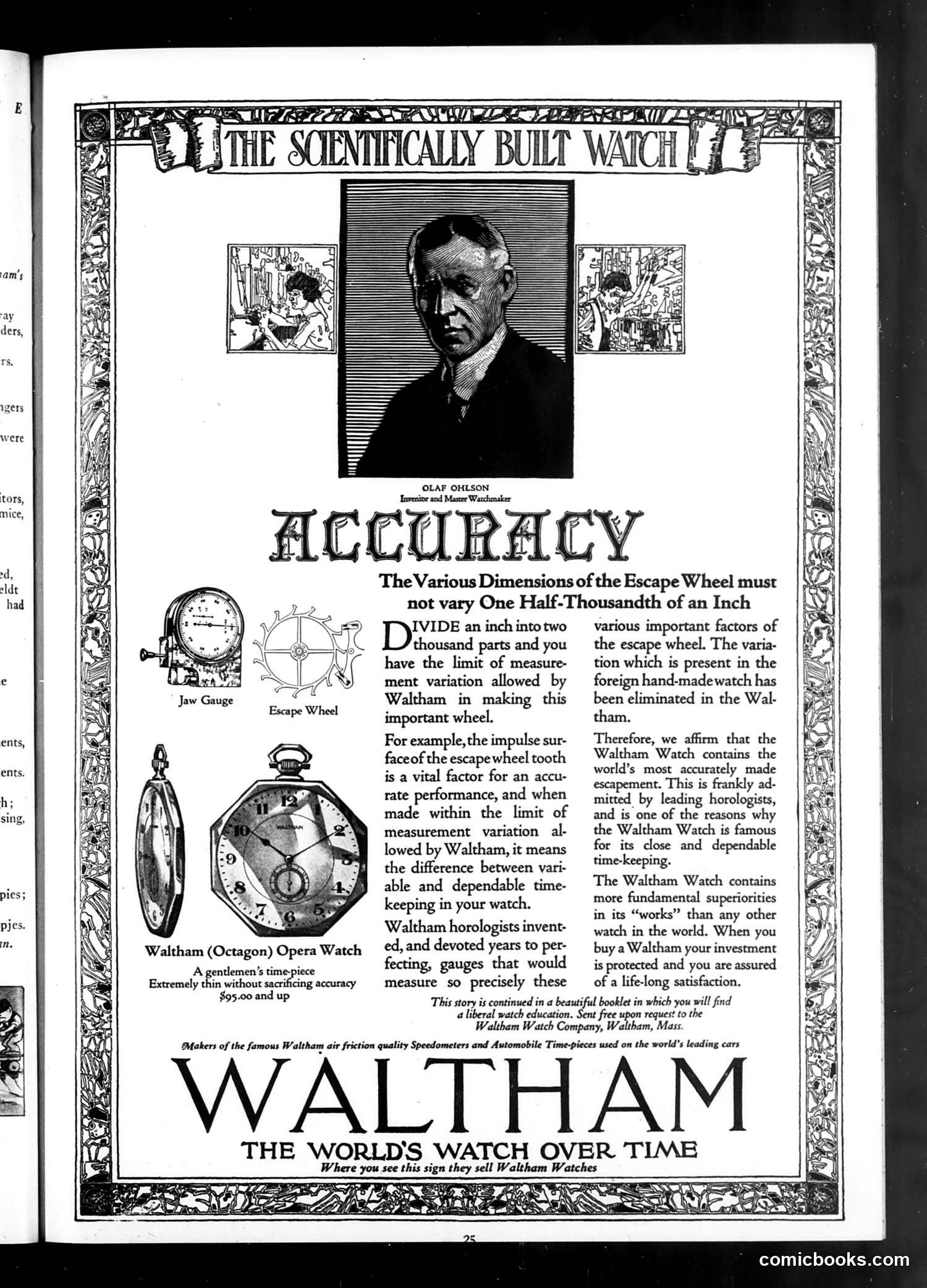
This is primarily a **watch advertisement**, not political satire. It features Olaf Ohlson, identified as an "Inventor and Master Watchmaker," promoting Waltham's precision manufacturing. The page emphasizes American industrial superiority by contrasting Waltham's scientifically engineered watches with "foreign hand-made" competitors. The advertisement targets gentlemen by showcasing technical precision—the escape wheel must vary less than 1/2000th of an inch—as proof of reliability and quality. The rhetoric reflects early 20th-century American confidence in industrial technology and mass production as superior to European craftsmanship. The Waltham Octagon Opera Watch ($95, expensive for the era) positions precise American manufacturing as a mark of dependable, lifetime value—an implicit nationalist argument about product superiority wrapped in technical specifications.
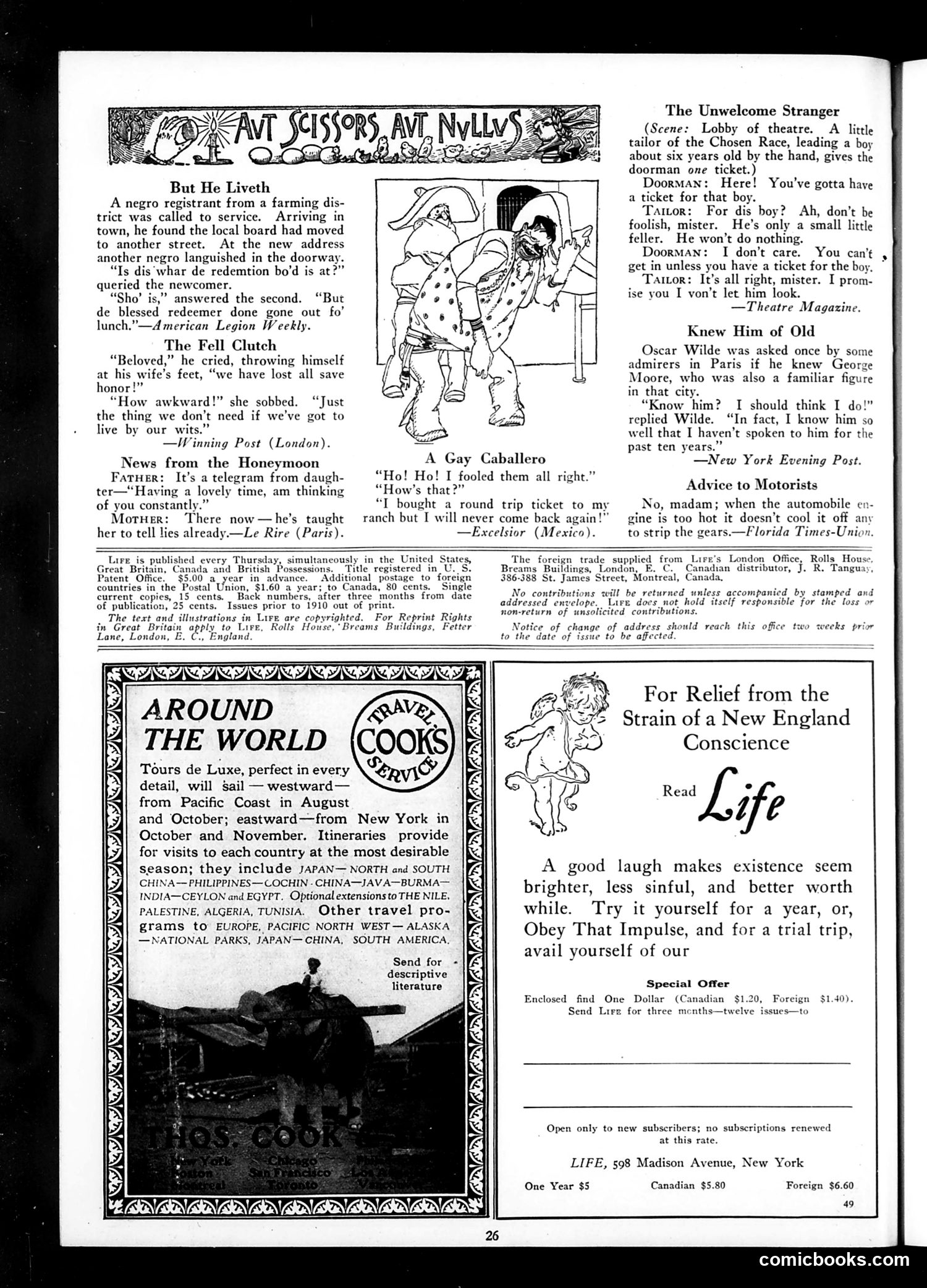
This page contains six brief humorous anecdotes reflecting early 20th-century social attitudes: **"But He Liveth"** mocks African American dialect and religious language through a joke about a Black man seeking military draft registration. **"The Fell Clutch"** presents a marriage joke about a couple who have lost their fortune but still possess honor—the wife's deadpan response that honor is useless to them is the punchline. **"The Unwelcome Stranger"** depicts ethnic stereotyping, showing a Jewish tailor (identified as "of the Chosen Race") attempting to bring an underage boy into a theater without a ticket, promising the boy "won't look"—implying Jews are deceptive. **"A Gay Caballero"** presents a Mexican man's trick of buying a round-trip ticket he never intends to use. The remaining anecdotes contain mild marital and social humor. The page demonstrates the casual bigotry—toward Black Americans, Jewish people, and immigrants—embedded in mainstream American humor of this era.
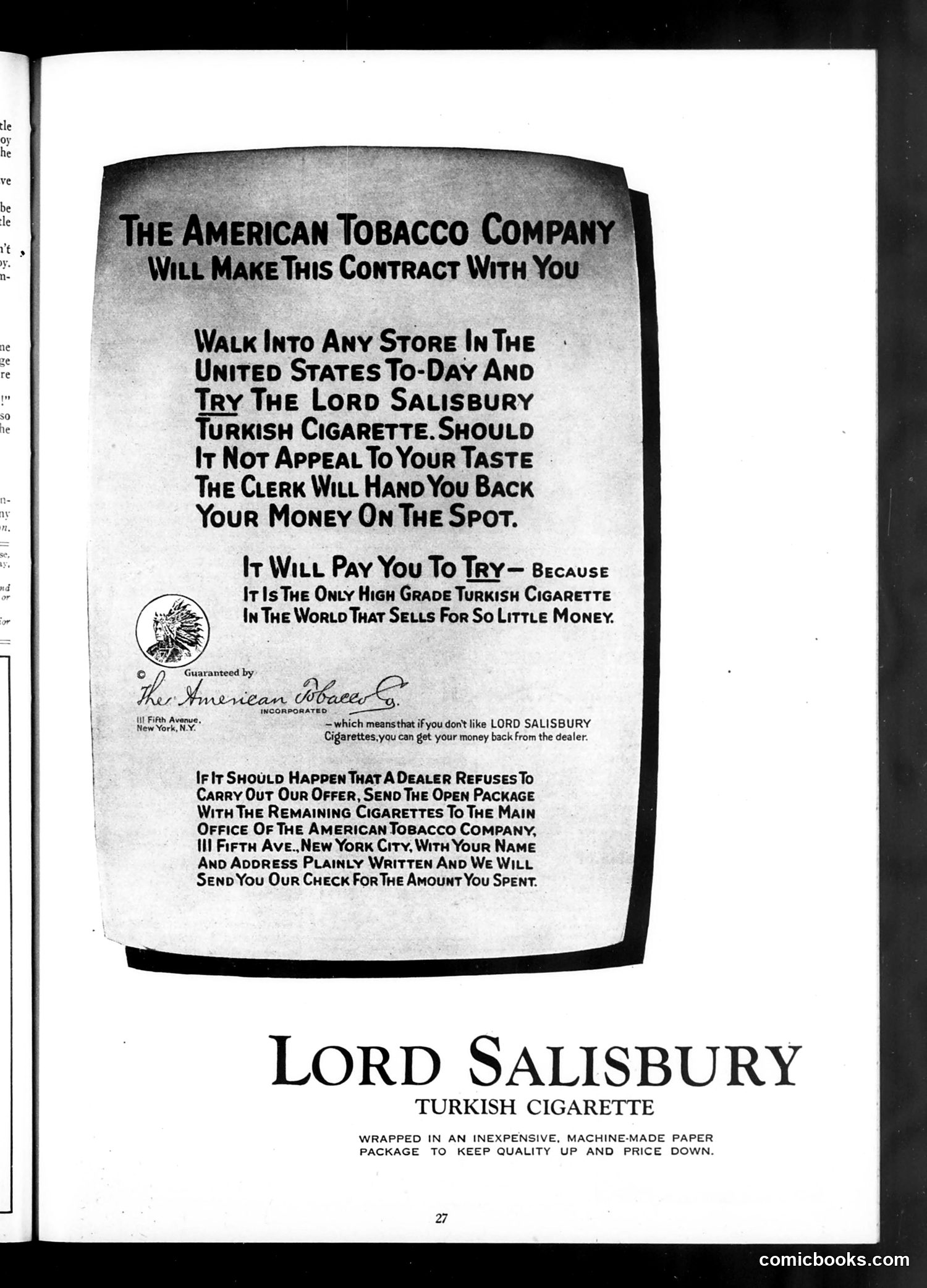
This is a straightforward **advertisement**, not satire. The American Tobacco Company promotes Lord Salisbury Turkish cigarettes with an aggressive money-back guarantee: customers can try them in any U.S. store risk-free, with immediate refunds if unsatisfied. The ad emphasizes the product's value proposition—high-quality Turkish tobacco at low cost due to inexpensive machine-made packaging. It includes a contingency clause: if dealers refuse the offer, customers should mail the remaining cigarettes to corporate headquarters for reimbursement. The "Lord Salisbury" brand name (likely referencing the British Prime Minister) suggests aspirational quality, while the aggressive guarantee and corporate contact information reflect early 20th-century competitive cigarette marketing. This appears designed to build consumer confidence in a relatively new mass-market product category.
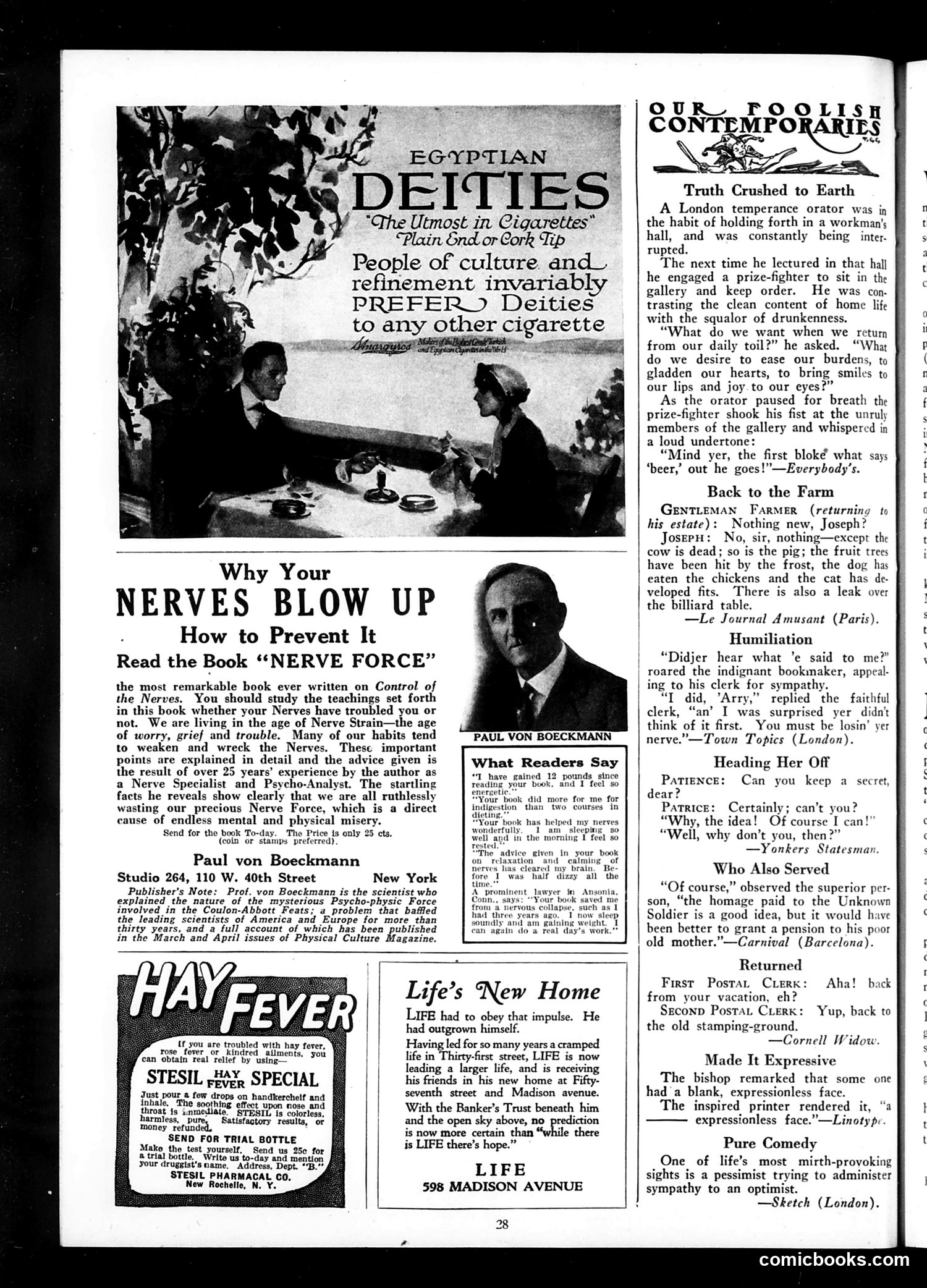
This page consists primarily of **advertisements and humorous anecdotes** rather than political cartoons. The main content includes: **"Egyptian Deities" cigarette ad** - A pseudo-sophisticated advertisement claiming cultured people prefer this brand, using mock-Egyptian imagery to suggest luxury and refinement. **"Nerve Force" book promotion** - A self-help advertisement by Paul von Boeckmann claiming to cure "nerve strain" through psychological methods—reflecting early 20th-century anxieties about modern life's pace and mental health. **Humor pieces** ("Our Foolish Contemporaries" section) include anecdotes about: - A temperance speaker hiring a prize-fighter to enforce order - A country gentleman returning home to discover livestock dead and property ruined - Various short satirical quips about human foibles **"Life's New Home"** announces the magazine itself has relocated to a prestigious Manhattan address (598 Madison Avenue). The overall tone is lighthearted social satire typical of Life magazine's early 20th-century style—mocking pretension, modern anxieties, and human absurdity rather than engaging serious political commentary.
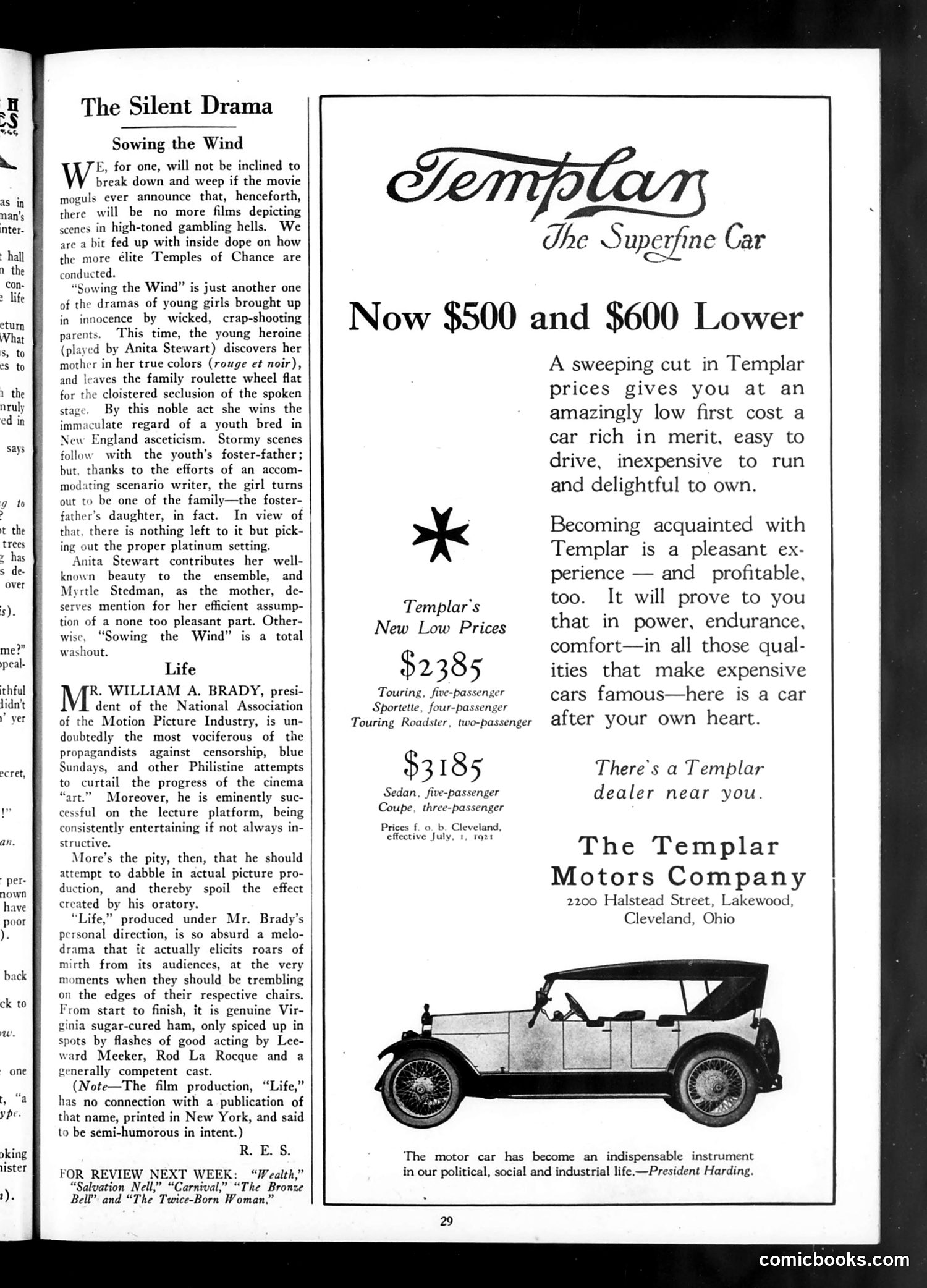
This page combines film criticism with an automobile advertisement, typical of 1920s Life magazine content. **The Film Reviews:** The left column critiques two silent films. "Sowing the Wind" is dismissed as a tedious melodrama about a girl discovering her mother's gambling addiction—a tired plot device. The reviewer mocks how such "gambling hell" films had become formulaic and tiresome. The second review attacks William A. Brady, head of the Motion Picture Industry Association and vocal anti-censorship advocate. The critic notes Brady's hypocrisy: while eloquently defending cinema's artistic freedom in lectures, his own film "Life" is so poorly made it provokes unintended laughter rather than drama. The pun—noting this film has no connection to Life magazine itself—adds satirical bite. **The Advertisement:** The Templar Motors Company ad occupies the right side, promoting price cuts ($500-600 reductions) to position the car as affordable and practical. The satire's point: Industry leaders like Brady preach artistic merit while producing dreck, while simultaneously the era's commercial products tout their own superior value.
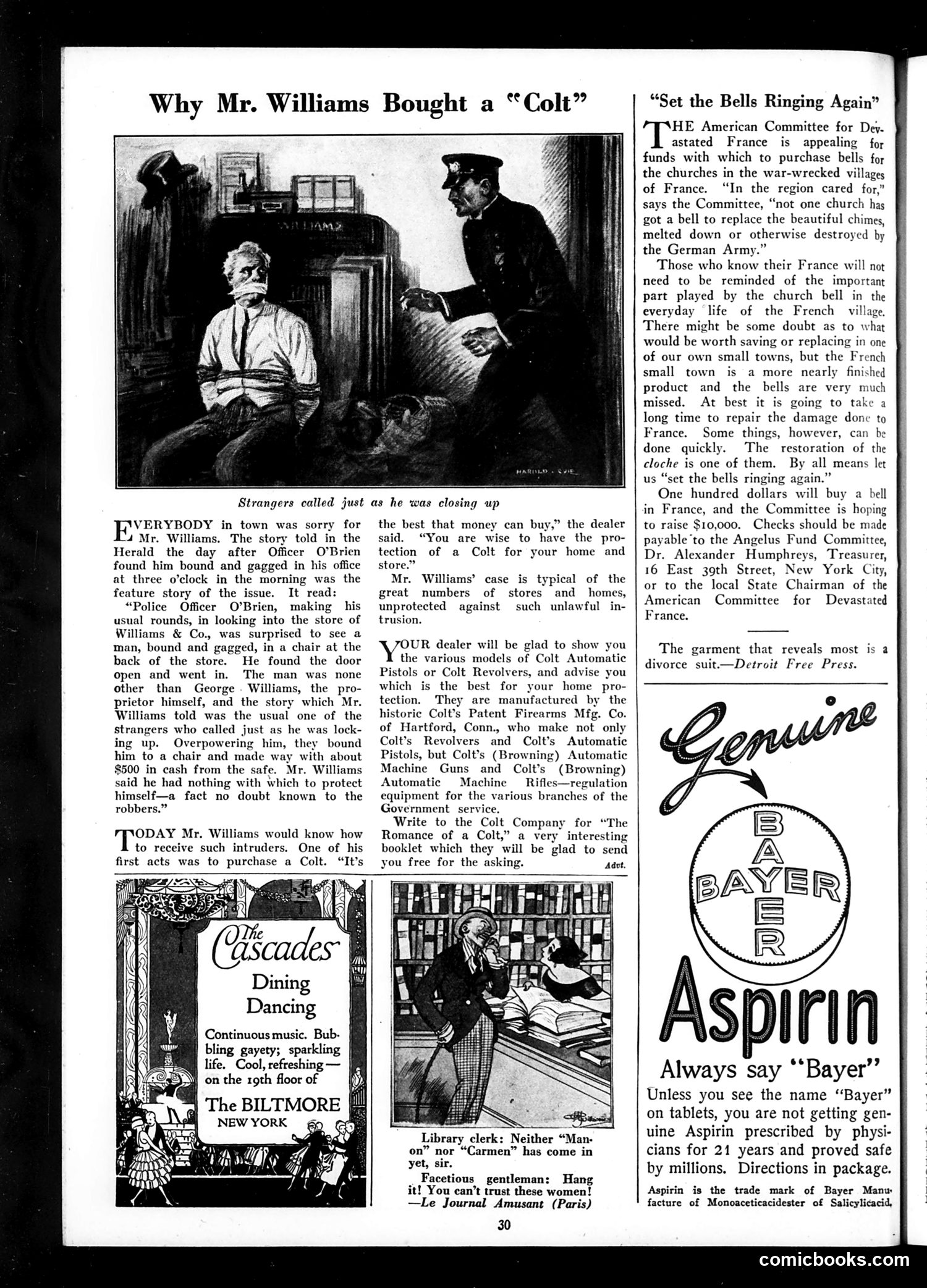
This Life magazine page is primarily **advertising disguised as editorial content**—a common early-20th-century practice. The main feature, "Why Mr. Williams Bought a Colt," is a thinly veiled **Colt firearms advertisement**. It presents a cautionary tale: a store owner is robbed while defenseless, then purchases a Colt revolver for "home protection." The narrative frames gun ownership as a rational response to crime, targeting business owners and homeowners worried about burglaries—a genuine anxiety in this period. The page also includes: - A fundraising appeal for war-damaged French church bells (post-WWI relief) - Advertisement for The Biltmore hotel's dining and dancing - Bayer Aspirin advertisement - A reprinted joke from a French publication about women's untrustworthiness The satirical *Life* magazine platform lent credibility to the Colt pitch by presenting it as news commentary rather than explicit advertising, a marketing tactic that would later be regulated.
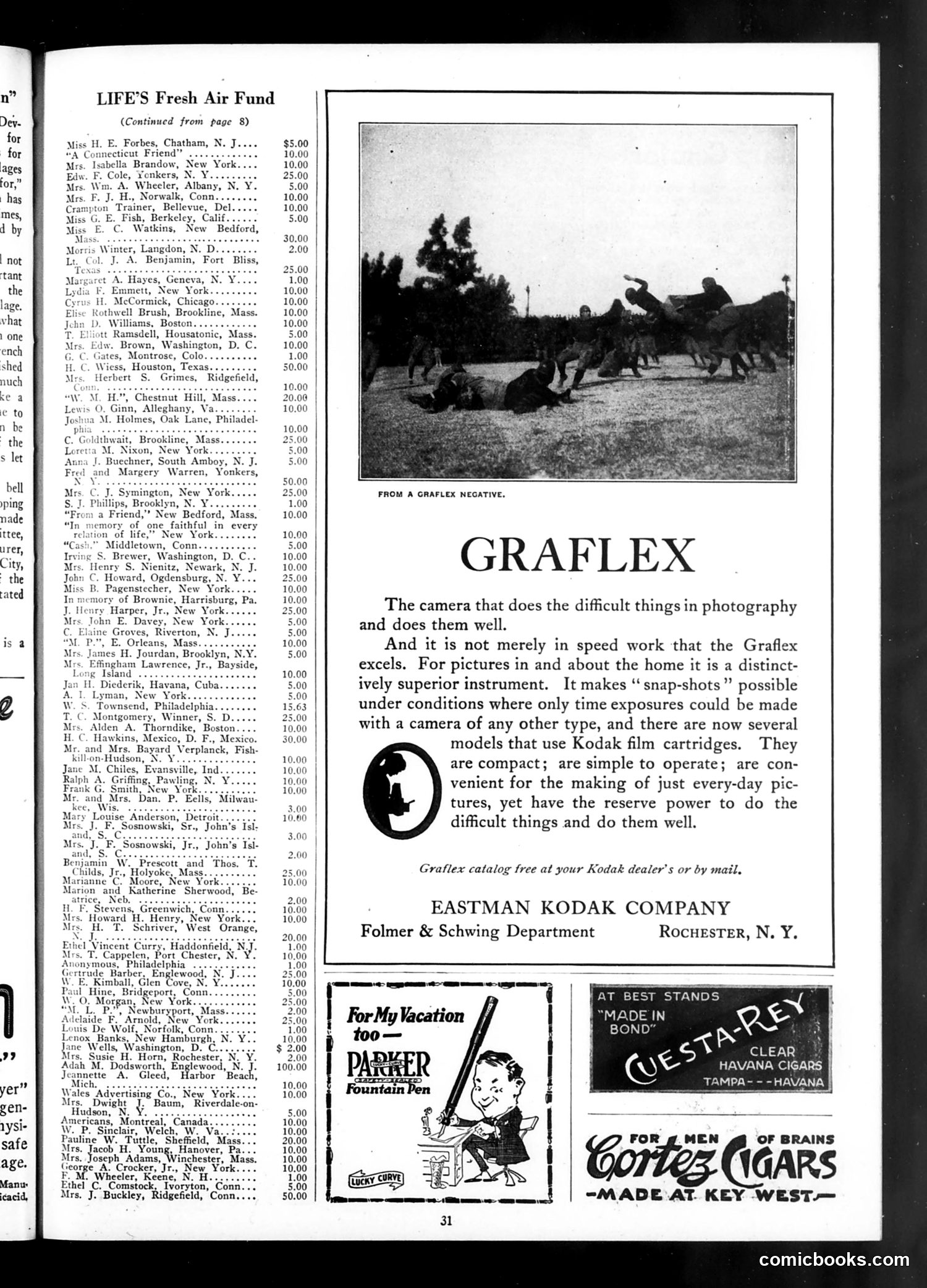
This page is primarily a **charitable fundraising list** (LIFE's Fresh Air Fund) rather than a satirical cartoon page. The Fresh Air Fund was a real philanthropic initiative providing vacations for underprivileged children. The single image shows **a pastoral outdoor scene** (credited "From a Graflex Negative"), likely depicting beneficiaries enjoying recreational activities—consistent with the Fund's purpose. The remainder of the page consists of **commercial advertisements**: a Graflex camera ad emphasizing its superior capabilities for snapshot photography, a Parker fountain pen advertisement, and cigar advertisements. These ads are typical early 20th-century marketing, not satirical content. **In context**: This represents Life magazine's dual function as both satirical publication and mainstream periodical carrying legitimate charitable causes and commercial content—a common practice for the era. There is no political cartoon or satire present on this particular page.
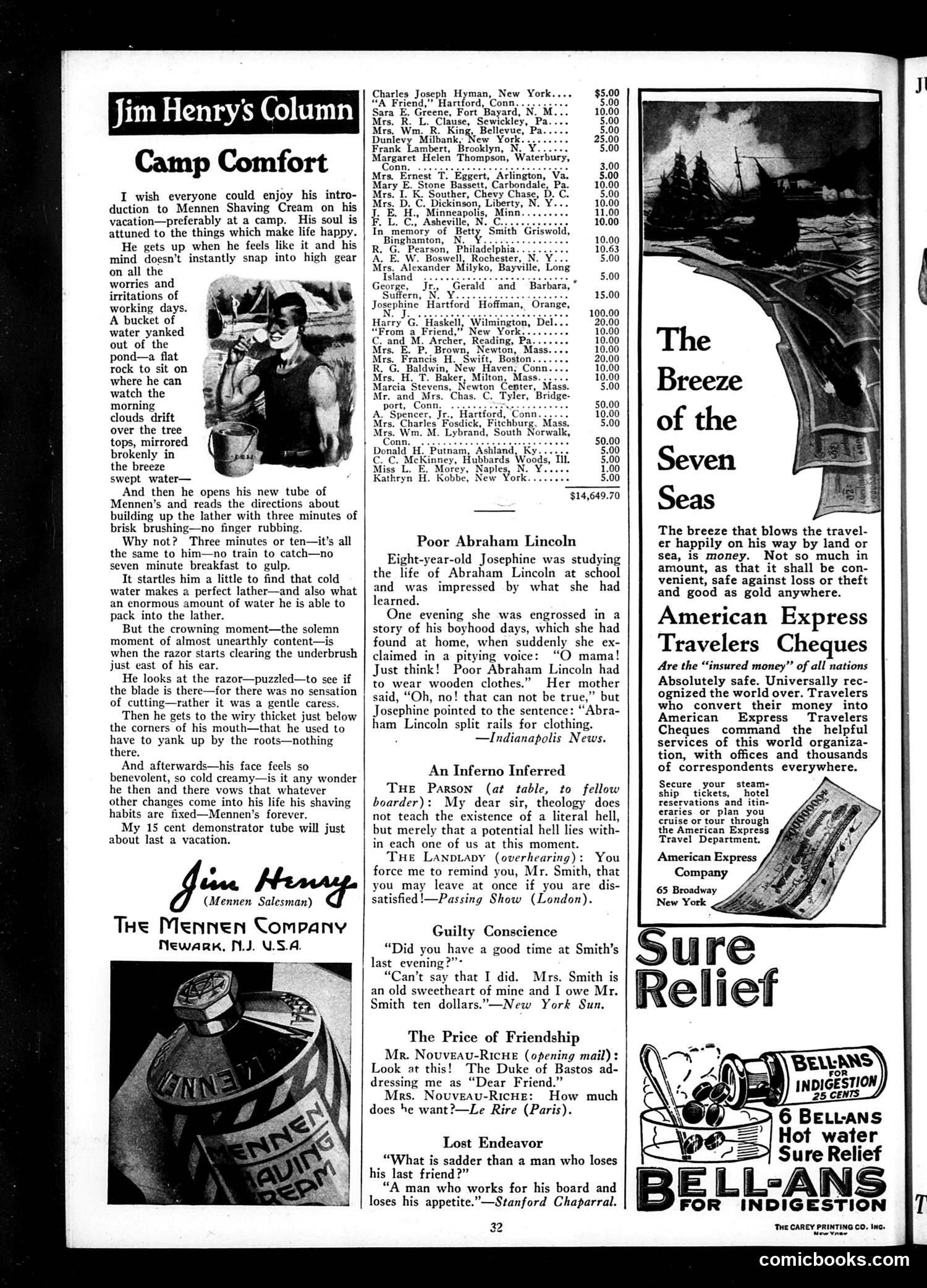
This page combines **advertising and light humor columns** rather than political cartoons. The main content is "Jim Henry's Column: Camp Comfort"—a **sponsored advertorial** for Mennen Shaving Cream disguised as lifestyle writing. It describes a vacationing man's morning shaving routine, emphasizing how the product performs smoothly without irritation. The narrative romanticizes leisure and relaxation to sell the product. Below are three **brief joke items**: 1. "Poor Abraham Lincoln"—a child's misreading of "split rails for clothing" (a historical phrase) as "wooden clothes," creating innocent wordplay humor. 2. "An Inferno Inferred"—a clergyman's abstract theology about internal moral struggle is hilariously challenged by a landlady's practical interruption, suggesting confrontation. 3. "Guilty Conscience," "Price of Friendship," and "Lost Endeavor"—short witty exchanges on human nature. The page also includes charitable donation listings and advertisements for American Express Traveler's Cheques and Bellans indigestion remedy. No political satire appears here.