
Life, 1921-07-14 · page 20 of 34
Life — July 14, 1921 — page 20: what you’re looking at
What you’re looking at
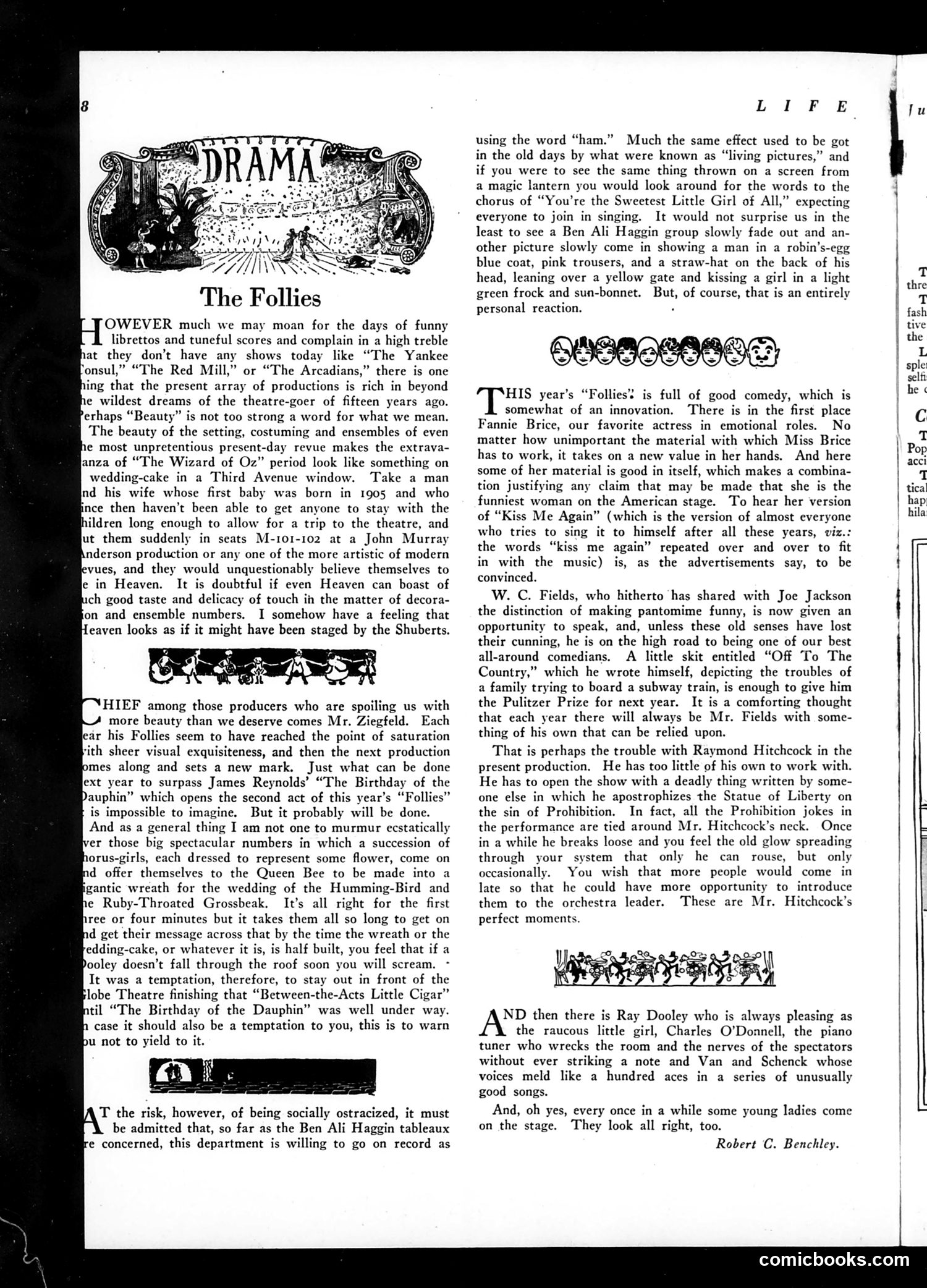
This is a theater review by Robert C. Benchley praising the Ziegfeld Follies production. The article celebrates modern theatrical spectacle—elaborate sets, costumes, and choreography—while gently mocking certain performance conventions. **Key references:** - **Ziegfeld Follies**: The famous revue known for extravagant production numbers - **Ben Ali Haggin tableaux**: Elaborate, posed scenic tableaux (living pictures), which Benchley criticizes as overly "hammy" and artificial—reminiscent of old-fashioned "living pictures" theater - **W.C. Fields and Raymond Hitchcock**: Comedians performing in the production - **"The Birthday of the Dauphin"**: A specific elaborate number the reviewer uses as an example The satire targets the excessive, static nature of spectacular staging numbers—particularly those featuring chorus girls dressed as flowers offering themselves "to the Queen Bee." Benchley finds these lengthy, visually stunning but narratively pointless sequences tedious, though he acknowledges their technical achievement. His complaint about Ben Ali Haggin's work suggests overly theatrical, posed artificiality rather than genuine entertainment.
📄 Transcribed text from this page (OCR, searchable)
Machine-transcribed from the original scan — historical spelling and the odd misread are preserved.
. The Follies OWEVER much we may moan for the days of funny librettos and tuneful scores and complain in a high treble at they don’t have any shows today like “The Yankee ‘onsul,” “The Red Mill,” or “The Arcadians,” there is one ing that the present array of productions is rich in beyond e wildest dreams of the theatre-goer of fifteen years ago. erhaps “Beauty” is not too strong a word for what we mean. The beauty of the setting, costuming and ensembles of even ie most unpretentious present-day revue makes the extrava- lanza of “The Wizard of Oz” period look like something on wedding-cake in a Third Avenue window. Take a man ind his wife whose first baby was born in 1905 and who ince then haven’t been able to get anyone to stay with the ildren long enough to allow for a trip to the theatre, and ut them suddenly in seats M-101-102 at a John Murray Anderson production or any one of the more artistic of modern evues, and they would unquestionably believe themselves to le in Heaven. It is doubtful if even Heaven can boast of ich good taste and delicacy of touch ih the matter of decora- ion and ensemble numbers. I somehow have a feeling that eaven looks as if it might have been staged by the Shuberts. HIEF among those producers who are spoiling us with more beauty than we deserve comes Mr. Ziegfeld. Each ear his Follies seem to have reached the point of saturation yith sheer visual exquisiteness, and then the next production pmes along and sets a new mark. Just what can be done lext year to surpass James Reynolds’ “The Birthday of the Dauphin” which opens the second act of this year’s “Follies” is impossible to imagine. But it probably will be done. And as a general thing I am not one to murmur ecstatically er those big spectacular numbers in which a succession of jorus-girls, each dressed to represent some flower, come on id offer themselves to the Queen Bee to be made into a igantic wreath for the wedding of the Humming-Bird and ¢ Ruby-Throated Grossbeak. It’s all right for the first ree or four minutes but it takes them all so long to get on d get their message across that by the time the wreath or the edding-cake, or whatever it is, is half built, you feel that if a Pooley doesn’t fall through the roof soon you will scream. ~ It was a temptation, therefore, to stay out in front of the lobe Theatre finishing that “Between-the-Acts Little Cigar” til “The Birthday of the Dauphin” was well under way. case it should also be a temptation to you, this is to warn bu not to yield to it. AT the risk, however, of being socially ostracized, it must be admitted that, so far as the Ben Ali Haggin tableaux e concerned, this department is willing to go on record as LtIrFeE using the word “ham.” Much the same effect used to be got in the old days by what were known as “living pictures,” and if you were to see the same thing thrown on a screen from a magic lantern you would look around for the words to the chorus of “You're the Sweetest Little Girl of All,” expecting everyone to join in singing. It would not surprise us in the least to see a Ben Ali Haggin group slowly fade out and an- other picture slowly come in showing a man in a robin’s-egg blue coat, pink trousers, and a straw-hat on the back of his head, leaning over a yellow gate and kissing a girl in a light green frock and sun-bonnet. But, of course, that is an entirely personal reaction. SOSBCCBBOE HIS year’s “Follies? is full of good comedy, which is somewhat of an innovation. There is in the first place Fannie Brice, our favorite actress in emotional roles. No matter how unimportant the material with which Miss Brice has to work, it takes on a new value in her hands. And here some of her material is good in itself, which makes a combina- tion justifying any claim that may be made that she is the funniest woman on the American stage. To hear her version of “Kiss Me Again” (which is the version of almost everyone who tries to sing it to himself after all these years, viz.: the words “kiss me again” repeated over and over to fit in with the music) is, as the advertisements say, to be convinced. W. C. Fields, who hitherto has shared with Joe Jackson the distinction of making pantomime funny, is now given an opportunity to speak, and, unless these old senses have lost their cunning, he is on the high road to being one of our best all-around comedians. A little skit entitled “Off To The Country,” which he wrote himself, depicting the troubles of a family trying to board a subway train, is enough to give him the Pulitzer Prize for next year. It is a comforting thought that each year there will always be Mr. Fields with some- thing of his own that can be relied upon. That is perhaps the trouble with Raymond Hitchcock in the present production. He has too little of his own to work with. He has to open the show with a deadly thing written by some- one else in which he apostrophizes the Statue of Liberty on the sin of Prohibition. In fact, all the Prohibition jokes in the performance are tied around Mr. Hitchcock’s neck. Once in a while he breaks loose and you feel the old glow spreading through your system that only he can rouse, but only occasionally. You wish that more people would come in late so that he could have more opportunity to introduce them to the orchestra leader. These are Mr. Hitchcock's perfect moments. iH) ND then there is Ray Dooley who is always pleasing as the raucous little girl, Charles O’Donnell, the piano tuner who wrecks the room and the nerves of the spectators without ever striking a note and Van and Schenck whose voices meld like a hundred aces in a series of unusually good songs. And, oh yes, every once in a while some young ladies come on the stage. They look all right, too. Robert C. Benchley. comicbooks.com fu thre fash tive the sple’ selft he « Pop acci tical hap hila