
Life, 1921-07-14 · page 26 of 34
Life — July 14, 1921 — page 26: what you’re looking at
What you’re looking at
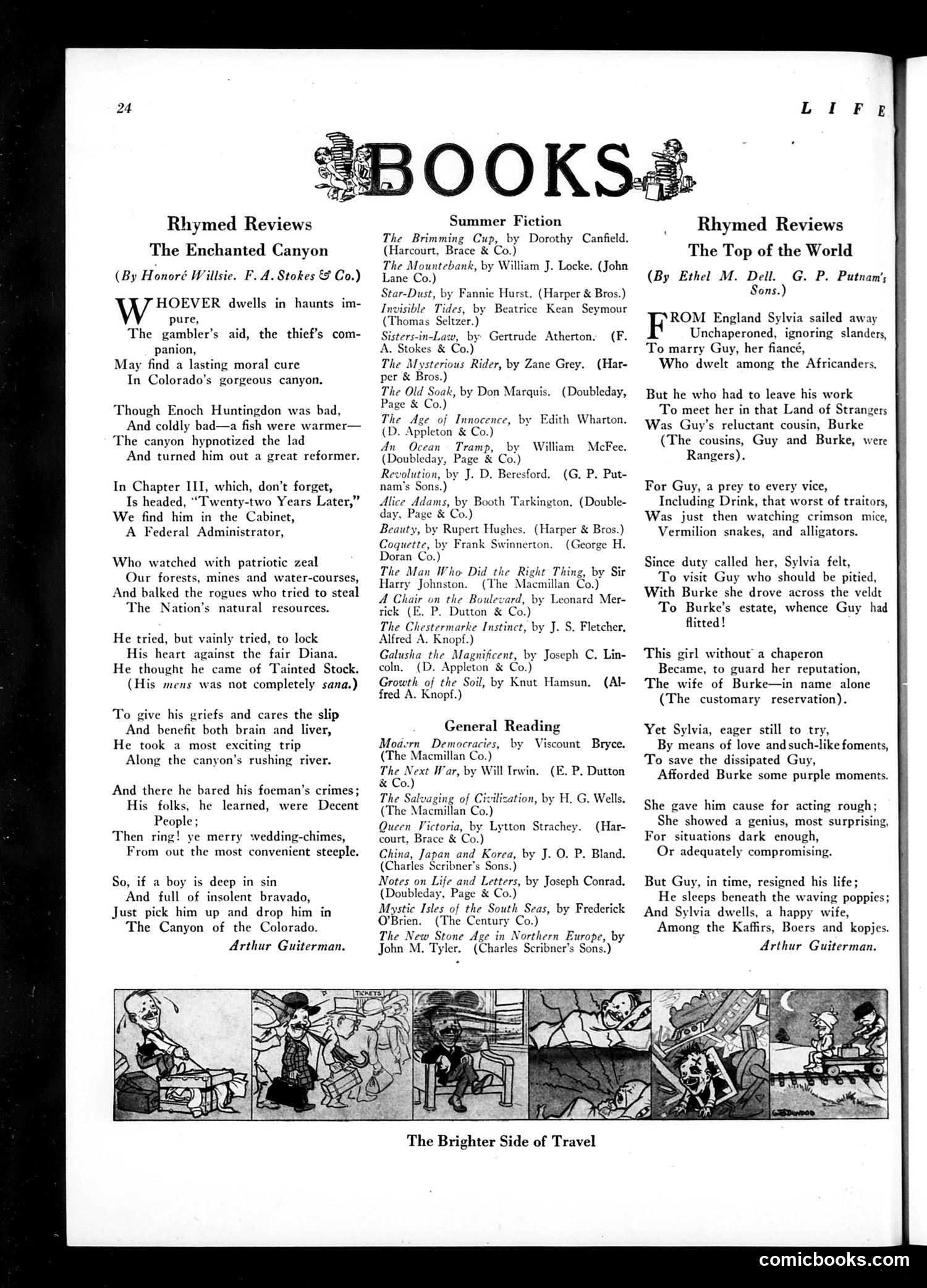
This page from *Life* magazine presents book reviews in two formats: serious rhymed poetry critiques and satirical commentary on popular fiction. **"The Enchanted Canyon"** reviews a moral redemption tale where a corrupt man named Enoch Huntingdon transforms after visiting Colorado's Grand Canyon. The reviewer mocks the melodramatic plot: a "tainted" man becomes a reformer, falls for a woman named Diana, discovers his family is actually respectable, and marries conveniently. The closing couplet sarcastically suggests simply dropping corrupt boys into the canyon as a cure-all solution. **"The Top of the World"** satirizes romantic adventure fiction. A woman travels unchaperoned to Africa to marry her fiancé Guy, who's now drinking and hallucinating exotic animals. She instead marries his cousin Burke "in name alone" for propriety—mocking the era's absurd conventions where even fake marriage supposedly protects a woman's reputation. Both reviews lampoon popular literature's implausible plotting, moralizing, and outdated social codes through exaggerated verse, targeting readers' taste for sensational, emotionally manipulative fiction.
📄 Transcribed text from this page (OCR, searchable)
Machine-transcribed from the original scan — historical spelling and the odd misread are preserved.
g Rhymed Reviews The Enchanted Canyon (By Honoré Willsic. F. A. Stokes & Co.) HOEVER dwells in haunts im- pure, The gambler’s aid, the thief’s com- panion, May find a lasting moral cure In Colorado’s gorgeous canyon. Though Enoch Huntingdon was bad, And coldly bad—a fish were warmer— The canyon hypnotized the lad And turned him out a great reformer. In Chapter III, which, don’t forget, Is headed, “Twenty-two Years Later,” We find him in the A Federal Adminis Who watched with patriotic zeal Our forests, mines and water-courses, And balked the rogues who tried to steal The Nation’s natural resources. He tried, but vainly tried, to lock His heart against the fair Diana. He thought he came of Tainted Stock. (His mens was not completely sana.) To give his griefs and cares the slip And benefit both brain and liver, He took a most exciting trip Along the canyon’s rushing river. And there he bared his foeman’s crimes; His folks, he learned, were Decent People; Then ring! ye merry wedding-chimes, From out the most convenient steeple. So, if a boy is deep in sin And full of insolent bravado, Just pick him up and drop him in The Canyon of the Colorado. Arthur Guiterman. BOOKS& Summer Fiction The Brimming Cup, by Dorothy Canfield. (Harcourt, Brace & Co.) The Mountebank, by William J. Locke. (John Lane Co.) Star-Dust, by Fannie Hurst. (Harper & Bros.) Invisible Tides, by Beatrice Kean Seymour (Thomas Seltzer. Sisters-in-Law, by Gertrude Atherton. (F. A. Stokes & Co.) The Mysterious Rider, by Zane Grey. per & Bros.) The Old Soak, by Don Marquis. Page & Co.) The Age of Innocence, by Edith Wharton. (D. Appleton & Co.) An Ocean Tramp, by (Doubleday, Page & Co.) Revolution, by J. D. Beresford. Sons.) Adams, by Booth Tarkington, (Double- , Page & Co.) Beauty, by Rupert Hug! Coquette, by Frank Sw Doran Co. The Man Who- Did the Ri, Harry Johnston. (The M A Chair on the Boulevard ©. P. Dutton & Co.) rstermarke Instinct, by J. S. Fletcher, A. Knopf.) Galusha the Magnificent, by Joseph C. Lin- coln. (D. Appleton & Co.) Growth of the Soil, by Knut Hamsun. (Al- fred A. Knopf.) (Har- (Doubleday, William McFee. (G. P. Put- es, (Harper & Bros.) nerton. (George H. ght Thing, by Sir millan Co.) by Leonard Mer- General Reading Modern Democracies, by Viscount Bryce. (The Macmillan Co.) The Next War, by Will Irwin. (E. P. Dutton Co.) g of Civil millan Co.) Queen Victoria, by Lytton Strachey. court, Brace & Co.) pan and Korea, by J. O. P. Bland. ibner’s Sons.) Notes on Life and Letters, by Joseph Conrad. (Doubleday, Page & Co.) Mystic Isles of the South Seas, by Frederick O'Brien. (The Century Co.) The New Stone Age in Northern Europe, by John M. Tyler. (Charles Scribner’s Sons.) ization, by H. G. Wells. (Har- The Brighter Side of Travel Rhymed Reviews The Top of the World (By Ethel M. Dell. G. P. Putnam's Sons.) ROM England Sylvia sailed away Unchaperoned, ignoring slanders, To marry Guy, her fiancé, Who dwelt among the Africanders, But he who had to leave his work To meet her in that Land of Strangers Was Guy’s reluctant cousin, Burke (The cousins, Guy and Burke, were Rangers). For Guy, a prey to every vice, Including Drink, that worst of traitors, Was just then watching crimson mice, Vermilion snakes, and alligators. Since duty called her, Sylvia felt, To visit Guy who should be pitied, With Burke she drove across the veldt To Burke’s estate, whence Guy had flitted! This girl without’ a chaperon Became, to guard her reputation, The wife of Burke—in name alone (The customary reservation). Yet Sylvia, eager still to try, By means of love and such-like foments, To save the dissipated Guy, Afforded Burke some purple moments. She gave him cause for acting rough; She showed a genius, most surprising, For situations dark enough, Or adequately compromising. But Guy, in time, resigned his life; He sleeps beneath the waving poppi And Sylvia dwells, a happy wife, Among the Kaffirs, Boers and kopjes. Arthur Guiterman. comicbooks.com