
Life, 1921-07-14 · page 16 of 34
Life — July 14, 1921 — page 16: what you’re looking at
What you’re looking at
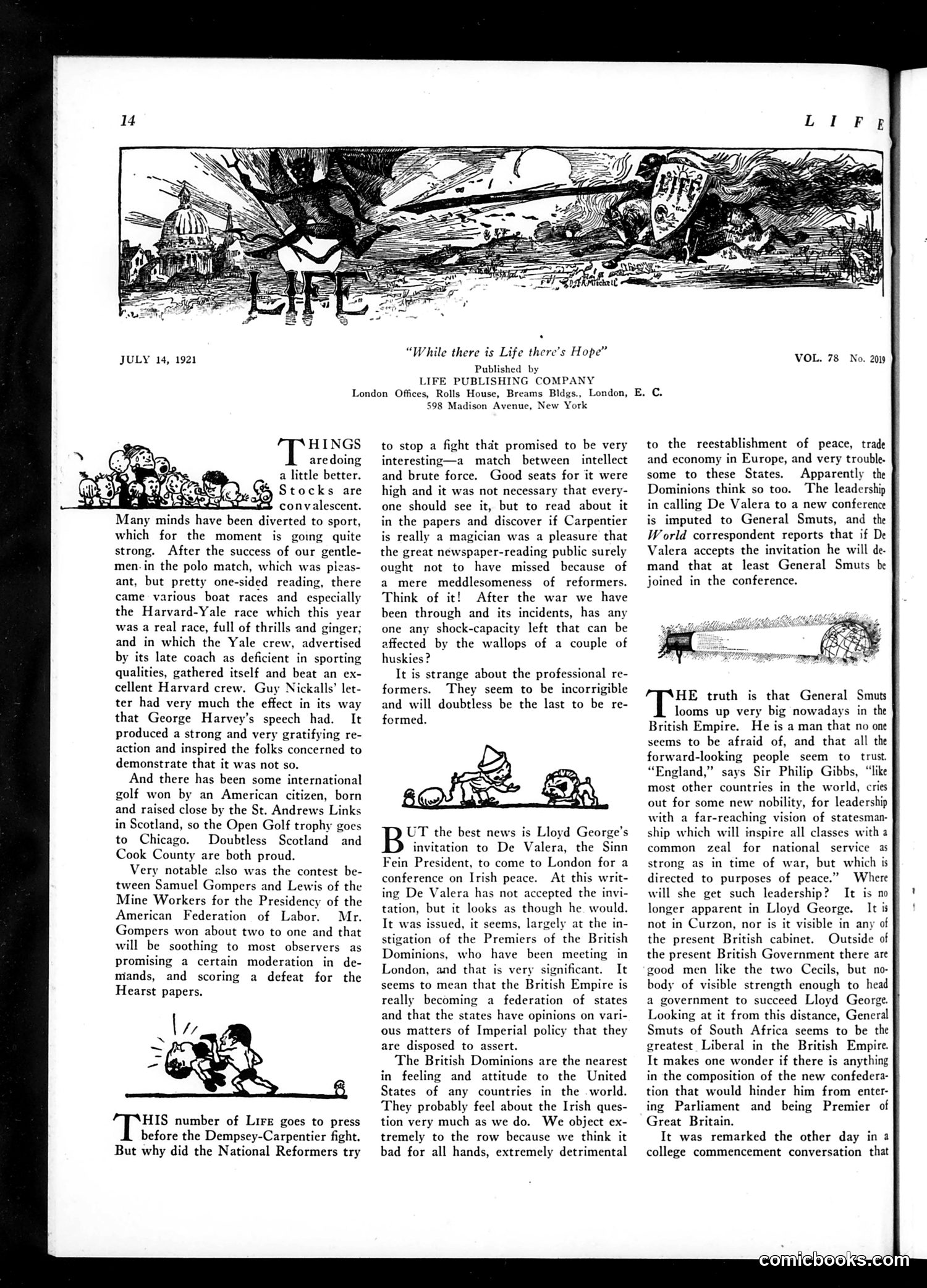
This page discusses contemporary political figures and events. The text references **Lloyd George** (British Prime Minister) inviting **De Valera** (Irish independence leader) to a London peace conference on Irish independence. It also mentions **General Smuts** of South Africa as a respected figure within the British Empire. The satirical commentary critiques the **National Reformers** and references a **Dempsey-Carpenter fight** (a famous 1921 boxing match that diverted public attention). The article suggests that while interesting political developments occur, the public's attention gets diverted to sporting events instead. The small cartoon illustrations appear to depict casual figures, though their specific identities are unclear from the image alone. The overall tone mocks public distraction from serious political matters.
📄 Transcribed text from this page (OCR, searchable)
Machine-transcribed from the original scan — historical spelling and the odd misread are preserved.
A ET Re JULY 14, 1921 “While there is Life there's Hope” Published by LIFE PUBLISHING COMPANY London Offices, Rolls House, Breams Bldgs., London, HINGS aredoing a little better. Stocks are convalescent. Many minds have been diverted to sport, which for the moment is going quite strong. After the success of our gentle- men. in the polo match, which was pieas- ant, but pretty one-sided reading, there came various boat races and especially the Harvard-Yale race which this year was a real race, full of thrills and ginger; and in which the Yale crew, advertised by its late coach as deficient in sporting qualities, gathered itself and beat an ex- cellent Harvard crew. Guy Nickalls’ let- ter had very much the effect in its way that George Harvey's speech had. It produced a strong and very gratifying re- action and inspired the folks concerned to demonstrate that it was not so. And there has been some international golf won by an American citizen, born and raised close by the St. Andrews Links in Scotland, so the Open Golf trophy goes to Chicago. Doubtless Scotland and Cook County are both proud. Very notable also was the contest be- tween Samuel Gompers and Lewis of the Mine Workers for the Presidency of the American Federation of Labor. Mr. Gompers won about two to one and that will be soothing to most observers as promising a certain moderation in de- mands, and scoring a defeat for the Hearst papers. HIS number of Lire goes to press before the Dempsey-Carpentier fight. But why did the National Reformers try 598 Madison Avenue, New York to stop a fight thdt promised to be very interesting—a match between intellect and brute force. Good seats for it were high and it was not necessary that every- one should see it, but to read about it in the papers and discover if Carpentier is really a magician was a pleasure that the great newspaper-reading public surely ought not to have missed because of a mere meddlesomeness of reformers. Think of it! After the war we have been through and its incidents, has any one any shock-capacity left that can be affected by the wallops of a couple of huskies? It is strange about the professional re- formers. They seem to be incorrigible and will doubtless be the last to be re- formed. UT the best news is Lloyd George's invitation to De Valera, the Sinn Fein President, to come to London for a conference on Irish peace. At this writ- ing De Valera has not accepted the invi- tation, but it looks though he would. It was issued, it seems, largely at the in- stigation of the Premiers of the British Dominions, who have been meeting in London, and that is very significant. It seems to mean that the British Empire is really becoming a federation of states and that the states have opinions on vari- ous matters of Imperial policy that they are disposed to assert. The British Dominions are the nearest in feeling and attitude to the United States of any countries in the world. They probably feel about the Irish ques- tion very much as we do. We object ex- tremely to the row because we think it bad for all hands, extremely detrimental VOL. 78 No. 2019 to the reestablishment of peace, trade and economy in Europe, and very trouble. some to these States. Apparently the Dominions think so too. The leadership in calling De Valera to a new conference is imputed to General Smuts, and the W orld correspondent reports that if De Valera accepts the invitation he will de- mand that at least General Smuts be joined in the conference. HE truth is that General Smuts looms up very big nowadays in the British Empire. He is a man that no one seems to be afraid of, and that all the forward-looking people seem to trust. “England,” says Sir Philip Gibbs, “like most other countries in the world, cries out for some new nobility, for leadership with a far-reaching vision of statesman- ship which will inspire all classes with a common zeal for national service as strong as in time of war, but which is directed to purposes of peace.” Where will she get such leadership? It is no longer apparent in Lloyd George. It is not in Curzon, nor is it visible in any of F the present British cabinet. Outside of f the present British Government there are good men like the two Cecils, but no- > body of visible strength enough to head a government to succeed Lloyd George. Looking at it from this distance, General Smuts of South Africa seems to be the greatest Liberal in the British Empire. It makes one wonder if there is anything in the composition of the new confedera- tion that would hinder him from enter- ing Parliament and being Premier of Great Britain. It was remarked the other day in a college commencement conversation that