
Life, 1921-07-14 · page 24 of 34
Life — July 14, 1921 — page 24: what you’re looking at
What you’re looking at
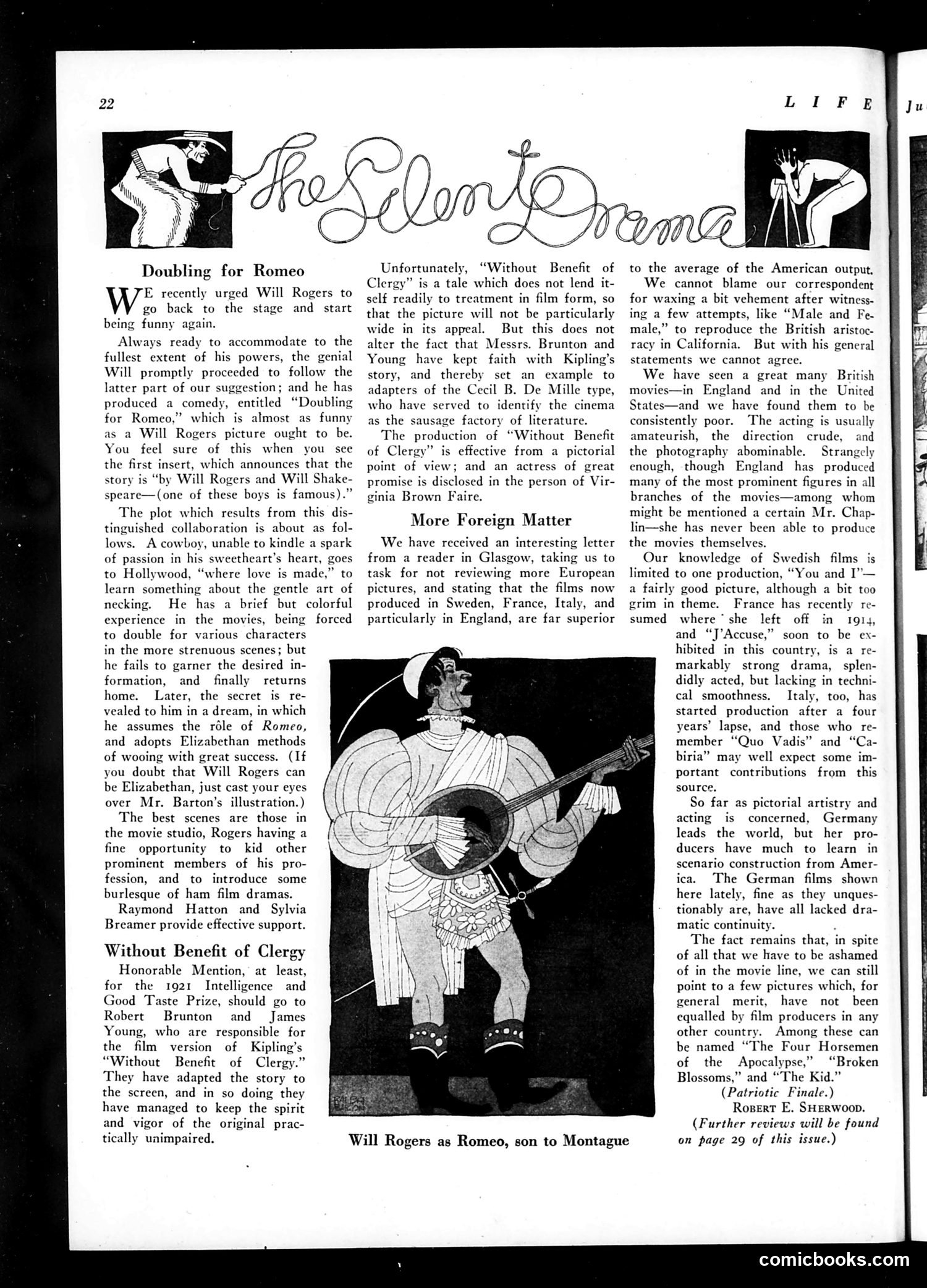
This page reviews Will Rogers' 1921 comedy film "Doubling for Romeo." The illustration shows Rogers in Elizabethan costume as Romeo, satirizing the film's premise: a cowboy goes to Hollywood to learn romance techniques, works as a stunt double in various movie scenes, then dreams himself into Shakespeare's famous role. The satire works on two levels: Rogers himself was known for stage comedy, so the article jokes that he'd "stopped being funny" in films—calling him back to theaters. The film's title credits to "Will Shakespeare—(one of these boys is famous)" mock pretentious literary adaptations, suggesting Rogers' version is frivolous compared to the Bard's original. The page also critiques British and European films, dismissing British productions as "consistently poor" despite their famous actors like Chaplin, while acknowledging superior European cinema's technical sophistication compared to American output.
📄 Transcribed text from this page (OCR, searchable)
Machine-transcribed from the original scan — historical spelling and the odd misread are preserved.
Doubling for Romeo E recently urged Will Rogers to go back to the stage and start being funny again. Always ready to accommodate to the fullest extent of his powers, the genial Will promptly proceeded to follow the latter part of our suggestion; and he has produced a comedy, entitled “Doubling for Romeo,” which is almost as funny as a Will Rogers picture ought to be. You feel sure of this when you see the first insert, which announces that the story is “by Will Rogers and Will Sha’ speare—(one of these boys is famous).” The plot which results from this dis- tinguished collaboration is about as fol- lows. A cowboy, unable to kindle a spark of passion in his sweetheart’s heart, goes to Hollywood, “where love is made,” to learn something about the gentle art of necking. He has a brief but colorful experience in the movies, being forced to double for various characters in the more strenuous scenes; but he fails to garner the desired in- formation, and finally returns home. Later, the secret is re- vealed to him in a dream, in which he assumes the role of Romeo, and adopts Elizabethan methods of wooing with great success. (If you doubt that Will Rogers can be Elizabethan, just cast your eyes over Mr. Barton’s illustration.) The best scenes are those in the movie studio, Rogers having a fine opportunity to kid other prominent members of his pro- fession, and to introduce some burlesque of ham film dramas. Raymond Hatton and Sylvia Breamer provide effective support. Without Benefit of Clergy Honorable Mention, at least, for the 1921 Intelligence and Good Taste Prize, should go to Robert Brunton and James Young, who are responsible for the film version of Kipling’s “Without Benefit of Clergy.” They have adapted the story to the screen, and in so doing they have managed to keep the spirit and vigor of the original prac- Unfortunately, “Without Benefit of Clergy” is a tale which does not lend it- self readily to treatment in film form, so that the picture will not be particularly wide in its appeal. But this does not alter the fact that Messrs. Brunton and Young have kept faith with Kipling’s story, and thereby set an example to adapters of the Cecil B. De Mille type, who have served to identify the cinema as the sausage factory of literature. The production of “Without Benefit of Clergy” is effective from a pictorial point of view; and an actress of great promise is disclosed in the person of Vir- ginia Brown Faire. More Foreign Matter We have received an interesting letter from a reader in Glasgow, taking us to task for not reviewing more European pictures, and stating that the films now produced in Sweden, France, Italy, and particularly in England, are far superior to the average of the American output, We cannot blame our correspondent for waxing a bit vehement after witness- ing a few attempts, like “Male and Fe. male,” to reproduce the British aristoc- racy in California. But with his general ements we cannot agree. We have seen a great many British movies—in England and in the United States—and we have found them to be consistently poor. The acting is usually amateurish, the direction crude, and the photography abominable. Strangely enough, though England has produced many of the most prominent figures in all branches of the movies—among whom might be mentioned a certain Mr. Chap- lin—she has never been able to produce the movies themselves. Our knowledge of Swedish films is limited to one production, “You and I”— a fairly good picture, although a bit too grim in theme. France has recently re- sumed where“ she left off in 1914, and “J’Accuse,” soon to be ex- hibited in this country, is a re- markably strong drama, splen- didly acted, but lacking in techni- cal smoothness. Italy, too, has started production after a four years’ lapse, and those who re- member “Quo Vadis” and “Ca- biria” may well expect some im- portant contributions from this source. So far as pictorial artistry and acting is concerned, Germany leads the world, but her pro- ducers have much to learn in scenario construction from Amer- ica. The German films shown here lately, fine as they unques- tionably are, have all lacked dra- matic continuity. - The fact remains that, in spite of all that we have to be ashamed of in the movie line, we can still point to a few pictures which, for general merit, have not been equalled by film producers in any other country. Among these can be named “The Four Horsemen of the Apocalypse,” “Broken Blossoms,” and “The Kid.” (Patriotic Finale.) Rosert E. SHERWoop. (Further reviews will be found tically unimpaired. Will Rogers as Romeo, son to Montague on page 29 of this issue.) comicbooks.com