
Life, 1921-07-14 · page 17 of 34
Life — July 14, 1921 — page 17: what you’re looking at
What you’re looking at
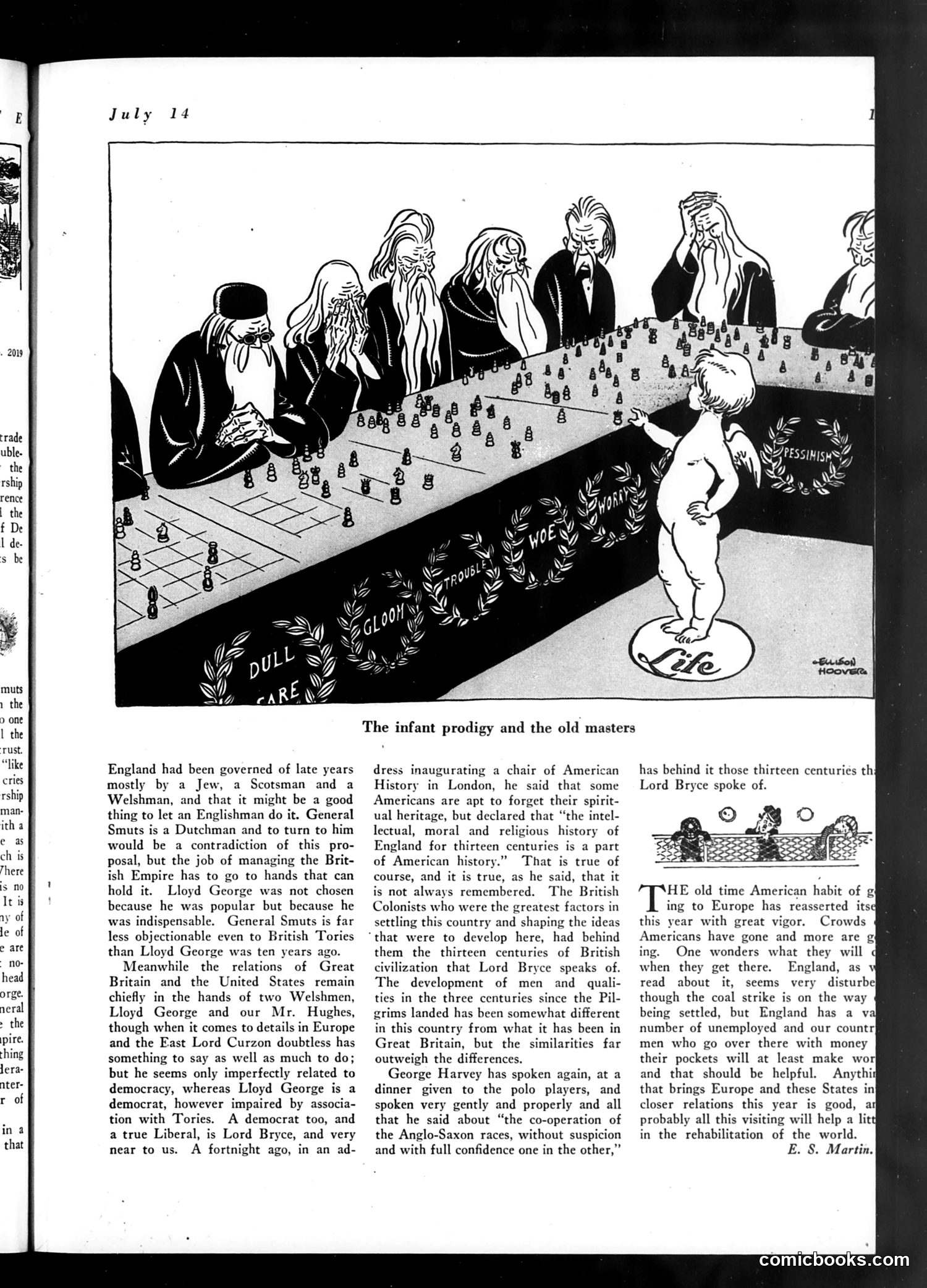
This cartoon satirizes post-WWI Anglo-American relations and generational conflict. The "old masters" are elderly British statesmen seated at a chess table labeled with phrases like "dull care" and "gloom"—representing establishment figures like Lloyd George and Lord Curzon mentioned in the text. The "infant prodigy" (labeled "Life") is a naked cherub observing their game, symbolizing American youth and vitality. The accompanying article criticizes British governance by non-English figures (Lloyd George, a Welshman; others of Jewish/Scottish origin) while praising Anglo-Saxon cultural heritage shared between Britain and America. The satirical point: aging British leadership appears paralyzed by caution and tradition, while energetic America ("the infant") watches with fresh perspective. The text references American tourists and investments arriving in post-war Britain, suggesting American vigor might revitalize the weary old empire.
📄 Transcribed text from this page (OCR, searchable)
Machine-transcribed from the original scan — historical spelling and the odd misread are preserved.
Wa WA pul s% Ww). cape WF NZ PY, England had been governed of late years mostly by a Jew, a Scotsman and a Welshman, and that it might be a good thing to let an Englishman do it. General Smuts is a Dutchman and to turn to him would be a contradiction of this pro- posal, but the job of managing the Brit- ish Empire has to go to hands that can hold it. Lloyd George was not chosen because he was popular but because he was indispensable. General Smuts is far less objectionable even to British Tories than Lloyd George was ten years ago. Meanwhile the relations of Great Britain and the United States remain chiefly in the hands of two Welshmen, Lloyd George and our Mr. Hughes, though when it comes to details in Europe and the East Lord Curzon doubtless has something to say as well as much to do; but he seems only imperfectly related to democracy, whereas Lloyd George is a democrat, however impaired by associa- tion with Tories. A democrat too, and a true Liberal, is Lord Bryce, and very near to us. A fortnight ago, in an ad- ptt ye 1h \ 2 S a SE The infant prodigy and the old masters dress inaugurating a chair of American History in London, he said that some Americans are apt to forget their spirit- ual heritage, but declared that “the intel- lectual, moral and religious history of England for thirteen centuries is a part of American history.” That is true of course, and it is true, as he said, that it is not always remembered. The British Colonists who were the greatest factors in settling this country and shaping the ideas “that were to develop here, had behind them the thirteen centuries of British civilization that Lord Bryce speaks of. The development of men and quali- ties in the three centuries since the Pil- grims landed has been somewhat different in this country from what it has been in Great Britain, but the similarities far outweigh the differences. George Harvey has spoken again, at a dinner given to the polo players, and spoken very gently and properly and all that he said about “the co-operation of the Anglo-Saxon races, without suspicion and with full confidence one in the other,” (\ WFressimisy NZ V WNZ ae has behind it those thirteen centuries th Lord Bryce spoke of. ing to Europe has this year with great vigor. Crowds Americans have gone and more are g| ing. One wonders what they will when they get there. England, as v read about it, seems very disturbe| though the coal strike is on the way being settled, but England has a va number of unemployed and our countr men who go over there with money their pockets will at least make wor and that should be helpful. Anythi that brings Europe and these States in closer relations this year is good, ai probably all this visiting will help a lity in the rehabilitation of the world. E. 8. Martin. comicbooks.com