
Life, 1921-07-14 · page 22 of 34
Life — July 14, 1921 — page 22: what you’re looking at
What you’re looking at
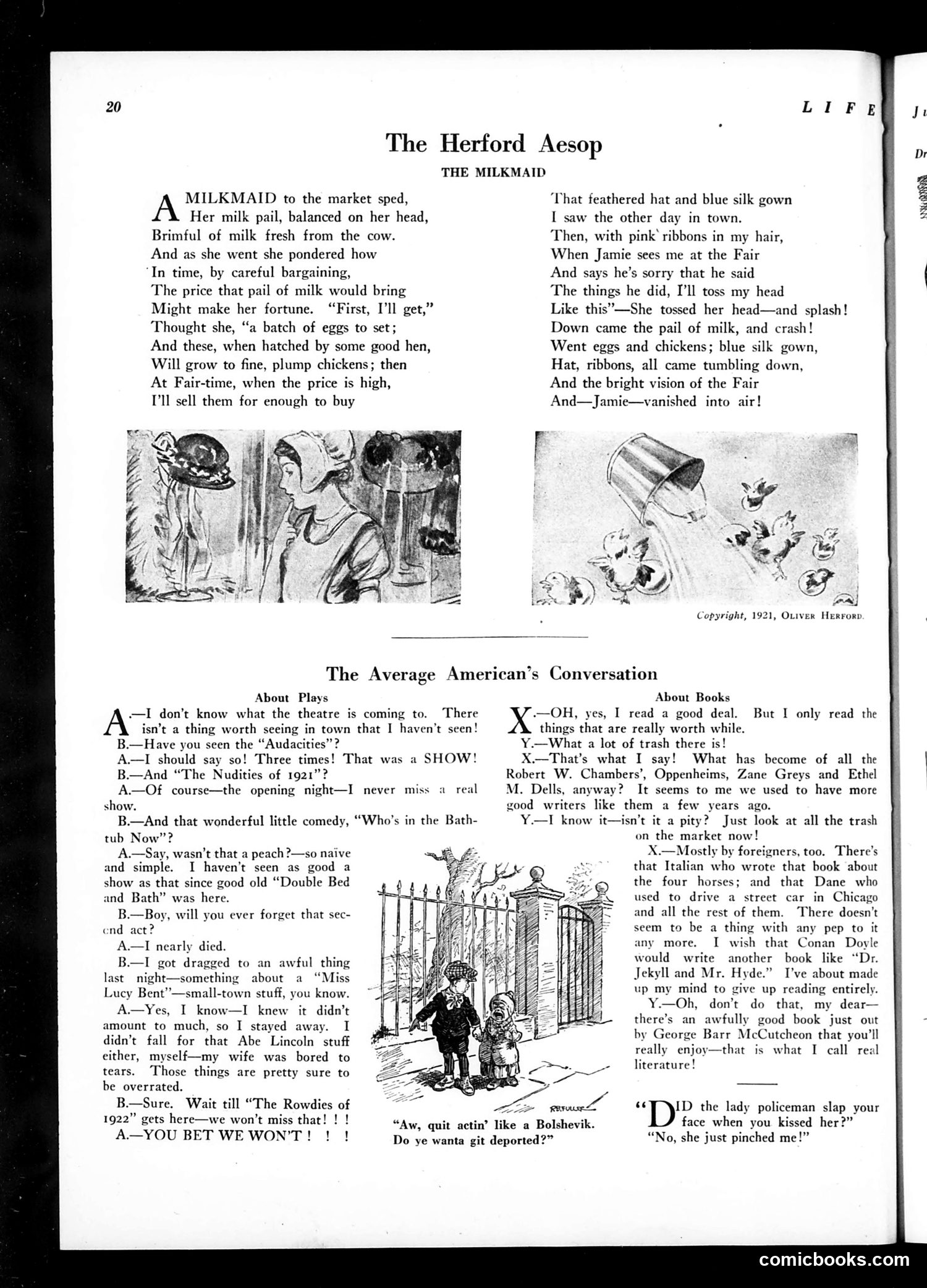
**"The Milkmaid"** illustrates Aesop's classical fable about counting chickens before they hatch. The milkmaid daydreams of selling milk for eggs, raising chickens, and buying fancy clothes to impress "Jamie" at the fair. Her distraction causes her to spill the milk, destroying her imagined fortune. The moral: idle fantasizing about future gains can cause you to lose what you already have. **"The Average American's Conversation"** satirizes shallow, pretentious talk about theater and books. Characters boast they've seen shows without remembering details, dismiss serious literature as "trash," and complain that old popular authors (Chambers, Zane Grey) no longer write. The satire targets Americans who claim cultural sophistication while admitting they avoid genuine art—preferring light entertainment and nostalgia over actual engagement with literature and theater.
📄 Transcribed text from this page (OCR, searchable)
Machine-transcribed from the original scan — historical spelling and the odd misread are preserved.
The Herford Aesop THE MILKMAID MILKMAID to the market sped, Her milk pail, balanced on her head, Brimful of milk fresh from the cow. And as she went she pondered how ‘In time, by careful bargaining, The price that pail of milk would bring Might make her fortune. “First, I’ll get,” Thought she, “a batch of eggs to set; And these, when hatched by some good hen, Will grow to fine, plump chickens; then At Fair-time, when the price is high, I'll sell them for enough to buy ‘That feathered hat and blue silk gown I saw the other day in town. Then, with pink’ ribbons in my hair, When Jamie sees me at the Fair And says he’s sorry that he said The things he did, I’ll toss my head Like this’—She tossed her head—and splash! Down came the pail of milk, and crash! Went eggs and chickens; blue silk gown, Hat, ribbons, all came tumbling down, And the bright vision of the Fair And—Jamie—vanished into air! Copyright, 1921, Oxiver Herrorp. The Average American’s Conversation About Books Xe yes, I read a good deal. things that are really worth while. Y.—What a lot of trash there is! About Plays —I don’t know what the theatre is coming to. There A isn’t a thing worth seeing in town that I haven't seen! B.—Have you seen the “Audacities” ? A.—I should say so! Three times! That was a SHOW! B.—And “The Nudities of 1921”? A—Of course—the opening night—I never miss a real show. B.—And that wonderful little comedy, “Who's in the Bath- tub Now”? A.—Say, wasn’t that a peach ?—so naive and simple. I haven't seen as good a show as that since good old “Double Bed and Bath” was here. B.—Boy, will you ever forget that sec- end act? A.—I nearly died. B—I got dragged to an awful thing last night—something about a “Miss Lucy Bent”—small-town stuff, you know. A—Yes, I know—I knew it didn’t amount to much, so I stayed away. I didn’t fall for that Abe Lincoln stuff either, myself—my wife was bored to tears. Those things are pretty sure to be overrated. B.—Sure. Wait till “The Rowdies of 1922” gets here—we won’t miss that! ! ! A—YOU BET WE WON'T! ! ! “Aw, quit actin’ like a Bolshevik. Do ye wanta git deported?” But I only read the X.—That’s what I say! What has become of all the Robert W. Chambers’, Oppenheims, Zane Greys and Ethel M. Dells, anyway? It seems to me we used to have more good writers like them a few years ago. Y.—I know it—isn’t it a pity? Just look at all the trash on the market now! X.—Mostly by foreigners, too. There's that Italian who wrote that book about the four horses; and that Dane who used to drive a street car in Chicago and all the rest of them. There doesn’t seem to be a thing with any pep to it any more. I wish that Conan Doyle would write another book like ‘Dr. Jekyll and Mr. Hyde.” I’ve about made up my mind to give up reading entirely. Y.—Oh, don’t do that, my dear— there’s an awfully good book just out by George Barr McCutcheon that you’ll really enjoy—that is what I call real literature! “ ID the lady policeman slap your face when you kissed her?” “No, she just pinched me!” comicbooks.com