
Life, 1921-07-14 · page 6 of 34
Life — July 14, 1921 — page 6: what you’re looking at
What you’re looking at
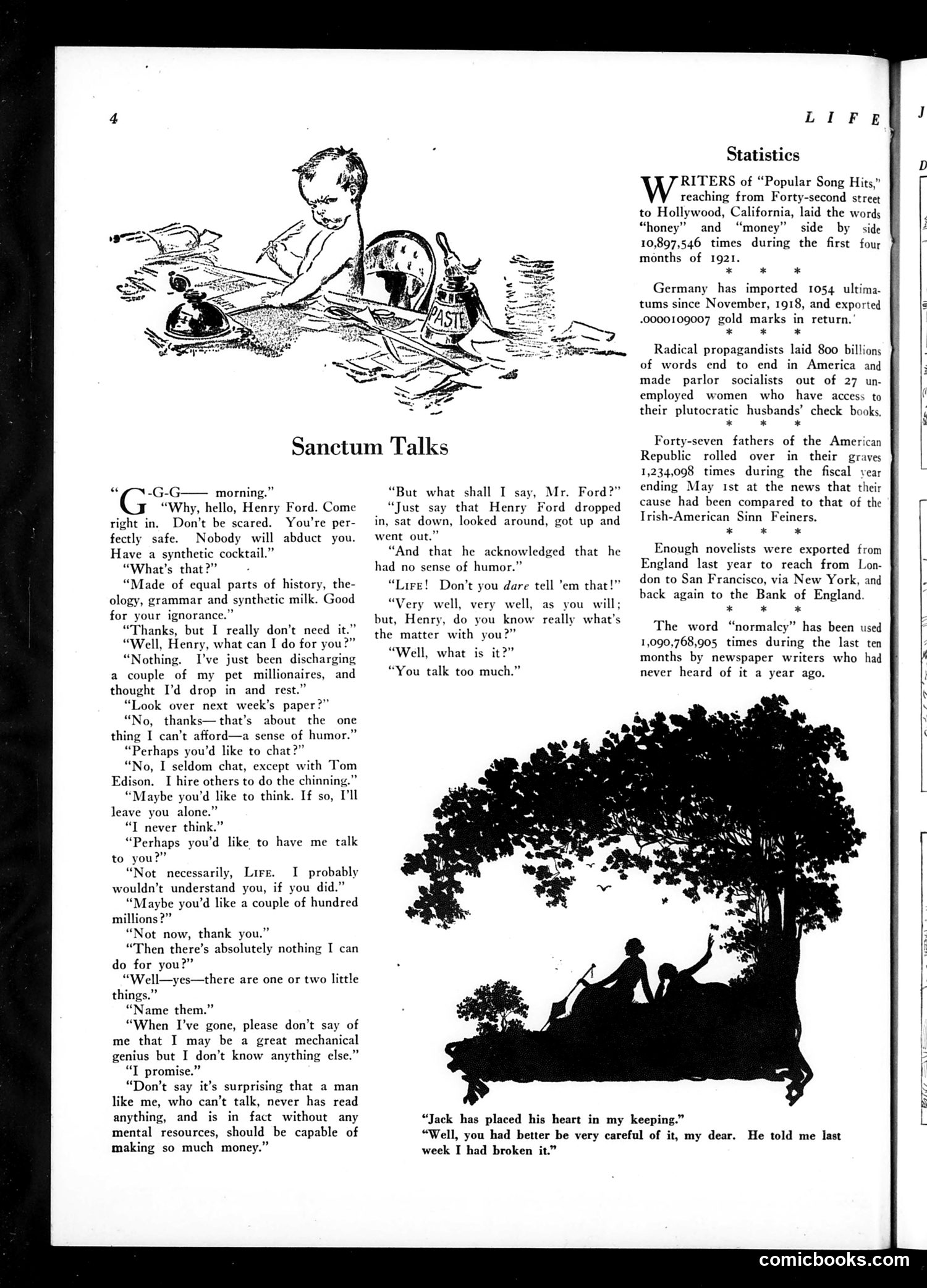
**"Sanctum Talks"** depicts a conversation between Henry Ford and the magazine *Life*, presented as satirical dialogue. Ford appears dismissive and defensive about his lack of knowledge beyond mechanics, declaring he "can't talk" and doesn't read. The joke satirizes Ford's public persona—a brilliant industrialist with limited intellectual interests outside engineering. **Statistics section** contains unrelated brief news items from 1921, including German gold imports and British propaganda efforts. **Bottom illustration** shows a silhouetted couple under a tree with the caption about "Jack" placing his heart in someone's keeping, then breaking it. This appears to be a sentimental romance illustration typical of period magazine content, unrelated to the Ford satire above.
📄 Transcribed text from this page (OCR, searchable)
Machine-transcribed from the original scan — historical spelling and the odd misread are preserved.
Sanctum Talks st -G-G. morning.” G “Why, hello, Henry Ford. Come right in. Don’t be scared. You're per- fectly safe. Nobody will abduct you. Have a synthetic cocktail.” “What's that?” “Made of equal parts of history, the- ology, grammar and synthetic milk. Good for your ignorance.” “Thanks, but I really don’t need it.” “Well, Henry, what can I do for you?” “Nothing. I’ve just been discharging a couple of my pet millionaires, and thought I’d drop in and rest.” “Look over next week’s paper?” “No, thanks—that’s about the one thing I can’t afford—a sense of humor.” “Perhaps you’d like to chat?” “No, I seldom chat, except with Tom Edison. I hire others to do the chinning.” “Maybe you'd like to think. If so, I'll leave you alone.” “T never think.” “Perhaps you’d like to have me talk to you?” “Not necessarily, Lire. I probably wouldn’t understand you, if you did.” “Maybe you'd like a couple of hundred millions?” “Not now, thank you.” “Then there’s absolutely nothing I can do for you?” “Well—yes—there are one or two little things.” “Name them.” “When I’ve gone, please don’t say of me that I may be a great mechanical genius but I don’t know anything else.” “T promise.” “Don’t say it’s surprising that a man like me, who can’t talk, never has read anything, and is in fact without any mental resources, should be capable of making so much money.” “But what shall I say, Mr. “Just say that Henry Ford dropped in, sat down, looked around, got up and went out.” “And that he acknowledged that he had no s “Lire! nse of humor.” Don’t you dare tell ’em that!” “Very well, very well, as you will; but, Henry, do you know really what's the matter with you?” : “Well, what is it?” “You talk too much.” LIFE Statistics RITERS of “Popular Song Hits,” reaching from Forty-second street to Hollywood, California, laid the words “honey” and “money” side by side 10,897,546 times during the first four months of 1921. * * * Germany has imported 1054 ultima. tums since November, 1918, and exported .0000109007 gold marks in return.’ * * * Radical propagandists laid 800 billions of words end to end in America and made parlor socialists out of 27 un- employed women who have access to their plutocratic husbands’ check books. * * * Forty-seven fathers of the American Republic rolled over in their graves 1,234,098 times during the fiscal year ending May 1st at the news that their cause had been compared to that of the Irish-American Sinn Feiners. * * * Enough novelists were exported from England last year to reach from Lon- don to San Francisco, via New York, and back again to the Bank of England. * * * The word “normalcy” has been used 1,090,768,905 times during the last ten months by newspaper writers who had never heard of it a year ago. “Jack has placed his heart in my keeping.” “Well, you had better be very careful of it, my dear. week I had broken it.” He told me last comicbooks.com ———