
A complete issue · 38 pages · 1921
Life — June 9, 1921
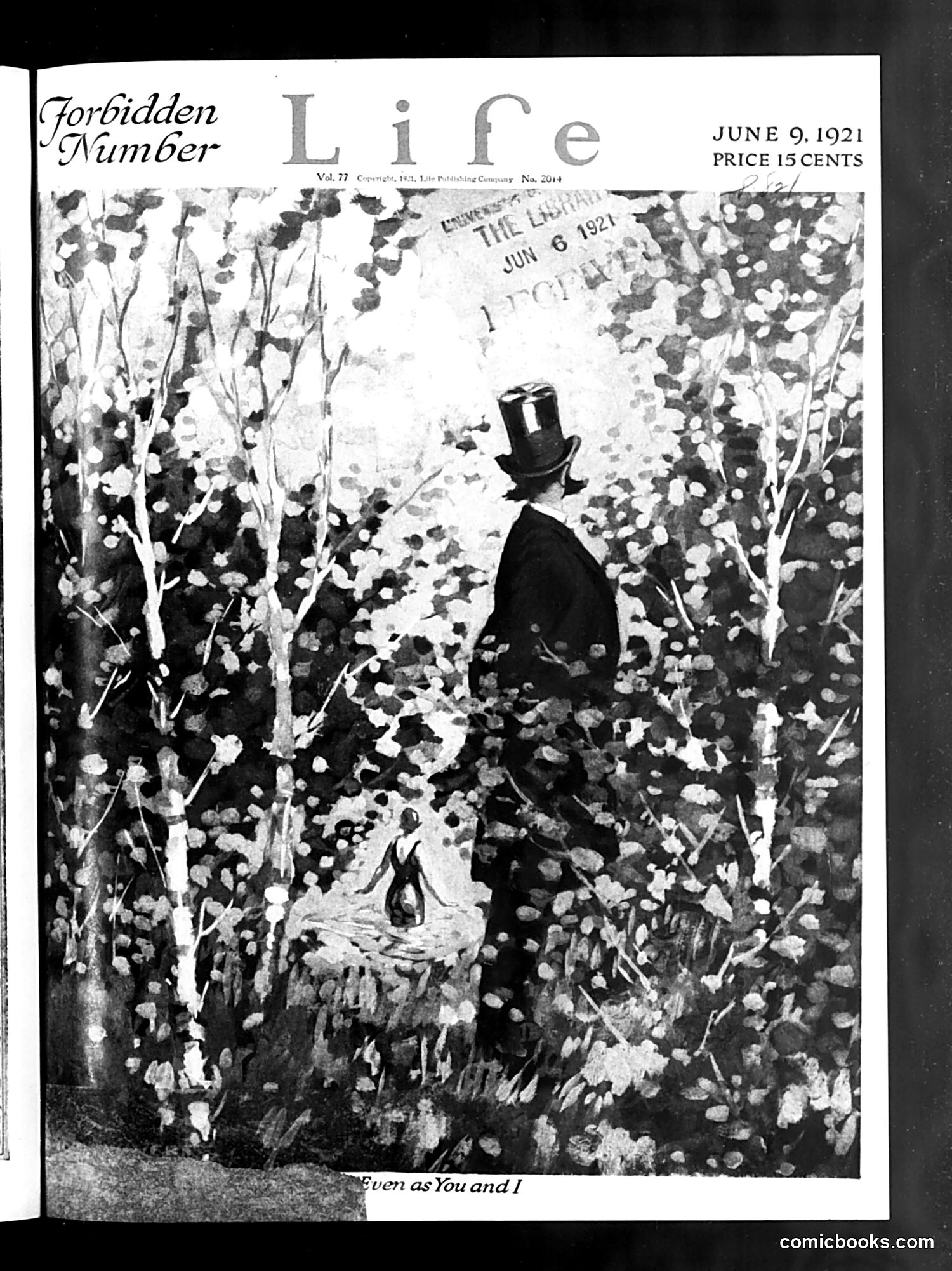
This cover illustrates "Even as You and I," a phrase suggesting universal human experiences. A man in formal attire (top hat and tailcoat) stands amid a massive field of blooming flowers, appearing small and somewhat lost in nature's abundance. The satire likely comments on the contrast between civilized formality and natural chaos, or possibly the futility of human pretension when confronted with nature's indifference. The "Forbidden Number" label suggests this issue contained content considered risqué or controversial for 1921 audiences. Without additional context from the magazine's contents, the specific political or social reference remains unclear, though the image plays on contrasts between artifice and authenticity common to Life's satirical approach of that era.
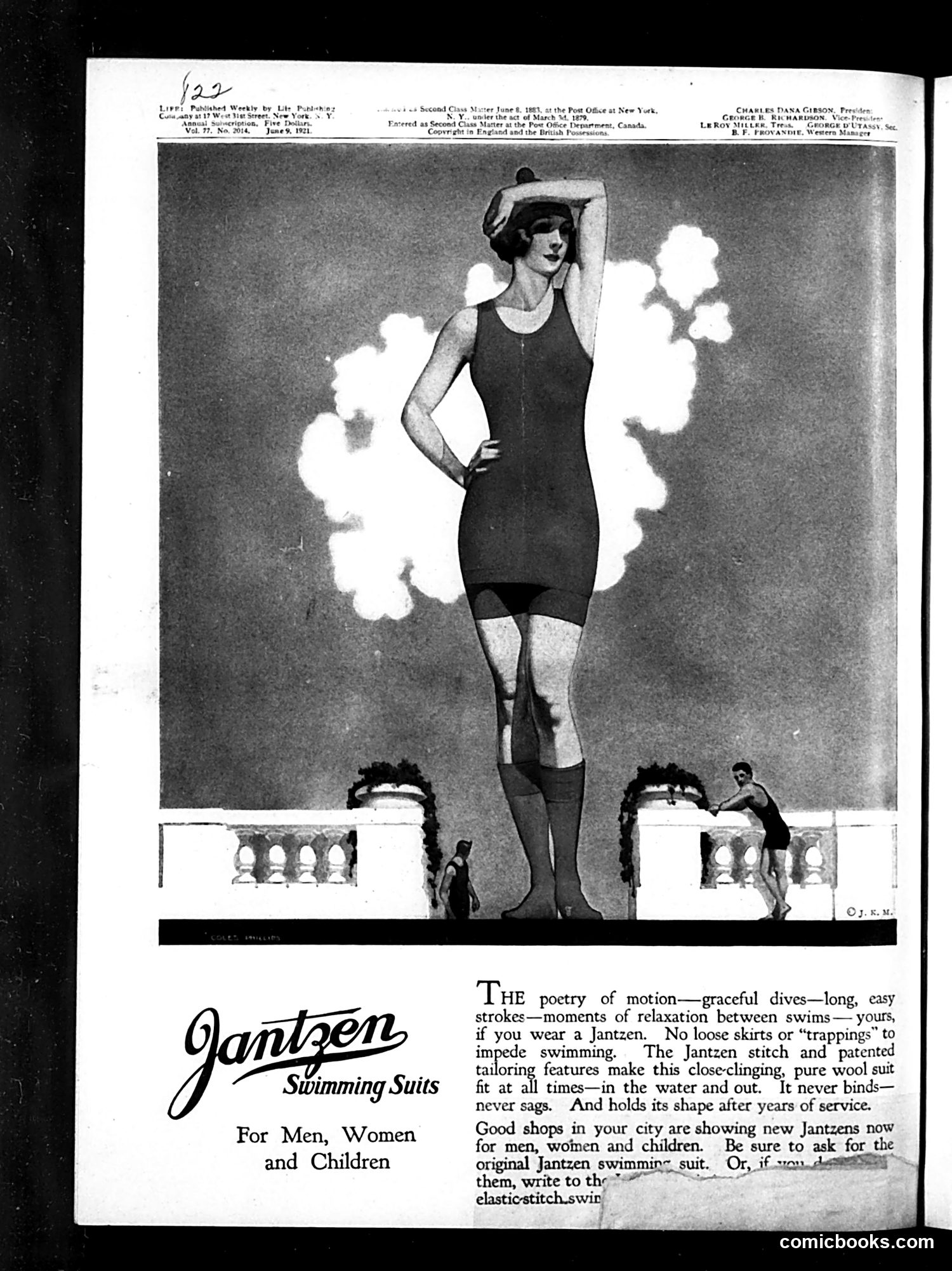
This page is primarily an **advertisement for Jantzen Swimming Suits**, not satire or political commentary. The image depicts a stylized woman in a one-piece swimming suit striking a confident pose on what appears to be a classical balustrade. The dramatic composition—with clouds and small figures below—presents the swimsuit as elegant and fashionable rather than purely functional. The accompanying text emphasizes the suit's innovative design features: the patented elastic-stitch construction that prevents binding, maintains shape, and fits snugly when wet. The copy targets middle-class consumers ("good shops in your city"), positioning Jantzen as the premium "original" brand worth seeking out. This reflects 1920s marketing strategies that used artistic, aspirational imagery to sell women's athletic wear as symbols of modernity and freedom.
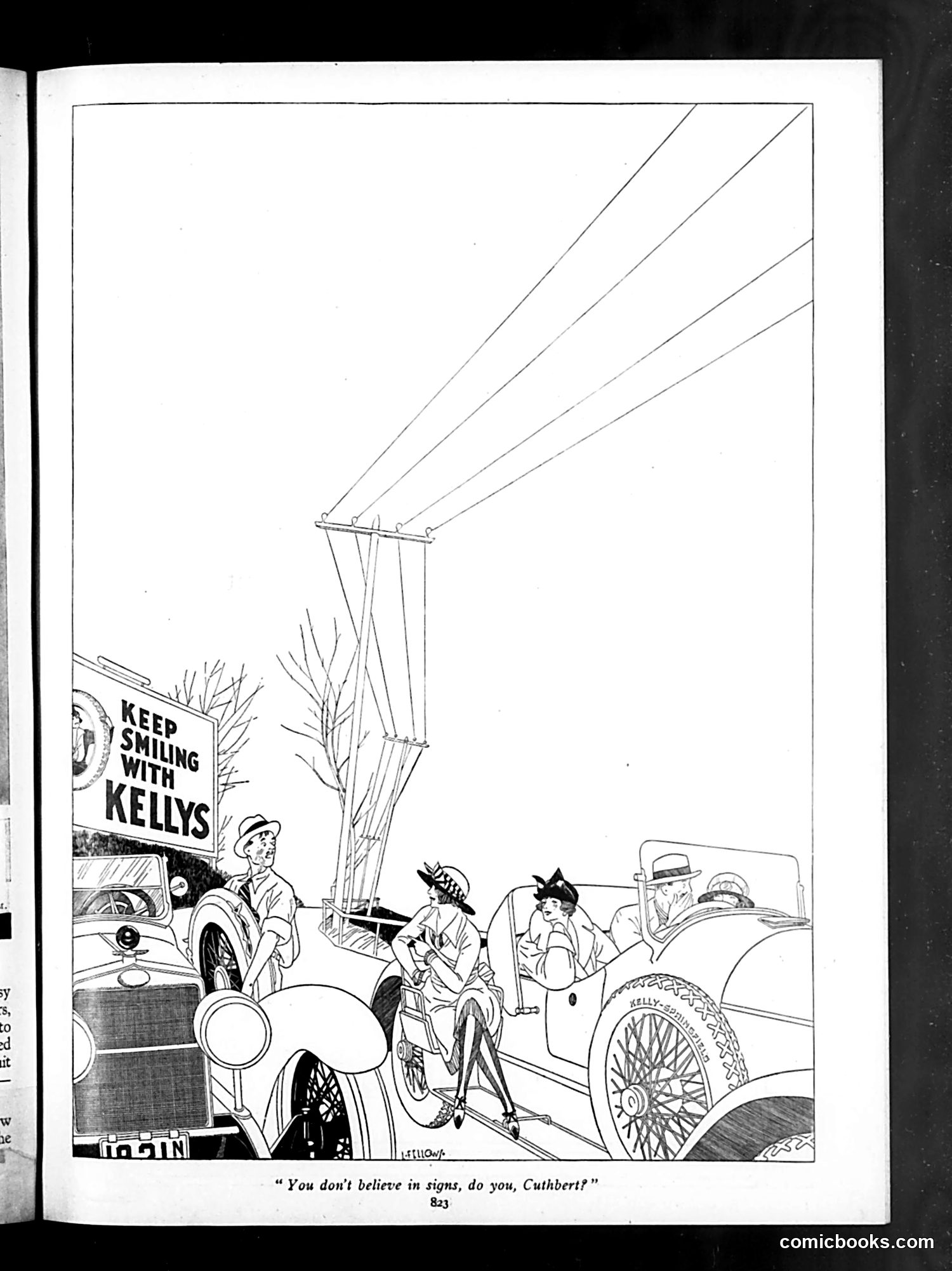
This is a satirical cartoon about automotive safety and skepticism. The scene shows what appears to be a car accident or collision at a gas station under a "Keep Shilling with Kellys" sign. One character asks another, "You don't believe in signs, do you, Cuthbert?" The joke plays on a double meaning: the sign advertises Kelly tires/automotive products, but the character's skepticism about "signs" refers to warning signs or omens. The implication is that ignoring warning signs—whether literal safety signs or intuitive warnings—leads to accidents. The cartoon satirizes consumer attitudes about automotive safety products and the tendency to disregard cautions. The vintage car styles and gas station setting suggest this is from the early-to-mid 20th century, when automobile safety was an emerging concern.
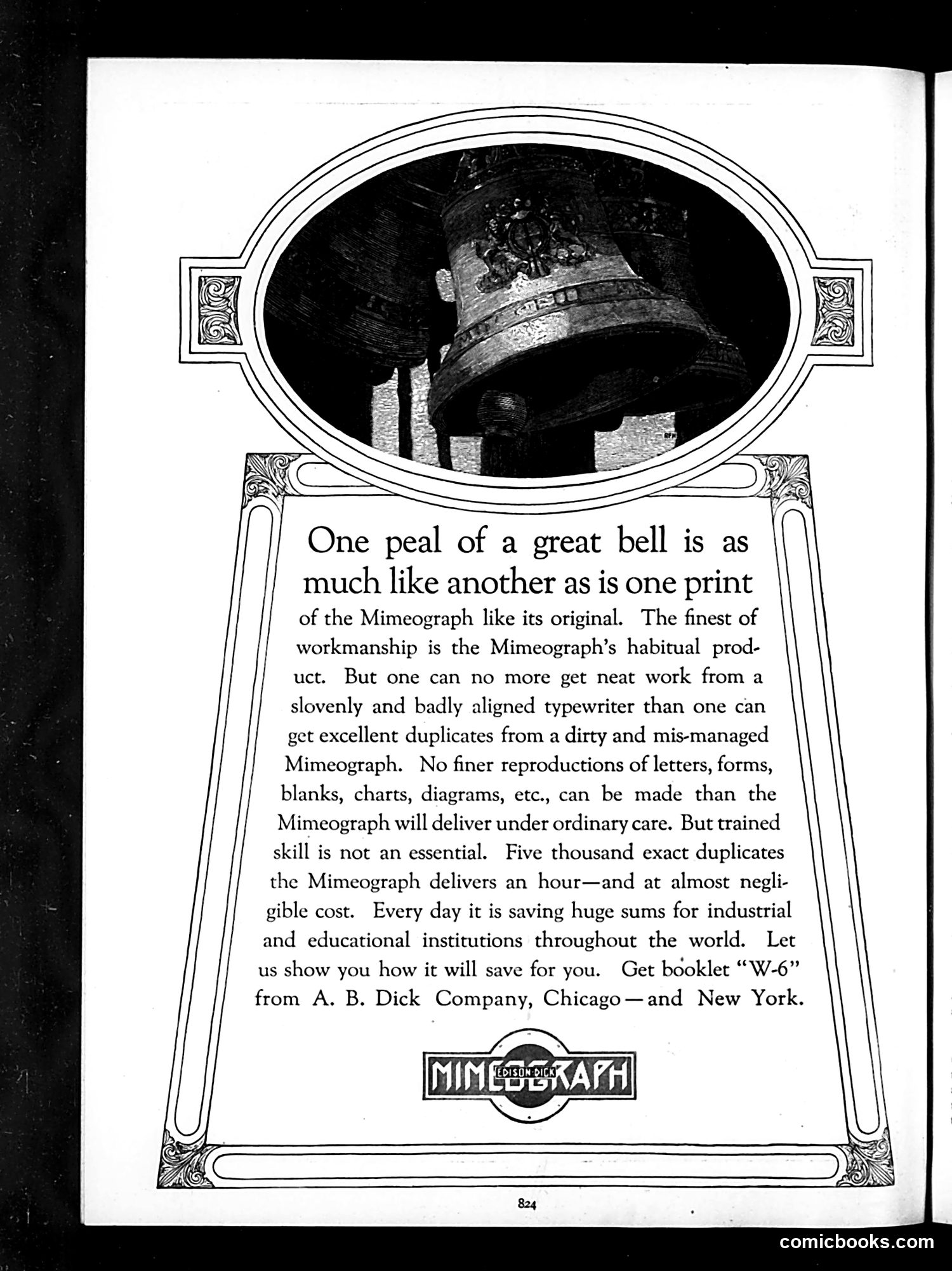
This page is **advertising, not satire or political cartoon**. It's a Mimeograph machine advertisement from the A. B. Dick Company (Chicago and New York). The ad uses an extended metaphor comparing a bell's peal to a typewriter's output and Mimeograph duplicates—all supposedly similar in quality. The ornate oval photograph shows a large bell, illustrating the "one peal of a great bell" opening line. The advertisement emphasizes the Mimeograph's efficiency (5,000 duplicates hourly) and cost-effectiveness for "industrial and educational institutions." It claims excellent reproduction quality requires only ordinary care, not specialized skill. Readers are directed to request booklet "W-6" for more information. This reflects early-20th-century office technology marketing before photocopiers.
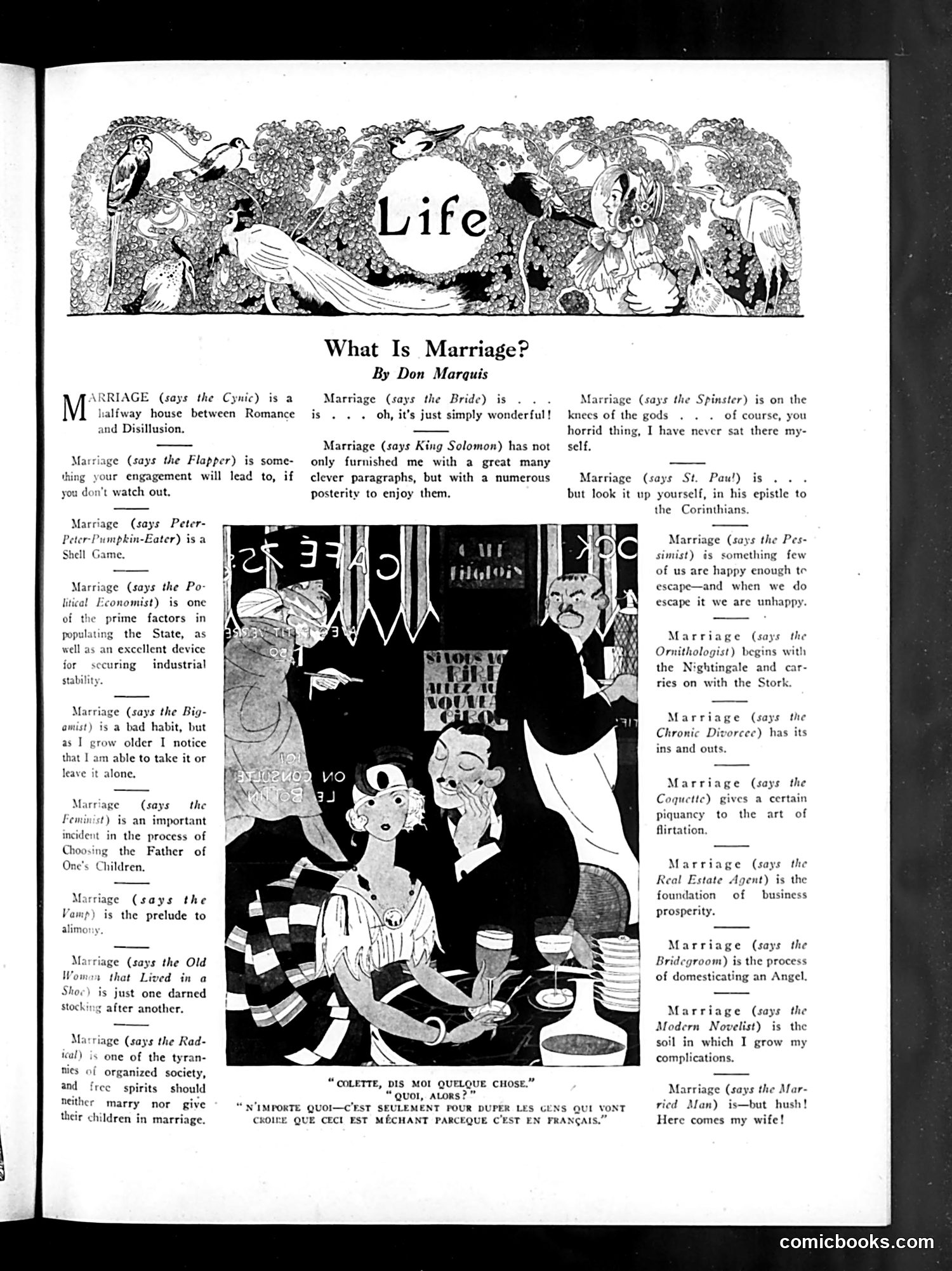
This satirical piece defines marriage through contrasting perspectives—cynical, romantic, religious, and practical. Marquis uses various "speakers" (the Cynic, the Bride, the Flapper, King Solomon, St. Paul, a Pessimist, etc.) to humorously expose marriage's contradictions. The central illustration depicts a couple at what appears to be a social gathering, surrounded by drink glasses and cigarette smoke—likely referencing 1920s Jazz Age culture and the social anxieties it provoked among traditionalists. The French caption suggests European sophistication, typical of *Life* magazine's urbane tone. The overall message: marriage means different things to different people, often creating conflict between romantic ideals and harsh realities. It's gentle social commentary on matrimonial expectations versus lived experience.
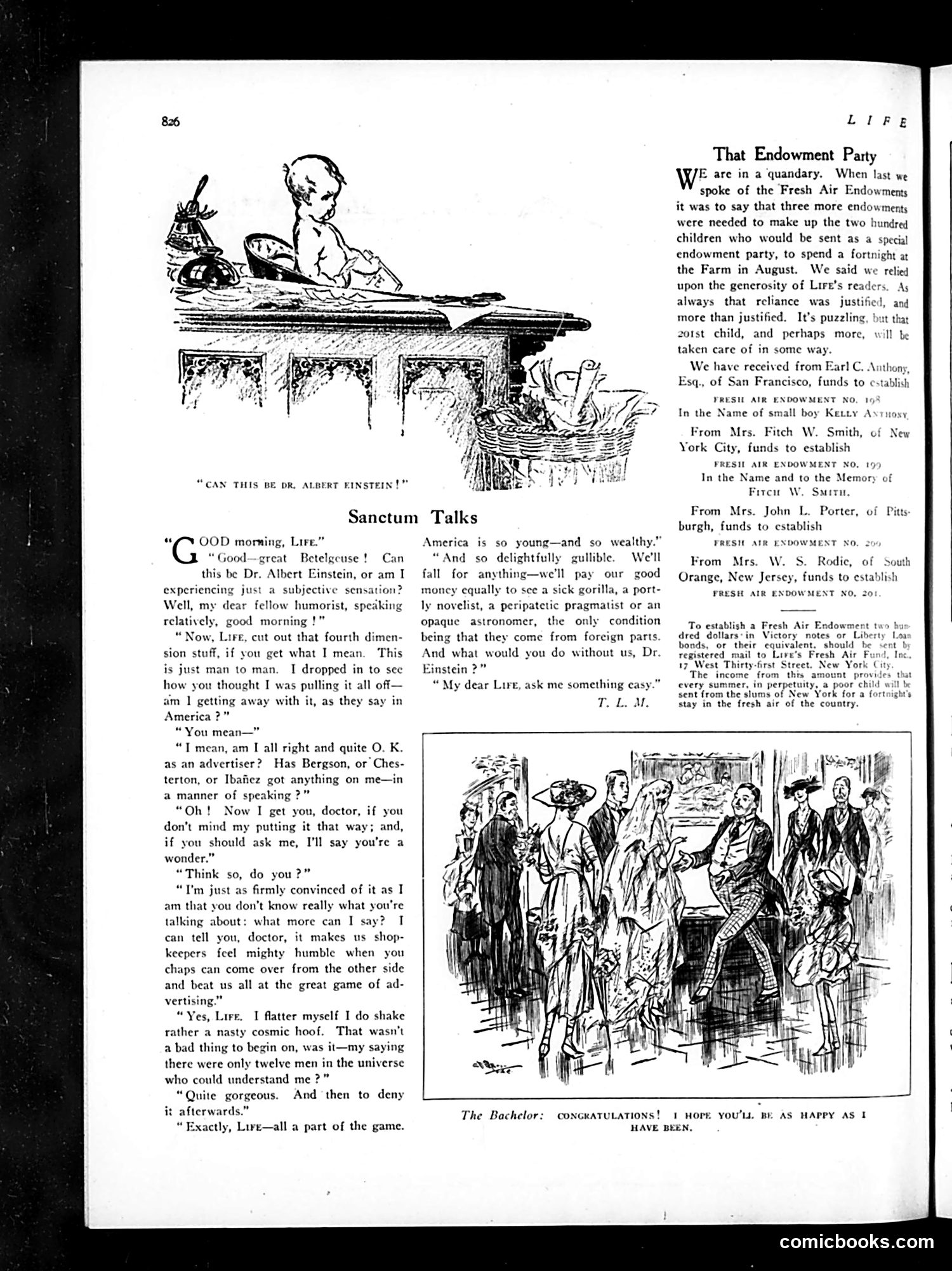
This page contains two distinct sections: **"Sanctum Talks"** (left): A satirical dialogue between "LIFE" and "Dr. Albert Einstein," playing on Einstein's famous complexity. The joke mocks how Einstein's theories are incomprehensible to ordinary people—even experts admit they don't understand what he's discussing. The satire suggests that advertising and public discourse often similarly rely on nonsensical claims nobody truly grasps, yet people accept them anyway. It's social commentary on both scientific obscurantism and advertising's persuasive emptiness. **Right side**: Text about "Fresh Air Endowment" fundraising and an illustration titled "The Bachelor" depicting a social gathering, likely celebrating an engagement or wedding. The page primarily serves LIFE's satirical mission: mocking intellectual pretension and commercial manipulation through humor.
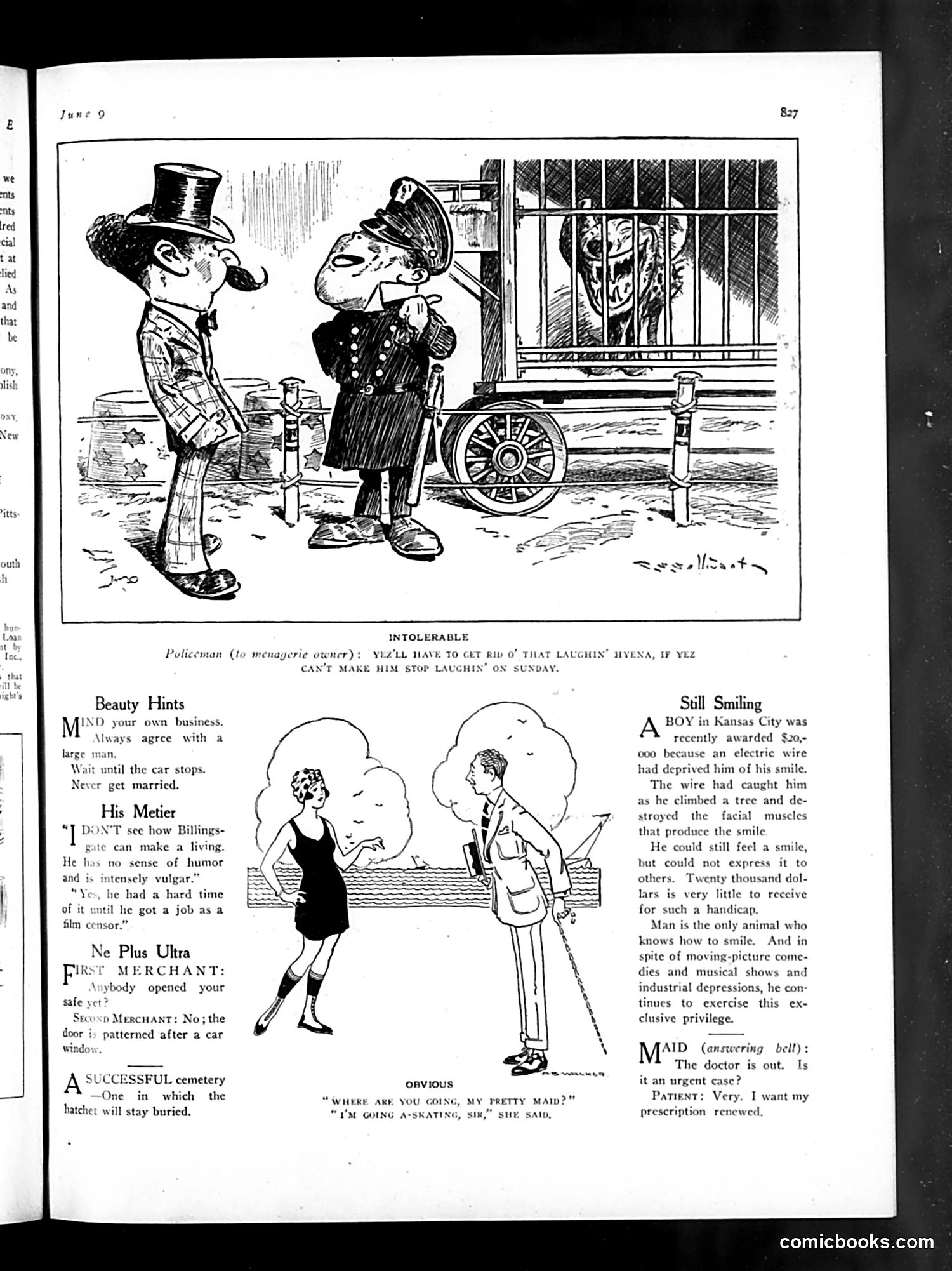
The top cartoon depicts a policeman confronting a menagerie owner beside a cage containing what appears to be a laughing hyena. The caption reads: "Policeman (to menagerie owner): Yiz'll have to get rid o' that laughin' hyena, if yez can't make him stop laughin' on Sunday." **The joke**: This satirizes blue laws—religious regulations prohibiting activities on Sundays. The absurdist humor comes from applying these restrictions to an animal's involuntary behavior. The policeman represents overzealous enforcement of puritanical Sunday laws, while the hyena's uncontrollable laughter mocks the impossibility of compliance. The cartoon criticizes such laws as unreasonable intrusions on personal freedom, even extending to the ridiculous notion of policing an animal's natural conduct.
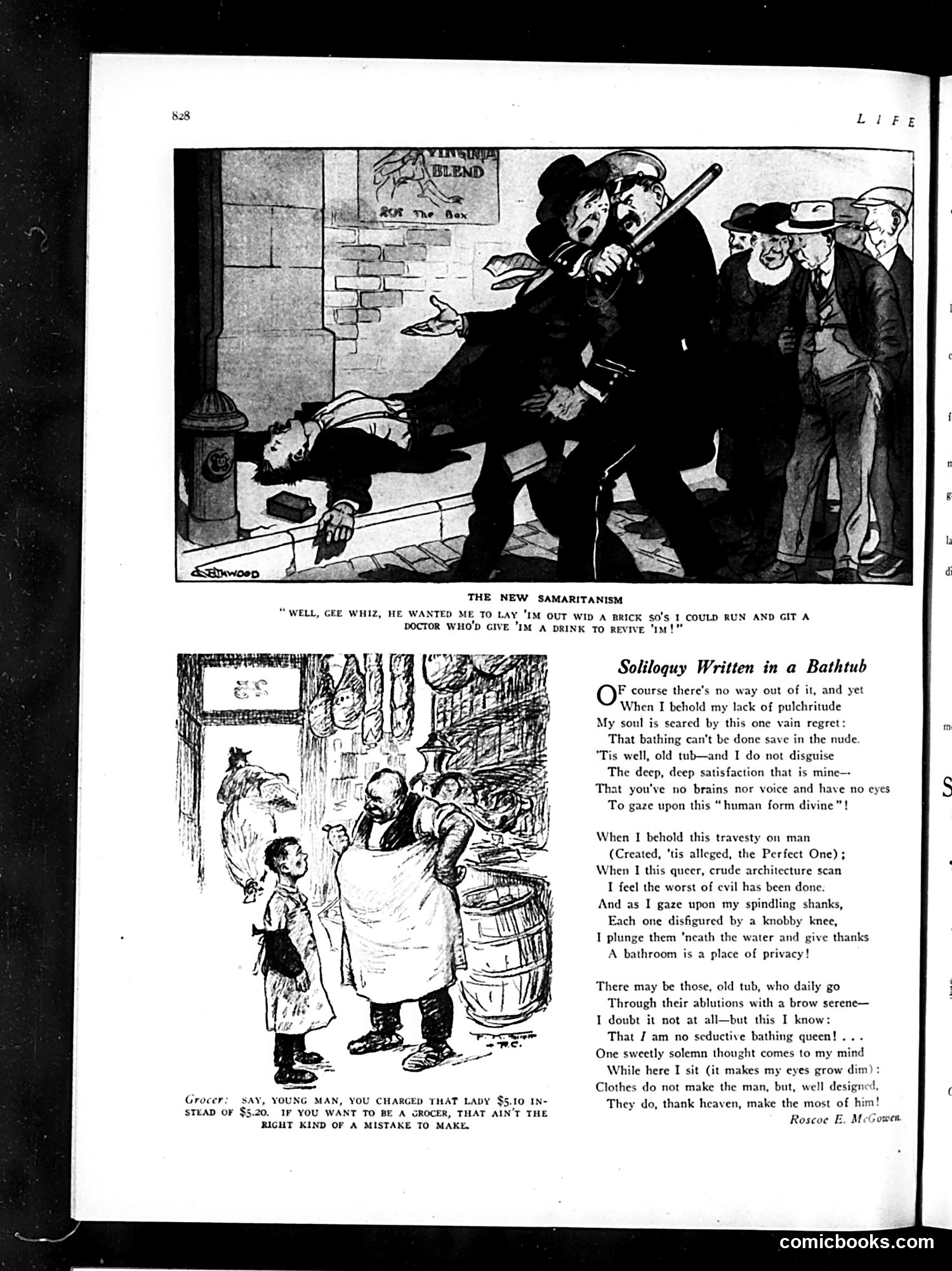
**Top Cartoon:** Shows a man lying injured on a street while well-dressed bystanders pass by. One figure holds a club. The caption sarcastically invokes the Biblical "Good Samaritan" parable—contrasting the story's moral lesson about helping strangers with modern urban indifference. The club-wielder appears to have *caused* the injury, and onlookers ignore the victim. This satirizes how contemporary society failed to embody Christian charity despite claiming moral values. **Bottom Section:** A grocer's comic exchange mocks economic inequality—a customer complains about overcharging, and the grocer dismisses concern for ethical business. This reinforces the "New Samaritanism" theme: modern society prioritizes profit over human welfare. Both pieces critique the gap between professed Christian morality and actual social behavior.
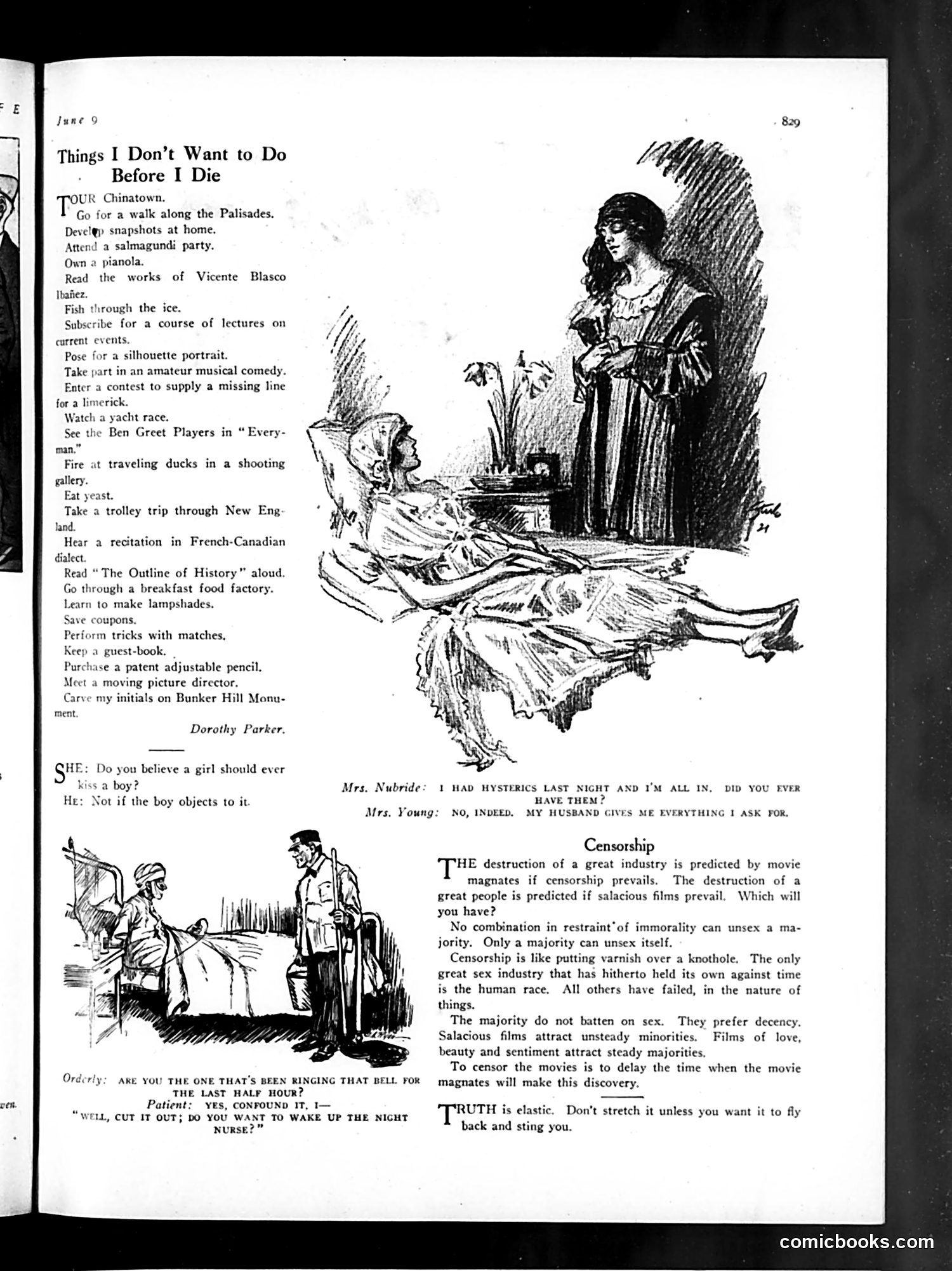
**"Things I Don't Want to Do Before I Die"** by Dorothy Parker is a humorous bucket-list inversion—listing activities she'll avoid rather than pursue. Items like "Tour Chinatown," "Attend a salmigundi party," and "Read 'The Outline of History' aloud" mock pretentious cultural pursuits and tedious social obligations common among educated Americans. **The cartoon below** depicts a domestic quarrel about kissing, with the woman asking if a girl should kiss a boy; the man refusing unless the boy objects—a commentary on dating customs and negotiated consent. **"Censorship"** is a serious editorial discussing film industry censorship, arguing that restricting "salacious" content delays inevitable social progress. The piece opposes censoring movies about love and beauty.
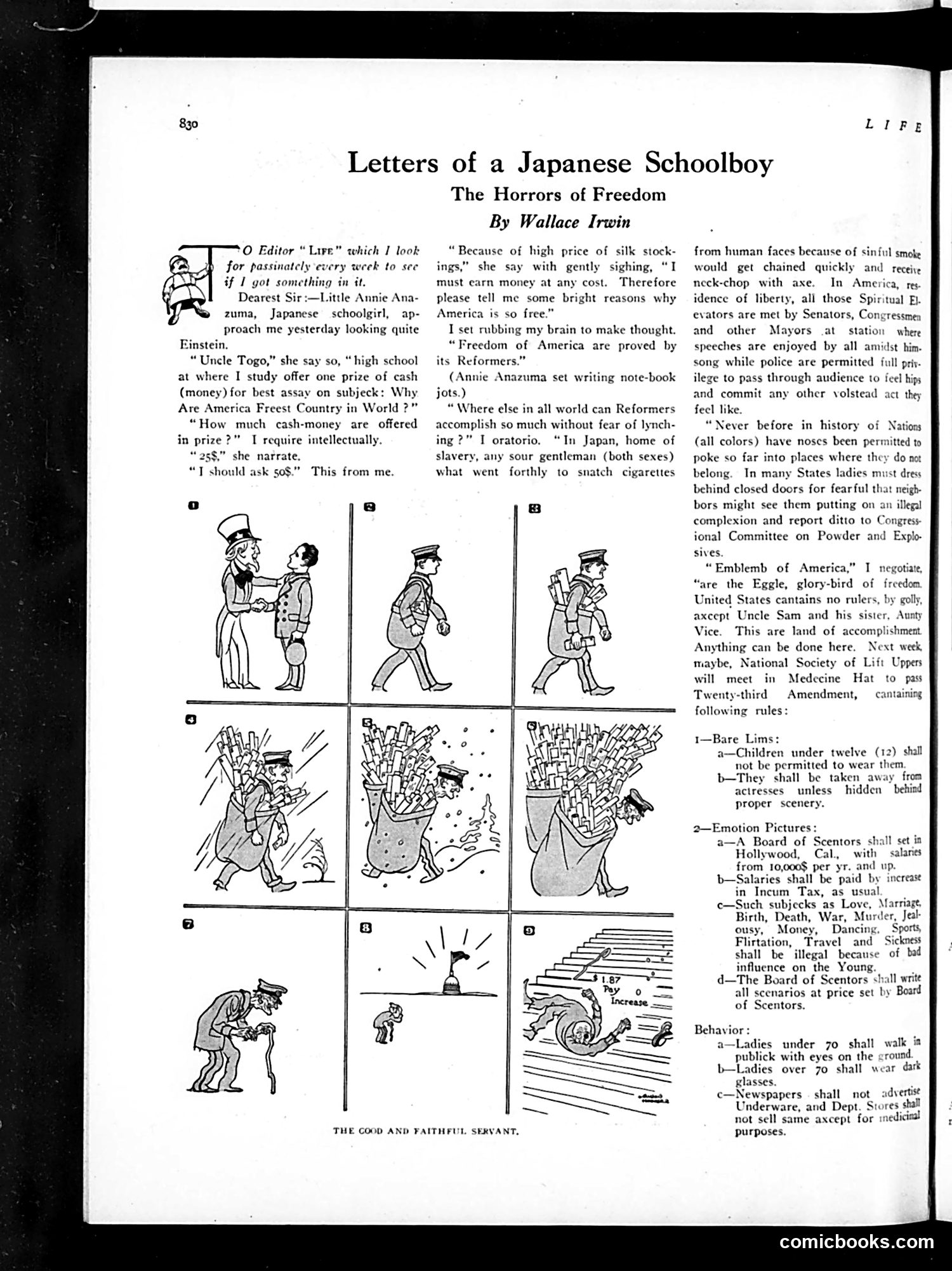
This satirical piece by Wallace Irwin presents a Japanese schoolboy's bewildered observations of American freedoms, which the author treats as absurdities. The boy questions why America offers cash prizes for schoolwork and expresses shock at American "Reformers" who accomplish social change without fear of lynching—contrasting this with Japan's stricter system. The accompanying comic strip (titled "The Good and Faithful Servant") depicts increasingly chaotic scenes of a servant struggling with overflowing baskets of cash/money, ultimately collapsing under the burden. This visualizes the satire's central joke: American capitalism and freedom, presented as comically excessive and unmanageable compared to Japan's more orderly hierarchy. The piece mocks American social progressivism while implicitly defending traditional Japanese structures.
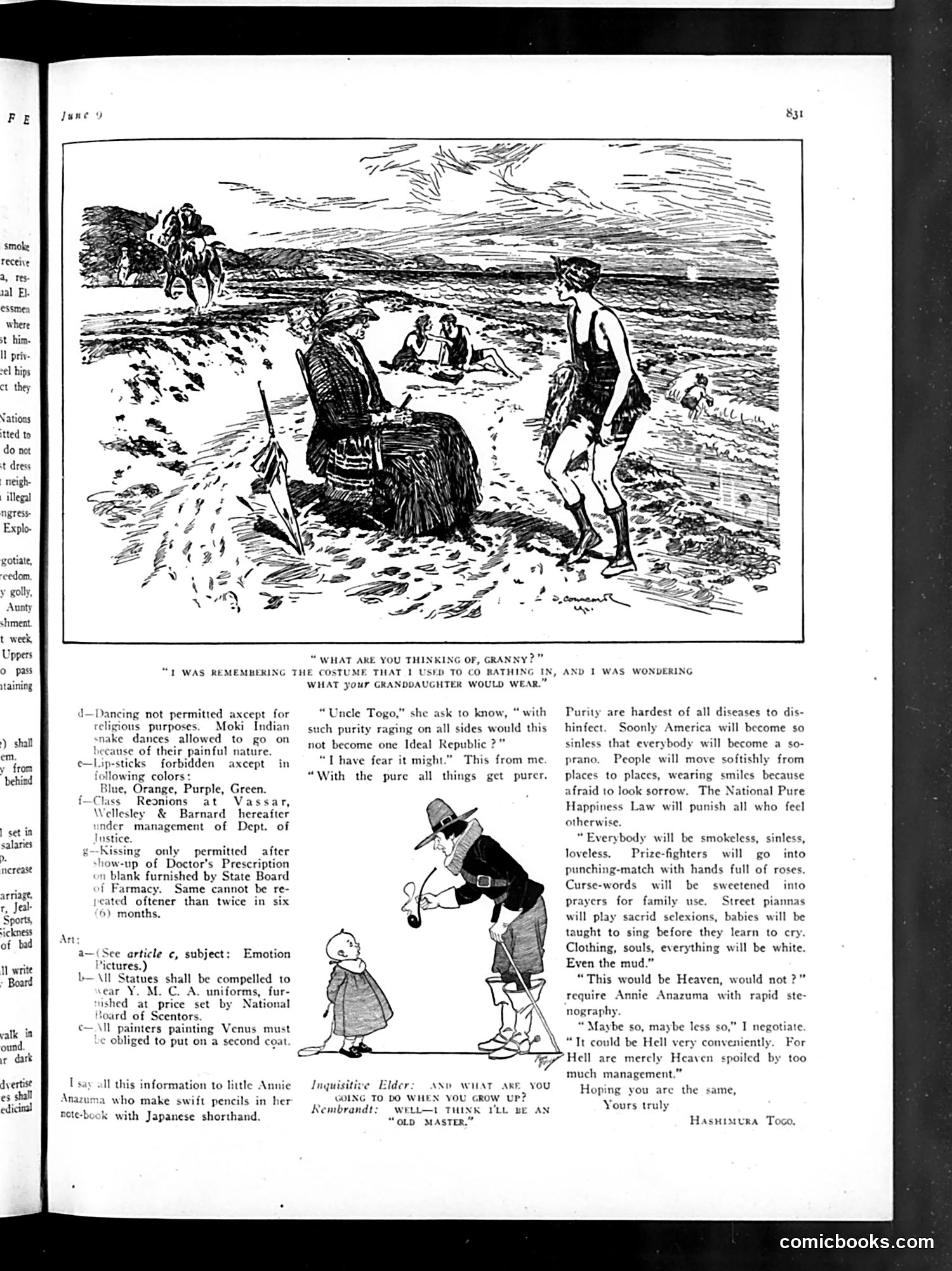
This page from *Life* magazine features a satirical beach scene with the caption "What are you thinking of, Granny?" The grandmother responds about remembering her bathing costume and wondering what her granddaughter would wear. The joke appears to target changing standards of modesty and women's fashion. The illustration shows beachgoers in what was contemporary (likely 1920s-era) swimwear, contrasting the grandmother's recollection of much more conservative Victorian or Edwardian bathing attire with the increasingly revealing styles of the younger generation. The right column contains unrelated content about "Purity" and social regulations, appearing to be editorial commentary or a letter. The page also includes various footnotes about conduct rules and artistic guidelines typical of the era. This reflects period anxieties about evolving social morality and generational differences regarding women's dress and public behavior.
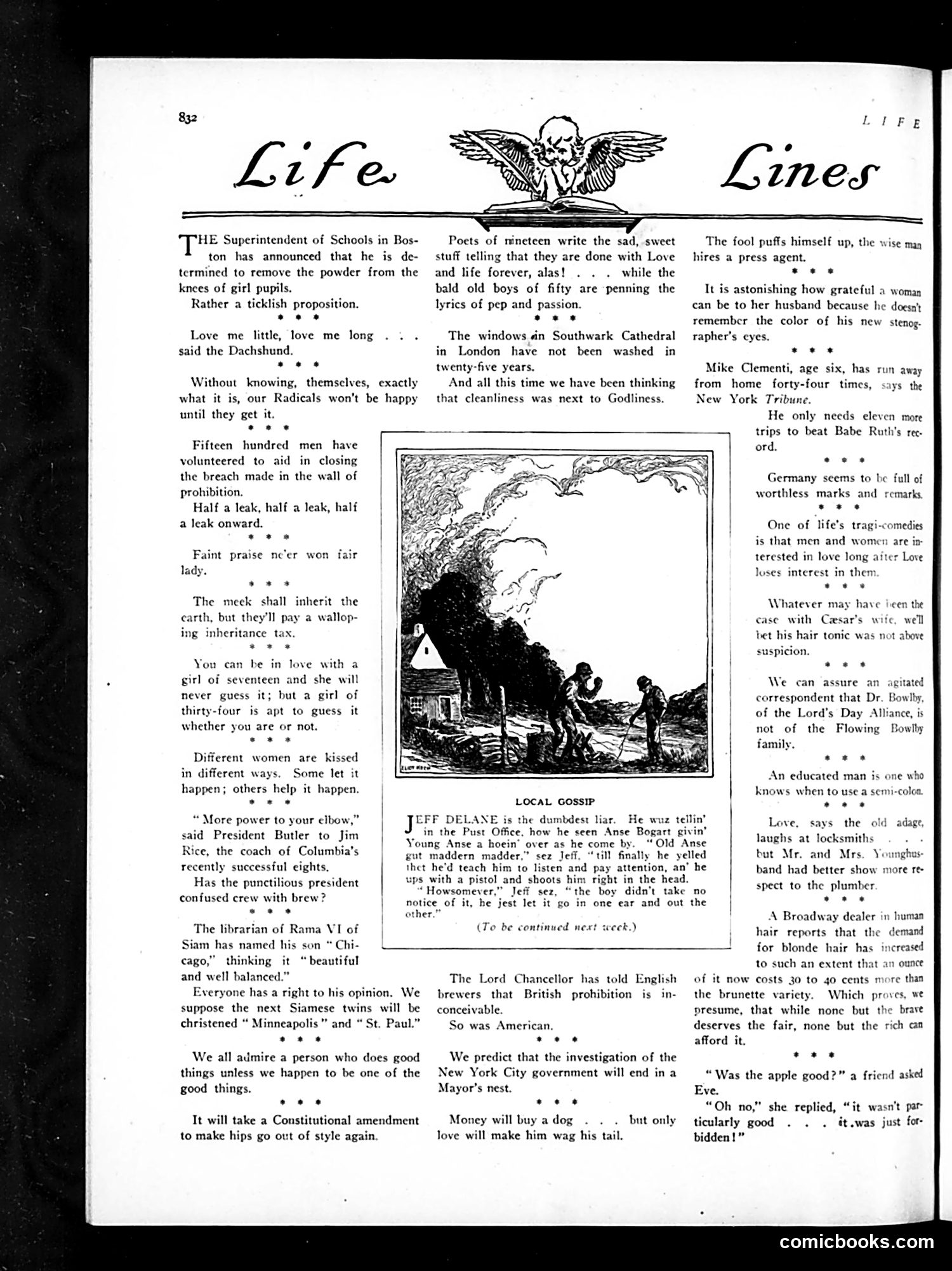
This page contains a "Life Lines" column of miscellaneous social and political commentary rather than a single unified cartoon. The content includes brief satirical observations on contemporary topics: - **School powder removal**: Mocking Boston's superintendent's decision to ban face powder from girls - **Love and poetry**: Cynical remarks about poets writing melancholy verses about romantic loss - **British social commentary**: References to Southwark Cathedral's dirty windows and debates about cleanliness and godliness - **Political jabs**: Criticisms of "Radicals" and commentary on American politics - **Minor gossip items**: Including Mike Clemente's baseball record and German currency issues The tone is consistently sardonic, targeting social pretension, romantic sentimentality, and political naïveté through brief, witty observations. An illustration of a rural scene appears but lacks clear political meaning.
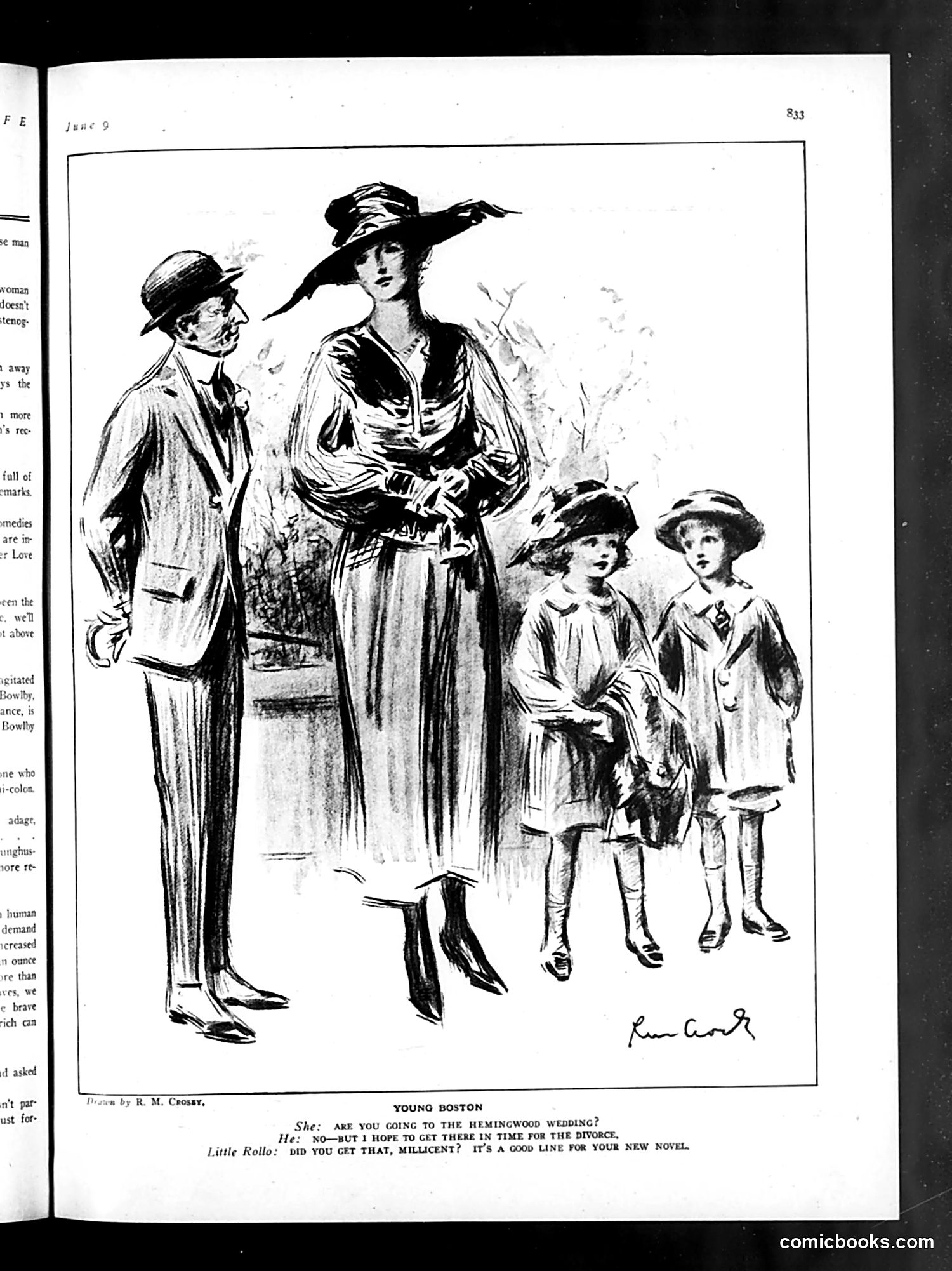
This satirical cartoon by R.M. Crosby depicts a well-dressed man and woman with two children, labeled "Young Boston." The dialogue mocks Boston society's preoccupation with high-society events and gossip. The woman asks if the man is attending the Hemingwood wedding; he responds he hopes to arrive in time for the divorce instead. The little boy then asks if this would make good material for a novel, suggesting satirical commentary on how Boston's elite scandals become fodder for literary fiction. The joke targets the stereotypical Boston upper class as simultaneously obsessed with formal social occasions while cynically expecting their marriages to fail, and willing to exploit personal tragedies for artistic material. It's social satire aimed at Brahmin hypocrisy.
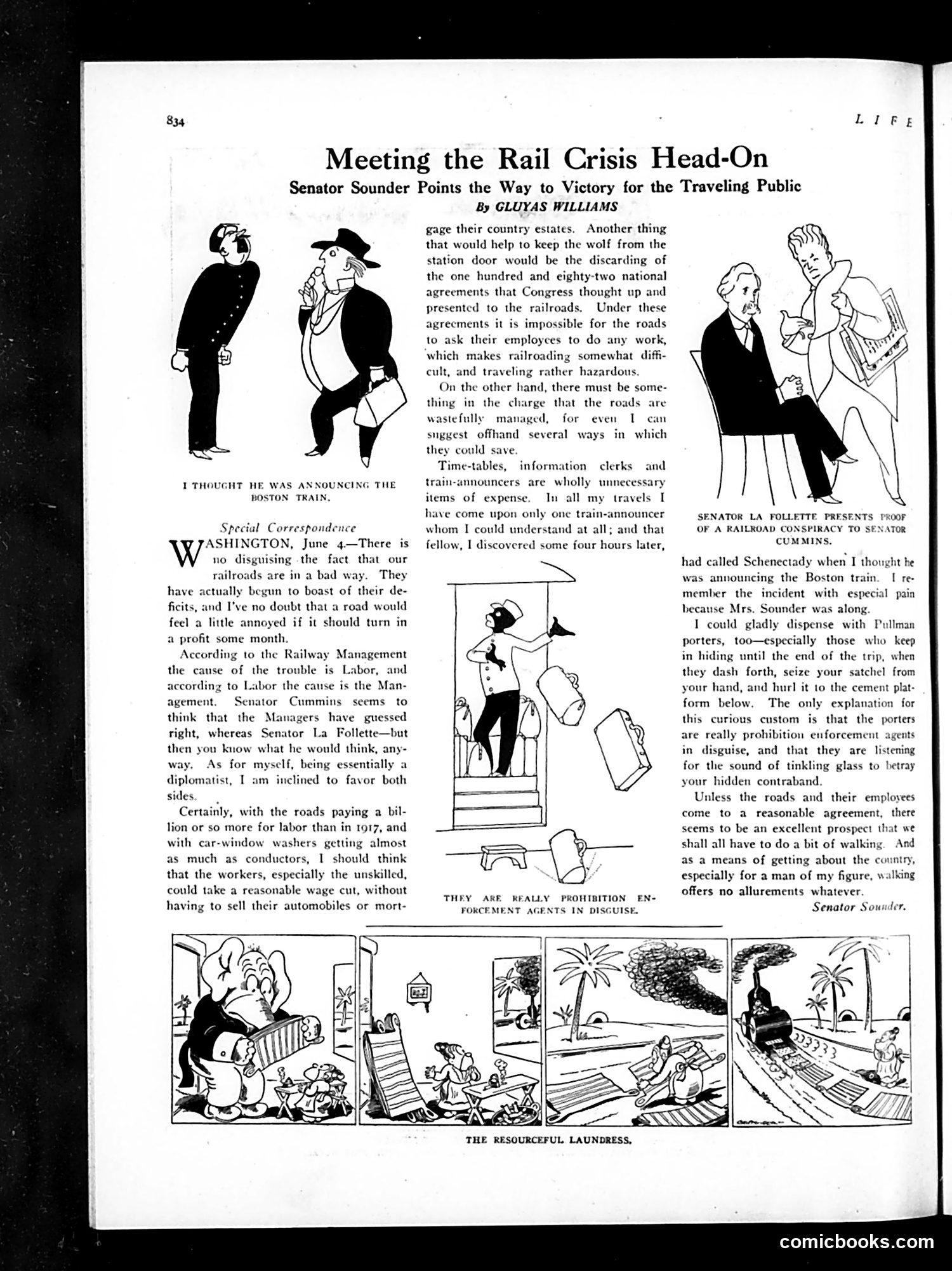
This *Life* magazine page satirizes the railroad labor crisis through Senator Sounder's perspective. The article criticizes railroad management for mismanagement and excessive overhead costs (train announcers, Pullman porters, unnecessary staff). The cartoons mock solutions: one depicts a senator announcing "the Boston train" (suggesting administrative bloat), another shows porters as "prohibition enforcement agents in disguise," sarcastically implying they confiscate contraband rather than serve passengers. The bottom comic strip, "The Resourceful Laundress," appears unrelated—a separate humorous feature showing a woman finding creative solutions, typical of *Life's* mixed satirical content. The satire targets both railroad management waste and what appears to be Prohibition-era absurdities affecting rail service.
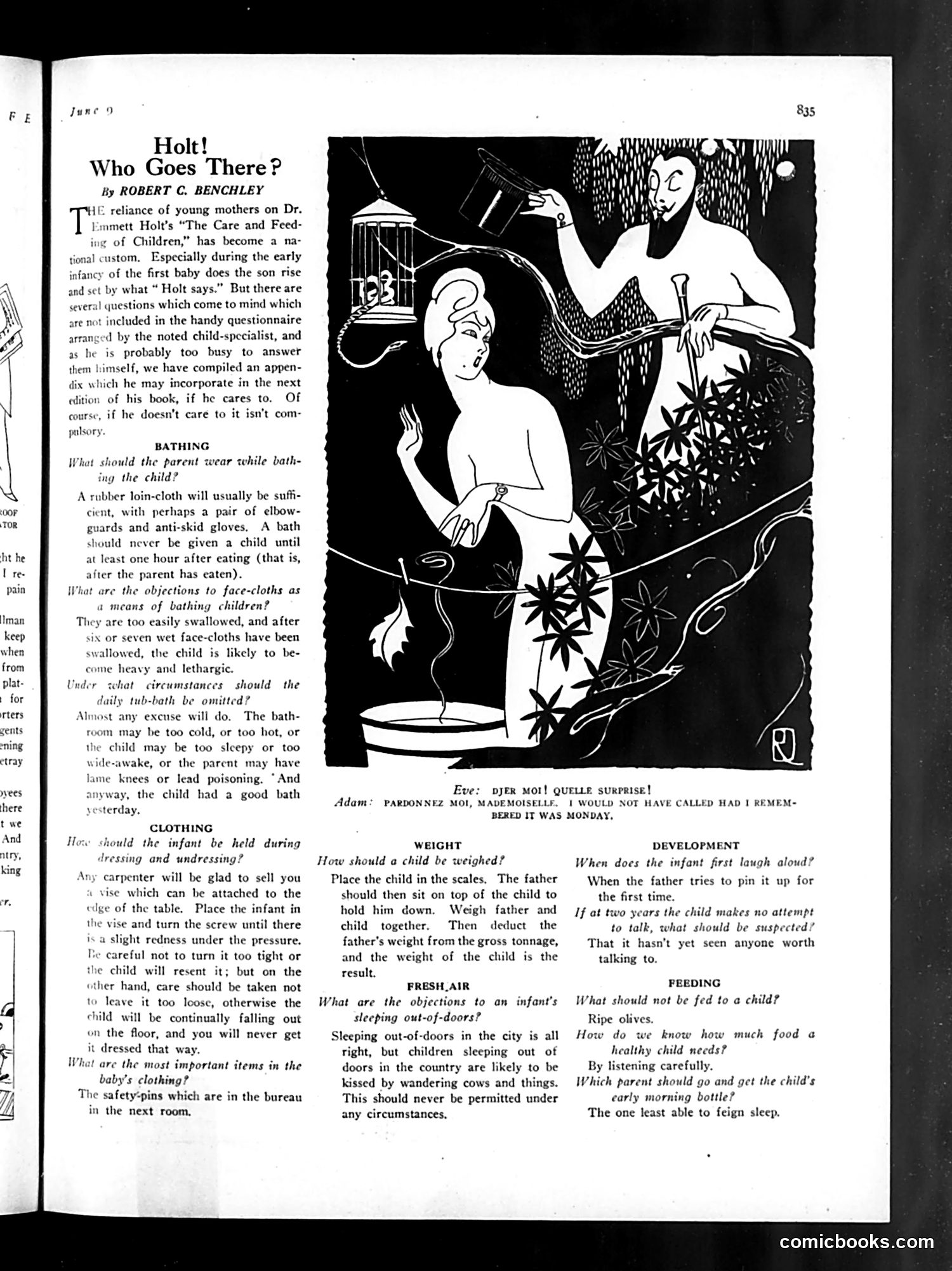
This is satirical advice about child-rearing based on Dr. Emmett Holt's influential book "The Care and Feeding of Children." The cartoon mocks the book's rigid recommendations by depicting a chaotic domestic scene where a mother wielding tools confronts a naked child in a bathtub surrounded by plants and animals—suggesting the absurdity of following Holt's prescriptive rules. The accompanying Q&A section parodies the book's format, offering increasingly ridiculous answers to parenting questions about bathing, clothing, weight, sleep, and feeding. The satire suggests Holt's advice, while popular among young mothers, often contradicts common sense and practical reality. The cartoonist implies such strict adherence to expert guidance produces confusion rather than better child care.
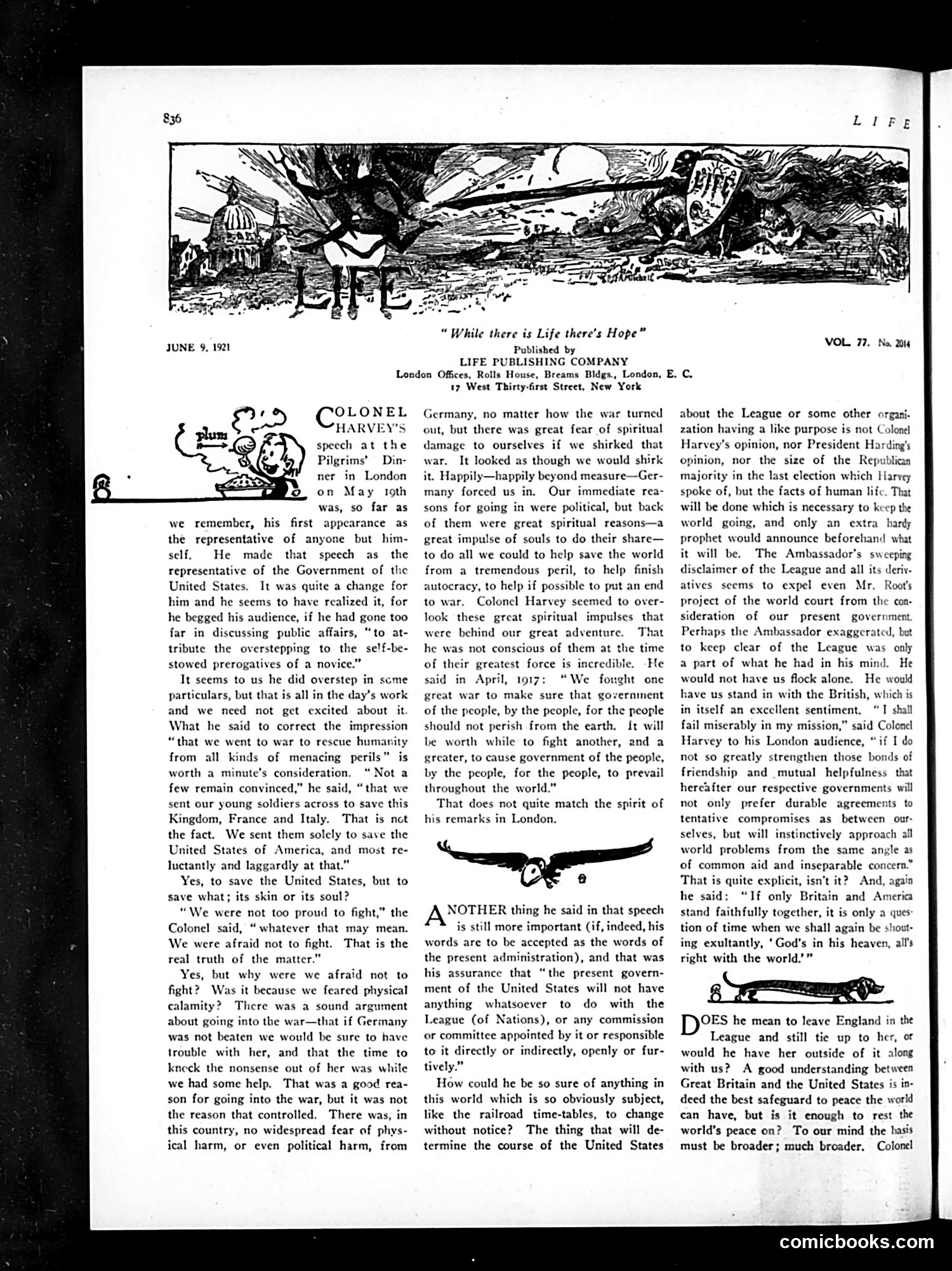
This page contains political commentary on Colonel Harvey's speech at the Pilgrims Club in London. The text discusses Harvey's assertion that the United States will not join the League of Nations or accept any League-appointed commissions, despite Britain and America's shared interests in world peace. The decorative header illustration appears to be a generic satirical masthead rather than commentary on the specific article. The article critiques Harvey's position, suggesting that while saving the U.S. from physical harm was justified, the refusal to cooperate internationally on peace matters is short-sighted. The author argues Britain and America must work together more broadly on world problems—that "the basis must be broader." This reflects 1921 isolationist tensions following World War I.
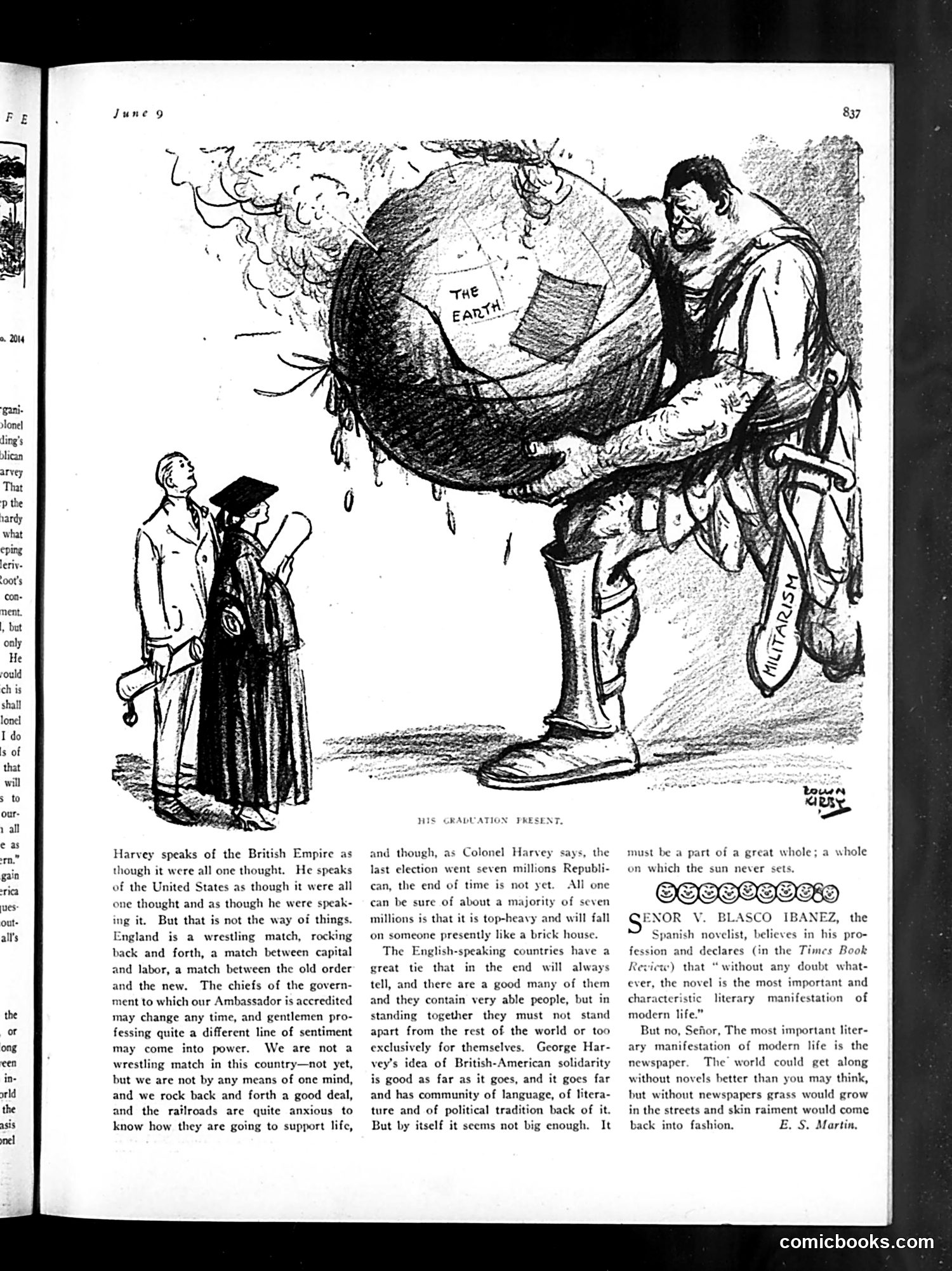
This cartoon satirizes Colonel George Harvey's advocacy for British-American solidarity. The image shows two large figures—apparently representing Britain and America—jointly holding up a globe labeled "THE EARTH," while two smaller figures below (likely representing ordinary citizens or diplomats) look on in wonder. The accompanying text criticizes Harvey's idea as insufficient. The author argues that while British-American alliance has merit through shared language and political tradition, it cannot stand alone; it must be part of a larger global community ("a whole on which the sun never sets"). The satire suggests Harvey's vision is too narrow and potentially dangerous if pursued as exclusive Anglo-American dominance rather than genuine international cooperation. The "graduation present" title likely implies this is a naive, idealistic gift to a newly independent perspective.
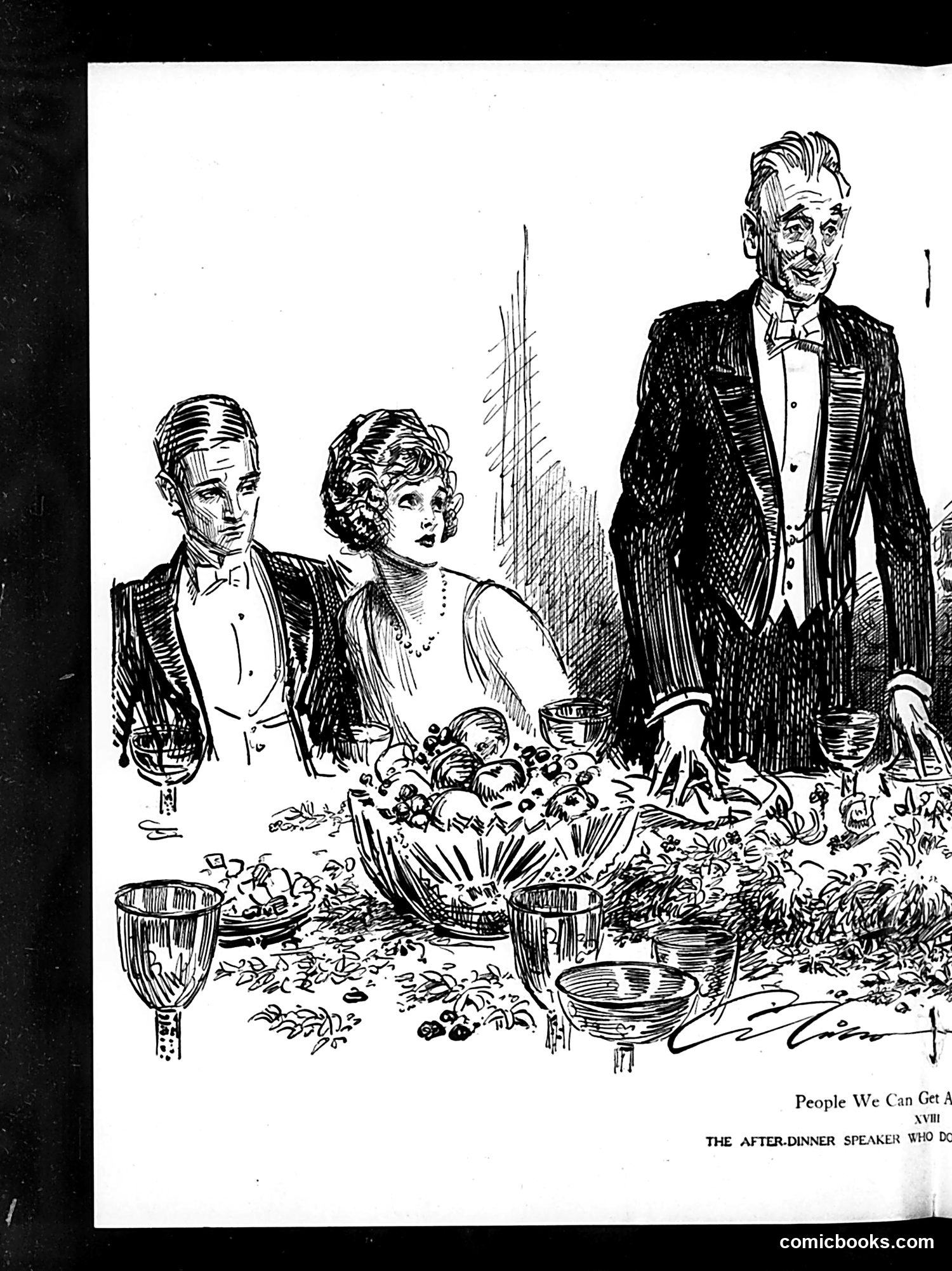
This is a satirical cartoon from *Life* magazine titled "The After-Dinner Speaker Who D[oes]..." (text cut off). It depicts three formally dressed people at what appears to be an elegant dinner, with food and drinks scattered on the table. The humor targets a recognizable social type: the after-dinner speaker at formal events. The cartoon likely satirizes speakers who are verbose, pompous, or otherwise problematic during post-meal speeches—a common fixture of upscale social gatherings in the early 20th century. The exaggerated formal attire and the presence of the tall, gesturing speaker on the right suggests he's the main subject of ridicule. The specific criticism isn't fully legible in the OCR'd text, but the cartoon mocks the pretension or tedium of formal dinner speeches, a social ritual that was more prominent then than today.
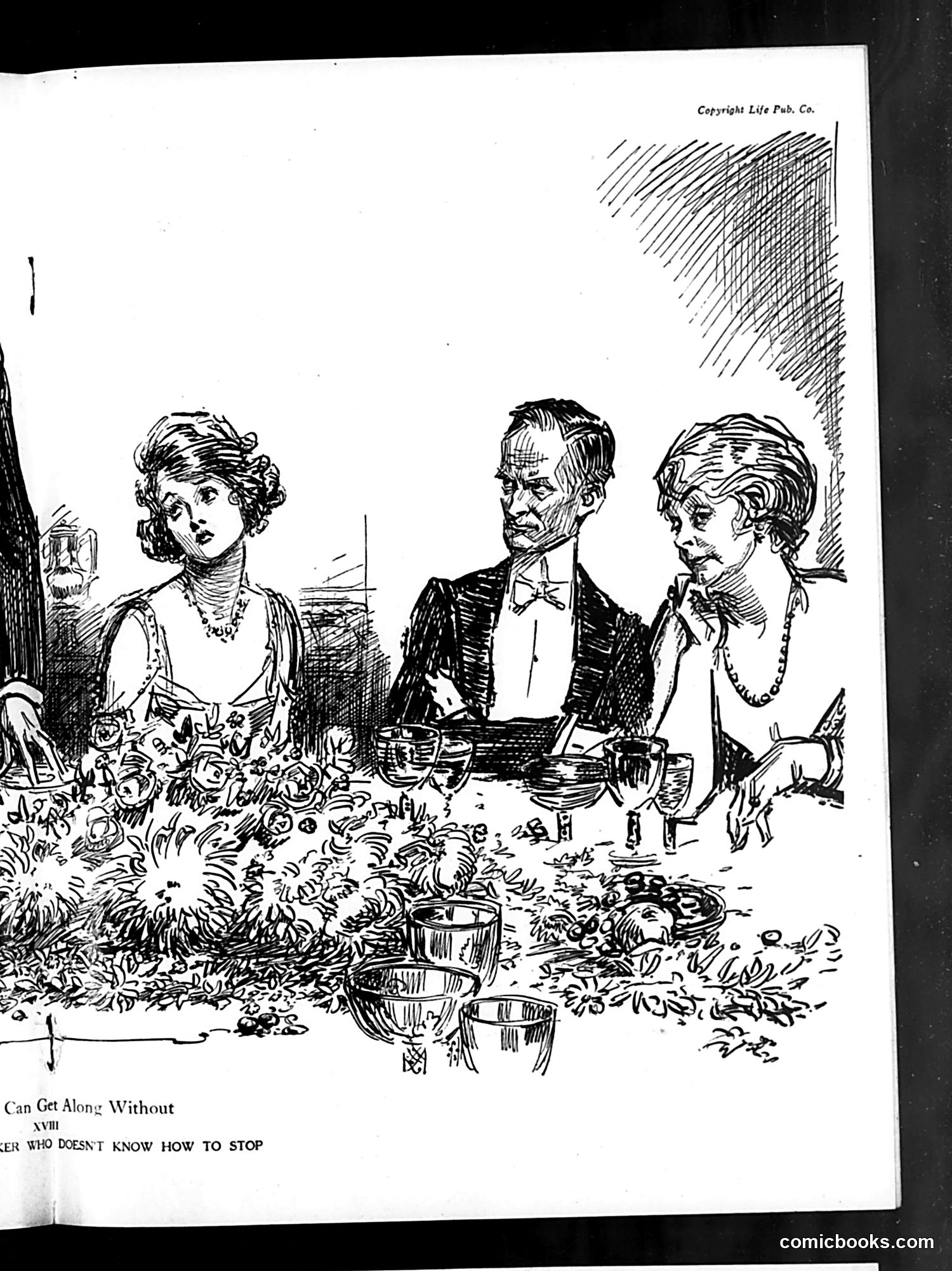
This is a satirical cartoon from *Life* magazine depicting a formal dinner scene with three elegant figures seated at a table laden with flowers and glassware. The caption reads "Can Get Along Without" followed by "A Man Who Doesn't Know How to Stop" (XVI suggests this is part of a series). The satire appears to target excessive talkers or bores at social gatherings—specifically men who dominate conversation and don't recognize social cues to cease speaking. The woman on the left appears skeptical or weary, while the central man in formal attire gestures while speaking. The cartoon satirizes a common social problem: someone who monopolizes dinner conversation without awareness of others' discomfort. This reflects early 20th-century etiquette concerns about social grace and dinner party comportment.
This page reviews a 1920 theatrical revival of "The Tavern," directed by and starring George M. Cohan, with William L. Thorne as the Tavern Keeper. The critic praises the production's intentional burlesque style—broad, exaggerated acting meant to mock melodramatic conventions. The satire targets motion-picture executives in the audience who miss the joke entirely, taking the hammy acting seriously. The critic compares Cohan's performance to his earlier work in vaudeville and musical comedy ("The Meanest Man in the World," "Hello, Broadway"), suggesting Cohan brings his characteristic vaudeville energy rather than the "mellow romance" another actor (Arnold Daly) previously brought to the role. The core complaint: Cohan's own clever additions and his natural comedic timing accidentally make audiences laugh *with* him rather than *at* the melodrama being parodied—undermining the burlesque's satirical intent. The critic gently chides Cohan for this confusion.
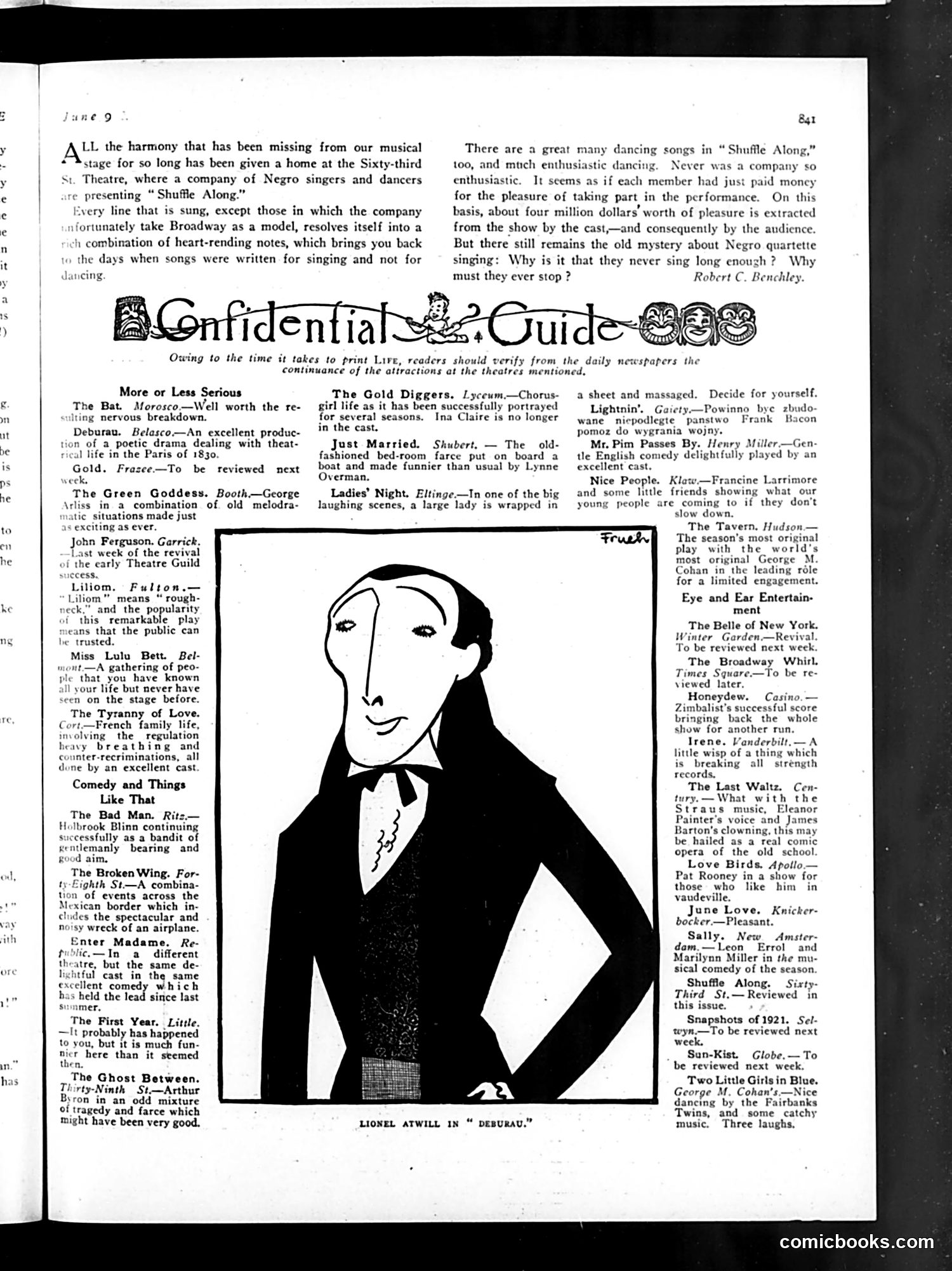
This page reviews "Shuffle Along," a groundbreaking 1921 Broadway show featuring Black singers and dancers. Critic Robert C. Benchley praises the production's musical authenticity and performers' enthusiasm, noting they extract "four million dollars' worth of pleasure" from the performance. **The cartoon** shows **Lionel Atwill** in "Deburau"—a separate theatrical production about 19th-century Parisian theater life, unrelated to the main review. **Historical context**: "Shuffle Along" was a landmark all-Black musical during the segregated 1920s, rare on mainstream Broadway. Benchley's review is notably respectful, though his closing question—"Why is it that they never sing long enough? Why must they ever stop?"—reflects period paternalism even in praise. The page is primarily **theater listings and reviews**, a standard Life magazine feature. The Atwill portrait is incidental illustration, not political commentary.
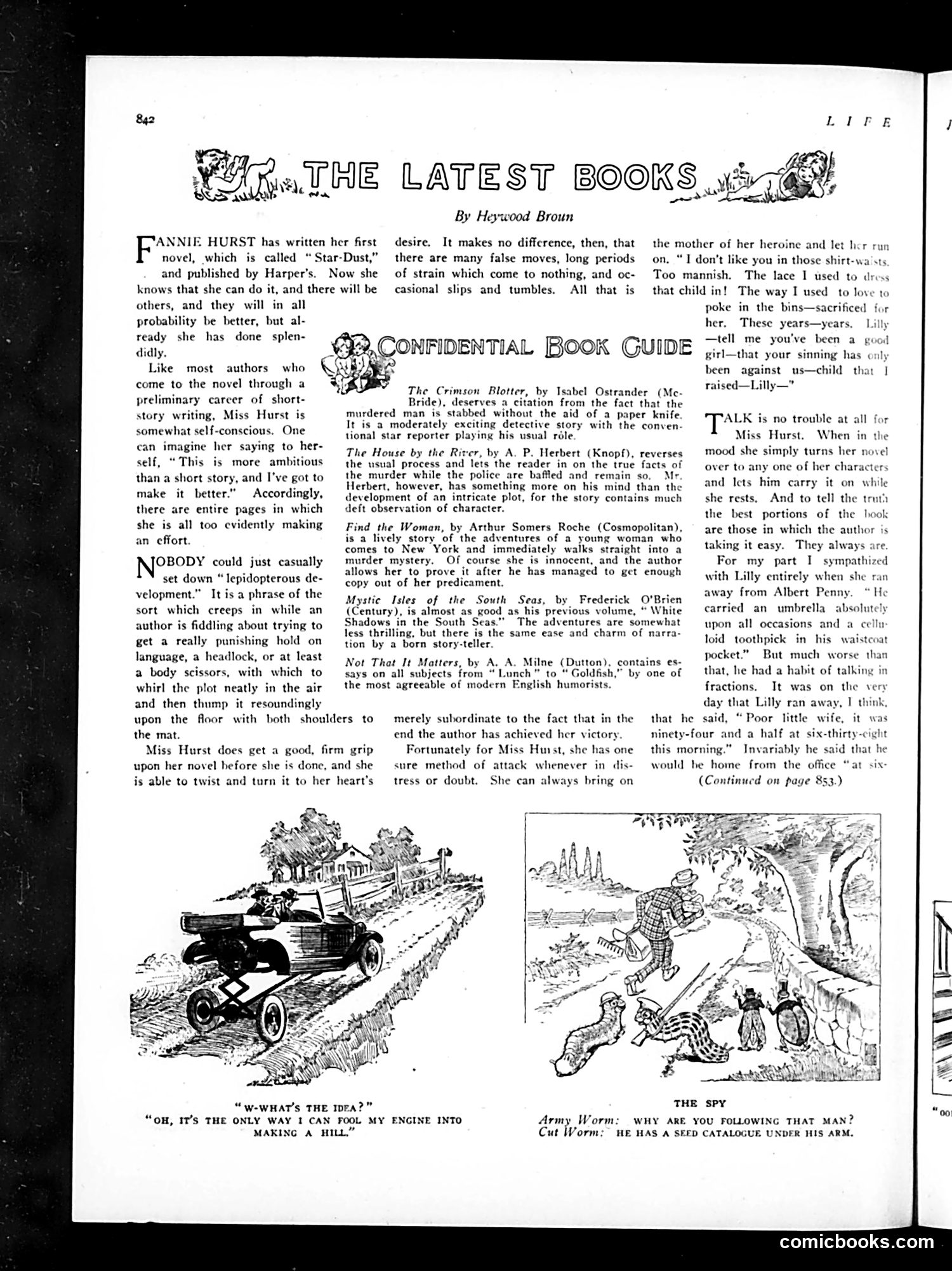
This is a literary review page featuring critic Heywood Broun's analysis of recent novels, including works by Fannie Hurst, Isabel Ostrander, and A.A. Milne. The page critiques Hurst's debut novel *Star-Dust*, praising her eventual control while noting her initial self-consciousness and overwrought prose ("lepidopterous development"). The two cartoons illustrate writing struggles: the top shows a car using an unconventional method to climb a hill—a visual metaphor for writers' awkward technical tricks. The bottom cartoon, titled "The Spy," depicts a character following someone with a seed catalogue, likely satirizing spy fiction's absurd plotting conventions (referenced in the book reviews discussing detective stories). The "Confidential Book Guide" sidebar provides brief reviews of contemporary mysteries and travel narratives, characteristic of 1920s popular fiction criticism emphasizing plot mechanics and narrative technique.
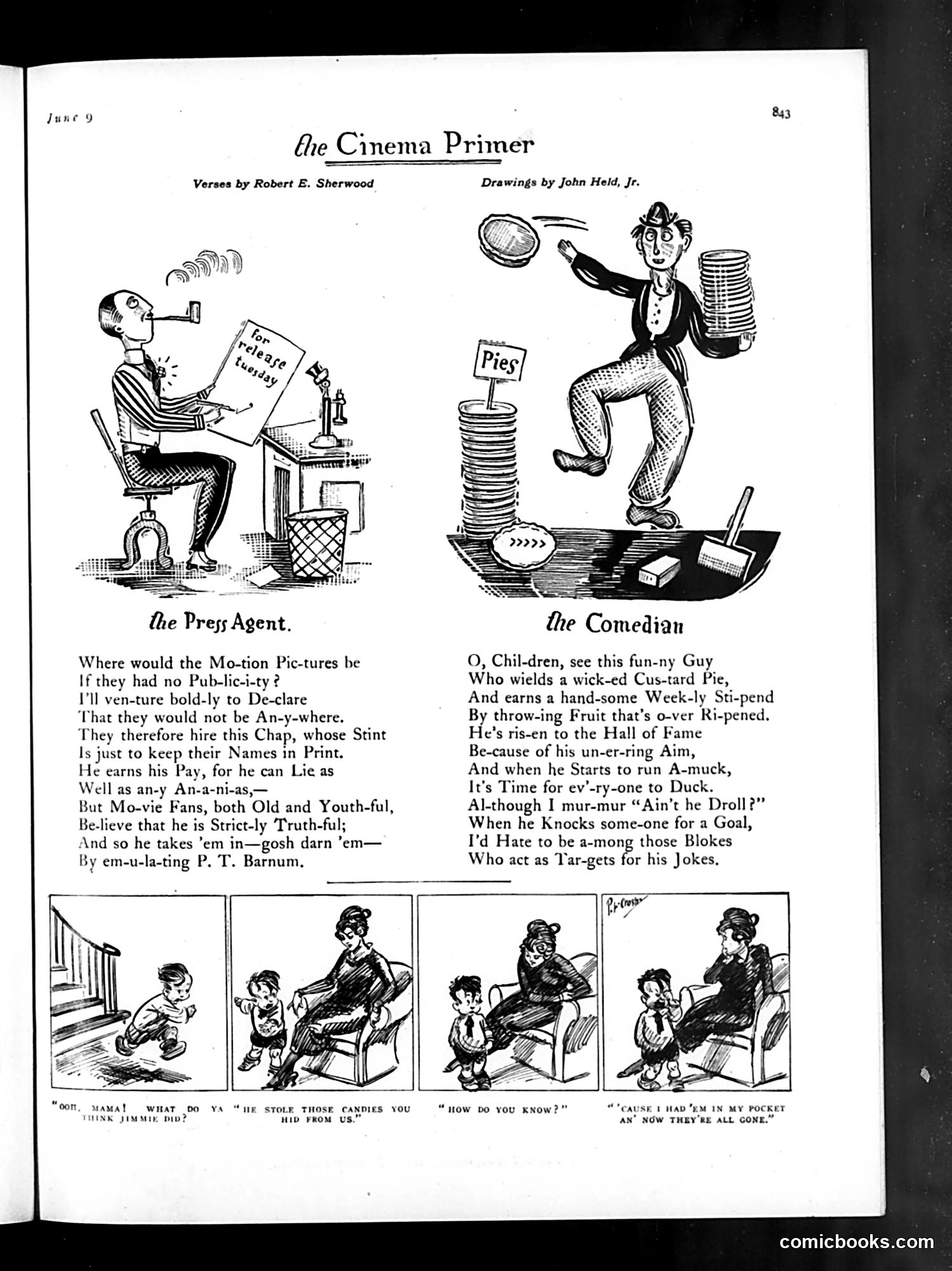
This is a satirical educational feature about early 1920s film industry types. The page presents two character archetypes in verse and illustration: **The Press Agent** (left): A publicist who lies constantly to promote movies, compared to P.T. Barnum (the famous huckster). The satire notes that movie fans paradoxically believe he's truthful despite knowing his job is generating publicity through deception. **The Comedian** (right): A slapstick performer who throws custard pies and throws people "for a goal," earning fame through physical comedy. The verse mocks the violence as entertainment while acknowledging its appeal to audiences. **The comic strip** (bottom) shows a child caught stealing candies—a simple joke about a child's transparent alibi. The overall point: silent film relied on exaggerated characters and manufactured hype, with the press agent manufacturing celebrity and the comedian making violence funny. Verses by Robert E. Sherwood, drawings by John Held Jr., this appears designed to gently mock film industry conventions for literate readers.
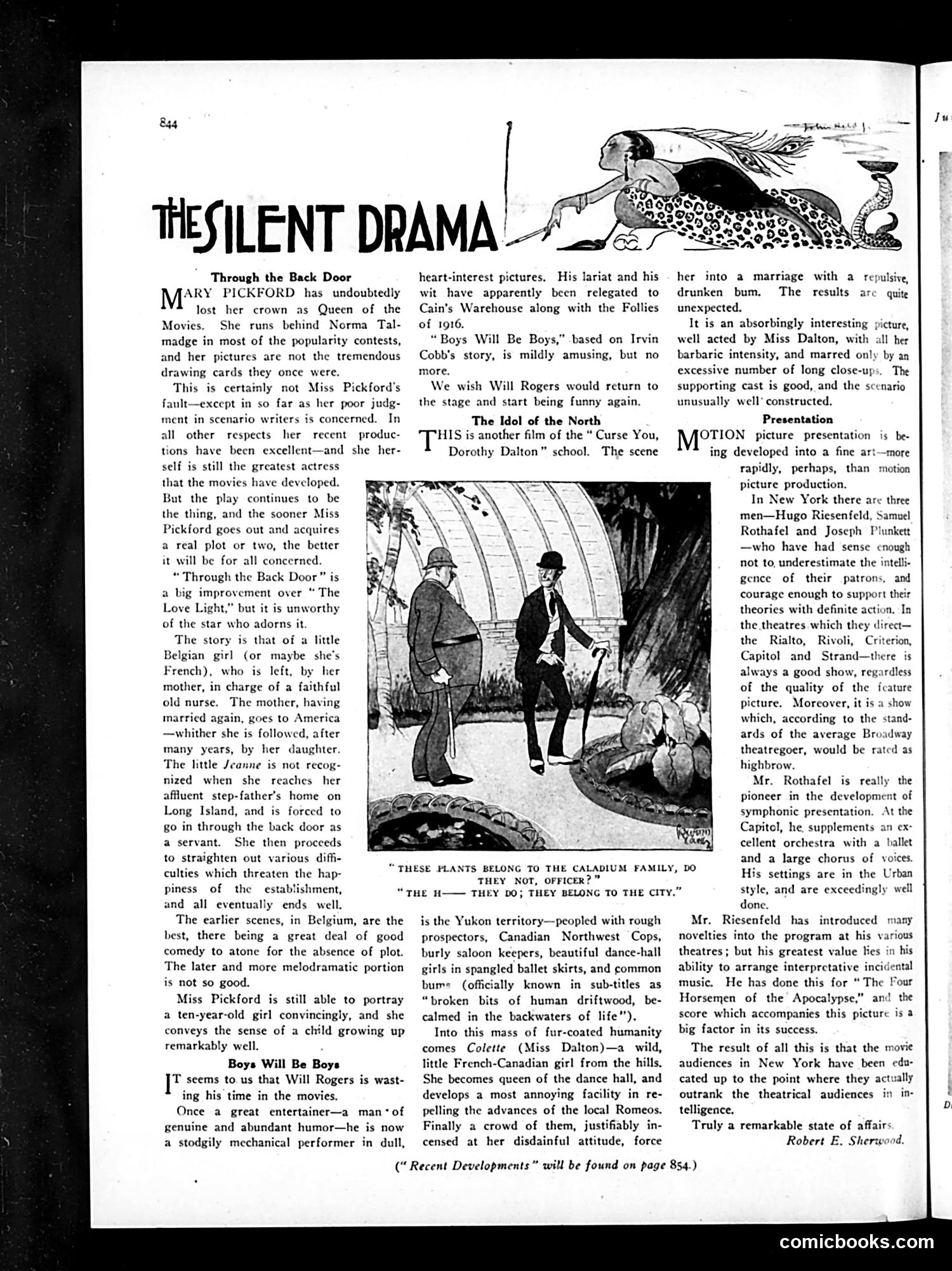
This is a film review section from Life magazine critiquing three silent movies. The author criticizes **Mary Pickford**, once Hollywood's biggest star, for declining popularity due to weak scripts—her new film "Through the Back Door" features a contrived plot about a Belgian servant girl. He similarly dismisses **Will Rogers** as wasting his talent in dull movies when he should return to stage comedy where his lariat tricks and humor belong. The page's only cartoon shows a police officer and civilian arguing over plants—the civilian claims they're calladiums; the cop retorts they're "the city's," making an obscure joke about property or regulation that's unclear without more context. The reviews celebrate advances in theatrical presentation by producers like Hugo Riesenfeld, suggesting film exhibition was evolving faster than filmmaking itself. The tone reflects 1920s concerns that Hollywood stars needed better material.
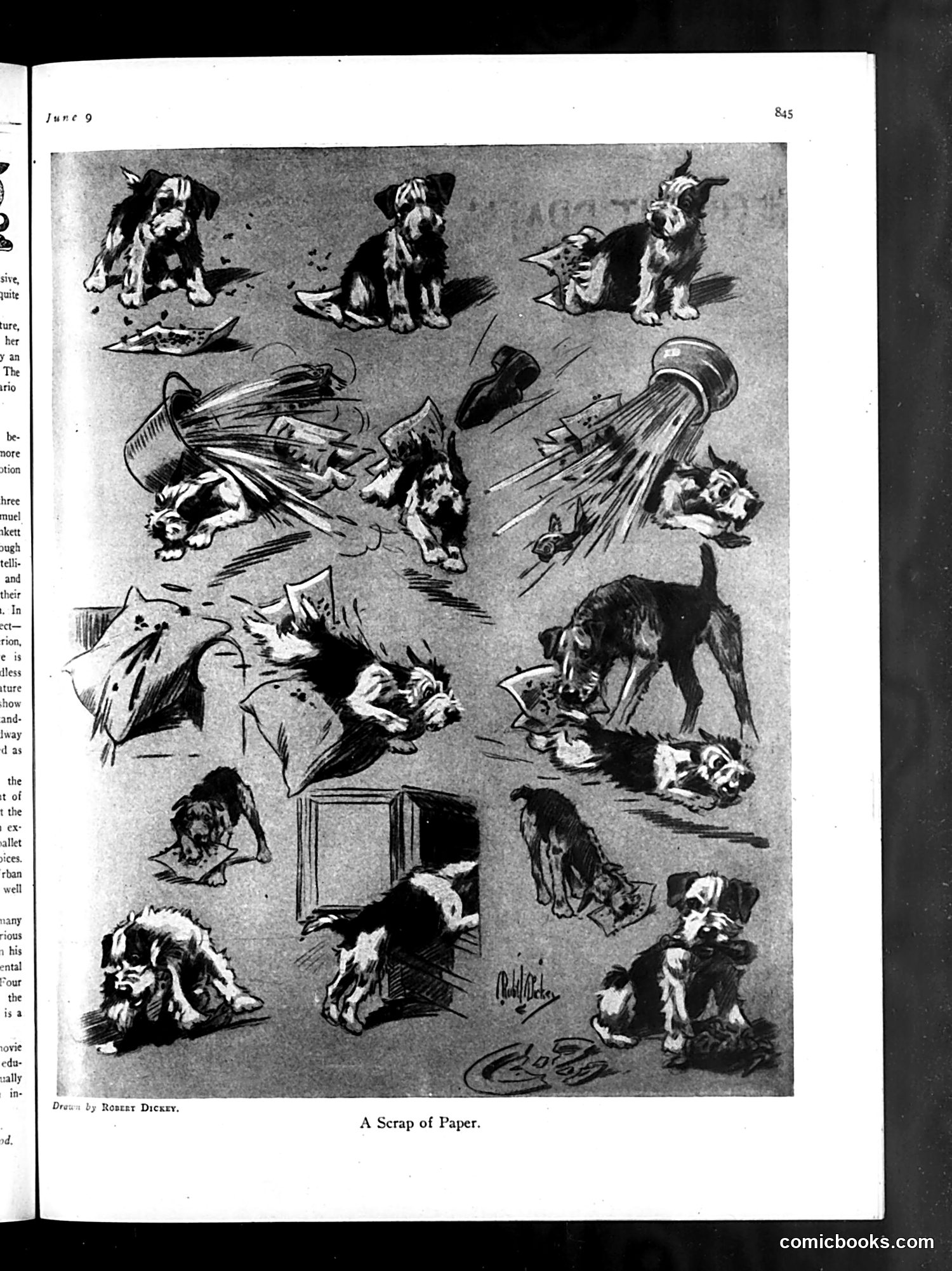
This is a series of sketches depicting dogs in various situations—playing, getting wet, fighting, exploring, and interacting with household objects. The title "A Scrap of Paper" appears ironic; rather than illustrating something momentous, Dickey presents mundane dog behavior as worthy of artistic attention. The work demonstrates early-20th-century illustrative cartooning focused on animal observation and humor. Each vignette captures characteristic canine poses and personalities. The drawing style emphasizes expressive line work and dynamic composition. Without additional context from the article text (which is largely obscured in the OCR), the specific satirical point remains unclear, though the comprehensive documentation of ordinary dog activity suggests commentary on what subjects merit artistic or editorial attention.
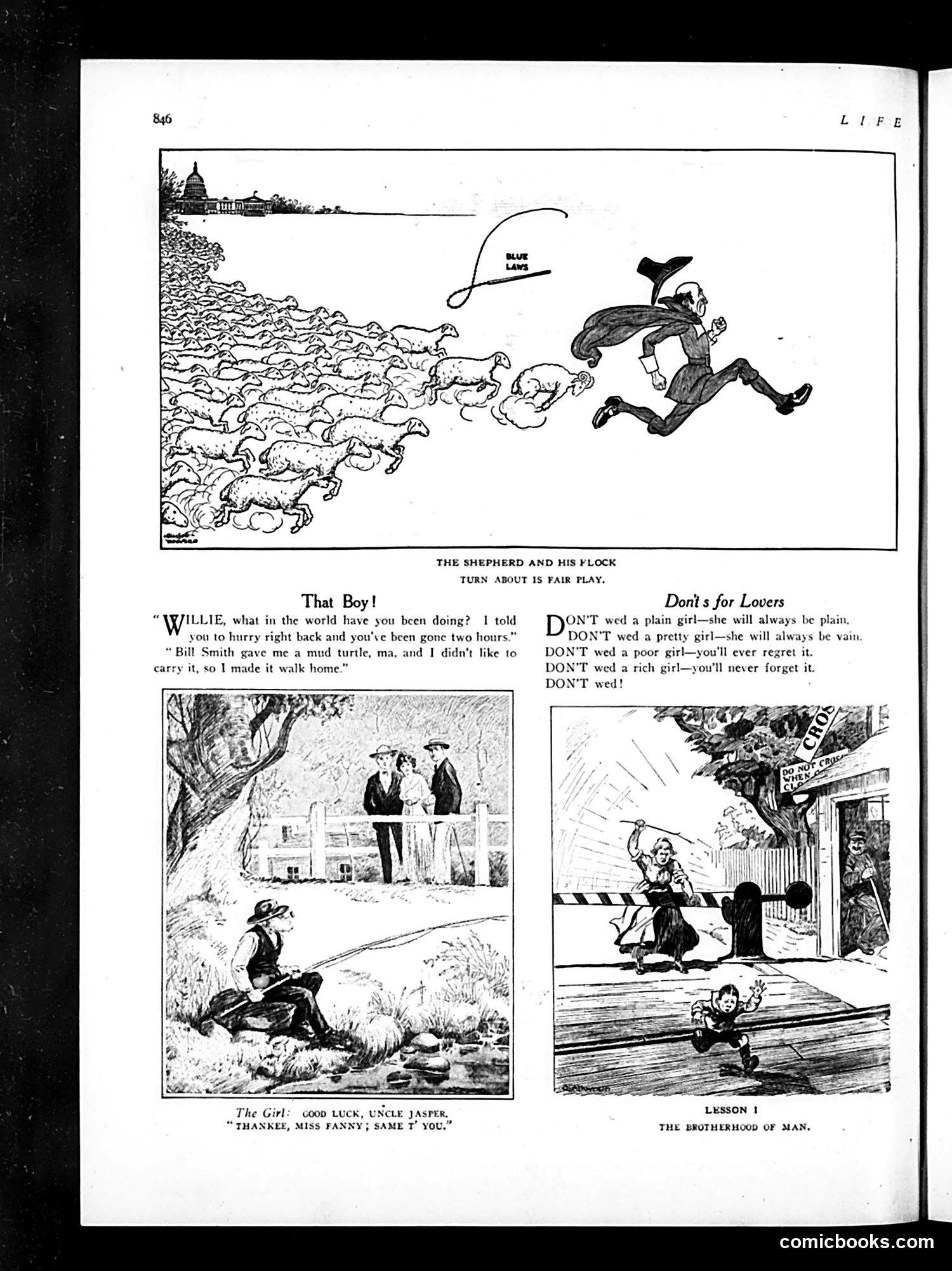
This page contains three separate humorous pieces typical of early 20th-century American satirical magazines: **"The Shepherd and His Flock"** (top): A political cartoon showing a man chasing sheep, labeled "BLUE LAWS" — likely satirizing government regulation or restrictive legislation that citizens try to evade. **"That Boy!"** (left): A domestic humor comic about a boy named Willie who made a mud turtle "walk home" rather than carry it — gentle satire of childhood logic and parental exasperation. **"Don'ts for Lovers"** (right): Cynical marital advice in verse mocking marriage itself, concluding with "DON'T wed!" — reflecting period skepticism about matrimony. The accompanying illustration shows domestic discord ("The Brotherhood of Man"). These pieces reflect *Life* magazine's characteristic blend of political commentary, family humor, and social satire aimed at middle-class readers. The anti-marriage sentiment was a recurring magazine theme of that era.
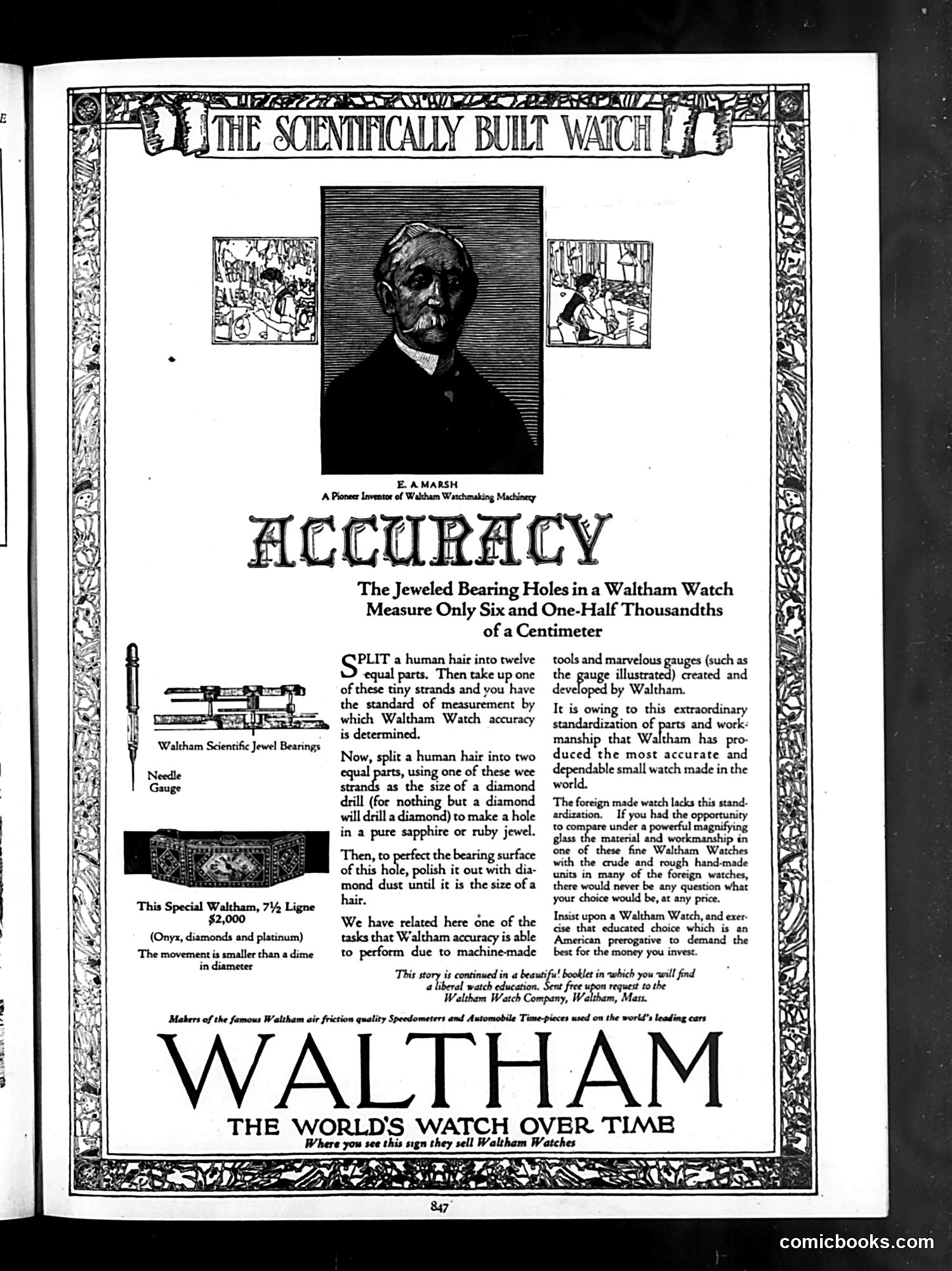
This is primarily a **product advertisement**, not political satire. It promotes Waltham watches by emphasizing American manufacturing precision and superiority. The page features a portrait of **E. A. Marsh**, identified as "a Pioneer Inventor of Waltham Watchmaking Machinery," establishing authority and heritage. The content uses vivid technical metaphors—splitting human hairs into progressively smaller parts—to demonstrate the extraordinary precision of Waltham's jeweled bearing holes (measuring 6.5 thousandths of a centimeter). The implicit satire targets **foreign (likely European) competitors**, which the ad claims lack standardization and rely on inferior "hand-made units." This reflects early 20th-century American industrial pride, positioning American machine manufacturing as scientifically superior to traditional craftsmanship. The appeal combines technical innovation with nationalist sentiment—buying Waltham is presented as exercising "American prerogative to demand the best." This advertising strategy sold American efficiency and progress as moral imperatives for consumers.
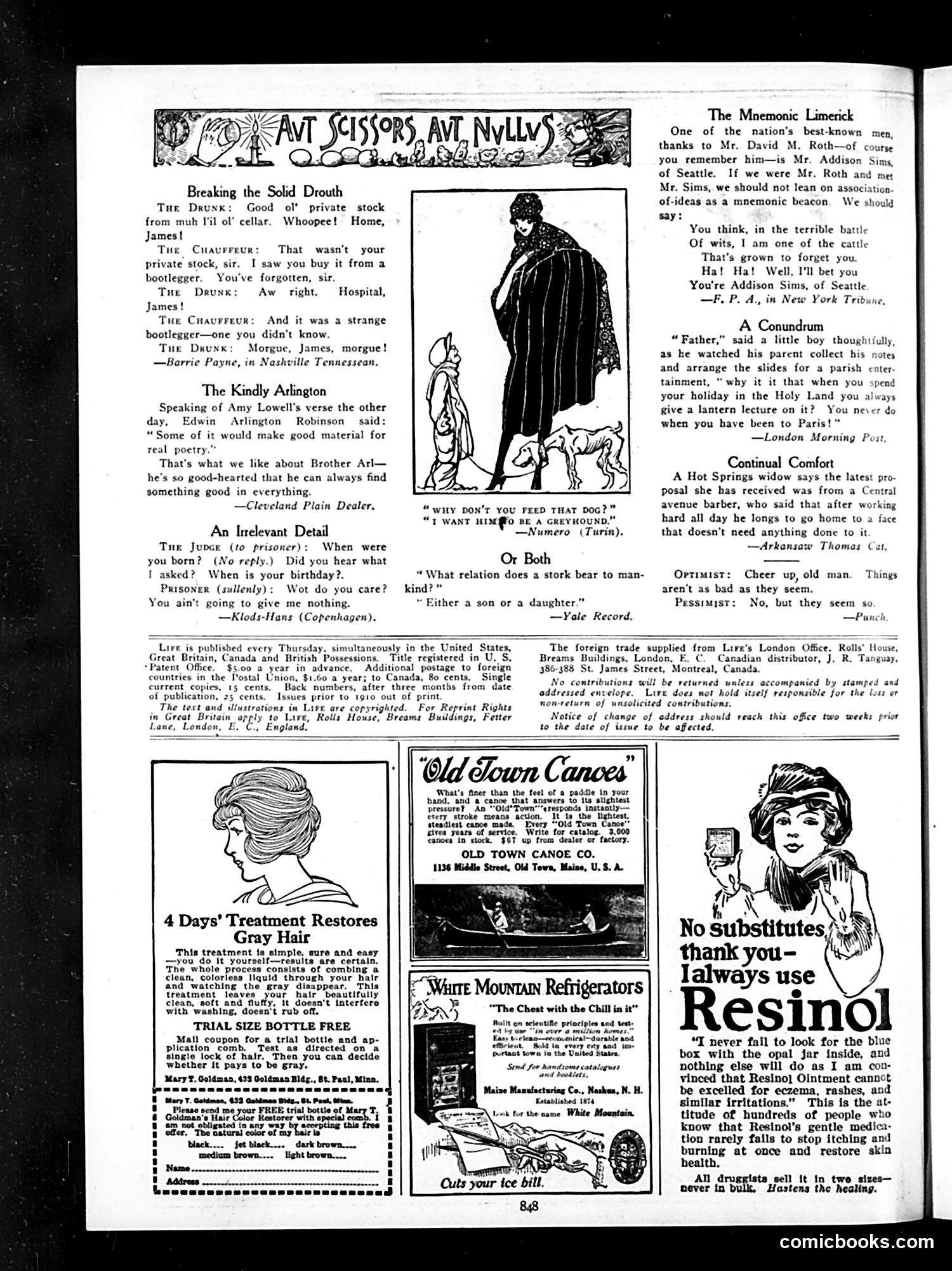
This Life magazine page contains six brief humorous pieces, each satirizing different aspects of early 20th-century life. **"Breaking the Solid Drouth"** mocks Prohibition-era hypocrisy: a drunk boasts of "private stock" from his cellar, but his chauffeur reveals he actually bought it from an unknown bootlegger—exposing the contradiction between pretense and reality during alcohol bans. **"The Kindly Arlington"** gently praises poet Edwin Arlington Robinson's generous nature. **"An Irrelevant Detail"** satirizes a prisoner's cynicism: when a judge asks his birthday, the prisoner responds indifferently that the judge won't give him anything anyway—commenting on judicial indifference to the poor. The remaining pieces are brief witticisms about storks, lantern lectures from Holy Land vacations, a widow rejecting suitors, and contrasting optimist/pessimist philosophies. The page is primarily **text-based humor** rather than visual satire, with one illustration accompanying the bootlegger joke. The ads below are period products (hair treatments, canoes, refrigerators).

This is **not a cartoon or satire**—it's a straightforward advertisement for Goodrich Silvertown Cord tires from The B.F. Goodrich Rubber Company (Akron, Ohio). The ad announces a **20% price reduction** on Silvertown tires while emphasizing their premium quality and prestige. Key selling points include: the brand name conveys "highest known quality," automobile manufacturers proudly feature them as standard equipment, and their distinctive appearance (black anti-skid treads, creamy white sidewalls) signals luxury craftsmanship. The ad instructs consumers to verify authenticity by checking for the full name "Goodrich Silvertown Cord" printed on each tire, suggesting counterfeit tires were a concern. For modern readers: this reflects early 20th-century automotive culture where tire brands carried significant status, and price reductions were marketed as opportunities to access premium products at discount—a marketing strategy still common today.
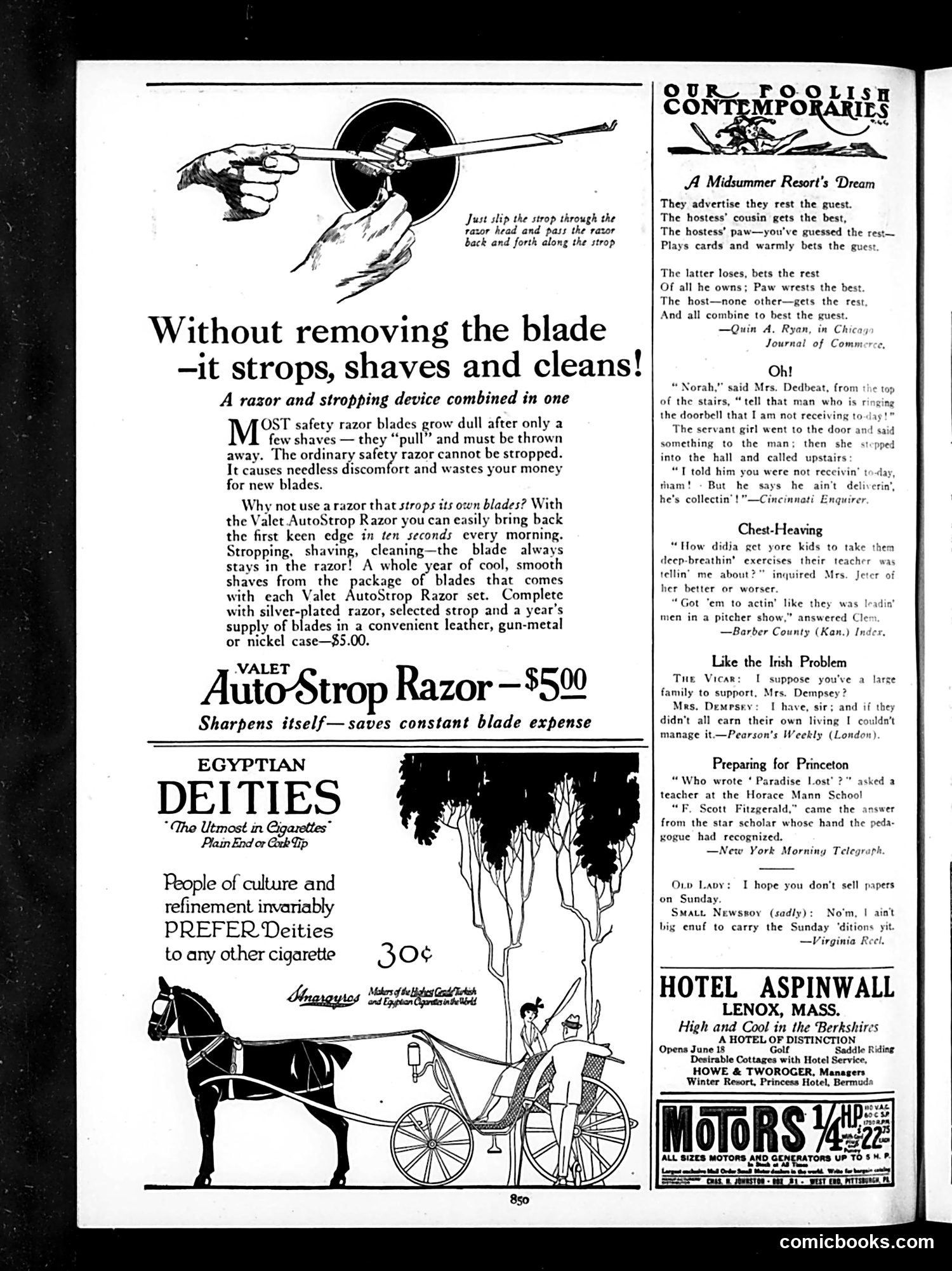
This page is primarily **advertising**, with brief humorous filler content in the right column. The main advertisement promotes the **Valet AutoStrop Razor** ($5.00)—a safety razor with an integrated stropping device that sharpens blades without removal, solving the common problem of dull razor blades that required frequent replacement. Below that, an **Egyptian Deities cigarette ad** uses pretentious language ("people of culture and refinement") to market 30-cent cigarettes, featuring decorative classical imagery. The right column contains several short **joke items** typical of Life's satirical humor: anecdotes about servants, teachers, vicars, and newsboys facing everyday absurdities. These gentle jokes mock social pretension, misunderstandings, and the struggles of working-class people—standard fare for early 20th-century American humor magazines. The **Hotel Aspinwall advertisement** targets wealthy leisure travelers seeking Berkshires accommodations. The page reflects early 1900s consumer culture and modest comedic sensibilities.
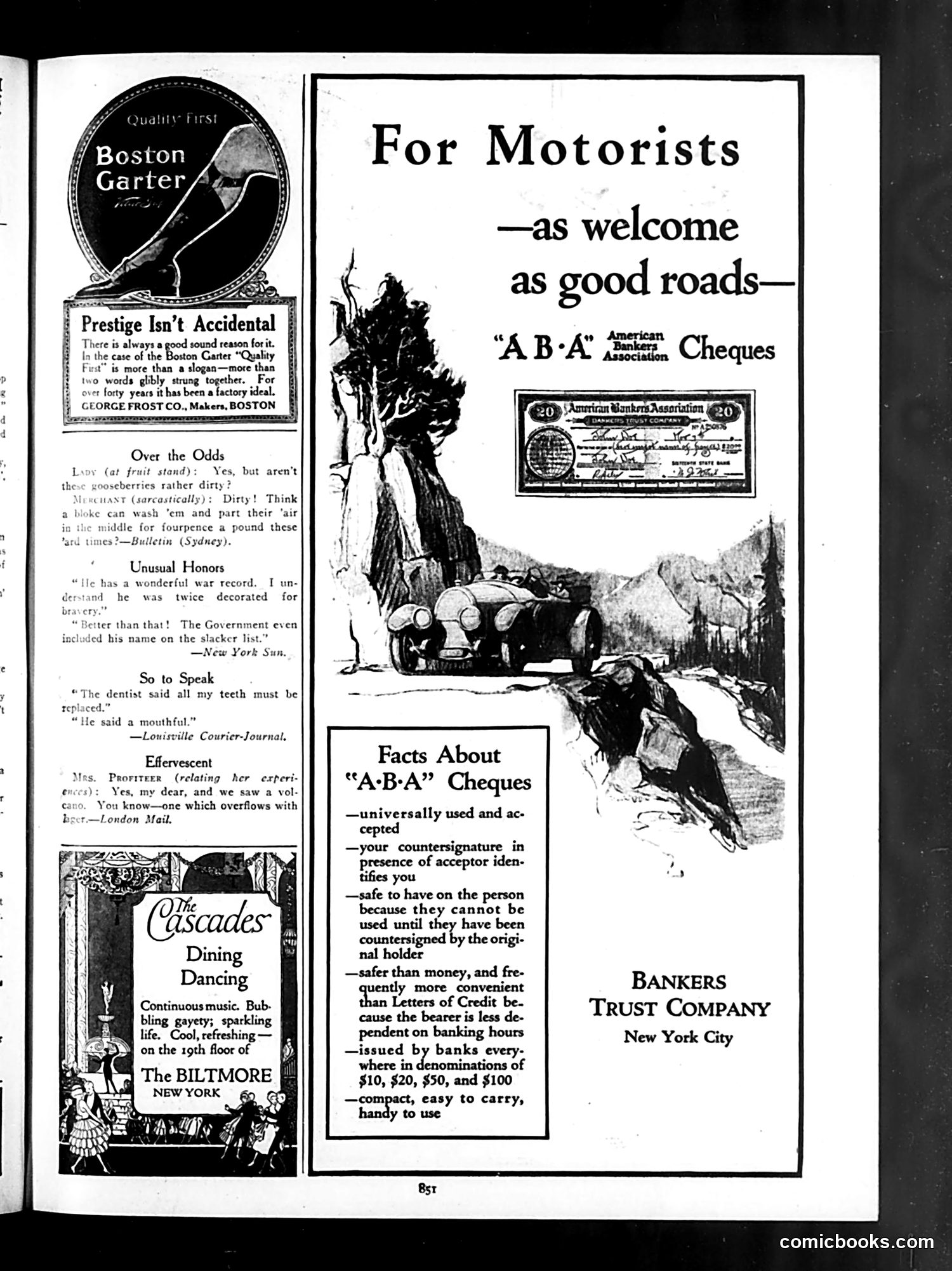
This page is primarily **advertising**, not political satire. The dominant content is an advertisement for "A.B.A." (American Bankers Association) Cheques, positioned as convenient for motorists traveling on roads. The left column contains brief humorous anecdotes unrelated to the main advertisement—jokes about dirty fruit, military honors, and dental work—typical filler content in *Life* magazine. The large central image depicts a vintage automobile on a scenic mountain road, visually supporting the motorist theme. The "A.B.A." cheques are promoted as practical alternatives to carrying cash while traveling, listing benefits: universally accepted, safe (requiring countersignature), and available in standard denominations. Small ads for the Boston Garter and The Biltmore hotel in New York appear in the lower left. This is straightforward commercial messaging aimed at early 20th-century travelers, not satirical commentary.
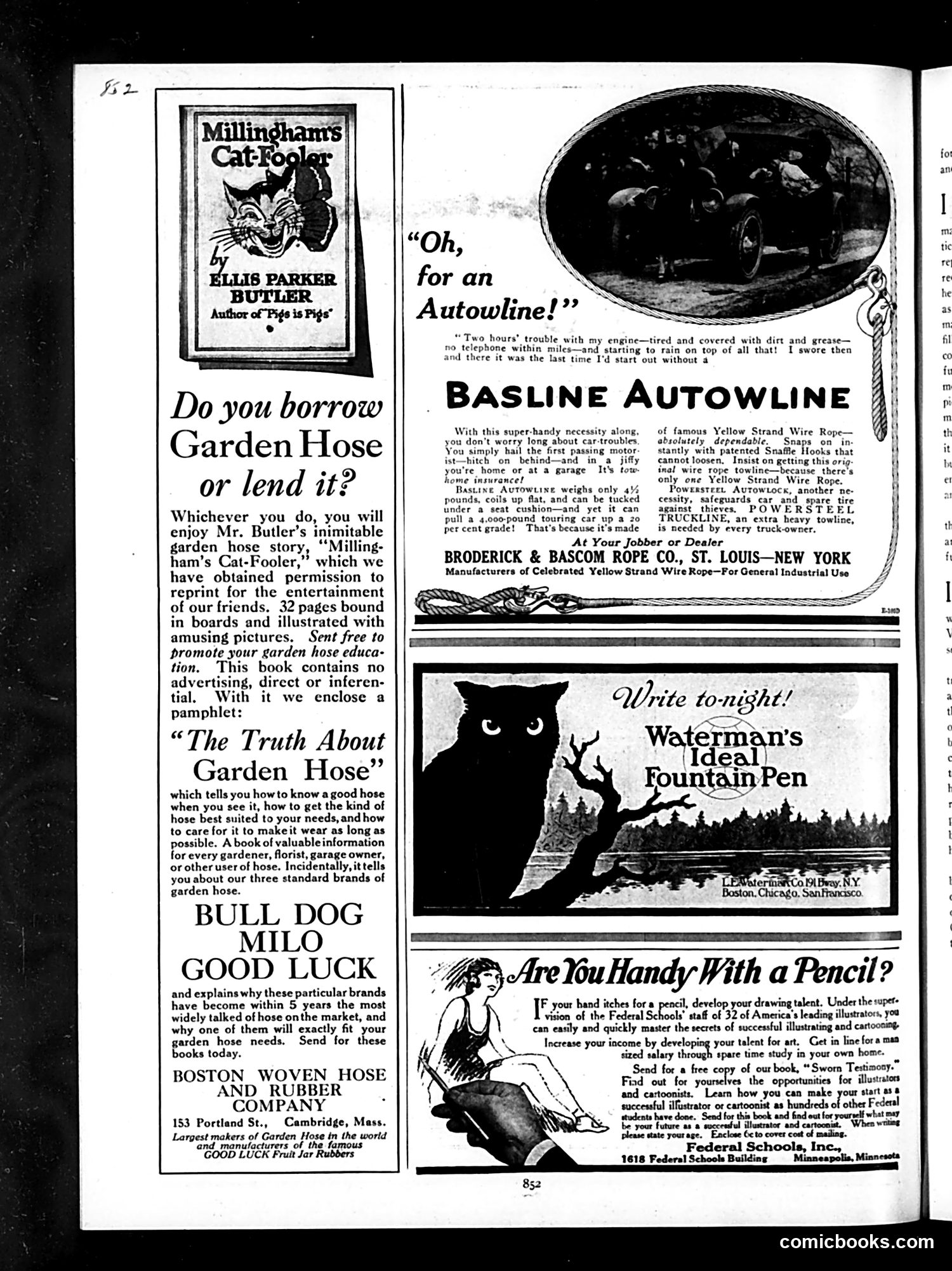
This page consists primarily of **advertisements**, not editorial satire or cartoons. The ads promote practical consumer goods popular in the 1920s-30s era: 1. **Boston Woven Hose & Rubber Company**: Markets three garden hose brands (Bull Dog, Milo, Good Luck), offering free promotional booklets about hose selection and care. 2. **Bassline Autowline**: Advertises a portable towing rope for automobiles—a 44-pound wire rope that fits under car seats. The ad depicts a stranded motorist grateful for roadside assistance. This addresses early automotive reliability concerns when breakdowns were common and garages distant. 3. **Waterman's Ideal Fountain Pen**: A writing instrument ad. 4. **Federal Schools**: Promotes correspondence courses in illustration and cartooning, targeting aspiring artists seeking income through spare-time study. The page reflects pre-Depression consumer culture emphasizing practical solutions to everyday problems: garden maintenance, automobile troubles, and self-improvement through correspondence education.
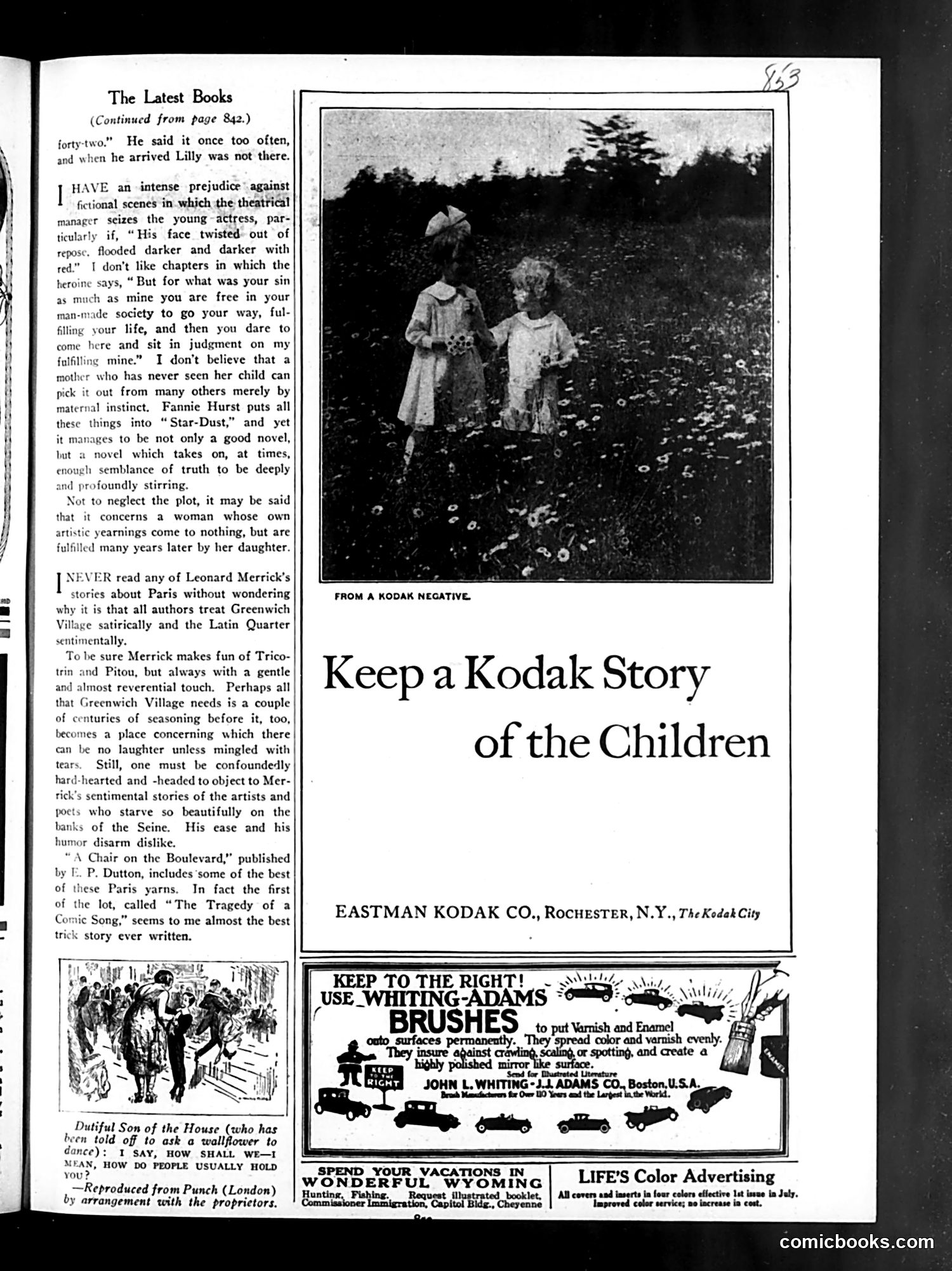
This page from *Life* magazine contains book reviews and advertisements rather than political cartoons. **Book Reviews:** The text critiques recent novels—Fannie Hurst's *Star-Dust* and Leonard Merrick's *A Chair on the Boulevard*. The reviewer discusses narrative techniques and characterization, expressing skepticism about theatrical clichés (like managers seizing actresses) while praising Merrick's sentimental treatment of Paris artists. **Small Comic:** At bottom left is a reprinted *Punch* cartoon showing a socially awkward young man asking a wallflower how to hold her for a dance—a gentle joke about masculine social incompetence. **Advertisements:** The page features Kodak cameras, Whiting-Adams brushes, and Wyoming tourism ads—typical period commercial content emphasizing photography, craftsmanship, and leisure travel. The satirical content is minimal; this page primarily showcases literary criticism alongside period advertising.
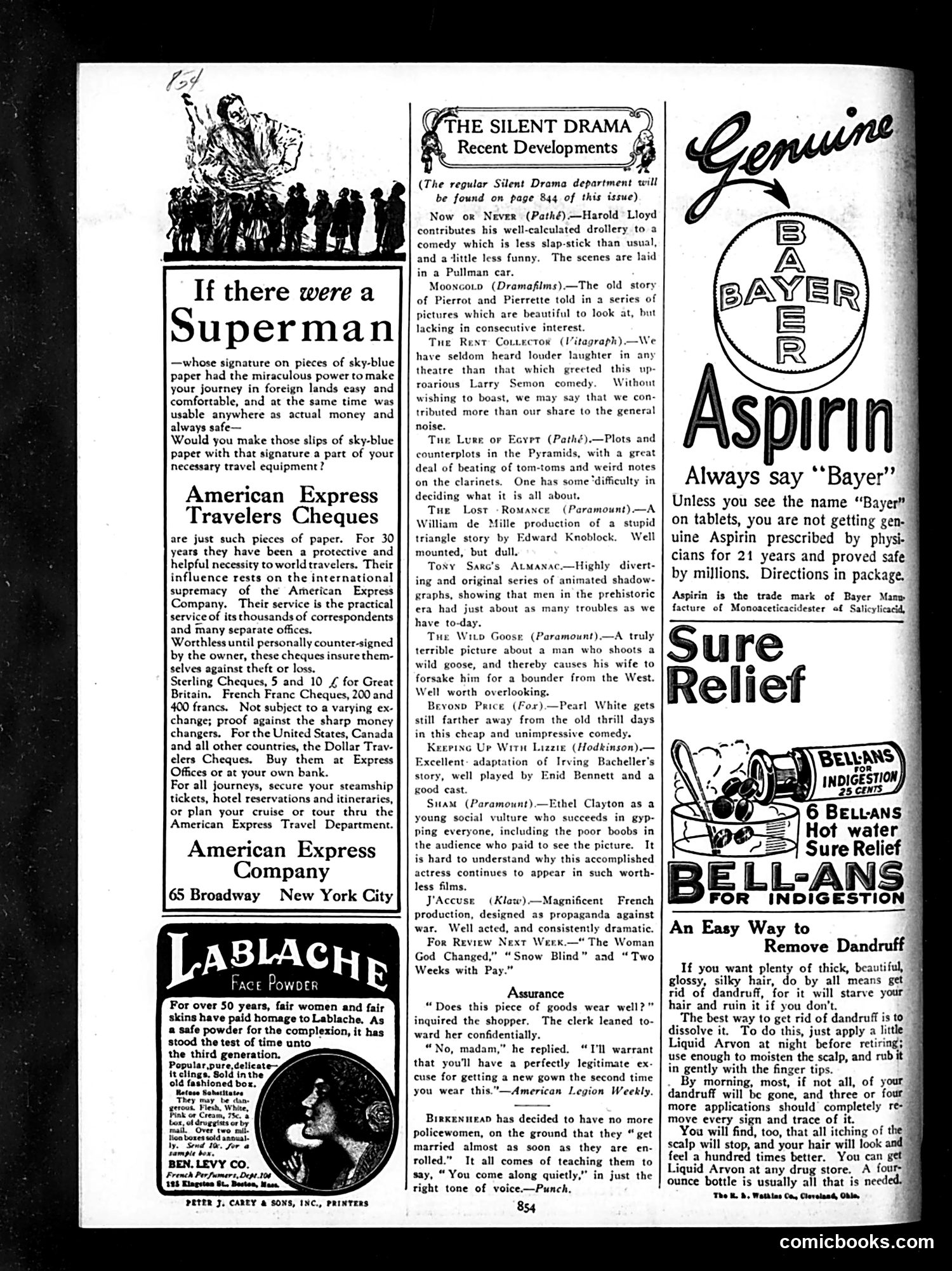
This page is primarily **advertising**, not political satire. It contains movie reviews and commercial advertisements from circa 1920s. The "Superman" reference in the American Express ad is **not political**—it's a hypothetical device to sell travelers' cheques. The ad imagines a fictional "Superman" whose signature on sky-blue paper would magically facilitate travel and function as money, then equates this fantasy to American Express cheques. The silent film reviews mention **Harold Lloyd, Pearl White, and Ethel Clayton**—major stars of the era. The reviews use typical period criticism ("slapstick," "dull," "well mounted"). Other advertisements include **Bayer Aspirin** (emphasizing it's the genuine product), **Lablache Face Powder** (50+ years established), and **Bell-Ans for Indigestion**. The page reflects **1920s consumer culture and entertainment**, not political commentary. No satire or political figures are present.

I can see this is a page from *Life* magazine, but the image is almost entirely black or severely faded, making it impossible to discern any cartoon content, caricatures, or text details beyond the watermark "comicbooks.com" at the bottom. The left margin shows some faint text fragments, but they're too degraded to read reliably. Without being able to see the actual cartoon(s), identify figures, or read the accompanying text clearly, I cannot accurately explain the satire, political references, or humor to a modern reader. To provide the analysis you're requesting, I would need a clearer, higher-contrast image of this page.

I can see this is a very dark page from Life magazine with minimal visible content. The image quality is extremely poor—mostly black with some faint outlines that might suggest cartoon figures or illustrations, but they're too obscured to identify clearly. There are scattered white dots and marks throughout, and a white border visible on the right edge. The only legible text is the "comicbooks.com" watermark in the bottom right corner, which appears to be from the digital archive source rather than original magazine content. Without clearer visibility of the actual illustrations or accompanying OCR text content, I cannot reliably identify specific figures, political references, or the satirical intent of whatever cartoons may appear on this page.
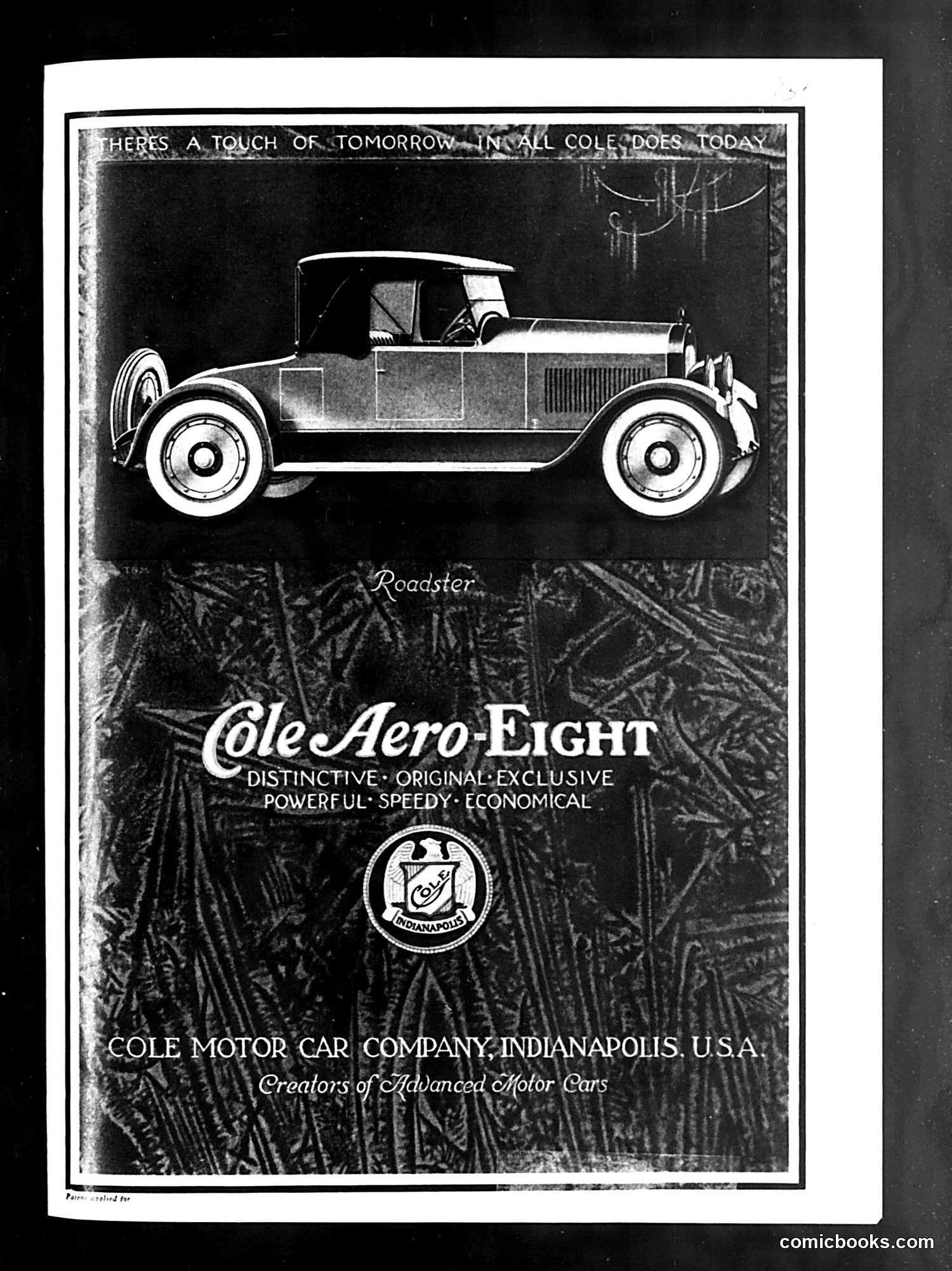
This page is **primarily an advertisement**, not political satire or a cartoon. It's a full-page ad for the Cole Aero-Eight automobile, manufactured by Cole Motor Car Company in Indianapolis. The tagline "Here's a touch of tomorrow in all Cole does today" is marketing copy positioning the vehicle as modern and forward-thinking. The image shows a side-profile technical drawing of a roadster model with detailed wheels and body panels. The ad emphasizes the car's qualities: "Distinctive, Original, Exclusive, Powerful, Speedy, Economical." The company describes itself as "Creators of Advanced Motor Cars." **No political or satirical content is present.** This is straightforward vintage automotive advertising from Life magazine's commercial pages, likely from the 1920s based on the vehicle's design and advertising style.
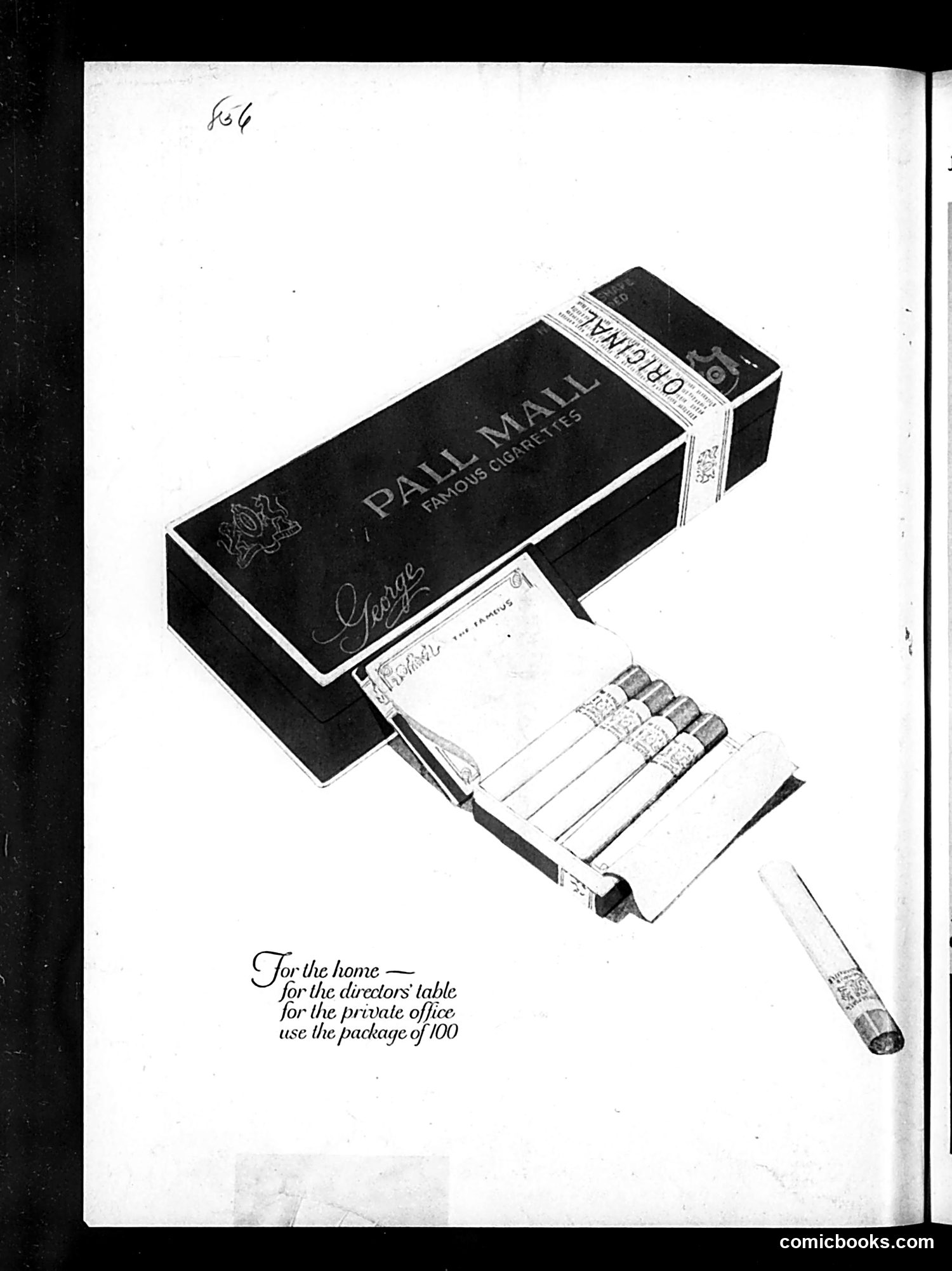
This is a **cigarette advertisement** for Pall Mall brand cigarettes, not political satire or a cartoon. The image shows a black package of Pall Mall cigarettes with individual cigarettes displayed below it. The text promotes the "package of 100" as suitable "for the home — for the directors' table for the private office," positioning the product as appropriate for various social and professional settings. This reflects mid-20th-century advertising that normalized smoking in workplaces and homes. The page demonstrates how cigarettes were marketed as a prestige product across different social contexts, before widespread awareness of health risks led to restrictions on such advertising.