
Life, 1921-06-09 · page 33 of 38
Life — June 9, 1921 — page 33: what you’re looking at
What you’re looking at
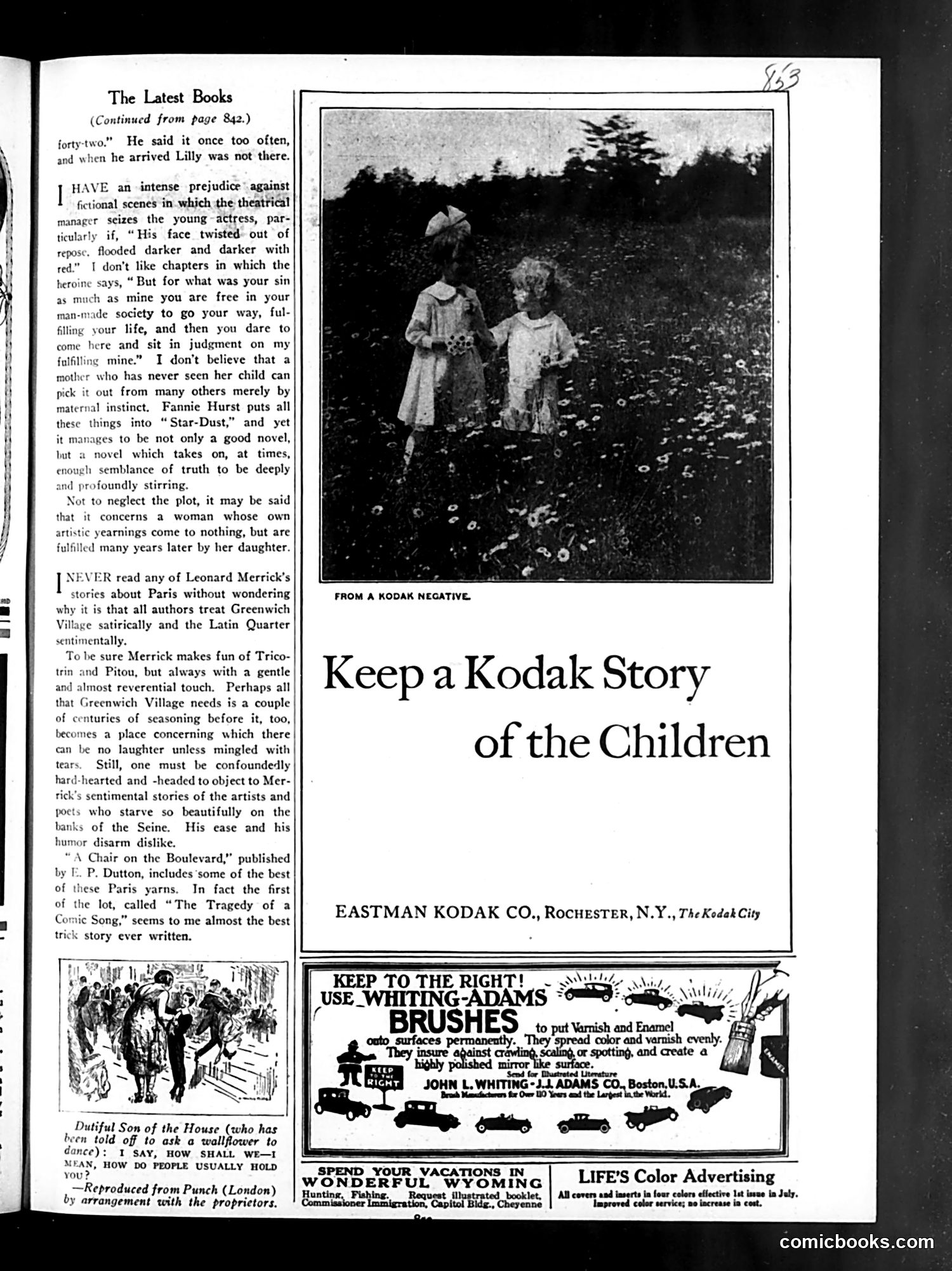
This page from *Life* magazine contains book reviews and advertisements rather than political cartoons. **Book Reviews:** The text critiques recent novels—Fannie Hurst's *Star-Dust* and Leonard Merrick's *A Chair on the Boulevard*. The reviewer discusses narrative techniques and characterization, expressing skepticism about theatrical clichés (like managers seizing actresses) while praising Merrick's sentimental treatment of Paris artists. **Small Comic:** At bottom left is a reprinted *Punch* cartoon showing a socially awkward young man asking a wallflower how to hold her for a dance—a gentle joke about masculine social incompetence. **Advertisements:** The page features Kodak cameras, Whiting-Adams brushes, and Wyoming tourism ads—typical period commercial content emphasizing photography, craftsmanship, and leisure travel. The satirical content is minimal; this page primarily showcases literary criticism alongside period advertising.
📄 Transcribed text from this page (OCR, searchable)
Machine-transcribed from the original scan — historical spelling and the odd misread are preserved.
The Latest Books (Continued from page 842.) forty-two.” He said it once too often, and when he arrived Lilly was not there. | HAVE an intense prejudice against ictional scenes in which the theatrical manager seizes the young actress, par- if, “His face twisted out of flooded darker and darker with I don’t like chapters in which the ays, “But for what was your sin » as mine you are free in your man-made society to go your way, ful- filling your life, and then you dare to come here and sit in judgment on my fulfilling mine.” I don’t believe that a mother who has never seen her child can pick it out from many others merely by maternal instinct. Fannie Hurst puts all these things into “Star-Dust,” and yet it manages to be not only a good novel, but novel which takes on, at times, enough semblance of truth to be deeply and profoundly stirring. Not to neglect the plot, it may be said that it concerns a woman whose own artistic yearnings come to nothing, but are fulfilled many years later by her daughter. ticularly repose. red.” heroi as 7 I NEVER read any of Leonard Merrick’s stories about Paris without wondering why it is that all authors treat Greenwich Village satirically and the Latin Quarter sentimentally, To be sure Merrick makes fun of Trico- and Pitou, but always with a gentle and almost reverential touch. Perhaps all that Greenwich Village needs is a couple of centuries of seasoning before it, too, becomes a place concerning which there can be no laughter unless mingled with tears. Still, one must be confoundedly hard-hearted and -headed to object to Mer- tick’s sentimental stories of the artists and who starve so beautifully on the banks of the Seine. His ease and his humor disarm dislike. “A Chair on the Boulevard,” published by EF. P. Dutton, includes ‘some of the best of these Paris yarns. In fact the first of the lot, called “The Tragedy of a Comic Song,” seems to me almost the best trick story ever written. trin poets FROM A KODAK NEGATIVE. Keep a Kodak Story | of the Children EASTMAN KODAK CO., RocuesTER, N.Y., The Kodak City Dutiful Son of the House (who has been told off to ask a wallflower to dance): 1 SAY, HOW SHALL WE—I MEAN; HOW DO PEOPLE USUALLY HOLD you? —Reproduced from Punch (London) by arrangement with the proprietors. JOHN wmunise SLL ADA aDANS MS CO,.Boston ULS.A. Masafactorer for Over 110 Yours and the Larjest YOUR VACATIONS IN WONDERFUL WYOMING ting, Fish! Request. Ecemiioser igen a ea chapeanss LIFE’S Color Raveatising All covers and inserts in four colors efiective 1st issue in July. Improved color service; no increase in cout. comicbooks.com