
Life, 1921-06-09 · page 20 of 38
Life — June 9, 1921 — page 20: what you’re looking at
What you’re looking at
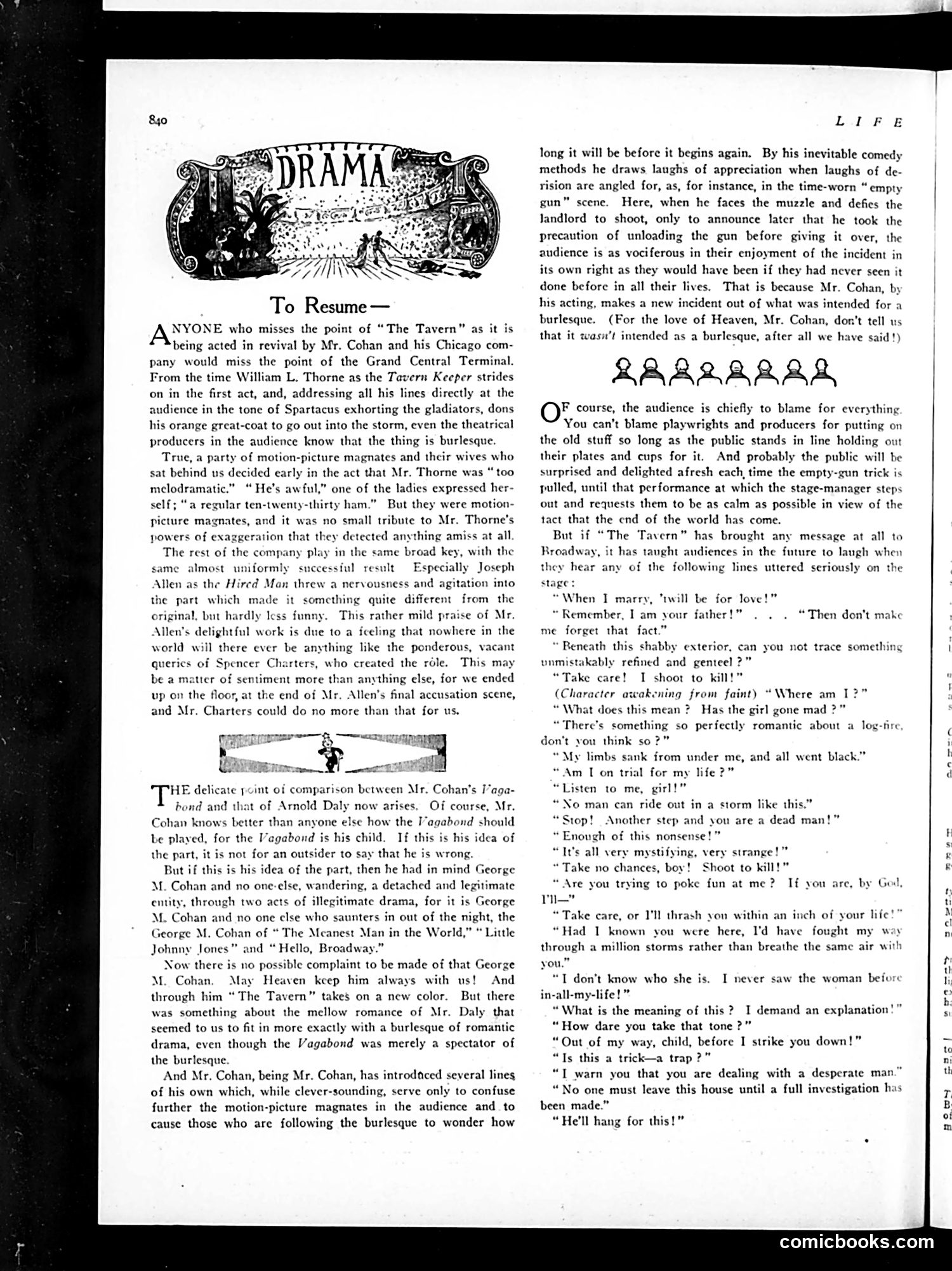
This page reviews a 1920 theatrical revival of "The Tavern," directed by and starring George M. Cohan, with William L. Thorne as the Tavern Keeper. The critic praises the production's intentional burlesque style—broad, exaggerated acting meant to mock melodramatic conventions. The satire targets motion-picture executives in the audience who miss the joke entirely, taking the hammy acting seriously. The critic compares Cohan's performance to his earlier work in vaudeville and musical comedy ("The Meanest Man in the World," "Hello, Broadway"), suggesting Cohan brings his characteristic vaudeville energy rather than the "mellow romance" another actor (Arnold Daly) previously brought to the role. The core complaint: Cohan's own clever additions and his natural comedic timing accidentally make audiences laugh *with* him rather than *at* the melodrama being parodied—undermining the burlesque's satirical intent. The critic gently chides Cohan for this confusion.
📄 Transcribed text from this page (OCR, searchable)
Machine-transcribed from the original scan — historical spelling and the odd misread are preserved.
To Resume — NYONE who misses the point of “The Tavern” as it is being acted in revival by Mr. Cohan and his Chicago com- pany would miss the point of the Grand Central Terminal. From the time William L. Thorne as the Tavern Keeper strides on in the first act, and, addressing all his lines directly at the audience in the tone of Spartacus exhorting the gladiators, dons his orange great-coat to go out into the storm, even the theatrical producers in the audience know that the thing is burlesque. True, a party of motion-picture magnates and their wives who sat behind us decided early in the act that Mr. Thorne was “ too ” “He's awful,” one of the ladies expressed her- But they were motion- picture magnates, and it was no small tribute to Mr. Thorne’s powers of exaggeration that they detected anything amiss at all The rest of the company play in the same broad key, with the same almost uniformly Especially Joseph melodramatic. self; ‘a regular ten-twenty-thirty ham.” successful result Allen as the Hired Man threw a nervousness and agitation into the part which made it something quite different from the original, but hardly less funny. se of Mr. Mlen’s delightful work is due to a fceling that nowhere in the world will there ever be anything like the ponderous, vacant ters, who created the réle. This may This rather mild p querics of Spencer Ci be a matter of sentiment more than anything else, for we ended t the end of Mr. Allen’s final accusation scene, and Mr. Charters could do no more than that for us. up on the floo 4 I HE delicate point of comparison between Mr. Cohan’s Maga- by ond and that of Arnold Daly now arises. Of course, Mr. Cohan knows better than anyone else how the Vagabond should Le played, for the Vagabond is his child the part, it is not for an outsider to say that he is wrong. But if this is his idea of the part, then he had in mind George M. Cohan and no one-else, wandering, a detached and legitimate If this is his idea of entity, through two acts of illegitimate drama, for it is George M. Cohan and no one else who saunters in out of the night, the George M. Cohan of “The Meanest Man in the World,” “ Little Johnny Jones” and “Hello, Broadway.” Now there is no possible complaint to be made of that George M. Cohan, May Heaven keep him always with us! And through him “The Tavern” takes on a new color. But there was something about the mellow romance of Mr. Daly that seemed to us to fit in more exactly with a burlesque of romantic drama, even though the Vagabond was merely a spectator of the burlesque. And Mr. Cohan, being Mr. Cohan, has introdaced several lines of his own which, while clever-sounding, serve only to confuse further the motion-picture magnates in the audience and to cause those who are following the burlesque to wonder how LIFE long it will be before it begins again. By his inevitable comedy methods he draws laughs of appreciation when laughs of de- rision are angled for, as, for instance, in the time-worn “empty Here, when he faces the muzzle and defies the landlord to shoot, only to announce later that he took the precaution of unloading the gun before giving it over, the audience is as vociferous in their enjoyment of the incident in its own right as they would have been if they had never seen it done before in all their lives. That is because Mr. Cohan, by his acting, makes a new incident out of what was intended for a burlesque. (For the love of Heaven, Mr. Cohan, don't tell us that it wasi’t intended as a burlesque, after all we have said!) RARLBRAL OF course, the audience is chiefly to blame for everything. You can’t blame playwrights and producers for putting on the old stuff so long as the public stands in line holding out their plates and cups for it. And probably the public will be surprised and delighted afresh cach, time the empty-gun trick is pulled, until that performance at which the stage-manager steps out and requests them to be as calm as possible in view of the tact that the end of the world has come. gun” scene. But if “The Tavern” has brought any message at all to Rroadway, it has taught audiences in the future to laugh when cy hear any of the following lines uttered seriously on the stage: “When I marry, ‘twill be for love * Remember, I am your father!” me forget that fact.” “Beneath this shabby exterior, can you not trace something “Then don't unmistakably refined and genteel “Take care! I shoot to kill! (Character akening from faint) “Where am 1?” “What does this mean ? Has the girl gone mad ?” “There’s something so perfectly romantic about a log-tire don’t you think so?” “My limbs sank from under me, and all went black.” “Am I on trial for my life?” “Listen to me, girl!” No man can ride out in a storm like thi Stop! Another step and you are a dead man!” Enough of this nonsense!” “It’s all very mystifying, very strange!” “Take no chances, boy! Shoot to kill! “Are you trying to poke fun at me ? ri—" “Take care, or I'll thrash you within an inch of your life!” Tf you are, by Ge “Had 1 known you were here, I'd have fought my way through a million storms rather than breathe the same air w you.” “TI don't know who she is. in-all-my “What is the meaning of this ? “How dare you take that tone “Out of my way, child, before I strike you down!” “Is this a trick—a trap?” “T warn you that you are dealing with a desperate man.” I never saw the woman befor: I demand an explanation!" “No one must leave this house until a full investigation has been made.” “He'll hang for this!” comicbooks.com