
Life, 1921-06-09 · page 24 of 38
Life — June 9, 1921 — page 24: what you’re looking at
What you’re looking at
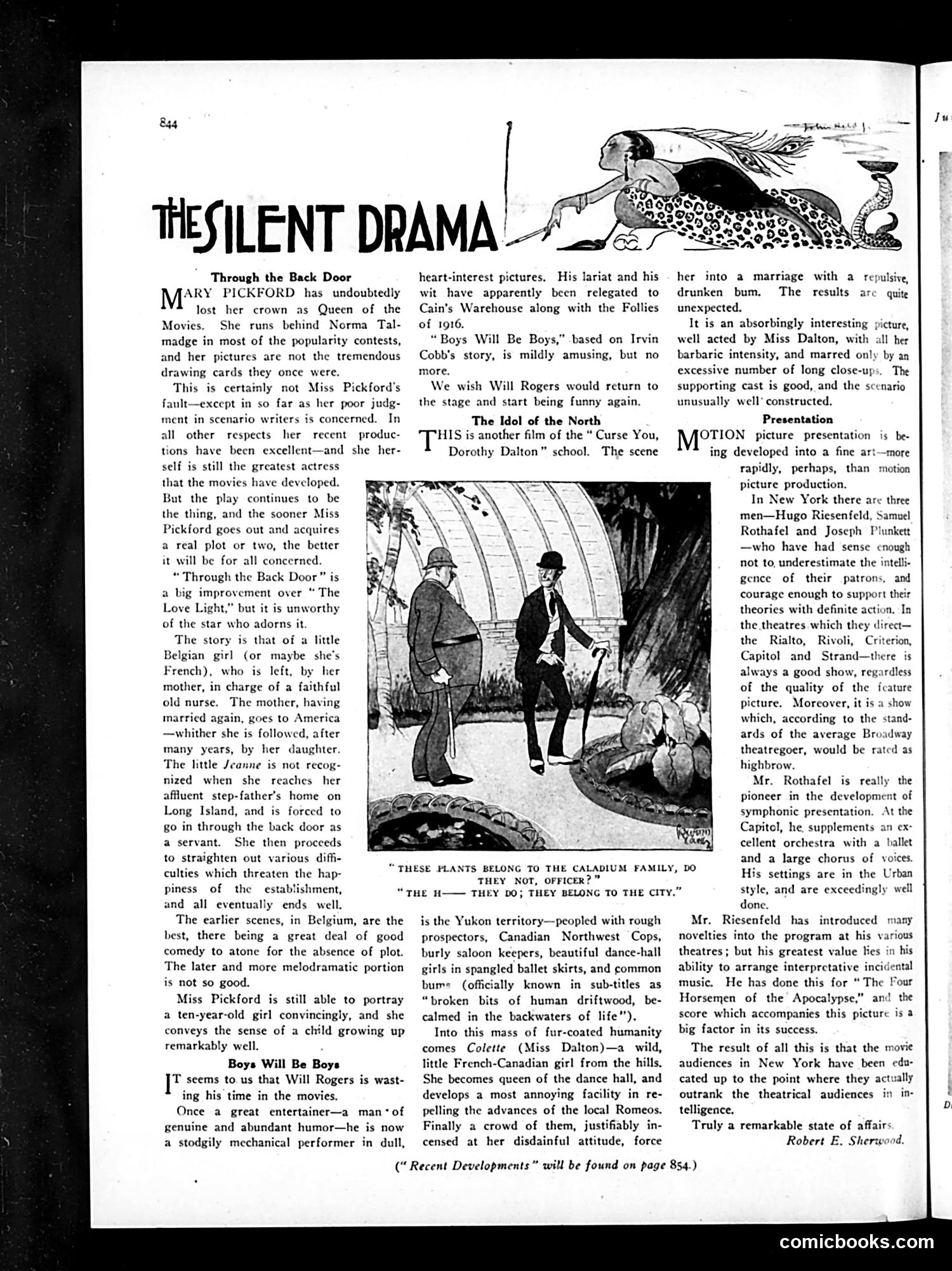
This is a film review section from Life magazine critiquing three silent movies. The author criticizes **Mary Pickford**, once Hollywood's biggest star, for declining popularity due to weak scripts—her new film "Through the Back Door" features a contrived plot about a Belgian servant girl. He similarly dismisses **Will Rogers** as wasting his talent in dull movies when he should return to stage comedy where his lariat tricks and humor belong. The page's only cartoon shows a police officer and civilian arguing over plants—the civilian claims they're calladiums; the cop retorts they're "the city's," making an obscure joke about property or regulation that's unclear without more context. The reviews celebrate advances in theatrical presentation by producers like Hugo Riesenfeld, suggesting film exhibition was evolving faster than filmmaking itself. The tone reflects 1920s concerns that Hollywood stars needed better material.
📄 Transcribed text from this page (OCR, searchable)
Machine-transcribed from the original scan — historical spelling and the odd misread are preserved.
TESILENT DRAMA Through the Back Door ARY PICKFORD has undoubtedly lost her crown as Queen of the Movies. She runs behind Norma Tal- madge in most of the popularity contests, and her pictures are not the tremendous drawing cards they once were, This is certainly not Miss Pickford’s fault—except in so far as her poor judg- ment in scenario writers is concerned. In all other respects her recent produc- tions have been excellent—and she her- self is still the greatest actress that the movies have developed. But the play continues to be the thing, and the sooner Miss Pickford goes out and acquires a real plot or two, the better it will be for all concerned. “ Through the Back Door” is a big improvement over “ The Love Light,” but it is unworthy of the star who adorns it The story is that of a little Belgian girl (or maybe she's French), who is left, by her mother, in charge of a faithful old nurse. The mother, having married again, goes to America —whither she is followed, after many years, by her daughter. The little Jeanne is not recog- nized when she reaches her affluent step-father’s home on Long Island, and is forced to go in through the back door as a servant. She then proceeds to straighten out various diffi- culties which threaten the hap- piness of the establishment, and all eventually ends well, The earlier scenes, in Belgium, are the best, there being a great deal of good comedy to atone for the absence of plot. The later and more melodramatic portion is not so good. Miss Pickford is still able to portray a ten-year-old girl convincingly, and she conveys the sense of a child growing up remarkably well. Boys Will Be Boys r seems to.us that Will Rogers is wast- ing his time in the movies. Once a great entertainer—a_ man‘ of genuine and abundant humor—he is now a stodgily mechanical performer in dull, heart-interest pictures. His lariat and his wit have apparently been relegated to Cain's Warehouse along with the Follies of 1916. “Boys Will Be Boys,” based on Irvin Cobb's story, is mildly amusing, but no more. We wish Will Rogers would return to the stage and start being funny again. The Idol of the North HIS is another film of the “ Curse You, Dorothy Dalton” school. The scene “THESE PLANTS BELONG TO THE CALADIUM FAMILY, DO THEY NOT, OFFICER?” “THE H—— THEY DO; THEY BELONG TO THE CITY.” is the Yukon territory—pceopled with rough prospectors, Canadian Northwest Cops, burly saloon keepers, beautiful dance-hall girls in spangled ballet skirts, and common bums (officially known in sub-titles as “broken bits of human driftwood, be- calmed in the backwaters of life”). Into this mass of fur-coated humanity comes Colette (Miss Dalton)—a wild, little French-Canadian girl from the hills, She becomes queen of the dance hall, and develops a most annoying facility in re- pelling the advances of the local Romeos. Finally a crowd of them, justifiably in- censed at her disdainful attitude, force her into a marriage with a repulsive, drunken bum, The results arc unexpected. It is an absorbingly interesting picture, well acted by Miss Dalton, with all her barbaric intensity, and marred only by an excessive number of long close-ups. The supporting cast is good, and the scenario unusually well’ constructed. quite Presentation OTION picture presentation is be- ing developed into a fine art—more rapidly, perhaps, than motion picture production. In New York there are three men—Hugo Riesenfeld, Samuel Rothafel and Joseph Plunkett —who have had sense cnough not to, underestimate the intelli- gence of their patrons, and courage enough to support their theories with definite action. In the theatres which they direct— the Rialto, Rivoli, Criterion, Capitol and Strand—there is 's a good show, regardless of the quality of the fcature picture. Moreover, it is a show which, according to the stand- ards of the average Broadway theatregoer, would be rated as highbrow. Mr. Rothafel is really the pioneer in the development of symphonic presentation. At the Capitol, he supplements an ex- cellent orchestra with a ballet and a large chorus of voices. His settings are in the Urban style, and are exceedingly well done. Mr. Riesenfeld has introduced many novelties into the program at his various theatres; but his greatest value lies i ability to arrange interpretative inci music. He has done this for “ The Four Horsemen of the Apocalypse,” and the score which accompanies this picture is a big factor in its success. The result of all this is that the movie audiences in New York have been edu- cated up to the point where they actually outrank the theatrical audiences in in- telligence. Truly a remarkable state of affairs. Robert E. Sherwood. (“ Recent Developments” will be found on page 854.) comicbooks.com