
Life, 1921-06-09 · page 21 of 38
Life — June 9, 1921 — page 21: what you’re looking at
What you’re looking at
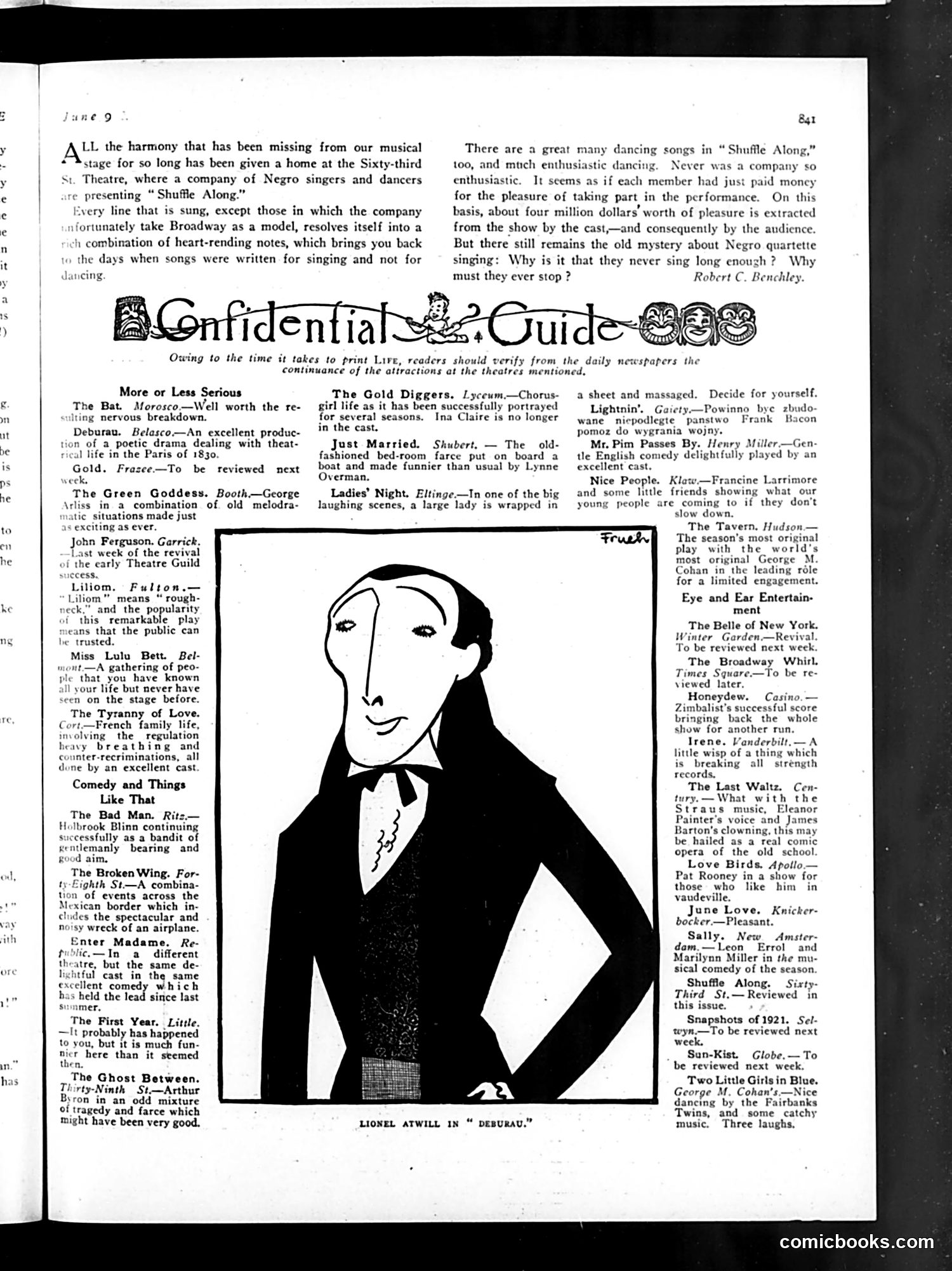
This page reviews "Shuffle Along," a groundbreaking 1921 Broadway show featuring Black singers and dancers. Critic Robert C. Benchley praises the production's musical authenticity and performers' enthusiasm, noting they extract "four million dollars' worth of pleasure" from the performance. **The cartoon** shows **Lionel Atwill** in "Deburau"—a separate theatrical production about 19th-century Parisian theater life, unrelated to the main review. **Historical context**: "Shuffle Along" was a landmark all-Black musical during the segregated 1920s, rare on mainstream Broadway. Benchley's review is notably respectful, though his closing question—"Why is it that they never sing long enough? Why must they ever stop?"—reflects period paternalism even in praise. The page is primarily **theater listings and reviews**, a standard Life magazine feature. The Atwill portrait is incidental illustration, not political commentary.
📄 Transcribed text from this page (OCR, searchable)
Machine-transcribed from the original scan — historical spelling and the odd misread are preserved.
une 9 LL the harmony that has been missing from our musical - age for so long has been given a home at the Sixty-third St. Theatre, where a company of Negro singers and dancers presenting “Shuffle Along.” Every line that is sung, except those in which the company fortunately take Broadway as a model, resolves itself into a 1 combination of heart-rending notes, which brings you back the days when songs were written for singing and not for neing. Owing to the time it takes to print Live, readers should v enthusiastic. There are a great many dancing songs in too, and much enthusiastic dancing. 841 Shuffle Along,” Never was a company so It seems as if each member had just paid money for the pleasure of taking part in the performance. basis, about four million dollars’ worth of pleasure is extracted from the show by the cast,—and consequently by the audience. But there still remains the old mystery about Negro quartette singing: Why is it that they never sing long enough ? must they ever stop ? On this Why Robert C. Benchley. verify from the daily newspapers the continuance of the attractions at the theatres mentioned, More or Less Serious The Bat. Morosco—Well worth the re- ting nervous breakdown. Deburau. Belasco—An excellent produc- tion of a poetic drama dealing with theat- 11 life in the Paris of 1830. Gold. Frazee—To be reviewed next The Green Goddess. Booth—George \rliss in a combination of old melodra- tic situations made just exciting as ever. John Ferguson. Garrick. Last week of the revival of the early Theatre Guild success. Liliom, Fulton.— iom” means “ rough- and the popularity of this remarkable play means that the public can he trusted. Miss Lulu Bett. Bel- ont—A gathering of peo- © that you have known !l your life but never have seen on the stage before. The Tyranny of Love. Cort—French family life, nvolving the regulation heavy breathing and counter-recriminations, all done by an excellent cast. Comedy and Things Like That The Bad Man. Ri: Holbrook Blinn continuing successfully as a bandit of kentlemanly bearing and good aim. The Broken Wing. For- ty-Eighth St—A combina- tion of events across the Mexican border which in- cludes the spectacular and noisy wreck of an airplane. pub theatre, but the same de- lightful cast in the same excellent comed: has held the lea summer, The First Year. Little. —It probably has happened to you, but it is much fun- nier here than it seemed then, The Ghost Between. Thirty-Ninth St—Arthur Byron in an odd mixture of tragedy and farce which might have been very good. which since last The Gold Diggers. Lyceum.—Chorus- girl life as it has been successfully portrayed for several seasons. Ina Claire is no longer in the cast. Just Married. Shubert, — The old- fashioned bed-room farce put on board a boat and made funnier than usual by Lynne Overman. Ladies’ Night. Eltinge—In one of the big laughing scenes, a large lady is wrapped in LIONEL ATWILL IN “ DEBURAU.” a sheet and massaged. Decide for yourself. Lightnin’. Gaie wane’ niepodlegte pomoz do wygrania wojny. Mr. Pim Passes By. Henry Miller —Gen tle English comedy delightfully played by an excellent cast. Nice People. Klaw.—Francine Larrimore and some little friends showing what our young people are coming to if they don't slow down, The Tavern. Hudson — The season's most original play with the world’s most original George M. Cohan in the leading réle for a limited engagement. Eye and Ear Entertain- ment The Belle of New York. Winter Garden—Revival. To be reviewed next week. The Broadway Whirl. Times Square-—To be re- viewed later. Honeydew. Casino. — Zimbalist’s successful score bringing back the whole show for another run. Irene. Vanderbilt, —A little wisp of a thing which is breaking all strength records. The Last Waltz. Cen- tury. — What with the Straus music, Eleanor Painter's voice and James Barton's clowning, this may be hailed as a real comic opera of the old school. Love Birds. Apotlo— Pat Rooney in a show for those who like him in vaudeville. June Love. Knicker- bocker.—Pleasant. Sally. New Amster- dam.—Leon Errol and Marilynn Miller in the mu- sical comedy of the season Shuffle Along. Sixty- Third St.— Reviewed in this issue. Snapshots of 1921. Sel- wyn.—To be reviewed next weel Sun-Kist. Globe. — To be reviewed next week. Two Little Girls ii in Blue. George M. Cohan’s.—Nice dancing by the rbanks Twins, and some catchy music. Three laughs, —Powinno bye zbudo- “panstwo Frank Bacon comicbooks.com