
Life, 1921-06-09 · page 22 of 38
Life — June 9, 1921 — page 22: what you’re looking at
What you’re looking at
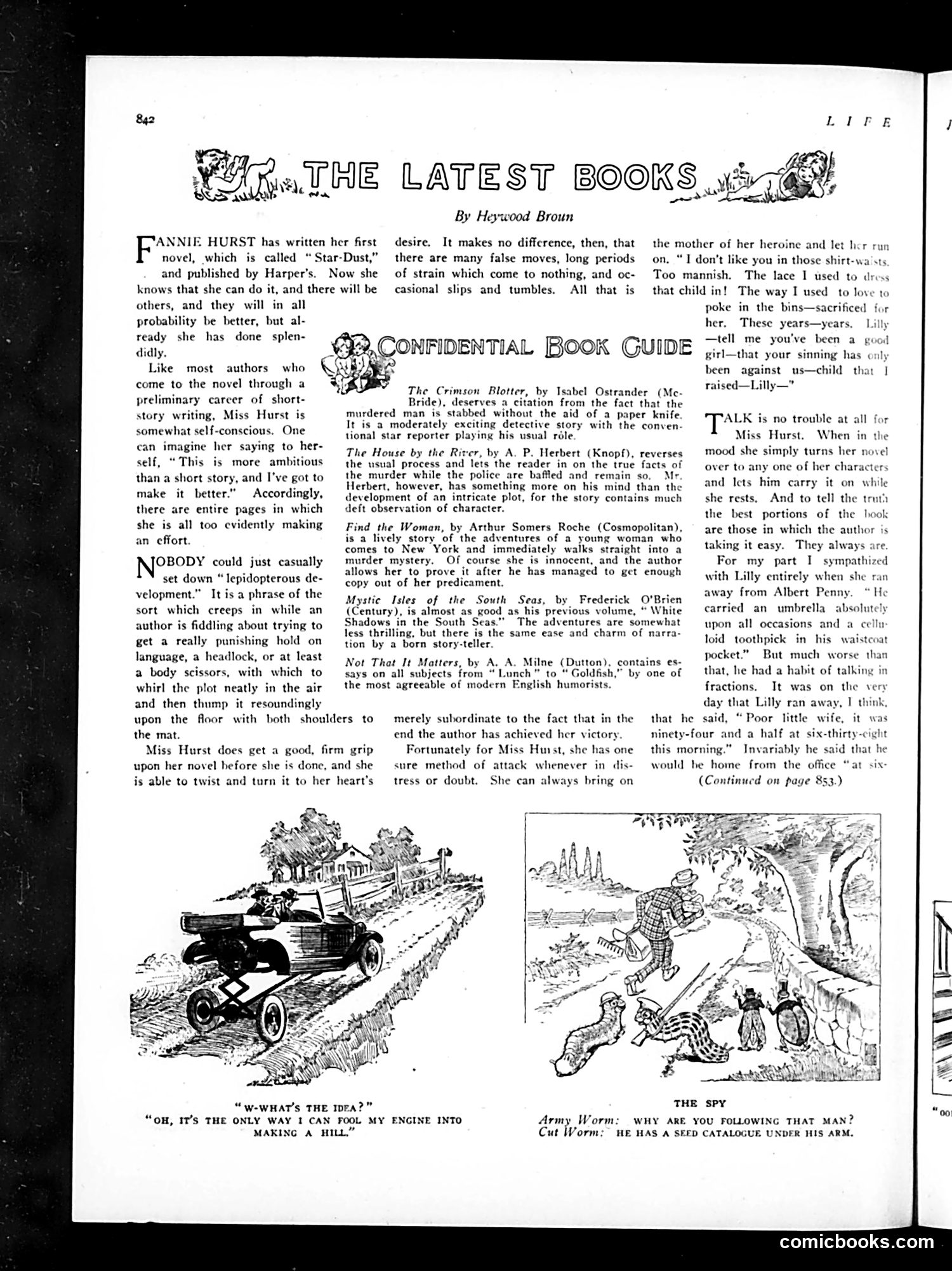
This is a literary review page featuring critic Heywood Broun's analysis of recent novels, including works by Fannie Hurst, Isabel Ostrander, and A.A. Milne. The page critiques Hurst's debut novel *Star-Dust*, praising her eventual control while noting her initial self-consciousness and overwrought prose ("lepidopterous development"). The two cartoons illustrate writing struggles: the top shows a car using an unconventional method to climb a hill—a visual metaphor for writers' awkward technical tricks. The bottom cartoon, titled "The Spy," depicts a character following someone with a seed catalogue, likely satirizing spy fiction's absurd plotting conventions (referenced in the book reviews discussing detective stories). The "Confidential Book Guide" sidebar provides brief reviews of contemporary mysteries and travel narratives, characteristic of 1920s popular fiction criticism emphasizing plot mechanics and narrative technique.
📄 Transcribed text from this page (OCR, searchable)
Machine-transcribed from the original scan — historical spelling and the odd misread are preserved.
aTHE LATEST BOOKS ANNIE HURST has written her first novel, which is called “ Star-Dust, Now she knows that she can do it, and there will be and published by Harper's. others, and they will in all probability be better, but al- ready done splen- didly, Like most authors come to the novel through a preliminary carcer of short- story writing, Miss Hurst is somewhat self-conscious. One can imagine her saying to her- self, “This is more ambitious than a short story, and I've got to make it better.” Accordingly, there are entire pages in which she is all too evidently making an effort. OBODY could just casually set down “lepidopterous de- velopment.” It is a phrase of the sort which creeps in while an author is fiddling about trying to get a really punishing hold on language, a headlock, or at least a body scissors, with which to whirl the plot neatly in the air and then thump it resoundingly she has who upon the floor with both shoulders to the mat. Miss Hurst does get a good, firm grip upon her novel hefore she is done, and she is able to twist and turn it to her heart's “W-WHAT'S THE IDEA?” “OH, IT’S THE ONLY WAY I CAN FOOL MY ENGINE INTO MAKING A HILL.” By Heywood Broun desire, It makes no difference, then, that there are many false moves, long periods of strain which come to nothing, and oc- casional slips and tumbles. All that is CONT ENTIAL [BOOK GUIDE The Crimson Blotter, by Isabel Ostrander (Me- Bride), deserves a citation from the fact that the murdered man is stabbed without the aid of a paper knife. It is a moderately exciting detective story with the conven. tional star reporter playing his usual role. The House by the River, by A. P. Herbert (Knopf), reverses the usual process and lets the reader in on the true facts of the murder while the police are baffled and remain so. Mr Herbert, however, has something more on his mind than the development of an intricate plot, for the story contains much deft observation of character. Find the Woman, by Arthur Somers Roche (Cosmopolitan), is a lively story of the adventures of a young woman who comes to New York and immediately walks straight into a murder mystery. Of course she is innocent, and the author allows her to prove it after he has managed to get enough copy out of her predicament. Mystic Isles of the South Seas, by Frederick O'Brien (Century), is almost as good as Previous volume, “ White Shadows in the South Seas.” © adventures are somewhat less thrilling, but there is the same ease and charm of narra- tion by a born story-teller. Not That It Matters, by A. A. Milne (Dutton says on all subjects from “Lunch” to “ Goldfish the most agreeable of modern English humorists. ntains es- by one of merely subordinate to the fact that in the end the author has achieved her victory Fortunately for Miss Hurst, she has one sure method of attack whenever in dis- tress or doubt. She can always bring on that he ninety-four and a half at. six-thirty-cight this morning.” would be home from the office (Continued on page 853.) the mother of her heroine and let her run on, “I don't like you in those shirt-y Too mannish. that child in!’ The way I used to love to The lace I used to dress poke in the bins—sacrificed for her. These years—years. Lilly —tell me you've been a good girl—that your sinning has only been against us—child thar raised—Lilly—” T LK is no trouble at all for Miss Hurst. When in the mood she simply turns her novel over to any one of her characters and Iets him carry it on while she rests. And to tell the truth the best portions of the hook are those in which the author is taking it easy. They always « For my part I sympathized with Lilly entirely when she ran away from Albert Penny. “H carried an umbrella absolutely upon all occasions and a cellu loid toothpick in his waistcoat pocket.” But much worse than that, he had a habit of talk fractions. It was on the very day that Lilly ran away, I think, said, “Poor little wife, it was Invariably he said that he Army Worm: Cut Worm: THE SPY WHY ARE YOU FOLLOW! HE HAS A SEED CATALOGUE L Pan Ge wal THAT MAN? DER HIS ARM. comicbooks.com