
A complete issue · 36 pages · 1921
Life — May 26, 1921
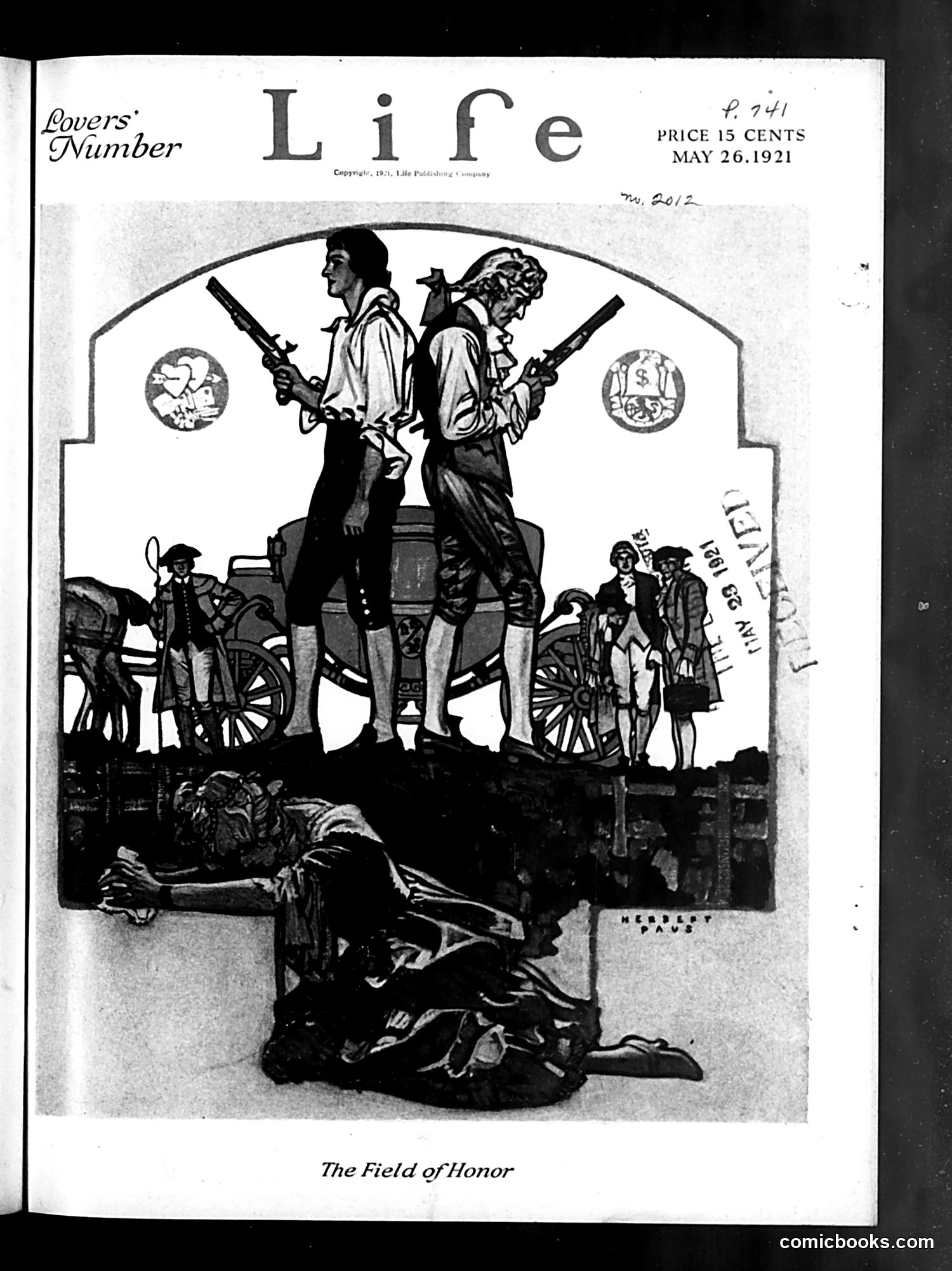
This satirical illustration depicts two armed soldiers standing victoriously atop a cannon, overlooking a battlefield strewn with corpses. The title "The Field of Honor" employs bitter irony—what's traditionally called honorable military ground is shown as a mass grave. The composition contrasts the glorification of war (the heroic soldier figures, the coins suggesting wealth/power) with its horrific reality (the dead bodies below). Published in 1921, just after World War I's conclusion, this likely critiques the romanticization of war and questions whether the enormous human cost—millions of casualties—was truly "honorable." The stark black-and-white imagery emphasizes the grim message: warfare produces death and suffering, not glory.
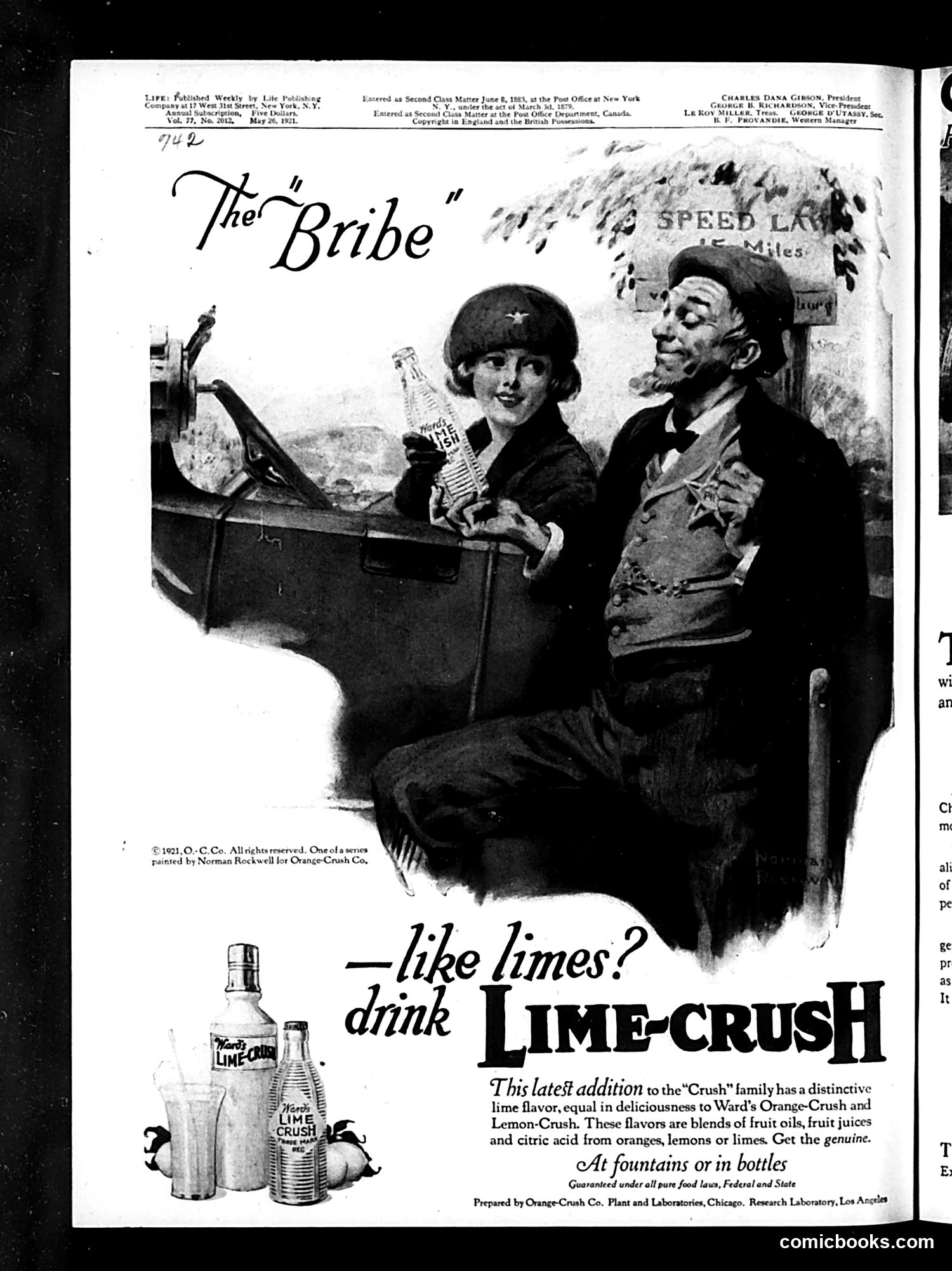
This is primarily a **commercial advertisement** for Lime-Crush soft drink, not political satire. The illustration depicts a comedic scenario where a woman appears to be bribing a man (likely a police officer or authority figure, given his formal attire) with a bottle of Lime-Crush beverage. The wordplay "like limes? drink LIME-CRUSH" uses humor to suggest the product is so appealing it's practically irresistible—worth "bribing" someone to obtain. The cartoon plays on contemporary advertising humor rather than political commentary. The ad emphasizes Lime-Crush as a citrus-flavored beverage competing with Ward's Orange-Crush and Lemon-Crush, distributed by Orange-Crush Co., Chicago. It's typical 1920s-era advertising that uses suggestive scenarios to create memorable marketing.
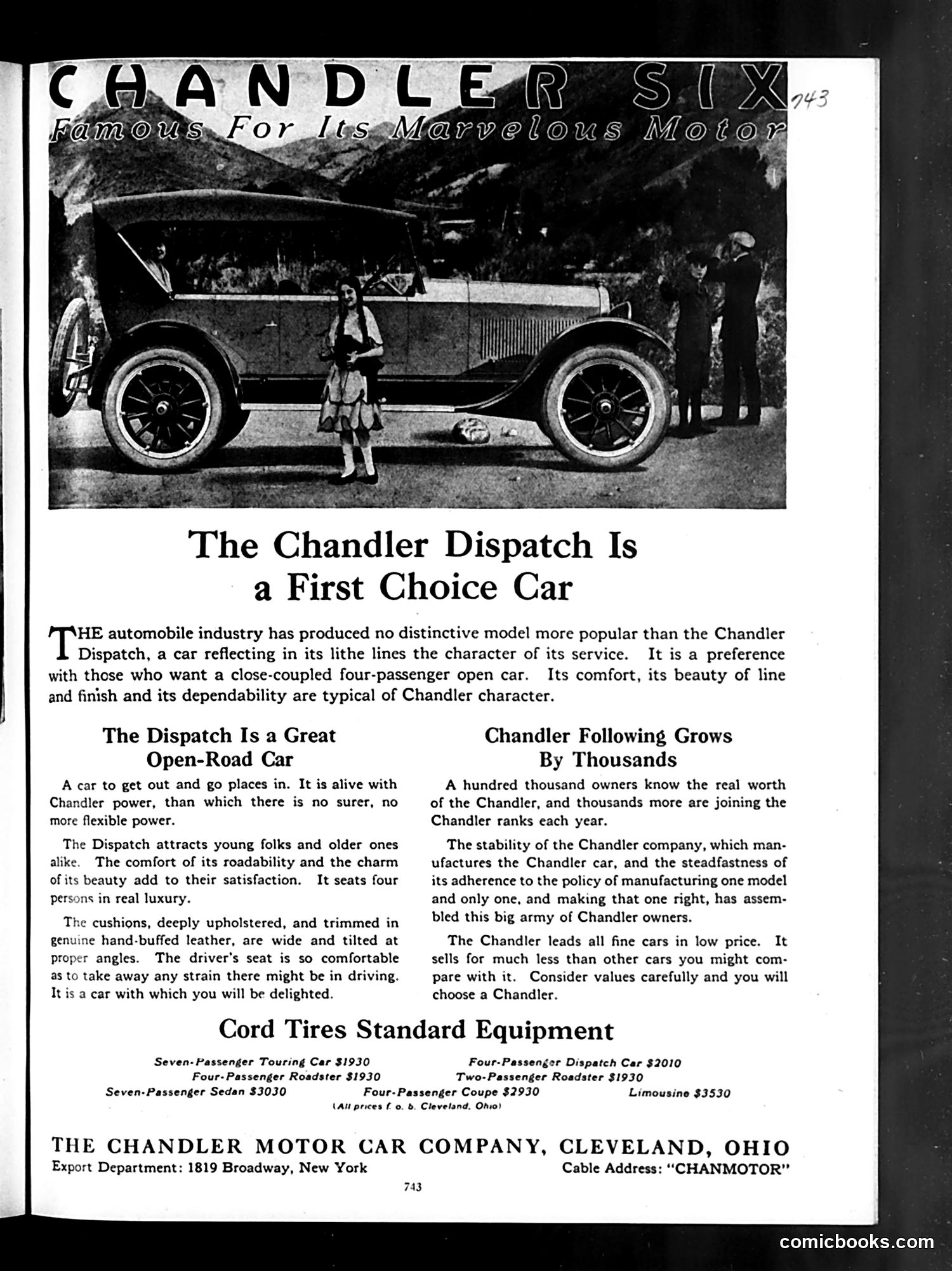
This is **not a cartoon or satire**—it's a straightforward automobile advertisement for the Chandler Motor Car Company of Cleveland, Ohio. The page promotes the "Chandler Dispatch," a four-passenger open car, emphasizing its popularity, comfort, reliability, and affordability compared to competitors. The advertisement includes pricing for various models (ranging from $1930 to $3530) and highlights that Chandler uses Cord tires as standard equipment. The image shows the vehicle with period-appropriate styling and figures posed alongside it. This represents typical early 20th-century automotive marketing, showcasing the car as a luxury but accessible option for middle-class buyers seeking dependable transportation.
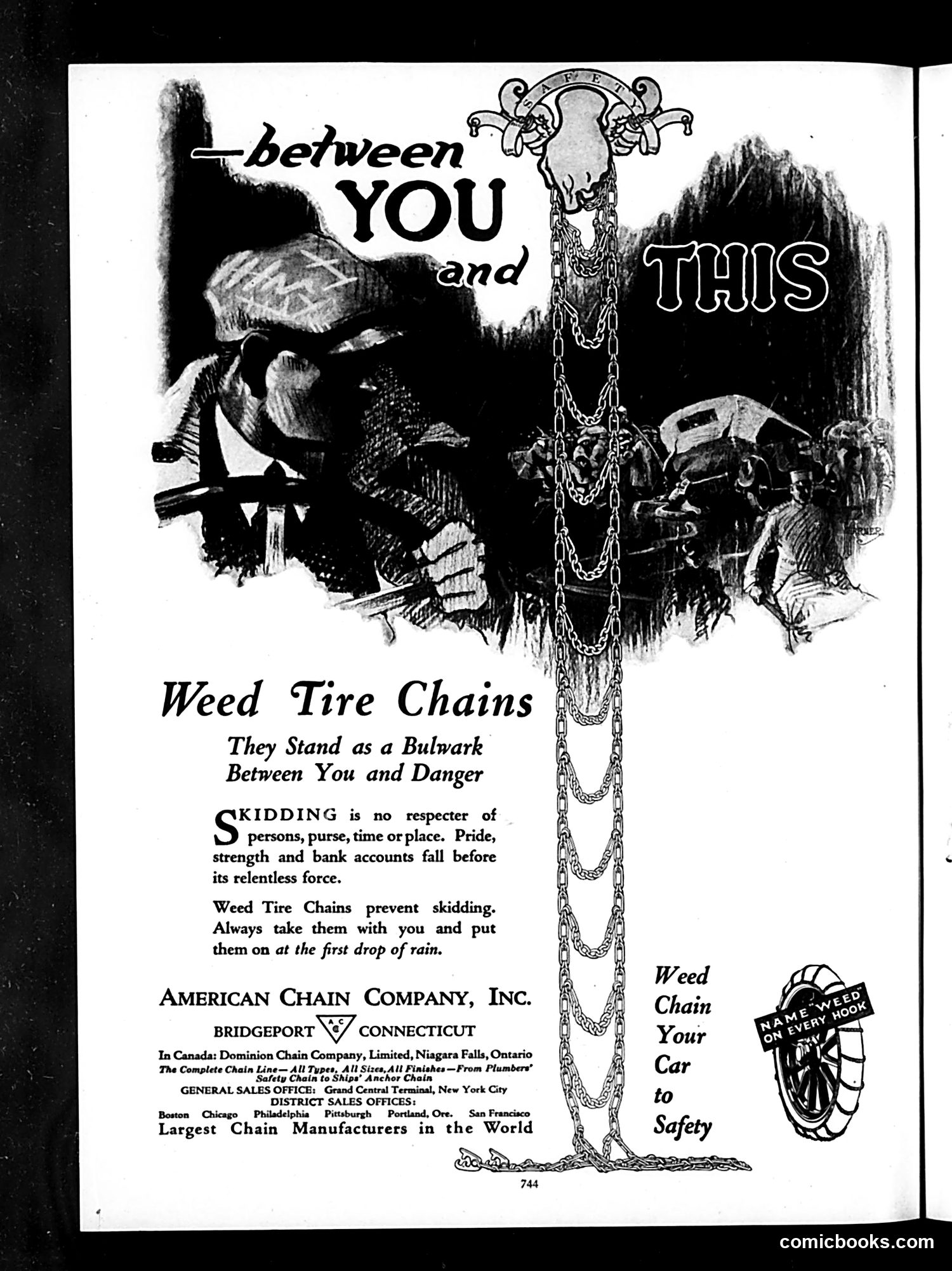
This is a **product advertisement**, not satire or political commentary. American Chain Company is marketing "Weed Tire Chains" — metal chains fitted to vehicle tires for winter traction. The visual metaphor compares tire chains to a protective barrier: the top shows a dangerous figure (representing "skidding" or loss of control) on the left, while chains form a shield in the center, with a wrecked car on the right—illustrating the consequence of driving without chains in bad conditions. The text personifies "skidding" as a criminal threat ("no respecter of persons, purse, time or place") that "falls before" the chains' "relentless force." The ad urges drivers to install chains "at the first drop of rain." This reflects early 20th-century automotive safety messaging, when tire chains were standard winter equipment.
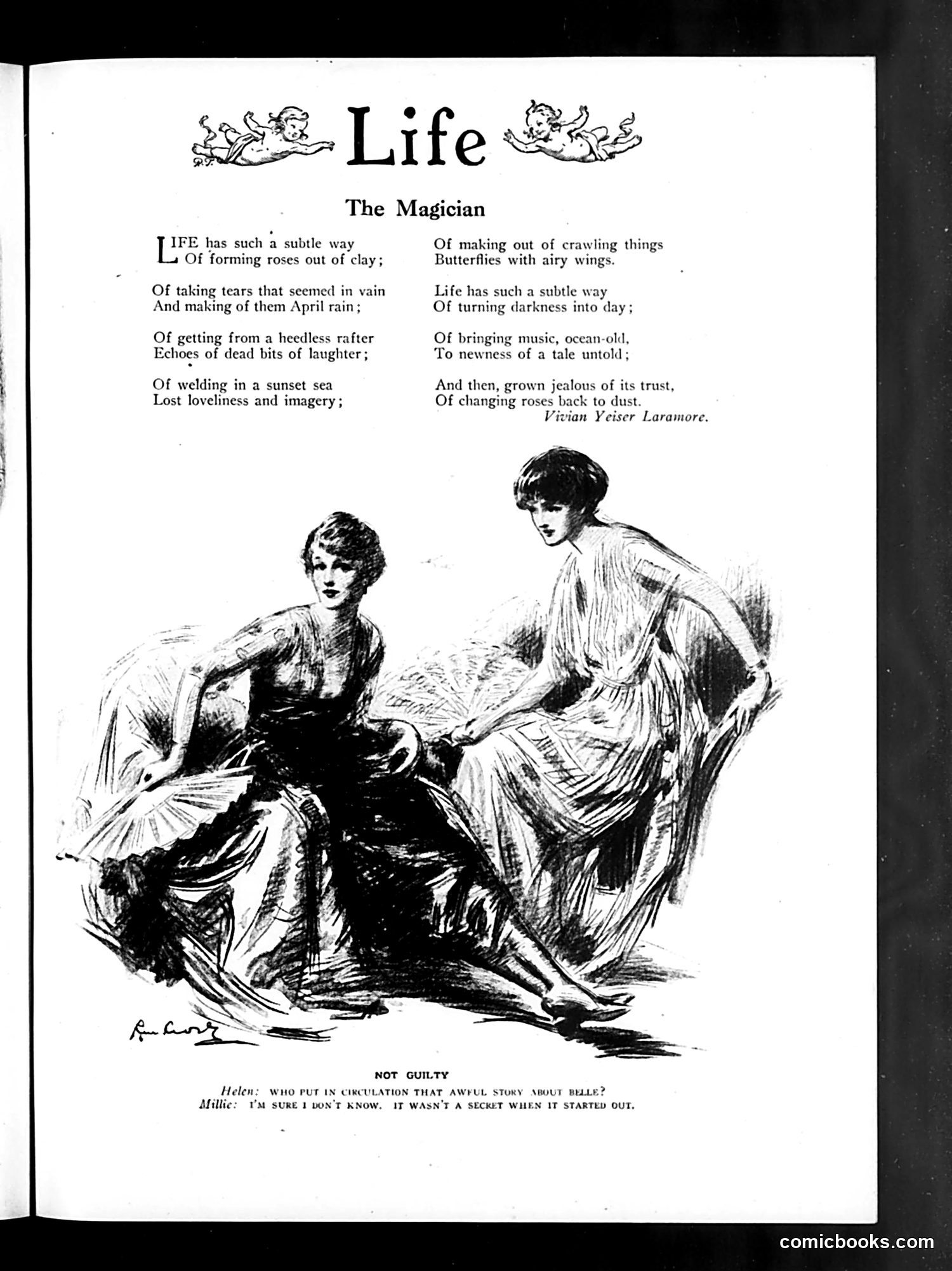
This page presents a poem titled "The Magician" by Vivian Yeiser Laramore, celebrating life's ability to transform the mundane into beauty—roses from clay, tears into rain, laughter from sorrow. The illustration below depicts two elegantly dressed women in flowing garments with a figure in dark clothing between them, captioned "NOT GUILTY." The dialogue reveals a social scandal: Helen asks who spread an "awful story about Belle," while Millie claims ignorance, stating "it wasn't a secret when it started out." This satirizes how gossip and rumors spread through society—particularly among women—with the implication that secrets inevitably become public knowledge. The "magician" metaphor suggests life transforms private matters into public scandal, paralleling the poem's theme of life's subtle, unavoidable transformations.
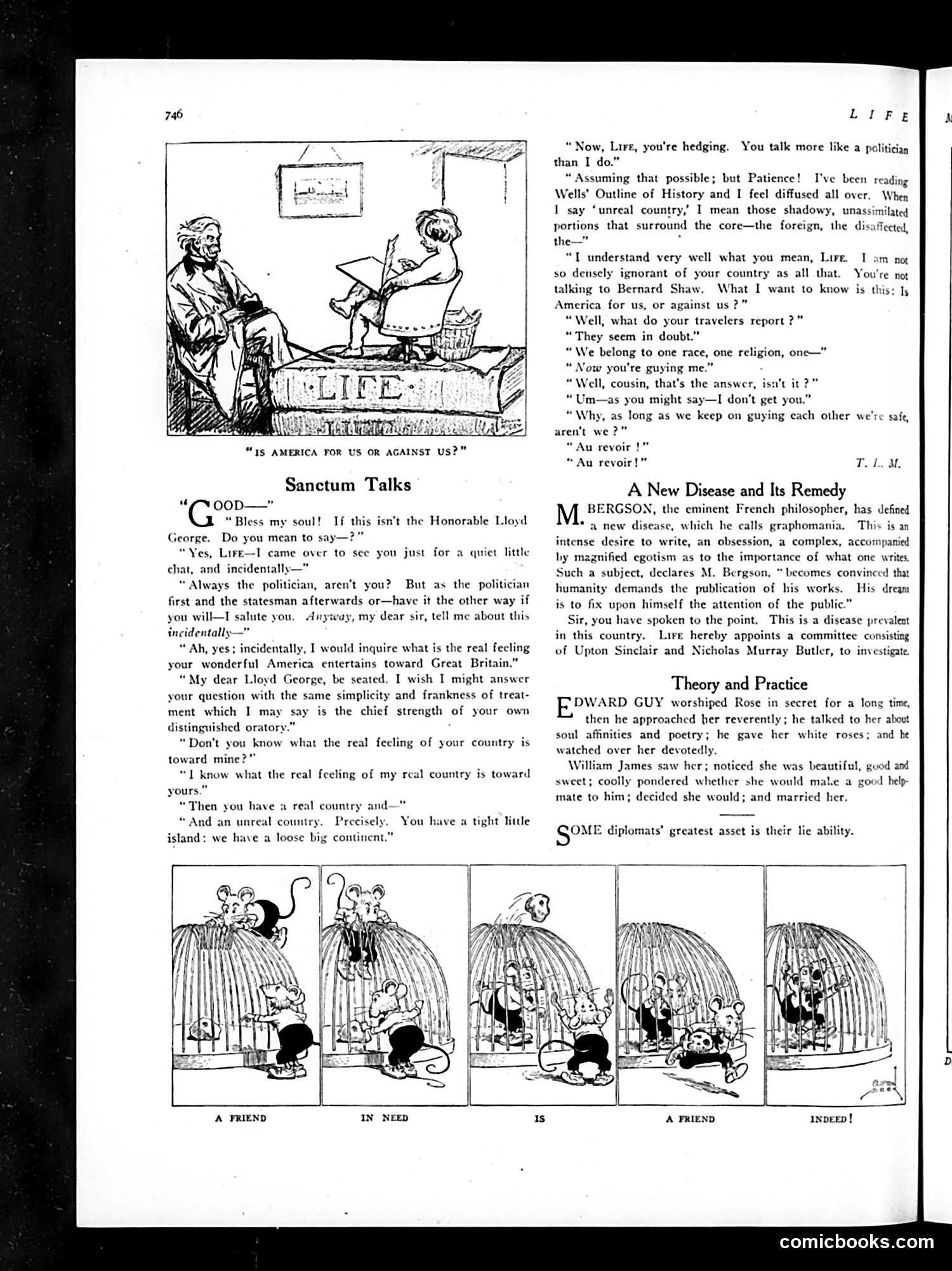
**Top Cartoon ("Is America For Us or Against Us?"):** This depicts a conversation between two figures—likely representing American and British perspectives—debating national allegiance. The dialogue discusses whether America belongs to "one race, one religion" and references Bernard Shaw, suggesting a debate about American identity and immigration policy circa early 20th century. **Bottom Comic Strip ("A Friend in Need is a Friend Indeed"):** This sequential cartoon uses a mouse and cat dynamic as metaphor. It illustrates how fair-weather friendship evaporates when help is needed—the "friend" disappears once the other party becomes disadvantaged. The satire targets hypocrisy in social relationships. **Context:** The page reflects early-20th-century concerns about American identity, immigration, and social obligation.
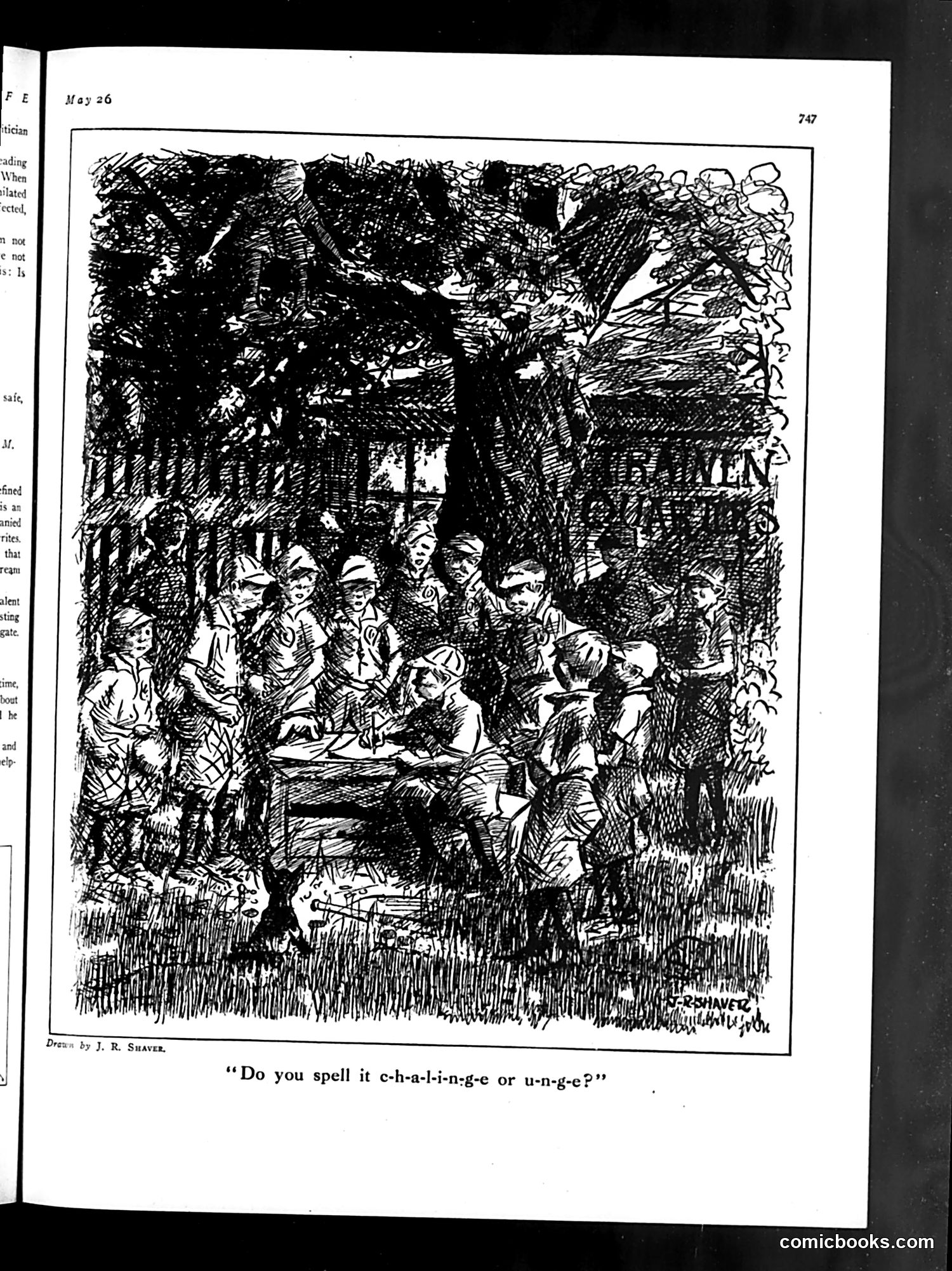
This cartoon depicts a group of soldiers or military personnel gathered outdoors, apparently engaged in a discussion or debate about spelling. The drawing by J.R. Shaver shows them in what appears to be a camp or field setting with trees in the background. The humor centers on a spelling dispute—likely referencing "challenge" versus an incorrect variant. The joke appears to satirize military life, possibly poking fun at soldiers' education levels, communication breakdowns, or the absurdity of camp discussions during wartime. Without additional context about the specific Life magazine issue date or military campaign referenced, the exact satirical target remains unclear, though it generally mocks military personnel's intellectual capacities or the mundane nature of soldier conversations.
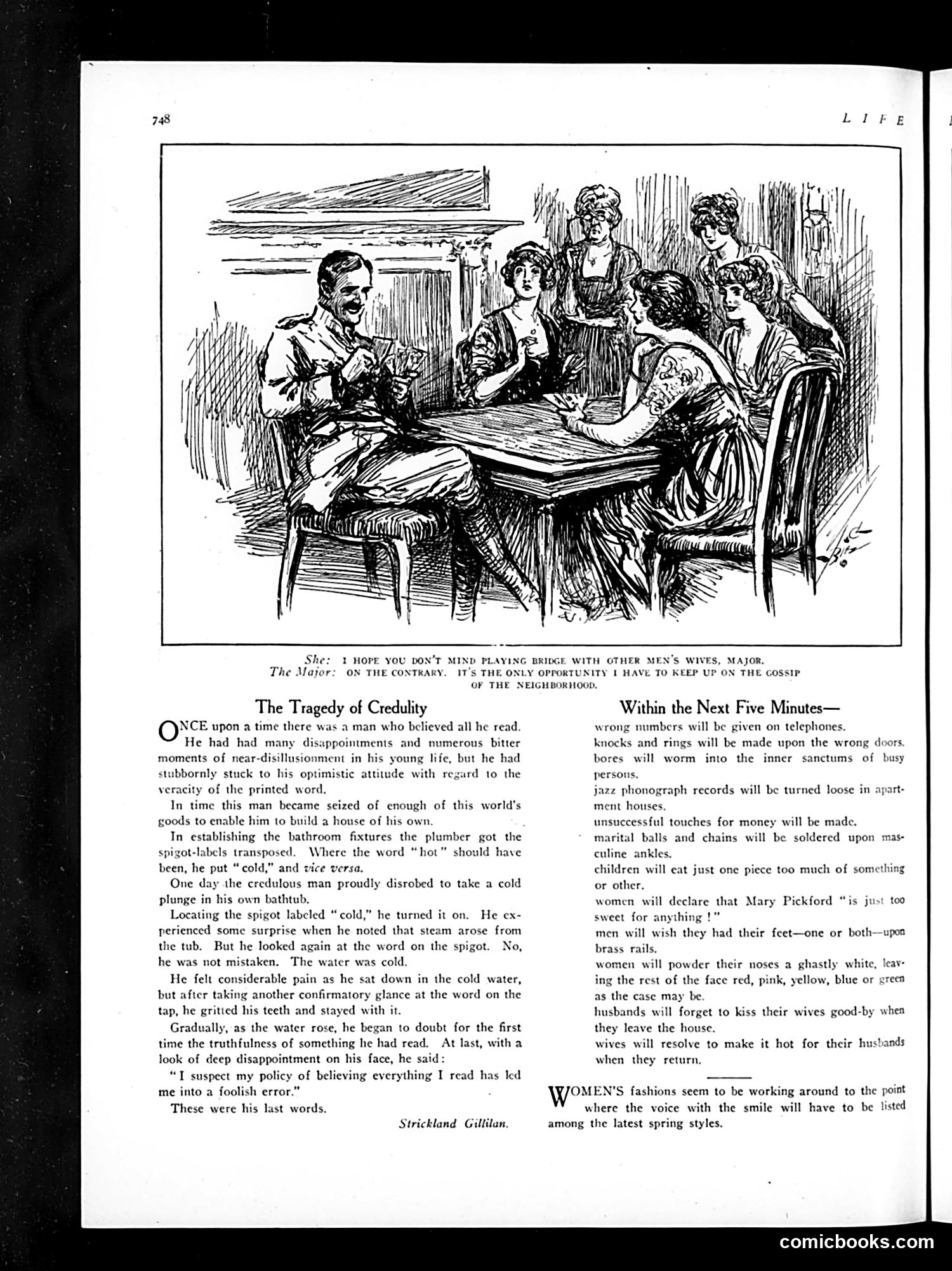
The page contains two distinct pieces: **Left: Cartoon and caption** depicting a social scene where a man and woman discuss bridge playing. The Major's line suggests wealthy women had leisure time for card games while their husbands worked, and that gossiping about neighbors was considered the main social benefit. The humor targets upper-class female socialization and presumed superficiality. **Right: "The Tragedy of Credulity"** by Strickland Gilman—a short humorous story about a man who believed everything he read. He fatally misinterprets a bathtub label ("cold," meaning temperature) as instruction, filling it with literally cold water and dying from the shock. The satire mocks excessive literal-mindedness and credulity toward printed information. **Bottom right:** A satirical prediction list of "Within the Next Five Minutes," humorously cataloging common domestic annoyances and social mishaps—poking fun at everyday middle-class life.
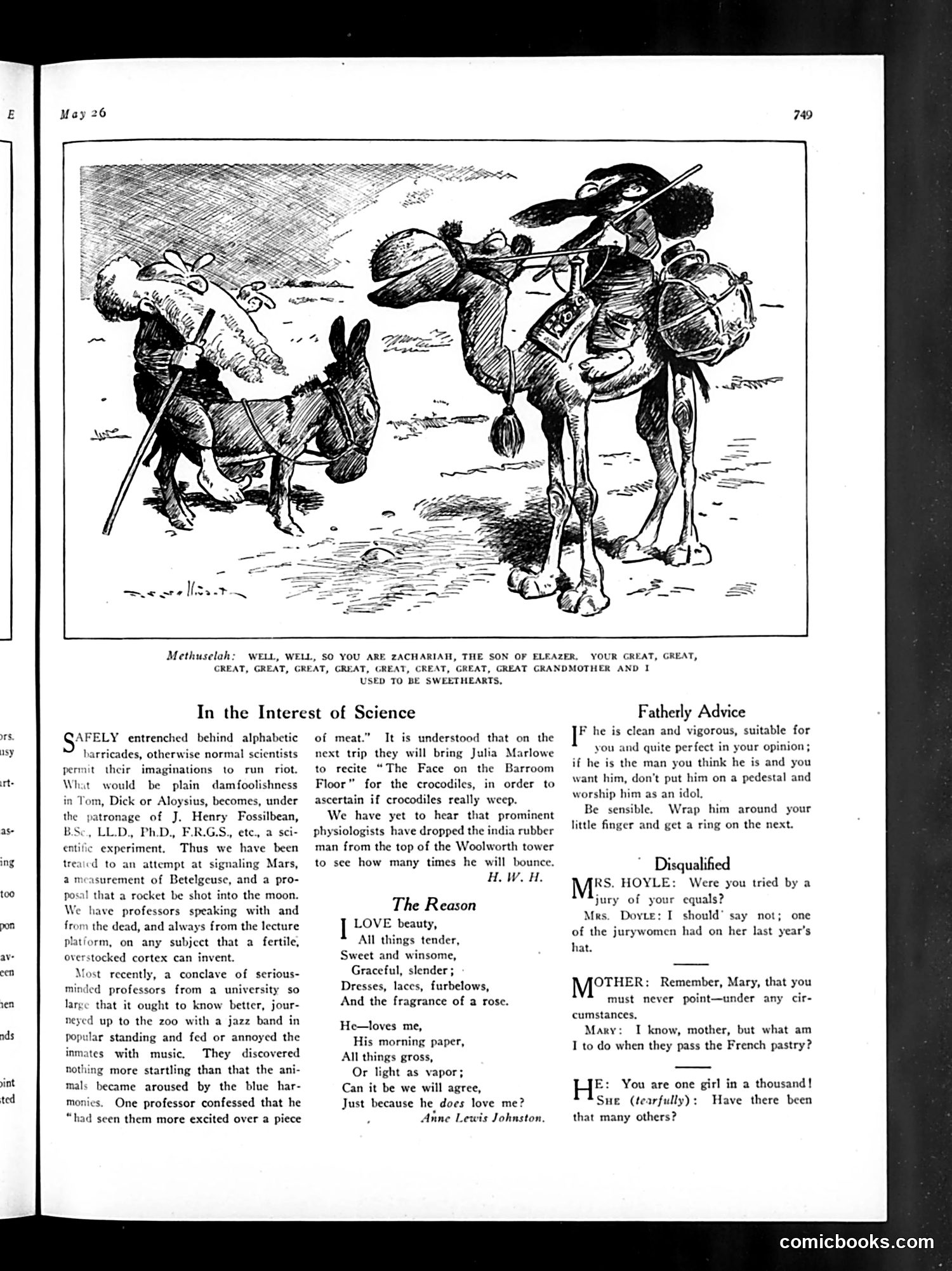
The main cartoon depicts a donkey loaded with household goods meeting a camel similarly burdened. The caption references "Zachariah, the son of Eleazer," establishing a Biblical humorous scenario. Below, three short pieces offer satirical commentary: "In the Interest of Science" mocks absent-minded academics conducting absurd experiments (like shooting rockets at the moon); "The Reason" is a romantic poem by Anne Lewis Johnston about love's tenderness; and "Fatherly Advice," "Disqualified," and "He" are brief comedic dialogues about courtship and social propriety. The overall page combines visual humor with light satirical sketches targeting professors, romantic conventions, and social etiquette—typical of *Life* magazine's early 20th-century blend of gentle mockery and domestic comedy.
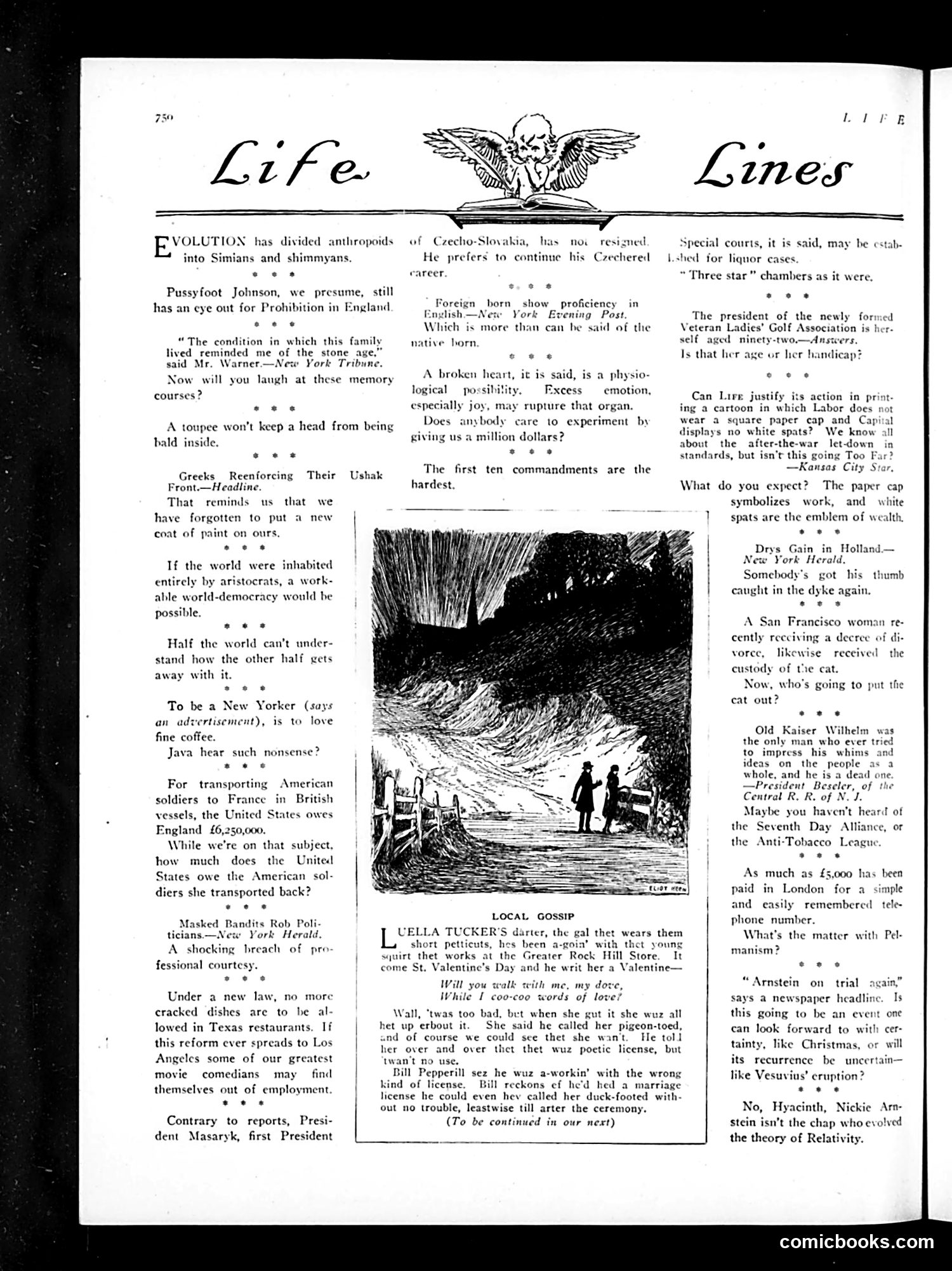
This page from *Life* magazine's "Life Lines" section contains brief satirical commentary and a central woodcut illustration. The cartoon depicts silhouetted figures (appears to be travelers or migrants) on a dramatic landscape with stormy skies. The text items are short, sharp jokes on contemporary topics: evolution (Simians vs. Shimmyans), Prohibition enforcement, Greek immigration, world governance, and New York coffee quality. Several items reference recent news events—a San Francisco woman's encounter with a divorcée, Kaiser Wilhelm's political influence, and debates about transportation costs for American soldiers. The humor targets American social anxieties of the 1920s-era: immigration, labor disputes, government inefficiency, and cultural change. The illustration's context isn't entirely clear from visible text, though it appears related to one of the gossipy anecdotes below it.
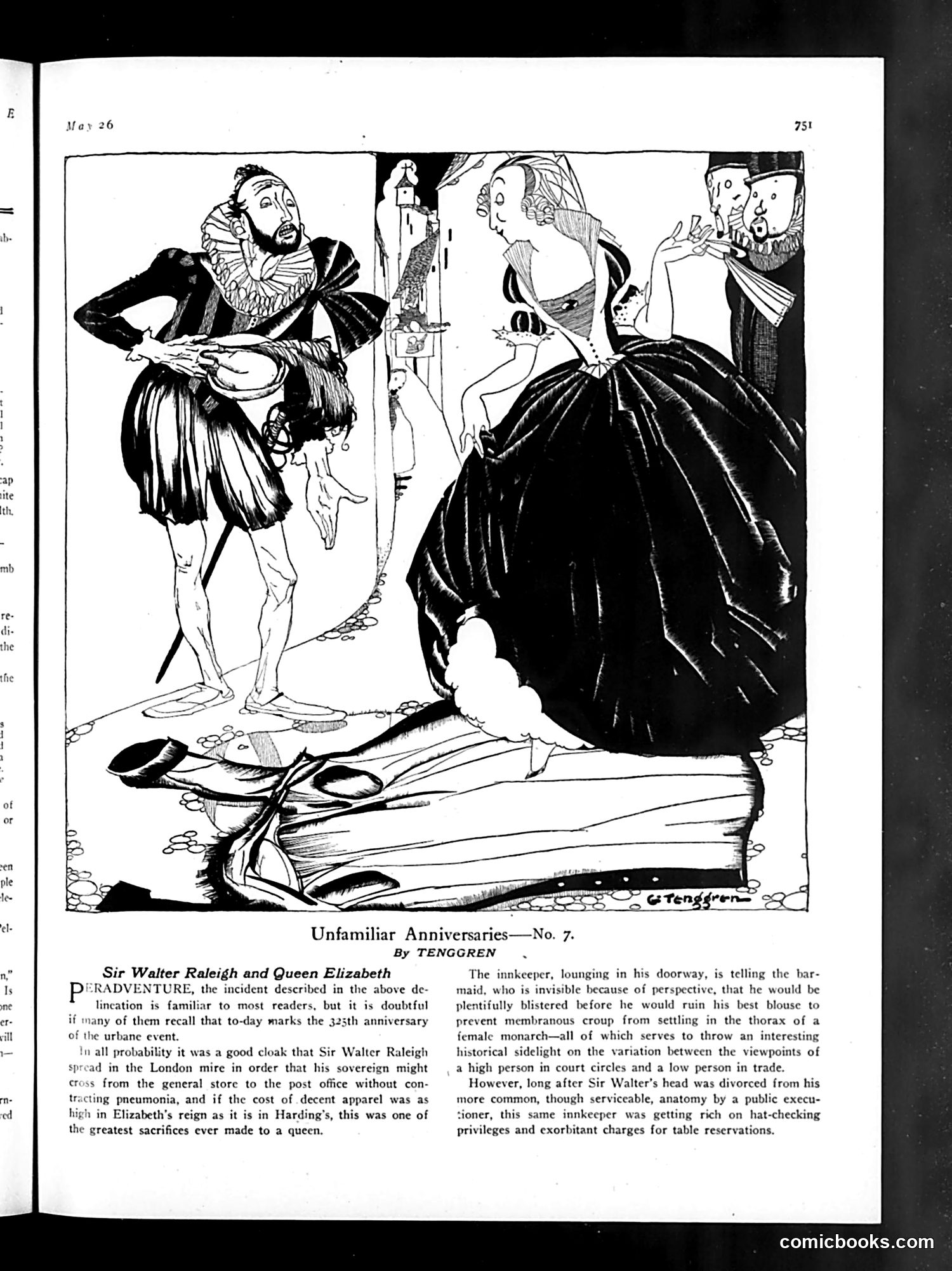
This satirical cartoon by Tenggren depicts the famous legend of Raleigh spreading his cloak for Queen Elizabeth. The text clarifies that while this story is well-known, it's historically dubious. The cartoon shows an innkeeper lounging nearby, invisible due to perspective, telling a barmaid he'd be "plentifully blistered" rather than ruin his best cloak. The satire mocks how the romantic legend obscures the actual historical event—Raleigh's head was later divorced from his body by public execution, yet his memory remains sanitized by courtly mythology. The cartoon contrasts the idealized version with unheroic reality, suggesting how history gets romanticized.
This page is primarily a **book review column**, not a political cartoon. The content discusses contemporary literary works and their merits, with a prominent section titled "Confidential Book Guide" that reviews recent publications. The author (signed "Heywood Broun") critiques how adventure and romantic fiction often lacks authenticity. He argues that adventure tales should feel genuinely mysterious rather than explained away, and that romance should reflect characters' actual emotional lives rather than merely following genre conventions. The page includes reviews of several books with their titles, authors, and publishers listed. This appears to be cultural criticism rather than political satire—focused on literary standards and what makes compelling fiction for contemporary readers.
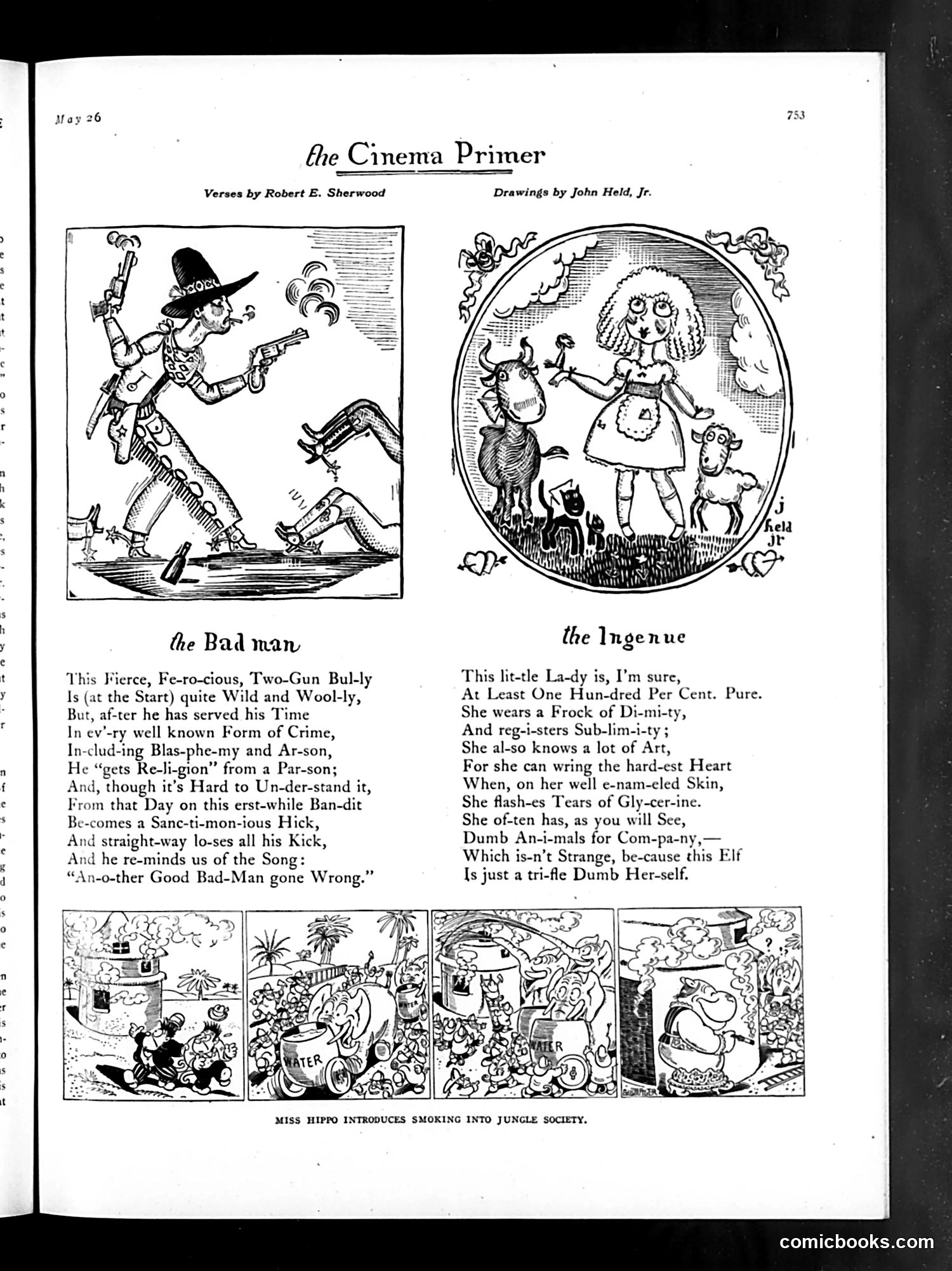
This is a satirical instructional page about movie character archetypes. The top illustrations present two stock cinema types with rhyming verse descriptions: **"The Bad Man"** (left): A violent, gun-slinging villain—the classic Western antagonist of silent films. The verse mockingly describes his criminal nature using exaggerated rhyming wordplay. **"The Ingenue"** (right): The innocent, virtuous young heroine—often portrayed as naive and easily manipulated. The text humorously suggests she's intellectually simple ("trifle Dumb Her-self"). The bottom comic strip, titled "Miss Hippo Introduces Smoking Into Jungle Society," shows an animal character introducing cigarettes to other jungle creatures—likely satirizing both mass-media influence on "primitive" societies and the advertising of harmful products. This reflects 1920s anxieties about cinema's cultural impact.
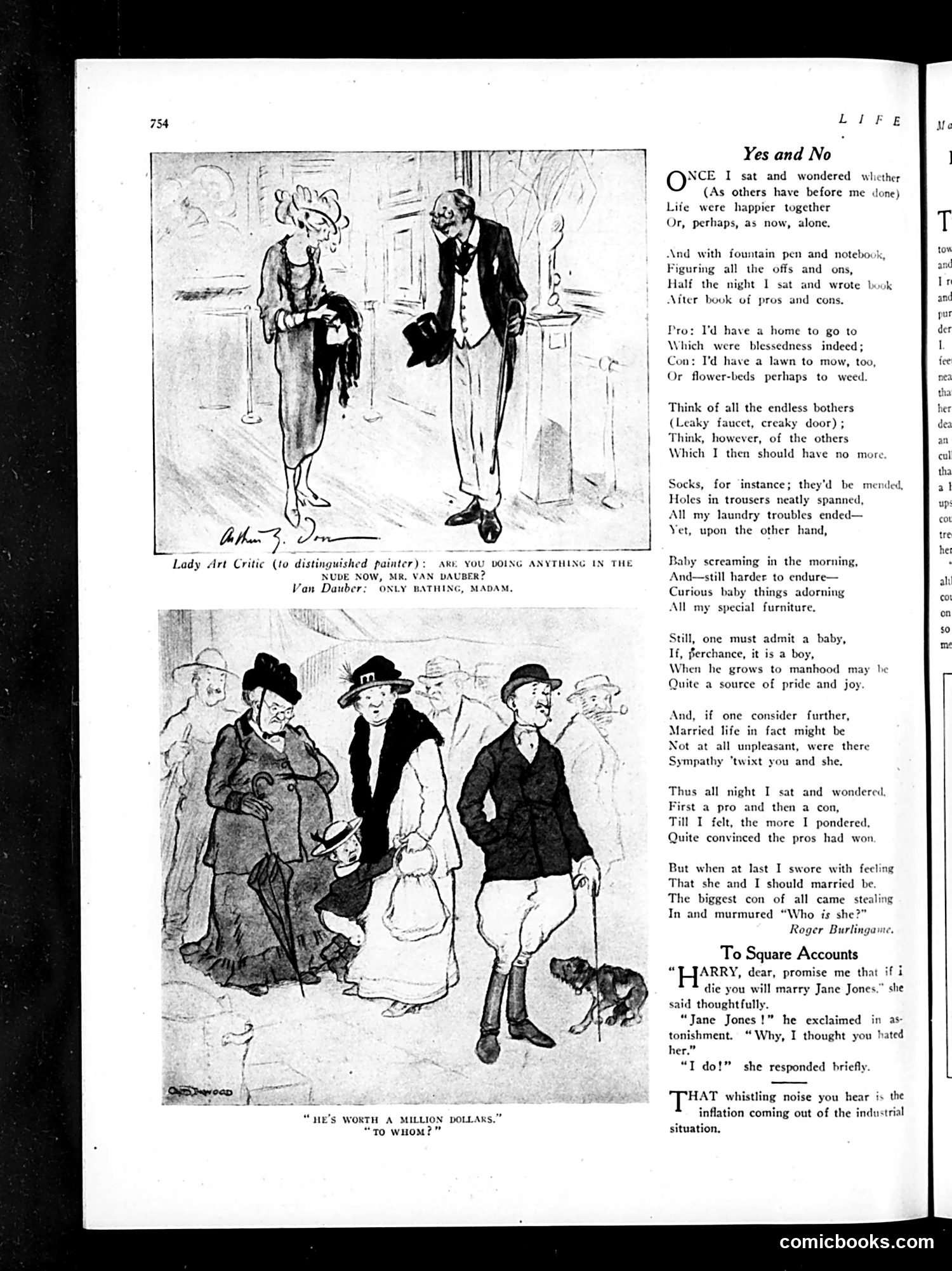
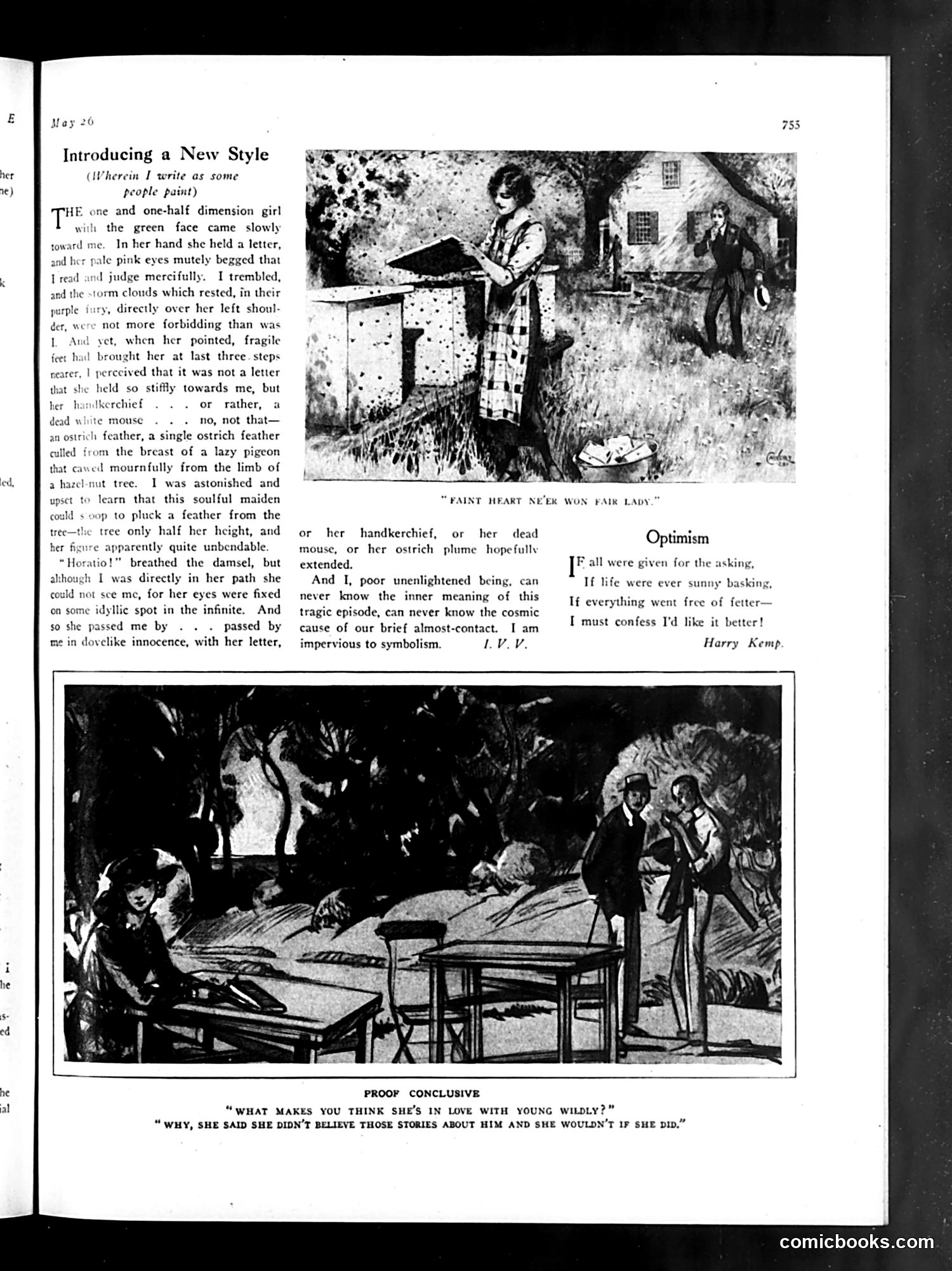
This page contains two illustrated stories from *Life* magazine (dated May 26). **"Introducing a New Style"** (top) is a short romantic sketch by I.V.V. about a young woman with distinctive features—described as having a green face and pink eyes—who delivers an unusual love token: a feather from a lazy pigeon. The narrator finds this bizarre gesture oddly touching. **"Optimism"** (right) is a brief poem by Harry Kemp expressing preference for an idealized life over harsh reality. **"Proof Conclusive"** (bottom) is a captioned illustration depicting what appears to be a domestic or social scene, illustrating skepticism about a young woman's romantic devotion based on her disbelief of rumors about her suitor. These are light, humor-focused pieces typical of *Life*'s satirical approach to romance and social relationships.
This page contains editorial commentary on Marshal Foch's planned October visit to the United States. The text discusses American delegation to post-WWI peace negotiations, particularly regarding the Supreme Council's authority and the Treaty of Versailles. The small cartoon at top-left appears to show four identical military figures (likely representing Allied leaders or soldiers), though specific identities aren't clear from the image alone. The main "War Peace" emblem/logo appears below the initial text sections. The article argues for American participation in international peace efforts while maintaining independence from European affairs. It discusses sending unofficial observers to conferences rather than formal representatives—reflecting post-war American isolationism tensions and debates about the League of Nations.
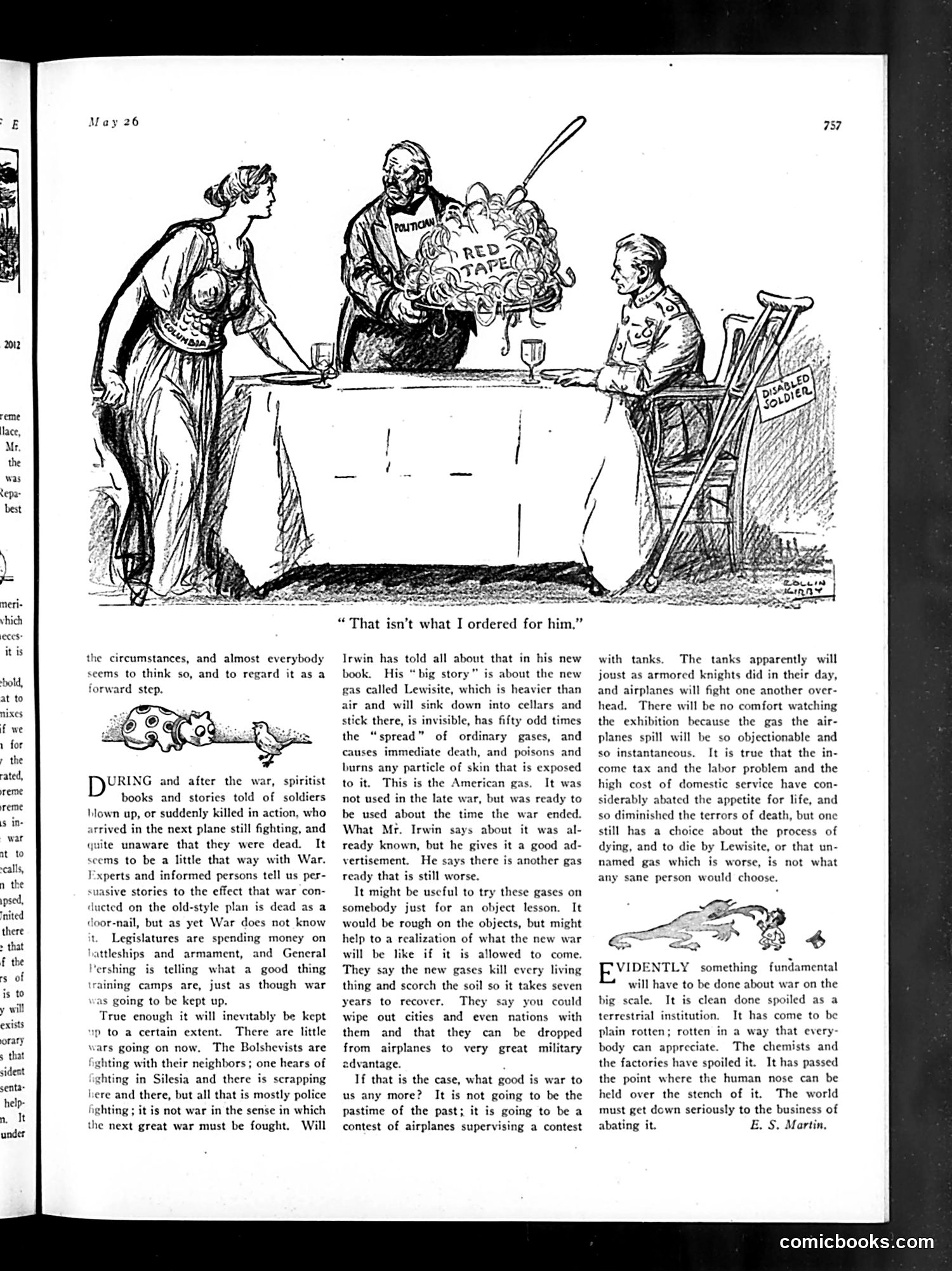
This cartoon satirizes post-WWI military planning. A commanding officer presents a grotesquely deformed baby labeled "RED TAPE" to a woman (representing the nation or public), while a disabled soldier sits nearby. The caption suggests this monstrosity is not what was expected. The accompanying article by E.S. Martin criticizes the continued militarization despite war's end. It references a new chemical weapon called Lewisite—a poisonous gas deadlier than those used in WWI—and argues that modern warfare has become so mechanized and chemically devastating (involving tanks and airplanes dropping poison) that it no longer serves any rational purpose. Martin contends that warfare has become morally indefensible and calls for serious international efforts to abolish large-scale war, since the "stench" of such destruction is now unbearable to civilized society. The cartoon's "red tape" baby represents the bureaucratic waste and misplaced priorities of post-war military spending.
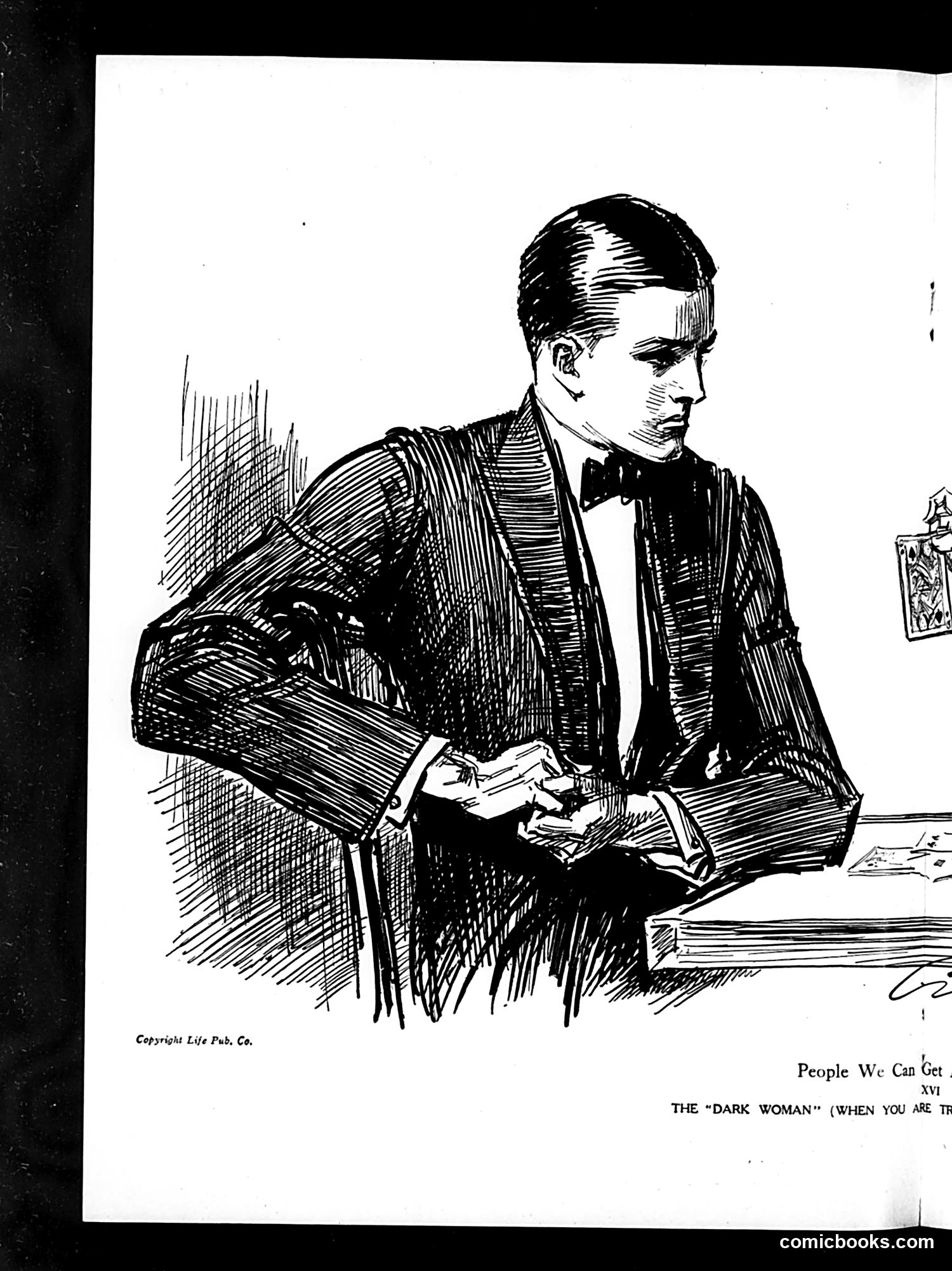
This appears to be an illustration from Life magazine's "People We Can Get" series (entry XVI). The image shows a well-dressed man in formal attire (tuxedo with bow tie) seated at a desk, looking downward with a somewhat serious or contemplative expression. The caption references "THE 'DARK WOMAN' (WHEN YOU ARE TR[...]" — the text is cut off, making the complete reference unclear. Based on the formal setting and the man's focused demeanor, this likely satirizes a specific social type or romantic/literary archetype popular in early-to-mid 20th century culture. The "dark woman" reference suggests commentary on a mysterious or alluring feminine figure, possibly mocking how certain men are attracted to or preoccupied with this romantic ideal. Without the complete caption, the specific satirical target remains uncertain.
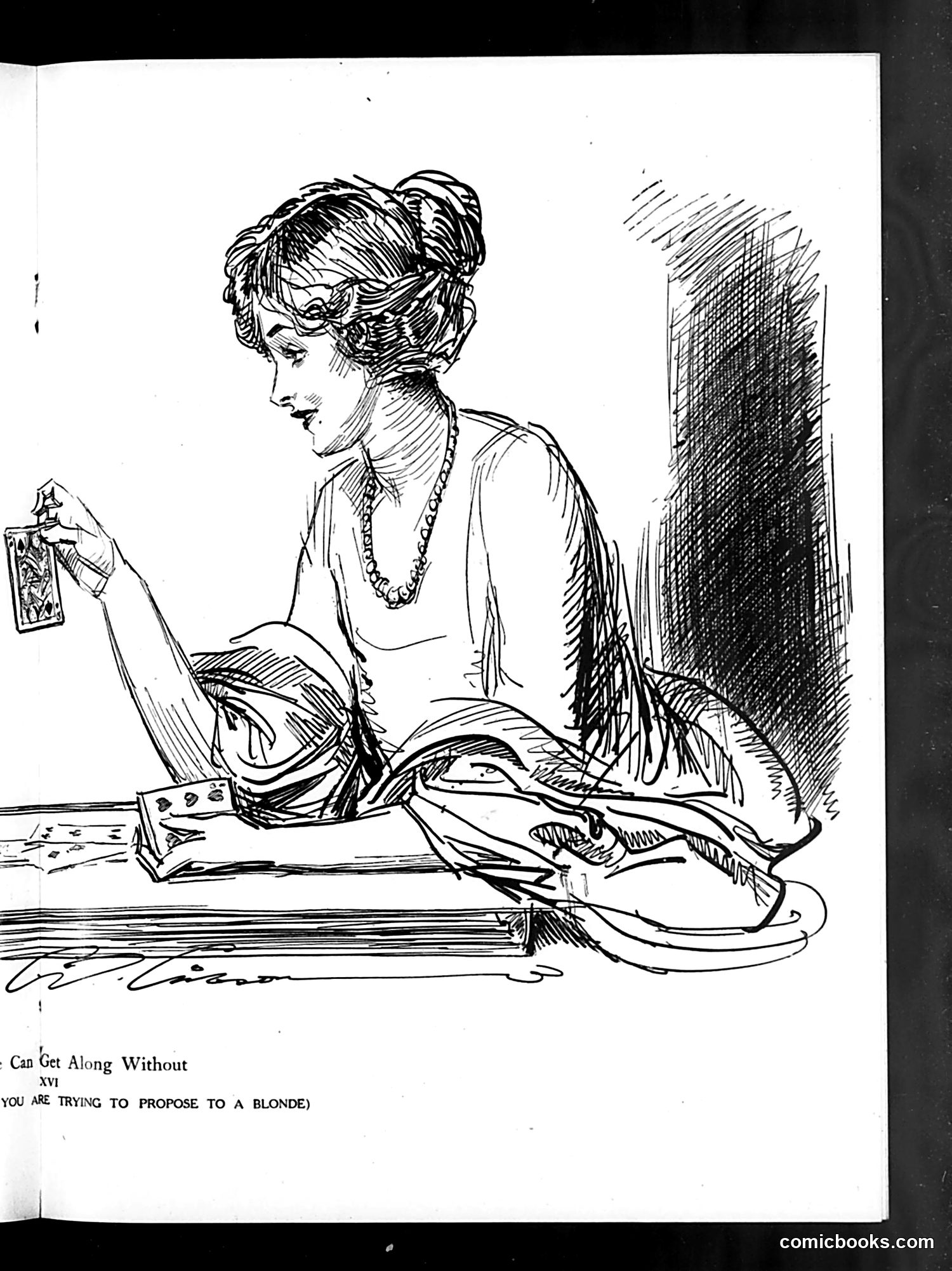
This is a satirical cartoon from Life magazine's series offering humorous advice to men. The caption reads: "YOU ARE TRYING TO PROPOSE TO A BLONDE." The illustration shows a woman seated at a table examining playing cards, appearing unimpressed or distracted while a man attempts to propose. The satire targets the stereotype that blonde women are vain, materialistic, or disinterested in romance—suggesting a man attempting courtship with a blonde woman faces inevitable failure or indifference. The series format ("XVI" indicates this is the 16th installment) allowed Life to mock various dating and relationship scenarios through period gender stereotypes. The artwork style and casual misogyny reflect early-to-mid 20th century humor conventions.
This is a theater review of the operetta *"The Last Waltz"* by Oscar Straus, praising its combination of quality music with genuine humor—a rare achievement in musical comedy. The piece celebrates performer **James Barton**, a former burlesque dancer whose unorthodox dancing style and comedic timing elevate the production. The critic compares his artistry to serious musicians like Mischa Elman and Sir Johnston Forbes-Robertson, elevating a vaudeville performer to high-art status as satire. The review also praises **Eleanor Painter**, the soprano lead, for her vocal control and ability to sing without the "dreaded" high-note strain typical of operatic sopranos. The smaller cartoon panels appear to satirize theater audiences—particularly the pretentious opera-goers who ostentatiously appreciate music while ignoring humor, and the self-appointed "cognoscenti" who signal when applause is appropriate, as if choreographing audience response. The satire targets class pretension in theater culture.
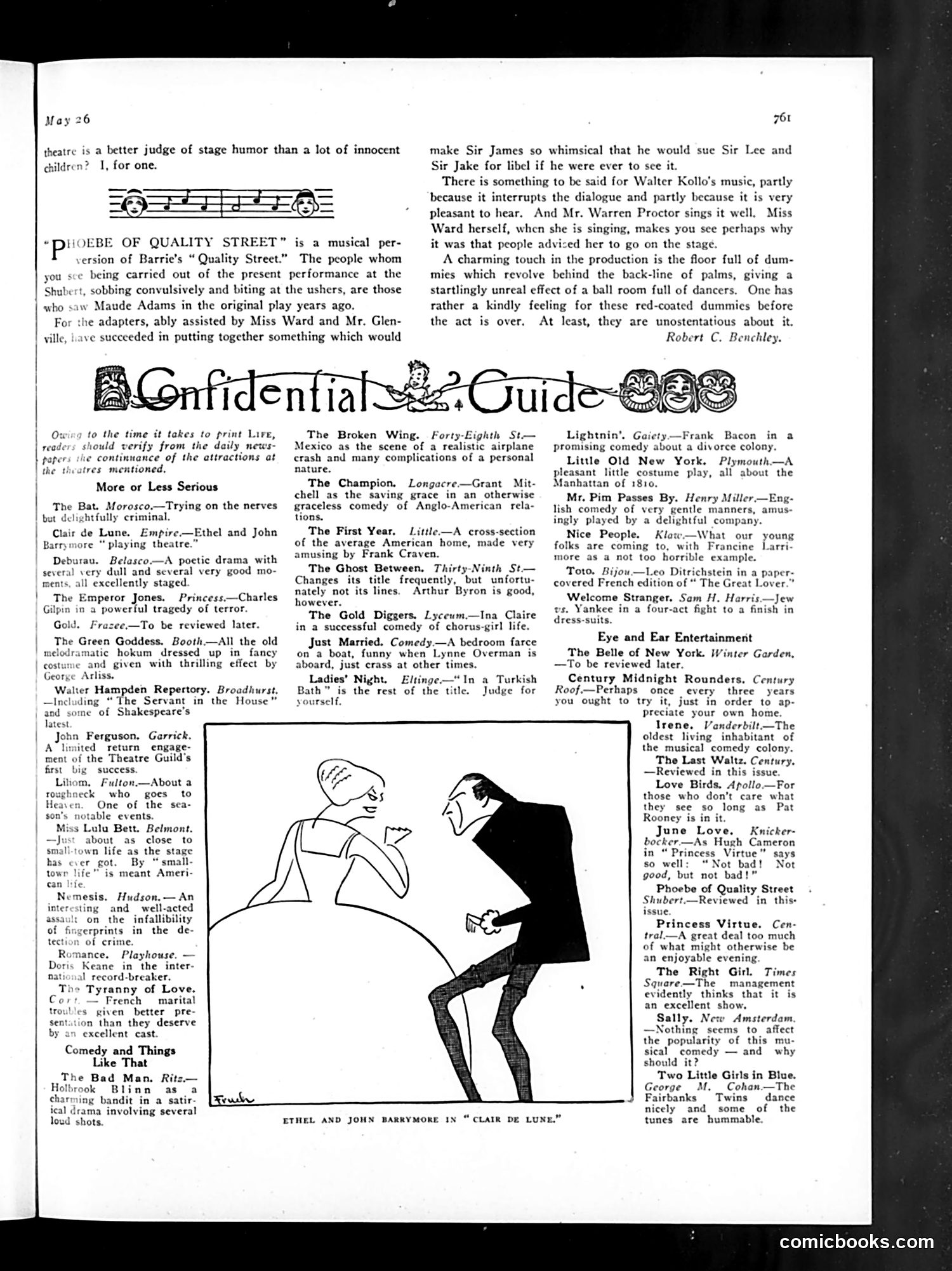
The illustration shows two figures in formal attire—a woman in an elegant dress and a man in a tuxedo—engaged in what appears to be a flirtatious or comedic interaction. The caption identifies them as Ethel and John Barrymore performing in the play "Clair de Lune" at the Empire Theatre. The cartoon likely satirizes the Barrymore siblings' on-stage chemistry or the play's romantic plot. The exaggerated postures and the man's animated gesture suggest theatrical melodrama or physical comedy. For modern readers: the Barrymores were America's most prestigious theatrical family in the 1920s, so their performances were widely reviewed and parodied. This appears to be gentle satire of stage conventions rather than political commentary—typical of Life magazine's arts criticism section.
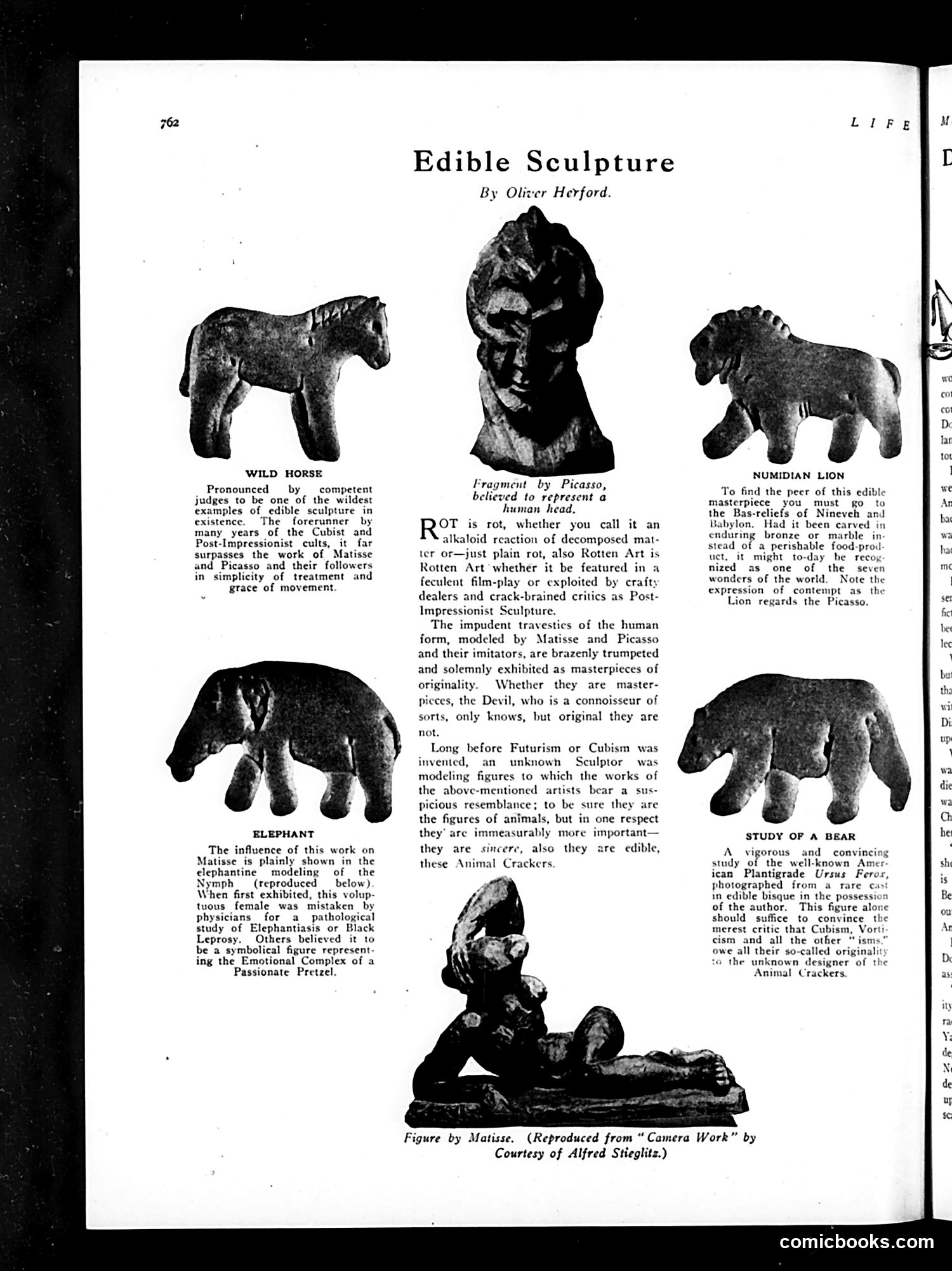
This article mocks early 20th-century avant-garde art movements—particularly Cubism and Post-Impressionism—by comparing modernist sculptures by Matisse and Picasso to animal crackers. The author argues that these celebrated artists' "impudent travesties" of form are no more original or meaningful than children's food products. The joke positions anonymous animal crackers as superior artworks: they possess "simplicity," "grace," and "sincerity" that famous modernists lack. The text sarcastically suggests animal crackers anticipated Cubism and represent the "seven wonders of the world." This reflects widespread early 1900s American skepticism toward abstract art, viewing modernism as pretentious fraud promoted by critics and dealers. The comparison to decomposing matter ("rot") and disease reinforces the hostility. The article weaponizes earnest aesthetic language to ridicule what many contemporaries considered artistic nonsense masquerading as genius.
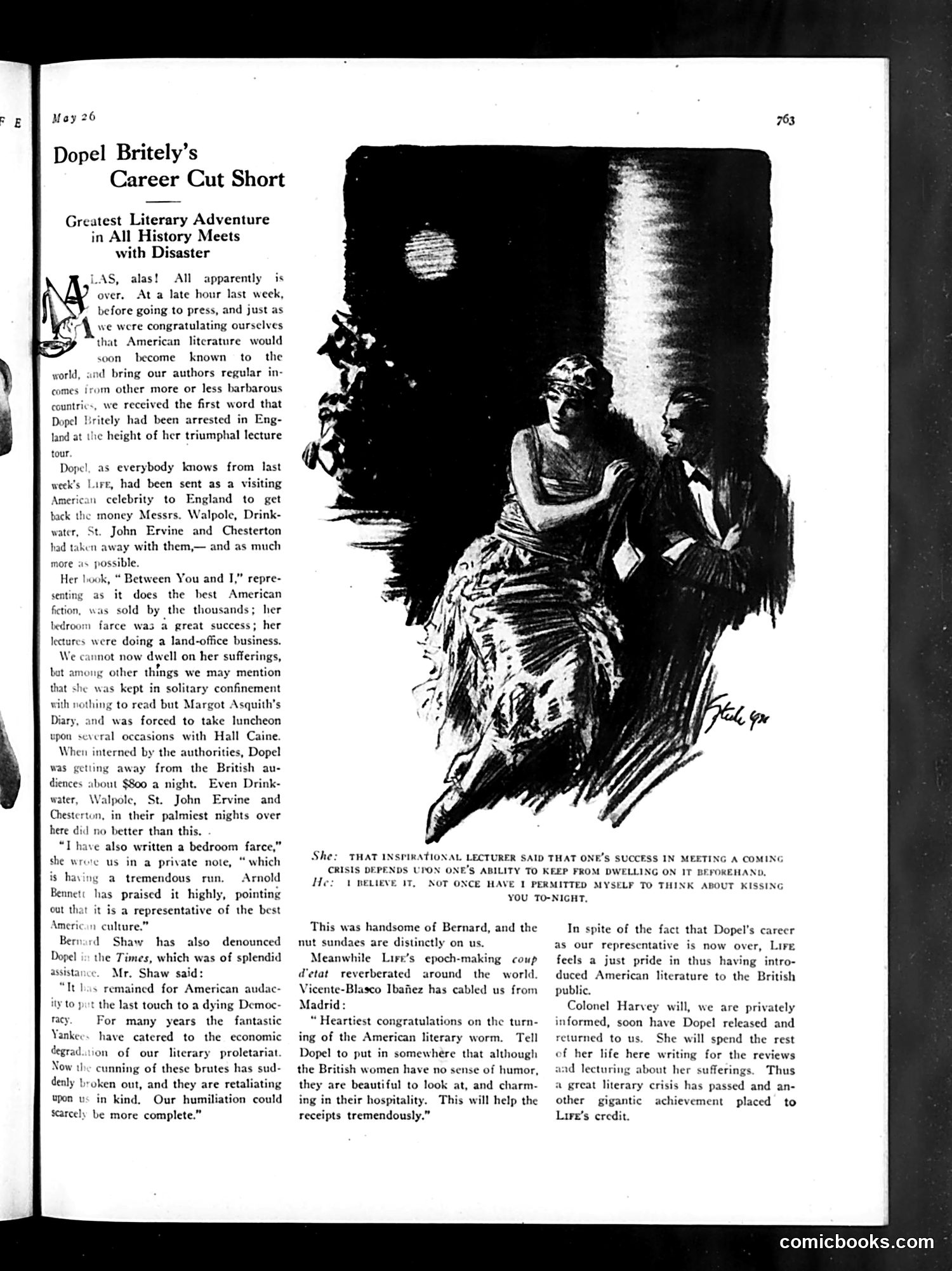
This is satirical commentary on American literary exports and cultural competition with Britain. "Dopel Britely" appears to be a fictional character—likely a composite parody of American authors (particularly women writers) sent to lecture in England to recoup money from British literary figures like Hugh Walpole and G.K. Chesterton. The satire mocks several things: American authors' commercial success abroad; pretentious "bedroom farce" comedies; and the notion that American literature represents the "best" fiction. The humor centers on Dopel's arrest and mistreatment in England—kept in solitary confinement, forced to dine with elderly author Hall Caine—as comeuppance for American cultural ambitions. The cartoon illustrates the article's mockery of transatlantic literary rivalry. References from Shaw and Spanish author Vicente-Blasco Ibáñez add international dimension to the joke about America's cultural pretensions. *Life* magazine here satirizes both American boosterism and the stereotype of British dismissiveness toward American letters.
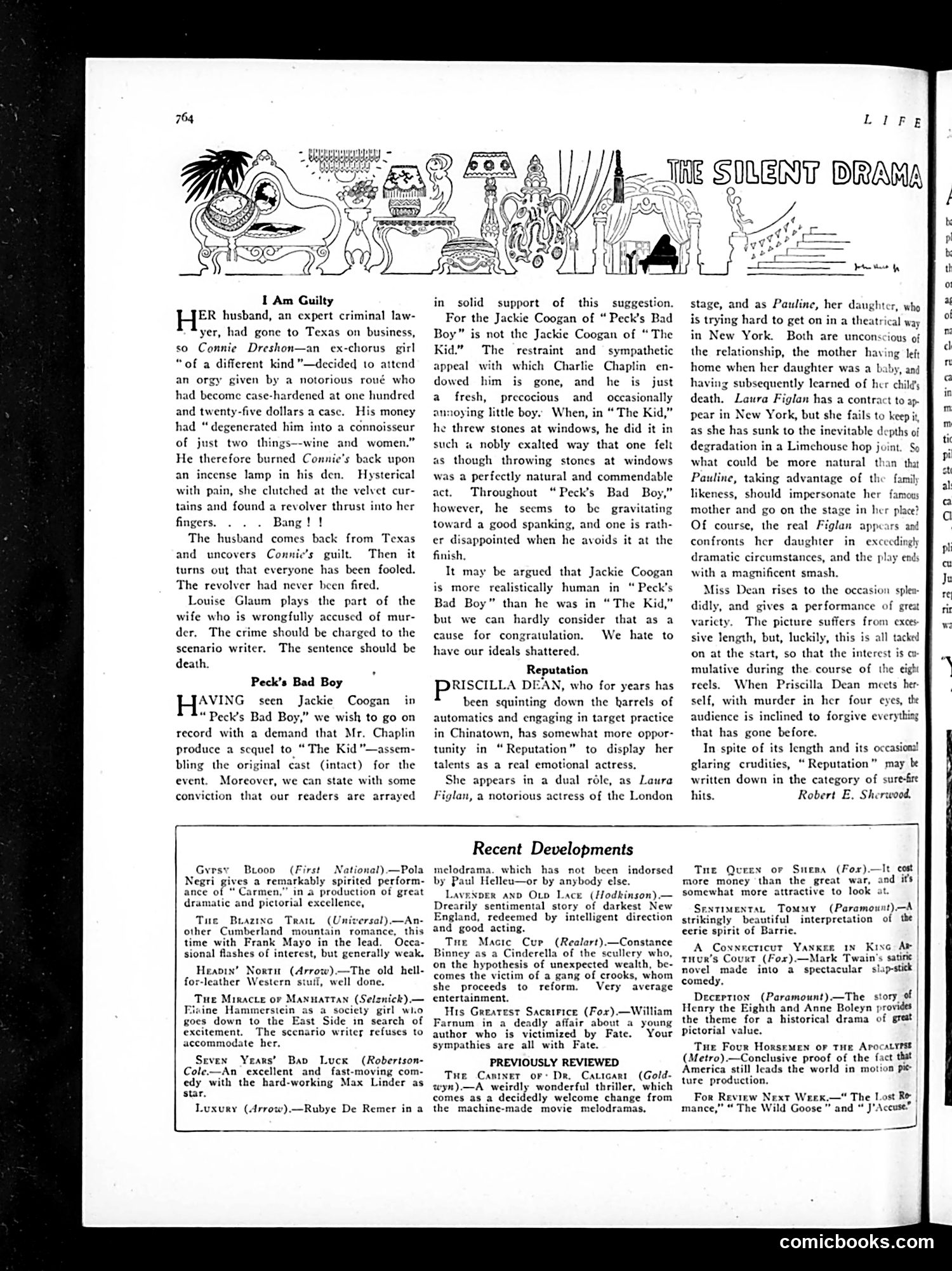
This page contains three film reviews from Life's movie criticism section, circa the silent film era (early 1920s based on references to Jackie Coogan and Charlie Chaplin). The opening cartoon illustration depicts various theatrical and cinematic scenes, establishing the "silent drama" theme. The reviews critique: 1. **"I Am Guilty"** - A melodrama starring Louise Glaum about a wrongfully accused wife, which the critic harshly condemns as poorly plotted ("The crime should be charged to the scenario writer"). 2. **"Peck's Bad Boy"** - Starring child actor Jackie Coogan. The reviewer criticizes Coogan's performance here compared to his acclaimed role in Chaplin's "The Kid," arguing he's merely an "annoying little boy" rather than the sympathetically drawn character audiences loved before. The critic regrets that "our ideals shattered." 3. **"Reputation"** - Featuring actress Priscilla Dean in a dual role as a mother and daughter separated by circumstance in London and New York. The tone is sophisticated critique aimed at theater-going audiences.
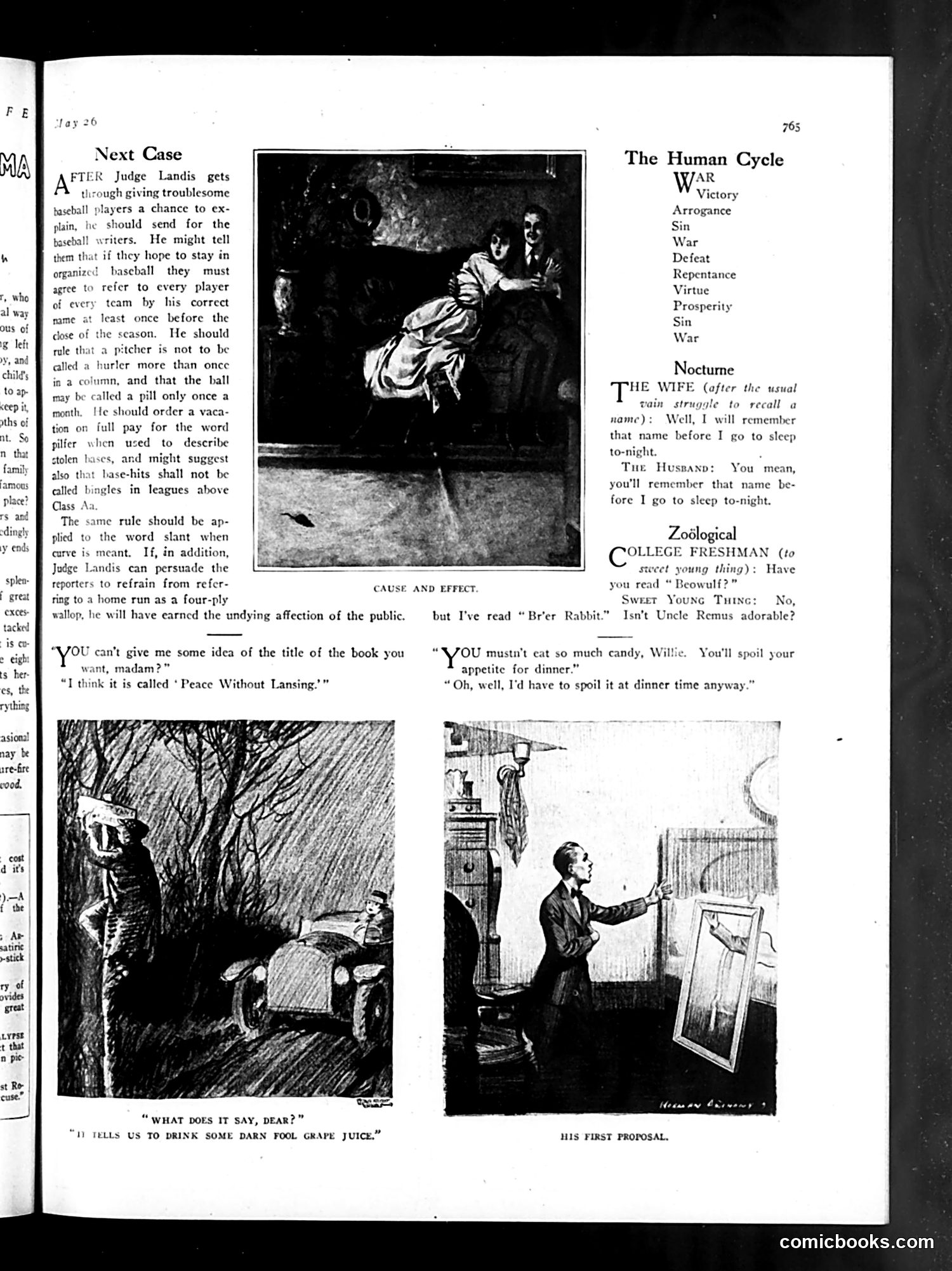
This page from *Life* magazine contains satirical commentary on early 20th-century American culture: **"Next Case"** critiques sportswriting clichés. Judge Landis (baseball's commissioner) is urged to enforce vocabulary standards on sports reporters—banning overused slang like "hurler," "pill" (for baseball), "bingles" (hits), "wallop" (home run), and "slant" (pitch). The satire mocks journalists' lazy, repetitive language. **"The Human Cycle"** presents a moral diagram showing civilization's inevitable decline: virtue leads to prosperity, which breeds sin and arrogance, triggering war and defeat—requiring repentance to restart the cycle. This reflects pessimistic early-20th-century anxieties about social progress. **The other comic vignettes** depict domestic humor: a wife's confused reference to "Peace Without Lansing" (likely a confused book title involving Secretary Lansing), a couple debating grape juice, and courtship scenarios. These represent genteel middle-class life and the era's prohibition debates. The overall tone is lighthearted social commentary on American manners, language, and morality.
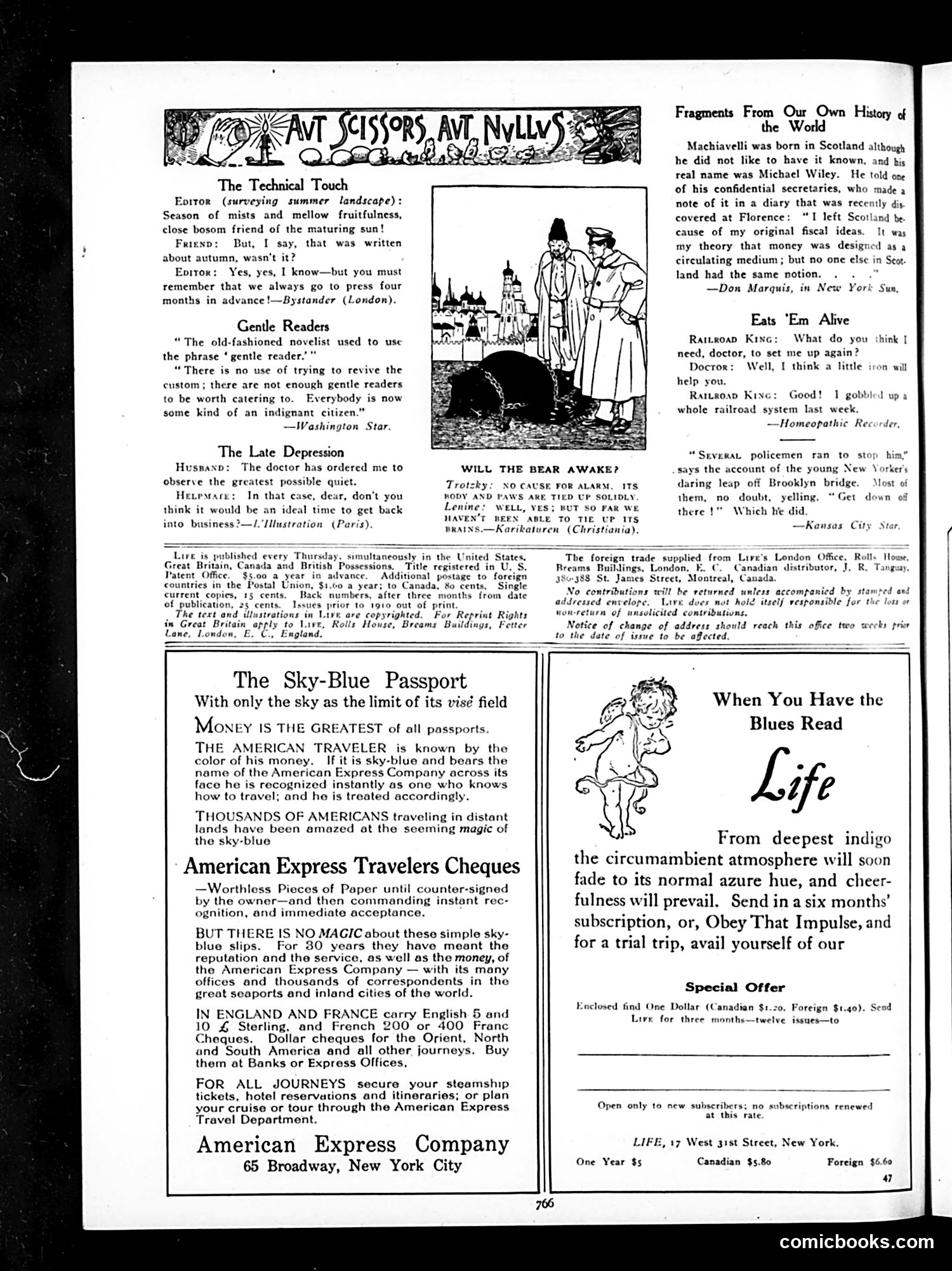
This page contains multiple short humor pieces typical of Life's satirical format, plus advertising. **"The Technical Touch"** mocks magazine editorial practices: an editor quotes Keats's autumn poem in summer because publications go to press four months in advance—a real constraint of pre-digital publishing that created absurd timing mismatches. **"Gentle Readers"** is a meta-joke about declining civility: old novels addressed "gentle readers," but modern readers are now "indignant citizens," so the convention is obsolete. **"The Late Depression"** plays on a husband's excuse to avoid returning to work during economic hardship, claiming doctor's orders for quiet. **"Fragments From Our Own History"** is satirical fake history, humorously falsifying Machiavelli's origins (Scotland, real name "Michael Wiley") and attributing this to Don Marquis—absurdist humor. The remaining pieces are brief joke exchanges about a railroad magnate and a Brooklyn Bridge incident. The page concludes with American Express Traveler's Cheques advertising, emphasizing how American money enables global travel and respect.
This page is **advertising**, not satire or political commentary. It's a Phoenix Hosiery company advertisement from Life magazine promoting women's stockings. The ad makes a straightforward commercial argument: Phoenix stockings have become the best-selling hosiery brand because they're durable and affordable—offering "long mileage at low cost." It appeals to "thrift" consciousness, suggesting that buying Phoenix stockings is economical for families. The ornamental borders and formal typography reflect early 20th-century advertising design. The reference to stockings being "a conspicuous part of the dress of the day" acknowledges that visible hosiery had become fashionable. There is no cartoon, caricature, or political satire present—just a conventional product advertisement emphasizing durability and value.
This page is primarily **advertising** with a small section of satirical humor content on the right side titled "Our Foolish Contemporaries." The humor section reprints amusing anecdotes and jokes from other publications, mocking human behavior across various situations: - A grocer's creative help-wanted ad mentioning newborn twins - Police enforcement against street magazine sales (likely referencing Prohibition-era regulatory overreach) - Writers' self-deception about their literary success - A golfer's resigned acceptance of mediocrity - Military recruit's literal interpretation of fire safety - A woman's failed diet attempt - The dual nature of human personality The jokes satirize everyday absurdities—bureaucratic confusion, self-delusion, disappointment—rather than specific political figures. The "Our Foolish Contemporaries" rubric suggests Life was collecting humorous observations about modern American life and society's quirks, poking gentle fun at universal human foibles and the contradictions between aspiration and reality.
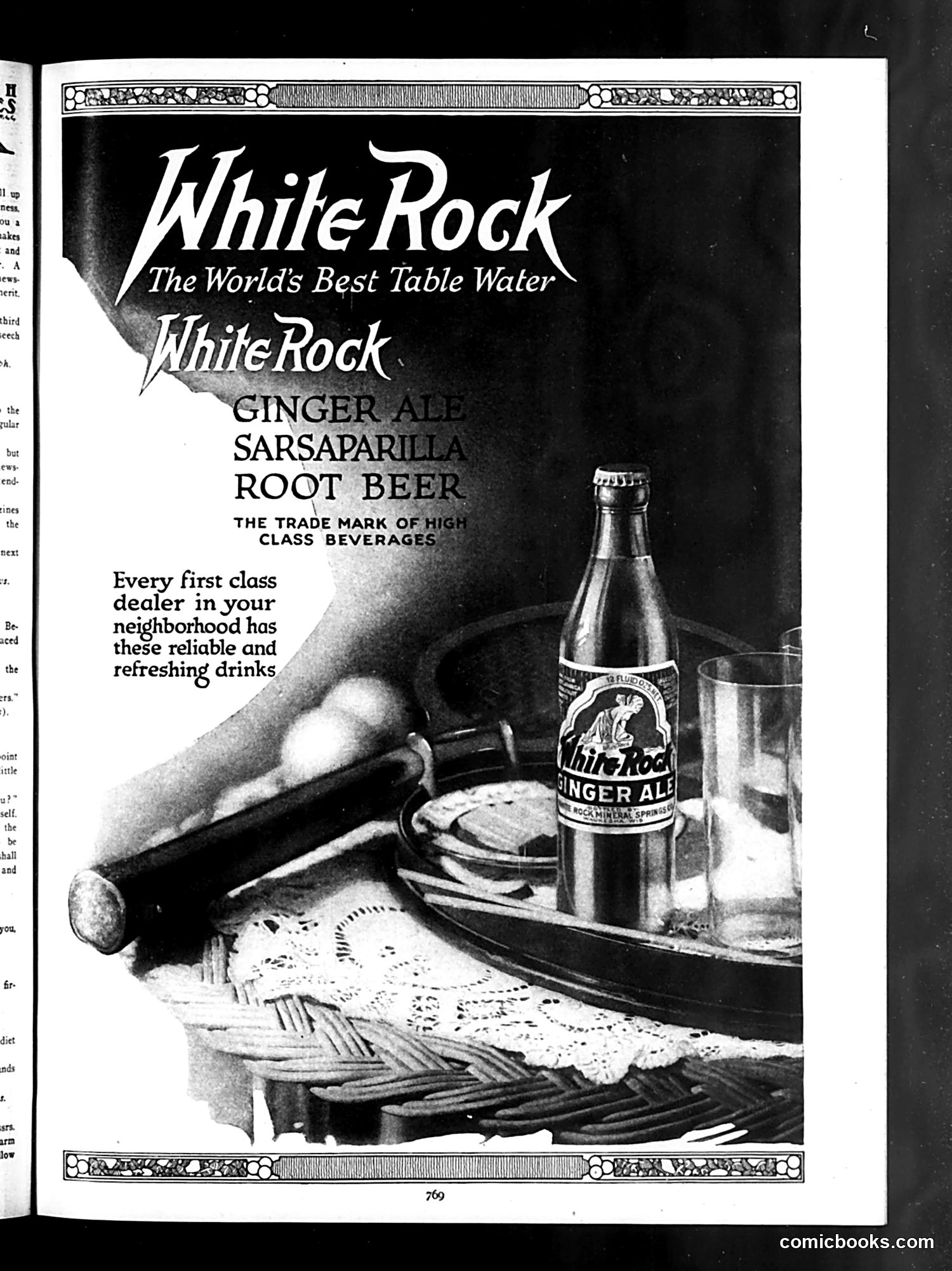
This is a **product advertisement**, not political satire or a cartoon. It promotes White Rock brand beverages—table water, ginger ale, sarsaparilla, and root beer—positioning them as "high class beverages" for upscale consumers. The ad features a vintage photograph of an elegantly dressed woman's hand holding a White Rock ginger ale bottle beside a glass, with fine dining accessories (lace napkin, place setting) visible. The messaging emphasizes exclusivity and social status: "every first class dealer in your neighborhood" carries these drinks, appealing to aspirational middle and upper-class consumers. This is typical early-to-mid 20th century advertising that used refined imagery and class signaling to market beverages. There is no political commentary or satire present.
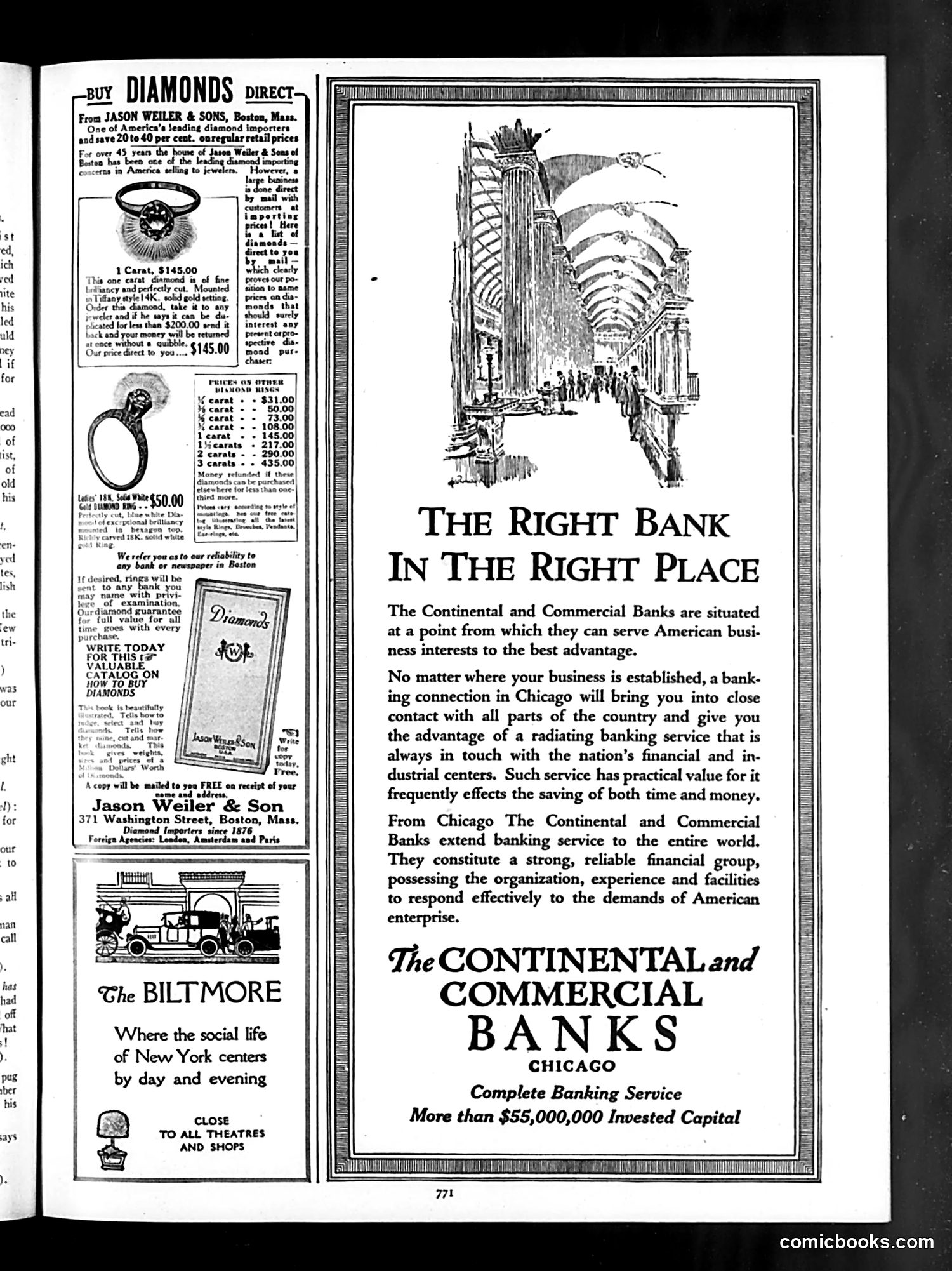
This is primarily a **advertising page**, not a satirical cartoon page. It contains three distinct advertisements: 1. **Jason Weiler & Sons** (top left): A Boston diamond importer advertising direct sales at discounted prices (20-40% below retail), with pricing for various carat weights. 2. **The Continental and Commercial Banks** (center/right): A Chicago bank promoting its services as a central hub for national banking, featuring an architectural illustration of what appears to be a grand banking hall with arched ceiling and people conducting business. 3. **The Biltmore** (bottom left): A New York hotel advertisement emphasizing its social amenities and proximity to theaters and shops. There are **no political cartoons or satirical content** on this page. The architectural illustration is decorative advertising imagery, not commentary. The page represents typical early 20th-century magazine advertising focused on luxury goods and financial services for affluent readers.
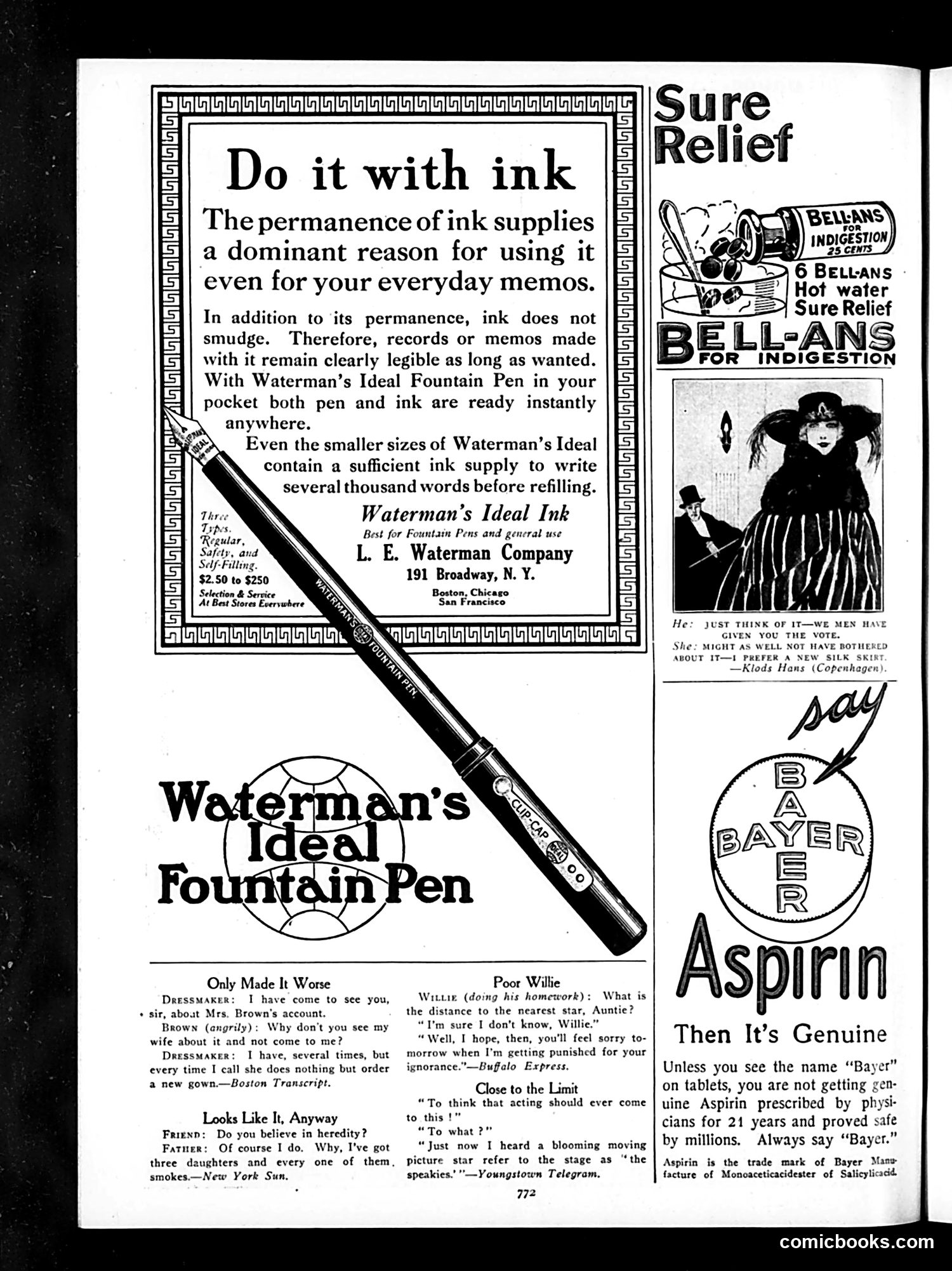
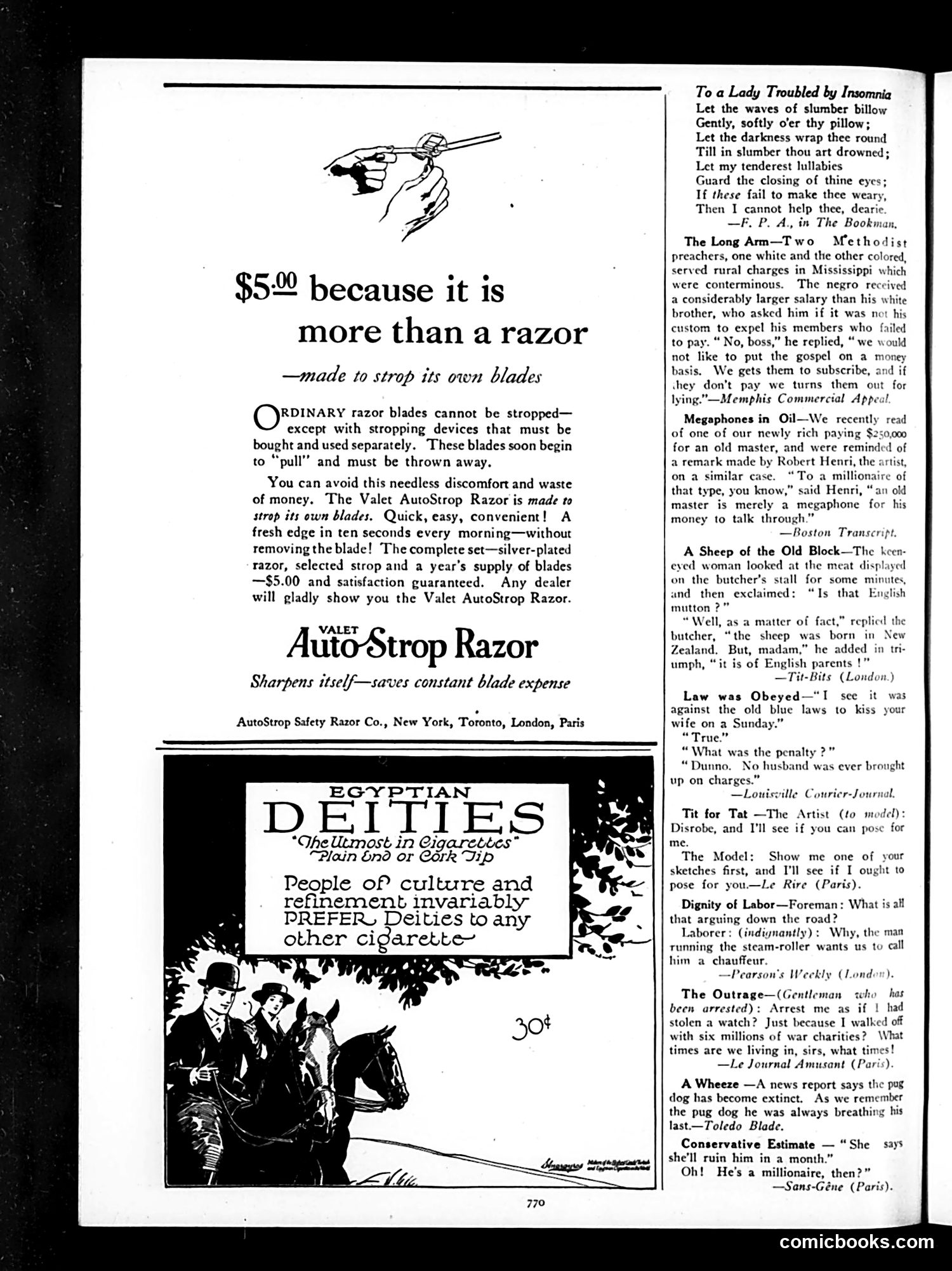
This page mixes **advertisements** with **satirical humor cartoons** typical of early 20th-century Life magazine. **Advertisements:** - Waterman's Ideal Fountain Pen (emphasizing permanence and legibility) - Bayer Aspirin (stressing genuine branded product vs. imitations) **Satirical Cartoons:** The page features several short joke panels mocking gender dynamics and social behavior: - **"Only Made It Worse"**: A husband deflects a dressmaker's complaint about unpaid bills to his wife, who apparently only responds to complaints by ordering more gowns—satirizing wives' shopping habits. - **"Looks Like It, Anyway"**: A father jokes that his three daughters smoking proves heredity works. - **"Sure Relief"**: A man celebrates giving women voting rights; the woman responds she'd prefer a new silk skirt instead—mocking women's supposed indifference to political participation. These jokes reflect common 1920s-30s stereotypes about women's materialism and frivolousness, presented as humor for Life's predominantly male readership. The satire targets both gender relations and consumer culture.
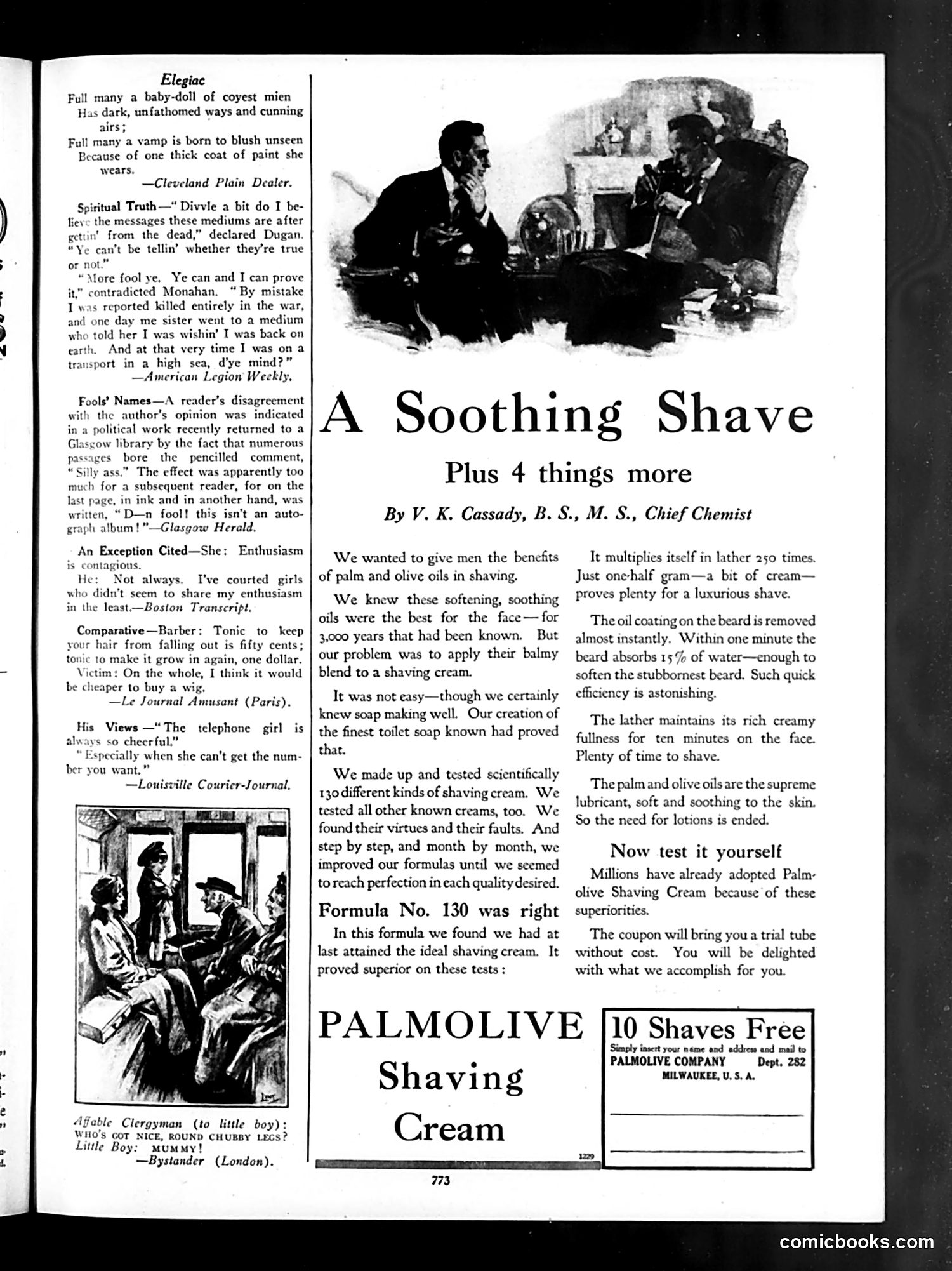
This page is primarily a **Palmolive Shaving Cream advertisement**, not political satire. The top section contains miscellaneous jokes and brief humorous quotes from various newspapers (Cleveland Plain Dealer, American Legion Weekly, Glasgow Herald, etc.)—standard filler content for Life magazine. The main advertisement features a testimonial-style article by "V. K. Cassady, B.S., M.S., Chief Chemist," claiming the product resulted from testing 130 shaving cream formulas. It emphasizes palm and olive oils as superior lubricants with ancient historical use. The small illustration shows a barbershop scene. A coupon offers a free trial tube and promises "10 Shaves Free," typical early 20th-century direct-response marketing. There is **no political content or satire** on this page—it is essentially a vintage advertisement using pseudo-scientific claims common to that era's marketing practices.
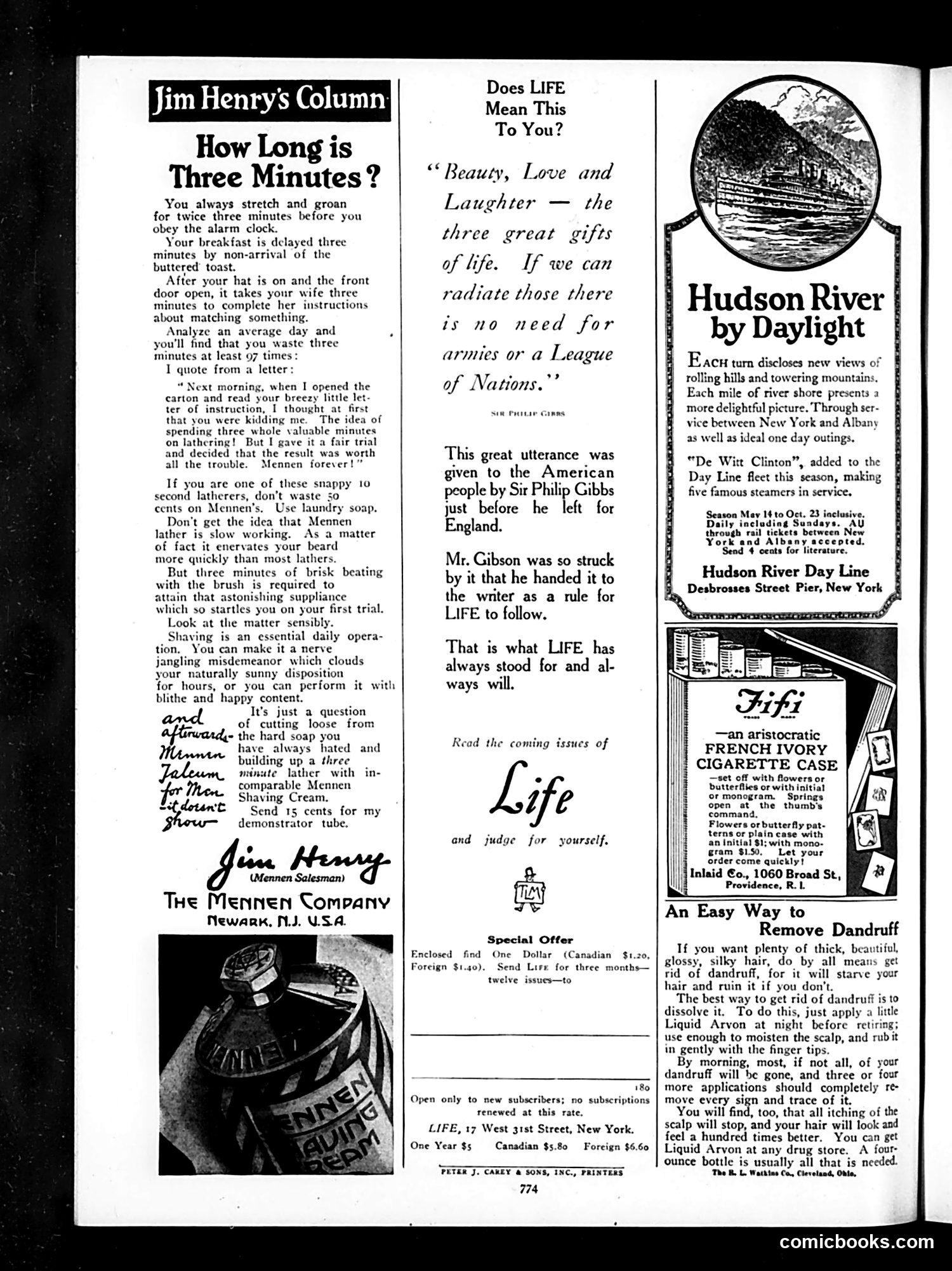
This page contains Jim Henry's column promoting **Mennen Shaving Cream**, arguing that three minutes spent lathering produces superior results to quick shaving with cheap soap. Henry uses humor about daily time-wasting to justify the investment in a proper shaving routine. The editorial section features a quote attributed to **Sir Philip Gibbs** (a British journalist), emphasizing "Beauty, Love and Laughter" as life's great gifts, positioned against war and international conflict—likely referencing post-WWI idealism and the League of Nations debate. The remainder is advertising: Hudson River Day Line steamboat service, a French Ivory cigarette case, and a Liquid Arvon dandruff treatment. The page reflects 1920s consumer culture emphasizing grooming and leisure travel, with implicit class aspirations (aristocratic cigarette cases, river cruises).
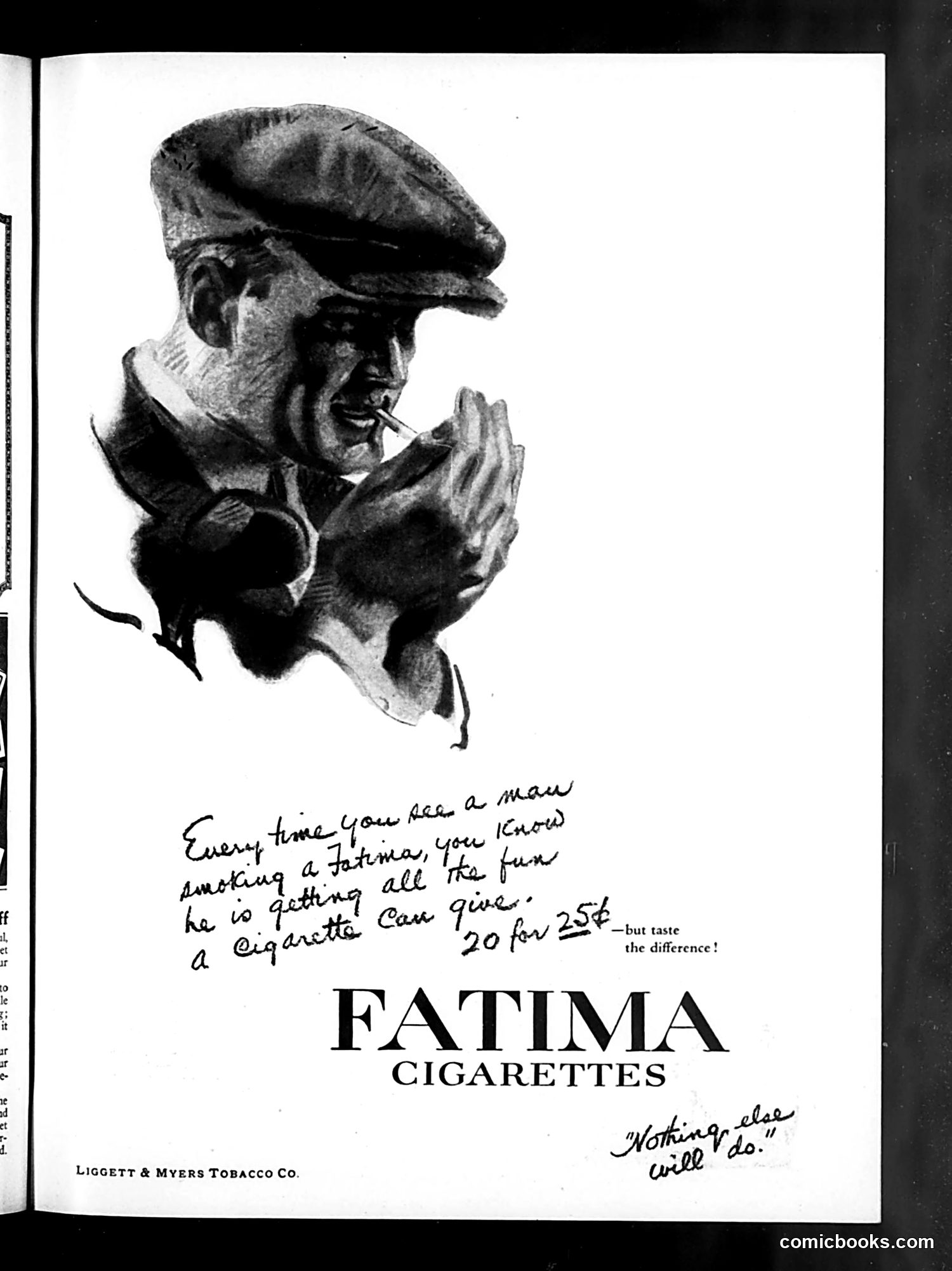
This is a **cigarette advertisement**, not political satire. The image shows a caricatured man in working-class attire (flat cap, collared shirt) smoking a cigarette. The handwritten text reads: "Every time you see a man smoking a Fatima, you know he is getting all the fun a cigarette can give. 20 for 25¢—but taste the difference!" The advertisement's pitch emphasizes value and quality—suggesting Fatima cigarettes offer superior taste at a competitive price point. The illustration uses a rough, masculine aesthetic to appeal to working-class male smokers. The tagline "Nothing else will do" reinforces brand loyalty. This represents early 20th-century cigarette marketing before health warnings, targeting affordability-conscious consumers.
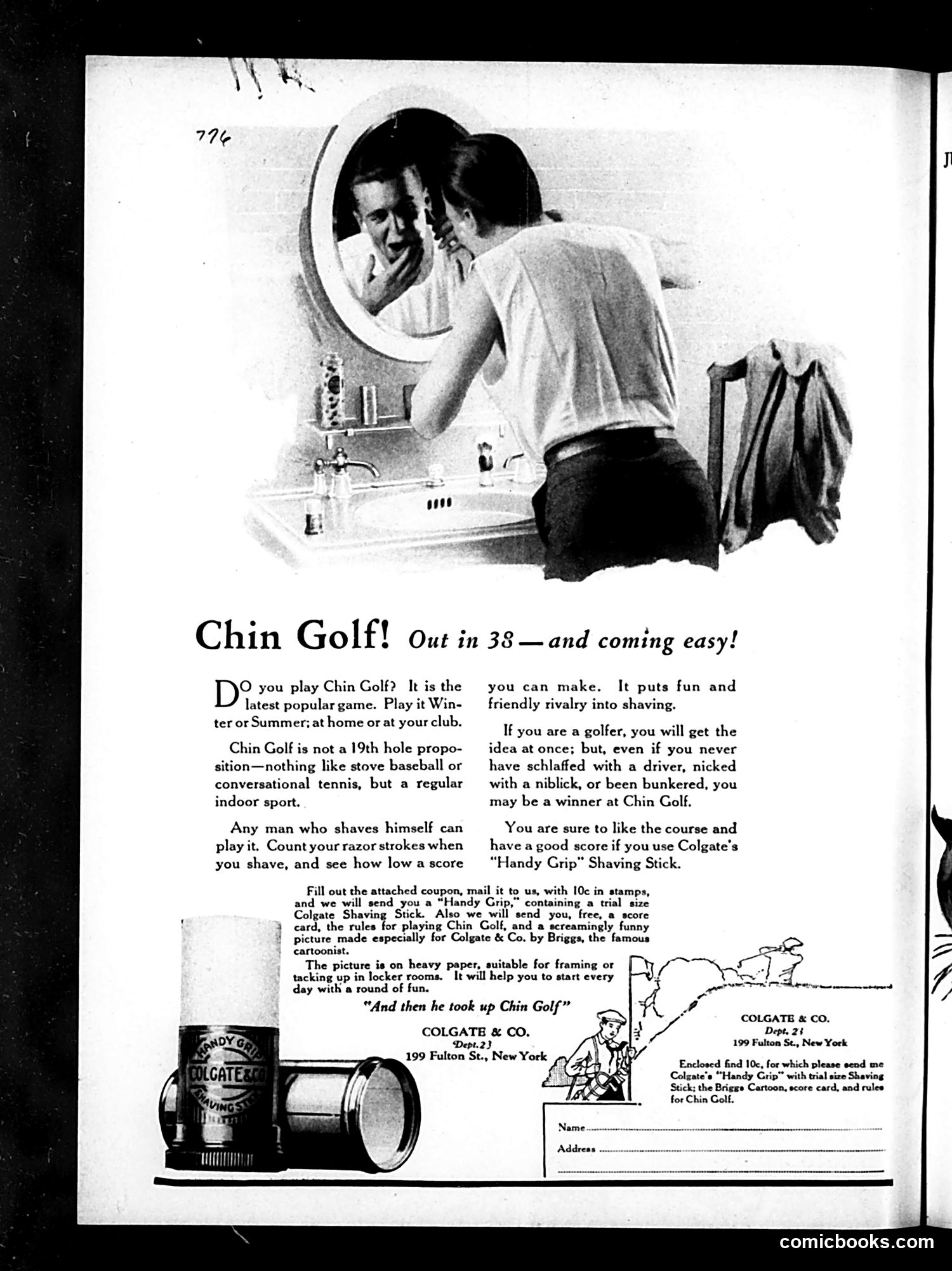
This is a **Colgate shaving cream advertisement**, not political satire. The page promotes a novelty game called "Chin Golf"—a humorous competition where men count their razor strokes while shaving, attempting to achieve the lowest score, mimicking golf's scoring system. The photograph shows a man shaving while looking in a bathroom mirror. The joke plays on the accessibility of the "game": any man who shaves can participate, making it democratic and inclusive. The advertisement promises humor and "friendly rivalry" around an everyday activity. The copy emphasizes that even non-golfers can enjoy it, and promises a "screamingly funny picture" by cartoonist Briggs as an incentive to purchase Colgate's "Handy Grip" shaving stick. Readers could mail in 10 cents plus a coupon to receive a trial-size product, score card, and framed cartoon. This reflects early-20th-century advertising strategy: combining product promotion with entertainment and games to build brand loyalty among male consumers.