
Life, 1921-05-26 · page 12 of 36
Life — May 26, 1921 — page 12: what you’re looking at
What you’re looking at
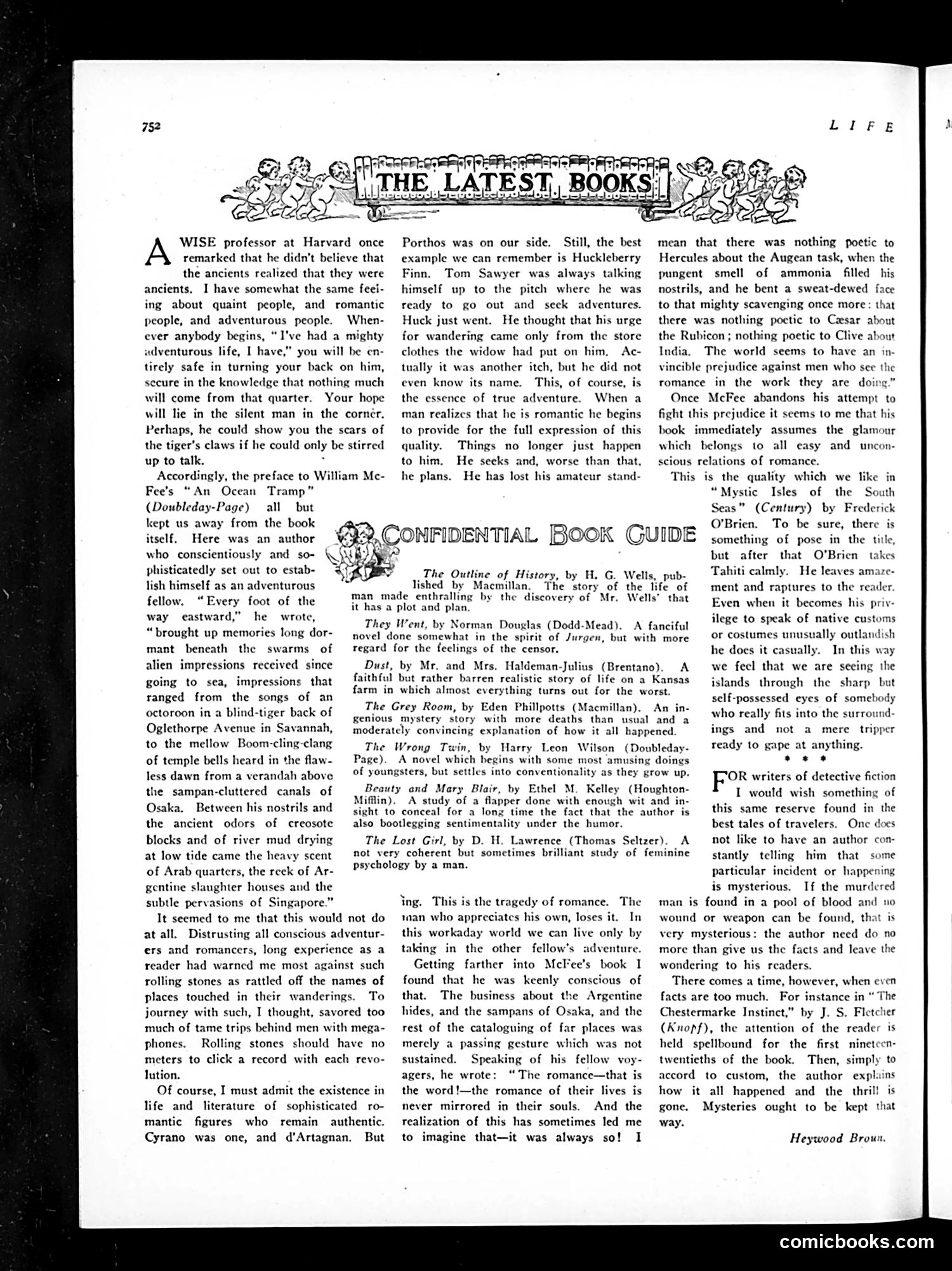
This page is primarily a **book review column**, not a political cartoon. The content discusses contemporary literary works and their merits, with a prominent section titled "Confidential Book Guide" that reviews recent publications. The author (signed "Heywood Broun") critiques how adventure and romantic fiction often lacks authenticity. He argues that adventure tales should feel genuinely mysterious rather than explained away, and that romance should reflect characters' actual emotional lives rather than merely following genre conventions. The page includes reviews of several books with their titles, authors, and publishers listed. This appears to be cultural criticism rather than political satire—focused on literary standards and what makes compelling fiction for contemporary readers.
📄 Transcribed text from this page (OCR, searchable)
Machine-transcribed from the original scan — historical spelling and the odd misread are preserved.
WISE professor at Harvard once remarked that he didn’t believe that the ancients realized that they were ancients, I have somewhat the same feei- ing about quaint people, and romantic people, and adventurous people. When- ever anybody begins, “I've had a mighty adventurous life, I have,” you will be en- tirely safe in turning your back on him, secure in the knowledge that nothing much will come from that quarter. Your hope will lie in the silent man in the corner. Perhaps, he could show you the scars of the tiger’s claws if he could only be stirred up to talk. . Accordingly, the preface to William Mc- Fee’s “An Ocean Tramp” (Doubleday-Page) all but kept us away from the book itself. Here was an author O who conscientiously and so- (SRY phisticatedly set out to estab- Porthos was on our side. Still, the best example we can remember is Huckleberry Finn. Tom Sawyer was always talking himself up to the pitch where he was ready to go out and seek adventures. Huck just went. He thought that his urge for wandering came only from the store clothes the widow had put on him. Ac- tually it was another itch, but he did not even know its name. This, of course, is the essence of true adventure. When a man realizes that he is romantic he begins to provide for the full expression of this quality. Things no longer just happen to him. He seeks and, worse than that, he plans. He has lost his amateur stand- , CONFIDENTIAL OOK GUIDE mean that there was nothing poetic to Hercules about the Augean task, when the pungent smell of ammonia filled his nostrils, and he bent a sweat-dewed face to that mighty scavenging once more: that there was nothing poctic to Czsar about the Rubicon ; nothing poetic to Clive about India. The world seems to have an in- vincible prejudice against men who see t romance in the work they are doing Once McFee abandons his attempt to fight this prejudice it seems to me that his book immediately assumes the glamour which belongs to all easy and uncon- scious relations of romance. This is the quality which we like in tic Isles of the South " (Century) by Frederick O'Brien. To be sure, there is something of pose in the title, but after that O’Brien takes lish himself as an adventurous fellow. “Every foot of the way castward,” he “brought up memories long dor- mant swarms of alien impressions received since going to sea, impressions that ranged from the songs of an octoroon in a blind-tiger back of Oglethorpe Avenue in Savannah, to the mellow Boom-cling-clang of temple bells heard in the flaw- less dawn from a verandah above the sampan-cluttered canals of Osaka. Between his nostrils and wrote, beneath the The Outline of History, by H. G. Wells, pub- lished by Macmillan. The story of the life of man made enthralling by the discovery of Mr. Wells’ that it has a plot and plan They Went, by Norman Douglas (Dodd-Mead). A fanciful novel done somewhat in the spirit of Jurgen, but with more regard for the feelings of the censor, Dust, by Mr. and Mrs. Haldeman-Julius (Brentano). A faithful but rather barren realistic story of life on a Kansas farm in which almost everything turns out for the worst. The Grey Room, by Eden Phillpotts (Macmillan), An in- genious mystery story with more deaths than usual and a moderately convincing explanation of how it all happened. The Wrong Twin, by Harry Leon Wilson (Doubleday- Page). A novel which begins with some most amusing doings of youngsters, but settles into conventionality as they grow up. Beauty and Mary Blair, by Ethel M. Kelley (Houghton- Mifflin). A study of a flapper done with enough wit and in- sight to conceal for a long time the fact that the author is Tahiti calmly. He leaves amaze- ment and raptures to the reader. Even when it becomes his priv- ilege to speak of native customs or costumes unusually outlandish he does it casually. In this way we fecl that we are seeing the islands through the sharp but self-possessed eyes of somebody who really fits into the surround- ings and not a mere tripper ready to gape at anything. ose OR writers of detective fiction I would wish something of this same reserve found in the the ancient odors of creosote blocks and of river mud drying at low tide came the heavy scent of Arab quarters, the reck of Ar- gentine slaughter houses and the subtle pervasions of Singapore.” It seemed to me that this would not do at all. Distrusting all conscious adventur- ers and romancers, long experience as a reader had warned me most against such rolling stones as rattled off the names of places touched in their wanderings. To journey with such, I thought, savored too much of tame trips behind men with mega- phones. Rolling stones should have no meters to click a record with each revo- lution. Of course, I must admit the existence in life and literature of sophisticated ro- mantic figures who remain authentic. Cyrano was one, and d’Artagnan, But also bootlegging sentimentality under the humor. The Lost Girl, by D. H. Lawrence (Thomas Seltzer). A not very coherent but sometimes brilliant study of feminine psychology by a man. ing. This is the tragedy of romance. The man who appreciates his own, loses it. In this workaday world we can live only by taking in the other fellow'’s adventure. Getting farther into Mclece’s book I found that he was keenly conscious of that. The business about Argentine hides, and the sampans of Osaka, and the rest of the cataloguing of far places was merely a passing gesture which was not sustained. Speaking of his fellow voy- agers, he wrote: “The romance—that is the word!—the romance of their lives is never mirrored in their souls. And the realization of this has sometimes led me to imagine that—it was always so! I best tales of travelers. One does not like to have an author con- stantly telling him that particular incident or happening is mysterious. If the murdered man is found in a pool of blood and no some wound or weapon can be found, that is very mysterious: the author need do no more than give us the facts and leave the wondering to his readers. There comes a time, however, when even facts are too much, For instance in “ The Chestermarke Instinct,” by J. S. Fletcher (Knopf), the attention of the reader is held spellbound for the first nineteen- twentieths of the book. Then, simply to accord to custom, the author explains how it all happened and the thril! is gone. Mysteries ought to be kept that way. Heywood Broun. comicbooks.com