
Life, 1921-05-26 · page 17 of 36
Life — May 26, 1921 — page 17: what you’re looking at
What you’re looking at
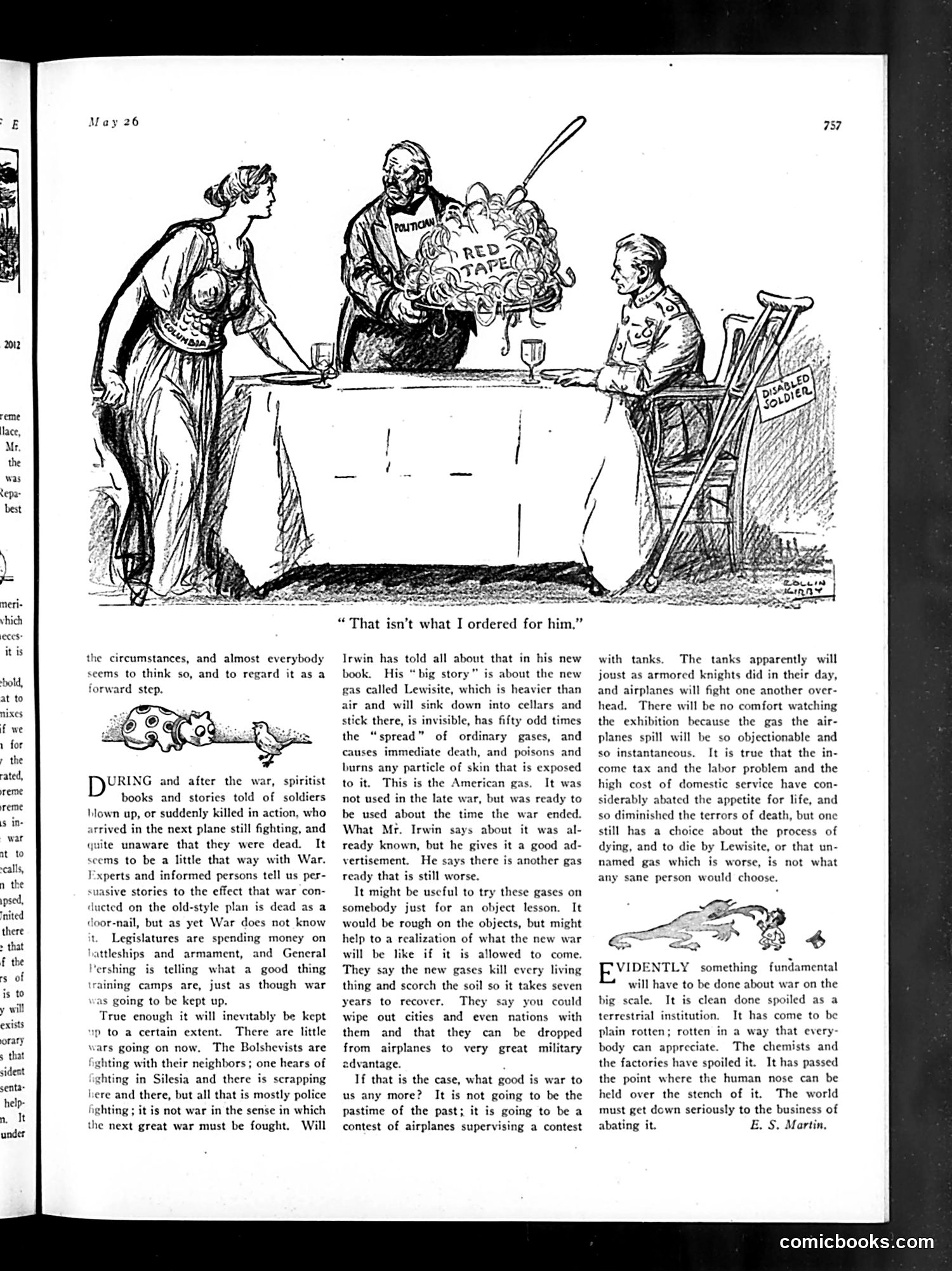
This cartoon satirizes post-WWI military planning. A commanding officer presents a grotesquely deformed baby labeled "RED TAPE" to a woman (representing the nation or public), while a disabled soldier sits nearby. The caption suggests this monstrosity is not what was expected. The accompanying article by E.S. Martin criticizes the continued militarization despite war's end. It references a new chemical weapon called Lewisite—a poisonous gas deadlier than those used in WWI—and argues that modern warfare has become so mechanized and chemically devastating (involving tanks and airplanes dropping poison) that it no longer serves any rational purpose. Martin contends that warfare has become morally indefensible and calls for serious international efforts to abolish large-scale war, since the "stench" of such destruction is now unbearable to civilized society. The cartoon's "red tape" baby represents the bureaucratic waste and misplaced priorities of post-war military spending.
📄 Transcribed text from this page (OCR, searchable)
Machine-transcribed from the original scan — historical spelling and the odd misread are preserved.
exists orary $ that sident sentay help- n. It under May 26 the circumstances, and almost everybody seems to think so, and to regard it as a forward step. DURING and after the war, spiritist books and stories told of soldiers ‘own up, or suddenly killed in action, who arrived in the next plane still fighting, and quite unaware that they were dead. It seems to be a little that way with War. Experts and informed persons tell us per- suasive stories to the effect that war con- ducted on the old-style plan is dead as a door-nail, but as yet War does not know t. Legislatures are spending money on attleships and armament, and General Vershing is telling what a good thing aining camps are, just as though war going to be kept up. True enough it will inevitably be kept ‘ip to a certain extent. There are little wars going on now. The Bolshevists are ghting with their neighbors; one hears of ghting in Silesia and there is scrapping here and there, but all that is mostly police fighting ; it is not war in the sense in which the next great war must be fought. Will “That isn’t what I ordered for him,” Irwin has told all about that in his new book. His “big story” is about the new gas called Lewisite, which is heavier than air and will sink down into cellars and stick there, is invisible, has fifty odd times the “spread” of ordinary gases, and causes immediate death, and poisons and burns any particle of skin that is exposed to it. This is the American gas. It was not used in the late war, but was ready to be used about the time the war ended. What Mr. Irwin says about it was al- ready known, but he gives it a good ad- vertisement. He says there is another gas ready that is still worse. It might be useful to try these gases on somebody just for an object lesson. It would be rough on the objects, but might help to a realization of what the new war will be like if it is allowed to come. They say the new gases kill every living thing and scorch the soil so it takes seven years to recover. They say you could wipe out cities and even nations with them and that they can be dropped from airplanes to very great military advantage. . If that is the case, what good is war to us any more? It is not going to be the pastime of the past; it is going to be a contest of airplanes supervising a contest with tanks. The tanks apparently will joust as armored knights did in their day, and airplanes will fight one another over- head. There will be no comfort watching the exhibition because the gas the air- planes spill will be so objectionable and so instantancous. It is true that the in- come tax and the labor problem and the high cost of domestic service have con- siderably abated the appetite for life, and so diminished the terrors of death, but one still has a choice about the process of dying, and to die by Lewisite, or that un- named gas which is worse, is not what any sane person would choose. eS. DP sk YTLY something fundamental will have to be done about war on the big scale. It is clean done spoiled as a terrestrial institution. It has come to be plain rotten; rotten in a way that every- body can appreciate. The chemists and the factories have spoiled it. It has passed the point where the human nose can be held over the stench of it. The world must get down seriously to the business of abating it. E. S. Martin, comicbooks.com