
Life, 1921-05-26 · page 21 of 36
Life — May 26, 1921 — page 21: what you’re looking at
What you’re looking at
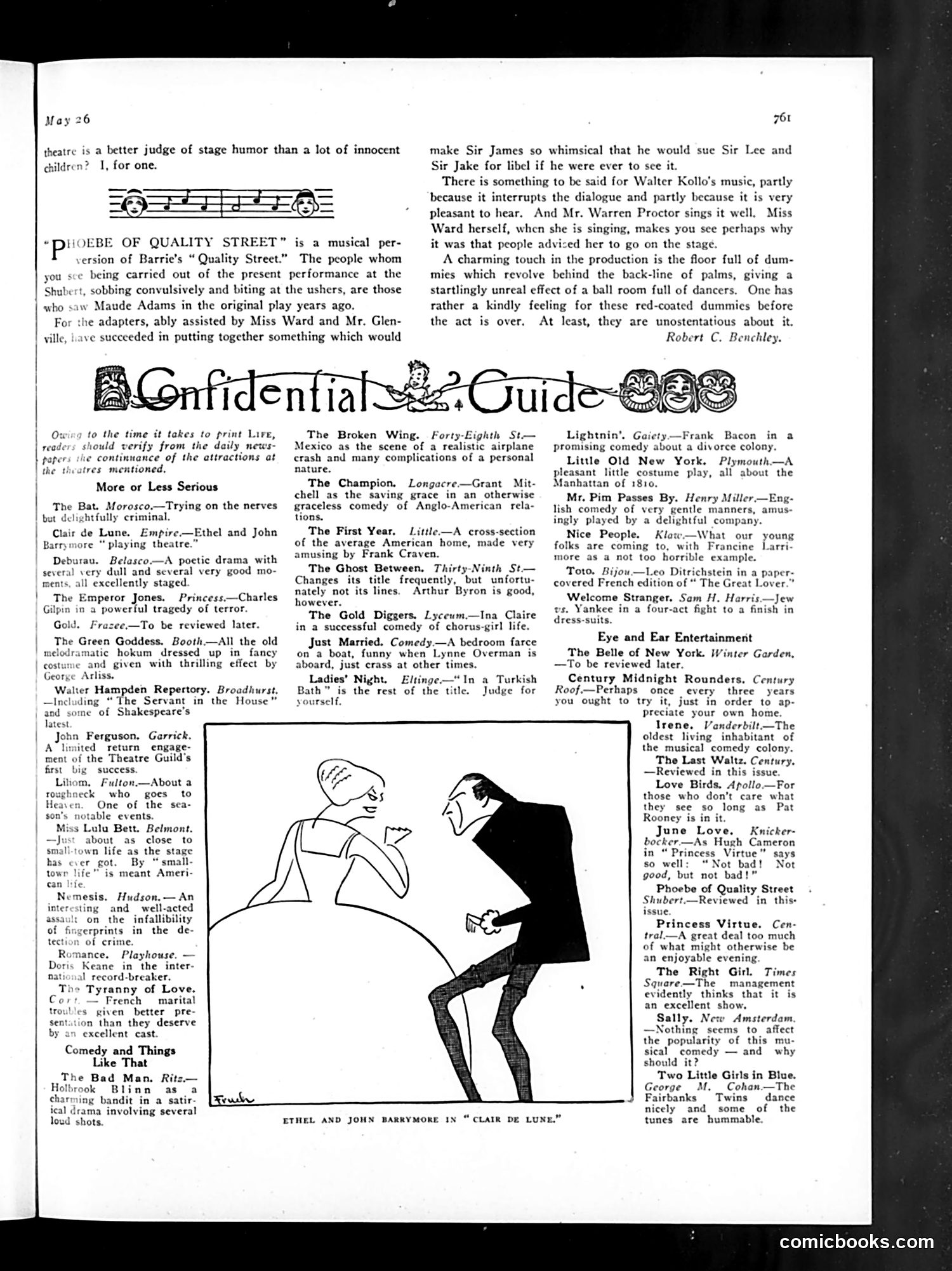
The illustration shows two figures in formal attire—a woman in an elegant dress and a man in a tuxedo—engaged in what appears to be a flirtatious or comedic interaction. The caption identifies them as Ethel and John Barrymore performing in the play "Clair de Lune" at the Empire Theatre. The cartoon likely satirizes the Barrymore siblings' on-stage chemistry or the play's romantic plot. The exaggerated postures and the man's animated gesture suggest theatrical melodrama or physical comedy. For modern readers: the Barrymores were America's most prestigious theatrical family in the 1920s, so their performances were widely reviewed and parodied. This appears to be gentle satire of stage conventions rather than political commentary—typical of Life magazine's arts criticism section.
📄 Transcribed text from this page (OCR, searchable)
Machine-transcribed from the original scan — historical spelling and the odd misread are preserved.
May 26 children? I, for one. EBE OF QUALITY STRE Shubert, who s For ville, the adapters, ably assisted by Miss to the time it takes to print Lire, should verify from the daily news- € continuance of the attractions at vatres mentioned, More or Less Serious The Bat. Morosco.—Trying on the nerves but delightfully criminal. Clair de Lune. Empire. Barrymore “ playing theatre Deburau. Belasco—aA poetic drama with several very dull and several very good mo- ments, all excellently staged. | The Emperor Jones. Princess.—Charles Gilpin in a powerful tragedy of terror. Gold. Frazee—To be reviewed later. The Green Goddess. Booth.—All the old melodramatic hokum dressed up in fancy costume and given with thrilling effect by George Arliss. Walter Hampden Repertory. Broadhurst. luding “ The Servant in the House” me of Shakespeare's hel and John | Ferguson. Garrick. Avlimited return engage- ment of the Theatre Guild's first big success. Lihom, Fulton.—About a who n. One of the sea- son's notable events. iss Lulu Bett. Belmont. eck goes to —Just about as close to small-town life as the stage has ever got. By “small- town life” is meant Ameri- can life. Nemesis. Hudson.— An interesting and well-acted | assa on the infallibility | of f rprints in the de- tection of crime. Romance. Playhouse. — joris Keane in the inter- pational record-breaker. The Tyranny of Love. Cort. — French marital troubles ven better pre- on than they deserve excellent cast Comedy and Things Like That e Bad Man. Ritz.— ook Blinn as a ng bandit in a satir- rama involving several shots. theatre is a better judge of stage humor than a lot of innocent ) P version of Barrie’s “ Quality Street. you sce being carried out of the present performance at the sobbing convulsively and biting at the ushers, are those w Maude Adams in the original play years ago. make Sir James so whimsical that he would sue Sir Lee and 761 Sir Jake for libel if he were ever to sce it. There is something to be said for Walter Kollo’s music, partly because it interrupts the dialogue and partly because it is very pleasant to hear. And Mr. Warren Proctor sings it well. Miss Ward herself, when she is singing, makes you see perhaps why is a musical per- The people whom Ward and Mr. Glen- the act is over. ve succeeded in putting together something which would The Broken Wing. Forty-Eighth St— Mexico as the scene of a realistic airplane crash and many complications of a personal nature. The Champion. Longacre—Grant Mit- chell as the saving grace in an otherwise graceless comedy of Anglo-American rela- tions. The First Year, Littl—A cross-section of the average American home, made very amusing by Frank Craven. The Ghost Between. Thirty-Ninth St— Changes its title frequently, but unfortu- nately not its lines. Arthur Byron is good, however. The Gold Diggers. Lyceum.—Ina Claire in a successful comedy of chorus-girl life. Just Married. Comedy.—A bedroom farce on a boat, funny when Lynne Overman is aboard, just crass at other times. Ladies’ Night. Eltinge—"In a Turkish Bath” is the rest of the title. Judge for yourself. ETHEL AND JOUN BARRYMORE IN “CLAIR DE LUNE.” it was that people advised her to go on the stage. A charming touch in the production is the floor full of dum- mies which revolve behind the back-line of palms, giving a startlingly unreal effect of a ball room full of dancers. One has rather a kindly feeling for these red-coated dummies before At least, they are unostentatious about it. Robert C. Benchley. : Bacon in a promising comedy about a divorce colony. Little Old New York. Plymouth—A pleasant little costume play, all about the Manhattan of 1810. Mr. Pim Passes By. Henry Miller —Eng- lish comedy of very gentle manners, amus- ingly played by a delightful company. Nice People. Klaw.—\What our folks are coming to, with Francine more as a not too horrible example. young Larri- Toto. Bijou—leo Ditrichstein in a paper- covered French edition of “ The Great Lover.” Welcome Stranger. Sam H. Harris—Jew vs. Yankee in a four-act fight to a finish in dress-suits. Eye and Ear Entertainment The Belle of New York. Winter Garden, —To be reviewed later. Century Midnight Rounders. Century Roof.—Perhaps once every three years you ought to try it, just in order to ap- Preciate your own home. Irene. Vanderbilt—The oldest living inhabitant of the musical comedy colony. ‘The Last Waltz. Century. —Reviewed in this issue. Love Birds. Apollo —For those who don’t care what they see so long as Pat Rooney is in it June Love. Knicker- bocker—As Hugh Cameron in “Princess Virtue” says so well: “Not bad! Not good, but not bad! Phoebe of Quality Street Shubert.—Reviewed in this- issue. Princess Virtue. Cen- tral.—A great deal too much of what might otherwise be an enjoyable evening. The Right Girl. Times Squere—The _ management evidently thinks that it is an excellent show. Sally. New Amsterdam —Nothing seems to affect the popularity of this mu- sical comedy — and why should it? Two Little Girls in Blue. George M._ Cohan.—The Fairbanks Twins dance nicely and some of the tunes are hummable. comicbooks.com