
Life, 1921-05-26 · page 22 of 36
Life — May 26, 1921 — page 22: what you’re looking at
What you’re looking at
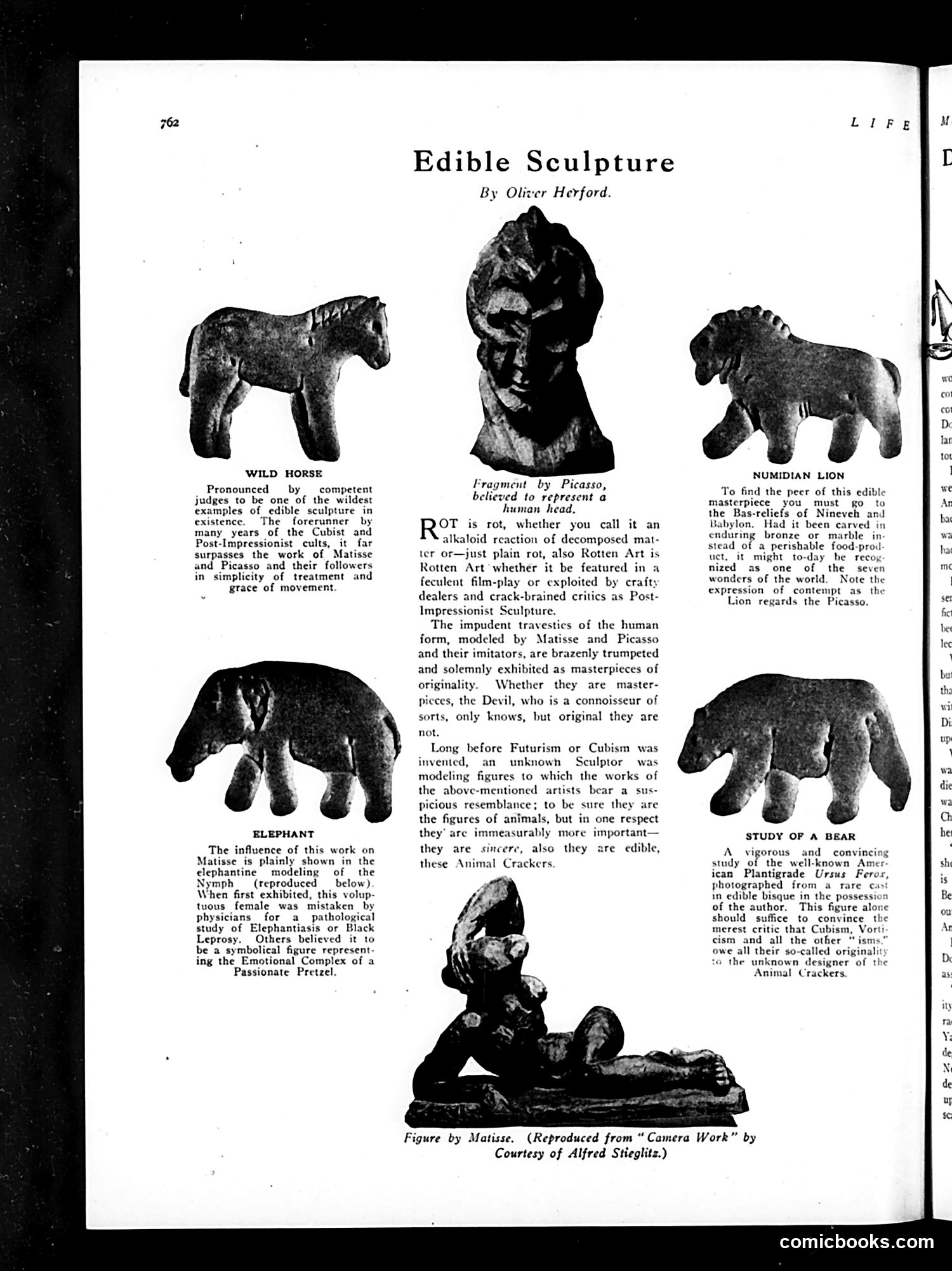
This article mocks early 20th-century avant-garde art movements—particularly Cubism and Post-Impressionism—by comparing modernist sculptures by Matisse and Picasso to animal crackers. The author argues that these celebrated artists' "impudent travesties" of form are no more original or meaningful than children's food products. The joke positions anonymous animal crackers as superior artworks: they possess "simplicity," "grace," and "sincerity" that famous modernists lack. The text sarcastically suggests animal crackers anticipated Cubism and represent the "seven wonders of the world." This reflects widespread early 1900s American skepticism toward abstract art, viewing modernism as pretentious fraud promoted by critics and dealers. The comparison to decomposing matter ("rot") and disease reinforces the hostility. The article weaponizes earnest aesthetic language to ridicule what many contemporaries considered artistic nonsense masquerading as genius.
📄 Transcribed text from this page (OCR, searchable)
Machine-transcribed from the original scan — historical spelling and the odd misread are preserved.
WILD HORSE Pronounced by competent judges to be one of the wildest examples of edible sculpture in existence. The forerunner by many years of the Cubist and Post-Impressionist cults, it far surpasses the work of Matisse and Picasso and their followers in simplicity of treatment and grace of movement ELEPHANT The influence of this work on Matisse is plainly shown in the clephantine modeling of the Nymph (reproduced _ below) When first exhibited, this volup tuous female was mistaken by physicians for a pathological study of Elephantiasis or Black Leprosy. Others believed it to be a symbolical figure represent- ing the Emotional Complex of a Passionate Pretzel. Figure by Matisse. Edible Sculpture By Oliver Heyford. Fragment by Picasso, believed to represent a human head, OT is rot, whether you call it an alkaloid reaction of decomposed mat- ter or—just plain rot, also Rotten Art is Rotten Art whether it be featured in a feculent film-play or exploited by crafty dealers and crack-brained critics as Post- Impressionist Sculpture. The impudent travestics of the human form, modeled by Matisse and Picasso and their imitators, are brazenly trumpeted and solemnly exhibited as masterpieces of originality. Whether they are master- pieces, the Devil, who is a connoisseur of sorts, only knows, but original they are not. Long before Futurism or Cubism was invented, an unknowh Sculptor was modeling figures to which the works of the above-mentioned artists bear a sus- picious resemblance; to be sure they are the figures of animals, but in one respect they’ are immeasurably more important— they are sincere, also they are edible, these Animal Crackers. Courtesy of Alfred Stieglitz.) NUMIDIAN LION To find the peer of this edible masterpiece you must go to the Bas-reliefs of Nineveh and Babylon, Had it been carved in enduring bronze or marble in stead of a perishable food-prod uct, it might to-day be recog nized as one of the seven wonders of the world. Note the expression of contempt as the Lion regards the Picasso. STUDY OF A BEAR A vigorous and convincing study of the well-known Amer. ican Plantigrade Ursus Feros, photographed from a rare cast in edible bisque in the possession of the author. This figure alone should suffice to convince the merest critic that Cubism, Vor cism and all the other “isms owe all their so-called originalit to the unknown designer of the Animal Crackers. (Reproduced from “ Camera Work” by comicbooks.com