
Life, 1921-05-26 · page 24 of 36
Life — May 26, 1921 — page 24: what you’re looking at
What you’re looking at
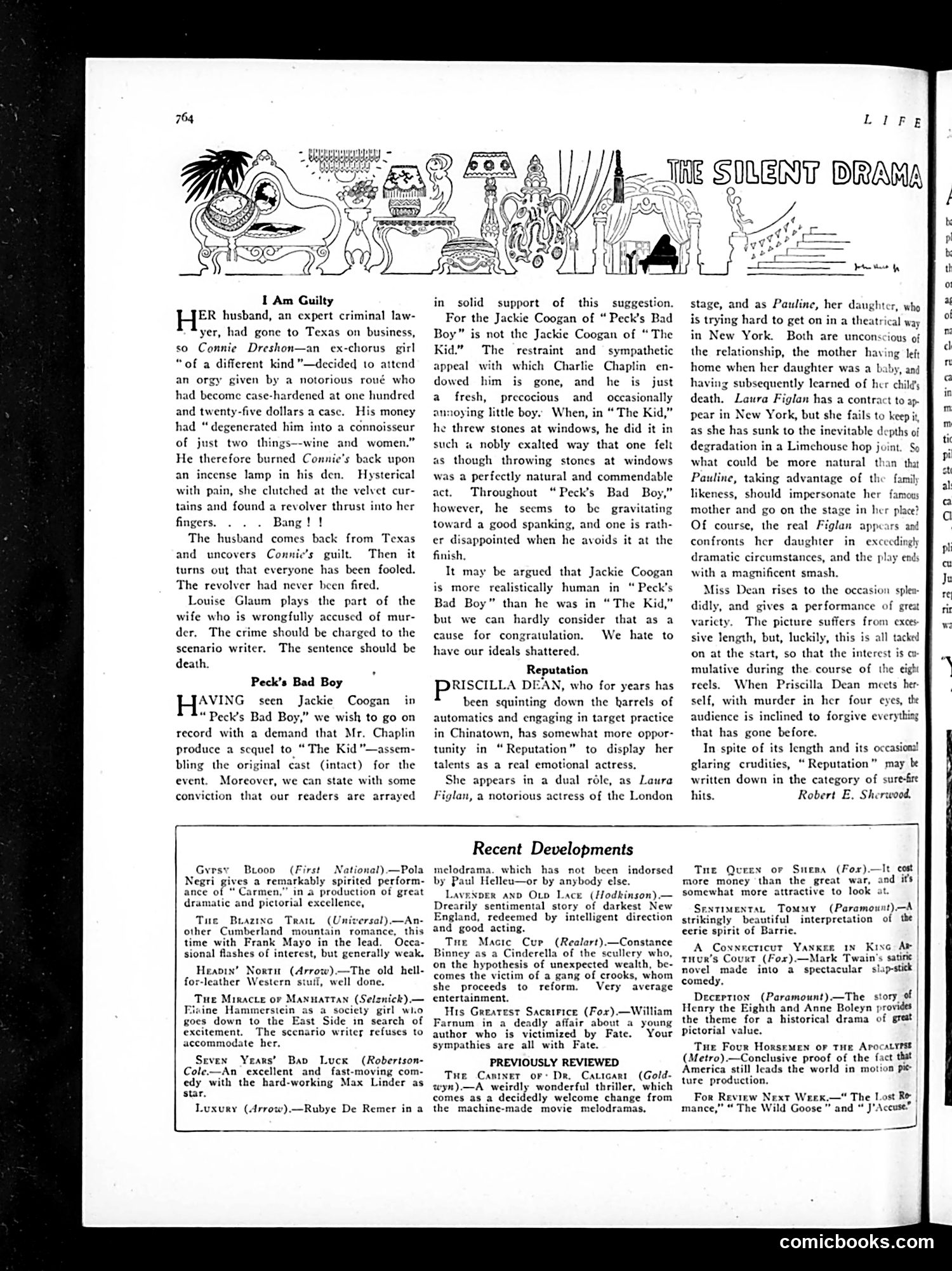
This page contains three film reviews from Life's movie criticism section, circa the silent film era (early 1920s based on references to Jackie Coogan and Charlie Chaplin). The opening cartoon illustration depicts various theatrical and cinematic scenes, establishing the "silent drama" theme. The reviews critique: 1. **"I Am Guilty"** - A melodrama starring Louise Glaum about a wrongfully accused wife, which the critic harshly condemns as poorly plotted ("The crime should be charged to the scenario writer"). 2. **"Peck's Bad Boy"** - Starring child actor Jackie Coogan. The reviewer criticizes Coogan's performance here compared to his acclaimed role in Chaplin's "The Kid," arguing he's merely an "annoying little boy" rather than the sympathetically drawn character audiences loved before. The critic regrets that "our ideals shattered." 3. **"Reputation"** - Featuring actress Priscilla Dean in a dual role as a mother and daughter separated by circumstance in London and New York. The tone is sophisticated critique aimed at theater-going audiences.
📄 Transcribed text from this page (OCR, searchable)
Machine-transcribed from the original scan — historical spelling and the odd misread are preserved.
1 Am Guilty ER husband, an expert criminal law- yer, had gone to Texas on business, so Connie Dreshon—an ex-chorus girl “of a different kind "—decided to attend an orgy given by a notorious roué who had become case-hardened at one hundred and twenty-five dollars a case. His money had “degenerated him into a connoisseur of just two things--wine and women.” He therefore burned Connie's back upon an incense lamp in his den. Hysterical with pain, she clutched at the velvet cur- tains and found a revolver thrust into her fingers. Bang! ! The husband comes back from Texas and uncovers Connie’s guilt. Then it turns out that everyone has been fooled. The revolver had never been fired, Louise Glaum plays the part of the wife who is wrongfully accused of mur- der, The crime should be charged to the scenario writer. The sentence should be death. Peck’s Bad Boy H4vinc seen Jackie Coogan “Peck’s Bad Boy,” we wish to go on record with a demand that Mr. Chaplin produce a sequel to “The Kid "—assem- in bling the original cast (intact) for the event. Moreover, we can state with some conviction that our readers are arrayed Gyrsv Buoon (First National) —Pola Negri gives a remarkably spirited perform- ance of “Carmen,” ina production of great dramatic and pictorial excellence, Tue Brazixc Trai (Universal) —An- other Cumberland mountain romance, this time with Frank Mayo in the lead. Occa- sional flashes of interest, but generally weak. for-leather Western siuil, well done. IATTAN (Selznick).— ine Hammerstein as a society girl who goes down to the East Side im search of excitement. The scenario writer refuses to accommodate her, Tite Mumscts o Mas Seven Years’ Bao Luck (Robertson- Cote.—An excellent and fast-moving com- edy with the hard-working Max Linder as star. Luxury (drrow).—Rubye De Remer in a LIFE ee fy solid support of this suggestion. For the Jackie Coogan of “ Peck’s Bad Boy” is not the Jackie Coogan of “The Kid.” The restraint and sympathetic appeal with which Charlie Chaplin en- dowed him is gone, and he is just a fresh, precocious and _ occasionally annoying little boy. When, in “ The Kid,” he threw stones at windows, he did it in such % nobly exalted way that one felt as though throwing stones at windows was a perfectly natural and commendable act. Throughout “Peck’s Bad Boy,” however, he seems to be gravitating toward a good spanking, and one is rath- er disappointed when he avoids it at the finish, It may be argued that Jackie Coogan is more realistically human in “ Peck's Bad Boy” than he was in “The Kid,” but we can hardly consider that as a cause for congratulation. We hate to have our ideals shattered. Reputation RISCILLA DEAN, who for years has been squinting down the harrels of automatics and cngaging in target practice in Chinatown, has somewhat more oppor- tunity in “Reputation” to display her talents as a real emotional actress. She appears in a dual réle, as Laura Figlan, a notorious actress of the London in stage, and as Pauline, her daughter, who is trying hard to get on in a theatrical way in New York. Both are unconscious of the relationship, the mother having left home when her daughter was a baby, and having subsequently learned of her chilt’s death. Laura Figlan has a contract to ap- pear in New York, but she fails to keep it, as she has sunk to the inevitable depths of degradation in a Limchouse hop joint. S what could be more natural than that Pauline, taking advantage of the family likeness, should impersonate her famous mother and go on the stage in her place? Of course, the real Figlan appears and confronts her daughter in exceedingly dramatic circumstances, and the play ends with a magnificent smash. Miss Dean rises to the occasion spleo- didly, and gives a performance of great The picture suffers from exces sive length, but, lucki this is all tacked on at the start, so that the interest is mulative during the course of the eigh reels. When Priscilla Dean meets her- self, with murder in her four eyes, the audience is inclined to forgive every! that has gone before. In spite of its length and its occasional glaring crudities, “ Reputation” may be written down in the category of sure-fire hits. Robert E, Sherwood, varicty, Recent Developments melodrama. which has not been indorsed by Paul Helleu—or by anybody else. LaveNper ano Otp Lace (Hodkinson).— Drearily sentimental story of darkest New England, redeemed by intelligent direction and good acting. Tne Mactc Cur (Realart).—Constance Binney as a Cinderella of the scullery who, on the hypothesis of unexpected wealth, be- comes the victim of a gang of crooks, whom she proceeds to reform. Very average entertainment. His Greatest Sacrifice (Fox).—William Farnum in a deadly affair about a young author who is victimized by Fate. Your sympathies are all with Fate. PREVIOUSLY REVIEWED Tue Cantxer or: Dr. Cattcant (Gold- wyn)—A weirdly wonderful thriller, which comes as a decidedly welcome change from the machine-made movie melodramas, | Tne Qcrex or Snema (Fox).—It cat | more money than the great war, and it’s somewhat more attractive to look | Sextimentat Tostay (Paramount) —A | strikingly. beautiful interpretation of the eerie spirit of Barrie. | A Coxnecticut Yanker 1x Kixo Ar tiur’s Court (Fox).—Mark Twain's satine novel made into a spectacular siap-stick | comedy, Decertion (Paramount)—The story, of Henry the Eighth and Anne Boleyn provides the theme for a historical drama of great) pictorial value. Tue Four Horsraen or tie Arocatrest (Metro).—Conclusive proof of the fact that America still leads the world in motion pit “ The Lost Re | mance,” and “ J'Accuse.” comicbooks.com