
Life, 1921-05-26 · page 20 of 36
Life — May 26, 1921 — page 20: what you’re looking at
What you’re looking at
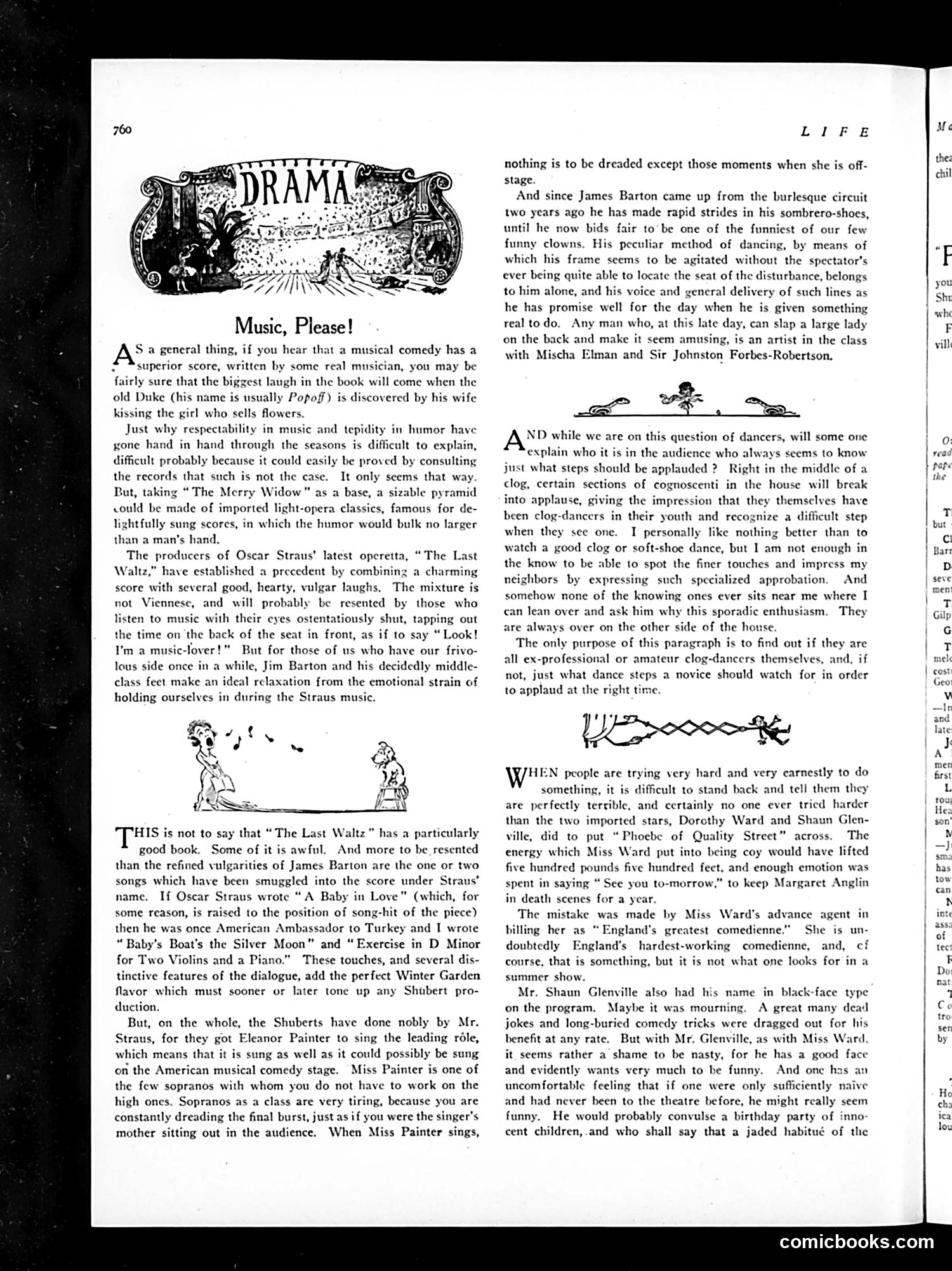
This is a theater review of the operetta *"The Last Waltz"* by Oscar Straus, praising its combination of quality music with genuine humor—a rare achievement in musical comedy. The piece celebrates performer **James Barton**, a former burlesque dancer whose unorthodox dancing style and comedic timing elevate the production. The critic compares his artistry to serious musicians like Mischa Elman and Sir Johnston Forbes-Robertson, elevating a vaudeville performer to high-art status as satire. The review also praises **Eleanor Painter**, the soprano lead, for her vocal control and ability to sing without the "dreaded" high-note strain typical of operatic sopranos. The smaller cartoon panels appear to satirize theater audiences—particularly the pretentious opera-goers who ostentatiously appreciate music while ignoring humor, and the self-appointed "cognoscenti" who signal when applause is appropriate, as if choreographing audience response. The satire targets class pretension in theater culture.
📄 Transcribed text from this page (OCR, searchable)
Machine-transcribed from the original scan — historical spelling and the odd misread are preserved.
Music, Please! a general thing, if you hear that a musical comedy has a superior score, written by some real musician, you may be fairly sure that the biggest laugh in the book will come when the old Duke (his name is usually Popoff) is discovered by his wife ki ing the girl who sells flowers. Just why respectability in music and tepidity in humor have gone hand in hand through the seasons is difficult to explain, difficult probably because it could easily be proved by consulting the records that such is not the case. It only seems that Rut, taking “The Merry Widow could be made of imported light-opera classics, famous for de- ay. as a base, a sizable pyramid lightfully sung scores, in which the humor would bulk no larger than a man's hand. The producers of Oscar Straus’ latest operetta, “ The Last Waltz,” have established a precedent by combining a charming score with several good, hearty, vulgar laughs, The mixture is not Viennese, and will probably be resented by those who listen to music with their eyes ostentatiously shut, tapping out the time on the back of the seat in front, as if to say “ Look! I'm a music-lover!” But for those of us who have our frivo- lous side once in a while, Jim Barton and his decidedly middle- class feet make an ic relaxation from the emotional strain of holding ourselves in during the Straus music. 'HIS is not to say that “The Last Waltz” has a particularly good book. Some of it is awful. And more to be resented than the refined vulgarities of James Barton are the one or two songs which have been smuggled into the score under Straus’ name. If Oscar Straus wrote “A Baby in Love” (which, for some reason, is raised to the position of song-hit of the then he was once American Ambassador to Turkey and I wrote “Baby's Boat's the Silver Moon” and “Exercise in D Minor for Two Violins and a Piano.” These touches, and several dis- tinctive features of the dialogue, add the perfect Winter Garden flavor which must sooner or later tone up any Shubert pro- duction. But, on the whole, the Shuberts have done nobly by Mr. Straus, for they got Eleanor Painter to sing the leading réle, h means that it is sung as well as it could possibly be sung on the American musical comedy stage. Miss Painter is one of the few sopranos with whom you do not have to work on the high ones. Sopranos as a class are very tiring, because you are constantly dreading the final burst, just as if you were the singer's mother sitting out in the audience. When Miss Painter sings, LIFE nothing is to be dreaded except those moments when she stage. And since James Barton came up from the burlesque circuit two years ago he has made rapid strides in his sombrero-shoes, until he now bids fair tobe one of the funniest of our few funny clowns. His peculiar method of dancing, by means of which his frame seems to be agitated without the spectator’s ever being quite able to locate the seat of the disturbance, belongs to him alone, and his voice and general delivery of such lines as s off- he has promise well for the day when he is given something real todo. Any man who, at this late day, can slap a large lady on the back and make it seem amusing, is an artist in the class with Mischa Elman and Sir Johnston Forbes-Robertson. ae NE, AN” while we are on this question of dancers, will some one explain who it is in the audience who always seems to know just what steps should be applauded ? Right in the middle of a clog, certain sections of cognoscenti in the house will break into applause, giving the impression that they themselves have been clog-dancers in their youth and recognize a difficult step when they see one. I personally like nothing better than to watch a good clog or soft-shoe dance, but I am not enough in the know to be able to spot the finer touches and impress my neighbors by expressing such specialized approbation. And somehow none of the knowing ones ever sits near me where I can lean over and ask him why this sporadic enthusiasm. They are always over on the other side of the house. The only purpose of this paragraph is to find out if they are all ex-professional or amateur clog-dancers themselves, and, if not, just what dance steps a novice should watch for in order to applaud at the right time. [Ei posoe He HEN people are trying very hard and very earnestly to do something, it is difficult to stand back and tell them they are perfectly tercible, and certainly no one ever tried harder than the two imported stars, Dorothy Ward and Shaun Glen- ville, did to put “Phoebe of Quality Street” across. The energy which Miss Ward put into being coy would have lifted five hundred pounds five hundred fect, and enough emotion was See you to-morrow,” to keep Margaret Anglin spent in saying in death scenes for a year. The mistake was made by Miss Ward’s advance agent in billing her as “England's greatest comedienne.” She is un- doubtedly England's hardest-working comedienne, and, cf course, that is something, but it is not what one looks for in a summer show. Mr. Shaun Glenville also had his name in black-face type on the program. Maybe it was mourning. A great many dead jokes and long-buried comedy tricks were dragged out for his benefit at any rate. But with Mr. Glenville, as with Miss Ward, it seems rather a shame to be nasty, for he has a good face and evidently wants very much to be funny. And one has an uncomfortable feeling that if one were only sufficiently naive and had never been to the theatre before, he might really seem funny, He would probably convulse a birthday party of inno cent children,.and who shall say that a jaded habitué of the Me read pore comicbooks.com