
A complete issue · 36 pages · 1921
Life — May 12, 1921
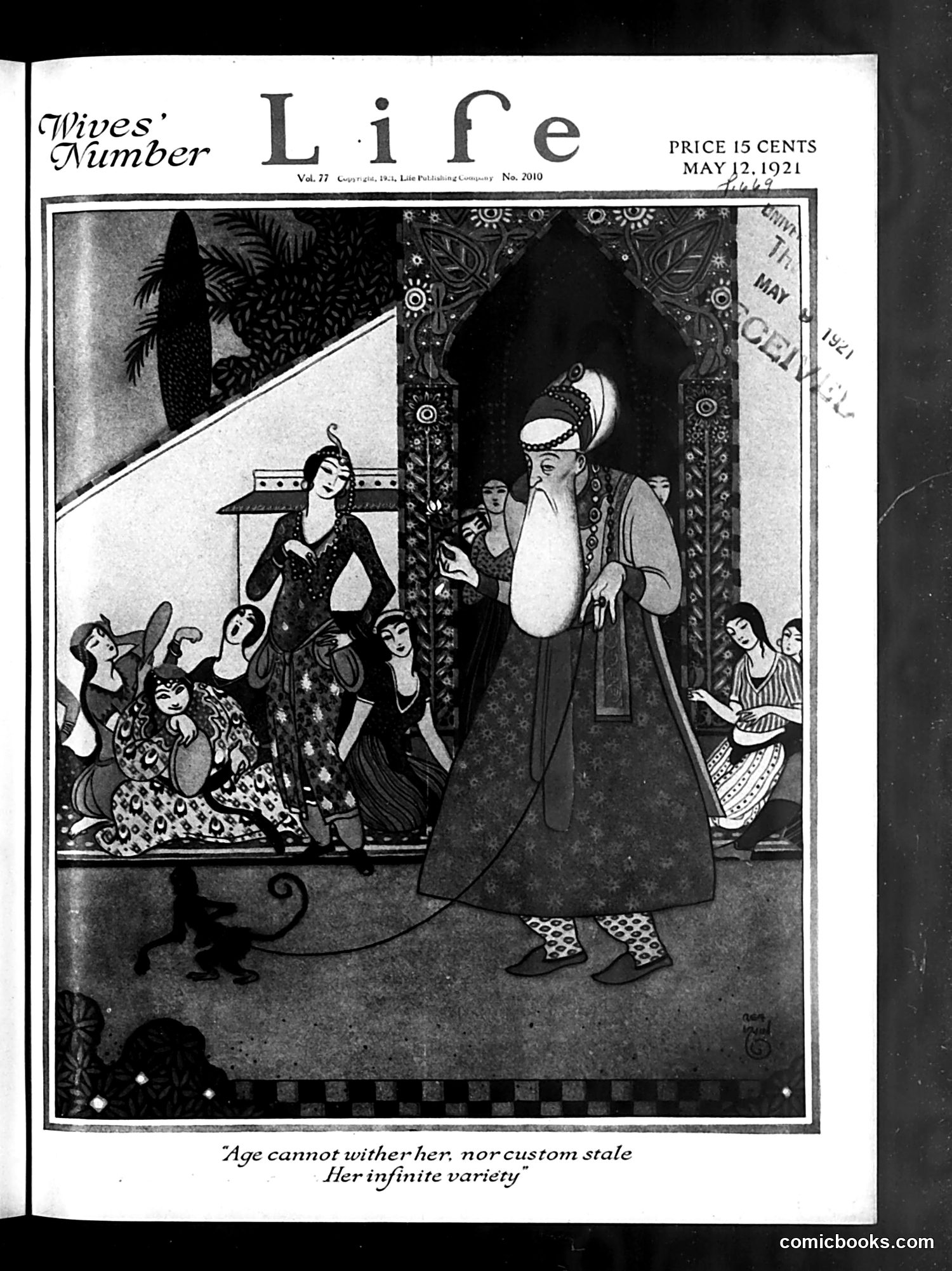
This cover illustration depicts an exotic, orientalist fantasy scene. A turbaned figure in flowing robes holds a long pipe, addressing an audience of women in a harem-like setting. The caption reads: "Age cannot wither, nor custom stale / Her infinite variety." The quote references Shakespeare's *Antony and Cleopatra*, suggesting the central female figure (likely Cleopatra, based on the theatrical setting) retains eternal allure and adaptability. The satire appears to comment on women's timeless appeal and social versatility, possibly mocking romantic idealization of women or commenting on changing feminine roles in 1920s society. The orientalist aesthetic—common in early 20th-century American satire—reflects period attitudes toward "exotic" cultures, now recognized as stereotypical.
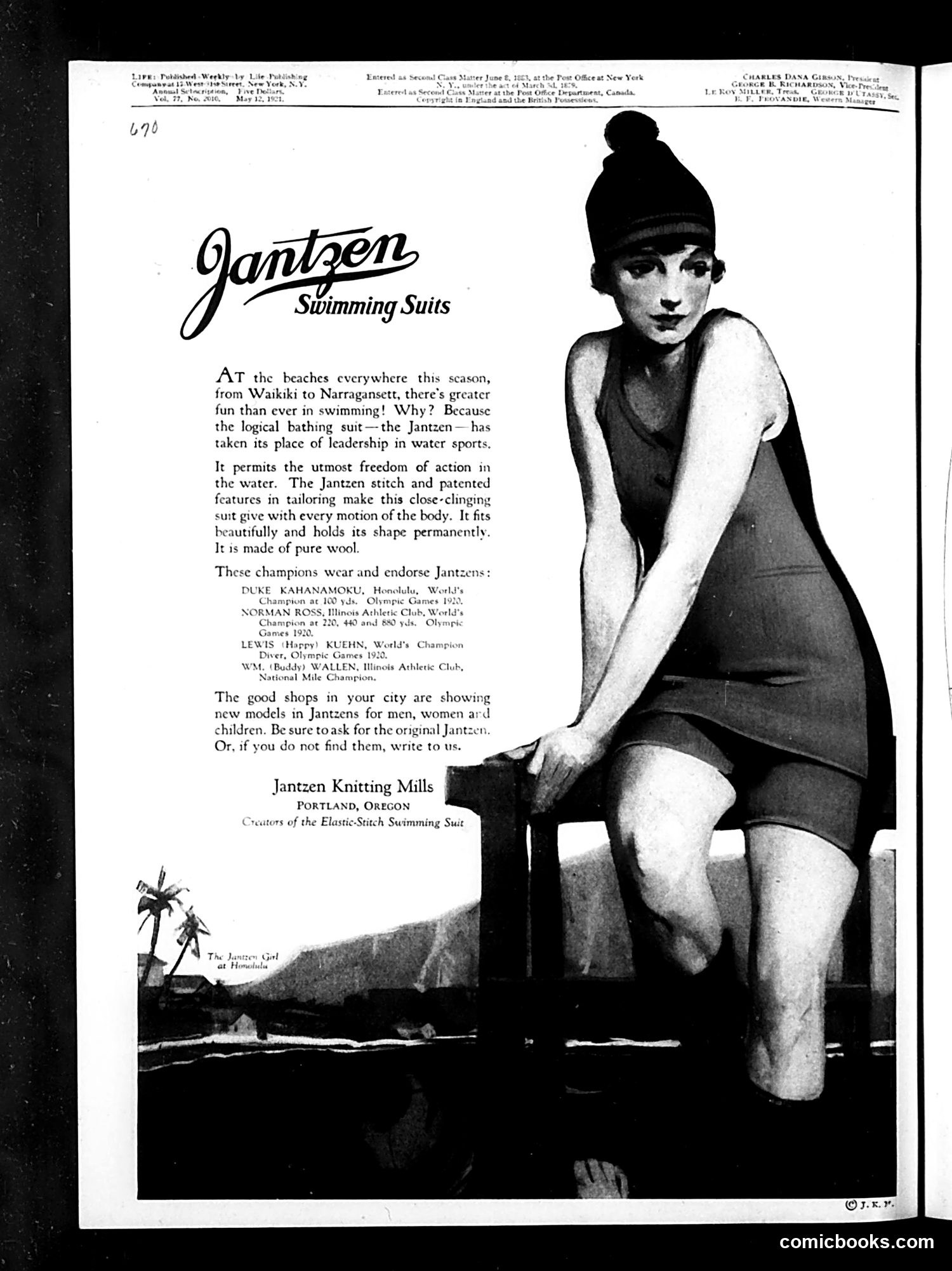
This is a straightforward **product advertisement**, not political satire or commentary. It promotes Jantzen brand swimming suits, manufactured by Jantzen Knitting Mills in Portland, Oregon. The ad emphasizes the suit's practical features—elastic-stitch construction, close-fitting design, and pure wool construction—claiming it permits "utmost freedom of action in the water." The advertisement leverages celebrity endorsements, listing Olympic champions and competitive swimmers who wore Jantzen suits, including Duke Kahanamoku (Hawaiian swimming legend) and other 1920s athletes. The photograph shows a woman in a one-piece bathing suit, posed sitting on what appears to be a dock, with a Hawaiian beach scene in the background. This reflects 1920s fashion advertising conventions and the era's growing acceptance of women's athletic swimwear.
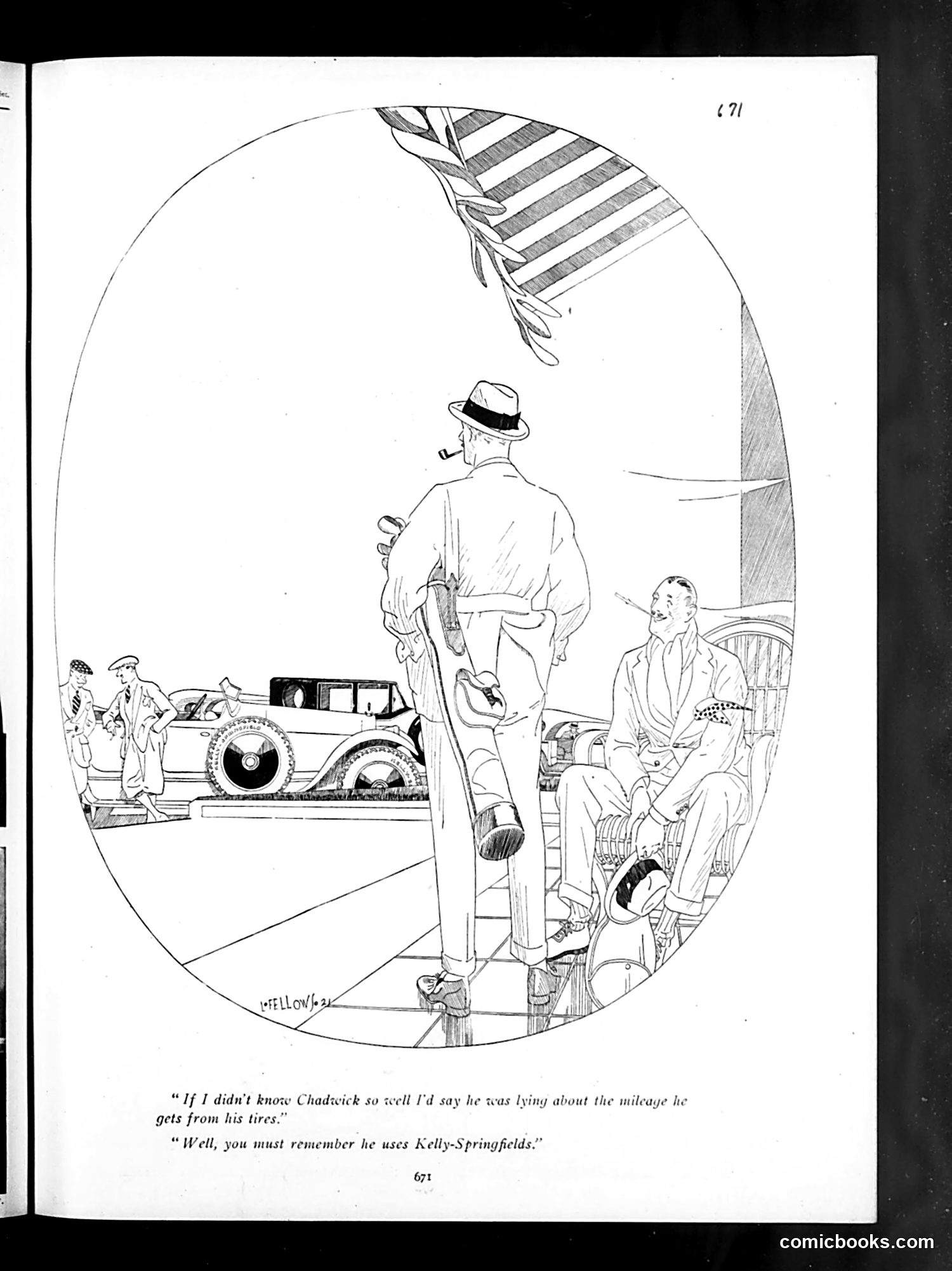
This cartoon satirizes a conversation between two men about a third person named Chadwick, who apparently exaggerates the fuel efficiency of his tires. One speaker says he'd suspect Chadwick of lying about his tire mileage if he didn't know he uses "Kelly-Springfields" (a tire brand). The joke plays on brand reputation: Kelly-Springfield tires were apparently renowned for reliability and mileage performance, so the speaker humorously suggests that Chadwick's claims—no matter how inflated—might actually be credible *because* he uses this superior product. The setting depicts an urban garage or parking area with a vintage automobile. The humor relies on early-20th-century consumer awareness of tire brands as status symbols and indicators of quality.
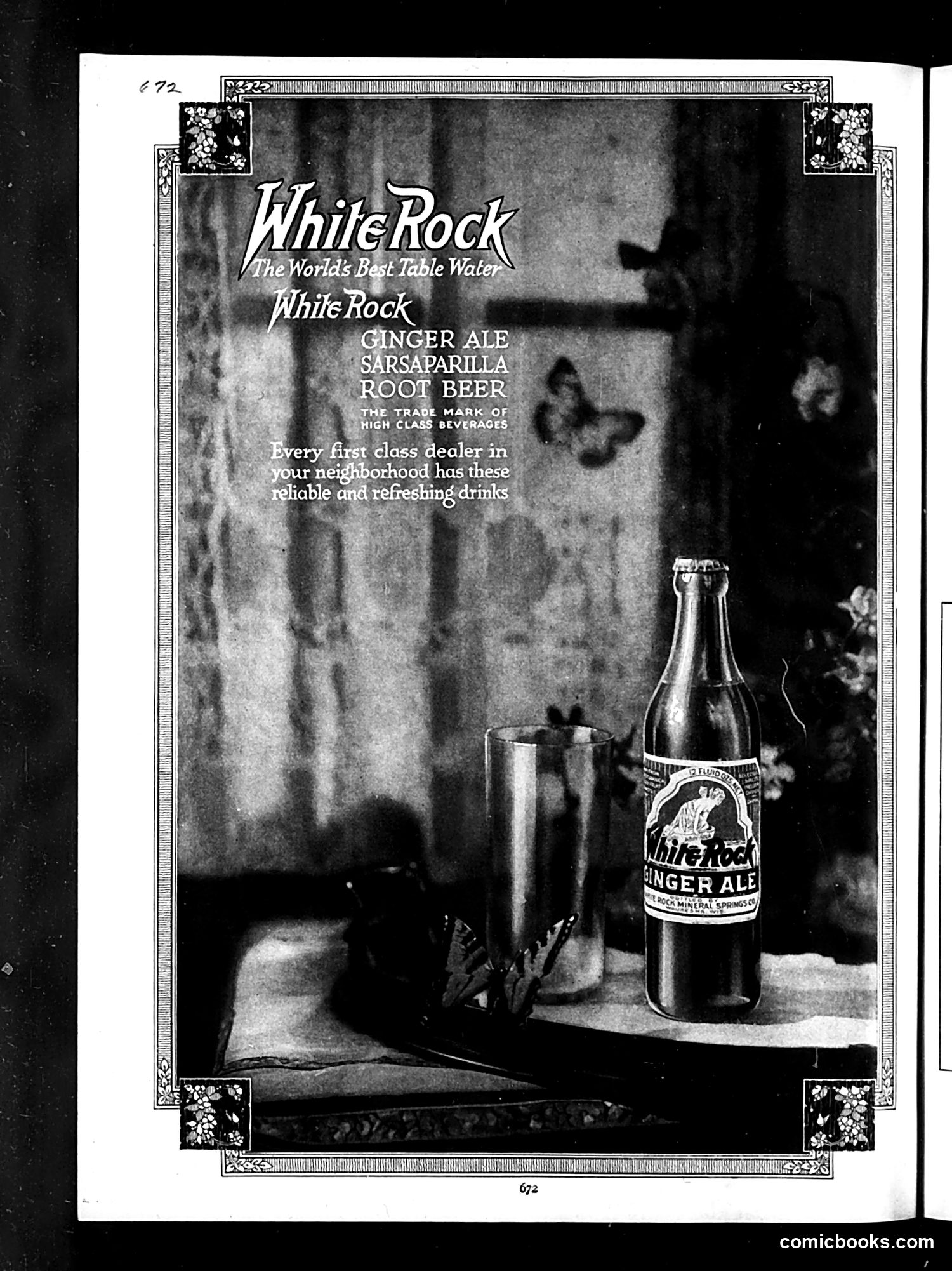
This is **not a cartoon or satire page** — it's a straightforward **advertisement** for White Rock beverages, specifically their ginger ale, sarsaparilla, and root beer products. The ad features a product photograph showing a White Rock ginger ale bottle next to a filled glass, positioned as upscale "high class beverages." The text emphasizes that these drinks are stocked by "every first class dealer in your neighborhood," positioning them as premium products. There is no political commentary, satire, or social criticism present. This is purely commercial advertising from an era when Life magazine, though known for satirical content, also carried paid advertisements to fund publication.
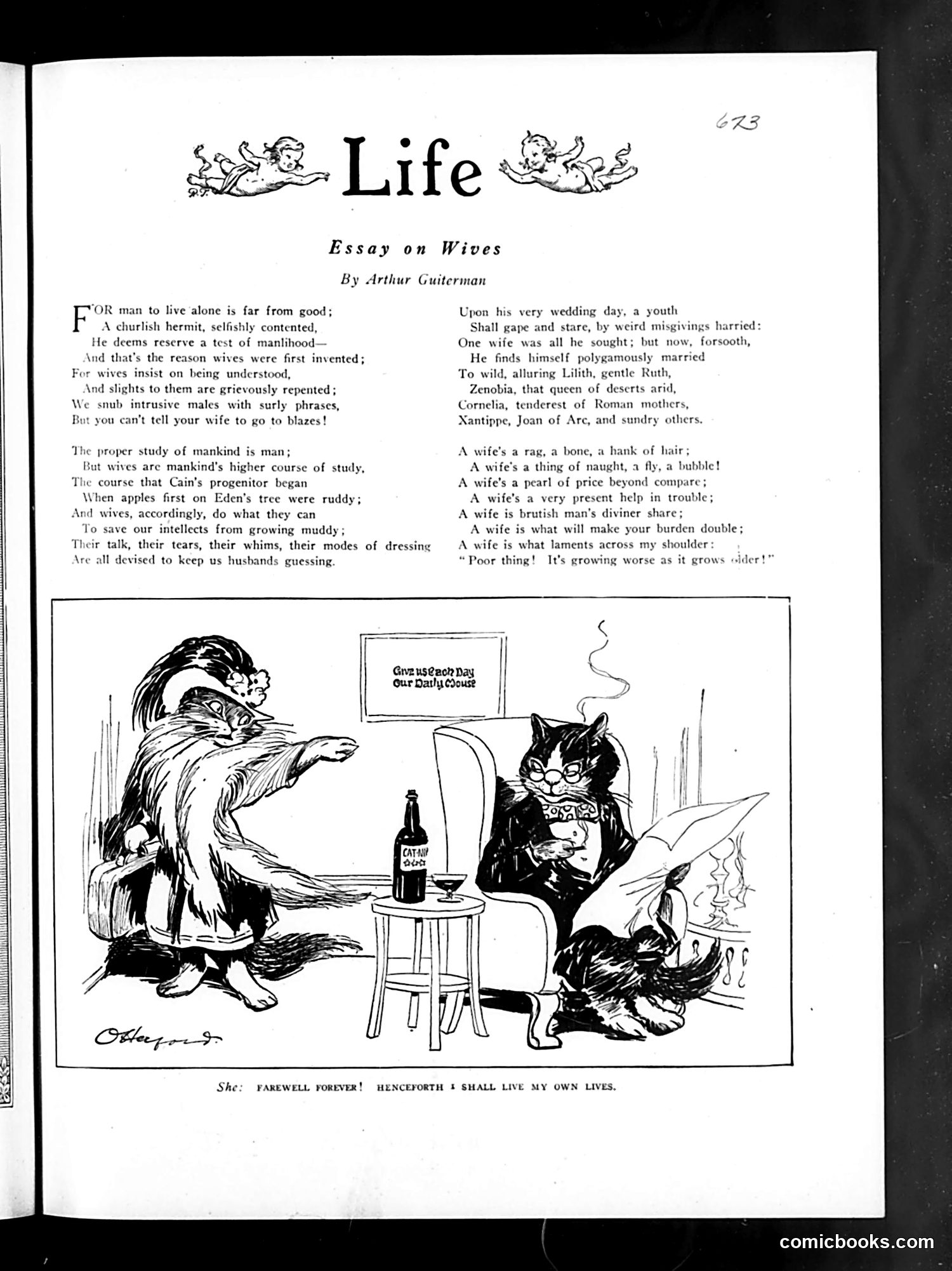
This page presents an essay by Arthur Guterman critiquing marriage and wives, accompanied by a satirical cartoon. The text sarcastically argues that wives are necessary for men's intellectual development while simultaneously listing their faults—they're demanding, intrusive, and "keep their husbands guessing." The cartoon depicts anthropomorphized animals (appearing to be dogs or similar creatures) in a domestic scene, with one female figure declaring "Farewell, forever! Henceforth I shall live my own lives." The satire mocks both wives' supposed independence aspirations and husbands' anxieties about female autonomy. The overall piece reflects early 20th-century satirical humor about marriage tensions, portraying wives as simultaneously indispensable and burdensome—typical of the era's gender-based comedy that would seem outdated today.
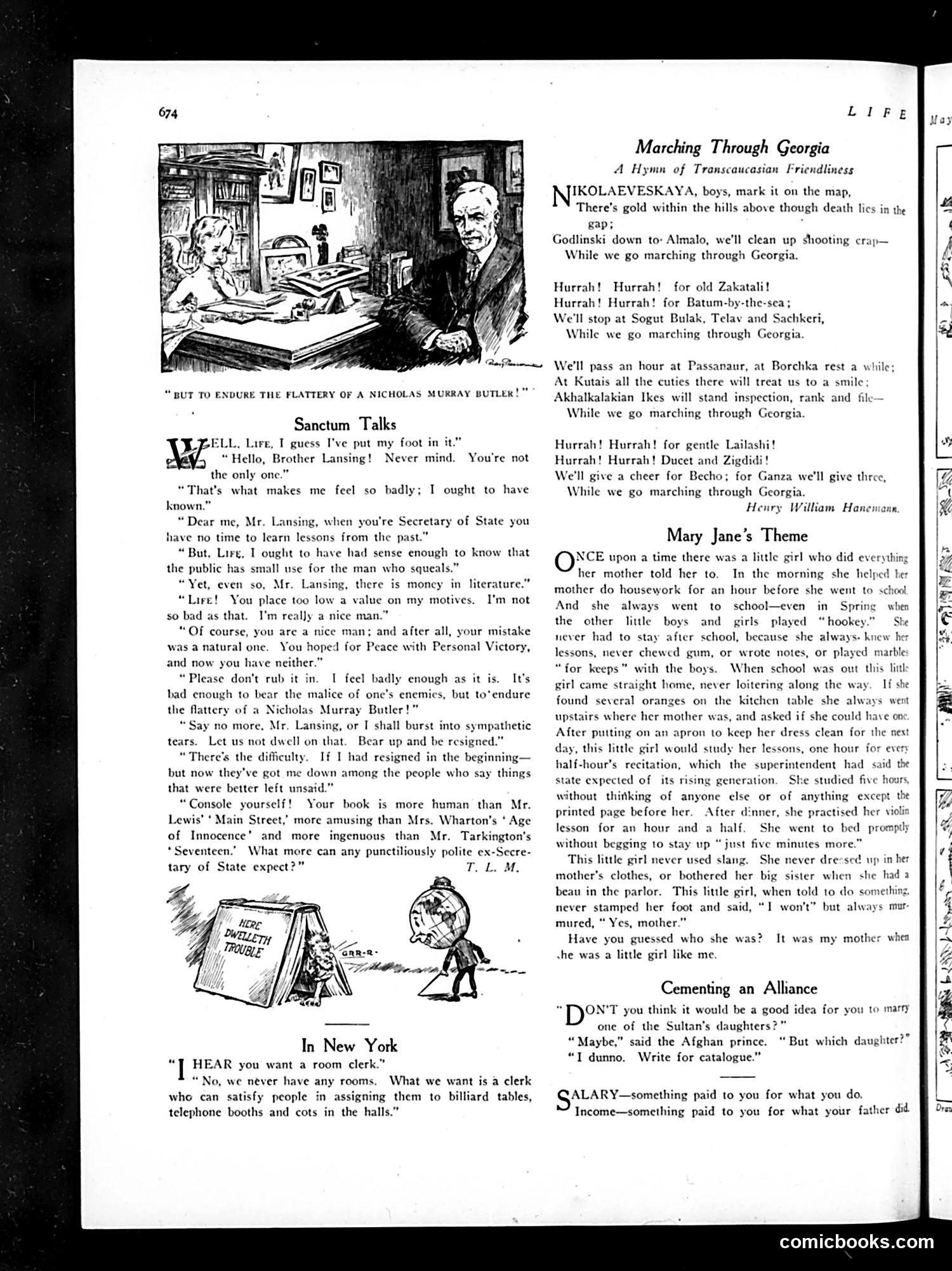
**"Sanctum Talks" section** features a dialogue between Life's editor and "Brother Lansing" (likely a staff member or contributor). The joke centers on Lansing's embarrassment about a mistake—apparently he sought "Peace with Personal Victory" but instead created "enemies." The editor gently mocks him for expecting too much credit while avoiding blame, satirizing the human tendency to rationalize failures. The editor suggests Lansing lacks the thick skin necessary for public work. **"Marching Through Georgia"** is a patriotic poem about transcontinental friendship, apparently celebrating peaceful travel through the American South. **"Mary Jane's Theme"** is a sentimental short story about a diligent schoolgirl learning discipline and responsibility. The remaining sections appear to be miscellaneous humor and brief commentary typical of Life's satirical format.
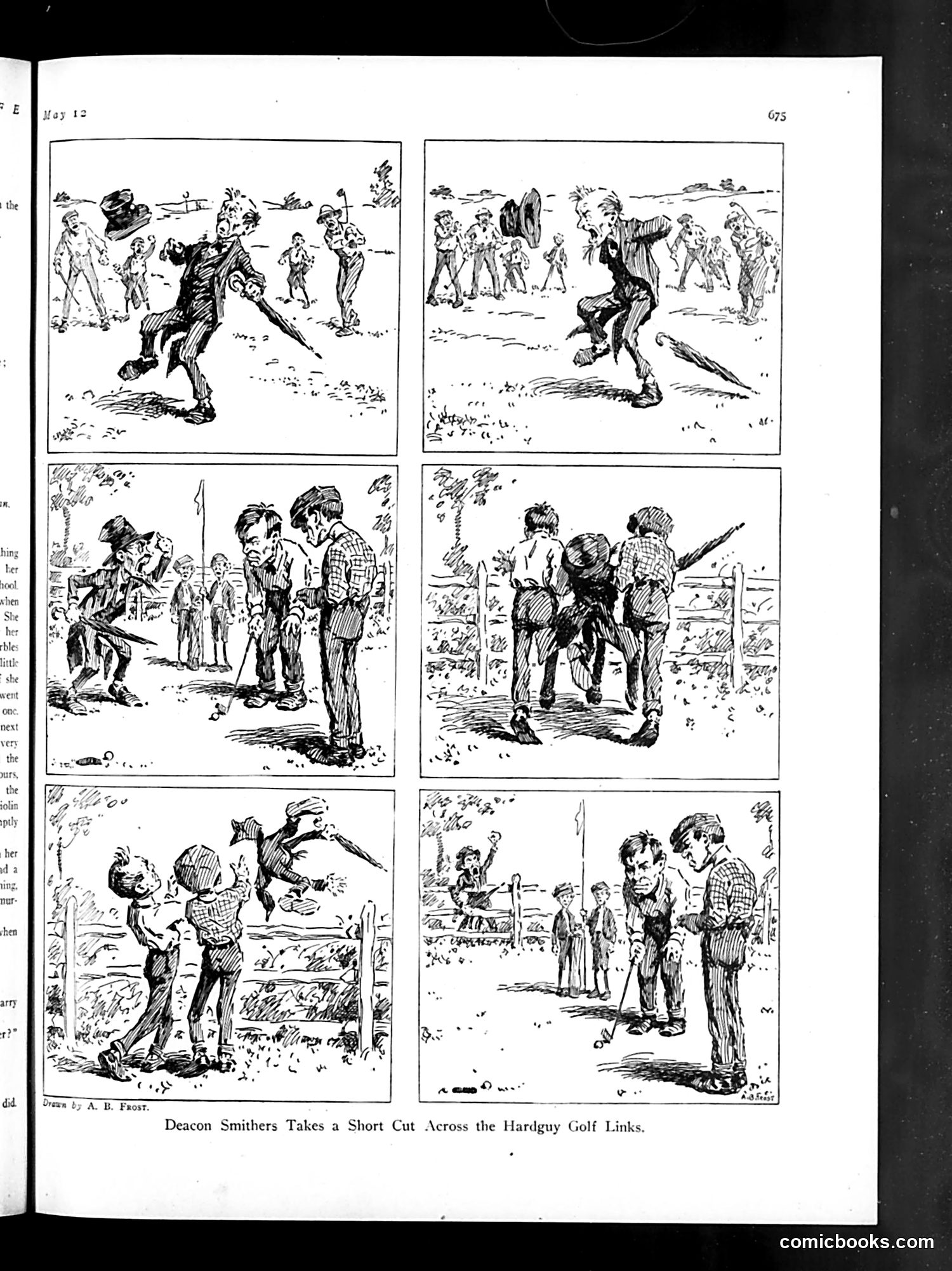
This six-panel comic strip, drawn by A.B. Frost, depicts a humorous narrative about a character named Deacon Smithers who attempts to cross a golf course illegally. The sequence shows: 1. Smithers running across the links while golfers play 2. Him evading approaching golfers 3. Confrontations with course workers or golfers 4. Escalating complications from his trespassing The satire mocks both Smithers' audacious rule-breaking and the stuffy formality of golf culture. His "short cut" violation of golf course etiquette—a serious breach in this era when golf represented upper-class respectability—provides the comedy. The strip satirizes class tensions and the rigid social hierarchies surrounding the sport in early 20th-century America.
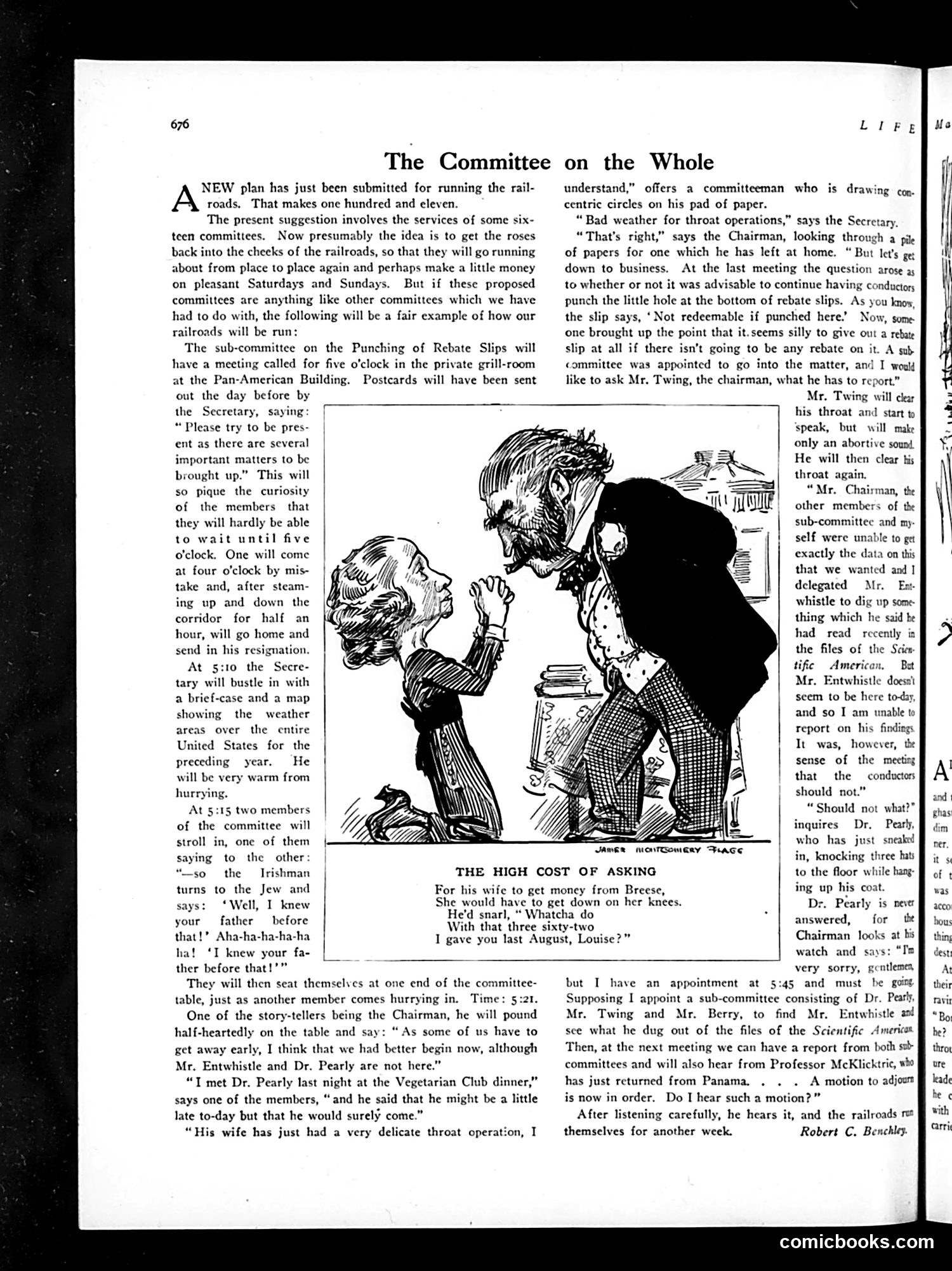
This cartoon satirizes the difficulty of borrowing money during what appears to be an economic period of financial constraint. The illustration shows a woman on her knees pleading with a man for money, captioned: "For his wife to get money from Breese, / She would have to get down on her knees. / He'd start, / With that thirty-two / 'I have you last August, Louise?'" The joke critiques stingy or reluctant lending between acquaintances—the man "Breese" apparently loaned money to this woman in August and now uses that as leverage to refuse further assistance. The cartoon mocks both the humiliation required to ask for money and the creditor's harsh attitude toward repeated requests for financial help.
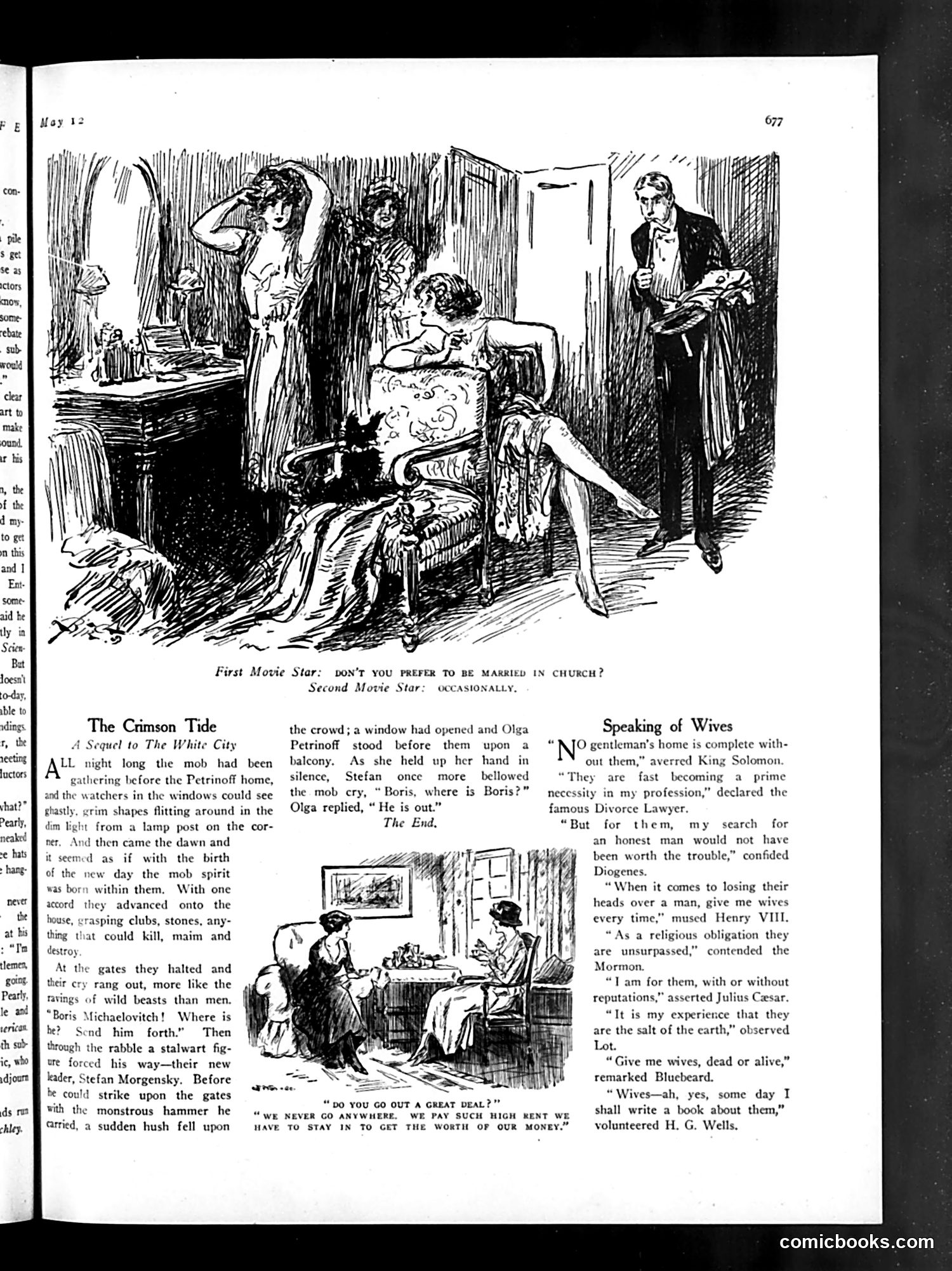
This page contains two distinct pieces of satire: **"The Crimson Tide"** (left) appears to be a short story excerpt about a mob attacking the Perroff home, seeking a character named Boris Michaelovich. The narrative suggests anti-immigrant violence, likely referencing xenophobic sentiment against Eastern European or Jewish immigrants during the early 20th century. **"Speaking of Wives"** (right) is a humor column featuring quotes about marriage and wives from various figures, including King Solomon and references to a "famous Divorce Lawyer." The satirical intent mocks contemporary attitudes toward marriage, suggesting wives are problematic and divorce is inevitable—typical early-1900s misogynist humor. Both pieces reflect the magazine's satirical commentary on contemporary social anxieties: immigration fears and evolving gender relations.
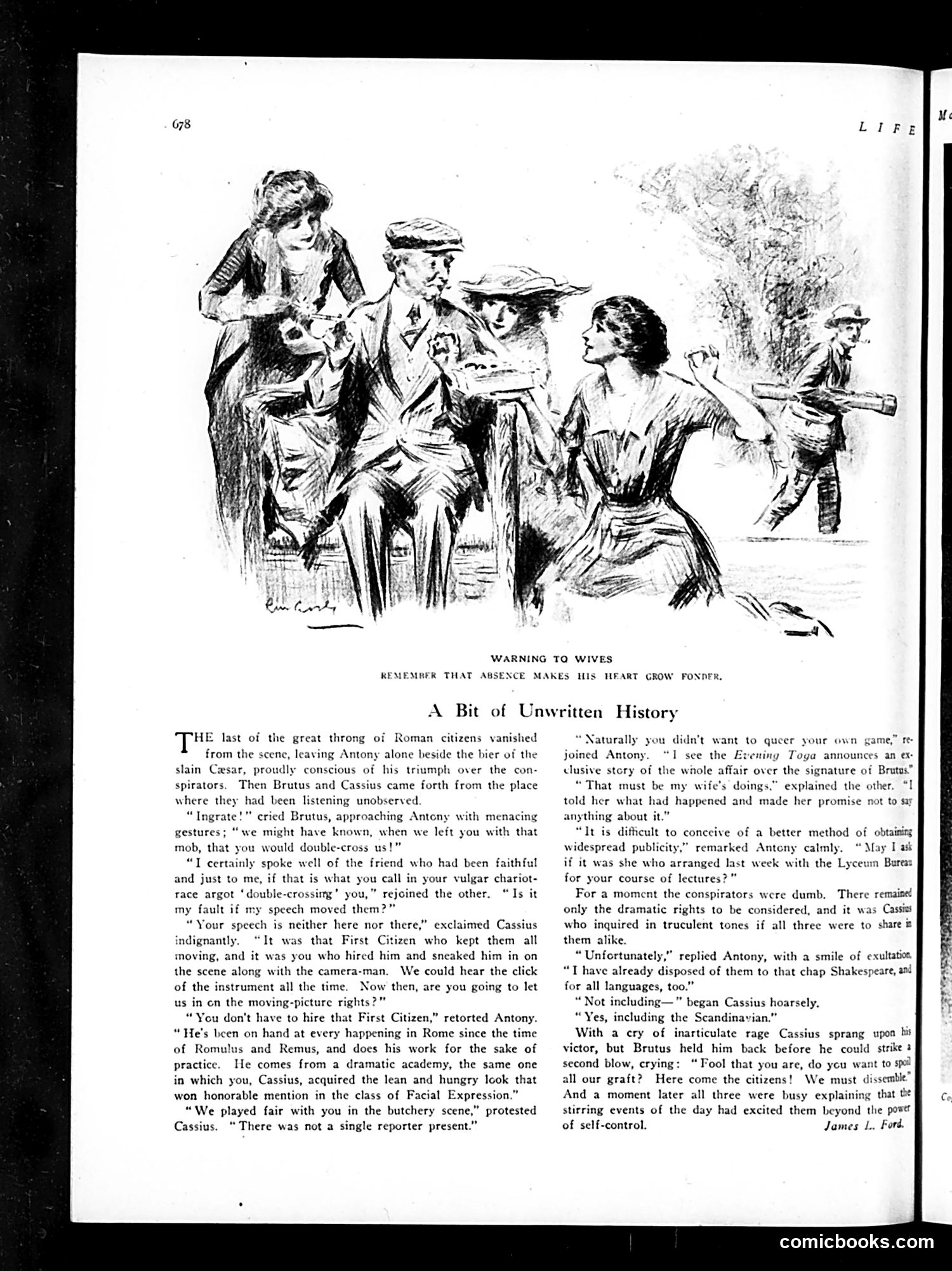
This satirical piece depicts a fictional confrontation between Roman conspirators and a wife of one of them. The cartoon's caption warns wives that "absence makes his heart grow fonder," suggesting infidelity concerns. The narrative mocks dramatic pretensions: when conspirators (appearing to be Brutus and Cassius based on the text) attempt serious justifications for their actions, Antony dismisses their theatrical posturing. He sarcastically notes one conspirator "comes from a dramatic academy" and suggests their "butchery scene" was merely performance art. The satire targets overwrought dramatic acting and self-important political speeches—suggesting real historical events are often less noble than their theatrical reenactments. The jokes emphasize how people justify questionable behavior through elaborate narratives and affected rhetoric.
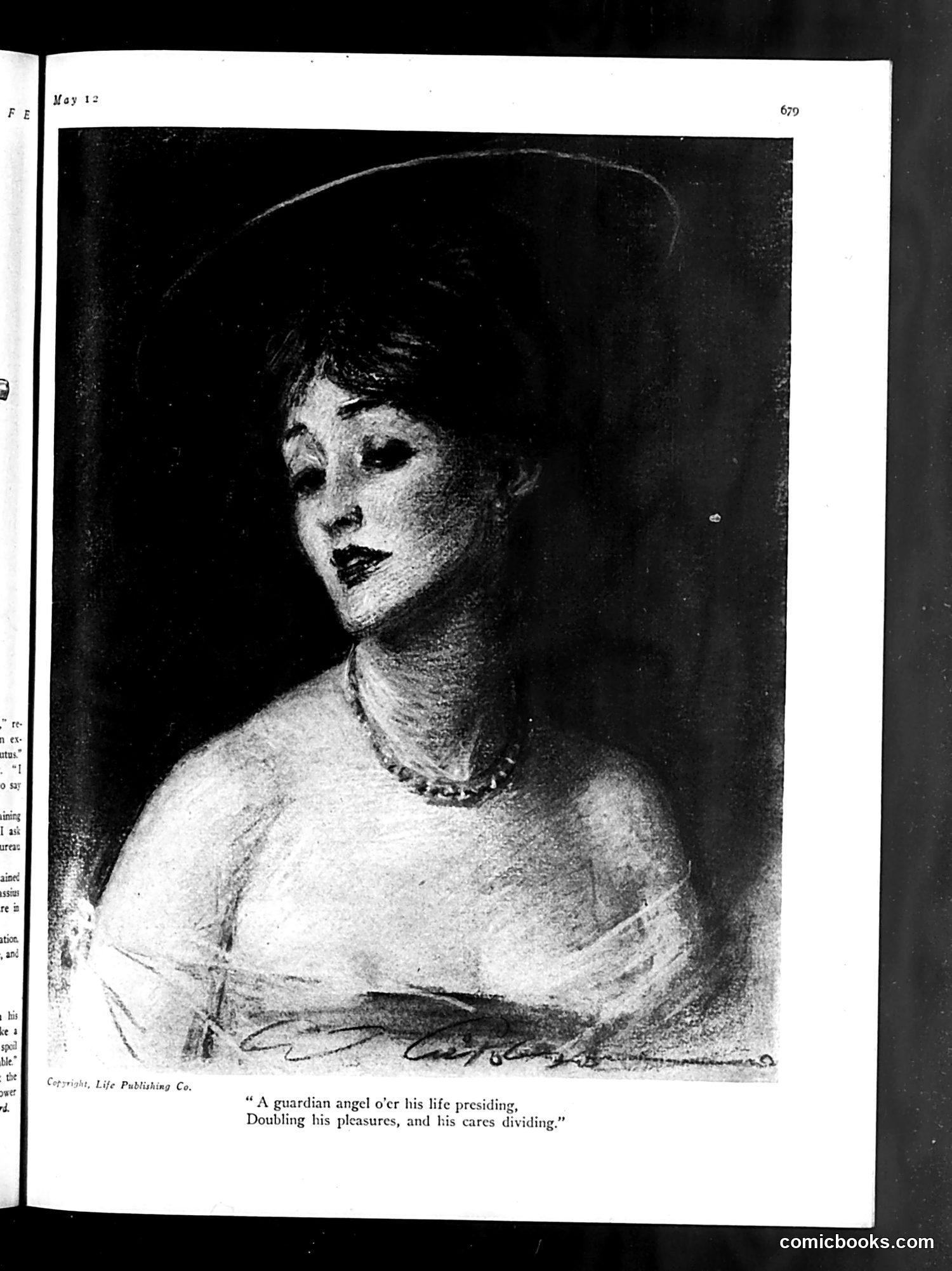
This page from *Life* magazine features a portrait illustration of a woman with short dark hair, styled in what appears to be 1920s fashion, wearing a pearl necklace and light-colored garment. The caption quotes poetry: "A guardian angel o'er his life presiding, / Doubling his pleasures, and his cares dividing." The image appears to be satirizing contemporary ideals about women's roles—specifically the notion of women as nurturing caregivers and pleasure-providers for men. The romantic, idealized portrayal contrasts with the satirical text, which critiques how women were expected to serve as emotional and social supports while men received all the benefits. This reflects *Life*'s commentary on gender relations during the Jazz Age era.
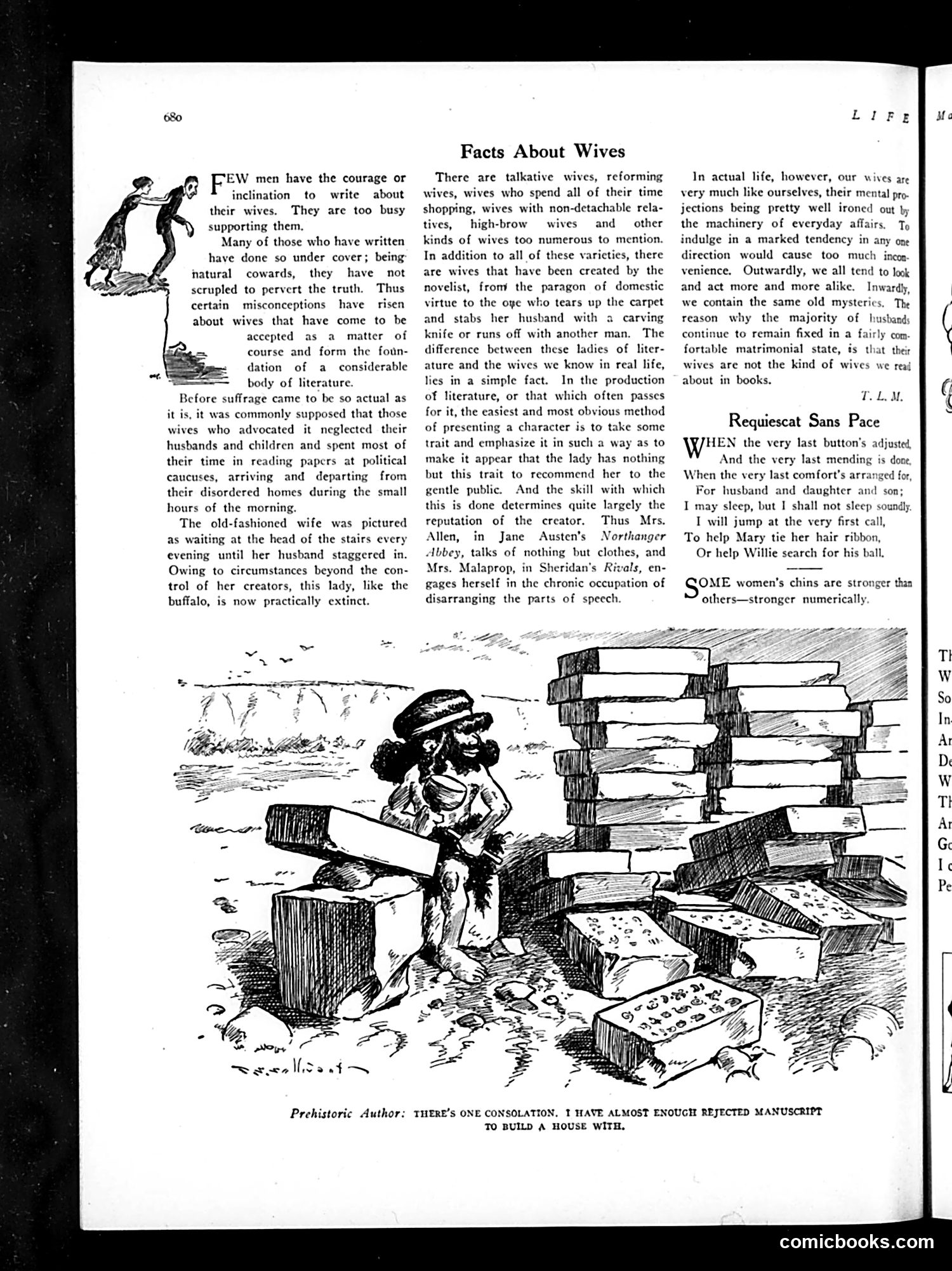
This page satirizes literary portrayals of wives versus reality. The text criticizes novelists and authors who depict wives as either shrewish (stabbing husbands with knives, running off with lovers) or impossibly perfect. Authors like Jane Austen, Sheridan, and unnamed others are mentioned as examples of exaggerated characterization. The bottom cartoon shows a "Prehistoric Author" surrounded by rejected manuscript pages, with the caption: "There's one consolation. I have almost enough rejected manuscript to build a house with." The joke: even ancient authors faced rejection—a timeless commentary on struggling writers. The cartoon humanizes prehistoric man as a frustrated scribe, making light of universal publishing disappointments while the article above critiques unrealistic female stereotypes in literature.
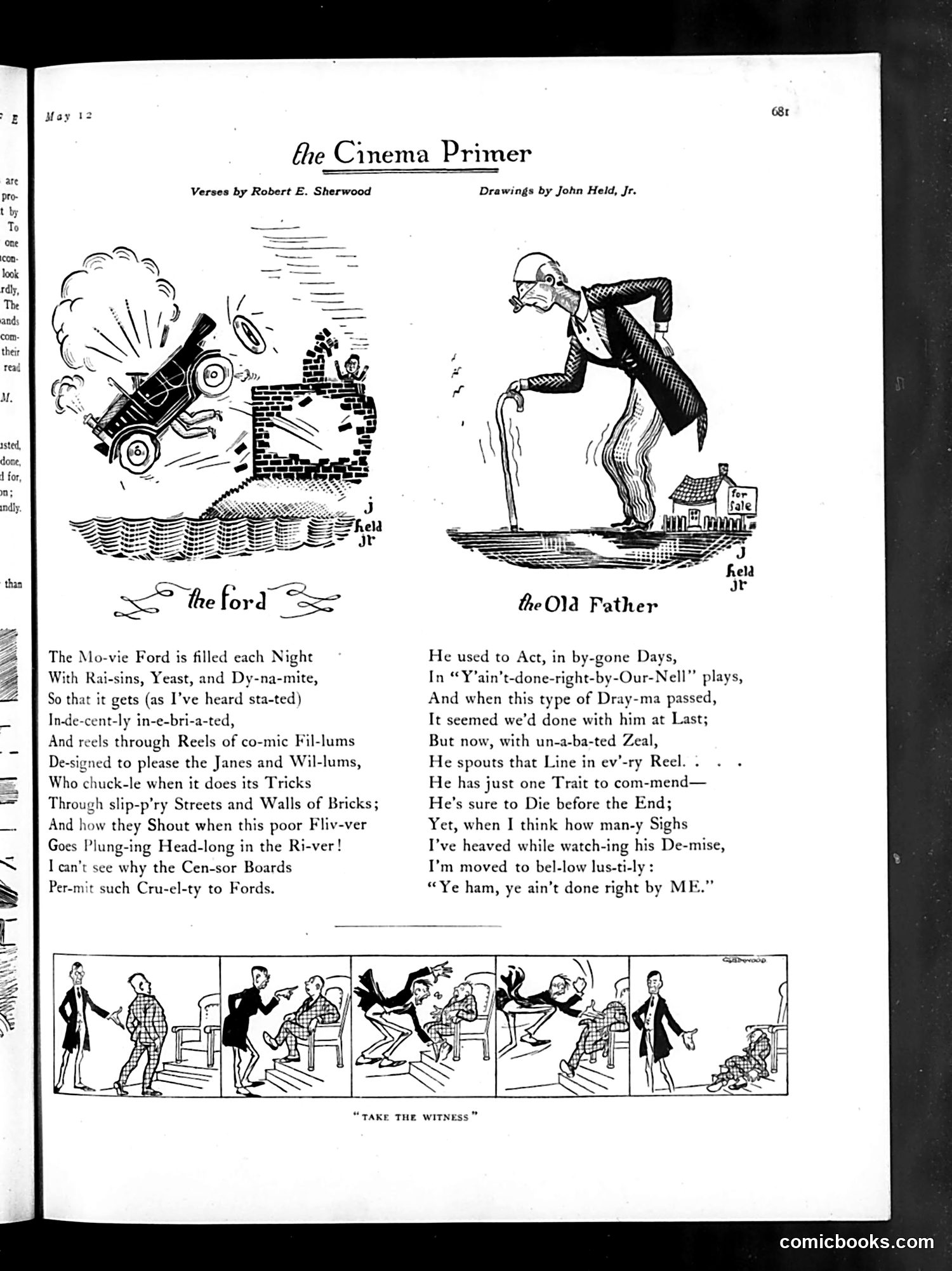
This page satirizes early silent film conventions. The two main illustrations parody common movie archetypes: **"The Ford"** depicts a slapstick car-chase sequence with exaggerated explosions and destruction—mocking the physical comedy and vehicular mayhem typical of silent comedies. **"The Old Father"** caricatures aging actors in melodramatic theater-derived performances, showing an exaggerated pose suggesting overwrought acting style. The verse notes he "used to Act" in old plays but now delivers unconvincing performances in films. The accompanying poem by Robert E. Sherwood mocks both the formulaic nature of silent movies—filled with "Raisins, Yeast," "comic Fil-lums"—and outdated acting techniques that audiences found laughable on screen. The bottom comic strip, "Take the Witness," appears to show slapstick courtroom chaos, extending the satire of film violence and theatrical excess.
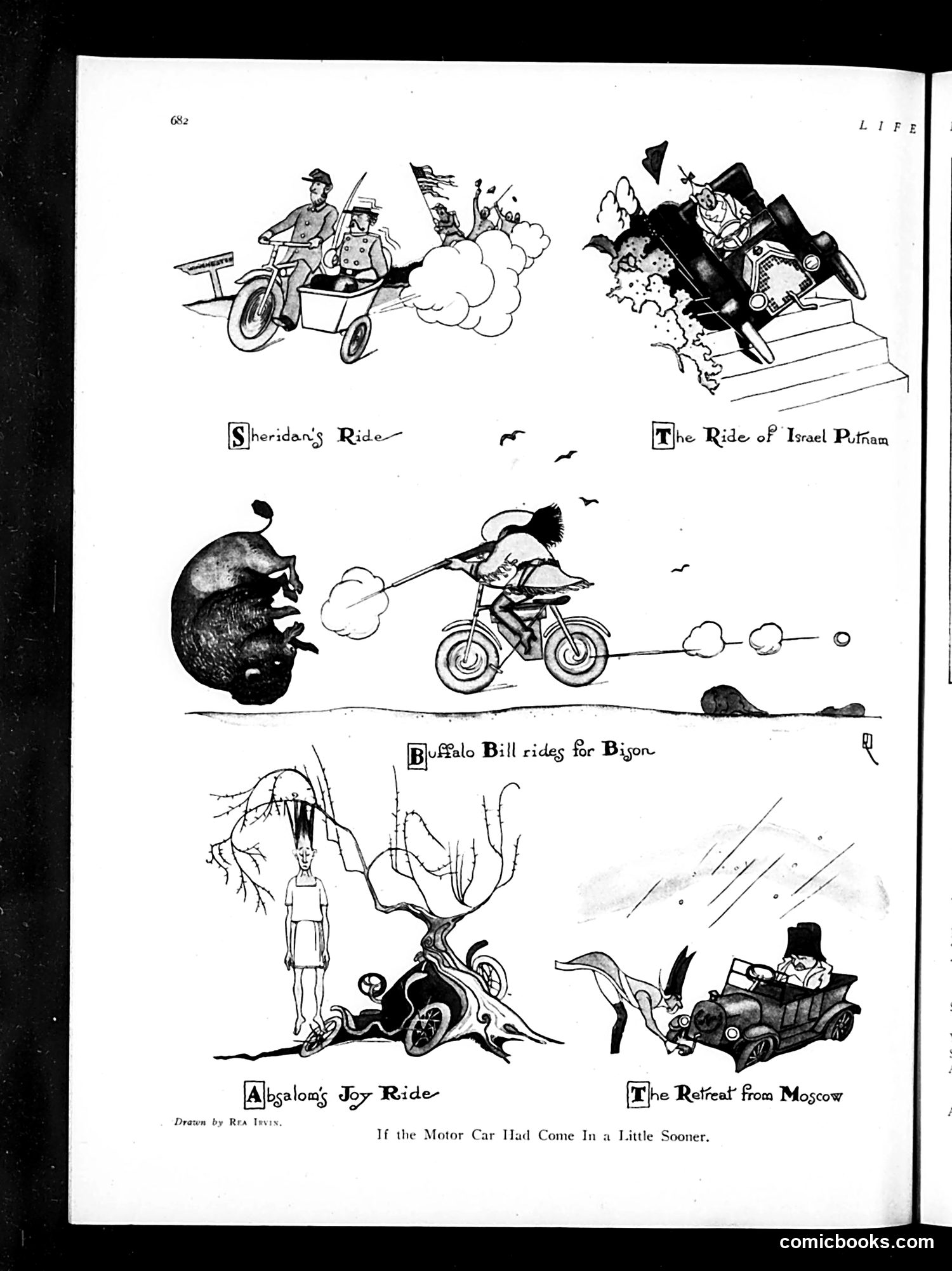
This satirical page reimagines famous historical rides and retreats using early automobiles and bicycles. The four panels parody: 1. **Sheridan's Ride** – Civil War General Philip Sheridan's famous cavalry charge, here on a motorcycle sidecar 2. **The Ride of Israel Putnam** – Revolutionary War general's legendary escape, now on a chaotic vehicle 3. **Absalom's Joy Ride** – Biblical reference to Absalom's death (caught in a tree), reimagined as a vehicular mishap 4. **The Retreat from Moscow** – Napoleon's disastrous 1812 retreat, depicted as a motorized escape The humor operates on anachronism: inserting modern transportation (circa 1910s) into historical moments creates absurdist comedy. The overall title suggests these famous historical figures would have fared differently—likely worse or more comically—with motorized vehicles. It's gentle satire on both history and the novelty of automobiles.
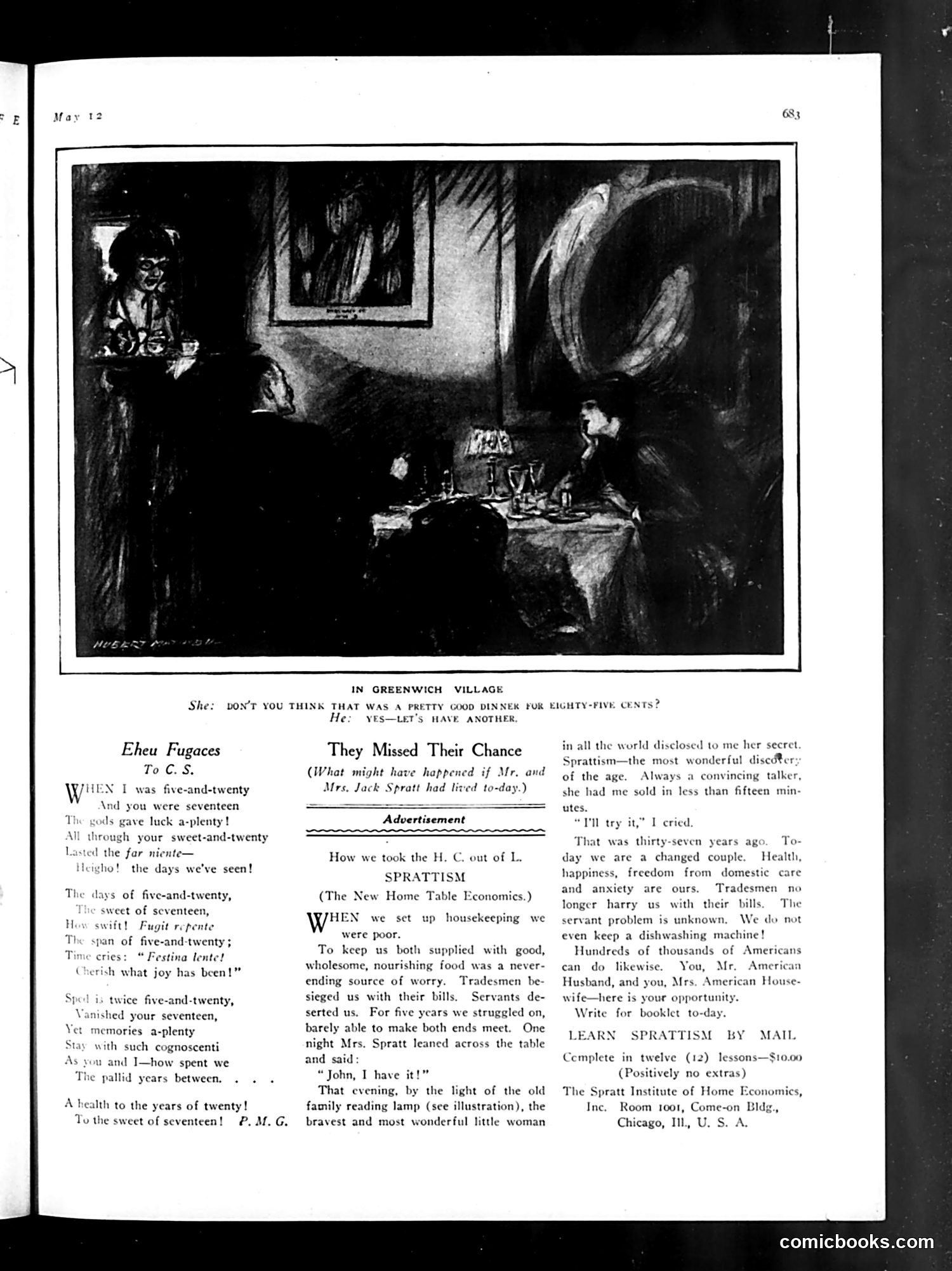
This page contains poetry and an advertisement, not political cartoons. The illustration shows a domestic scene titled "In Greenwich Village" depicting two people dining while a server stands nearby. The caption presents a humorous exchange about an inexpensive dinner. The accompanying poem "Eheu Fugaces" by F.M.G. nostalgically contrasts youth at "five-and-twenty" with current age, using the Latin phrase meaning "alas, fleeting [years]." The main content is an advertisement for "Spattism"—a mail-order home economics course promising to eliminate household bills and domestic worry. It targets American housewives, offering twelve lessons for $10.00 from the Spratt Institute in Chicago. This reflects early 20th-century consumer culture and marketing aimed at women's domestic management.
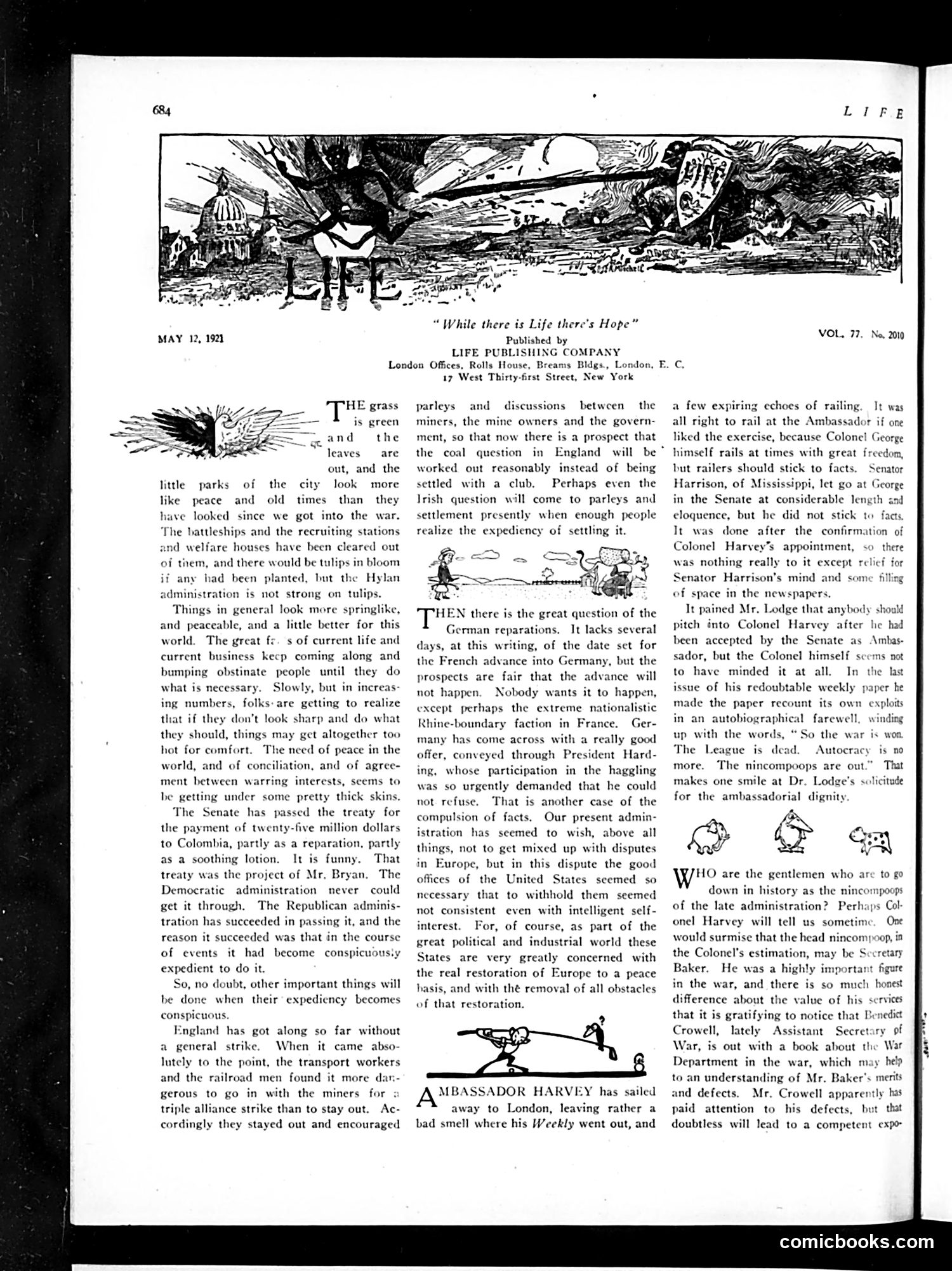
This page discusses post-WWI peace negotiations and labor disputes in England. The text references "Ambassador Harvey" sailing to London, coal miners' strikes, and debates over German reparations and French occupation terms. The small cartoons scattered throughout appear to depict miners or workers in various poses—likely satirizing labor negotiations or industrial unrest. One illustration shows figures in what seems to be a confrontational or comedic stance. The main satirical point concerns competing interests: miners seeking better conditions, mine owners resisting, government officials managing tensions, and broader questions about England's post-war recovery and Europe's reconstruction. The tone mocks the complexity of these negotiations and the various parties' inability to reach consensus on fundamental economic and political issues facing Britain in 1921.
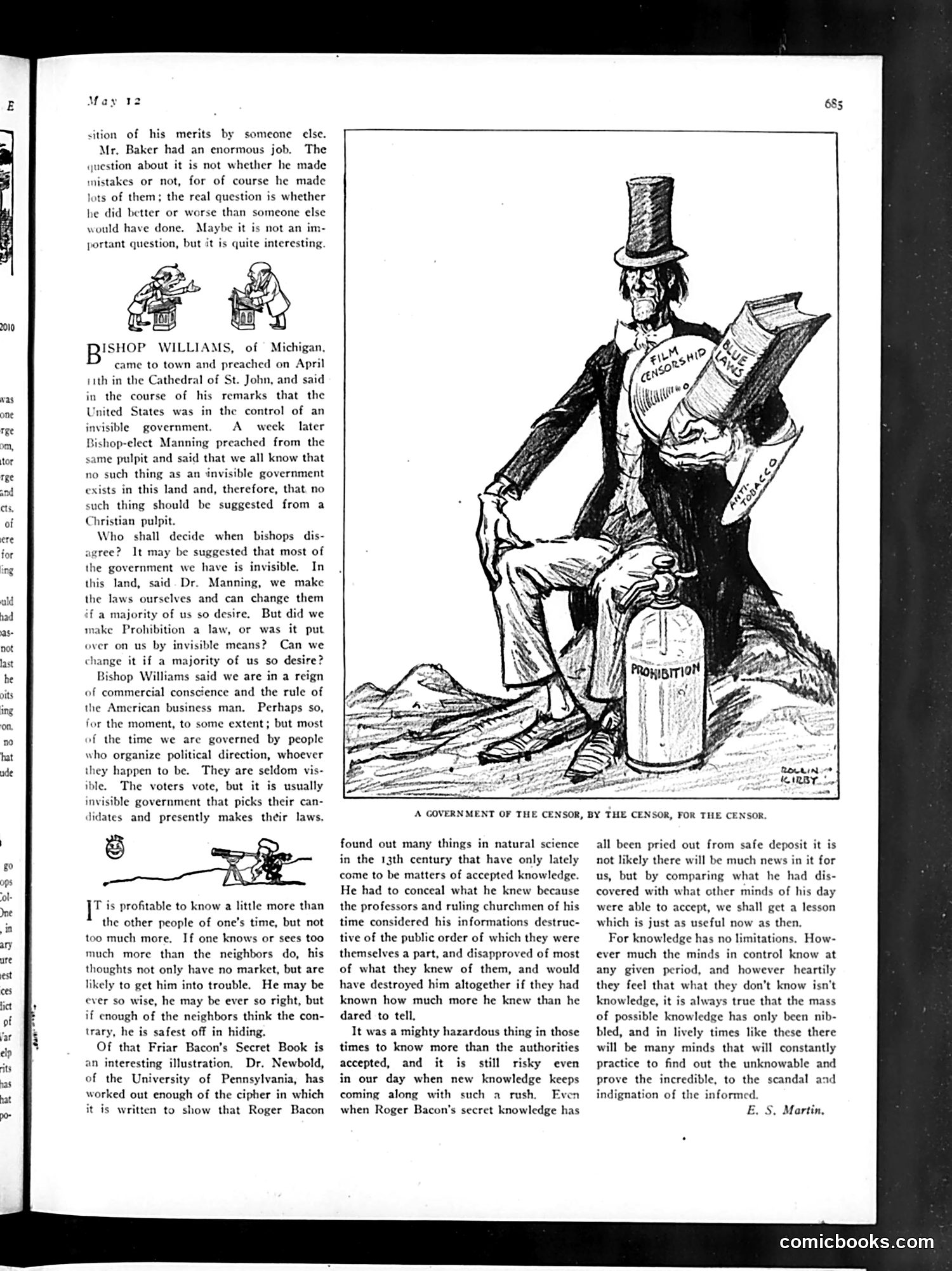
This cartoon satirizes **censorship and suppression of knowledge**, referencing a contemporary debate between Bishop Williams and Bishop-elect Manning about whether America has an "invisible government." The skeleton figure represents **censorship or tyrannical authority**, depicted as a grotesque top-hatted censor sitting atop dead bodies and gravestones labeled "Prohibition," holding papers marked with restrictions. The imagery evokes historical oppression. The article compares this to **Roger Bacon's 13th-century persecution**—the medieval scientist was forced to hide discoveries because authorities deemed them dangerous to "public order." The satire argues that modern America mirrors this medieval censorship: Prohibition was imposed "invisibly" by organized interests against popular will, and those in power suppress inconvenient truths. The cartoon's title—"government of the censor, by the censor, for the censor"—mocks Lincoln's "of the people, by the people, for the people" phrase, suggesting American democracy has been corrupted into authoritarian control.
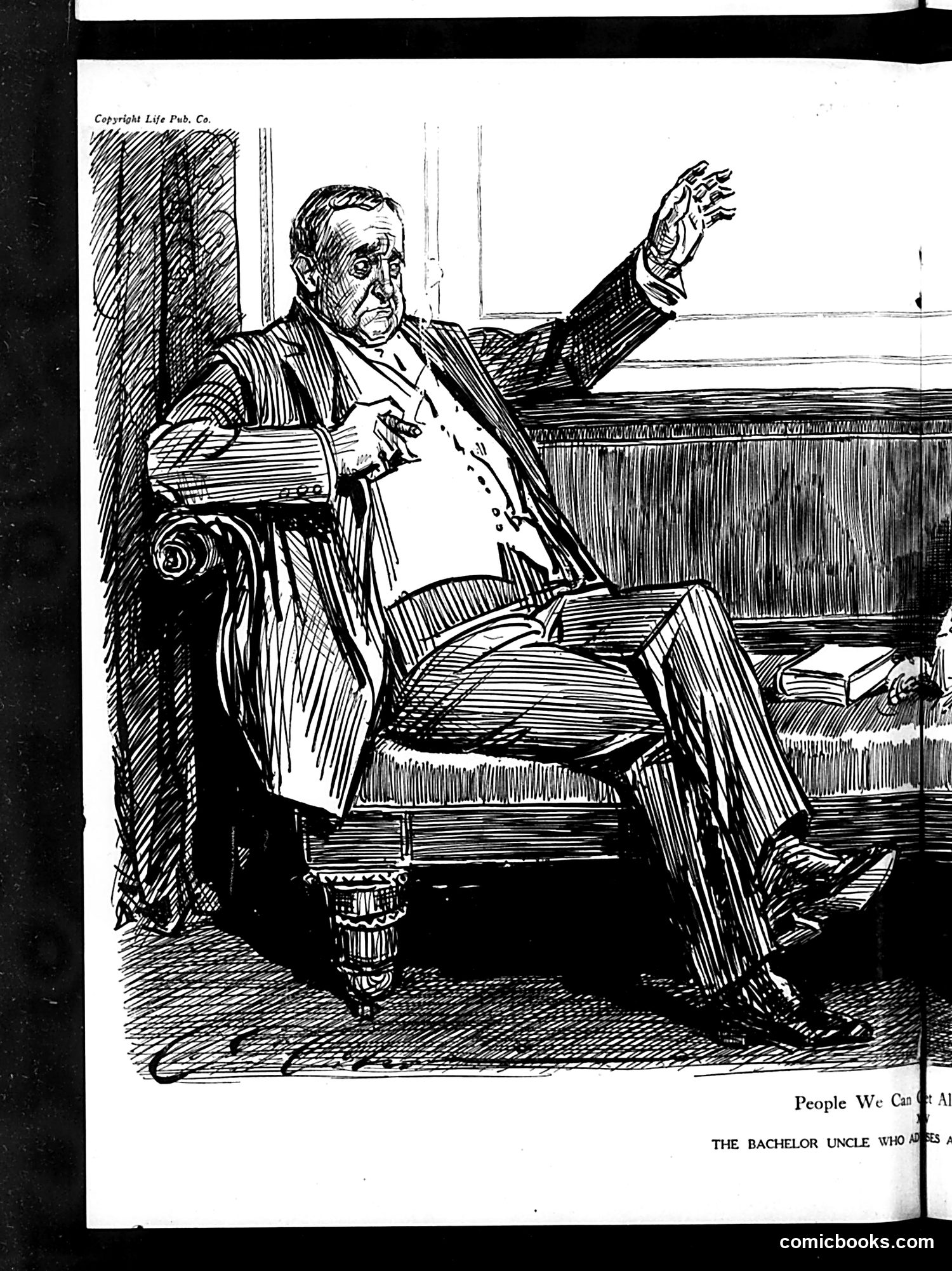
This is a satirical illustration from *Life* magazine showing "The Bachelor Uncle Who..." (caption cut off). The image depicts a well-dressed older gentleman in formal attire, seated and gesturing expressively with one arm raised. His animated pose and facial expression suggest he's telling a story or making a point. The satire appears to target bachelor uncles—a stock character in American humor representing unmarried men, often portrayed as either worldly storytellers or out-of-touch relatives. The uncle's theatrical posture and formal dress suggest he's a figure of mild ridicule, likely for being opinionated, nostalgic, or socially awkward. The specific satirical point is unclear due to the cut-off caption, but the illustration trades on contemporary stereotypes about eligible men who remained single.
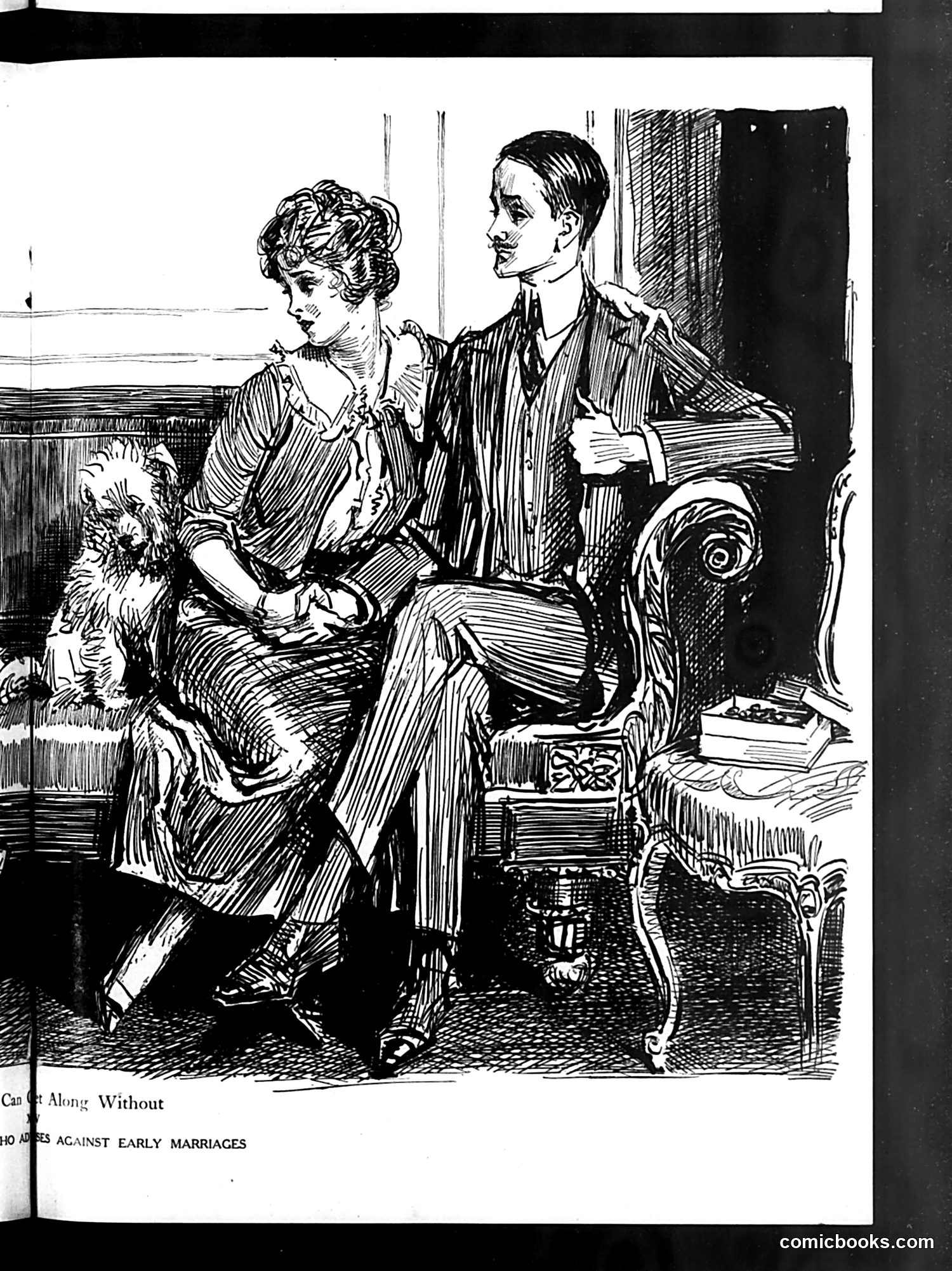
This page contains a satirical illustration addressing opposition to early marriages. The cartoon depicts an elegantly dressed couple—a woman seated with a small dog and a man standing beside her in an interior setting with period furniture. The caption "Can Get Along Without" paired with "Arguments Against Early Marriages" suggests the cartoon is satirizing social arguments opposing youthful matrimony. The fashionable attire and comfortable domestic setting may ironically suggest that young couples of means can indeed manage married life successfully, contradicting conventional wisdom of the era that discouraged early unions. The specific social context—whether this references a particular debate, legislation, or cultural moment—cannot be determined from the visible text alone.
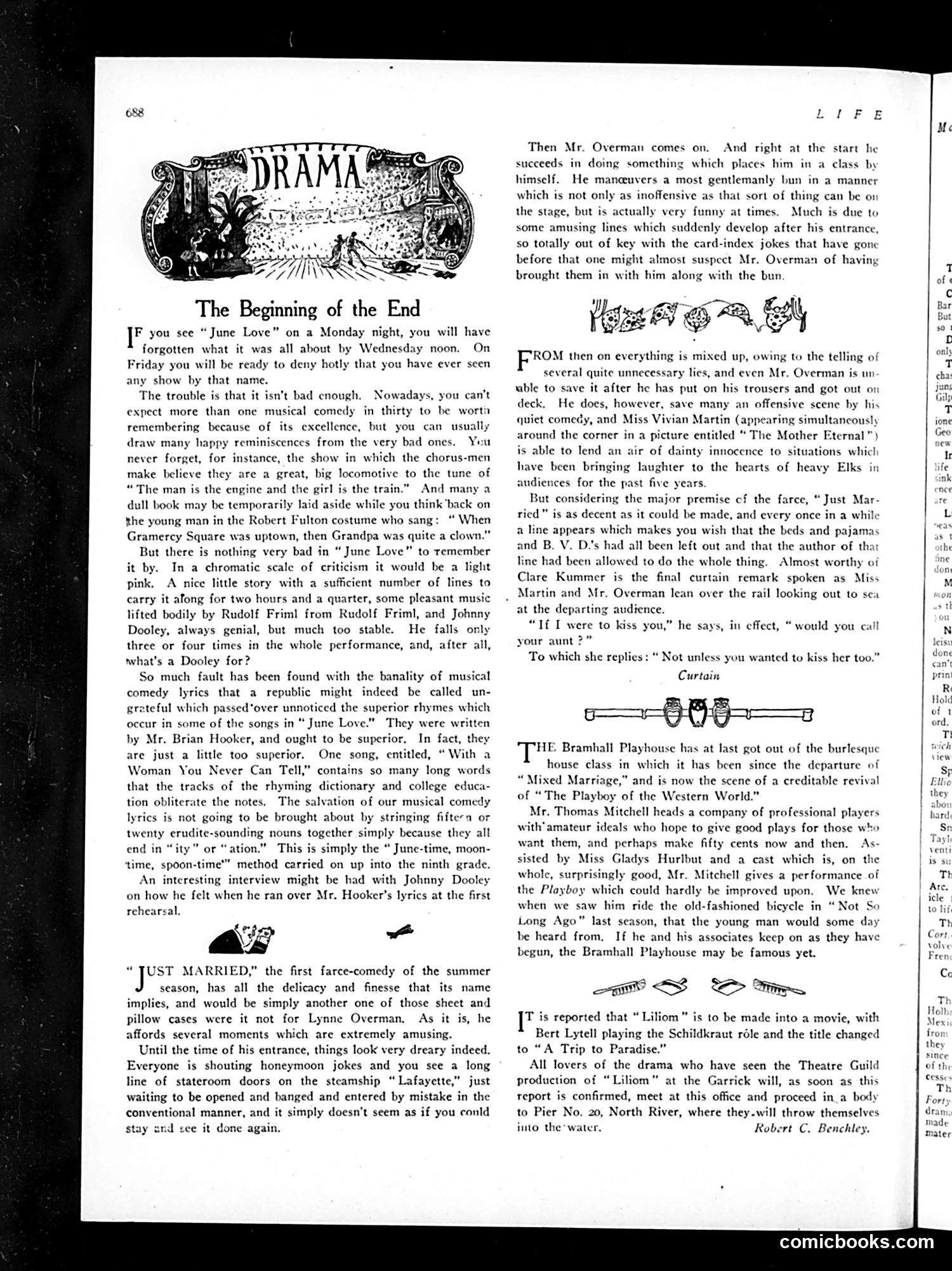
This is a theater review page from Life magazine critiquing contemporary Broadway productions. The main pieces discuss: **"June Love"** — A musical comedy the critic finds mediocre. The review satirizes forgettable musicals by contrasting them with memorably *bad* shows (like one featuring a chorus line as a locomotive). It praises lyricist Brian Hooker's wordplay as superior but suggests his erudition ("stringing fiftesa or twenty erudite-sounding nouns") undermines the musical's charm—a critique of pretentiousness in comedy. **"Just Married"** — A farce-comedy set aboard the steamship "Lafayette" with honeymoon-suite door-slamming gags. The critic credits actor Lynne Overman with salvaging an otherwise dreary show through physical comedy (manipulating "a most gentlemanly bun" in funny ways), though even he cannot save the plot once complications arise. The tone is sophisticated mockery of Broadway's formulaic entertainment while acknowledging performers' talent to briefly elevate mediocre material.
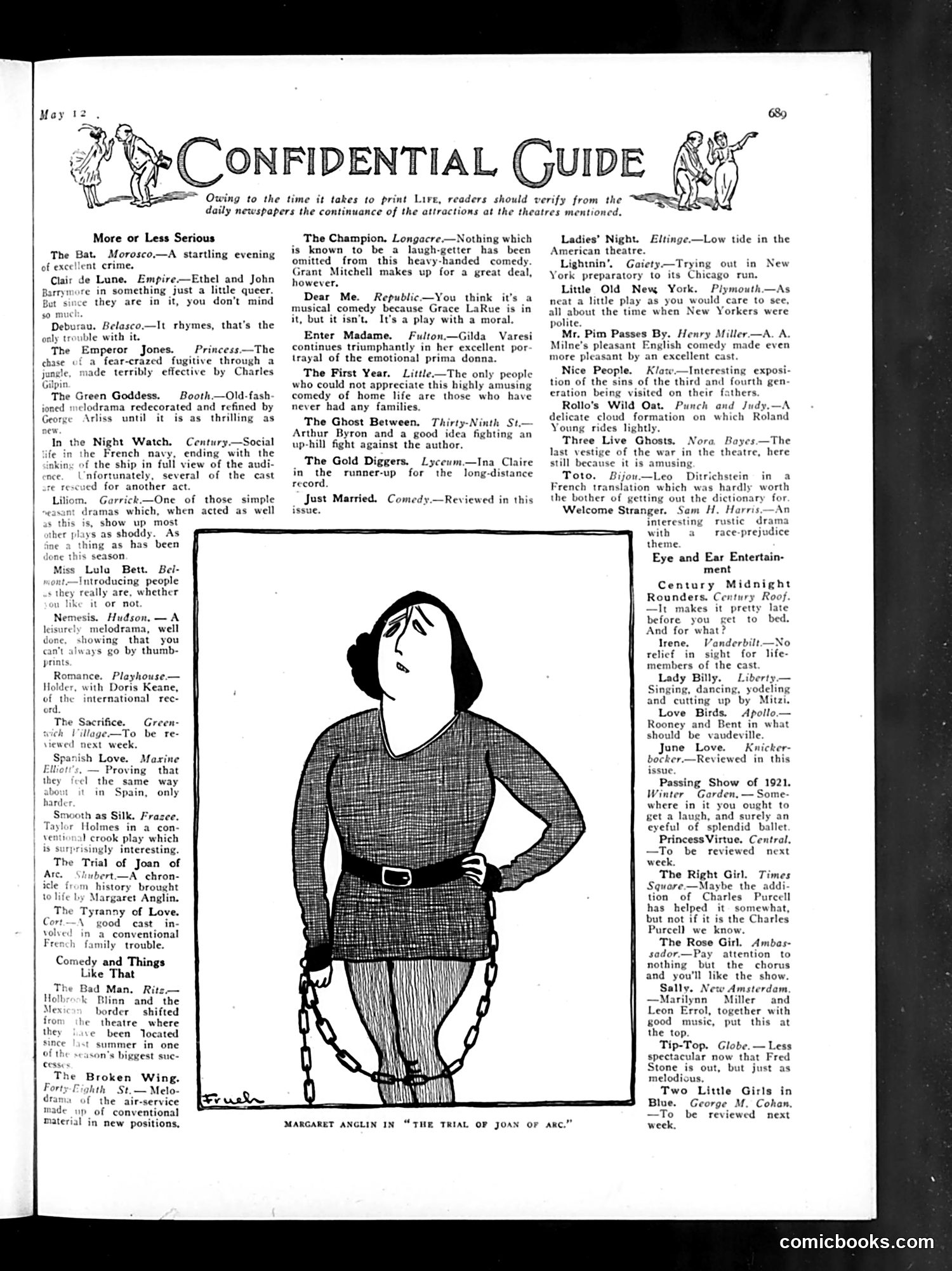
This page is a theater review column, not a political cartoon. It features Margaret Anglin in "The Trial of Joan of Arc" — a historical drama about the medieval French saint's persecution, performed by a prominent American actress of the era. The bulk of the page consists of brief, witty reviews of Broadway productions then running. These are satirical critiques using dry humor to assess current shows: praising strong performances (Grant Mitchell, Ina Claire, Gilda Varesi) while mocking weak plays as melodramatic, conventional, or morally preachy. References to "the war" in "Three Live Ghosts" suggest these reviews are contemporary to the post-WWI period. The "Confidential Guide" title promises insider theater gossip and candid assessment rather than promotional puffery — typical of *Life* magazine's satirical approach to entertainment coverage.
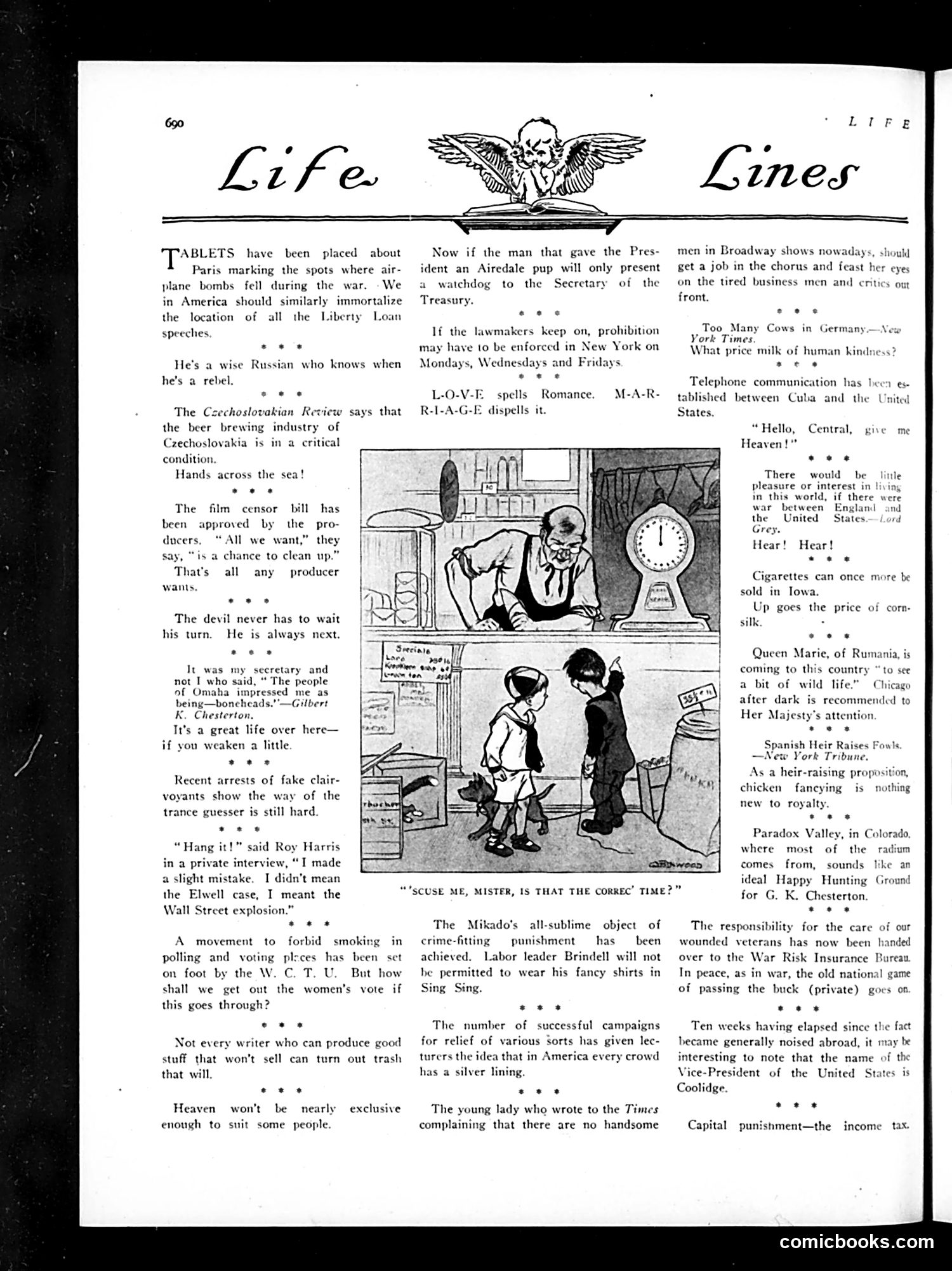
This page from *Life* magazine (likely early 1920s) contains brief satirical commentary on contemporary American politics and social issues, plus one cartoon. **The cartoon** depicts a man at a desk checking the time on a scale while a woman asks "Is that the correct time?" — a visual pun playing on the dual meaning of "scale" (weighing device vs. time measurement). **The text snippets mock:** - Post-WWI conditions (war memorials, Liberty Loan speeches) - Prohibition enforcement difficulties in New York - The newly appointed Vice-President Coolidge, whom readers apparently didn't know - The income tax as "capital punishment" - Censorship of film producers - The Elwell case (a famous unsolved 1920 murder) and Roy Harris's confusion about it - Fake spiritualists and séance fraud The humor relies on readers' familiarity with current events: war recovery, Prohibition debates, celebrity scandals, and political figures. The tone is sophisticated, urbane mockery typical of *Life*'s educated readership.
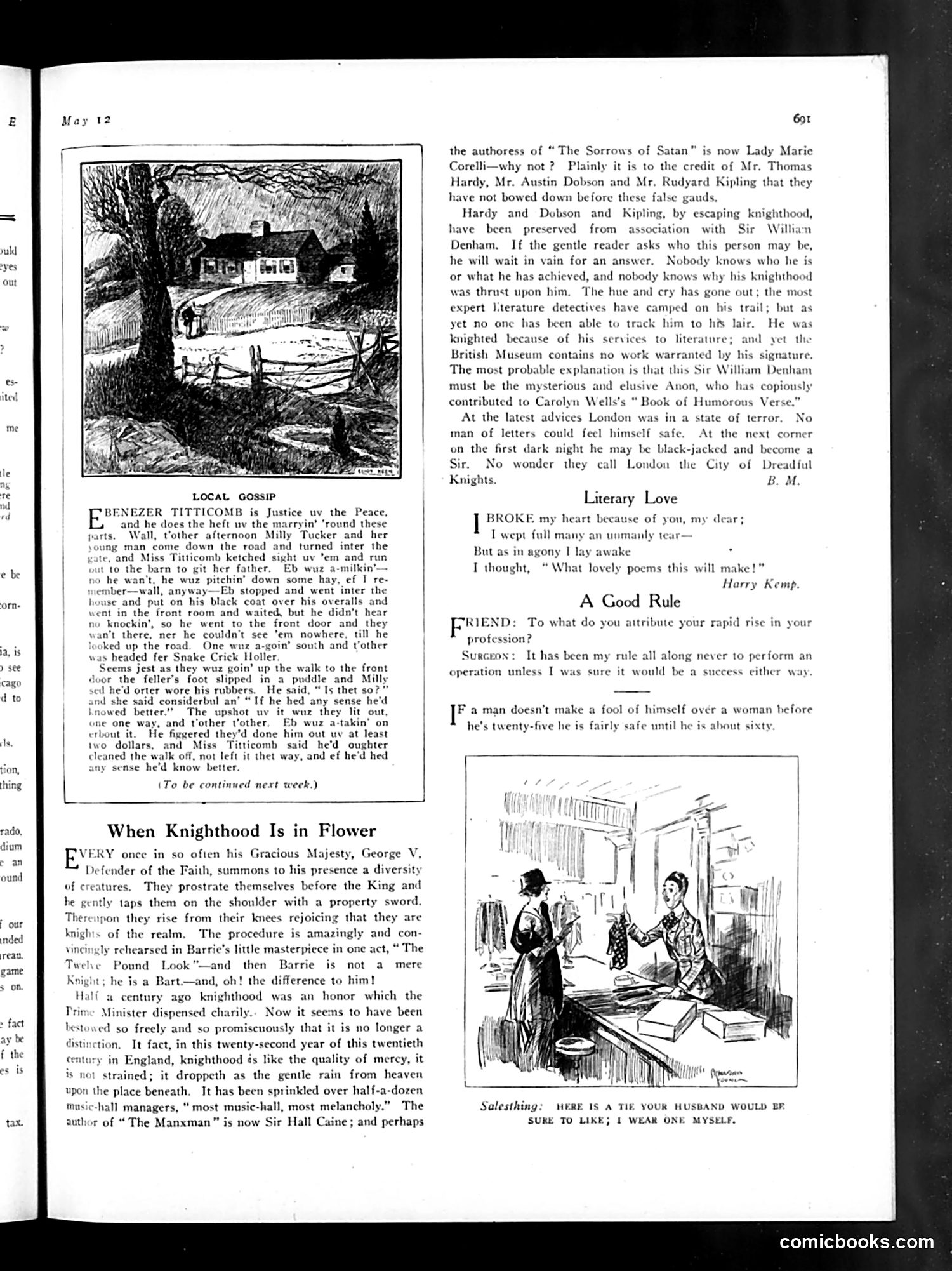
This page contains two satirical pieces from Life magazine: **"Local Gossip"** is a humorous rural anecdote about Eb Titticomb, a justice of the peace. A young couple arrives to be married, but the woman criticizes the man's footwear choices. Offended, he leaves—and she follows him. Eb misses the wedding entirely and blames her for not cleaning the walkway, missing the irony that *his* poor maintenance caused the initial slip. **"When Knighthood Is in Flower"** satirizes Britain's devaluation of knighthoods. The author argues that King George V now grants knighthoods so indiscriminately to music-hall managers and minor writers that the honor has become meaningless—"droppeth as the gentle rain from heaven." The piece mocks a mysterious "Sir William Denham," whose qualifications nobody can identify, suggesting he may actually be the anonymous author "Anon." The satire praises Hardy, Dobson, and Kipling for *refusing* knighthoods, preserving their dignity by rejecting these now-hollow honors.
This page reviews German and European silent films gaining popularity in America, sparking protectionist outcry from unemployed American actors. **The Satire's Target:** The article criticizes American film industry workers demanding tariffs against "cheap foreign labor" — actually cheap *films* from Europe. Life's editors argue the real problem is domestic overproduction and financial depression, not imports. They mock the protectionist impulse by suggesting we should equally ban novels by H.G. Wells or plays by Galsworthy if we're protecting against foreign culture. **The Films Discussed:** "Deception" (likely *Deceptive Carmen*, 1921) and "Passion" are German productions by director Lubitsch, praised for superior artistry and acting (Henny Porten, Emil Jannings). The article notes they're technically excellent but occasionally let spectacle overwhelm drama. **The Point:** European films are demonstrably better art, which is precisely what threatens American producers. Tariffs won't save inferior work — only better craftsmanship will.
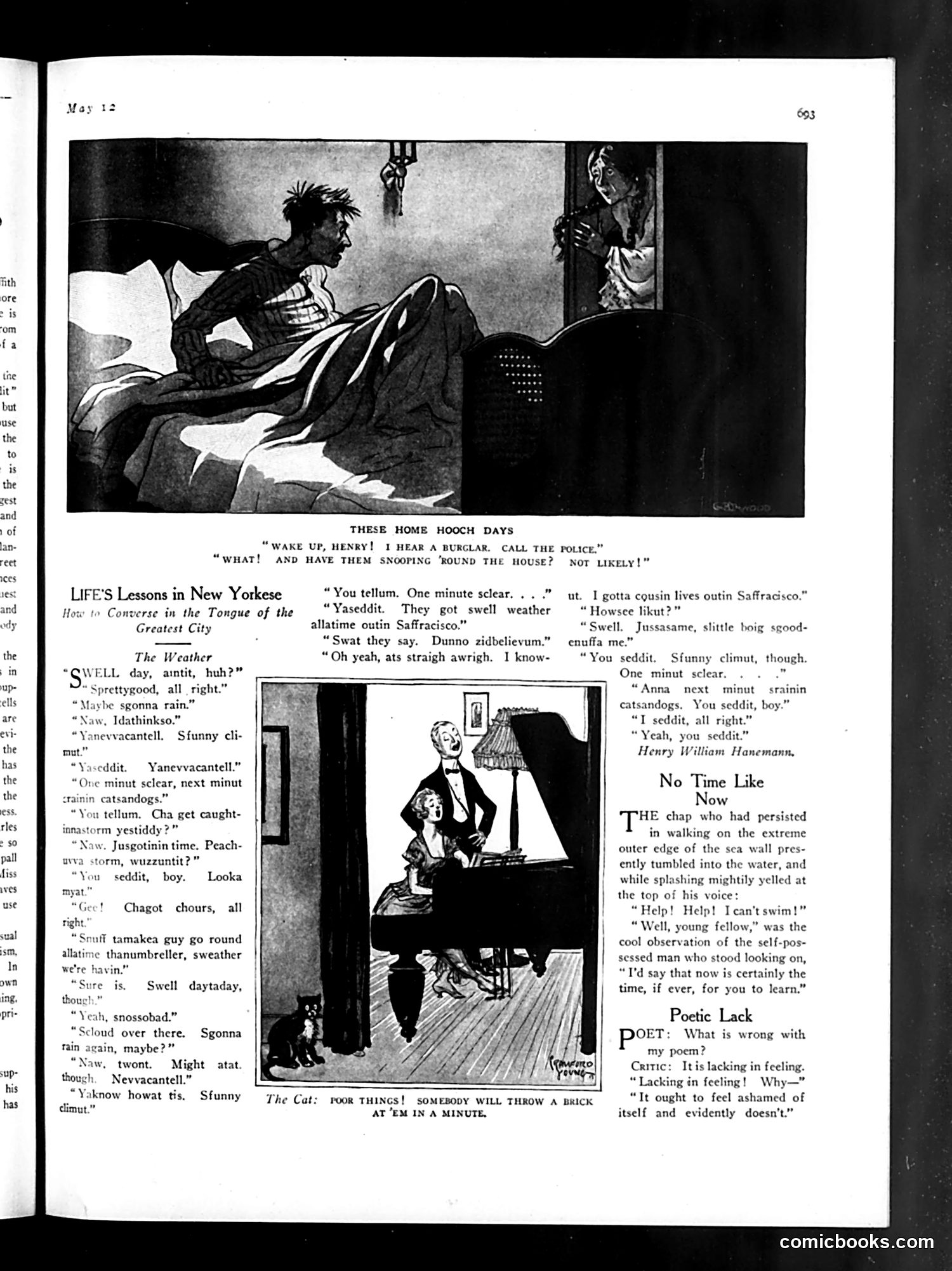
This page satirizes early-1920s New York City vernacular and immigrant speech patterns. The main feature, "Life's Lessons in Yorkese," mocks how working-class New Yorkers—likely recent immigrants—speak English, exaggerating their accent and grammar through phonetic spelling ("Yaseddit," "Sfunny," "Jussasame"). The humor derives from depicting rapid-fire, colloquial conversation about mundane topics like weather. The top illustration references Prohibition-era concerns ("hooch days"), showing a burglar interruption—a commentary on home security fears during lawlessness. The page also includes three short humor pieces: "No Time Like Now" (a dark joke about learning to swim while drowning), and "Poetic Lack" (art criticism). These reflect typical early-20th-century American magazine humor—broad, often cruel mockery of ethnic speech patterns and working-class life that would be considered offensive today.
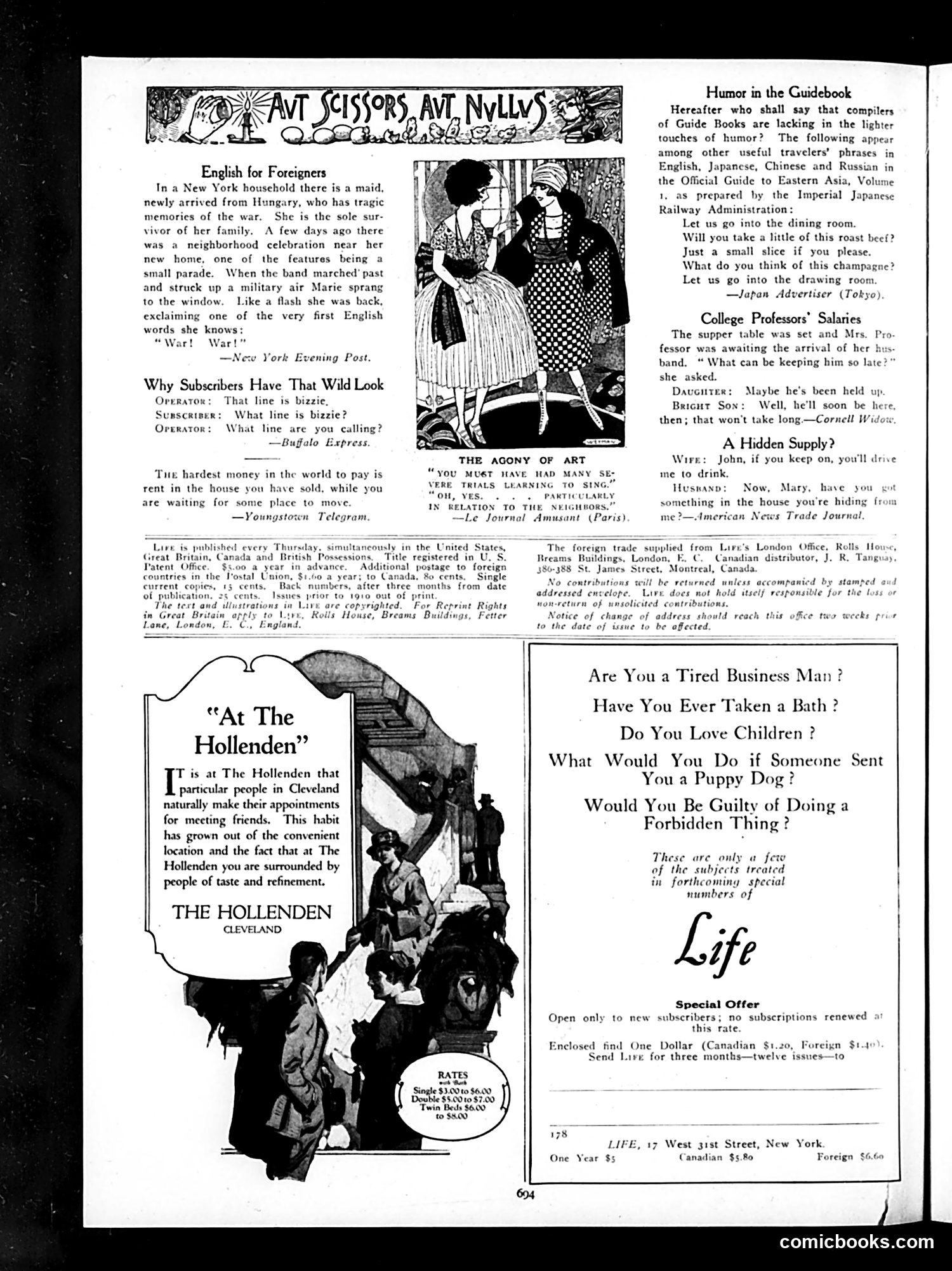
This page from *Life* magazine contains several brief humorous sketches satirizing everyday American life and miscellaneous social observations: **"English for Foreigners"** mocks immigrant unfamiliarity with English through a Hungarian maid who, hearing a military march at a neighborhood parade, exclaims her first learned English word: "War! War!"—a darkly ironic choice given her tragic wartime losses. **"Why Subscribers Have That Wild Look"** jokes about telephone operator confusion and the frustration of trying to reach a busy line. **"The Agony of Art"** and other brief items poke fun at everyday annoyances: high rent prices, college professors' low salaries, marital quarrels about hidden alcohol (likely referencing Prohibition-era tensions), and artistic pretension. The page also includes advertisements for *Life* magazine subscriptions and Cleveland's Hollenden hotel, plus a guidebook humor piece about awkwardly formal English phrases provided to Japanese railway travelers. The overall tone reflects *Life*'s satirical approach to middle-class American anxieties and cultural tensions of the era.
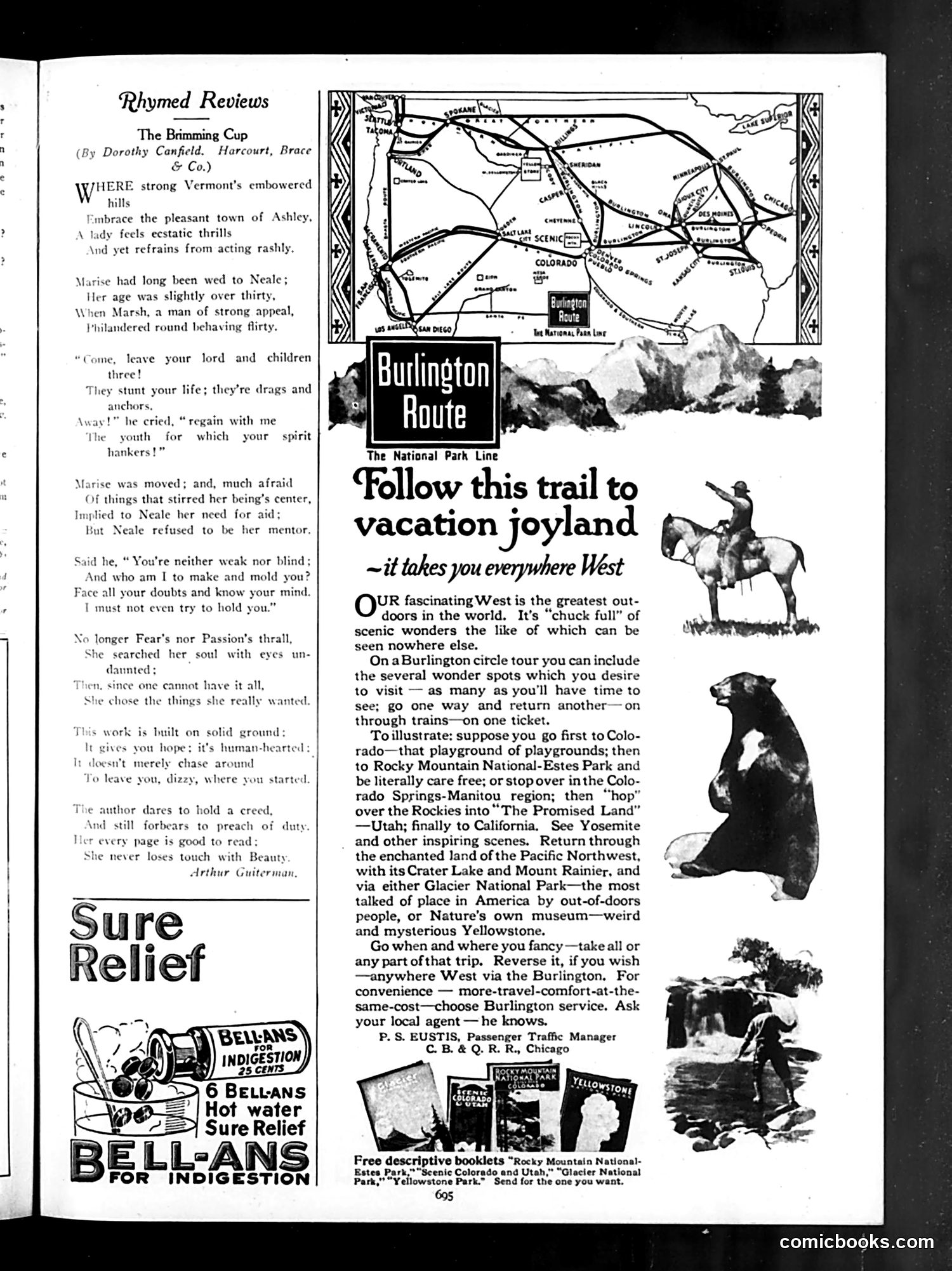
This page combines a literary review with travel advertising, typical of early 20th-century magazine layouts. **"The Brimming Cup" Review** (left side): A rhymed critique of Dorothy Canfield's novel about a married Vermont woman tempted by another man. The review, credited to Arthur Guiterman, praises the author's moral grounding—she doesn't sensationalize the adultery scenario but instead shows the protagonist rationally choosing her actual values over passion. The satire's gentle point: this is serious, thoughtful literature that respects both reader and subject matter. **Burlington Route Advertisement** (right side): A straightforward travel promotion encouraging Western tourism via the Burlington railroad. The imagery—cowboys, bears, geysers—represents actual scenic attractions (Yellowstone, Rocky Mountains, California). This isn't satirical; it's a genuine commercial pitch emphasizing flexibility and affordability of circular train routes. **"Sure Relief" (bottom left)**: An unrelated patent medicine ad for Bellans antacid. The page reflects Life's editorial strategy: juxtaposing literary sophistication with commercial content aimed at educated, affluent readers.
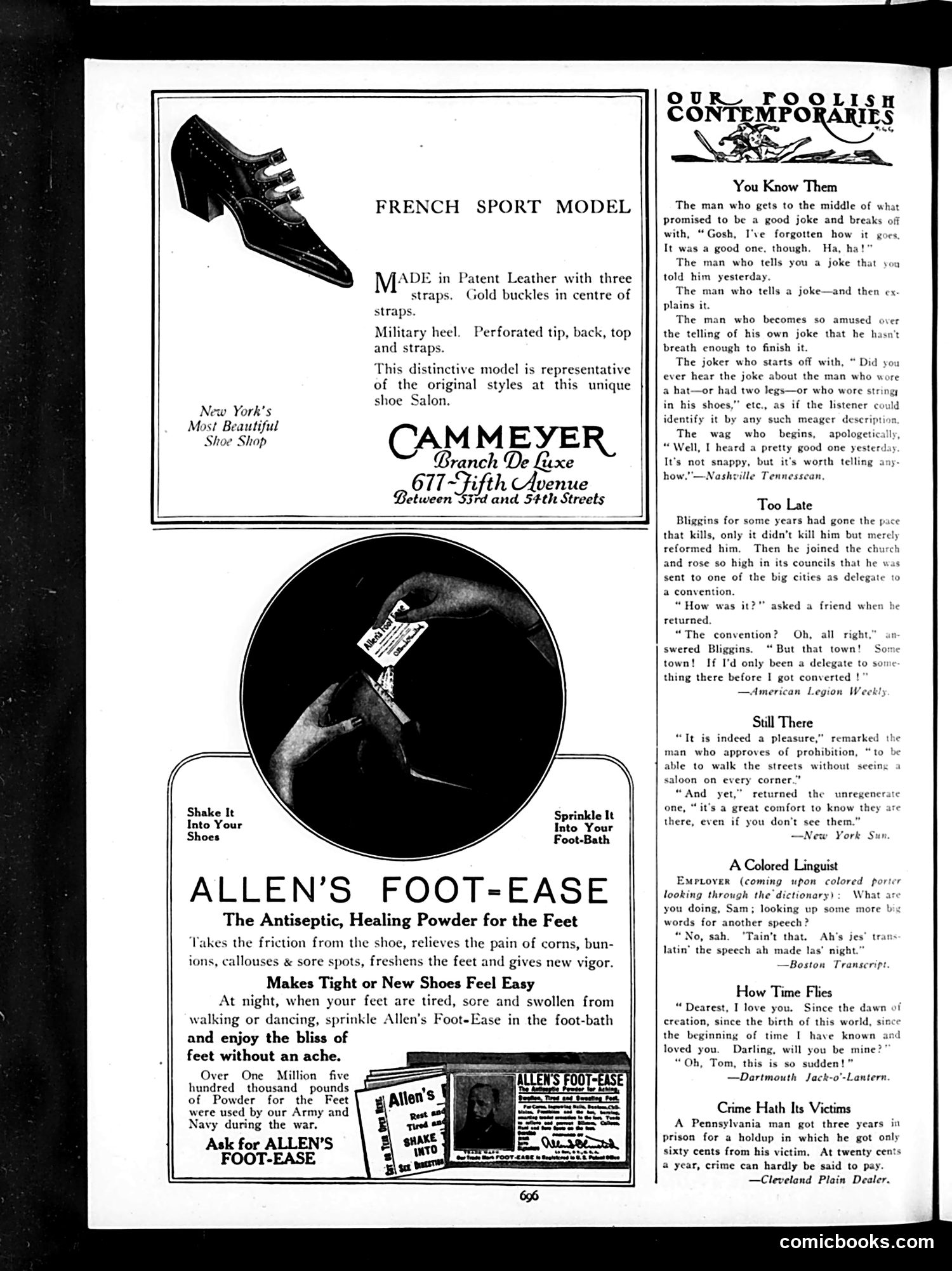
This page is primarily **advertising** with a sidebar of humorous short pieces. The main advertisements feature **Cammeyer shoes** (a French sport model) and **Allen's Foot-Ease powder**, a foot remedy marketed with a WWI reference (noting over 1.5 million pounds were used by the Army and Navy during the war). The right column, titled "Our Foolish Contemporaries," contains brief satirical pieces mocking common social annoyances: - People who forget or mangle jokes in the telling - A reformed "wastrel" (Bliggins) who joins the church and becomes respectable, only to regret missing his wild youth before converting - Humor about Prohibition's ineffectiveness - A racial stereotype about a Black porter looking up dictionary words The satire targets everyday social types and behaviors—poor storytellers, hypocrites, and the gap between stated morality and actual desire. The tone is mild, drawing-room humor typical of 1920s Life magazine.
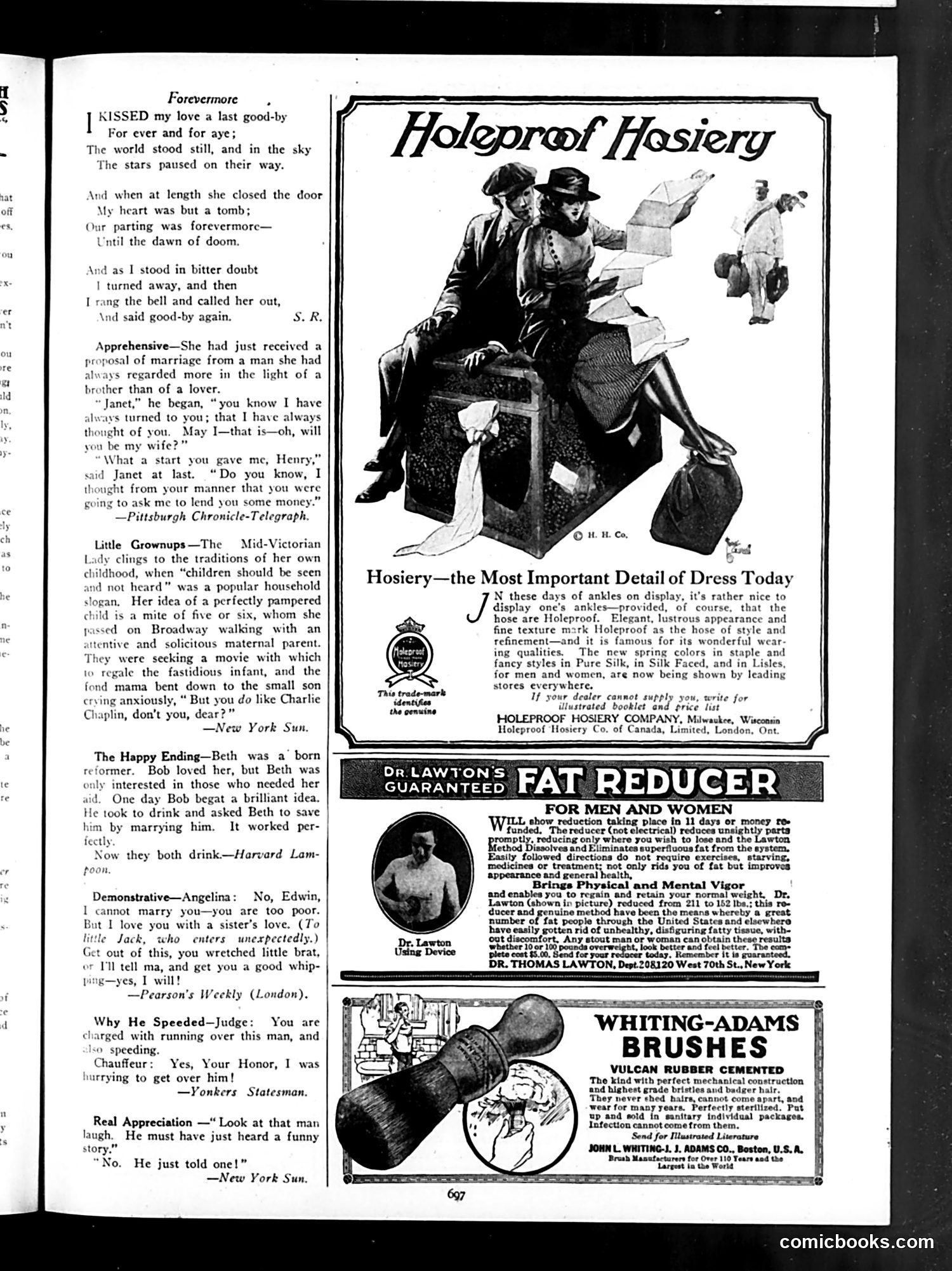
This page contains primarily **humorous short anecdotes** (jokes) rather than political cartoons. The jokes satirize common human behaviors and social situations of the era: - A lover's overly dramatic farewell that he immediately undoes by ringing the doorbell - A woman who mistakes a marriage proposal for a money-lending request - "Mid-Victorian" mothers clinging to outdated child-rearing strictness while seeking entertainment - A woman who claims sisterly love while being viciously cruel to a child - A chauffeur's dark humor about hitting a pedestrian The page is **primarily advertising**: prominent ads for Holeproof Hosiery (emphasizing women's visible ankles as a fashion detail), Dr. Lawton's Fat Reducer (a dubious weight-loss device), and Writing-Adams Brushes. The humor reflects early 20th-century concerns: courtship anxieties, class consciousness, parenting debates, and the era's fascination with new consumer products and dubious medical devices. No specific political figures or events are referenced.
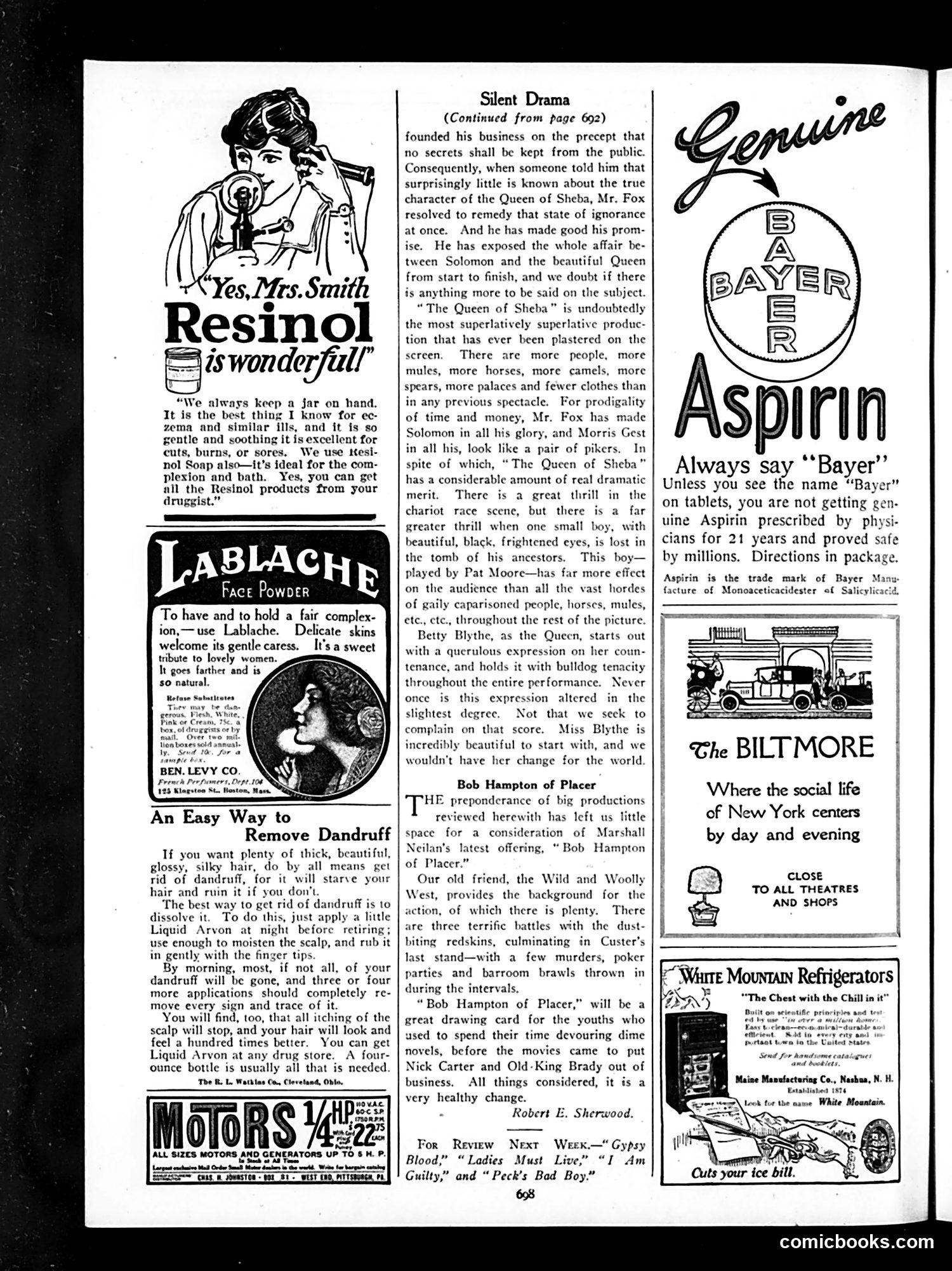
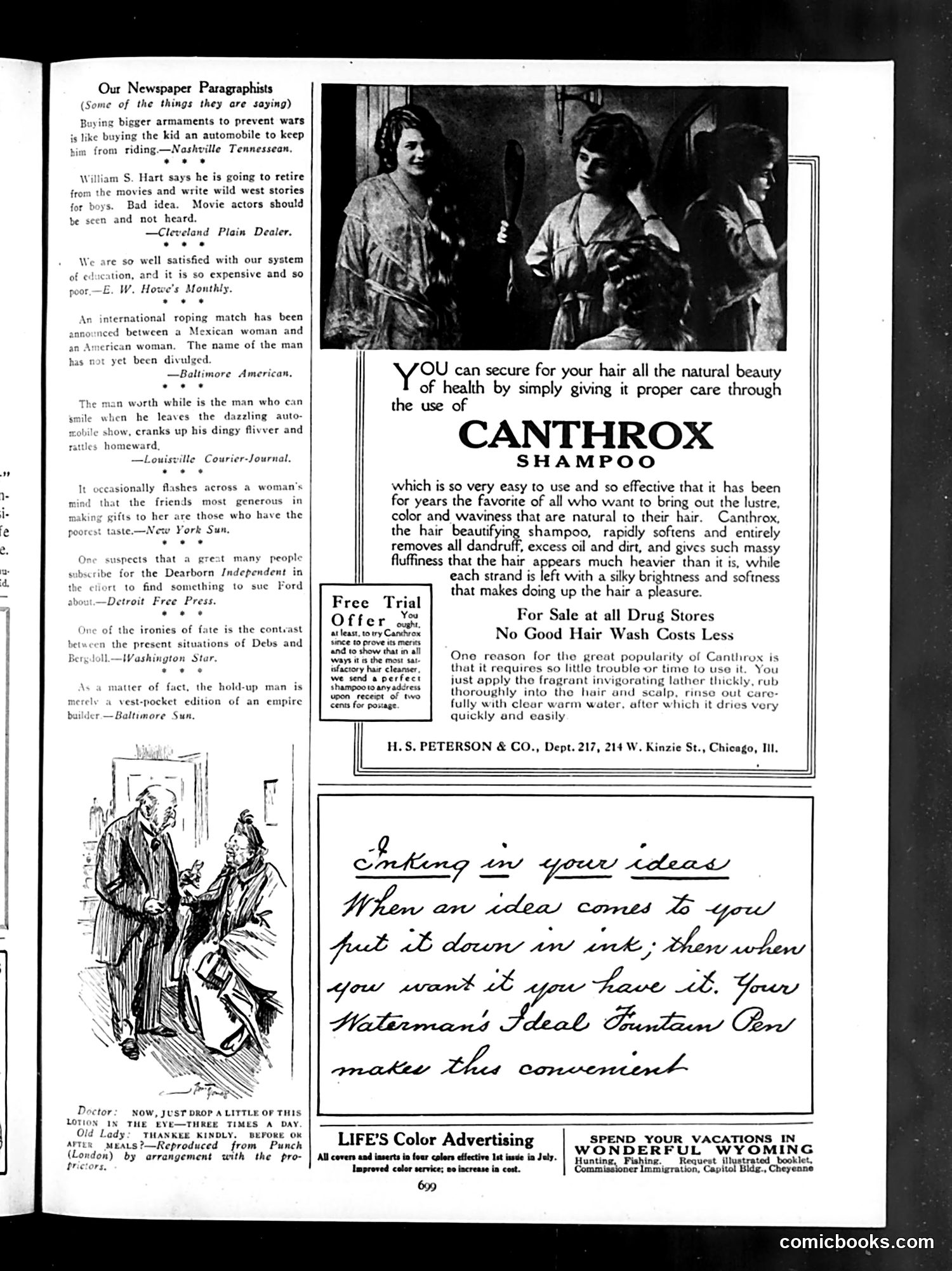
This page is primarily **advertising and filler content**, not political satire. The main elements are: **"Newspaper Paragraphists" section (left):** A collection of brief, sardonic quotes from various newspapers offering social commentary. Notable examples: - Nashville's joke about buying kids cars to prevent them from riding (bikes/horses) - Cleveland's criticism of William S. Hart retiring from silent films to write westerns - A quip about a Mexican-American women's roping match whose male promoter remains unnamed **The cartoon (bottom left):** Shows a doctor advising a woman to apply eye lotion three times daily—simple visual humor with no deeper political meaning. **Main content:** The page is dominated by advertisements for Canthrox shampoo and Wyoming tourism, reflecting early 20th-century marketing. The historical context worth noting: references to William S. Hart (silent film star) and the mention of Debs and Bergdoll (likely Eugene Debs, the socialist, and Grover Bergdoll, a WWI draft dodger) ground this in the 1920s era.
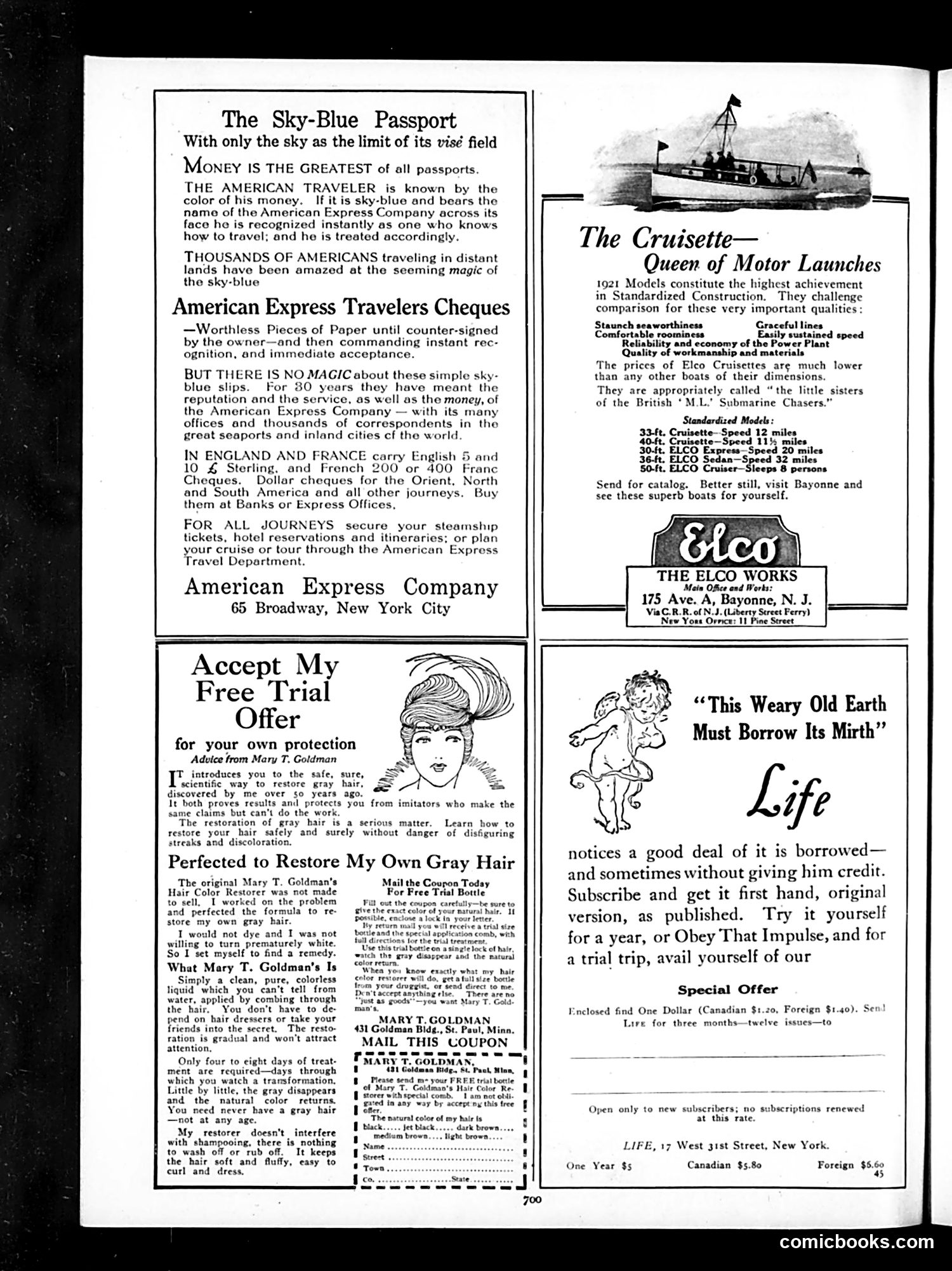
This page consists entirely of **advertisements**, not political cartoons or satirical content. The ads reflect early 1920s consumer culture: **"Sky-Blue Passport"** promotes American Express Traveler's Cheques, positioning wealthy American travelers as a recognizable global class. The ad associates financial credentials with social status and international respect. **"The Cruisette"** advertises motor launches, targeting affluent leisure consumers interested in recreational boating. **"Restore My Own Gray Hair"** features Mary T. Goldman's hair restoration product, with an illustrated woman's face. This targets aging consumers, particularly women, with promises of safe hair coloring without professional salon visits. **"Life" magazine itself** advertises subscriptions with the tagline "This Weary Old Earth Must Borrow Its Mirth," promoting the publication as original satirical content worth reading. These ads collectively target upper-middle-class Americans with disposable income for travel, leisure, and personal grooming—typical Life magazine demographics of the era.
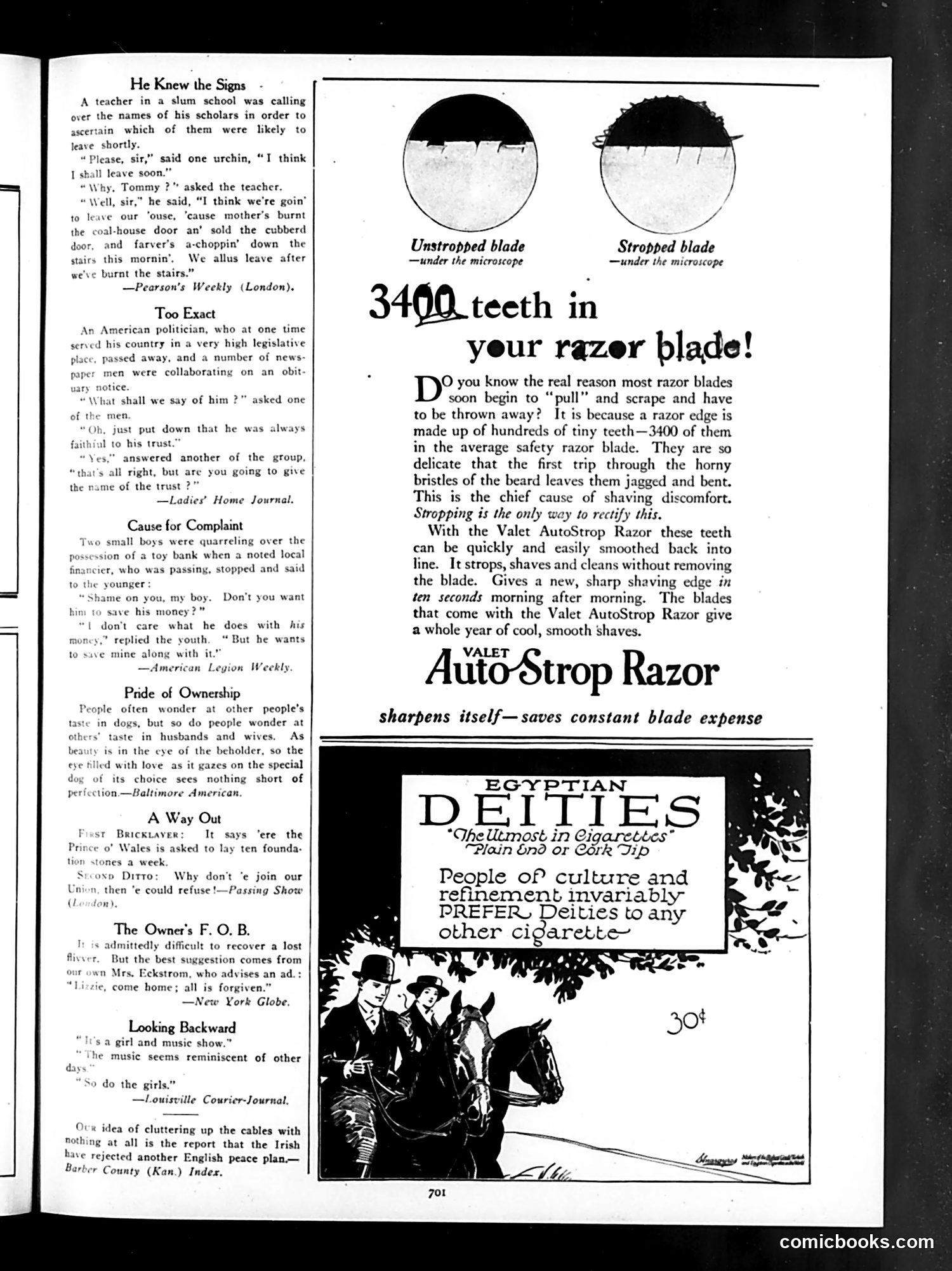
This page contains **multiple brief humorous anecdotes** (typical of Life's satirical format) plus advertisements. ## The Humor Pieces: Short jokes satirize working-class poverty ("He Knew the Signs"—a slum child whose family burns furniture for fuel), political hypocrisy ("Too Exact"—a deceased politician's loyalty to "the trust" rather than the public), and class relations ("Cause for Complaint"—a poor boy resents a banker's lecture about saving money). Other items mock British labor unions, lost-and-found advice, and Irish-English peace negotiations. ## The Advertisements: The **Valet AutoStrop Razor** dominates the page, using microscope imagery to explain why blades dull (3,400 tiny teeth get bent by whiskers). The strop mechanism "sharpens itself," saving blade expenses. Below sits an **Egyptian Deities cigarette ad** marketing to "people of culture and refinement" at 30¢, claiming superiority over other brands. The page reflects early 20th-century consumer culture alongside satirical class commentary.
This is primarily a **Butterick sewing pattern advertisement**, not satire or political commentary. It targets women during what appears to be the early-to-mid 20th century, addressing a genuine social context: women's limited access to fashionable clothing due to cost. The ad's appeal relies on several assumptions about its female audience: 1. **Economic anxiety**: Women want stylish spring fabrics but can't afford ready-made dresses (savings of $0.50-$10 mentioned—significant money then) 2. **A new skill becomes accessible**: The "Deltor" (combining "Delineator" magazine + "Butterick" patterns) supposedly makes home sewing practical for non-seamstresses through step-by-step instructions 3. **Gendered expectations**: The rhetorical question "If you have—you aren't a woman!" assumes women's identity centers on perpetual desire for new clothes The advertisement exploits both aspiration and practicality: you can look fashionable *and* save money by sewing at home—a form of unpaid labor presented as empowerment rather than necessity.
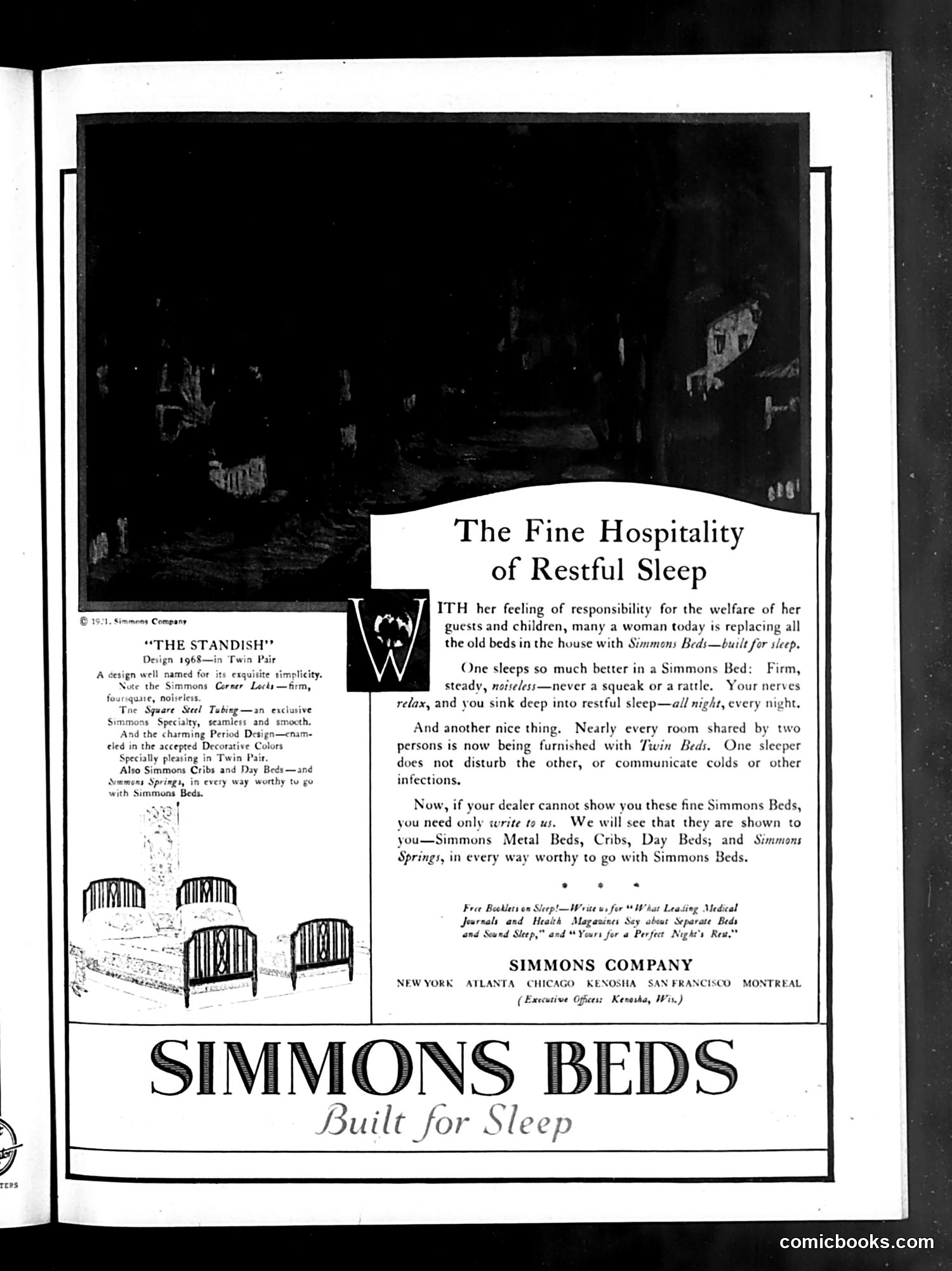
This is **primarily an advertisement**, not satire or political commentary. The page promotes Simmons Beds furniture, marketed to women as responsible homemakers. The ad's cultural angle targets early-20th-century anxieties: it sells separate "Twin Beds" by framing them as hygienic and considerate—one sleeper won't disturb the other or "communicate colds or other infections." This reflects period concerns about disease transmission and suggests marital sleeping arrangements were shifting. The left side showcases "The Standish" bed design, emphasizing its steel construction and "Square Steel Tubing" as markers of quality engineering. The accompanying bedroom photo aims to position Simmons as aspirational furniture for middle-class women managing households. The tagline "Built for Sleep" is straightforward product messaging rather than satire. The ad appeals to women's sense of hospitality and responsibility for family welfare—a gendered marketing approach typical of the era.
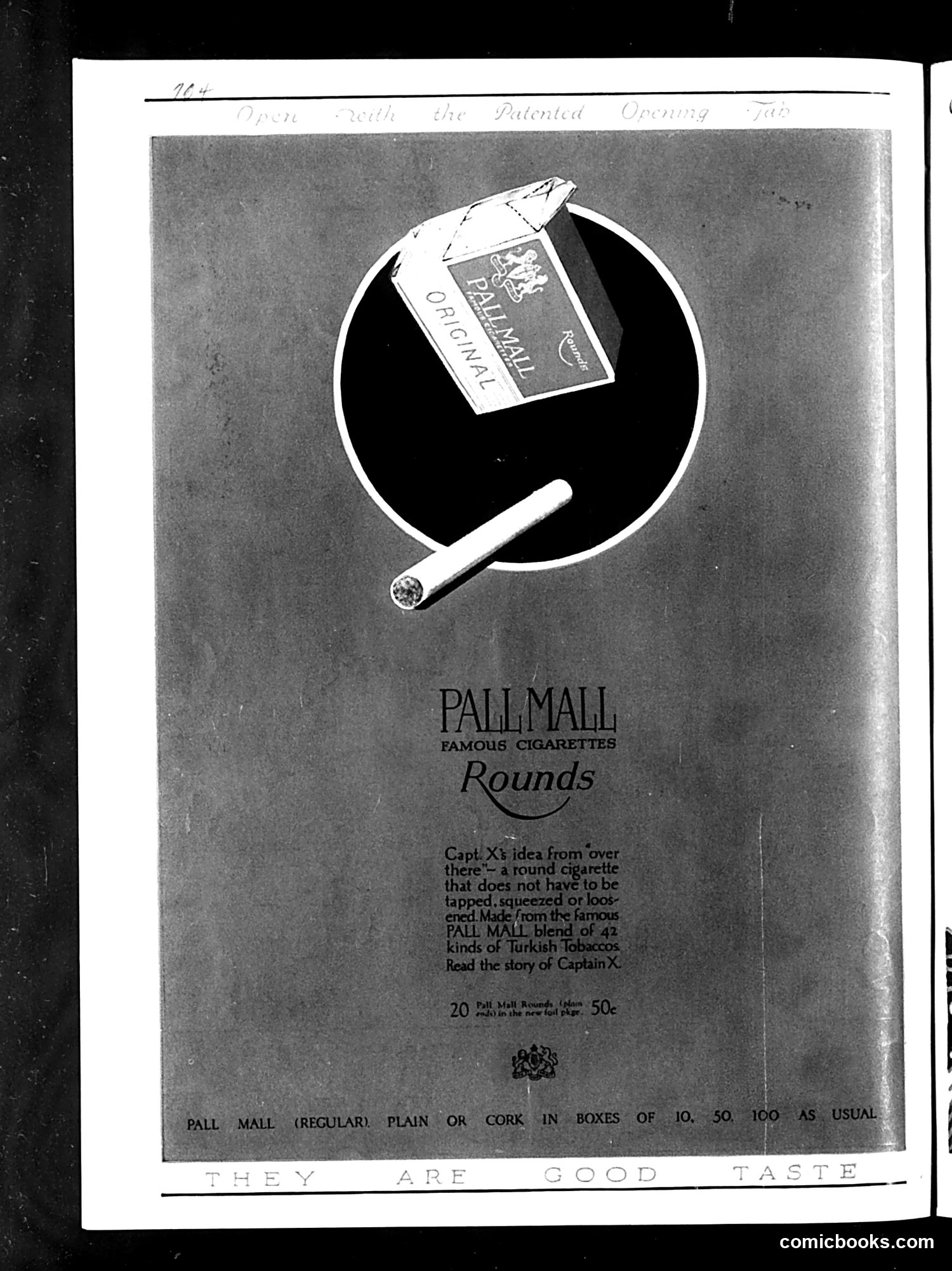
This is a **cigarette advertisement**, not political satire or a cartoon. It advertises Pall Mall "Rounds" — a circular cigarette product marketed as novel because it "does not have to be tapped, squeezed or loosened." The ad features a "Captain X" character promoting the product's convenience. The copy emphasizes the cigarettes' blend of "42 kinds of Turkish Tobaccos" and notes they're sold in boxes of 10, 50, or 100 at 50 cents per pack of 20. The visual shows a round cigarette next to an ashtray with the brand's original packaging. The tagline reads "They Are Good Taste." This reflects early 20th-century cigarette marketing, when such products were openly advertised without health warnings.