
Life, 1921-05-12 · page 17 of 36
Life — May 12, 1921 — page 17: what you’re looking at
What you’re looking at
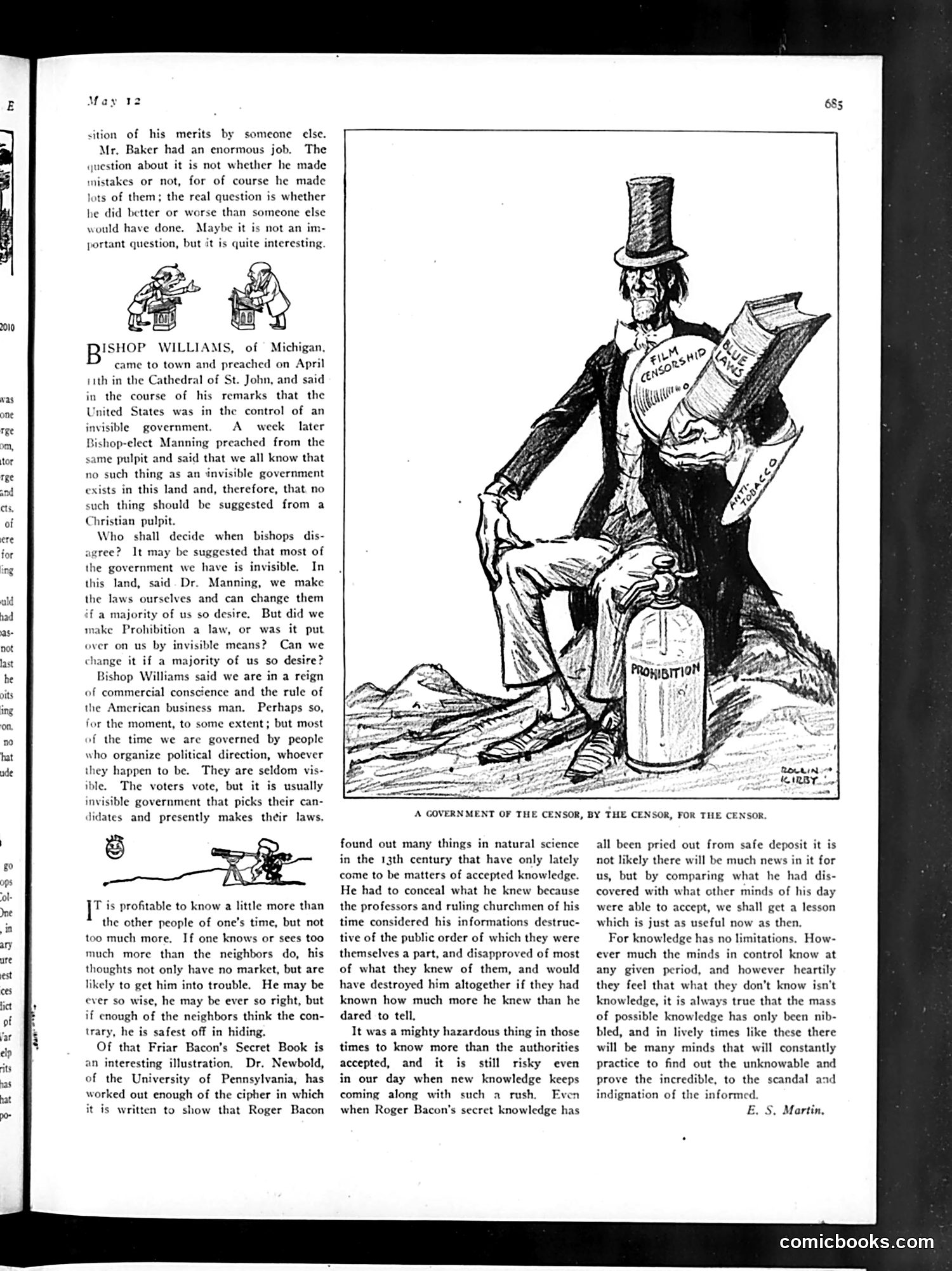
This cartoon satirizes **censorship and suppression of knowledge**, referencing a contemporary debate between Bishop Williams and Bishop-elect Manning about whether America has an "invisible government." The skeleton figure represents **censorship or tyrannical authority**, depicted as a grotesque top-hatted censor sitting atop dead bodies and gravestones labeled "Prohibition," holding papers marked with restrictions. The imagery evokes historical oppression. The article compares this to **Roger Bacon's 13th-century persecution**—the medieval scientist was forced to hide discoveries because authorities deemed them dangerous to "public order." The satire argues that modern America mirrors this medieval censorship: Prohibition was imposed "invisibly" by organized interests against popular will, and those in power suppress inconvenient truths. The cartoon's title—"government of the censor, by the censor, for the censor"—mocks Lincoln's "of the people, by the people, for the people" phrase, suggesting American democracy has been corrupted into authoritarian control.
📄 Transcribed text from this page (OCR, searchable)
Machine-transcribed from the original scan — historical spelling and the odd misread are preserved.
May 12 sition of his merits by someone else. Mr. Baker had an enormous job. The question about it is not whether he made mistakes or not, for of course he made lots of them; the real question is whether he did better or worse than someone else would have done. M portant question, but it is quite interesting. ybe it is not an im- ISHOP WILLIAMS, of Michigan, came to town and preached on April ith in the Cathedral of St. John, and said in the course of his remarks that the United States was in the control of an invisible government. A week later Bishop-elect Manning preached from the same pulpit and said that we all know that no such thing as an invisible government exists in this land and, therefore, that no such thing should be suggested from a Christian pulpit. Who shall decide when bishops dis- agree? It may be suggested that most of the government we have is invisible. In this land, said Dr. Manning, we make the laws ourselves and can change them f a majority of us so desire. But did we make Prohibition a law, or was it put over on us by invisible means? Can we change it if a majority of us so desire? Bishop Williams said we are in a reign of commercial conscience and the rule of the American business man. Perhaps so, for the moment, to some extent; but most of the time we are governed by people who organize political direction, whoever they happen to be. They are seldom vis- ible. The voters vote, but it is usually invisible government that picks their can- didates and presently makes their laws. ) T is profitable to know a little more than the other people of one’s time, but not too much more. If one knows or sees too much more than the neighbors do, his thoughts not only have no market, but are likely to get him into trouble. He may be ever so wise, he may be ever so right, but if enough of the neighbors think the con- trary, he is safest off in hiding. Of that Friar Bacon's Secret Book is an interesting illustration. Dr. Newbold, of the University of Pennsylvania, has worked out enough of the cipher in which it is written to show that Roger Bacon [ A GOVERN MENT OF THE CENSOR, BY THE CENSOR, FOR THE CENSOR. found out many things in natural science in the 13th century that have only lately come to be matters of accepted knowledge. He had to conceal what he knew because the professors and ruling churchmen of his time considered his informations destruc- tive of the public order of which they were themselves a part, and disapproved of most of what they knew of them, and would have destroyed him altogether if they had known how much more he knew than he dared to tell. It was a mighty hazardous thing in those times to know more than the authorities accepted, and it is still risky even in our day when new knowledge keeps coming along with such a rush. Even when Roger Bacon's secret knowledge has all been pried out from safe deposit it is not likely there will be much news in it for us, but by comparing what he had dis- covered with what other minds of his day were able to accept, we shall get a lesson which is just as useful now as then, For knowledge has no limitations. How- ever much the minds in control know at any given period, and however heartily they feel that what they don’t know isn't knowledge, it is always true that the mass of possible knowledge has only been nib- bled, and in lively times like these there will be many minds that will constantly practice to find out the unknowable and prove the incredible, to the scandal and indignation of the informed. E Martin, comicbooks.com