
Life, 1921-05-12 · page 20 of 36
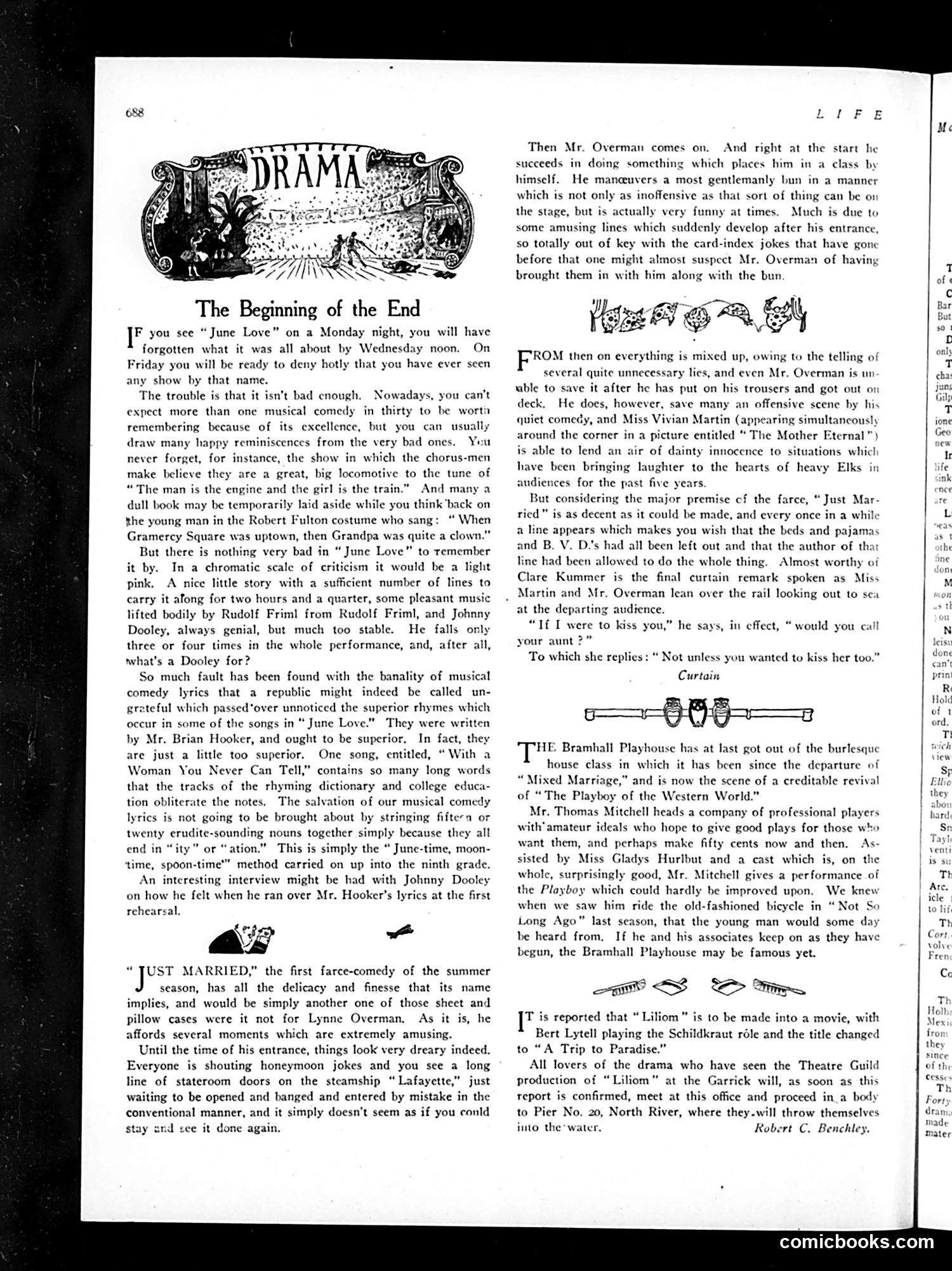
Life — May 12, 1921 — page 20: what you’re looking at
What you’re looking at
This is a theater review page from Life magazine critiquing contemporary Broadway productions. The main pieces discuss: **"June Love"** — A musical comedy the critic finds mediocre. The review satirizes forgettable musicals by contrasting them with memorably *bad* shows (like one featuring a chorus line as a locomotive). It praises lyricist Brian Hooker's wordplay as superior but suggests his erudition ("stringing fiftesa or twenty erudite-sounding nouns") undermines the musical's charm—a critique of pretentiousness in comedy. **"Just Married"** — A farce-comedy set aboard the steamship "Lafayette" with honeymoon-suite door-slamming gags. The critic credits actor Lynne Overman with salvaging an otherwise dreary show through physical comedy (manipulating "a most gentlemanly bun" in funny ways), though even he cannot save the plot once complications arise. The tone is sophisticated mockery of Broadway's formulaic entertainment while acknowledging performers' talent to briefly elevate mediocre material.
📄 Transcribed text from this page (OCR, searchable)
Machine-transcribed from the original scan — historical spelling and the odd misread are preserved.
The Beginning of the End you see “June Love” on a Monday night, you will have forgotten what it was all about by Wednesday noon. On Friday you will be ready to deny hotly that you have ever seen any show by that name. The trouble is that it isn't bad cnough. wadays, you can’t expect more than one musical comedy in thirty to be wortir remembering because of its excellence, but you can usually draw many happy reminiscences from the very bad ones. Yeu never forget, for instance, the show in which the chorus-men make believe they are a great, big locomotive to the tune of “The man is the engine and the girl is the train.” And many a dull book may be temporarily laid aside while you think back on the young man in the Robert Fulton costume who sang: “ When Gramercy Square was uptown, then Grandpa was quite a clown.” But there is nothing very bad in “ June Love” to remember it by. In a chromatic scale of criticism it would be a light pink. A nice little story with a sufficient number of lines to carry it afong for two hours and a quarter, some pleasant music lifted bodily by Rudolf Friml from Rudolf Friml, and Johnny Dooley, always genial, but much too stable. He falls only three or four times in the whole performance, and, after all, what's a Dooley for? So much fault has been found with the banality of musical comedy lyrics that a republic might indeed be called un- grateful which passed"over unnoticed the superior rhymes which occur in some of the songs in “ June Love.” They were written by Mr. Brian Hooker, and ought to be superior. In fact, they are just a little too superior. One song, entitled, “ With a Woman You Never Can Tell,” contains so many long words that the tracks of the rhyming dictionary and college educa- tion obliterate the notes. The salvation of our musical comedy lyrics is not going to be brought about by stringing fiftesa or twenty erudite-sounding nouns together simply because they all end in “ity” or “ation.” This is simply the “ June-time, moon- ‘time, spoon-time’™” method carried on up into the ninth grade. An interesting interview might be had with Johnny Dooley on how he felt when he ran over Mr. Hooker's lyrics at the first as “ “ TUST MARRIED,” the first farce-comedy of the summer season, has all the delicacy and finesse that its name implies, and would be simply another one of those sheet and pillow cases were it not for Lynne Overman, As it is, he affords several moments which are extremely amusing. Until the time of his entrance, things look very dreary indeed. Everyone is shouting honeymoon jokes and you see a long line of stateroom doors on the steamship “ Lafayette,” just waiting to be opened and banged and entered by mistake in the conventional manner, and it simply doesn't seem as if you conld stay and see it done again. or “ rehearsal. LIFe Then Mr. Overman comes on. And right at the start he succeeds in doing something which places him in a class by himself. He manceuvers a most gentlemanly bun in a manner which is not only as inoffensive as that sort of thing can be o the stage, but is actually very funny at times. Much is due to some amusing lines which suddenly develop after his entrance, so totally out of k before that one might almost suspect Mr. Overman of having brought them in with him along with the bun Ke @ ROM then on everything is mixed up, owing to the telling of several quite unnecessary lies, and even Mr. Overman is un able to save it after he has put on his trousers and got out on deck. He does, however, save many an offensive scene by his quiet comedy, and Miss Vivian Martin (appearing simultaneously around the corner in a picture entitled “ The Mother Eternal”) with the card-index jokes that have gone is able to lend an air of dainty innocence to situations whic! have been bringing laughter to the hearts of heavy audiences for the past five years. But considering the major premise cf the farce, “ Just Mar- ried” is as decent as it could be made, and every once in a while a line appears which makes you wish that the beds and pajamas and B. V. D.'s had all been left out and that the author of thar line had been allowed to do the whole thing. Almost worthy of Clare Kummer is the final curtain remark spoken as Miss Martin and Mr. Overman lean over the rail looking out to sea at the departing audience. “If I were to kiss you,” he says, in effect, “would you call your aunt ?” To which she replies: “ Not unless you wanted to kiss her too.” Curtain oa THe Bramhall Playhouse has at last got out of the burlesque house class in which it has been since the departure of “Mixed Marriage,” and is now the scene of a creditable revival of “The Playboy of the Western World.” Mr. Thomas Mitchell heads a company of professional play with’ amateur ideals who hope to give good plays for those who want them, and perhaps make fifty cents now and then. As- sted by Miss Gladys Hurlbut and a cast which is, on the whole, surprisingly good, Mr. Mitchell gives a performance of the Playboy which could hardly be improved upon. We knew when we saw him ride the old-fashioned bicycle in “Not So Long Ago” last season, that the young man would some day be heard from. If he and his associates keep on as they have begun, the Bramhall Playhouse may be famous yet. [ is reported that “Liliom"” is to be made into a movie, with Bert Lytell playing the Schildkraut réle and the title changed to “A Trip to Paradise.” All lovers of the drama who have seen the Theatre Guild production of “Liliom” at the Garrick will, as soon as this report is confirmed, meet at this office and proceed in a body to Pier No. 20, North River, where they.will throw themselves Robert C. Benchley. yers into the‘ water, Mo made mater comicbooks.com