
Life, 1921-05-12 · page 24 of 36
Life — May 12, 1921 — page 24: what you’re looking at
What you’re looking at
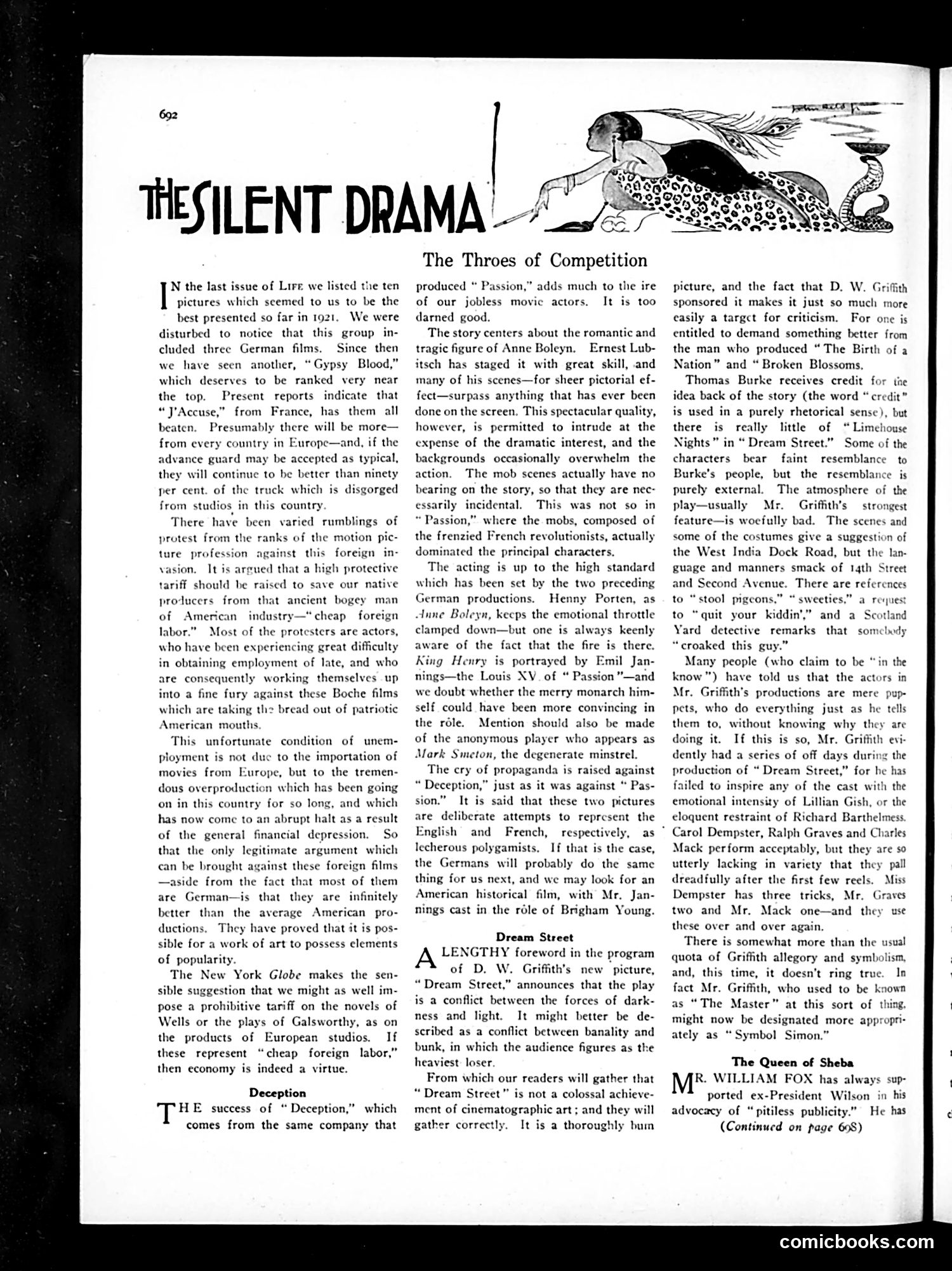
This page reviews German and European silent films gaining popularity in America, sparking protectionist outcry from unemployed American actors. **The Satire's Target:** The article criticizes American film industry workers demanding tariffs against "cheap foreign labor" — actually cheap *films* from Europe. Life's editors argue the real problem is domestic overproduction and financial depression, not imports. They mock the protectionist impulse by suggesting we should equally ban novels by H.G. Wells or plays by Galsworthy if we're protecting against foreign culture. **The Films Discussed:** "Deception" (likely *Deceptive Carmen*, 1921) and "Passion" are German productions by director Lubitsch, praised for superior artistry and acting (Henny Porten, Emil Jannings). The article notes they're technically excellent but occasionally let spectacle overwhelm drama. **The Point:** European films are demonstrably better art, which is precisely what threatens American producers. Tariffs won't save inferior work — only better craftsmanship will.
📄 Transcribed text from this page (OCR, searchable)
Machine-transcribed from the original scan — historical spelling and the odd misread are preserved.
THESILENT DRAMA N the last issue of Lire we listed the ten pictures which seemed to us to be the best presented so far in 1921, We were disturbed to notice that this group in- cluded three German films. Since then we have seen another, “Gypsy Blood,” which deserves to be ranked very near the top. Present reports indicate that “J'Accuse,” from France, has them all beaten. Presumably there will be more— from every country in Europe—and, if the advance guard may be accepted as typical, they will continue to be better than ninety per cent. of the truck which is disgorged from studios in this country. There have been varied rumblings of protest from the ranks of the motion pic- ture profession inst this foreign in- vasion, It is argued that a high protective tariff should be raised to save our native producers from that ancient bogey man of American industry—"cheap foreign labor.” Most of the protesters are actors, who have been experiencing great difficulty in obtaining employment of late, and who are consequently working themselves up into a fine fury against these Boche films which are taking the bread out of patriotic American mouths. This unfortunate condition of ployment is not duc to the importation of movies from Europe, but to the tremen- unem- dous overproduction which has been going on in this country for so long, and which has now come to an abrupt halt as a result of the general financial depression. So that the only legitimate argument which can be brought against these foreign films —aside from the fact that most of them are German—is that they are infinitely better than the average American pro- ductions. They have proved that it is pos- sible for a work of art to possess elements of popularity. The New York Globe makes the sen- sible suggestion that we might as well im- pose a prohibitive tariff on the novels of Wells or the plays of Galsworthy, as on the products of European studios. If these represent “cheap foreign labor,” then economy is indeed a virtue. Deception HE success of “ Deception,” which comes from the same company that The Throes of Competition produced “ Passion,” adds much to the ire of our jobless movic actors. It is too darned good. The story centers about the romantic and tragic figure of Anne Boleyn. Ernest Lub- itsch has staged it with great skill, and many of his scenes—for sheer pictorial ef- fect—surpass anything that has ever been done on the screen. This spectacular quality, however, is permitted to intrude at the expense of the dramatic interest, and the backgrounds occasionally overwhelm the action. The mob scenes actually have no bearing on the story, so that they are nec- essarily incidental. This was not so in “ Passion,” where the mobs, composed of the frenzied French revolutionists, actually dominated the principal characters, The acting is up to the high standard which has been set by the two preceding German productions. Henny Porten, as Anne Boleyn, keeps the emotional throttle clamped down—but one is always keenly aware of the fact that the fire is there. King Henry is portrayed by Emil Jan- nings—the Louis XV_ of “ Passion ”"—and we doubt whether the merry monarch him- self could have been more convincing in the rdle. Mention should also be made of the anonymous player who appears as Mark Smeton, the degenerate minstrel. The cry of propaganda is raised against “ Deception,” just as it was against “ Pas- sion.” It is said that these two pictures are deliberate attempts to represent the English and French, respectively, as lecherous polygamists. If that is the case, the Germans will probably do the same thing for us next, and we may look for an American historical film, with Mr. Jan- nings cast in the role of Brigham Young. Dream Street LENGTHY foreword in the program of D. W. Griffith's ‘picture, “Dream Street,” announces that the play is a conflict between the forces of dark- ness and light. It might better be de- scribed as a conflict between banality and bunk, in which the audience figures as the heaviest loser. From which our readers will gather that “Dream Street” is not a colossal achie ment of cinematographic art; and they will gather correctly. It is a thoroughly bun new picture, and the fact that D. W. Gri sponsored it makes it just so much more easily a targct for criticism. For one is entitled to demand something better from the man who produced “The Birth of a Nation” and “Broken Blossoms, Thomas Burke receives credit for the idea back of the story (the word “credit” is used in a purely rhetorical sense), but there is really little of “Limehouse Nights” in “ Dream Street.” Some of the characters bear faint resemblance to Burke's people, but the resemblance is purely external. The atmosphere of the play—usually Mr. Griffith's feature—is woefully bad. strongest The scenes and some of the costumes give a suggestion of the West India Dock Road, but the lan- guage and manners smack of 14th Street and Second Avenue. There are references to “stool pigeons,” “ sweetie to “quit your kiddin’,” and a Scotland Yard detective remarks that “croaked this guy.” Many people (who claim to be the know") have told us that the ac’ Mr. Griffith's productions are mere pup- a request somebud ors in pets, who do everything just as he tells them to, without knowing why they are doing it. If this is so, Mr. Griffith evi- dently had a series of off days during the production of “ Dream Street,” for he has failed to inspire any of the cast with the emotional intensity of Lillian Gish, or the * Carol Dempster, Ralph Graves and Charl Mack perform acceptabl; f utterly lacking in variety that they pall dreadfully after the first few reels. Miss Dempster has three tricks, Mr. Graves two and Mr. Mack one—and they use these over and over again. There is somewhat more than the usual quota of Griffith allegory and symbolism, and, this time, it doesn’t ring true. In fact Mr. Griffith, who used to be known as “The Master” at this sort of might now be designated more appr ately as “Symbol Simon.” The Queen of Sheba R. WILLIAM FOX has always sup- ported ex-President Wilson his advocacy of “pitiless publicity.” He has (Continued on page 608) comicbooks.com