
Life, 1921-05-12 · page 12 of 36
Life — May 12, 1921 — page 12: what you’re looking at
What you’re looking at
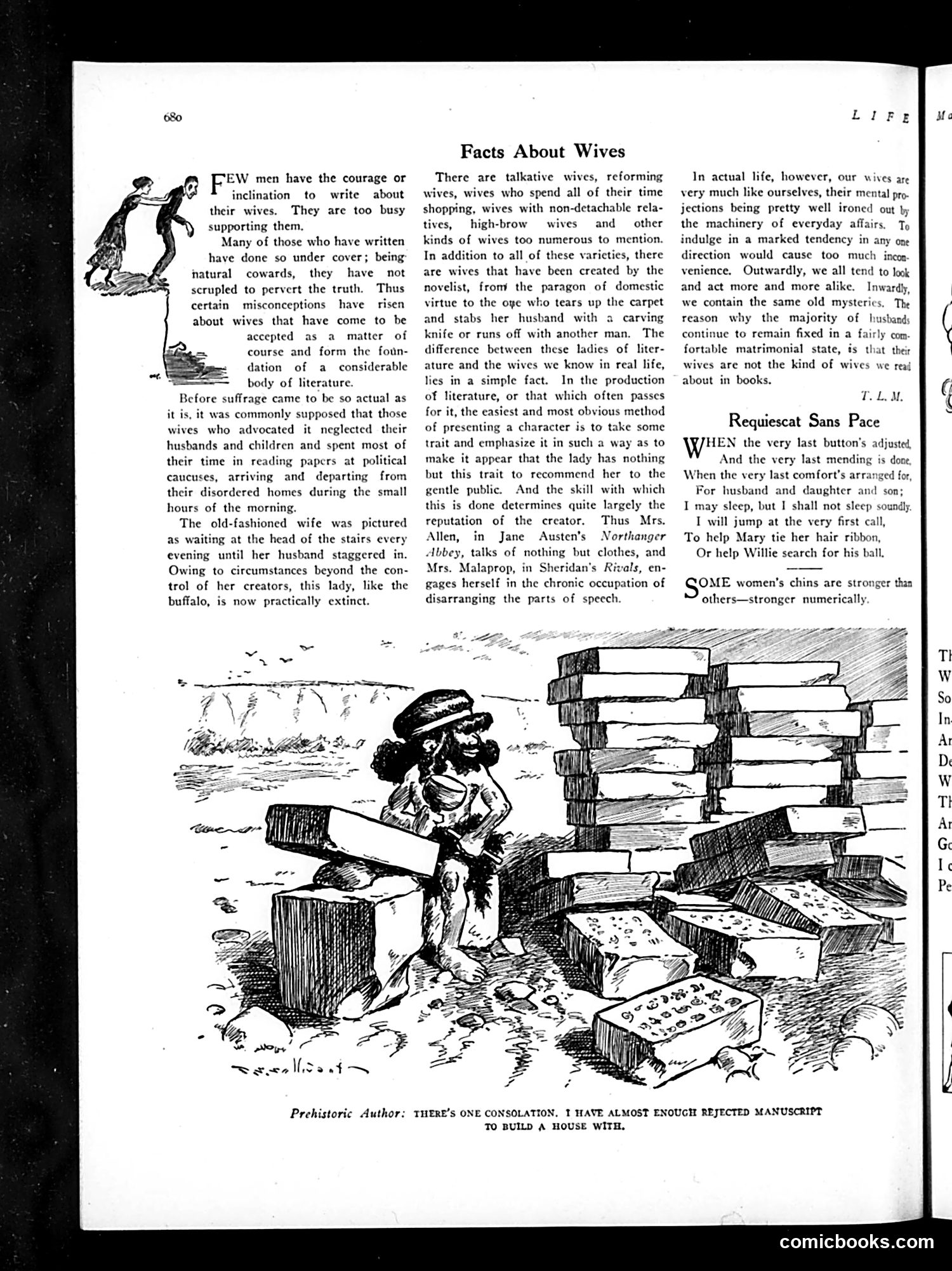
This page satirizes literary portrayals of wives versus reality. The text criticizes novelists and authors who depict wives as either shrewish (stabbing husbands with knives, running off with lovers) or impossibly perfect. Authors like Jane Austen, Sheridan, and unnamed others are mentioned as examples of exaggerated characterization. The bottom cartoon shows a "Prehistoric Author" surrounded by rejected manuscript pages, with the caption: "There's one consolation. I have almost enough rejected manuscript to build a house with." The joke: even ancient authors faced rejection—a timeless commentary on struggling writers. The cartoon humanizes prehistoric man as a frustrated scribe, making light of universal publishing disappointments while the article above critiques unrealistic female stereotypes in literature.
📄 Transcribed text from this page (OCR, searchable)
Machine-transcribed from the original scan — historical spelling and the odd misread are preserved.
W men have the courage or inclination to write about their wives. They are too busy supporting them, Many of those who have written have done so under cover; being natural cowards, they have not scrupled to pervert the truth. Thus certain misconceptions have risen about wives that have come to be accepted as a matter of course and form the foun- dation of a considerable body of literature. Before suffrage came to be so actual as it is, it was commonly supposed that those wives who advocated it neglected their husbands and children and spent most of their time in reading papers at political caucuses, arriving and departing from their disordered homes during the small hours of the morning. The old-fashioned wife was pictured as waiting at the head of the stairs every evening until her husband staggered i Owing to circumstances beyond the con- trol of her creators, this lady, like the buffalo, is now practically extinct. Facts About Wives There are talkative wives, reforming wives, wives who spend all of their time shopping, wives with non-detachable rela- tives, high-brow wives and other kinds of wives too numerous to mention. In addition to all of these varicties, there are wives that have been created by the novelist, from’ the paragon of domestic virtue to the oye who tears up the carpet and stabs her husband with a carving knife or runs off with another man, The difference between these ladies of liter- ature and the wives we know in real life, lies in a simple fact. In the production of literature, or that which often passes for it, the easiest and most obvious method of presenting a character is to take some trait and emphasize it in such a way as to make it appear that the lady has nothing but this trait to recommend her to the gentle public. And the skill with which this is done determines quite largely the reputation of the creator, Thus Mrs. Allen, in Jane Austen's Northanger Abbey, talks of nothing but clothes, and Mrs. Malaprop, in Sheridan's Rivals, en- gages herself in the chronic occupation of disarranging the parts of speech. LIF: In actual life, however, our wives are very much like ourselves, their mental pro- jections being pretty well ironed out y the machinery of everyday affairs. To indulge in a marked tendency in any one direction would cause too much incor venience, Outwardly, we all tend to look and act more and more alike. Inwardly, we contain the same old mysteries. The reason why the majority of husbands continue to remain fixed in a fai fortable matrimonial state, is that their wives are not the kind of wives we reaj about in books. T. LM. Requiescat Sans Pace WHEN the very last button’s adjusted, And the very last mending is done, When the very last comfort’s arranged for, For husband and daughter and son; I may sleep, but I shall not sleep soundly. I will jump at the very first call, To help Mary tie her hair ribbon, Or help Willie search for his ball. OME women’s chins are stronger than others—stronger numerically. ee Prehistoric Author: THERE’s ONE CONSOLATION, 1 HAVE ALMOST ENOUGH REJECTED MANUSCRIPT To BUILD A HOUSE WITH. comicbooks.com