
A complete issue · 45 pages · 1920
Life — November 25, 1920
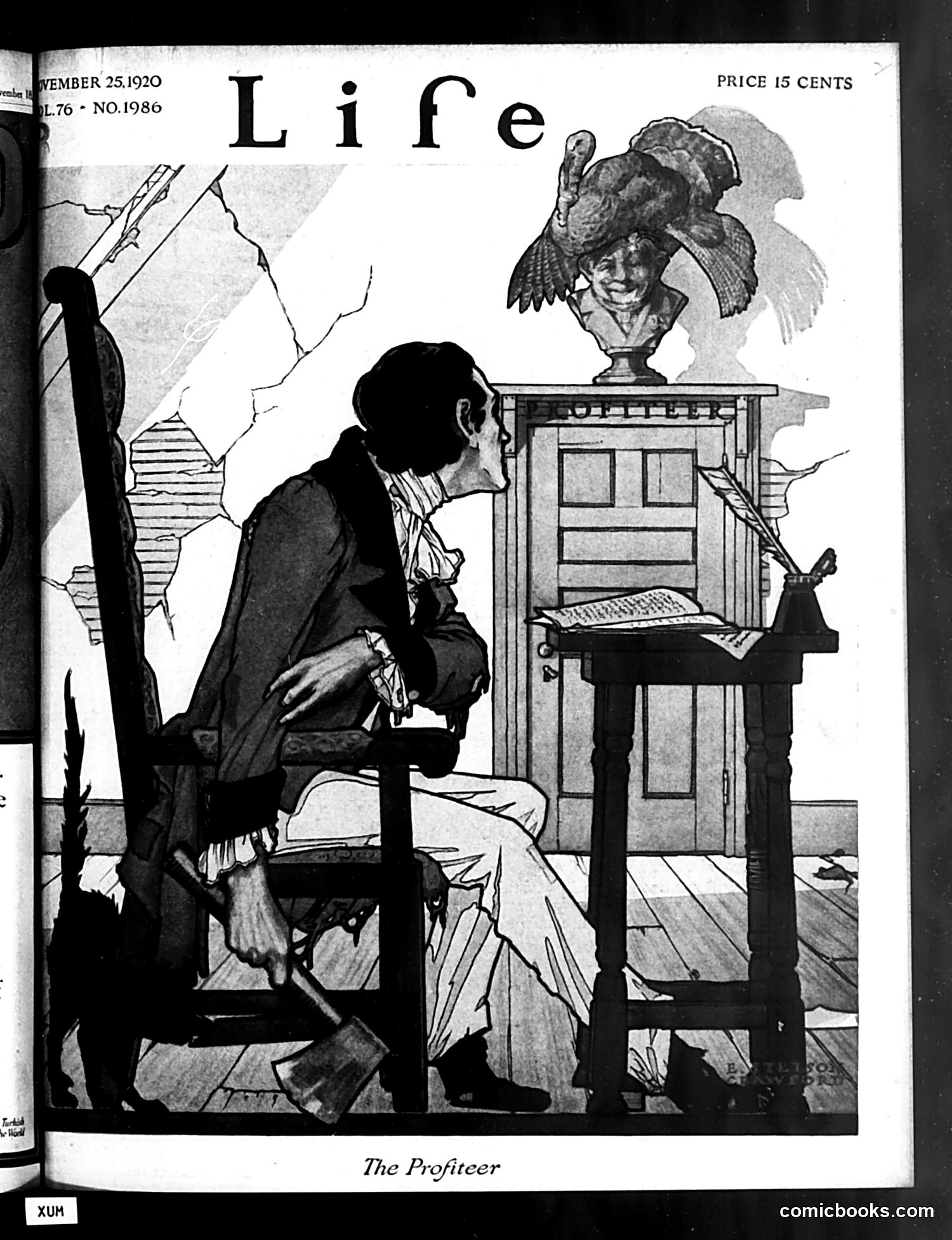
This satirical illustration depicts a well-dressed businessman sitting at a desk, appearing nervous or evasive while handling papers. The title "The Profiteer" suggests criticism of wartime or post-war business practices. The cartoon likely references profiteers who accumulated wealth through exploitative practices during or immediately after World War I (which ended in 1918). The man's anxious posture and body language suggest guilt or fear of consequences—possibly alluding to public outcry against those deemed to have unfairly enriched themselves while others sacrificed during the war. The decorative bust and relatively comfortable office setting emphasize the profiteer's wealth, contrasting with the era's widespread economic hardship and resentment toward those seen as war profiteers.

This page is primarily a **U.S. Rubber Company advertisement**, not political satire. The illustration shows two enormous pneumatic truck tires flanking an industrial cityscape. The ad addresses a practical business question: whether pneumatic (air-filled) truck tires are economical. The company argues they developed these tires specifically for trucking demands—not simply enlarged passenger-car tires. The text emphasizes U.S. Rubber's philosophy of building better products before seeking market expansion. The visual metaphor is straightforward: the massive tires dwarf the city, emphasizing their superior scale and engineering. This is commercial persuasion rather than satire—appealing to trucking companies' concerns about tire durability and cost-effectiveness during an era when motor freight was becoming increasingly important to American commerce.
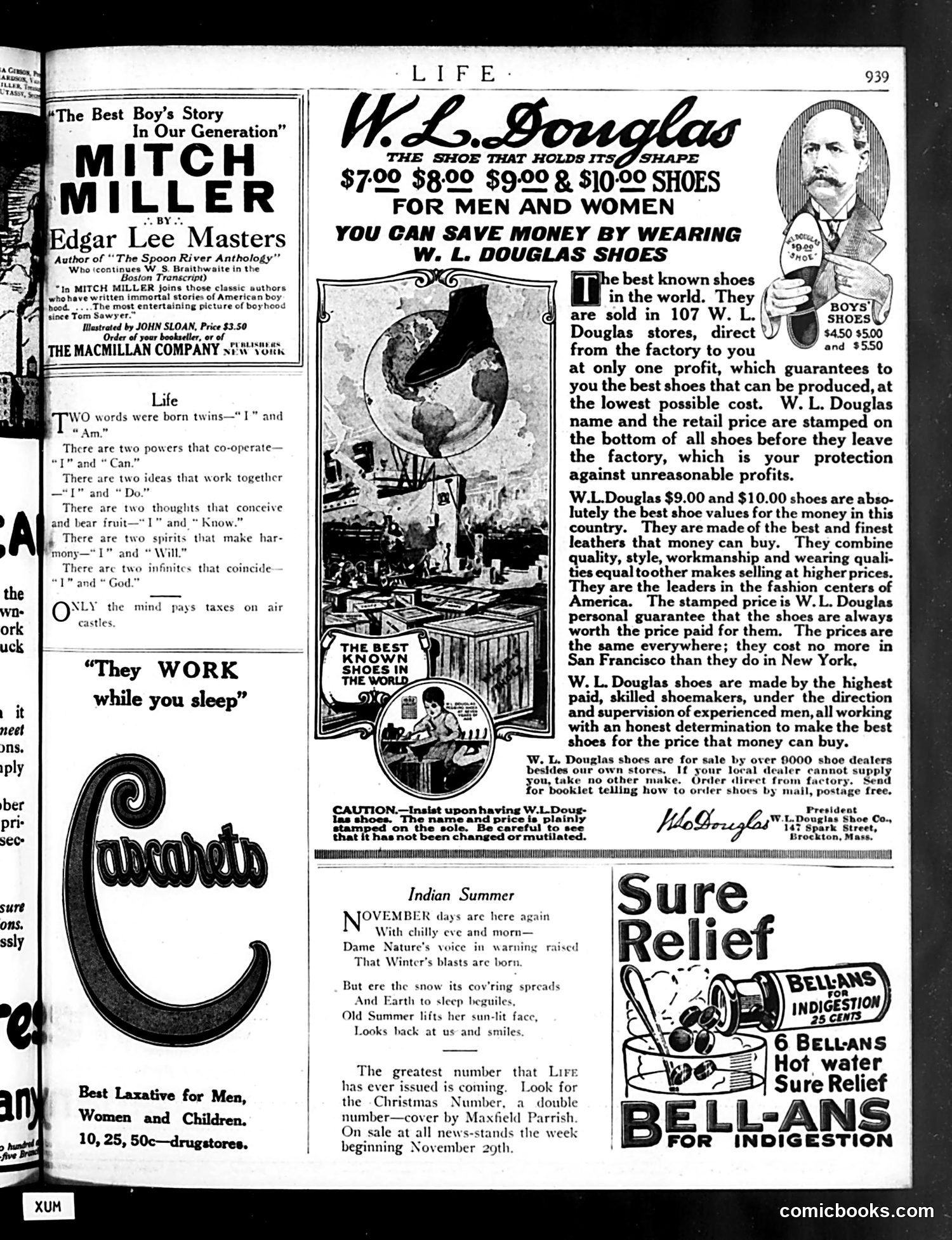
This page is **primarily advertising**, not satire or political commentary. The dominant content is a W.L. Douglas shoe advertisement featuring an illustrated globe and factory scene. The ad emphasizes that Douglas shoes ($7-$10) offer best value by being sold directly from factory to consumer at "only one profit," positioning them as affordable quality footwear. The left column contains a book advertisement for "Mitch Miller" by Edgar Lee Masters, and below it appears to be a Cascarets laxative ad. The bottom right advertises Bellans indigestion remedy. The page also includes a short poem titled "Indian Summer" about autumn weather. This is a typical early 20th-century magazine layout mixing editorial content with extensive advertising—no political cartoon or satirical commentary is present.
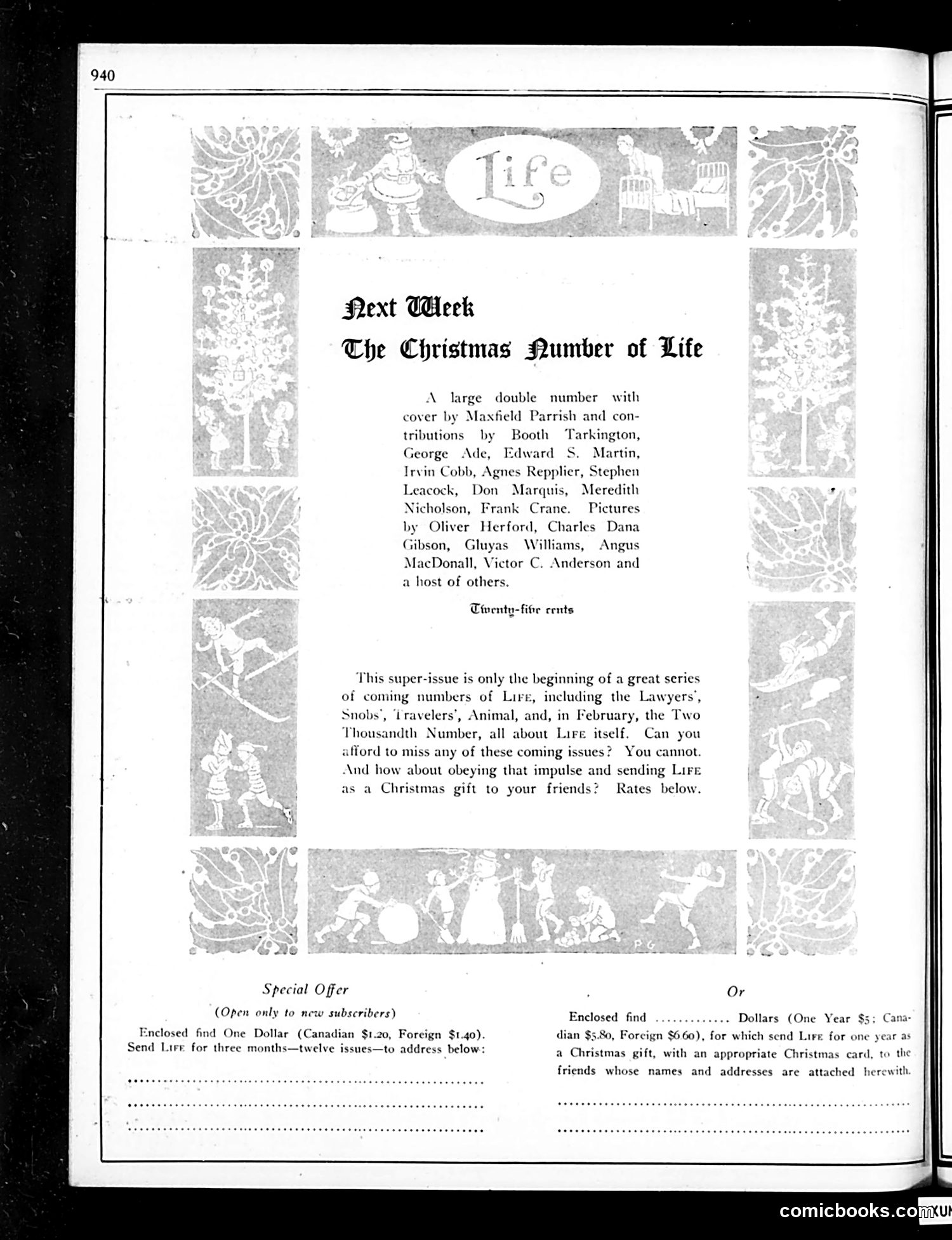
This is primarily a **promotional advertisement** for Life magazine's upcoming Christmas issue, not a political cartoon. The page announces "The Christmas Number of Life"—described as a "large double number" priced at twenty-five cents. The ad highlights contributions from various named artists and writers (Maxfield Parrish, Booth Tarkington, George Ade, and others), emphasizing the issue's quality and breadth of content. The decorative border features stylized illustrations suggesting holiday themes and festive scenes, though specific figures are unclear due to image quality. The bottom section offers **subscription incentives**: readers could send one dollar to receive Life for three months, or purchase gift subscriptions for friends—positioning Life as an ideal Christmas present for 1900s audiences.
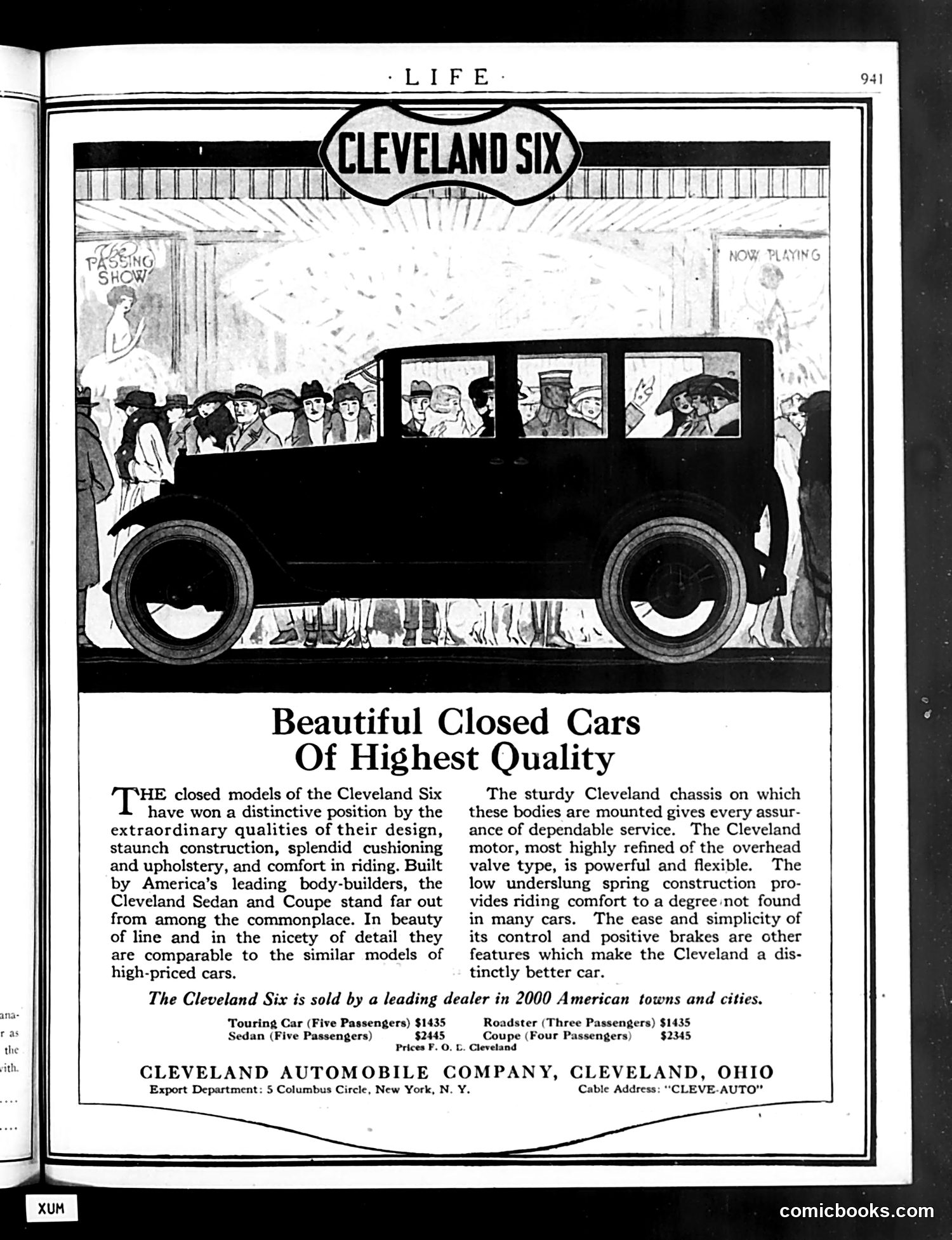
This page is primarily a **product advertisement**, not satire or political commentary. It promotes the Cleveland Six automobile from the Cleveland Automobile Company in Ohio. The illustration depicts a closed-body car surrounded by well-dressed pedestrians and storefront signage (including "Passing Show" and "Now Playing"), situating the vehicle in an urban, leisure context. The ad emphasizes the car's quality features: sturdy chassis, refined overhead valve motor, comfortable suspension, and reliable brakes. The text notes the Cleveland Six was "sold by a leading dealer in 2000 American towns and cities," listing prices for various models (Touring Car, Sedan, Roadster, Coupe). This represents typical early 1900s automotive marketing—positioning an American-made car as a reliable, quality product for middle-class buyers.
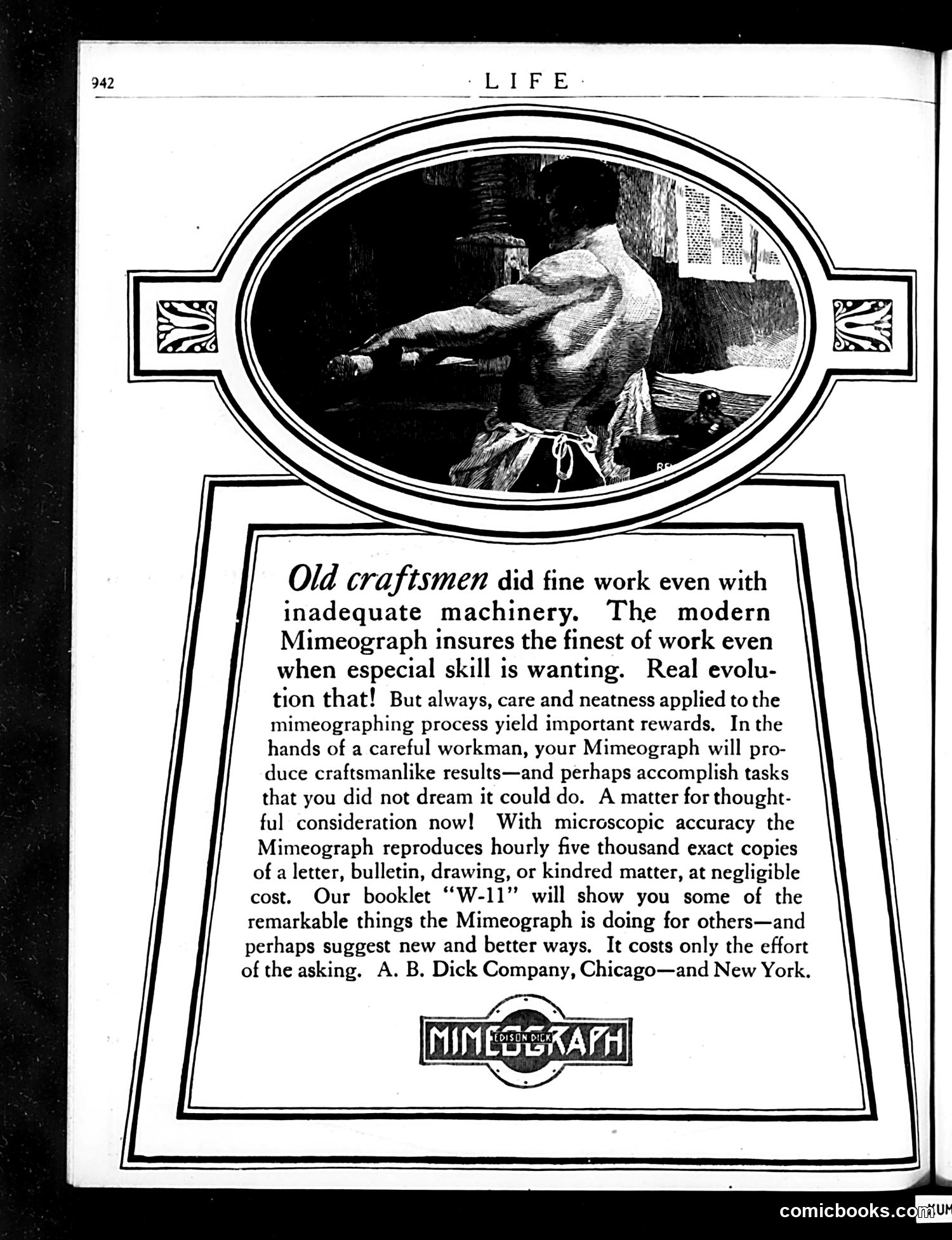
This page is **primarily an advertisement**, not satirical content. It's a Mimeograph machine ad from the A. B. Dick Company (Chicago and New York). The advertisement uses a photograph showing someone operating a Mimeograph machine. The accompanying text argues that while old craftsmen could produce fine work with inadequate tools, the modern Mimeograph enables quality results even without exceptional skill. It emphasizes the machine's precision—capable of producing 5,000 exact copies hourly of letters, bulletins, or drawings at minimal cost. The pitch positions the Mimeograph as democratizing quality reproduction work, making professional-grade output accessible to ordinary workers. This reflects early 20th-century marketing rhetoric celebrating industrial machinery as a great equalizer of human capability.
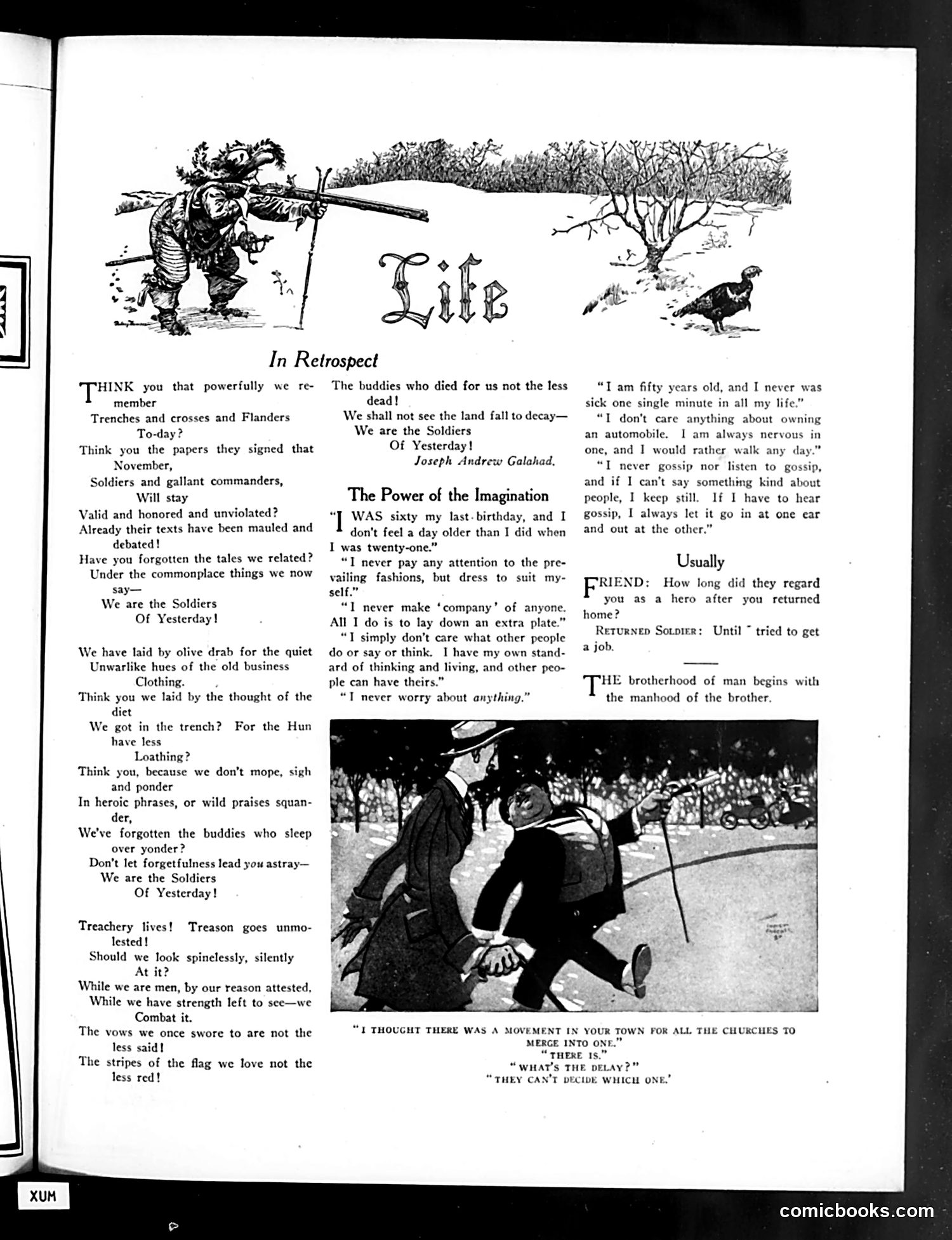
This page critiques post-war attitudes toward veterans. "In Retrospect" is a poem condemning those who've forgotten soldiers' sacrifices at Flanders and in the trenches. It attacks public forgetfulness and ingratitude toward "the Soldiers of Yesterday." The middle section presents quotes from returned soldiers expressing cynicism about civilian life—indifference to material possessions, refusal to gossip, emotional detachment. The satirical point: veterans return psychologically damaged and alienated, unable to readjust to trivial peacetime concerns. The photograph shows two men in formal attire (likely at a church or civic event based on the caption about churches merging). The caption's frustration—"they can't decide which one!"—appears to mock institutional ineffectiveness, contrasting civilian bureaucratic ineptitude with veterans' real suffering.
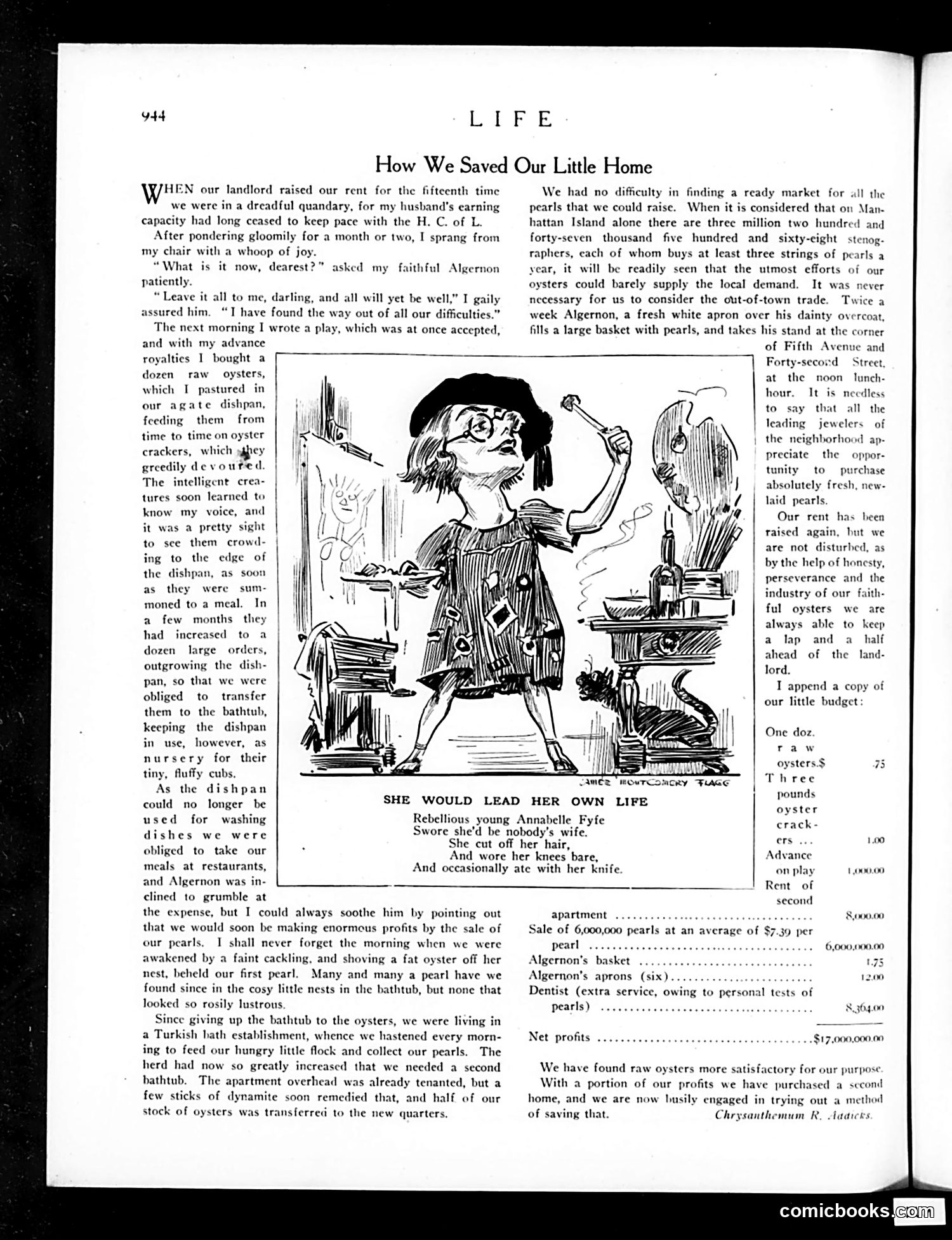
This satirical piece mocks a couple's scheme to make money through pearl farming. The accompanying cartoon shows a woman ("Annabelle Fyfe") who "would lead her own life"—she's depicted cutting her hair short and wearing knee-baring clothes, embodying the "rebellious" flapper aesthetic of the 1920s. The satire targets the get-rich-quick mentality: the couple raises oysters for pearls to pay their mounting rent. The accompanying budget breakdown reveals the actual profits are minimal (net $17,000,000 appears to be a joke about inflated claims), and they're reduced to humiliating work—selling pearls to jewelers, using bathwater for oyster farming—just to stay afloat. The cartoon ridicules both the impractical business scheme and the woman's liberated pretensions.
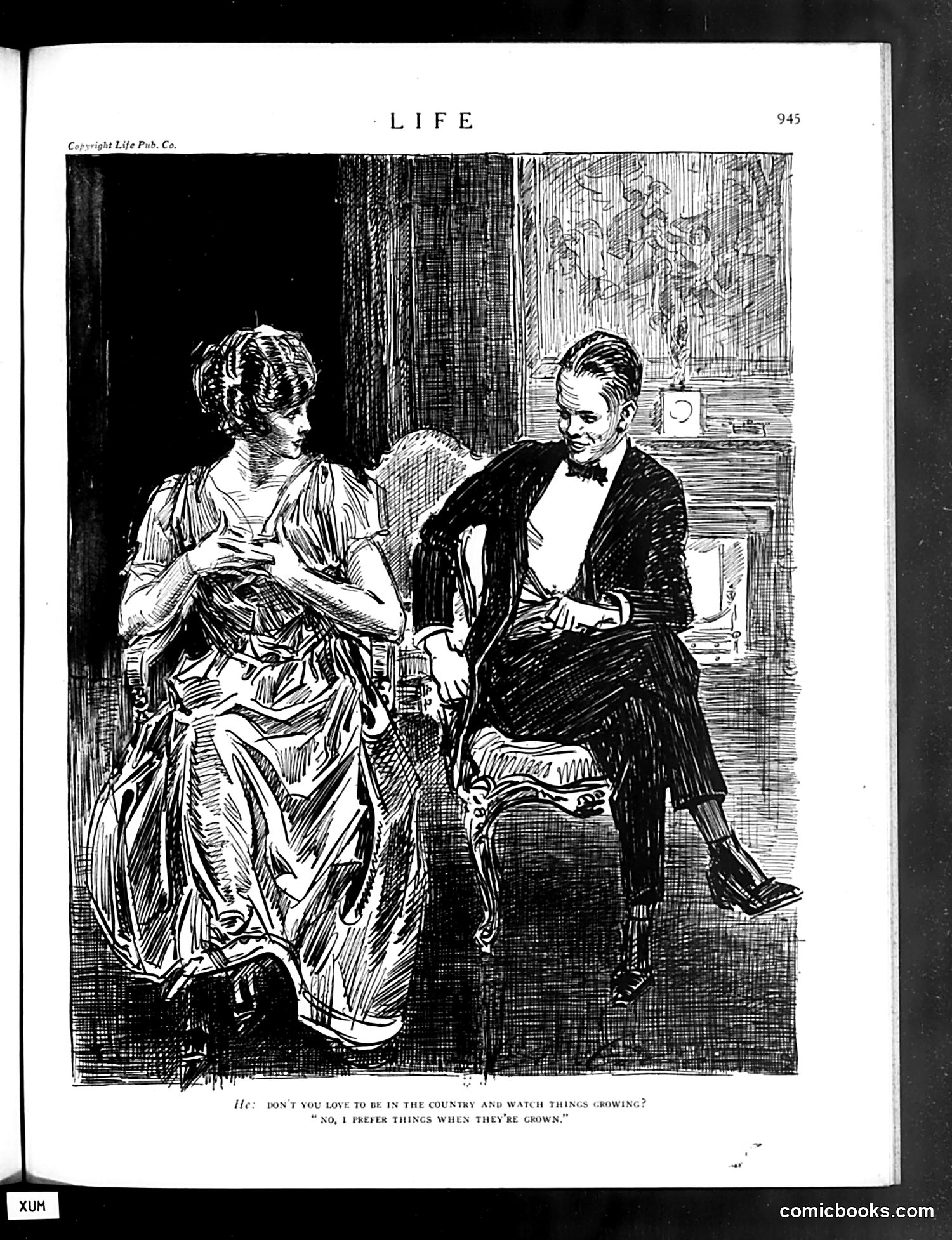
This is a single-panel cartoon from *Life* magazine (page 945) depicting two figures in an elegant interior setting. A woman in an ornate dress sits beside a man in formal evening wear (tuxedo). The dialogue reads: - **He:** "Don't you love to be in the country and watch things growing?" - **She:** "No, I prefer things when they're grown." The satire targets courtship and romantic dynamics of the era. The woman's quip suggests she prefers mature, established men over younger prospects—or possibly, she disdains rural life and agrarian interests. It's a witty rejoinder that subverts the man's romantic appeal to nature and growth, implying her pragmatic (or materialistic) preference for finished products over processes. The humor relies on the double meaning of "grown" and social expectations about feminine romanticism.
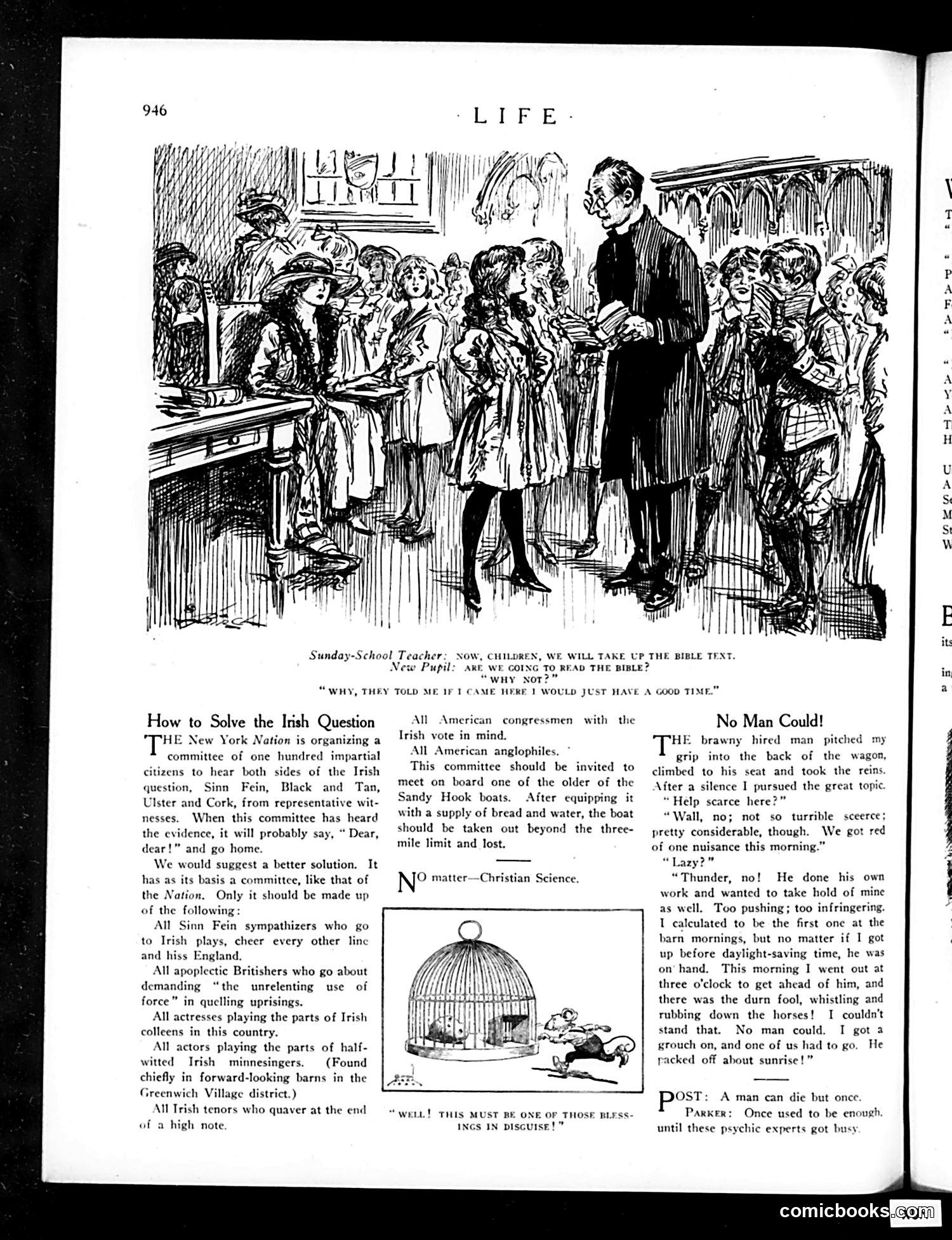
This page from *Life* magazine contains three separate satirical pieces: 1. **Top cartoon**: A Sunday school scene mocking religious education. The teacher asks children about Bible study; a student asks "Why not?" and another responds "They told me if I came here I would just have a good time"—satirizing how Sunday school has become entertainment rather than serious religious instruction. 2. **Left article "How to Solve the Irish Question"**: Satirizes American politicians' obsession with the Irish vote. It proposes sending Irish-American sympathizers on a boat with supplies, suggesting they should leave America rather than constantly agitate about Irish independence—mocking their political influence and nostalgia. 3. **Right piece "No Man Could!"**: A humorous anecdote about a hired man's competitive nature with farm work, illustrating working-class pride and stubbornness.
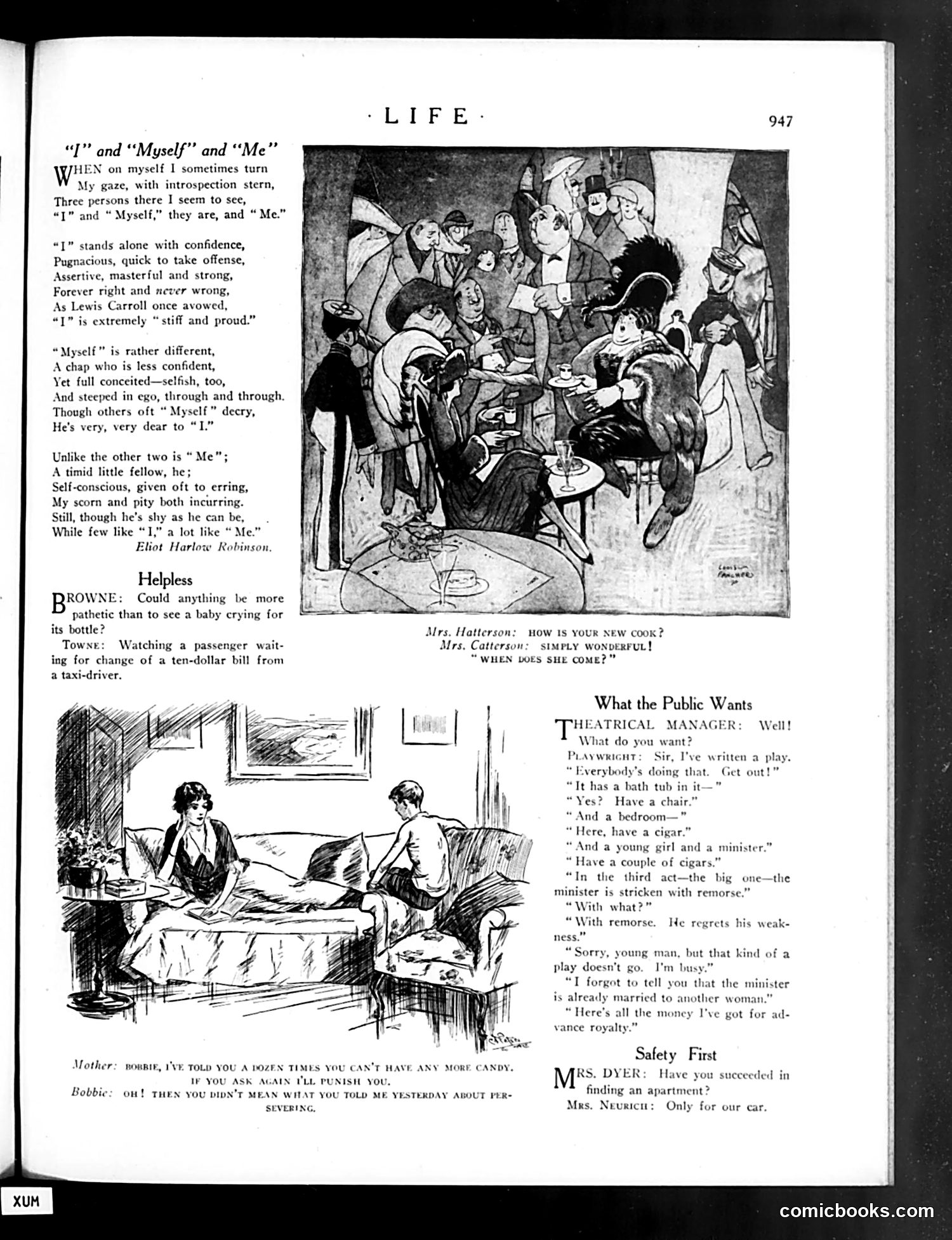
This page contains several unrelated humorous sketches typical of early 20th-century American satire magazines. The top poem "I" and "Myself" and "Me" by Eliot Harrow Robinson explores introspection—three aspects of the self, with "I" being confident and proud, "Myself" self-conscious and conceited, and "Me" self-pitying. The middle cartoon "Helpless" depicts two brief vignettes: a baby crying for its bottle, and a taxi passenger waiting for change from a ten-dollar bill—contrasting human dependency at different life stages. The lower cartoon shows a mother scolding a child about asking for more candy, with the child claiming he didn't mean what he said yesterday about punishment. The right column contains theatrical and domestic humor sketches involving a playwright pitching a play and an apartment-hunting couple.
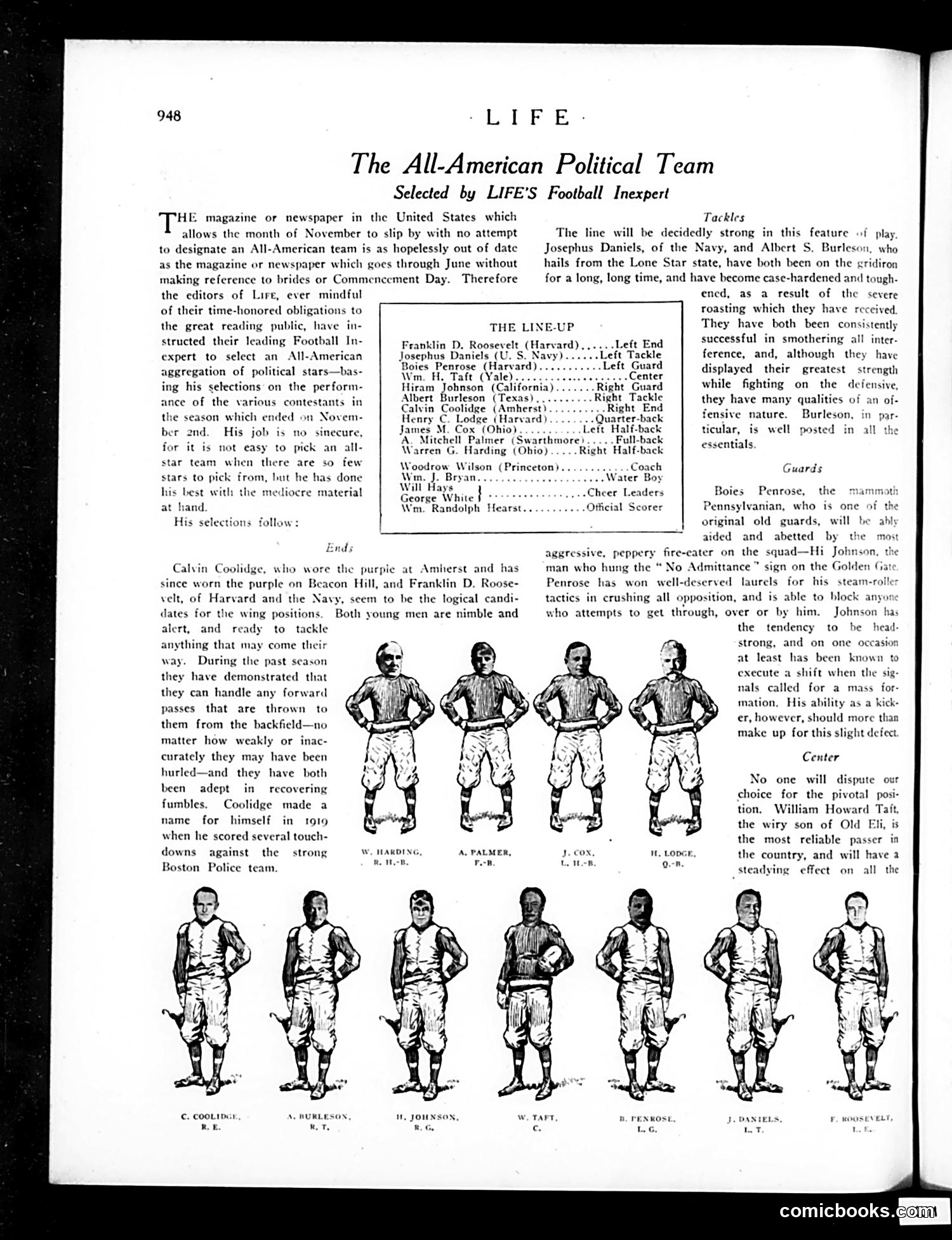
This page presents a satirical "All-American football team" composed entirely of prominent U.S. politicians from the 1920s era. The caption explains that Life's football inspector selected this lineup because November allows the magazine to discuss politics without mentioning elections or "Commencement Day." The joke is a visual pun: instead of actual football players, the positions list real politicians like Franklin D. Roosevelt (Harvard), Josephus Daniels (Navy), and others, treating them as if they were athletes. The accompanying illustrated figures show these politicians in football uniforms and poses. This satirizes political figures by comparing their "performance" to sports competition, mocking their strategic maneuvering and competitive nature through the football metaphor.
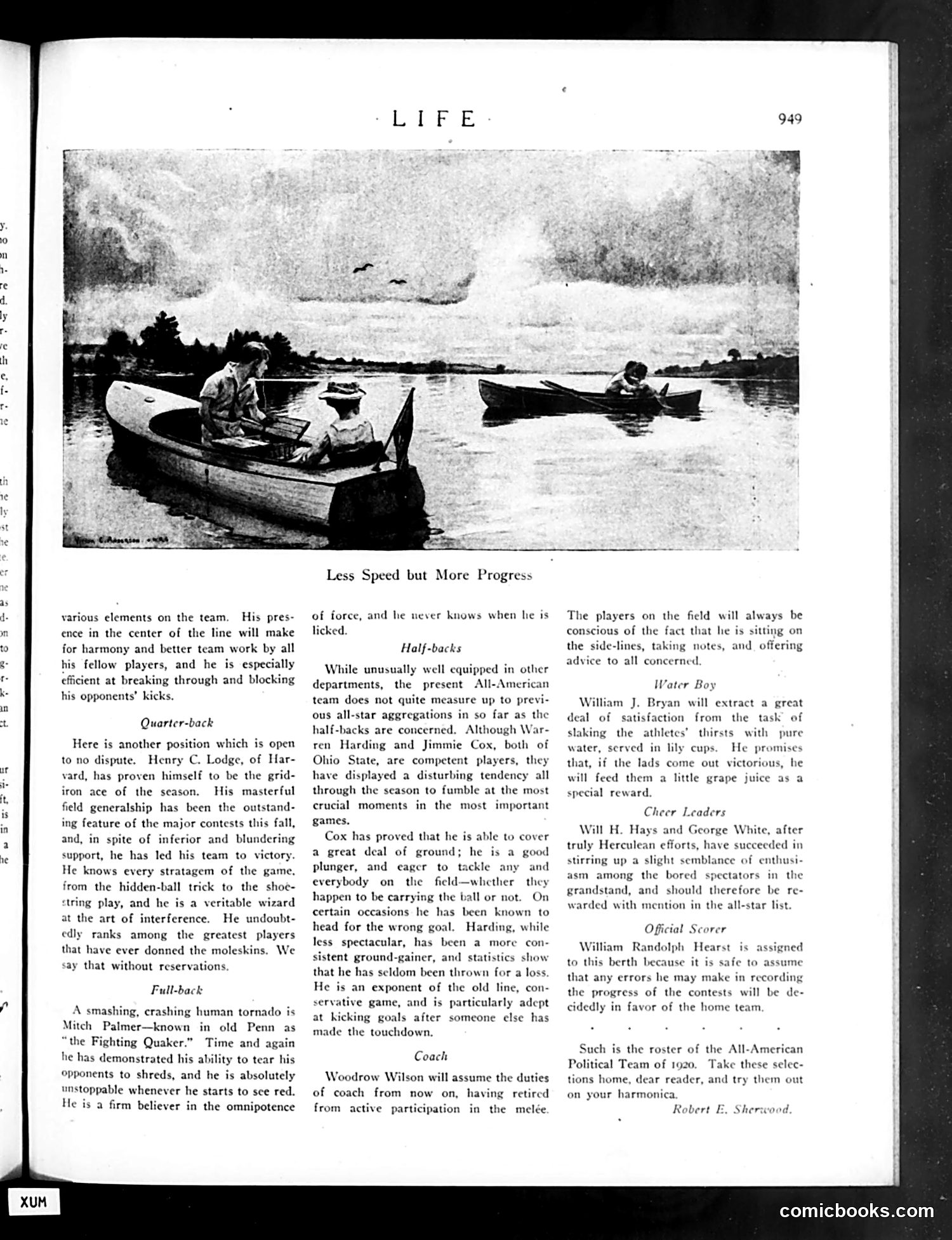
This page from *Life* magazine features a photograph captioned "Less Speed but More Progress" showing people in rowboats on a calm river. The accompanying text discusses American football positions and players from 1920, including references to Henry C. Lodge (Quarter-back), Mitch Palmer (Full-back), and others. The image appears to be a visual metaphor comparing careful, steady progress (slow rowboats) to hasty action—likely commentary on the political climate of 1920. The football terminology applied to political figures suggests *Life* is satirizing the "All-American Political Team," treating contemporary politicians as team players. Without clearer identification of specific figures, the exact political targets remain unclear, though the cautious approach advocated seems relevant to post-World War I American policy debates.
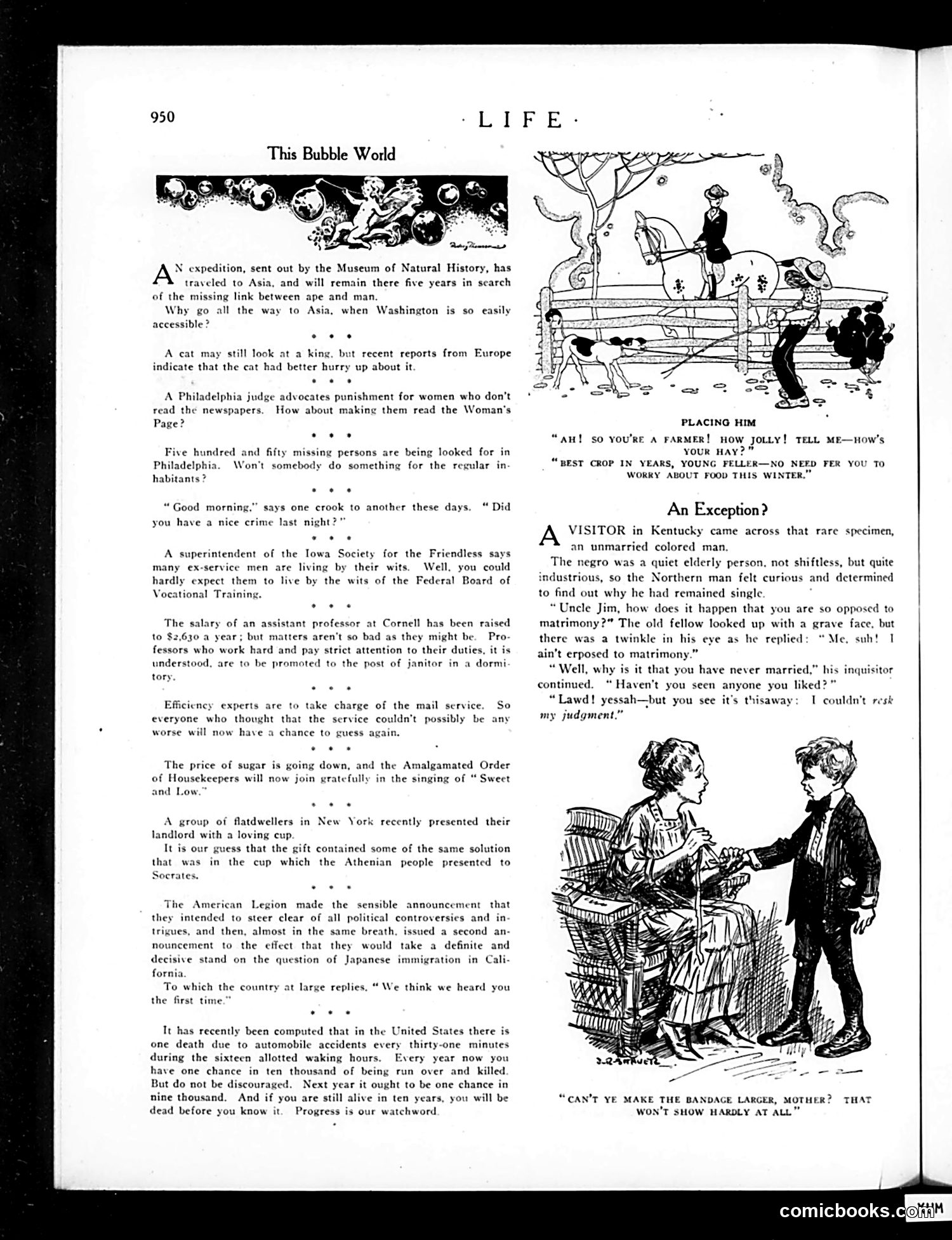
This cartoon satirizes racial attitudes in early 20th-century America. An unmarried Black man in Kentucky is questioned by a white woman about why he's never married. His response—"Me, suh! I ain't 'sposod to matrimony'"—reflects the deeply racist social norms of the era that discouraged or prohibited interracial relationships. The "exception" in the title appears ironic: the woman seems surprised he hasn't married, but his reply suggests he accepts the racial barriers preventing him from doing so. The cartoon mocks both the absurdity of these prejudices and the resigned acceptance of them. The illustration's style and patronizing dialect reinforce the racist stereotyping typical of period publications, even in supposedly sophisticated satirical magazines.
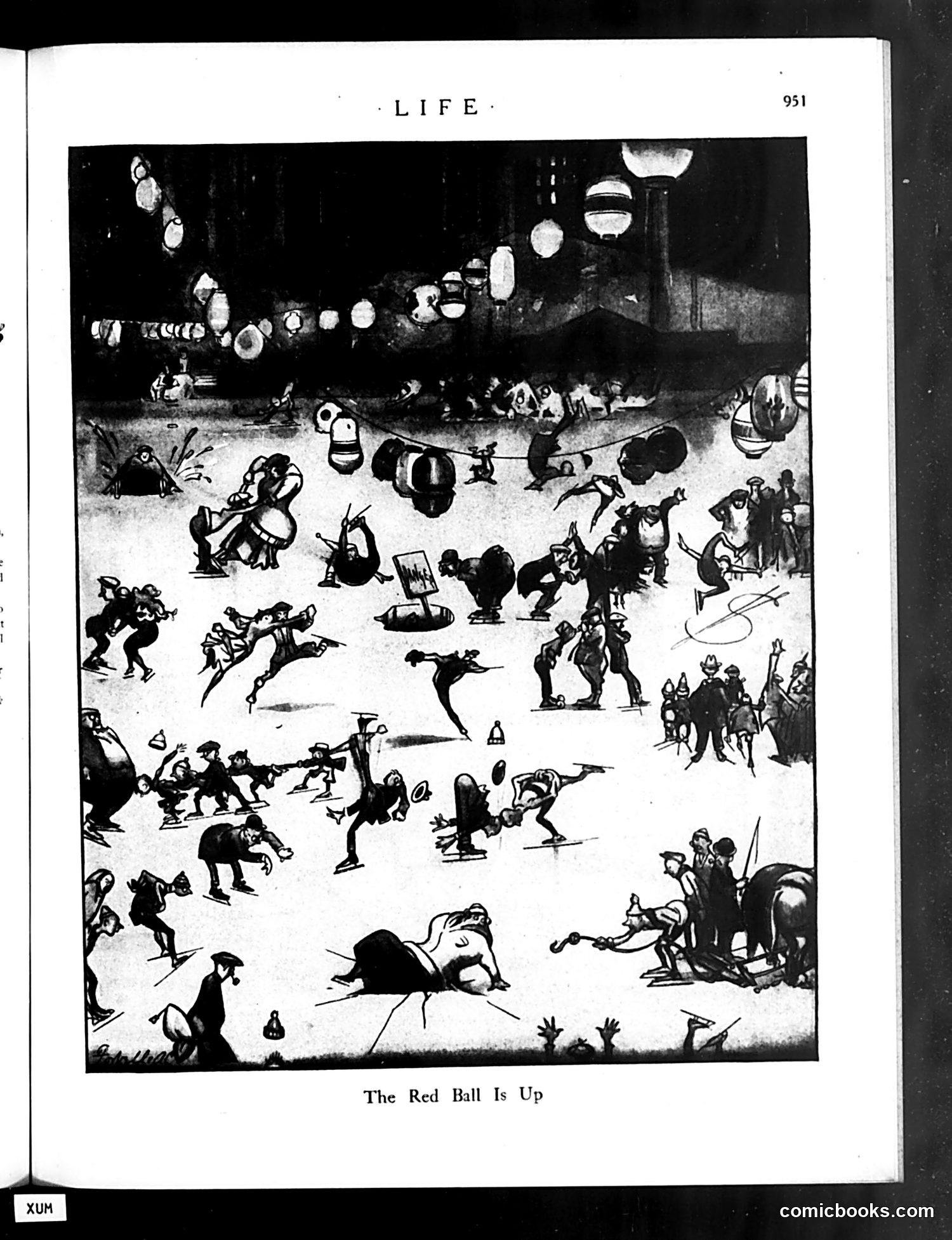
This appears to be a satirical cartoon depicting a chaotic scene of numerous figures engaged in various activities beneath a night sky lit by lanterns and a large red ball (likely representing the sun or moon). The title "The Red Ball Is Up" suggests some kind of signal or event has been triggered. The cartoon shows crowds of people in apparent disorder—some running, fighting, or gesturing wildly—suggesting social upheaval or panic. The style is typical of early 20th-century Life magazine satire, likely commenting on a contemporary political or social event through exaggerated, surreal imagery. Without additional context about the publication date or historical moment, the specific references remain unclear, though the composition suggests commentary on mass behavior or social chaos.
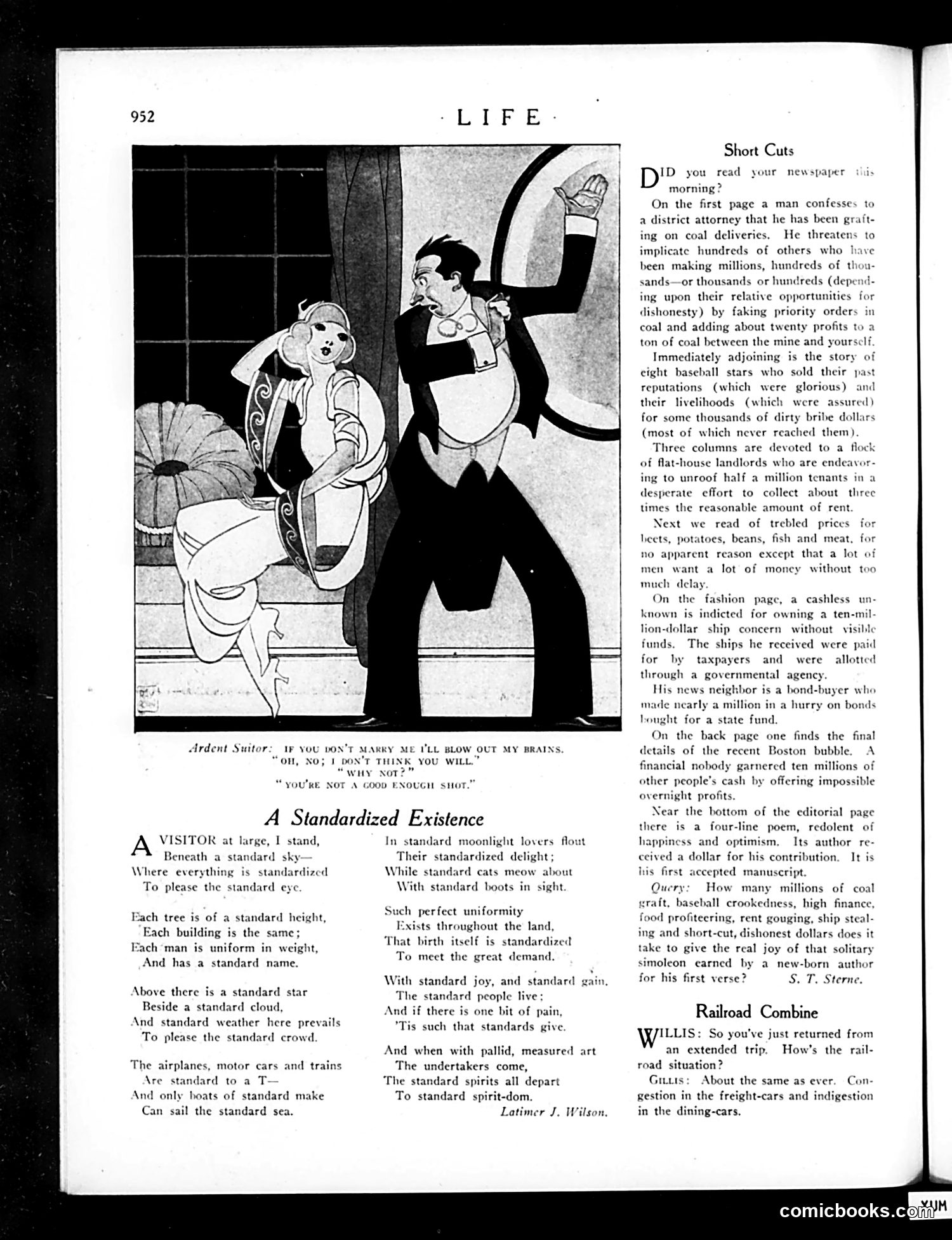
The cartoon depicts a man in formal dress threatening a woman with a gun, with dialogue about marriage. The caption reads "Ardent Suitor: If you don't marry me I'll blow out my brains" followed by her dismissive response. This satirizes a common melodramatic trope of the era—the desperate suitor using emotional blackmail or threats to coerce marriage. The humor lies in the woman's practical, unimpressed rejection: she doubts his threat and questions whether he'd be "a good enough shot" anyway. The satire targets both romantic conventions (overwrought male desperation) and gender relations, mocking men who treated marriage proposals as life-or-death matters while portraying women as sensible enough to see through such manipulation.
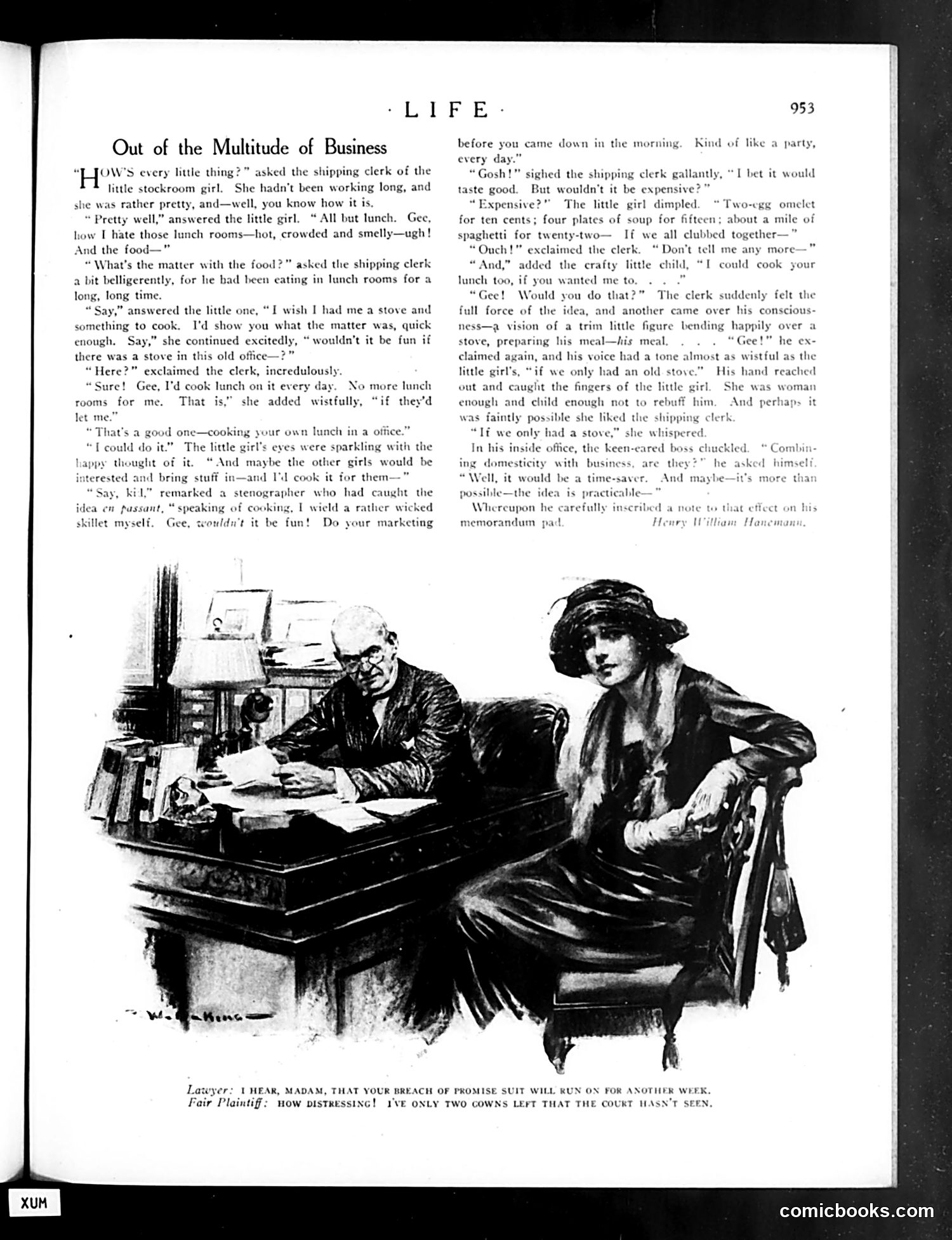
This is a two-part satirical piece about workplace dynamics and gender in early 20th-century office culture. **Main Story (top):** A shipping clerk flirts with an attractive young female stockroom worker. When she complains about expensive, poor-quality lunch rooms, he and coworkers suggest she cook lunch in the office—a proposal everyone finds delightfully romantic. The boss overhears and sees profit: combining "domesticity with business." He decides to formalize the arrangement in a memo, transforming casual flirtation into workplace efficiency. **The Satire:** The piece mocks both workplace gender dynamics (the pretty girl as object of male attention) and early management's embrace of domestic labor as cost-cutting. What begins as courtship becomes instrumentalized as business savings. **Lower Cartoon:** Unrelated—a lawyer discusses a "breach of promise" suit (a woman suing a man who broke an engagement), with the plaintiff lamenting she's only two courtroom-appropriate gowns left. This mocks litigation excess and materialism.
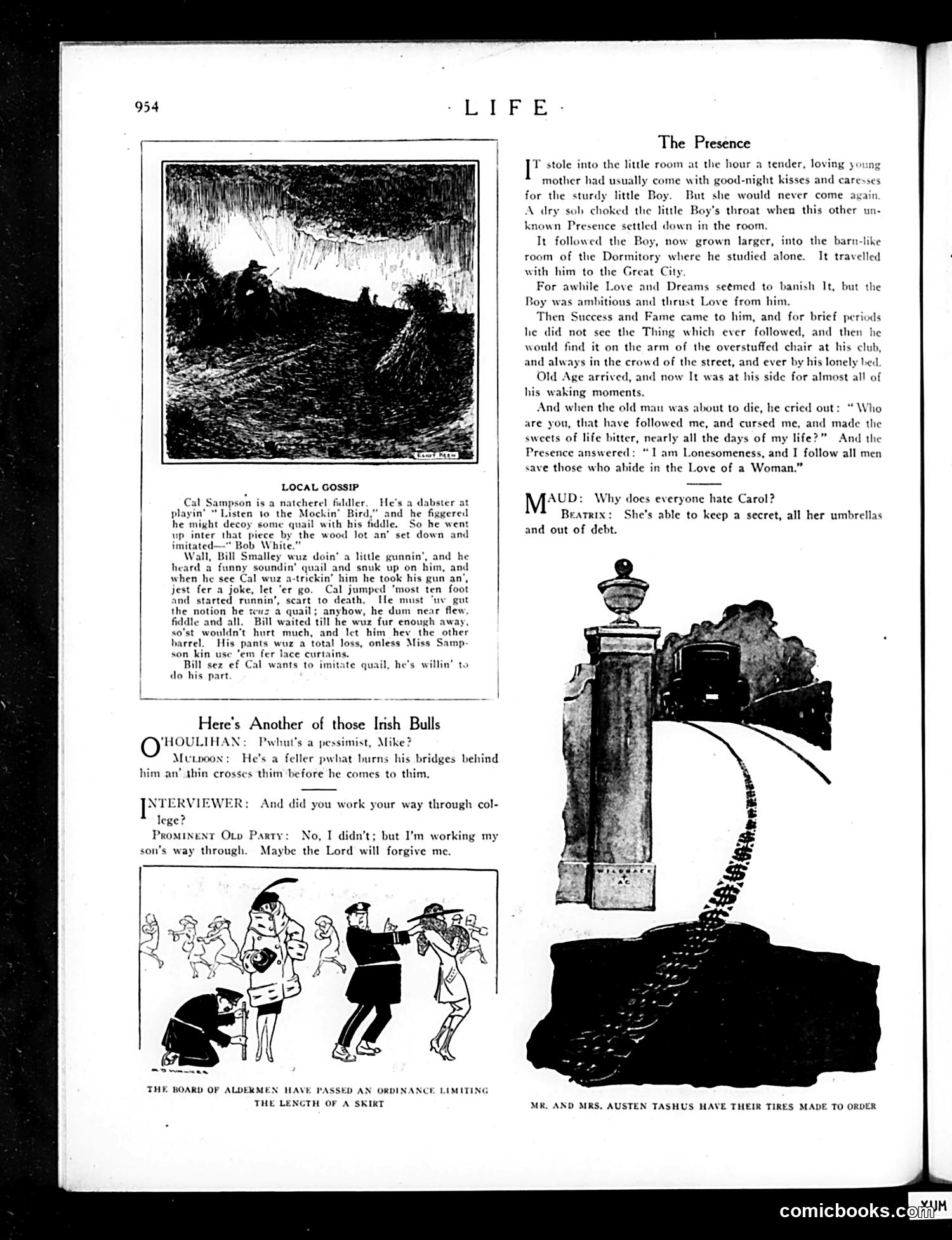
This page contains several satirical pieces typical of early 20th-century Life magazine: **"Local Gossip"**: A rural tall tale about Cal Sampson using his fiddle to imitate quail calls while hunting, only to be shot at by Bill Smalley, who mistakes him for game. The humor relies on dialect humor and slapstick consequences (Cal's ruined pants). **"Irish Bulls"**: A humor section exploiting Irish-American stereotypes through malapropisms—Houlihan's definition of a pessimist ("burns his bridges...then crosses them") and the "Prominent Old Party" who's working his son through college rather than attending himself. **"The Presence"**: An allegorical short story where an unnamed specter follows a man through life—revealed at the end to be Loneliness, which only leaves those in loving relationships. **Bottom cartoon**: Satirizes aldermen passing ordinances limiting women's skirt length—a recurring moral-panic topic of the era, depicted through absurdist visual humor. The page reflects early-1900s American preoccupations: rural/immigrant stereotypes, gender anxieties, and social morality debates.
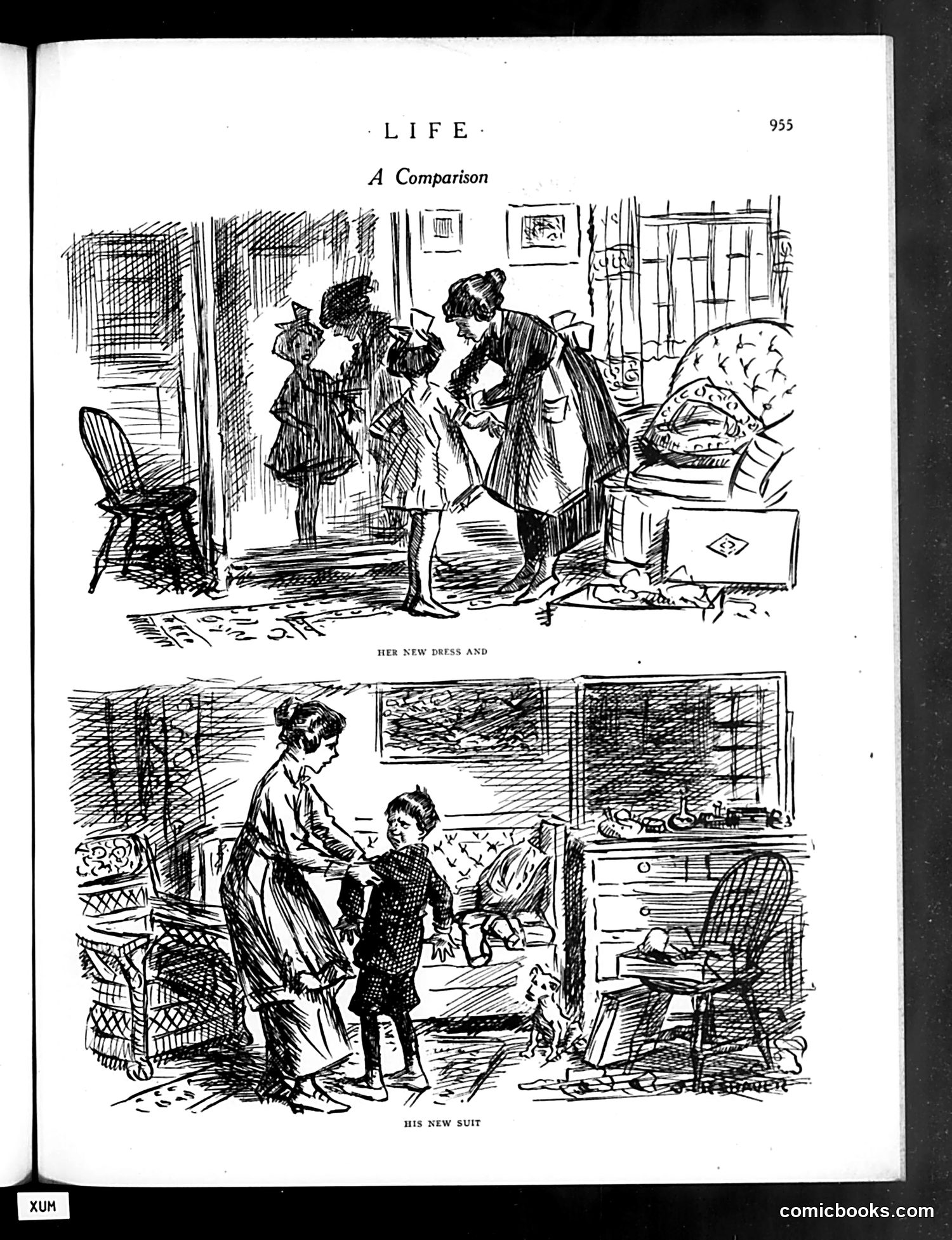
This two-panel satirical cartoon contrasts parental responses to children's new clothing. **Top panel** ("Her New Dress"): A mother fusses over her daughter's new dress while visitors admire it, suggesting parents celebrate and showcase girls' fashion acquisitions. **Bottom panel** ("His New Suit"): A mother simply hands a boy his new suit with minimal fanfare; he stands indifferently while she attends to other matters. The satire mocks gendered parenting disparities—the assumption that girls' clothing warrants elaborate attention and social presentation, while boys' new garments receive casual, functional treatment. It gently ridicules how mothers invest emotional energy differently in their children's wardrobes based on gender, reflecting early-20th-century social attitudes about femininity, display, and children's roles.
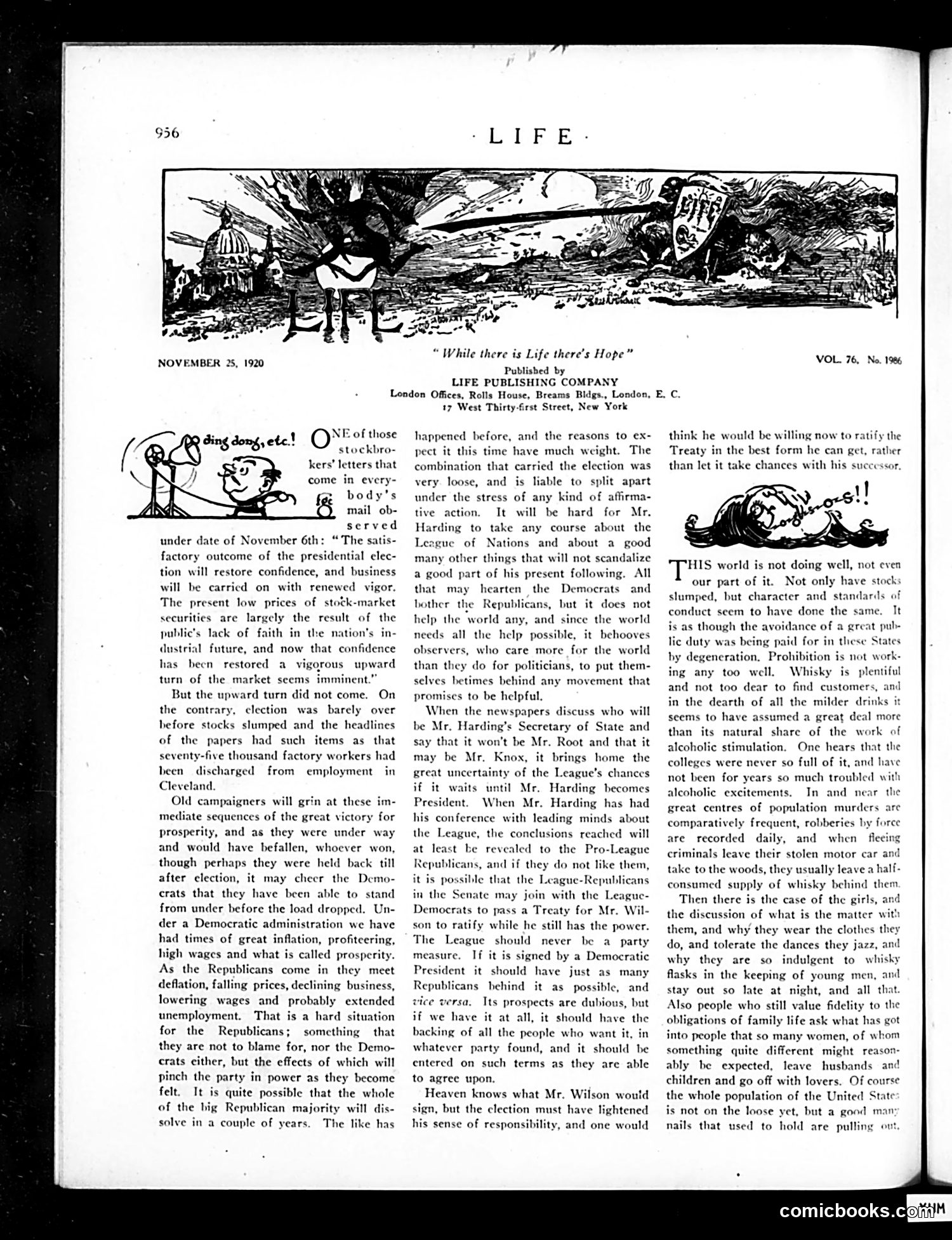
This page appears from just after the 1920 U.S. presidential election, which Republican Warren G. Harding won decisively over Democrat James M. Cox. **The Satire:** A stockbroker's letter predicted the election outcome would restore market confidence and prosperity. Instead, stocks immediately slumped and 75,000 factory workers were discharged in Cleveland alone. Life mocks this failed prediction, noting that Republicans inherited economic deflation, falling prices, and unemployment—precisely the opposite of promised "prosperity." **The Point:** The editorial warns that the loose Republican coalition will fracture under the weight of governing. It especially focuses on the uncertain fate of Wilson's League of Nations, noting that Harding's choice of Secretary of State (possibly Knox rather than Root) signals the League's dim prospects. The piece argues the League needs bipartisan support to survive the transition from Democratic to Republican leadership. **Visual Elements:** Small cartoons at page margins appear to comment on these themes, though details are unclear at this resolution.
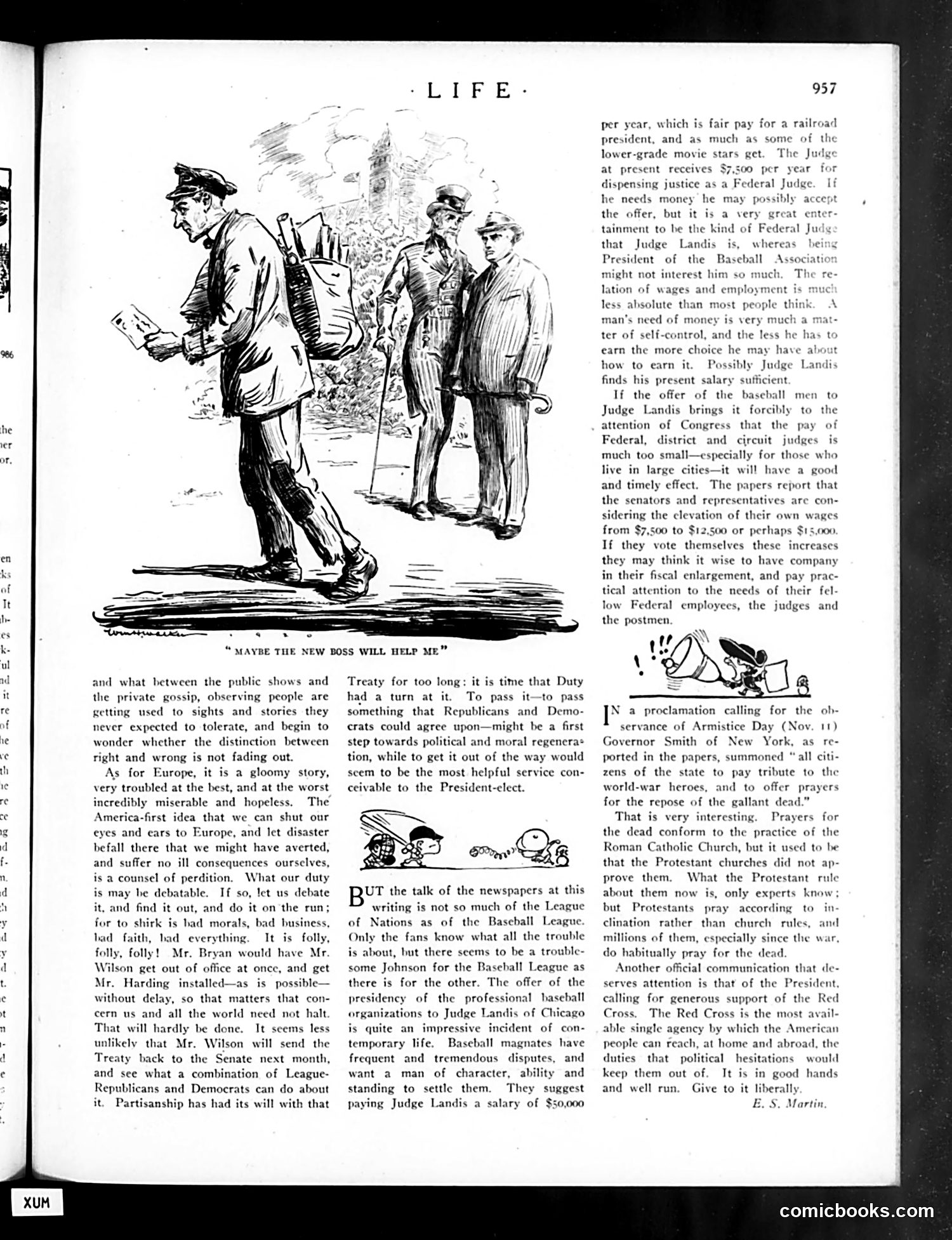
**The Main Cartoon:** Shows a man in a coat labeled as the "new boss" speaking to military/official figures. The caption "Maybe the new boss will help me" appears sardonic—likely referencing hopes that incoming President Harding (elected November 1920) would improve conditions after Wilson's presidency. **The Baseball Judge Landis Story:** The page's primary focus discusses an offer to federal judge Kenesaw Mountain Landis to become president of professional baseball at $50,000 annually. The satire: baseball magnates are offering a federal judge a massive salary to settle disputes, yet federal judges themselves earn far less ($7,500) despite dispensing actual justice. The article uses this absurdity to argue Congress should raise judicial salaries—and notes Congress is conveniently considering raising *their own* wages simultaneously. **The Underlying Point:** American priorities seem backwards: we'll pay handsomely to settle baseball squabbles but underpay judges handling real legal matters. It's a critique of misplaced values and congressional self-interest.
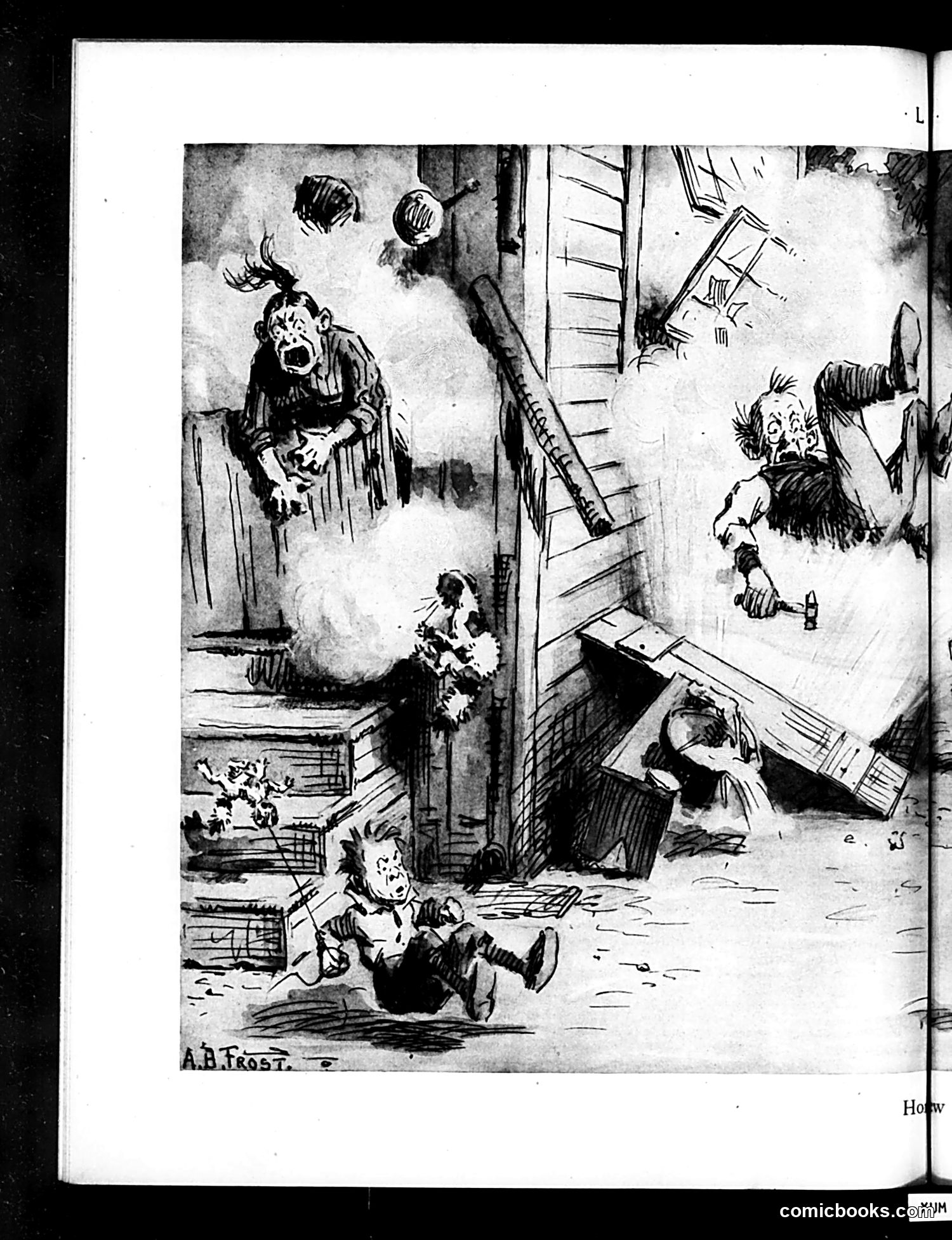
This A.B. Frost cartoon depicts what appears to be a domestic chaos scene, likely satirizing urban tenement or working-class living conditions. Multiple figures—including adults and children—are shown in distress amid cramped, deteriorating quarters with exposed beams and sparse furnishings. The exaggerated facial expressions and body language suggest comedic commentary on overcrowded poverty housing. The scattered debris and chaotic arrangement of figures implies either disaster, eviction, or the general disorder of impoverished domestic life. Without additional text context visible in the OCR, the exact political target remains unclear—whether this critiques housing conditions, poverty, immigration, or specific social policy. The cartoonist's satirical intent appears to be exposing uncomfortable realities of lower-class urban existence through caricature and visual exaggeration.
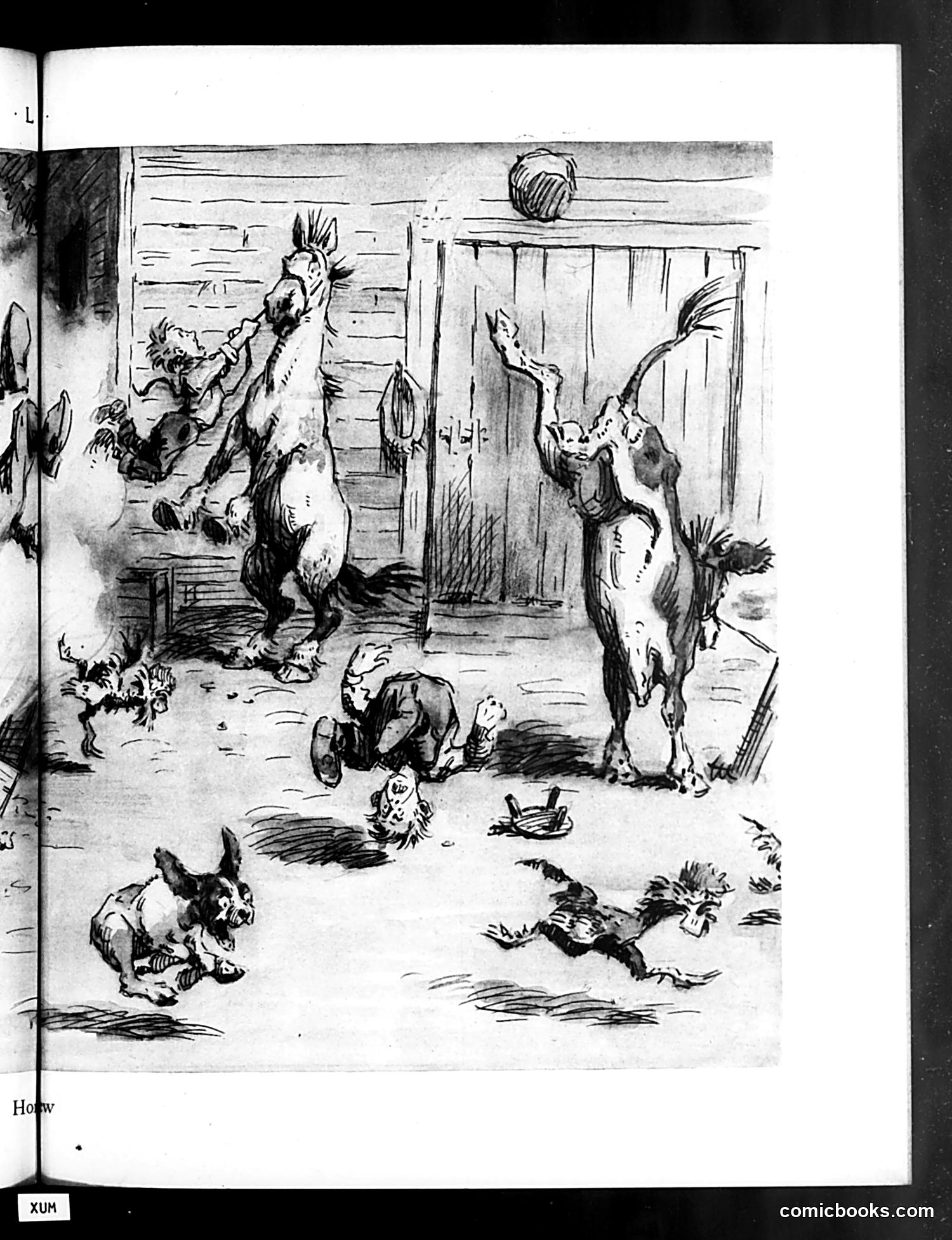
The OCR text is largely unreadable/corrupted, so I'm relying on the image alone. This appears to be a satirical illustration showing anthropomorphic animals (likely goats or similar creatures with exaggerated features) in a chaotic domestic scene. Several figures are engaged in what appears to be violent or frenzied activity around a wooden structure (possibly a barn or house), while smaller animal figures scatter across the ground. The style and crude energy suggest slapstick humor typical of early 20th-century American satire. Without readable text or caption, I cannot definitively identify what political or social event this references or which specific figures are being caricatured. The scene may represent labor unrest, political chaos, or general social upheaval, but the specific target remains unclear from the visual alone.
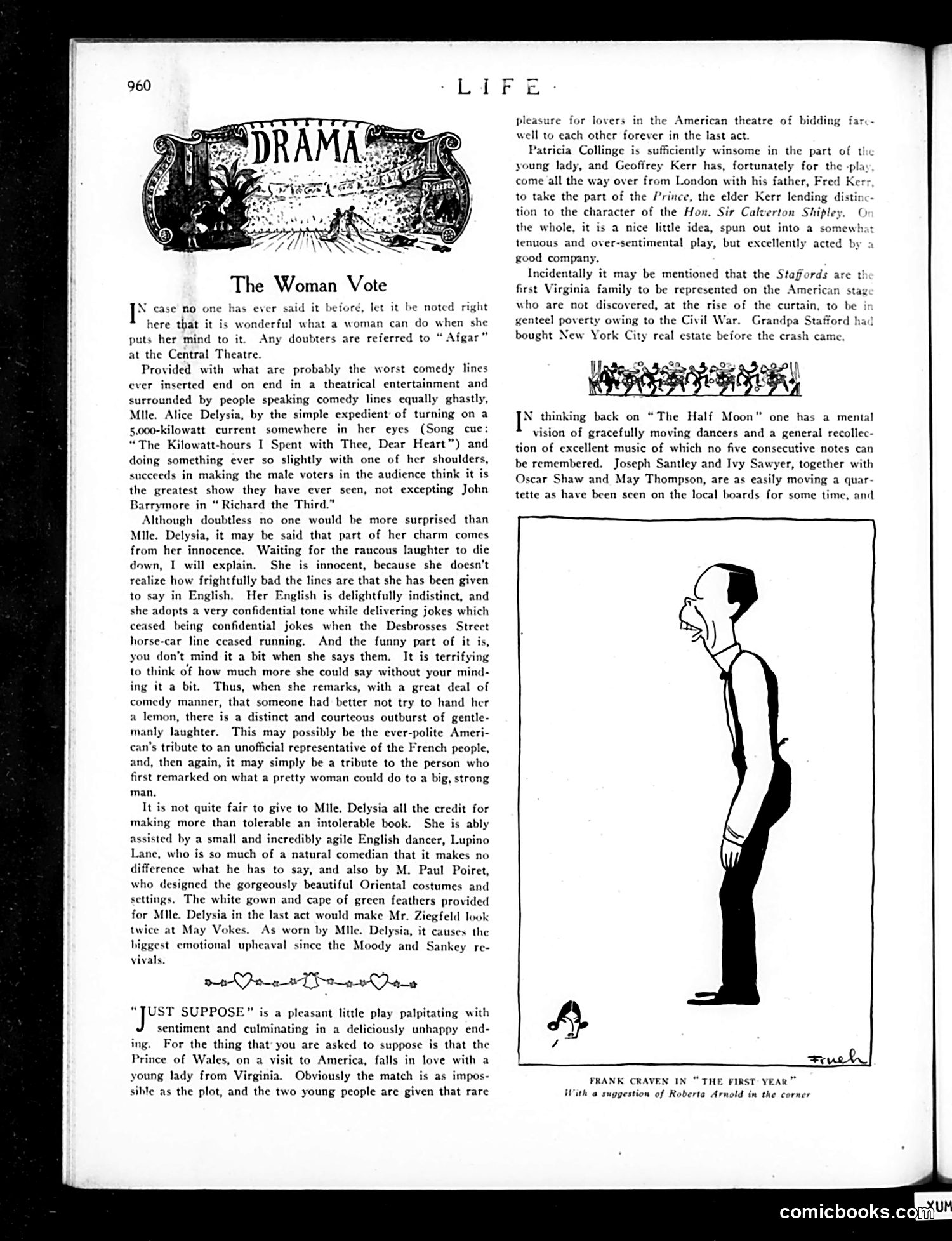
This page reviews theatrical productions, focusing on French actress Mlle. Alice Delysia in "Afgar." The critic sardonically praises how Delysia—despite delivering "probably the worst comedy lines ever inserted"—captivates male audience members through charm and charisma rather than script quality. The satire targets both the actress's manipulative appeal ("5,000-kilowatt current somewhere in her eyes") and male susceptibility to it, suggesting men will overlook terrible material if delivered by an attractive woman. The title "The Woman Vote" appears ironic: rather than serious political power, the "woman vote" here means a woman's ability to sway men through feminine wiles. The accompanying illustration of a man in formal dress further emphasizes this theme of masculine vulnerability to female charm. A secondary review discusses "Just Suppose," featuring the Prince of Wales falling for a Virginia lady—an impossibly romantic fantasy that the critic finds sentimentally overwrought.
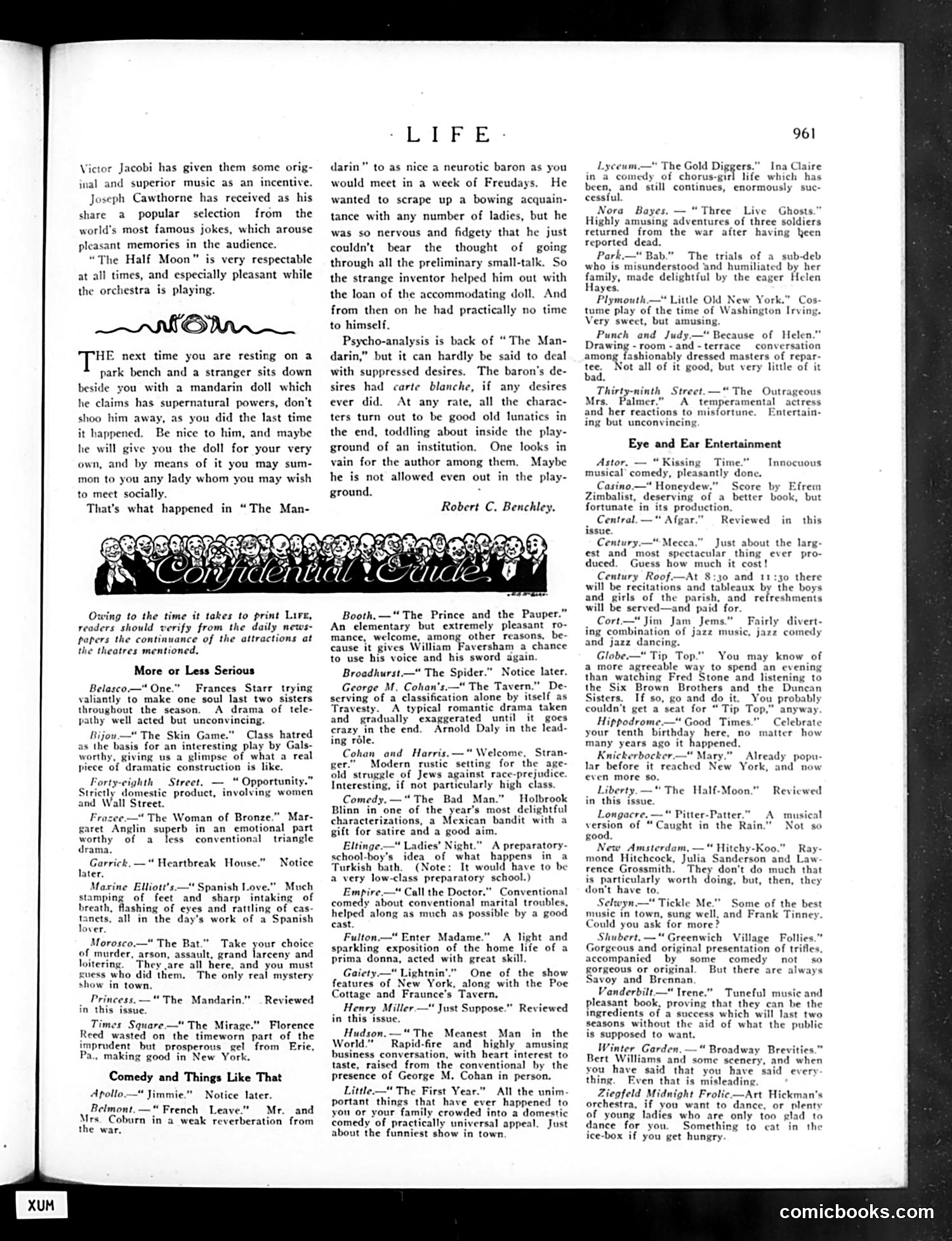
This page contains theater reviews from Life magazine's drama criticism section. The prominent illustrated cartoon labeled "Confidential Service" depicts a stylized group of faces, likely representing the theater world or gossip culture that Life frequently satirized. The main text discusses "The Mandarin," a play featuring a neurotic baron who uses a magical doll to meet women, avoiding awkward social preliminaries. Critic Robert C. Benchley notes the plot involves psycho-analysis themes, with characters ultimately revealed as "lunatics" in an institution—suggesting the play's absurdist satire of modern neurosis and social anxiety. The reviews cover various Broadway productions with brief assessments: some praised (Galsworthy's "The Skin Game"), others dismissed as conventional or weak. The tone is witty and dismissive toward sentimental drama while appreciating clever construction. This reflects Life's role as sophisticated cultural commentator mocking both theatrical pretension and audiences' tastes during the Jazz Age.
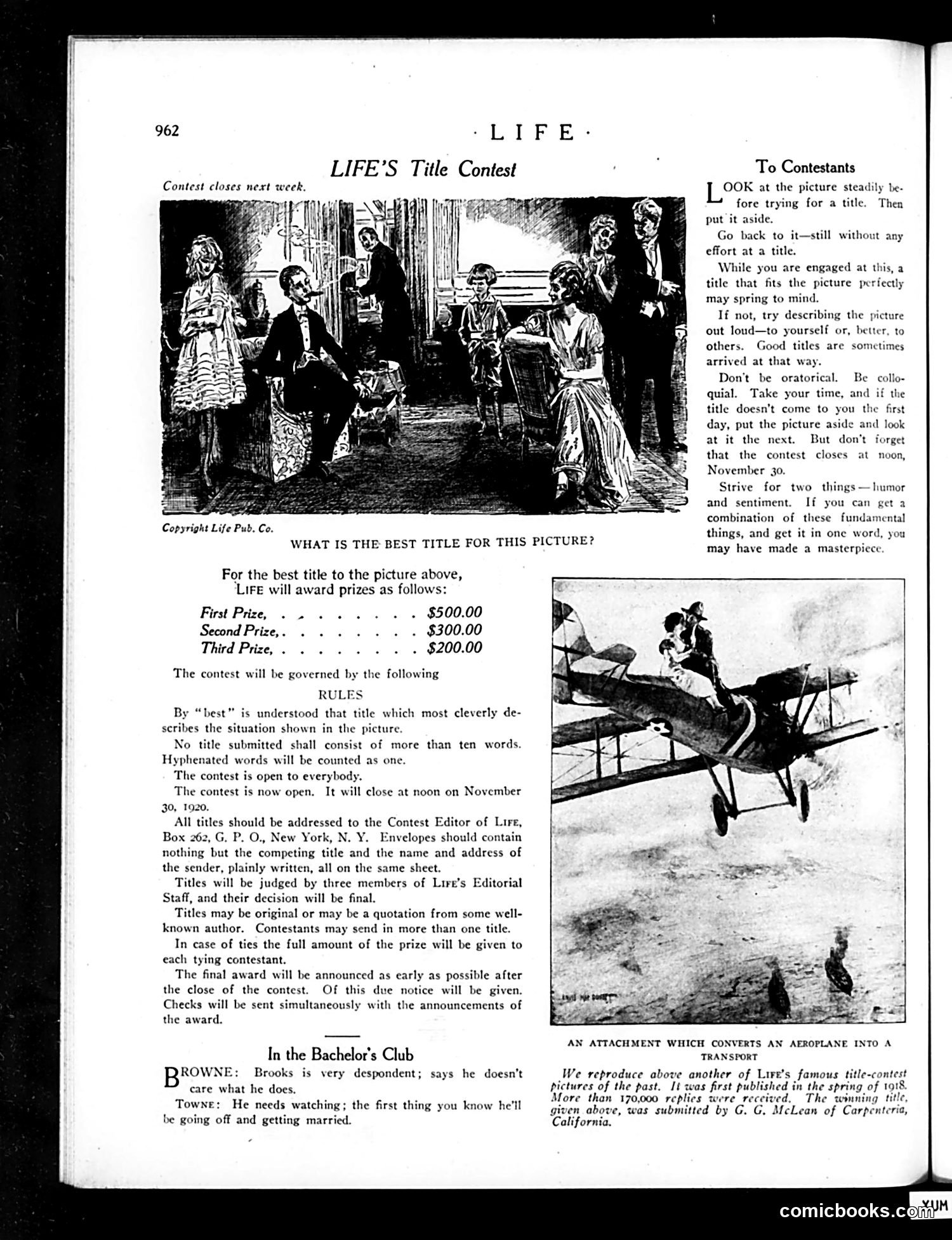
This page presents **Life's weekly title-writing contest**—a popular feature where readers submitted witty captions for illustrations. The main image shows a formal social gathering (appears to be an elegant party or reception), and readers had until November 30 to submit titles in ten words or fewer, competing for prize money ($500 first place). The contest rules emphasize combining **humor and sentiment**. The accompanying smaller image depicts an airplane modified into a transport vehicle—an engineering innovation from World War I era. The brief "Bachelor's Club" dialogue at bottom is unrelated satirical commentary: a man named Brooks is depressed, so his friend warns he'll "go off and get married" as an impulsive escape—a common comedic trope suggesting marriage as either salvation or desperate measure for unhappy men. This reflects Life's dual purpose: sophisticated humor for educated readers and interactive entertainment through reader participation contests.
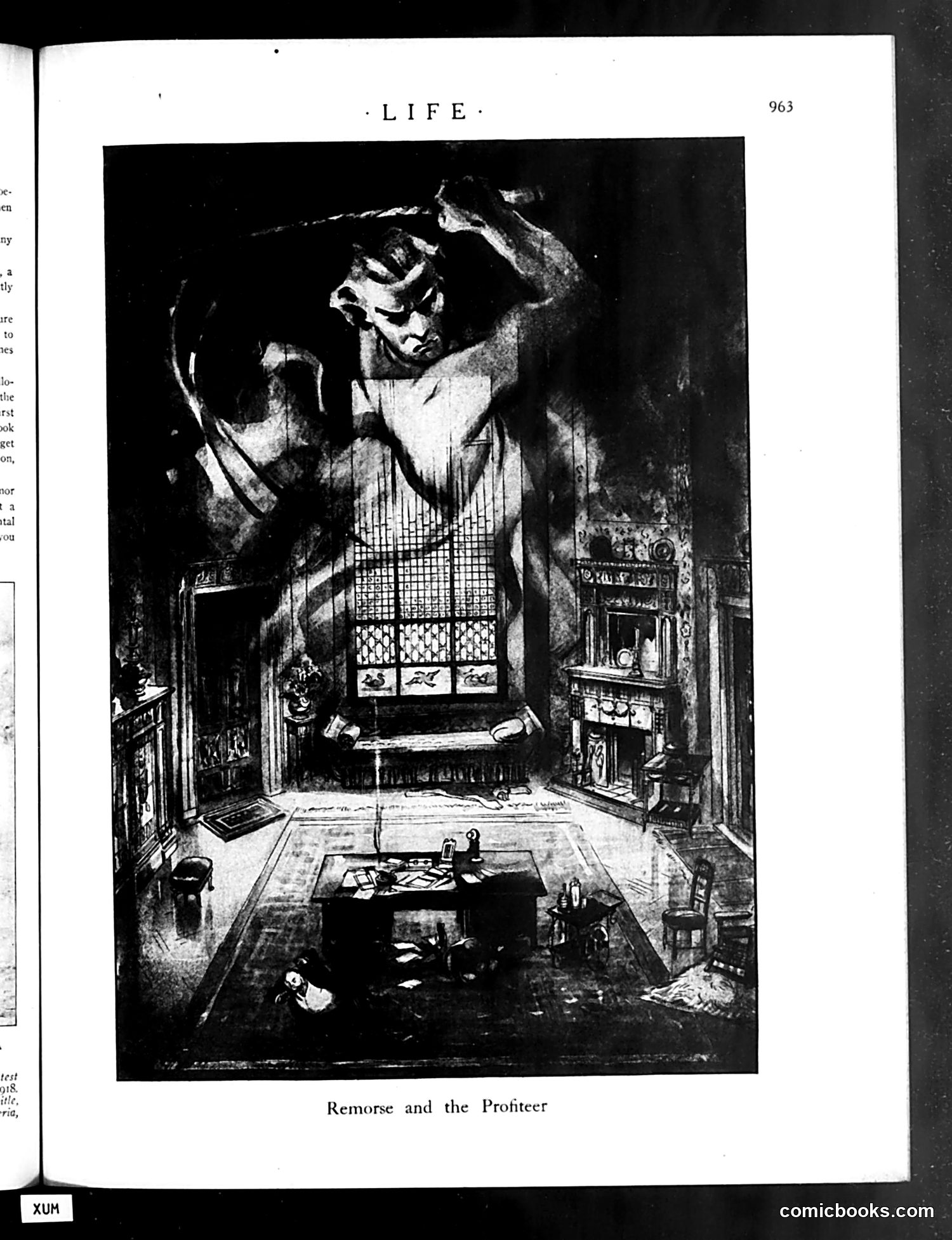
This illustration depicts a dramatic interior scene contrasting two figures: a ghostly, anguished spirit looming above and a businessman seated at a desk below, surrounded by papers and money. The title suggests a moral commentary on wartime profiteering—a common satirical target in *Life* magazine during the early 20th century. The "profiteer" (the businessman) represents someone who accumulated wealth through exploitative practices, likely during World War I. The "remorse" figure above symbolizes the moral consequences or haunting guilt of such greed. The cluttered desk and financial documents emphasize commercial gain. The satire critiques capitalists who enriched themselves while others suffered, a popular Progressive-era theme. The gothic imagery—the ghost, shadows, confined space—heightens the moral darkness of profiteering.
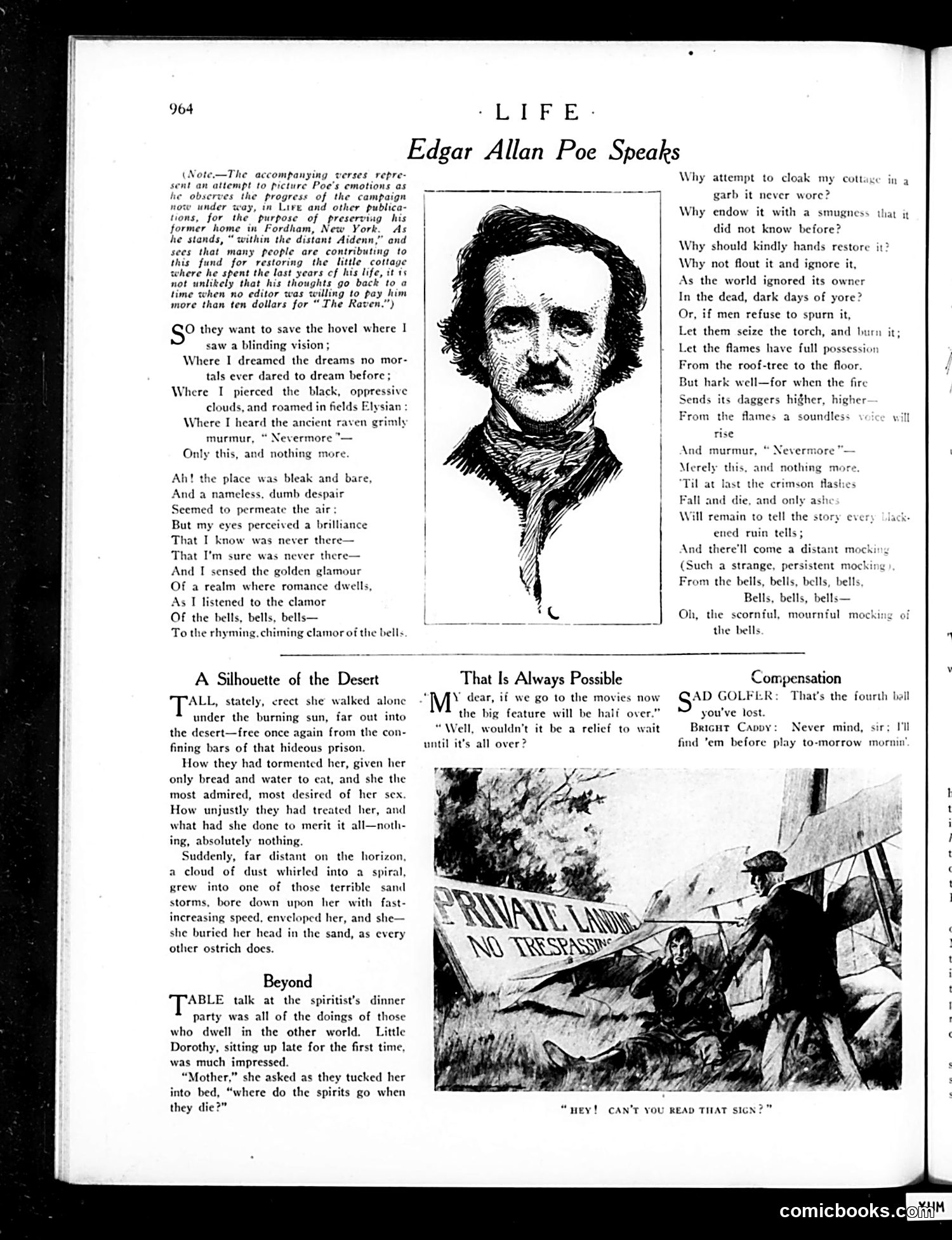
This 1909 *Life* magazine page features satirical verse attributed to Edgar Allan Poe's ghost, commenting on a contemporary fundraising campaign to preserve his former cottage in Fordham, New York. **The Main Point**: The satire is bitter social commentary. Poe's ghostly voice notes the irony that people now want to preserve and honor his modest home—yet during his lifetime, editors refused to pay him fairly (the note mentions they paid only ten dollars for "The Raven"). The verses, written in Poe's characteristic style, mock the false nostalgia: why restore the cottage to false "smugness" when he lived in actual poverty and despair there? **Supporting Details**: The accompanying note explicitly explains the campaign's purpose and the historical context of Poe's financial struggles, making the satire's target clear—the hypocrisy of posthumous veneration without lifetime support. **Other Content**: The page includes unrelated short humorous pieces and illustrations typical of *Life*'s satirical format.
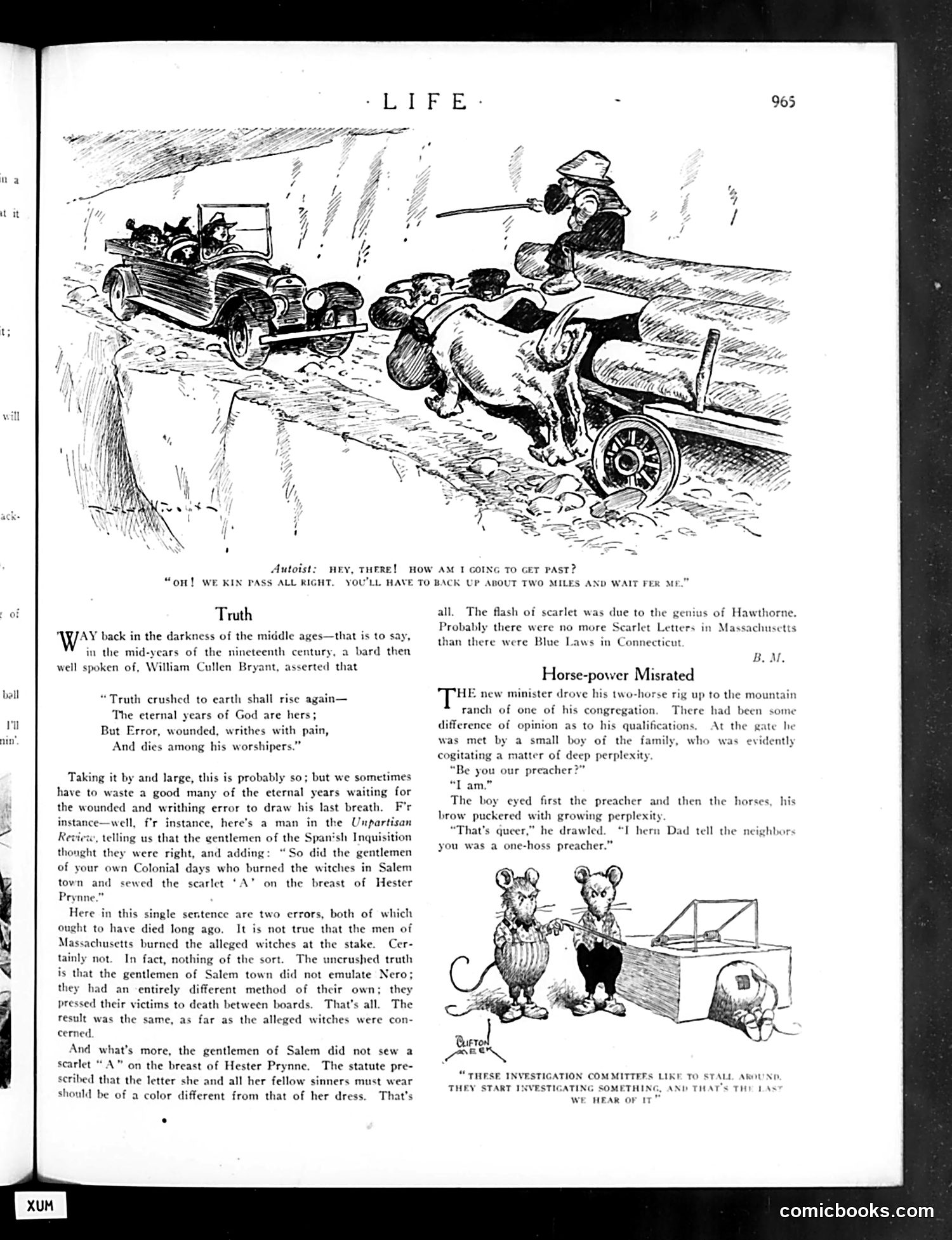
This page contains three distinct pieces of satire: **Top cartoon:** An automoblist demands passage from a farmer with a horse-drawn wagon on a narrow road. The joke mocks early auto drivers' aggressive entitlement toward slower traffic—the motorist expects the farmer to back up miles rather than compromise. **"Truth" essay:** The author corrects historical errors about Salem witch trials and Hester Prynne (*The Scarlet Letter*). He notes that Salem victims were pressed to death between boards (not burned at stake) and that Hawthorne invented the scarlet letter's vivid red color—the actual statute only required a different-colored letter. This is pedantic satire about how "errors" persist in popular memory. **"Horse-power Misrated" cartoon:** A rural boy meets a new minister arriving by two-horse buggy, expressing confusion: his father called the preacher "a one-hoss preacher"—meaning weak or ineffective. The boy's literal interpretation of "horse-power" creates the joke, satirizing both rural speech patterns and the minister's apparently limited reputation.
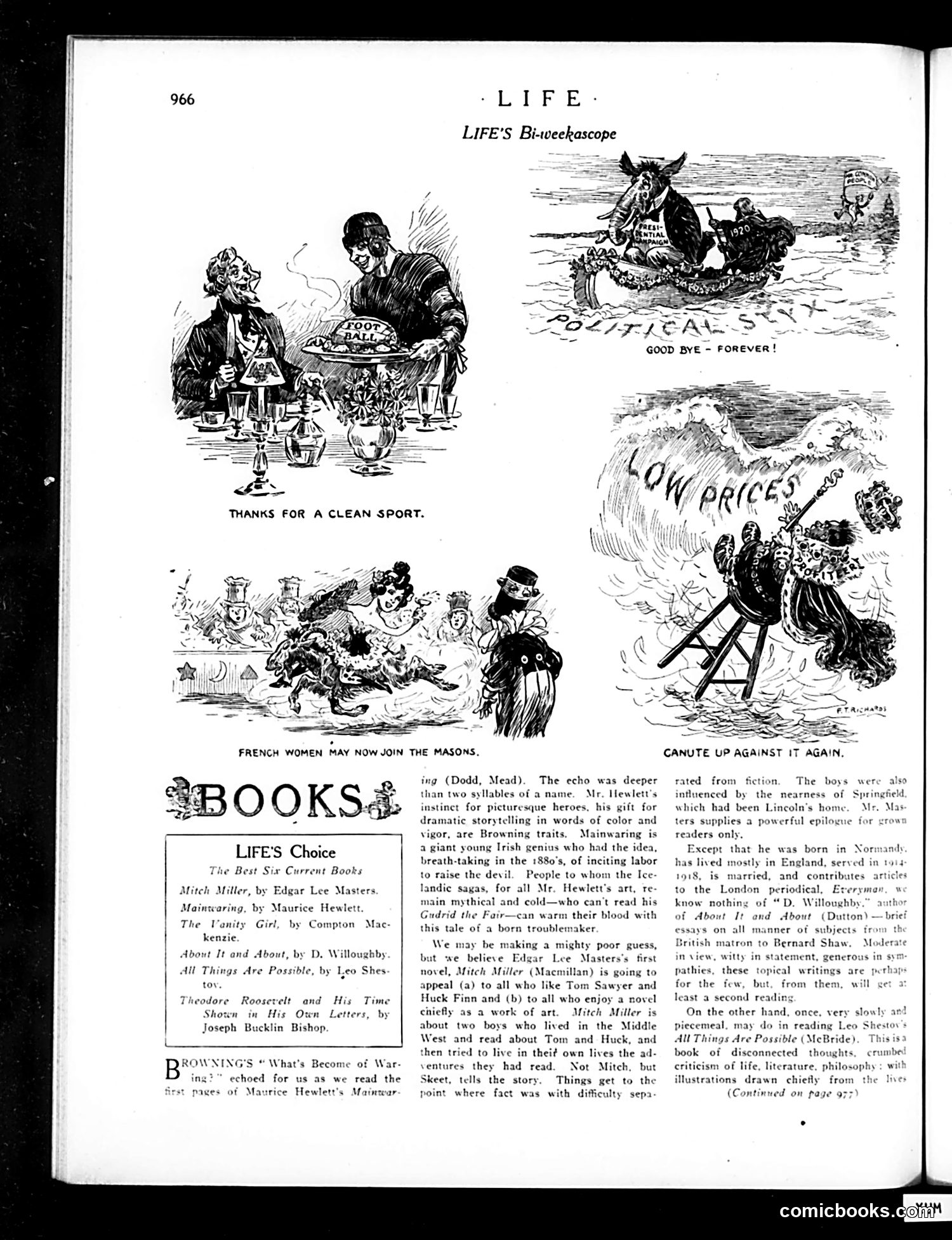
This page features **"Life's Bi-weekascope,"** a satirical prediction column. The top cartoon mocks the recent admission of French women to Freemasonry, a historically male-only organization. The image shows a woman in formal dress being welcomed into masonic circles—the satire being that this represents a dramatic social shift in traditionally exclusive male institutions. Below, "Canute Up Against It Again" references King Canute, the legendary medieval ruler who supposedly commanded the tide to stop. Here, the cartoon depicts a figure (likely representing conservative or political resistance) futilely attempting to hold back a wave labeled "Low Prices"—satirizing the impossibility of resisting economic forces or market trends. The page also contains a "Books" section reviewing contemporary literature, including works by Edgar Lee Masters and Maurice Hewlett. The overall tone mocks both social progress (women's admission to institutions) and futile political/economic resistance.
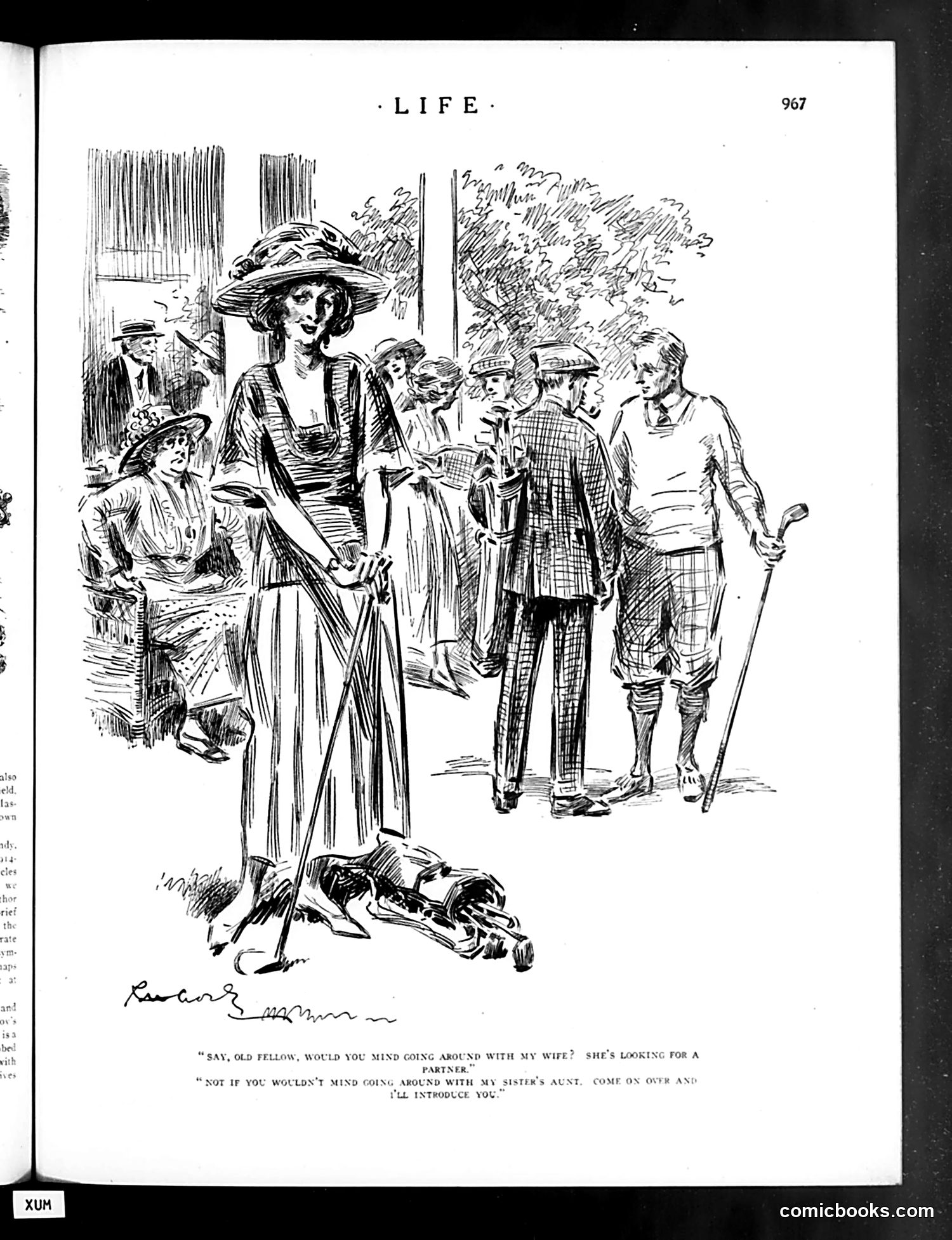
This is a satirical cartoon about social matchmaking and uncomfortable introductions. A well-dressed woman seeks a dance or social partner, and her husband offers to arrange one. The man agrees, but counters by proposing to introduce the husband to his "sister's aunt"—a deliberately vague and distant relative, suggesting he's being deliberately unhelpful or evasive. The joke mocks the awkwardness of social obligation and tit-for-tat barter in polite society. By offering such a remote family connection ("sister's aunt"), the man deflates the husband's confident proposal with absurdist humor. The cartoon satirizes how people navigate social arrangements and the potential ridiciculousness of obligatory introductions among acquaintances. The signature appears to be by the cartoonist, though it's not clearly legible.
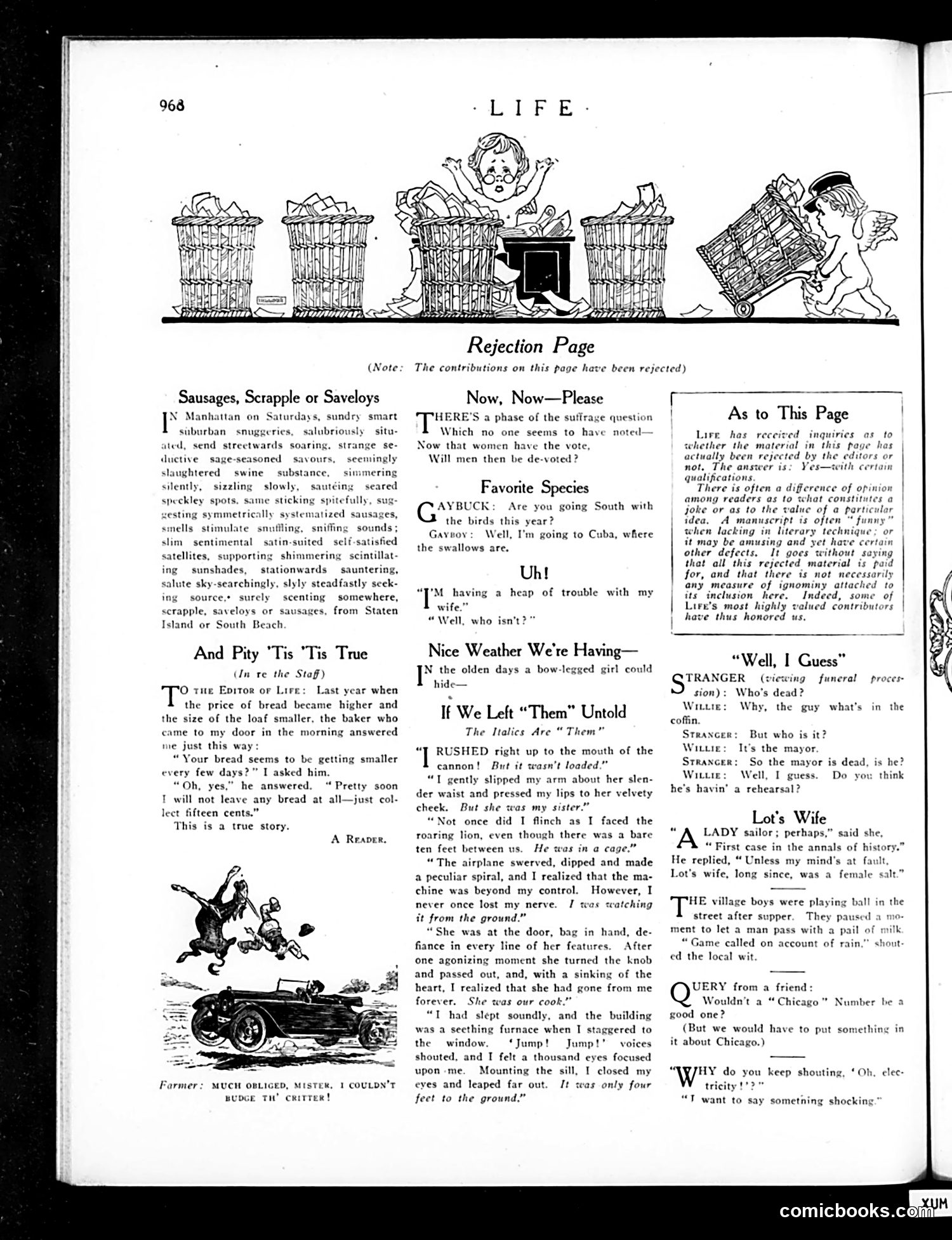
This page is explicitly labeled as containing rejected submissions to Life magazine. The satirical content illustrates why these pieces didn't make the cut: **Top cartoon**: Shows a chaotic "rejection" process with overflowing baskets of submissions and a frantic editor, humorously depicting the volume of material Life receives. **Content examples**: The rejected pieces include: - A laborious alliterative piece about sausages (excessive wordplay) - A tired joke about women's suffrage ("Will men then be de-voted?") - Weak punchlines and contrived setups throughout - Stories undermined by obvious twists (the "fierce lion" is caged; the dangerous plane fall is only four feet) **The point**: Life is satirizing bad amateur humor—overwrought writing, predictable jokes, and stories that undercut their own drama with parenthetical "gotchas." The explanatory box clarifies that rejection doesn't mean the material is valueless, just that editors deemed it unsuitable, acknowledging subjective judgment and occasional missteps.
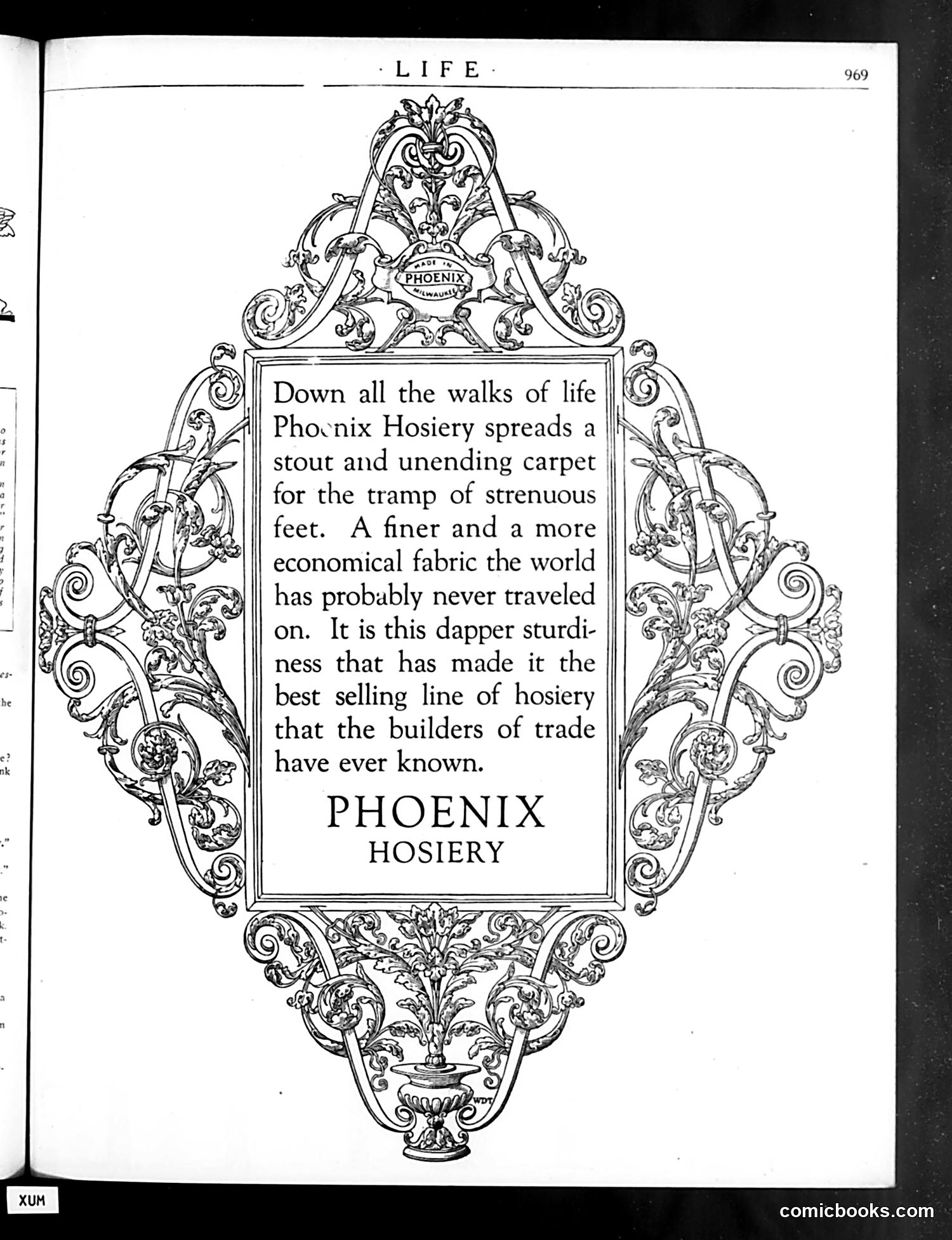
This is a **full-page advertisement**, not a cartoon or satire. It promotes Phoenix Hosiery, a brand of socks or stockings. The ornate decorative border—featuring elaborate scrollwork, flourishes, and a phoenix emblem at the top—creates a formal, luxurious aesthetic designed to elevate the product's perceived value. The text uses metaphorical language common to early 20th-century advertising: hosiery is described as a "carpet" supporting people through life's "walks" and "strenuous" activities. It emphasizes both durability ("sturdy") and economy ("economical"). The visual grandeur contrasts with the mundane product, a marketing technique meant to make everyday hosiery seem prestigious and desirable. This is pure advertising copy, not social commentary or satire.
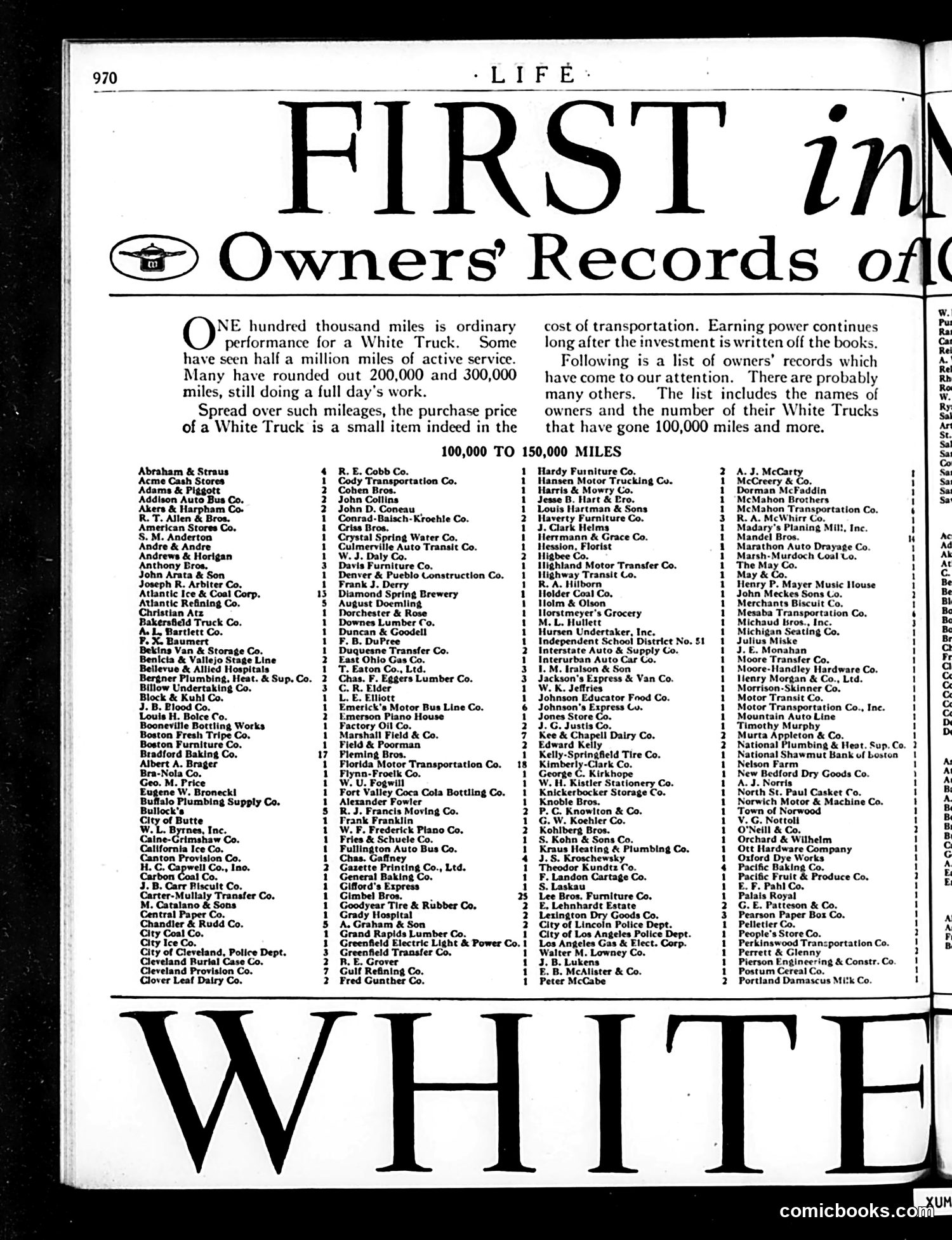
This is an advertisement for White Trucks, not a cartoon. The page from *Life* magazine presents a list of business owners' records documenting White Truck durability. The ad claims that 100,000+ miles represents ordinary performance, with some vehicles reaching 200,000-300,000 miles while still functioning fully. The text argues that despite the initial purchase price, the truck's earning power over its extended lifespan makes it economical. The lengthy list of company names (bakeries, furniture stores, transportation firms, etc.) serves as testimonial proof—showing that diverse American businesses across multiple industries have successfully operated White Trucks to these mileage milestones. This was a common advertising strategy of the era: building credibility through exhaustive documentation of satisfied customers.
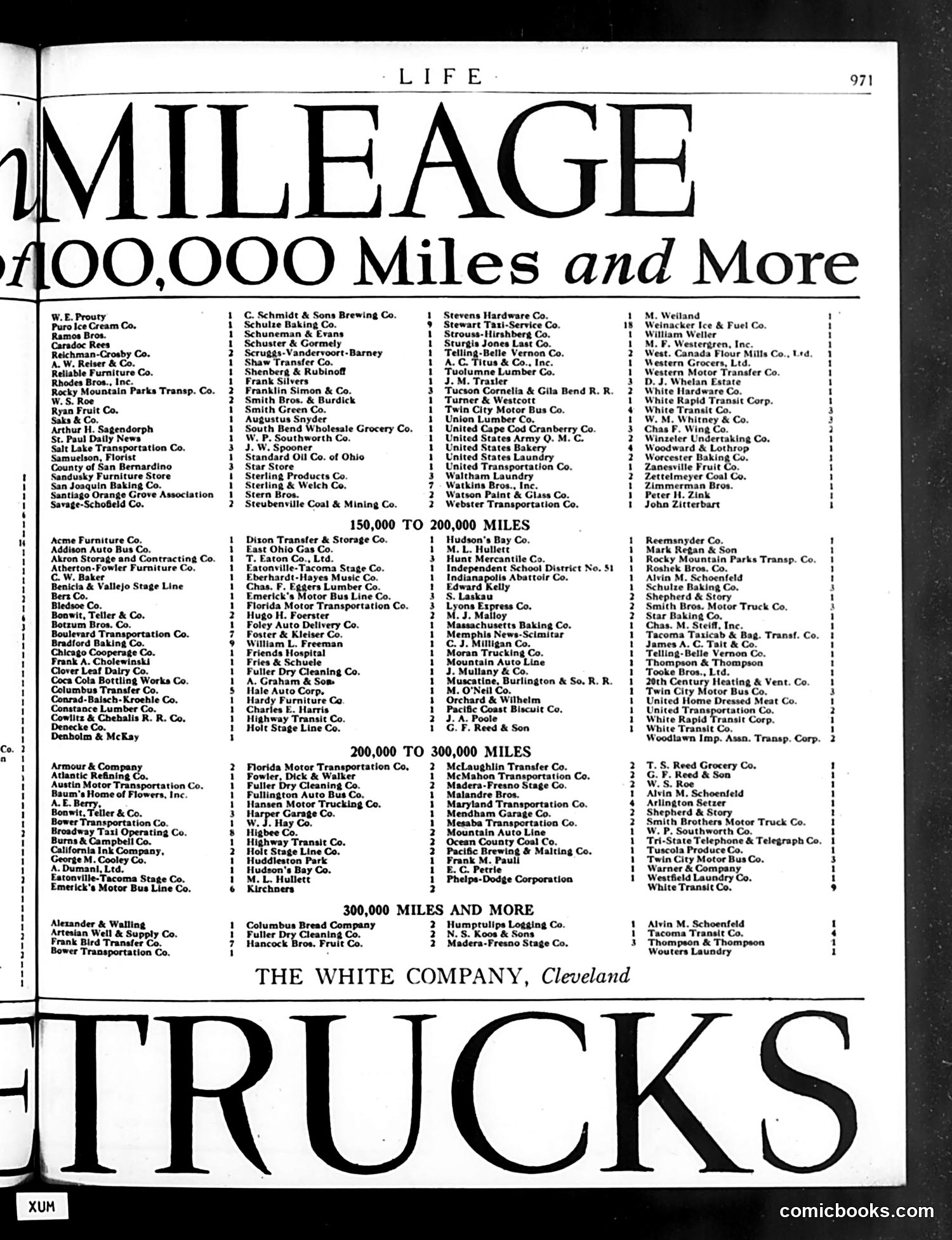
This page is primarily **advertising**, not a cartoon or satirical content. It's a directory listing companies organized by their vehicle mileage usage—categorized into "100,000 Miles and More," "150,000 to 200,000 Miles," "200,000 to 300,000 Miles," and "300,000 Miles and More." The page advertises **The White Company of Cleveland**, a truck manufacturer. By organizing businesses by mileage, the ad implicitly endorses White trucks' durability and reliability—these companies collectively logged enormous miles, demonstrating product quality. The listing includes diverse enterprises: furniture stores, bakeries, transportation services, laundries, and gas companies. This variety suggests White trucks served all commercial sectors, positioning the company as essential infrastructure for American business.
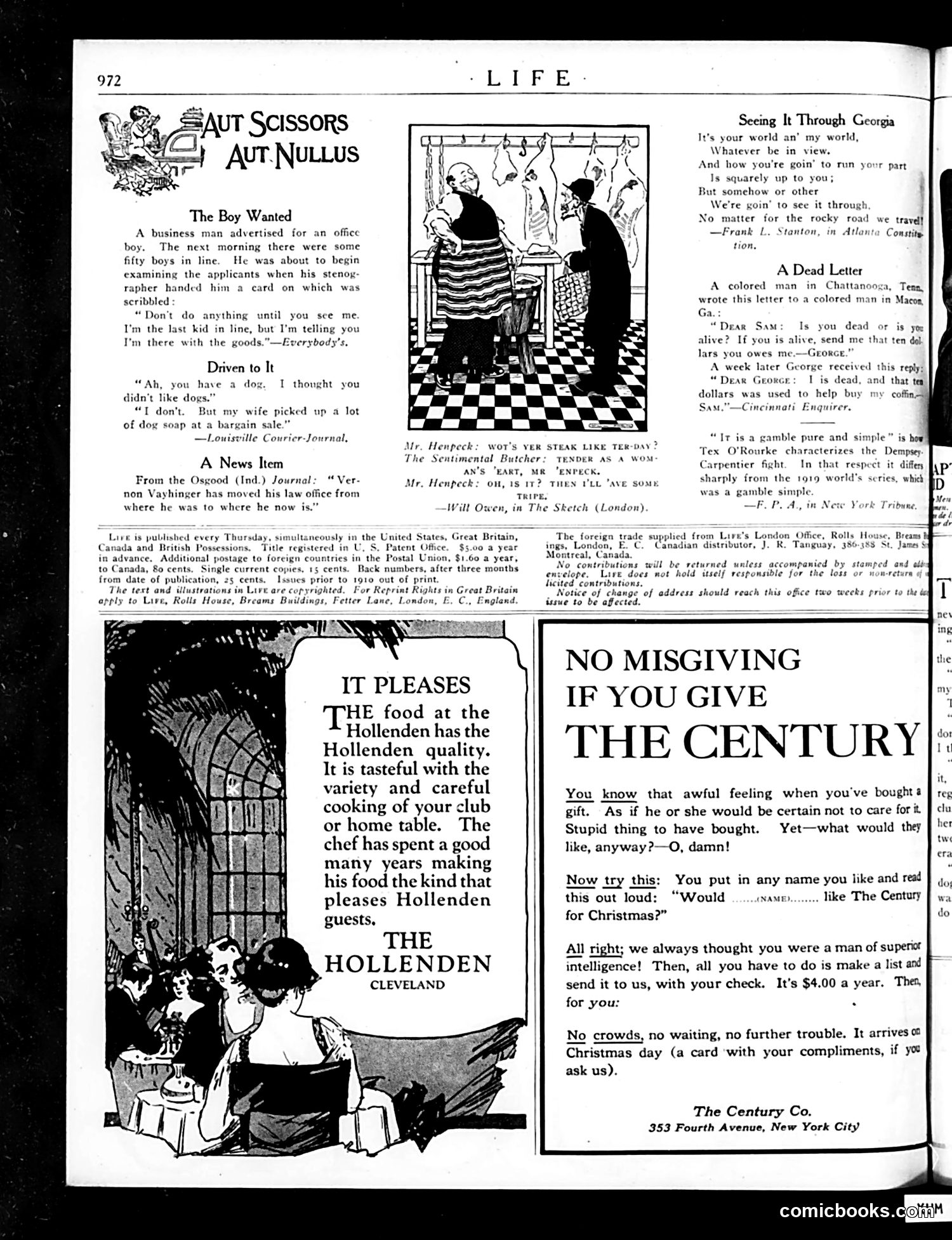
This page contains **short humorous anecdotes** rather than political cartoons. The jokes reflect early 20th-century American attitudes: **"The Boy Wanted"** and **"Driven to It"** are brief comedic stories illustrating workplace and domestic frustrations—a boy's self-promotion at a job interview, a man forced to buy dog soap after his wife adopts a stray. **"A News Item"** satirizes local journalism's trivial reporting (a man moving his office from one location to another). The central cartoon depicts **"The Sentimental Butcher,"** showing a butcher selecting meat while anthropomorphizing it—addressing a steak as a woman. This satirizes misplaced sentimentality: the butcher treats his merchandise tenderly while still selling meat, mocking emotional inconsistency. The advertisements below (Hollenden restaurant, The Century magazine subscription) are period marketing. **"A Dead Letter"** jokes about a freed African American debt collector using creative accounting—the debtor claims death to escape repayment. The page emphasizes humor through wordplay, domestic situations, and character ironies typical of Life's satirical style.
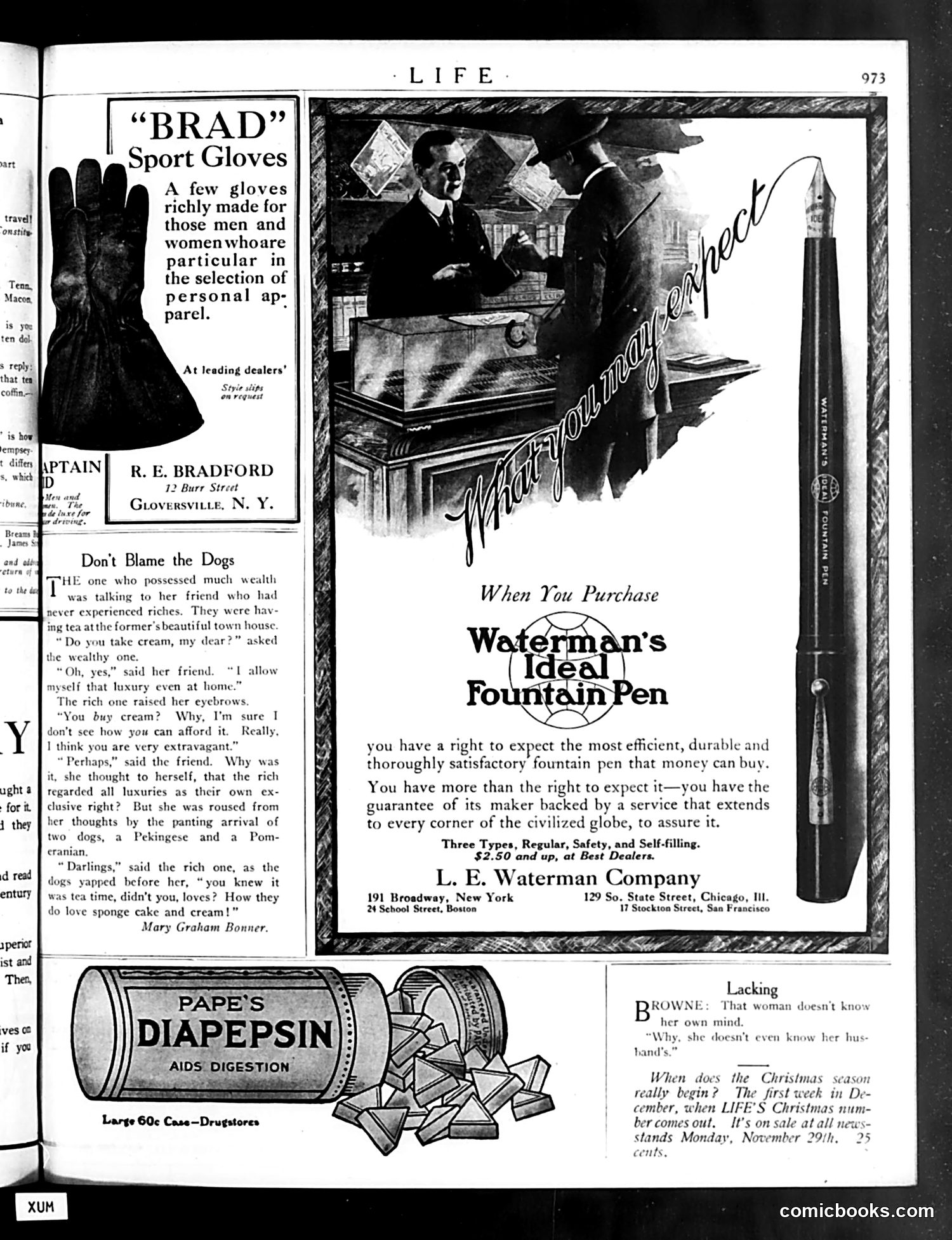
This page contains mostly **advertisements and a brief satirical story**, not political cartoons. The main content is "Don't Blame the Dogs," a social satire by Mary Graham Bonner mocking wealthy hypocrisy. A rich woman criticizes her poorer friend for buying cream as an "extravagant" luxury—then is caught lavishing the same cream on her pet dogs, who "love sponge cake and cream." The joke exposes the absurdity of the wealthy: they deny modest comforts to those below them while indulging their animals with luxuries. It's a class-consciousness satire common to Life's tradition of gentle social criticism. The advertisements include "Brad" sport gloves, Waterman's fountain pens, and Pape's Diapepsin digestive aid—typical early-20th-century consumer goods marketing. A brief note announces Life's Christmas issue availability, suggesting this is from late November.
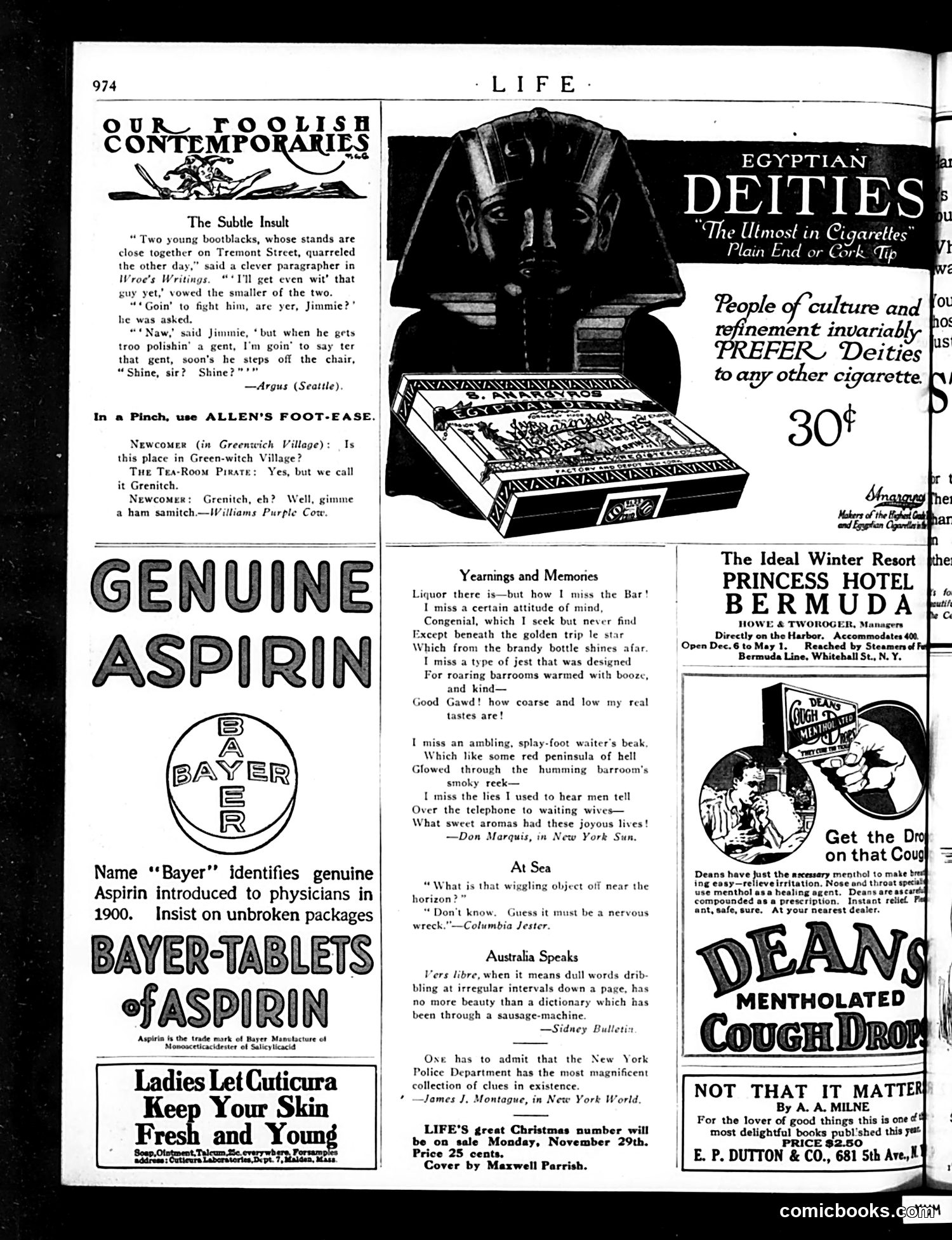
This is primarily an **advertising and humor page** from Life magazine, circa 1920s. The main content includes: **"Our Foolish Contemporaries"** — A humor section featuring brief satirical anecdotes. The featured story mocks bootblacks on Tremont Street: one boy subtly undermines his rival by suggesting customers get a "shine" after the competitor finishes, implying the work was inadequate. A second joke about Greenwich Village mocks the pretentious pronunciation ("Grenitch") and affected speech of Village residents, then plays on a customer's malapropism ("ham samitch"). **Advertisements** dominate: Bayer Aspirin, Egyptian Deities cigarettes, Allen's Foot-Ease, Dean's Mentholated Cough Drops, and the Princess Hotel Bermuda. **Poetry section** titled "Yearnings and Memories" — nostalgic verses about missing pre-Prohibition barroom culture, including its crude humor and casual deceptions. The page's satire targets: working-class competitiveness, Greenwich Village affectation, and (implicitly) post-Prohibition longing for old tavern life.
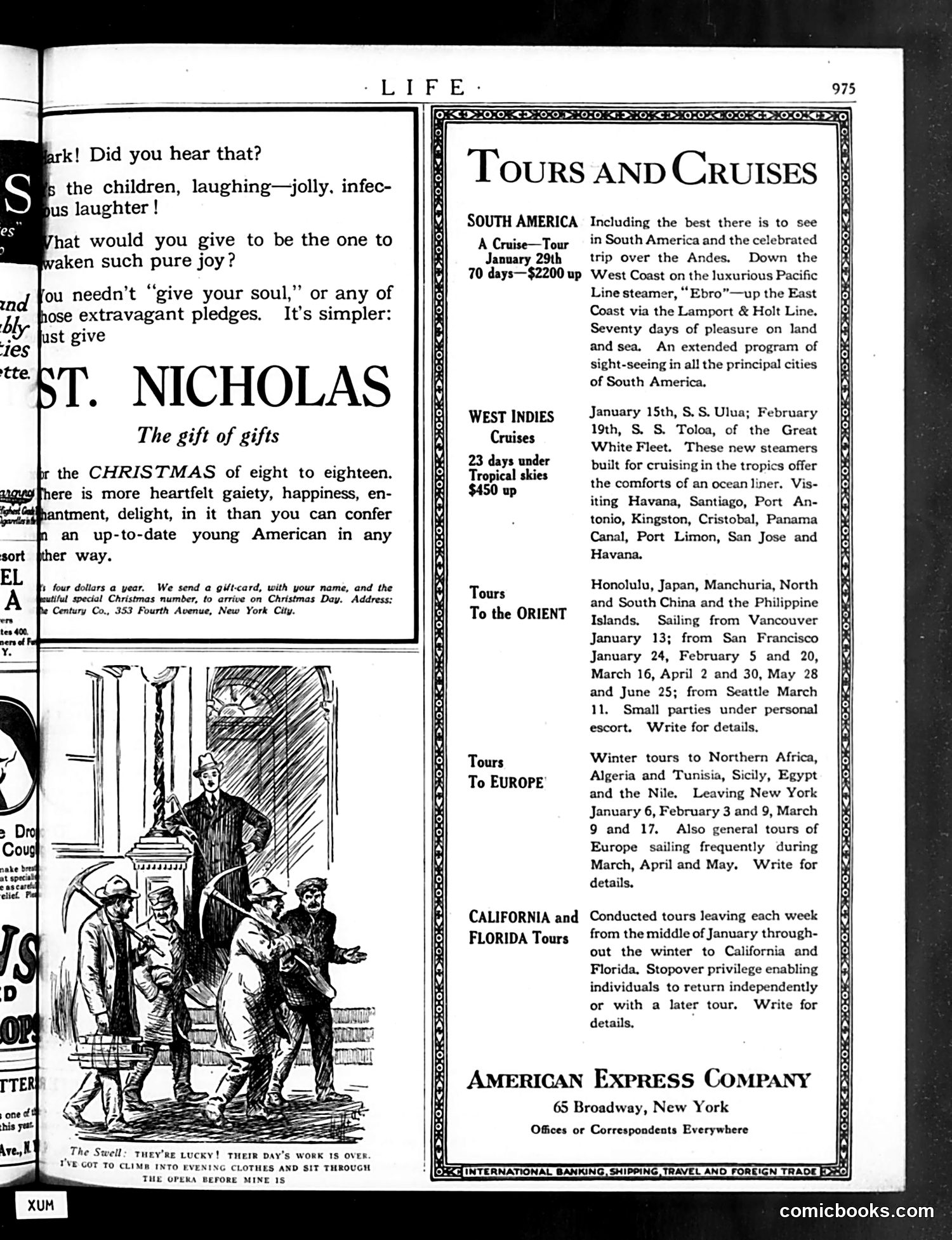
This page is primarily **advertising content** rather than editorial satire. The bulk consists of travel advertisements from American Express Company, promoting luxury cruises and tours to South America, the West Indies, the Orient, Europe, and domestic destinations like California and Florida. The small cartoon at bottom depicts "The Swell"—a wealthy man in evening clothes complaining that his social obligations (attending the opera) represent work, while working-class people can rest after their day ends. This is gentle **class satire**: the joke mocks the upper class's self-pitying attitude toward leisure activities they consider burdensome compared to laborers' simpler pleasures. The left column contains an advertisement for "St. Nicholas" magazine as a Christmas gift for children, emphasizing wholesome entertainment and cultural refinement for young Americans. The overall page reflects **early 20th-century American consumer culture**, targeting affluent readers interested in conspicuous leisure travel and cultural consumption.
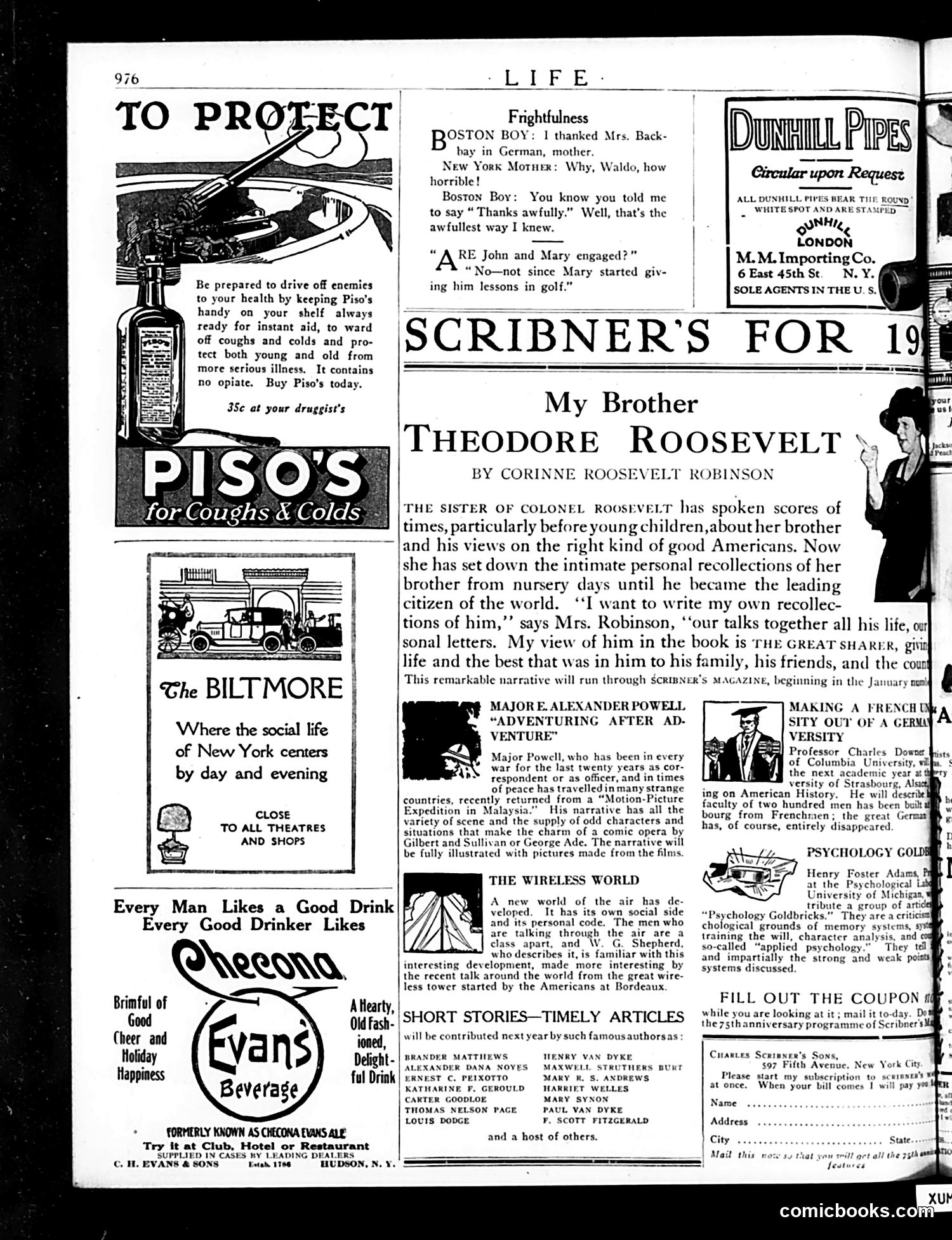
This page mixes advertisements with editorial content announcing upcoming Scribner's Magazine features. The main satirical content appears in the brief humor section titled "Frightfulness": A Boston boy thanks a German woman in German, causing his New York mother to react with horror—calling it "horrible." The joke satirizes post-WWI American attitudes toward Germany. "Frightfulness" (*Schrecklichkeit*) was a specific propaganda term used during WWI to describe alleged German brutality. The boy's mother finds even polite German speech disturbing, reflecting the anti-German sentiment prevalent in American culture immediately after the war. The second joke about John and Mary's engagement plays on the frustration of golf lessons—a common domestic comedy theme of the era. The advertisements (Piso's cough medicine, Evans Beverages, The Biltmore Hotel) represent typical period marketing. The page primarily announces Scribner's Magazine upcoming serialization of Corinne Roosevelt Robinson's memoir about her brother Theodore Roosevelt, plus other features and contributors.
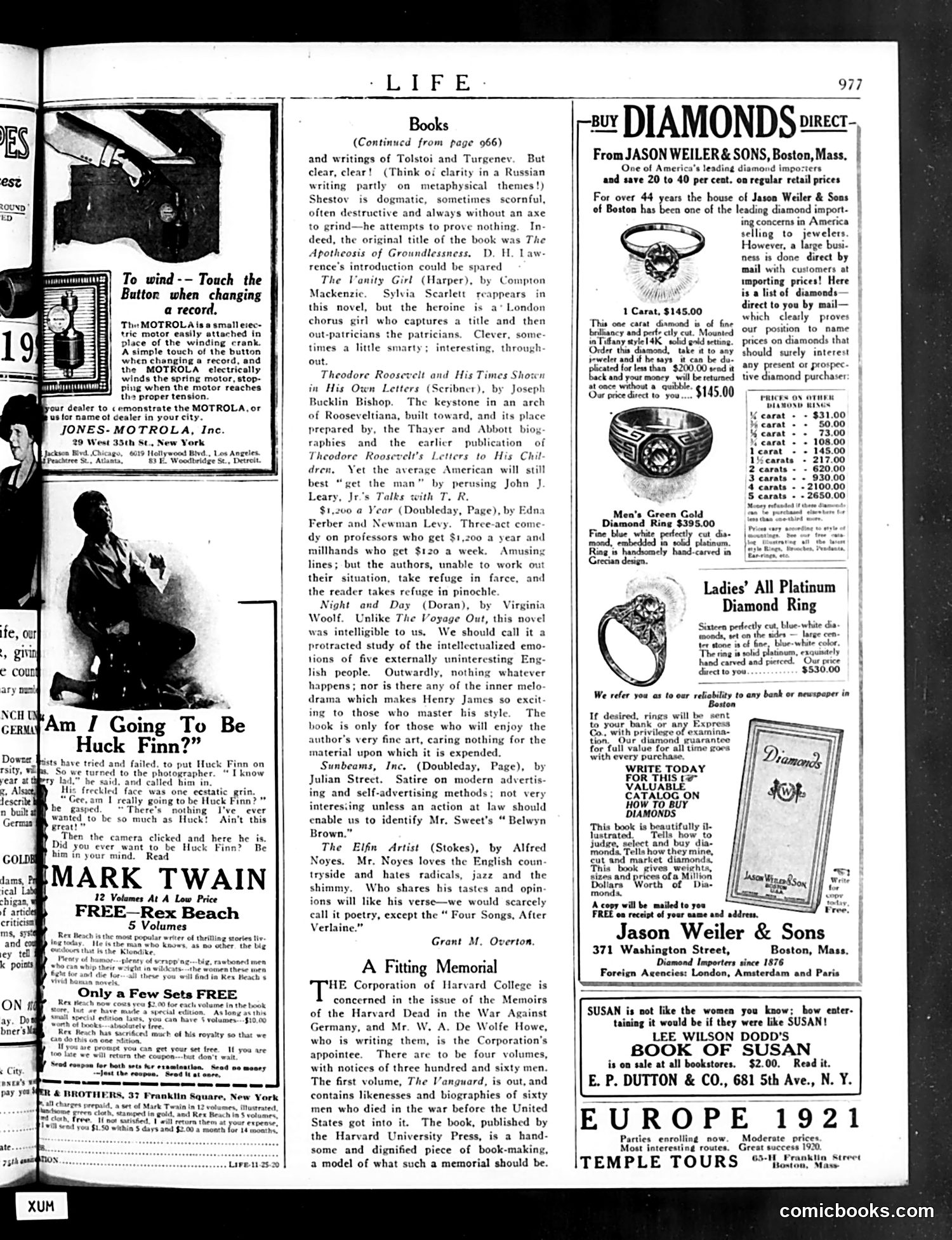
This page combines book reviews with vintage advertising. The main content includes critical assessments of contemporary literary works by authors like Virginia Woolf, Edna Ferber, and Julian Street. The reviews employ Life's characteristic sardonic tone—praising Woolf's literary skill while noting her work offers nothing to "those who will enjoy the author's very fine art, caring nothing for the material." The cartoons include a humorous piece titled "Am I Going To Be Huck Finn?" showing a young man who claims to want to embody Mark Twain's character, accompanied by promotional offers for Twain's collected works and Rex Beach novels. The advertisements—for Motorola record players, diamond rings from Jason Weiler & Sons, and European tours—reflect 1920s consumer goods and leisure activities targeting educated, affluent readers. The page exemplifies Life's role as a cultural arbiter blending literary criticism with aspirational advertising.
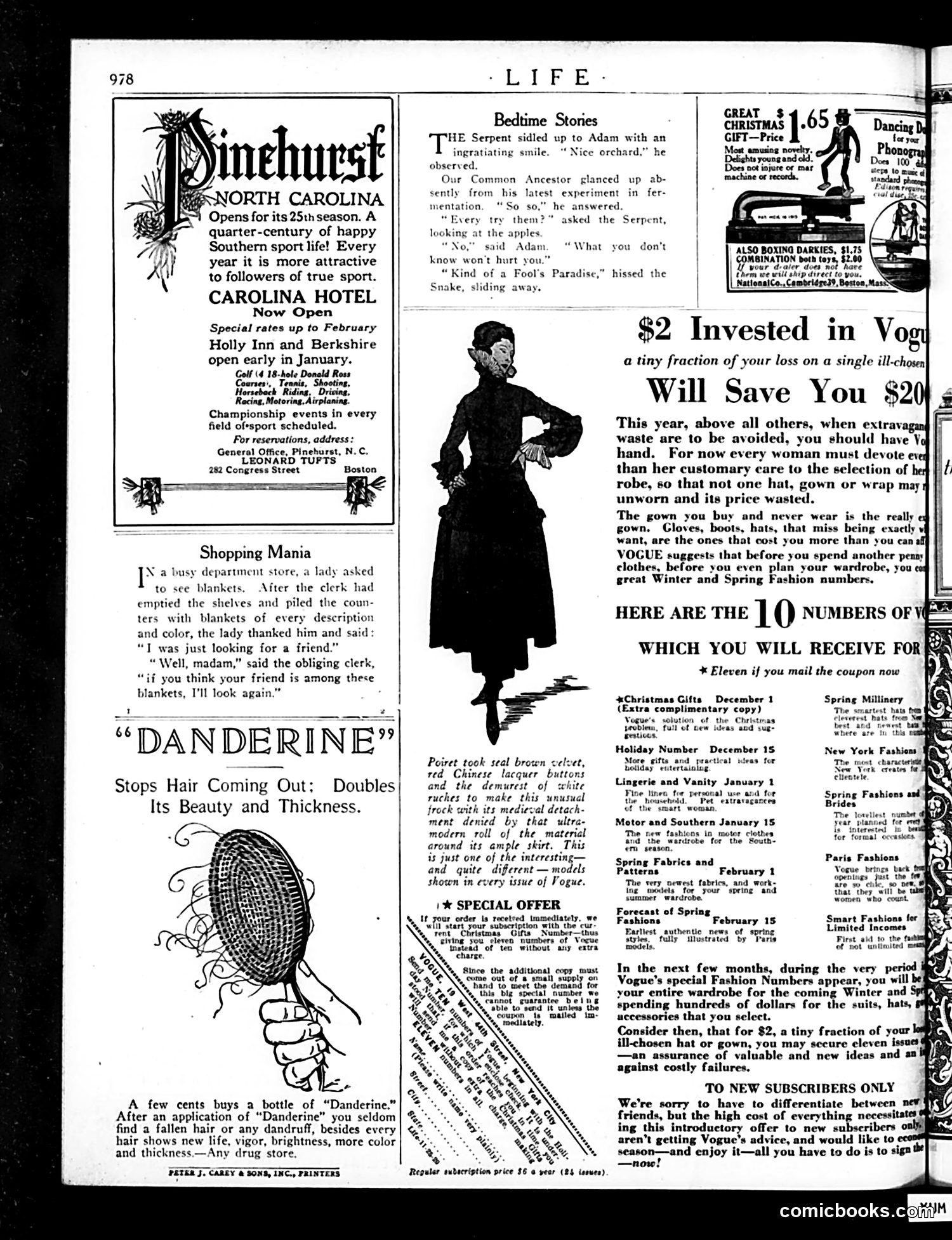
This page primarily features **advertisements and light humor** rather than political satire. **"Shopping Mania"** is a mild joke about department store excess: a woman asks to see blankets, exhausts the clerk by viewing every option, then reveals she was "just looking for a friend"—the humor lying in the absurdity of her vague request wasting the clerk's effort. **"Bedtime Stories"** is a whimsical retelling of the Adam and Eve temptation, with the Serpent tempting Adam to try apples from the garden. It's gentle, not satirical. **"Danderine"** is a hair-loss product advertisement claiming to stop hair loss and increase thickness. The dominant content is **Vogue magazine advertising**, promoting subscription deals for fashion issues with fashion illustration of a woman in winter coat. The pitch emphasizes avoiding clothing waste during economically conscious times, suggesting this is from the World War I era (likely around 1917-1918) when wartime frugality was emphasized. The page is primarily **commercial**: resort hotel advertising, product pitches, and magazine subscriptions dominate over editorial content.
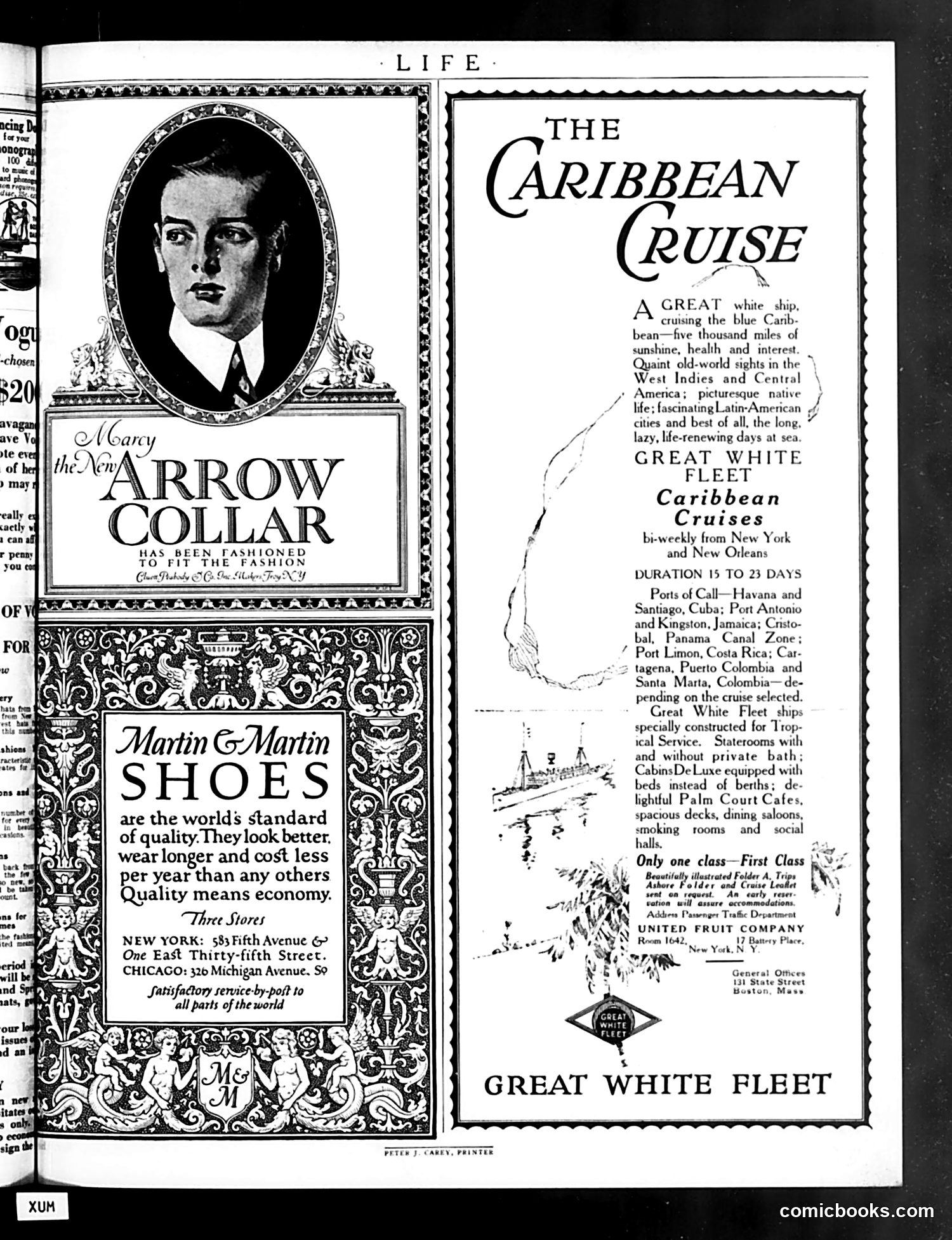
This is primarily an **advertising page**, not a political cartoon. It contains three distinct advertisements: 1. **"Arrow Collar" ad** (left): Features a male portrait promoting fashionable collars, with the tagline that they've been "fashioned to fit the fashions." This reflects early 20th-century men's fashion marketing. 2. **"Martin & Martin Shoes"** (lower left): Emphasizes quality and economy, with stores in New York and Chicago offering mail service worldwide. 3. **"Caribbean Cruise" ad** (right): The dominant advertisement promotes the Great White Fleet's Caribbean cruises departing from New York and New Orleans, lasting 15-23 days. It highlights tropical ports (Cuba, Jamaica, Panama, Costa Rica, Colombia) and ship amenities for "First Class" passengers seeking leisurely vacation travel. The "Great White Fleet" appears to reference actual cruise ships rather than the historical U.S. Navy fleet. This page demonstrates early 20th-century consumer culture targeting affluent readers seeking luxury travel and fashion goods.
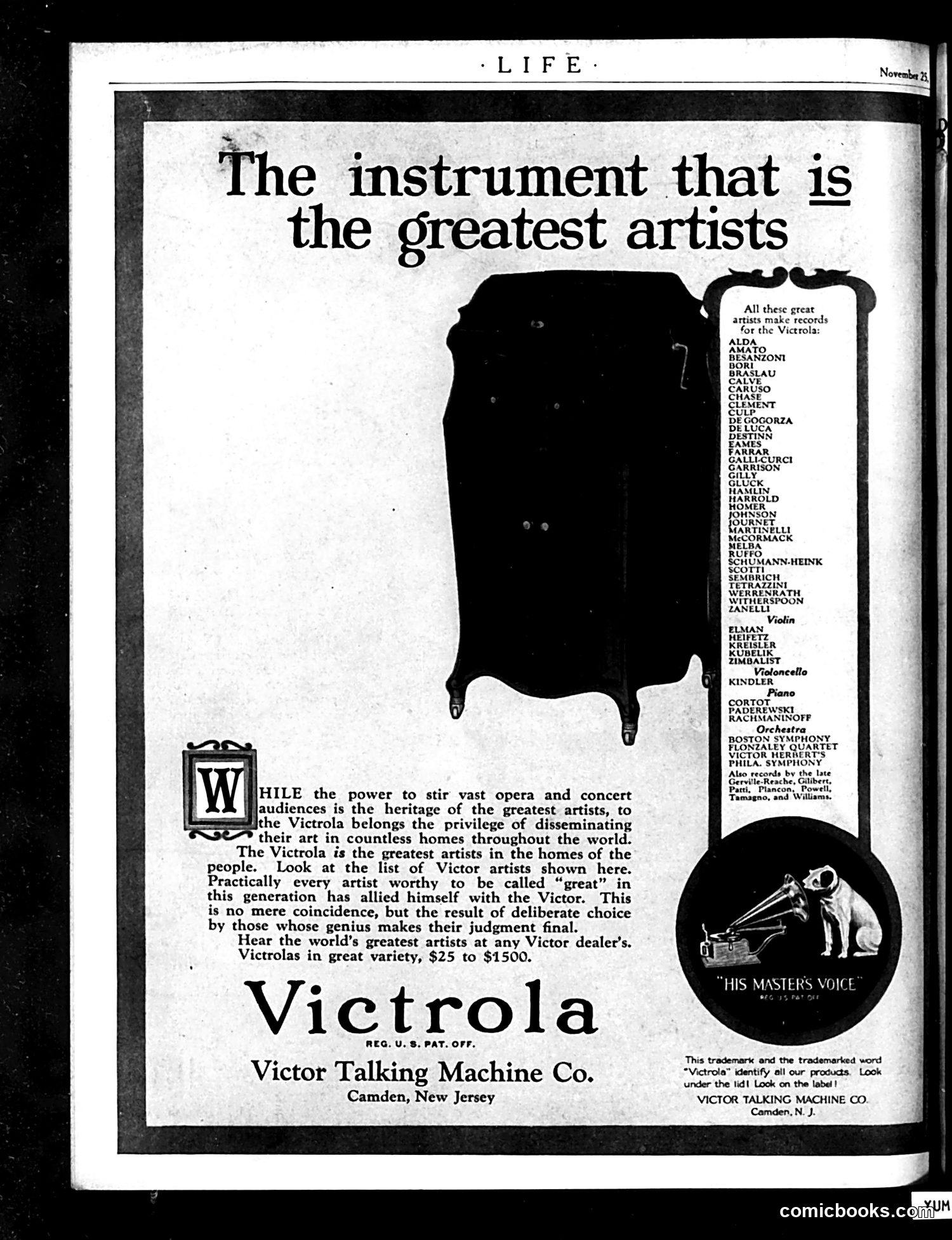
This is a **Victrola advertisement**, not political satire. The page promotes the Victor Talking Machine Company's phonograph by claiming it's "the instrument that is the greatest artists"—meaning the greatest artists choose to record for it. The silhouette of a gramophone dominates the visual. The text lists dozens of famous opera singers, violinists, and orchestras (Caruso, Melba, Paderewski, Boston Symphony, etc.) to suggest that owning a Victrola gives ordinary households access to world-class performances. The argument is straightforward advertising: elite musicians wouldn't associate with an inferior product, so the Victrola's endorsement by these luminaries proves its quality. Priced "$25 to $1500" (substantial sums in this era), it's positioned as a luxury good that brings high culture into homes. There is no satire here—this is earnest commercial persuasion targeting middle-class aspirations for refined entertainment.

I can see this is a page from Life magazine (indicated by the "comicbooks.com" credit at bottom), but the image is almost entirely black or severely underexposed, making it impossible to discern any cartoon, text, figures, or satirical content. The left margin shows what appears to be a white binding edge with a partial label at the top, and the bottom left corner displays "XUM" (possibly a reference number or code). However, without visible cartoon illustrations or legible text beyond the OCR attribution, I cannot identify the political figures, social references, or satirical intent of any content on this page. A clearer image would be needed for proper analysis.