
Life, 1920-11-25 · page 29 of 45
Life — November 25, 1920 — page 29: what you’re looking at
What you’re looking at
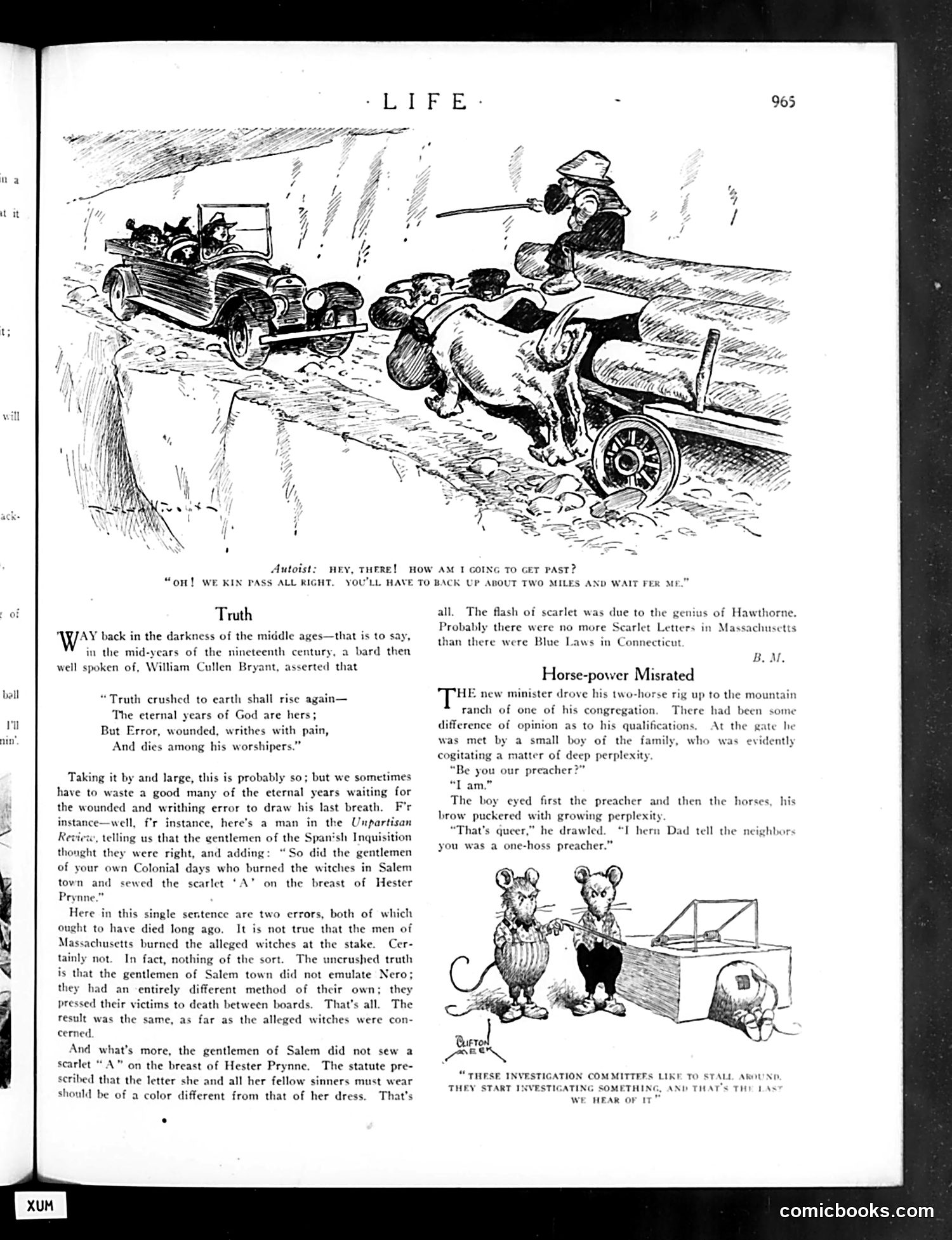
This page contains three distinct pieces of satire: **Top cartoon:** An automoblist demands passage from a farmer with a horse-drawn wagon on a narrow road. The joke mocks early auto drivers' aggressive entitlement toward slower traffic—the motorist expects the farmer to back up miles rather than compromise. **"Truth" essay:** The author corrects historical errors about Salem witch trials and Hester Prynne (*The Scarlet Letter*). He notes that Salem victims were pressed to death between boards (not burned at stake) and that Hawthorne invented the scarlet letter's vivid red color—the actual statute only required a different-colored letter. This is pedantic satire about how "errors" persist in popular memory. **"Horse-power Misrated" cartoon:** A rural boy meets a new minister arriving by two-horse buggy, expressing confusion: his father called the preacher "a one-hoss preacher"—meaning weak or ineffective. The boy's literal interpretation of "horse-power" creates the joke, satirizing both rural speech patterns and the minister's apparently limited reputation.
📄 Transcribed text from this page (OCR, searchable)
Machine-transcribed from the original scan — historical spelling and the odd misread are preserved.
Autoist: wEY, THE “on! WE KIN PASS ALL RIGHT. Truth AY back in the darkness of the middle ag in the mid-years of the nineteenth century, a bard then well spoken of, William Cullen Bryant, asserted that —that is to say, “Truth crushed to earth shall rise again— The eternal years of God are hers; But Error, wounded, writhes with pain, And dies among his worshipers.” Taking it by and large, this is probably so; but we sometimes have to waste a good many of the eternal years waiting for the wounded and writhing error to draw his last breath. F’r instance—well, f'r instance, here’s a man in the Unpartisan Review, telling us that the gentlemen of the Span'sh Inquisition thought they were right, and adding: So did the gentlemen of your own Colonial days who burned the witches in Salem town and sewed the scarlet ‘A’ on the breast of Hester Prynne.” Here in this single sentence are two errors, both of which ought to have died long ago, It is not true that the men of Massachusetts burned the alleged witches at the stake. Cer- tainly not. In fact, nothing of the sort. The uncrushed truth is that the gentlemen of Salem town did not emulate Nero; they had an entirely different method of their own; they pressed their victims to death between boards. That's all. The result was the same, as far as the alleged witches were con- cerned. And what's more, the gentlemen of Salem did not sew a scarlet “A” on the breast of Hester Prynne., The statute pre- scribed that the letter she and all her fellow sinners must wear should be of a color different from that of her dress, That's HOW AM I GOING TO GET PAST? YOU'LL HAVE TO BACK UP ABOUT TWO MILES AND WAIT FER MP.” all. The flash of scarlet was due to the genius of Hawthorne. Probably there were no more Scarlet Letters in Massachusetts than there were Blue Laws in Connecticut BLM. Horse-power Misrated HE new minister drove his two-horse rig up to the mountain ranch of one of his congregation. There had been some difference of opinion as to his qualifications, At the gate he was met by a small boy of the family, who was evidently cogitating a matter of deep perplexity “Be you our preache “Tam.” The boy eyed first the preacher and then the horses, his brow puckered with growing perplexity. “That's queer,” he drawled. “I hern Dad tell the neighl you was a one-hoss preacher.” “THESE INVESTIGATION COMMITTEFS LIKE TO STALL AROUND, THEY START INVESTIGATING SOMETHING, AND THAT'S THY LAS WE HEAR oF IT” comicbooks.com