
Life, 1920-11-25 · page 16 of 45
Life — November 25, 1920 — page 16: what you’re looking at
What you’re looking at
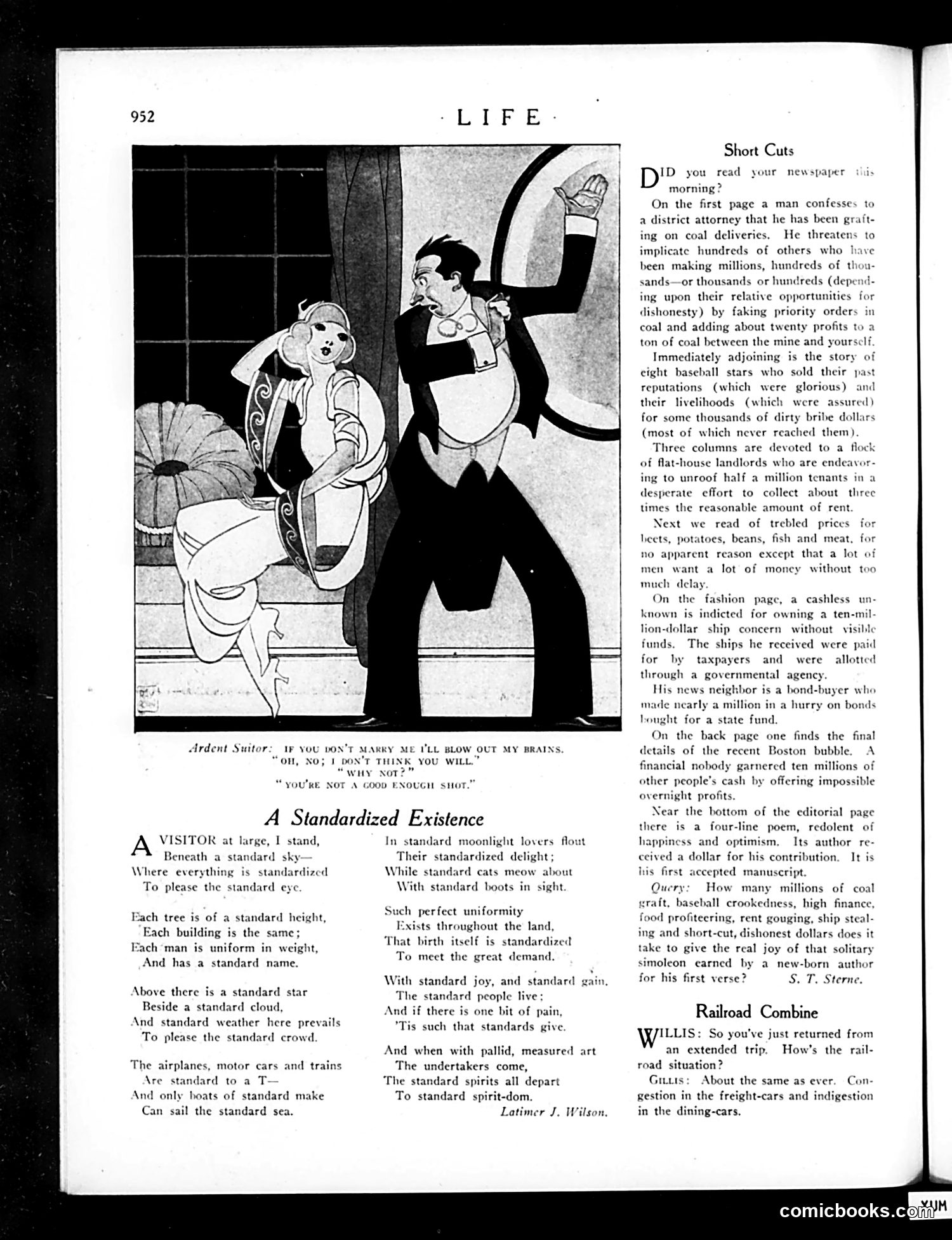
The cartoon depicts a man in formal dress threatening a woman with a gun, with dialogue about marriage. The caption reads "Ardent Suitor: If you don't marry me I'll blow out my brains" followed by her dismissive response. This satirizes a common melodramatic trope of the era—the desperate suitor using emotional blackmail or threats to coerce marriage. The humor lies in the woman's practical, unimpressed rejection: she doubts his threat and questions whether he'd be "a good enough shot" anyway. The satire targets both romantic conventions (overwrought male desperation) and gender relations, mocking men who treated marriage proposals as life-or-death matters while portraying women as sensible enough to see through such manipulation.
📄 Transcribed text from this page (OCR, searchable)
Machine-transcribed from the original scan — historical spelling and the odd misread are preserved.
Ardent Suitor: (Ff YoU pON’T MARKY ME I'LL BLOW OUT MY BRAINS. “OH, NO; 1 DON'T THINK YOU WILL.” “way "RE NOT A GOOD ENOUGH SHOT.” not?” A Standardized Existence VISITOR at Beneath a standard sky Where everything is standardized To please the standard eyc rge, 1 stand, Each tree is of a standard height, Each building is the same; ‘ach man is uniform in weight, And has a standard name. \bove there is a standard star Beside a standard cloud, And standard weather here prevails To please the standard crowd. The airplanes, motor cars and trains Are standard to a T— And only hoats of standard make Can sail the standard sea. In standard moonlight lovers fl Their standardized delight; While standard cats meow about With standard boots in sight Such perfect uniformity Exists throughout the land, That birth itself is standardized To meet the great demand. With standard joy, and standard ga’ The standard people live; And if there is one bit of pain, ‘Tis such that standards give. And when with pallid, measured art The undertakers come, The standard spirits all depart To standard spirit-dom. Latimer J. Wilson, Short Cuts ID you read your newspaper morning? On the first page a man confesses to a district attorney that he has been grait- ing on coal deliveries, He threatens to implicate hundreds of others who have been making millions, hundreds of thou- sands—or thousands or hundreds (depend ing upon their relative opportunities for dishonesty) by faking priority orders in coal and adding about twenty profits to a ton of coal between the mine and yourself, Immediately adjoining is the story of cight baseball stars who sold their past reputations (which were glorious) and their livelihoods (which were assured) for some thousands of dirty bribe dollars (most of which never reached them) Three columns are devoted to a flock flat-house landlords who are endeavo: ing to unroof half a million tenants in a desperate effort to collect about three times the reasonable amount of rent. Next we read of trebled prices fc leets, potatoes, beans, fish and meat, fc no apparent reason except that a lot of men want a lot of money without too much delay On the fashion page, a cashless un- known is indicted for owning a ten-r lion-dollar ship concern without visible funds. The ships he received were paid for by taxpayers and were allotted through a governmental agency. His news neighbor is a hond-buyer who made nearly a million in a hurry on bonds hought for a state fund. On the back page one finds the final details of the recent Boston bubble. A financial nobody garnered ten millions of other people’s cash by offering impossible overnight profits. Near the bottom of the editorial page there is a four-line poem, redolent of happiness and optimism. Its author re- ceived a dollar for his contribution. It is his first accepted manuscript. Query: How many millions of coal ‘aft, baseball crookedness, high finance, food profiteering, rent gouging, ship steal- ing and short-cut, dishonest dollars does it take to give the real joy of that solitary simoleon earned by a new-born author for his first verse? S. T. Sterne. Railroad Combine ILLIS: So you've just returned from an extended trip. How’s the rail- road situation? Guts: About the same as ever. Con- gestion in the freight-cars and indigestion in the dining-cars, comicbooks.coninal