
Life, 1920-11-25 · page 28 of 45
Life — November 25, 1920 — page 28: what you’re looking at
What you’re looking at
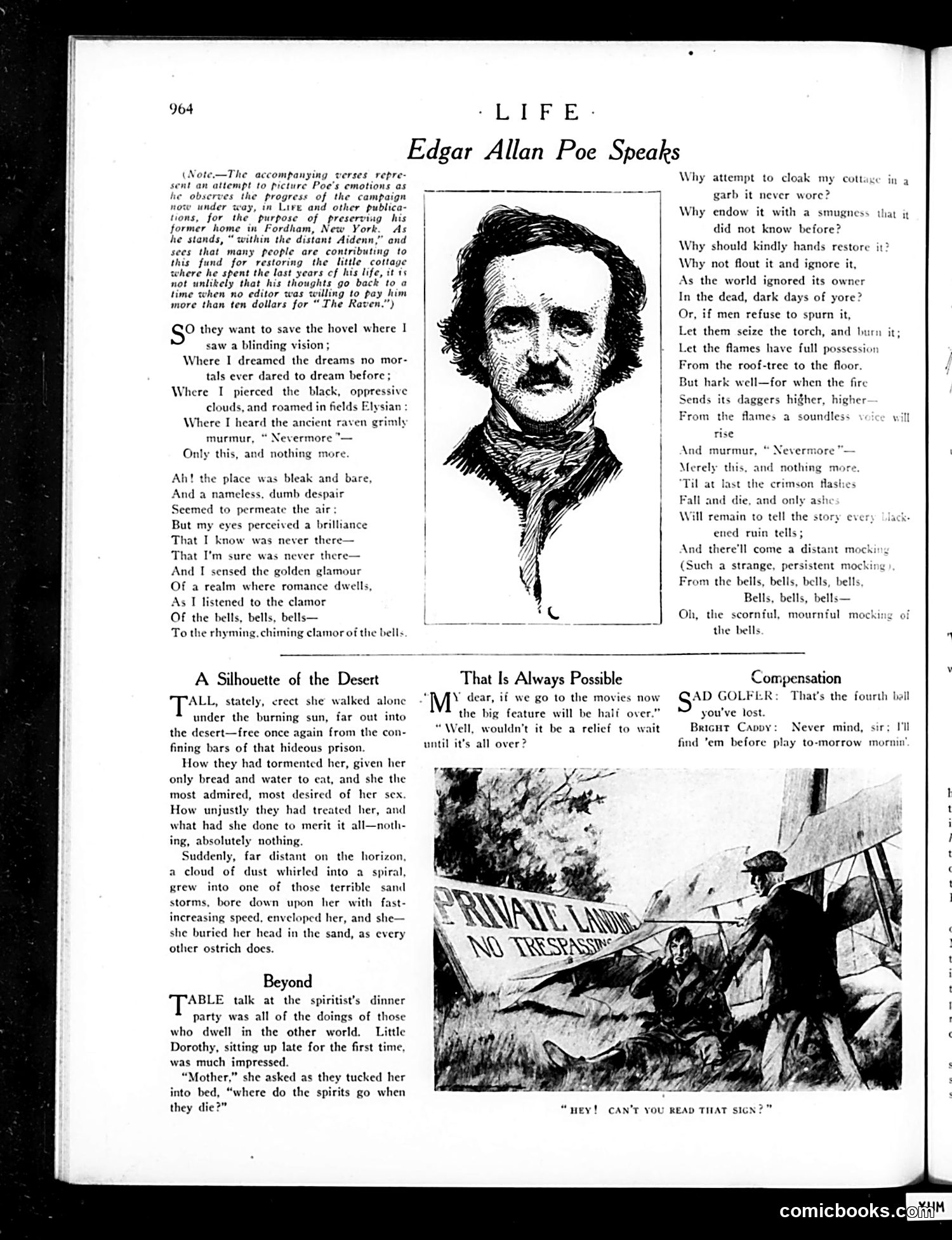
This 1909 *Life* magazine page features satirical verse attributed to Edgar Allan Poe's ghost, commenting on a contemporary fundraising campaign to preserve his former cottage in Fordham, New York. **The Main Point**: The satire is bitter social commentary. Poe's ghostly voice notes the irony that people now want to preserve and honor his modest home—yet during his lifetime, editors refused to pay him fairly (the note mentions they paid only ten dollars for "The Raven"). The verses, written in Poe's characteristic style, mock the false nostalgia: why restore the cottage to false "smugness" when he lived in actual poverty and despair there? **Supporting Details**: The accompanying note explicitly explains the campaign's purpose and the historical context of Poe's financial struggles, making the satire's target clear—the hypocrisy of posthumous veneration without lifetime support. **Other Content**: The page includes unrelated short humorous pieces and illustrations typical of *Life*'s satirical format.
📄 Transcribed text from this page (OCR, searchable)
Machine-transcribed from the original scan — historical spelling and the odd misread are preserved.
(Note—The accompanying verses repre- nt an attempt to picture Poe's emotions as he observes the progress of the campaign now under way, in Lire and other publica- tions, for the purpose of preserving his former home in Fordham, New York. As he stands, “ within the distant Aidenn,” and sees that many people are contributing to this fund for restoring the little cottage where he spent the last years cf his life, it ts not unlikely that his thoughts go back to a time when no editor was willing to pay him more than ten dollars for “The Raven.”) s° they want to save the hovel where I saw a blinding vision; Where I dreamed the dreams no mor- tals ever dared to dream before ; Where I pierced the black, oppressive clouds, and roamed in fields Elysian : Where I heard the ancient raven grimly murmur, “ Nevermore "— Only this, and nothing more. Ah! the place was bleak and bare, And a nameless, dumb despair Seemed to permeate the air: But my eyes perceived a brilliance That I know That I’m sure was never there— And I sensed the golden glamour Of a realm where romance dwells, was never there— As I listened to the clamor OF the bells, bells, bells— To the rhyming. chiming clamor of the bells A Silhouette of the Desert ALL, stately, erect she walked alone under the burning sun, far out into the desert—free once again from the con- fining bars of that hideous prison. How they had tormented her, given her only bread and water to eat, and she the most admired, most desired of her sex. How unjustly they had treated her, and what had she done to merit it all—noth- ing, absolutely nothing. Suddenly, far distant on the horizon, a cloud of dust whirled into a spiral, grew into one of those terrible nl storms, bore down upon her with fast- increasing speed, enveloped her, and she— she buried her head in the sand, as every other ostrich does. Beyond TABLE talk at the spiritist’s dinner party was all of the doings of those dwell in the other world. Little Dorothy, sitting up late for the first time, was much impressed. “Mother,” she asked as they tucked her into bed, “where do the spirits go when they die? who “LIFE: Edgar Allan Poe Speaks Why attempt to cloak my cottaze in a garb it never wore? Why endow it with a smugness that it did not know before? Why Why As the world ignored its owner In the dead, dark days of yore? Or, if men refuse to spurn it, Let them seize the torch, and burn it; Let the flames have full possession should kindly hands restore it? not flout it and ignore it, From the roof-tree to the floor. But hark well—for when the fire Sends its daggers higher, higher From the flames a soundless rise And murmur, “ Nevermore "— Merely this, and nothing more. “Til at last the crimson fas! Fall and die, and only ashe Will remain to tell the s' ened ruin tells; And there'll come a distant mock (Such a strange, persistent moch From the bells, bells, bells, bells Bells, bells, bells— Oh, the scornful, mournful mocking of the bells That Is Always Possible ‘ Y dear, if we go to the movies now the big feature will be half over.” “Well, wouldn't it be a relief to wait until it’s all over? “ney! ‘ Cc : V Compensation AD GOLFER: That's the fourth bell you've lost. Bricut Cappy: Never mind, sir: I'll find ’em before play to-morrow mornin’ t t i ] t ‘ t t i t I ' r CAN'T YOU READ THAT SIGN? comicbooks.comil