
Life, 1920-11-25 · page 25 of 45
Life — November 25, 1920 — page 25: what you’re looking at
What you’re looking at
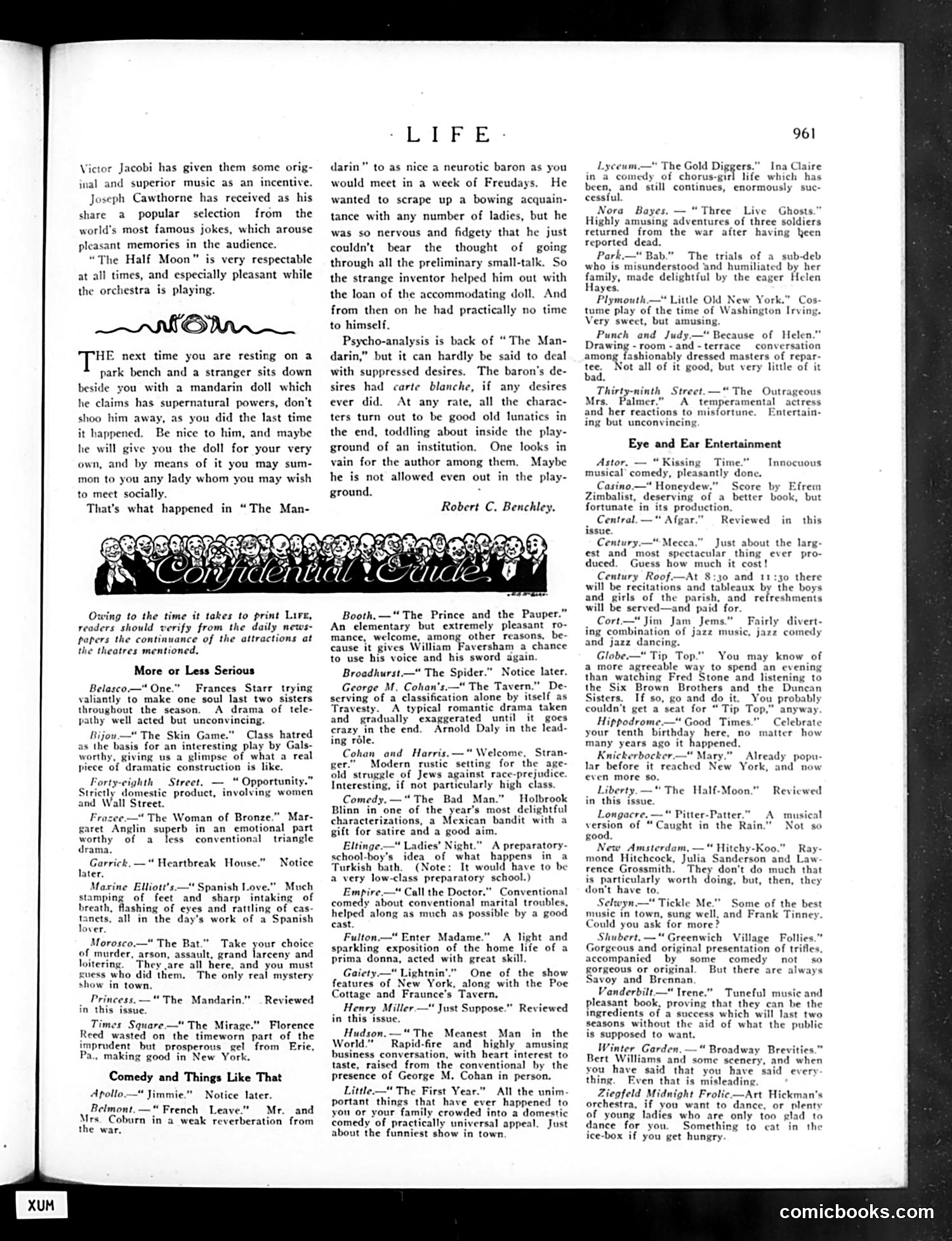
This page contains theater reviews from Life magazine's drama criticism section. The prominent illustrated cartoon labeled "Confidential Service" depicts a stylized group of faces, likely representing the theater world or gossip culture that Life frequently satirized. The main text discusses "The Mandarin," a play featuring a neurotic baron who uses a magical doll to meet women, avoiding awkward social preliminaries. Critic Robert C. Benchley notes the plot involves psycho-analysis themes, with characters ultimately revealed as "lunatics" in an institution—suggesting the play's absurdist satire of modern neurosis and social anxiety. The reviews cover various Broadway productions with brief assessments: some praised (Galsworthy's "The Skin Game"), others dismissed as conventional or weak. The tone is witty and dismissive toward sentimental drama while appreciating clever construction. This reflects Life's role as sophisticated cultural commentator mocking both theatrical pretension and audiences' tastes during the Jazz Age.
📄 Transcribed text from this page (OCR, searchable)
Machine-transcribed from the original scan — historical spelling and the odd misread are preserved.
Victor Jacobi has given them some orig- inal and superior music as an incentive. Joseph Cawthorne has received as his share a popular selection from the world’s most famous jokes, which arouse pleasant memories in the audience. “The Half Moon” is very respectable at all times, and especially pleasant while the orchestra is playing. ~~ ~ntOIinr_. THE next time you are resting on a park bench and a stranger sits down ou with a mandarin doll which ms has supernatural powers, don’t shoo him away, as you did the last time it happened. Be nice to him, and maybe he will give you the doll for your very own, and by means of it you may sum- mon to you any lady whom you may wish to meet socially. That's what happened in “The Man- beside he cla Owing to the time it takes to print Lirg, readers should verify from the daily new papers the continuance of the attractions at the theatres mentioned, More or Less Serious Belasco—*“ One.” Frances Starr trying valiantly to make one soul last two sisters throughout the season. A drama of tele- pathy well acted but unconvincing. Bijou.—" The Skin Game.” Class hatred as the basis for an interesting play by Gals- worthy, giving us a glimpse of what a real piece of dramatic construction is like. Forty-cighth Street. — “ Opportunity.” rictly domestic product, involving women and Wall Street. Frazee.—“ The Woman of Bronze.” Mar- garet Anglin superb in an emotional part worthy of a less conventional triangle drama. Garrick, —“ Heartbreak House.” later. Maxine Elliott’s— Spanish Love.” Much stamping of feet and sharp intaking of breath, flashing of eyes and rattling of cas- tanets, all in the day's work of a Spanish lover. Morosco. Notice "The Bat.” Take your choice of murder, assault, grand larceny and loitering. “They are all here, and you must guess who did them. The only real mystery show in town, P .—" The in this issue. Mandarin.” Reviewed Times Square—* The Mirage.” Florence Reed wasted on the timeworn part of the imprudent but prosperous gel from Erie, Pa., making good in New York. Comedy and Things Like That Apollo.—* Jimmie.” Belmont. —“ French Leave. Mr. and Mrs. Coburn in a weak reverberation from the war, Notice later. LIFE to as nice a neurotic baron as you would meet in a week of Freudays. He wanted to scrape up a bowing acquain- tance with any number of ladies, but he was so nervous and fidgety that he just couldn’t bear the thought of going through all the preliminary small-talk. So the strange inventor helped him out with the loan of the accommodating doll. And from then on he had practically no time to himself. Psycho-analysis is back of “The Man- darin,” but it can hardly be said to deal with suppressed desires. The baron’s de- sires had carte blanche, if any desires ever did. At any rate, all the charac- ters turn out to be good old lunatics in the end, toddling about inside the play- ground of an institution. One looks in vain for the author among them. Maybe he is not allowed even out in the play- darin” Robert C. Benchley. Booth.—“ The Prince and the Pauper.” An elementary but extremely pleasant ro- mance, welcome, among other reasons, be- cause it gives William Faversham a chance to use his voice and his sword again. Broadhurst —" The Spider.” Notice later. George M, Cohan's.—" The Tavern.” De- serving of a classification alone by itself as Travesty. A typical romantic drama taken and gradually exaggerated until it goes crazy in the end. Arnold Daly in the lead- ing réle. Cohan and Harris, —“ Welcome, Stran- ger. Modern rustic setting for the age- old struggle of Jews against race-prejudice. Interesting, if not particularly high class. Comedy.—“ The Bad Man.’ Holbrook Blinn in one of the year’s most delightful characterizations, a Mexican bandit with a gift for satire and a good aim. Eltinge. Ladies’ Night.” A preparatory- school-boy’s idea of what happens in a Turkish bath. (Note: It would have to be a very low-class preparatory school.) Empire.— Call the Doctor.” Conventional comedy about conventional marital troubles, helped along as much as possible by a good cast. Fulton.—“ Enter Madame.” A light and sparkling exposition of the home life of a prima donna, acted with great skill. Gaiety —" Lightnin’.”. One of the show features of New York, along with the Poe Cottage and Fraunce’s Tavern. Henry Miller —" Just Suppose.” in this issu Hudson. The Meanest Man in the World.” Rapid-fire and highly amusing business conversation, with heart interest to taste, raised from the conventional by the presence of George M. Cohan in person. Little —" The First Year.” All the unim portant things that have ever happened to you or your family crowded into a domestic comedy of practically universal appeal. Just about the funniest show in town Reviewed 961 Lyceum.— The Gold Diggers.” Ina Claire in a comedy of chorus-girl life which has been, and still continues, enormously suc- cessful Nora Bayes. — “Three Live Ghosts.” Highly amusing adventures of three soldiers returned from the war after having heen reported dead. Park.—" Bab.” The trials of a sub-deb who is misunderstood ‘and humiliated by her family, made delightful by the eager Helen Haye: Plymouth.—" Little Old New York.” Cos- tume play of the time of Washington Irving. Very swect, but amusing. Punch and Judy.—" Because of Helen.” Drawing - room -and-terrace conversation among fashionably dressed masters of repar- tee. Not all of it good, but very little of it bad. Thirty-ninth Street. —“ The Outrageous Mrs. Palme A temperamental actress and her reactions to misfortune. Entertain- ing but unconvincing Eye and Ear Entertainment Astor. — “Kissing Time.” Innocuous musical comedy, pleasantly done. Casino.—* Honeydew.” Score by Efrem Zimbalist, deserving of a better book, but fortunate in its production. Central. —“ Afgar.” Reviewed in issue. Century.—" Mecca.” Just about the larg- est and most spectacular thing ever pro- duced. Guess how much it cost! Century Roof-—At 8:30 and 11:30 there will be recitations and tableaux by the boys and girls of the and refreshments will be om paid for. 1 Jam Jems.” ion of jazz music, and jazz dancing. Globe.—" Tip Top.” You may know of a more agreeable way to spend an evening than watching Fred Stone and listening to the Six Brown Brothers and the Duncan Sisters. If so, go and do it. You probably couldn't get a seat for “ Tip Top,” anyway Hippodrome—" Good Times.” Celebrate your tenth birthday here, no matter how many years ago it happened. Knickerbocker —" Mary.” lar before it reached even more so. Liberty. —“ The in this issue. Longacr. version of good. New Amsterdam, —“ Hitchy-Koo.” Ray- mond Hitchcock, Julia Sanderson and Law rence Grossmith. They don’t do much that is particularly worth doing, but, then, they this Fairly divert- azz comedy Already popu- New York, and now Half-Moon.” Reviewed musical Not so “ Pitter-Patter.” A ‘aught in the Rain.” —‘ Tickle Me.” Some of the best music in town, sung well, and Frank Tinney. Could you ask for more? Greenwich Village Follies.” Gorgeous and original presentation of trifles, accompanied bh some comedy ot so gorgeous or original. But there are always Savoy and Brennan Vanderbilt—" Irene.” Tuneful music and pleasant book, proving that they can be the ingredients of a success which will last two seasons without the aid of what the public is supposed to want, Winter Garden. “ Broadway Bert Williams and some scener you have said that you have thing. Even that is misleading Ziegfeld Midnight Frolic—Art Hickman's orchestra, if you want to dance, or plenty of young ladies who are only too glad to dance for you. Something to cat in the ice-box if you get hungry Brevities.” comicbooks.com