
Life, 1920-11-25 · page 11 of 45
Life — November 25, 1920 — page 11: what you’re looking at
What you’re looking at
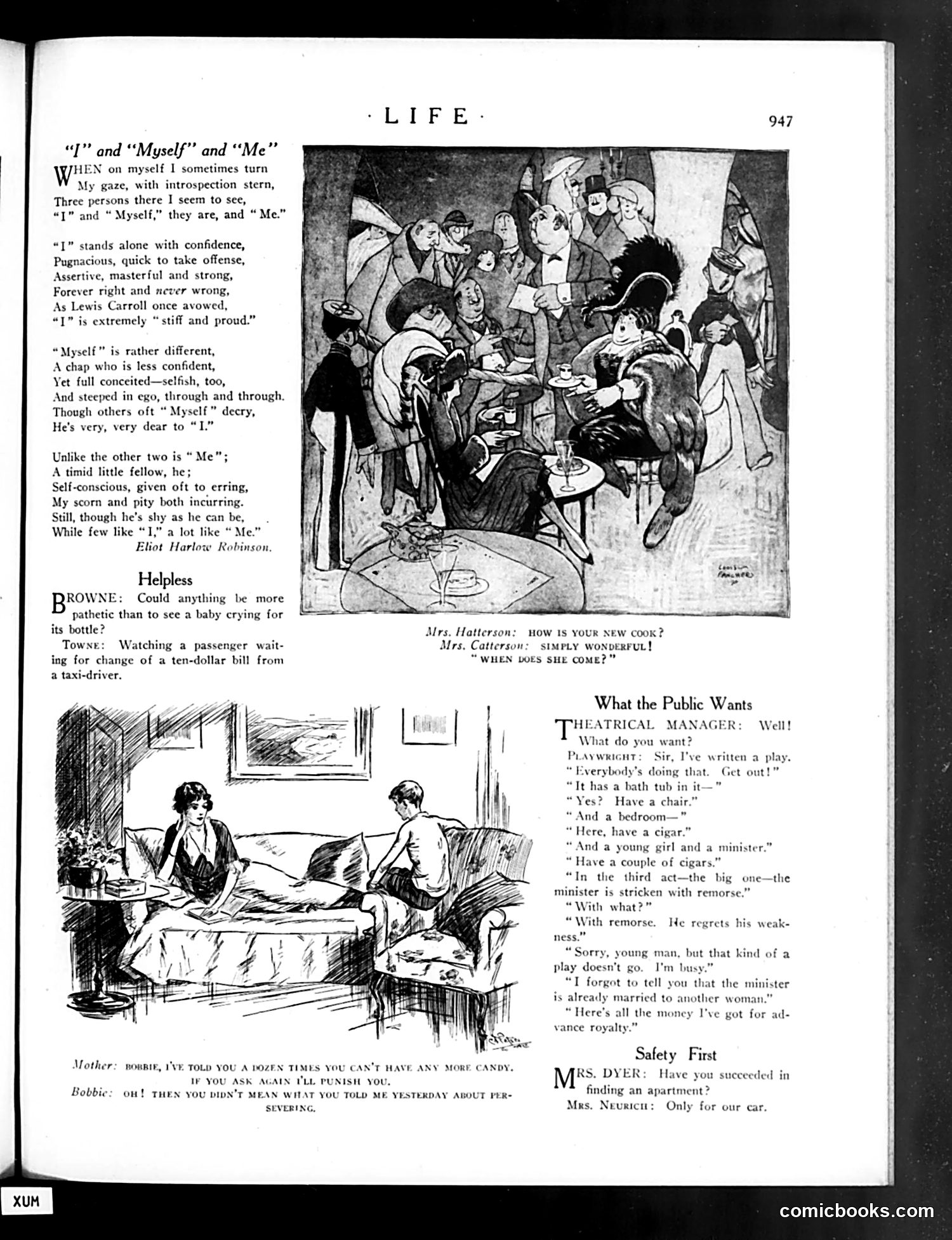
This page contains several unrelated humorous sketches typical of early 20th-century American satire magazines. The top poem "I" and "Myself" and "Me" by Eliot Harrow Robinson explores introspection—three aspects of the self, with "I" being confident and proud, "Myself" self-conscious and conceited, and "Me" self-pitying. The middle cartoon "Helpless" depicts two brief vignettes: a baby crying for its bottle, and a taxi passenger waiting for change from a ten-dollar bill—contrasting human dependency at different life stages. The lower cartoon shows a mother scolding a child about asking for more candy, with the child claiming he didn't mean what he said yesterday about punishment. The right column contains theatrical and domestic humor sketches involving a playwright pitching a play and an apartment-hunting couple.
📄 Transcribed text from this page (OCR, searchable)
Machine-transcribed from the original scan — historical spelling and the odd misread are preserved.
“1” and “Myself” and “Me” HEN on myself 1 sometimes turn My gaze, with introspection stern, Three persons there I seem to see, “I” and “ Myself,” they are, and “ Me.” “I” stands alone with confidence, Pugnacious, quick to take offense, Assertive, masterful and strong, Forever right and never wrong, As Lewis Carroll once avowed, “1” is extremely “stiff and proud.” “Myself” is rather different, ‘A chap who is less confident, Yet full conceited—selfish, too, And steeped in ego, through and through. Though others oft “ Myself” decry, He's very, very dear to “I.” Unlike the other two is “ Me"; A timid little fellow, he; Self-conscious, given oft to erring, My scorn and pity both incurring. Still, though he’s shy as he can be, While few like “I,” a lot like Eliot Harlow Robins Helpless ROWNE: Could anything be more pathetic than to see a baby crying for its bottle? Towne: Watching a passenger wait- ing for change of a ten-dollar bill from a taxi-driver. Mrs, Hatterson: Mrs, Catte Mother: nowpie, 1'Ve TOLD YOU A DOZEN TIMES YOU CAN'T HAVE ANY MORE CANDY. IF YOU ASK AGAIN ULL PUNISH You. Ou! THEN YOU DIDN'T MEAN WITAT YOU TOLD ME YESTERDAY ABOUT PER- SEVERIN Bobbie. SIMPLY WONDERFUL! “WHEN DOES SHE COME? What the Public Wants HEATRICAL MANAGE What do you want? PLAYWRIGHT Well! Sir, I've written a play. “Everybody's doing that. Get out!” It has a bath tub in it—” “Yes? Have a chair.” “And a bedroom— “Here, have a cigar.” “And a young girl and a minister.” “Have a couple of cigars.” “In the third act—the big one—the minister is stricken with remorse.” “With what?” “With remorse. ness.” “Sorry, young man, but that kind of a play doesn’t go. “TI forgot to tell you that the minister is already married to a He regrets his weak- I'm busy.” other woman.” “Here's all the money I've got for ad- vance royalty Safety First RS, DYER: finding an apartment? Mrs. Nevricu: Have you succeeded in Only for our car. comicbooks.com