
Life, 1920-11-25 · page 30 of 45
Life — November 25, 1920 — page 30: what you’re looking at
What you’re looking at
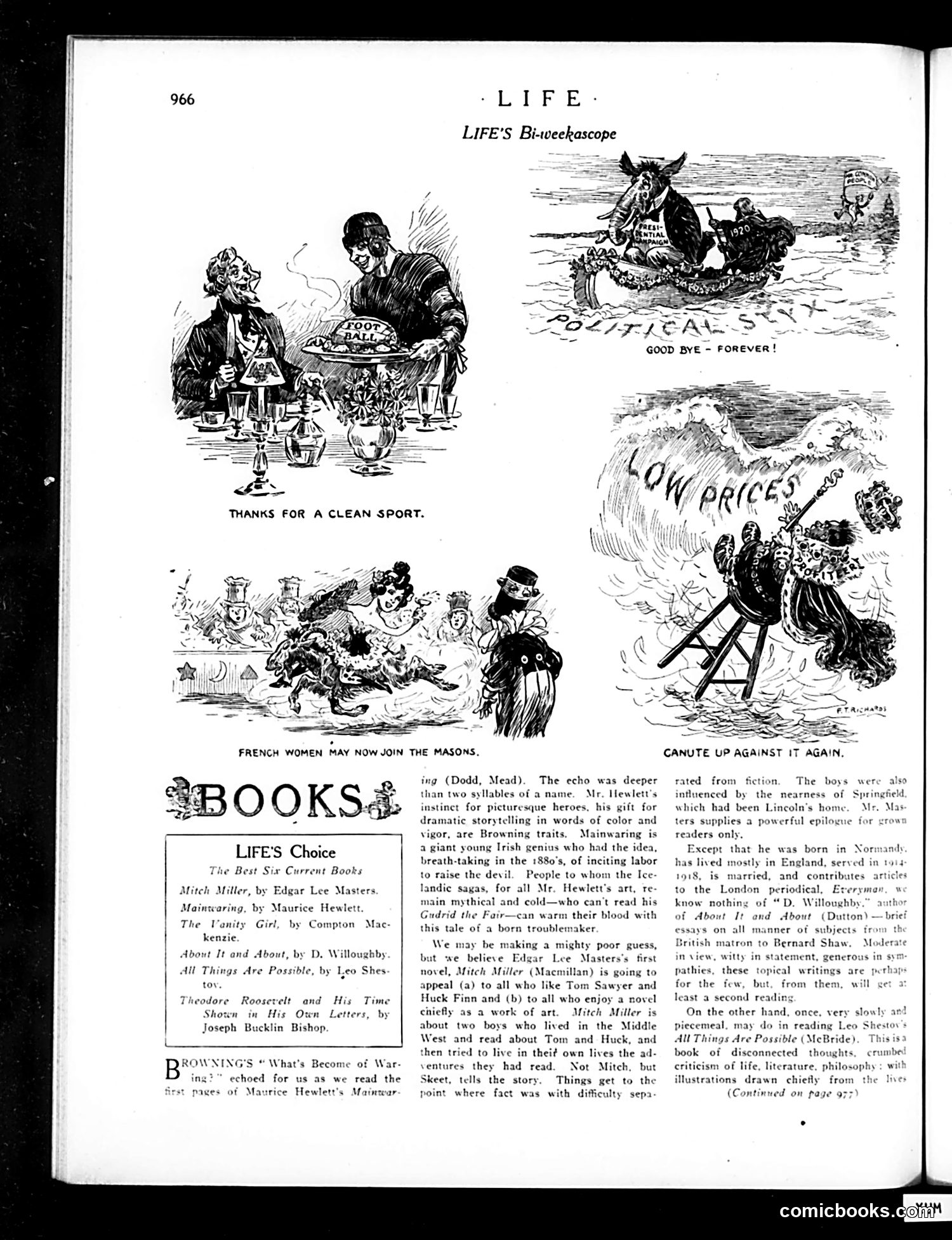
This page features **"Life's Bi-weekascope,"** a satirical prediction column. The top cartoon mocks the recent admission of French women to Freemasonry, a historically male-only organization. The image shows a woman in formal dress being welcomed into masonic circles—the satire being that this represents a dramatic social shift in traditionally exclusive male institutions. Below, "Canute Up Against It Again" references King Canute, the legendary medieval ruler who supposedly commanded the tide to stop. Here, the cartoon depicts a figure (likely representing conservative or political resistance) futilely attempting to hold back a wave labeled "Low Prices"—satirizing the impossibility of resisting economic forces or market trends. The page also contains a "Books" section reviewing contemporary literature, including works by Edgar Lee Masters and Maurice Hewlett. The overall tone mocks both social progress (women's admission to institutions) and futile political/economic resistance.
📄 Transcribed text from this page (OCR, searchable)
Machine-transcribed from the original scan — historical spelling and the odd misread are preserved.
-LIFE- LIFE’S Bi-weekascope FRENCH WOMEN MAY NOW JOIN THE MASONS. BOOKS LIFE’S Choice Six Current Books Mitch Miller, by Edgar Lee Masters. Mainwaring, by Mauri The Girl, by Hewlett. Vanity Mac- kenzie About It and About, by D. Willoughby All Things Are Possi Shes. tov. Compton » by Tec eodore Roosevelt and His Time Shown in His Own Letters, by Joseph Bucklin Bishop ——ESES—E—ESS Saas ROWNIN( echoed for us as we Maurice Hewlett's “What's Become of War- read the Mainwear t pages of ing (Dodd, Mead) than two syllables of a name. Mr instinct for picturesque heroes, his gift for dramatic storytelling in words of color and vigor, are Browning traits. Mainwaring is a giant young Irish genius who had the idea, breath-taking in the 1880's, of inciting labor to raise the devil. People to whom the Ice- landic sagas, for all Mr. Hewlett’s art, re- main mythical and cold—who can't read his Gudrid the Fair—can warm their blood with this tale of a born troublemaker The echo was deeper Hewlett's We may be making a mighty poor guess, but we believe Lee Masters’s. first novel, Mitch Miller (Macmillan) is going to appeal (a) to all who like Tom Sawyer and Huck Finn and (b) to all who enjoy a novel chiefly as a work of art. Mitch Miller is about two boys who lived in the Middle West and read about Tom and Huck, and then tried to live in theif own lives the ad- ventures they had read. Not Mitch, but Skeet, tells the story, Things get to the point where fact was with difficulty sepa Edgar The the nearness of Springfield Mr. Mas ters supplies a powerful epilogue for grow readers only, Except that he was born in Normandy has lived mostly in England, served in to 1918, is married, and contributes art to the London periodical, Everyman, w know nothing of “D. Willoughby.” author of About It and About (Di essays on all manner of subjects fro} rated from boys wer influenced by which had been Lincoln’s home fiction, ton) — brief British matron to Bernard Shaw, Moderate in view, witty in statement, generous in sym- pathies, these topical writings are for the few, from them, will least a second reading On the other hand, once, very slow! piecemeal. may ¢ reading Leo All Things Are Possible (McBride) book of disconnected thoughts, cf criticism of life, literature, philosophy illustrations drawn chiefly (Continued on page 977 from the comicbooks.