
Life, 1920-11-25 · page 24 of 45
Life — November 25, 1920 — page 24: what you’re looking at
What you’re looking at
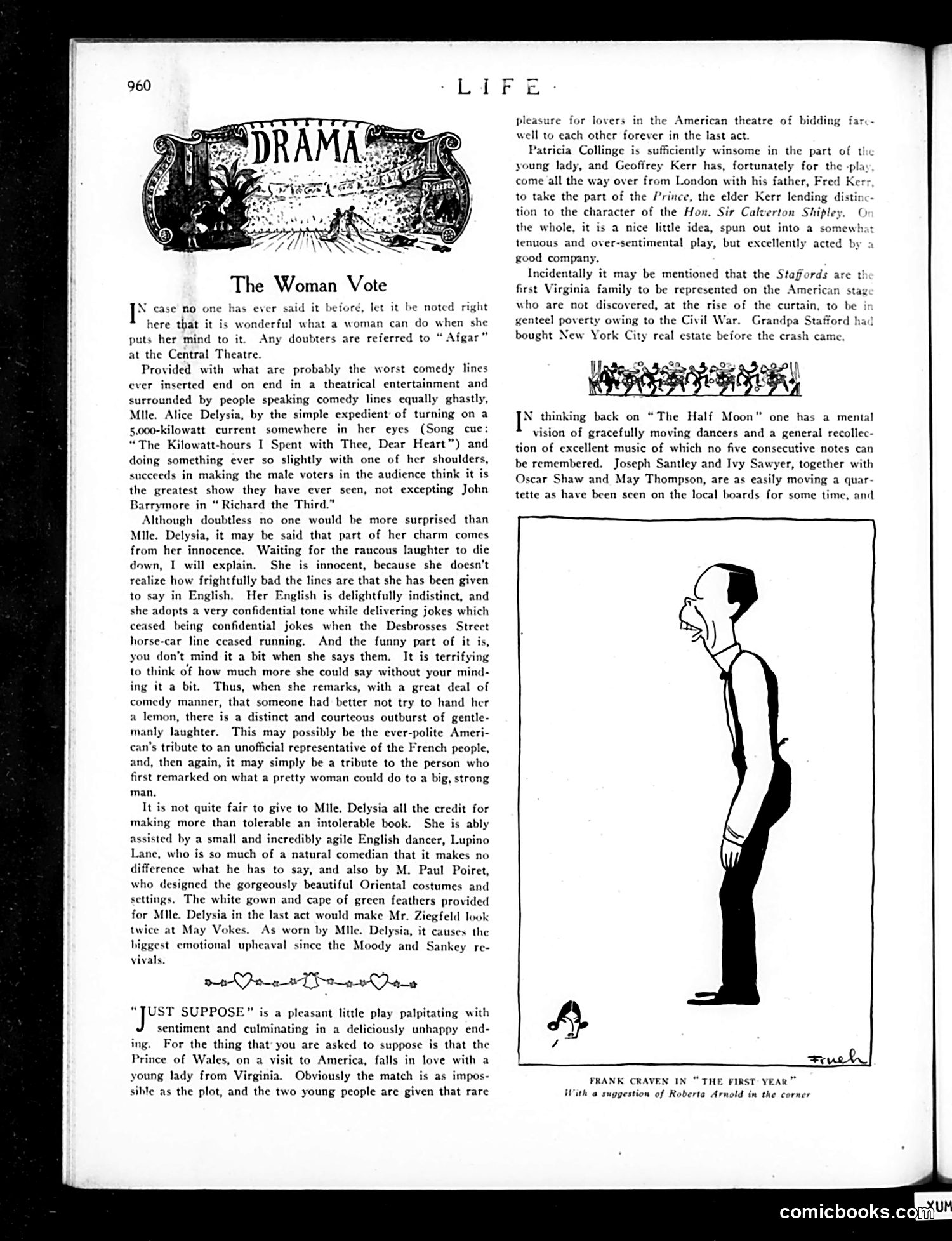
This page reviews theatrical productions, focusing on French actress Mlle. Alice Delysia in "Afgar." The critic sardonically praises how Delysia—despite delivering "probably the worst comedy lines ever inserted"—captivates male audience members through charm and charisma rather than script quality. The satire targets both the actress's manipulative appeal ("5,000-kilowatt current somewhere in her eyes") and male susceptibility to it, suggesting men will overlook terrible material if delivered by an attractive woman. The title "The Woman Vote" appears ironic: rather than serious political power, the "woman vote" here means a woman's ability to sway men through feminine wiles. The accompanying illustration of a man in formal dress further emphasizes this theme of masculine vulnerability to female charm. A secondary review discusses "Just Suppose," featuring the Prince of Wales falling for a Virginia lady—an impossibly romantic fantasy that the critic finds sentimentally overwrought.
📄 Transcribed text from this page (OCR, searchable)
Machine-transcribed from the original scan — historical spelling and the odd misread are preserved.
The Woman Vote as ever said it betord, let it be noted right N case no one here that it is wonderful what a woman can do when she puts her mind to it. Any doubters are referred to “ Afgar” at the Central Theatre. Provided with what are probably the worst comedy lines ever inserted end on end in a theatrical entertainment and surrounded by people speaking comedy lines equally ghastly, Mile. Alice Delysia, by the simple expedient of turning on a 5,000-kilowatt current somewhere in her eyes (Song cue: “The Kilowatt-hours I Spent with Thee, Dear Heart”) and doing something ever so slightly with one of her shoulders, succeeds in making the male voters in the audience think it is the greatest show they have ever scen, not excepting John Barrymore in “ Richard the Third.” Although doubtless no one would be more surprised than Mile. Delysia, it may be said that part of her charm comes from her innocence. Waiting for the raucous laughter to die down, I will explain. She is innocent, because she doesn't ize how frightfully bad the lines are that she has been given to say in English, Her English is delightfully indistinct, and she adopts a very confidential tone while delivering jokes which ceased being confidential jokes when the Desbrosses Street horse-car line ceased running. And the funny part of it is, you don’t mind it a bit when she says them. It is terrifying to think of how much more she could say without your mind- ing it a bit. Thus, when she remarks, with a great deal of comedy manner, that someone had better not try to hand her a lemon, there is a distinct and courteous outburst of gentle- manly laughter. This may possibly be the ever-polite Ameri- can’s tribute to an unofficial representative of the French people, and, then again, it may simply be a tribute to the person who first remarked on what a pretty woman could do to a big, strong man. It is not quite fair to give to Mlle. Delysia all the credit for making more than tolerable an intolerable book. She is ably assisted by a small and incredibly agile English dancer, Lupino Lane, who is so much of a natural comedian that it makes no difference what he has to say, and also by M. Paul Poiret, who designed the gorgeously beautiful Oriental costumes and settings. The white gown and cape of green feathers provided for Mlle. Delysia in the last act would make Mr. Ziegfeld look twice at May Vokes. As worn by Mlle. Delysi higgest emotional upheava’ vivals. rea » it causes the since the Moody and Sankey re- moon Tree “TUST SUPPOSE” is a pleasant little play palpitating with sentiment and culminating in a deliciously unhappy end- For the thing that’ you are asked to suppose is that the Prince of Wales, on a visit to America, falls in love with a young lady from Virginia. Obviously the match is as impos- sible as the plot, and the two young people are given that rare ing. i r co pleasure for lovers in the American theatre of bidding farc- well to each other forever in the last act. Patricia Collinge is sufficiently winsome in the part of t young lady, and Geoffrey Kerr has, fortunately for the -p! come all the way over from London with his father, Fred to take the part of the Prince, the elder Kerr lending disti tion to the character of the Hon. Sir Calverton Shipley. the whole, it is a nice little idea, spun out into a somewhat tenuous and over-sentimental play, but excellently acted by « good company. Incidentally it may be mentioned that the Staffords are t! first Virginia family to be represented on the American st: who are not discovered, at the rise of the curtain, genteel poverty owing to the Civil War. Grandpa Stafford bought New York City real estate before the crash came. N thinking back on “The Half Moon” one has a mental vision of gracefully moving dancers and a general recollec- tion of excellent music of which no five consecutive notes can be remembered. Joseph Santley and Ivy Sawyer, together with Oscar Shaw and May Thompson, are as easily moving a quar- tette as have been seen on the local boards for some time, and FRANK CRAVEN IN “THE FIRST YEAR” With @ suggestion of Roberta Arnold in the corner comicbooks.co