
A complete issue · 44 pages · 1920
Life — November 11, 1920
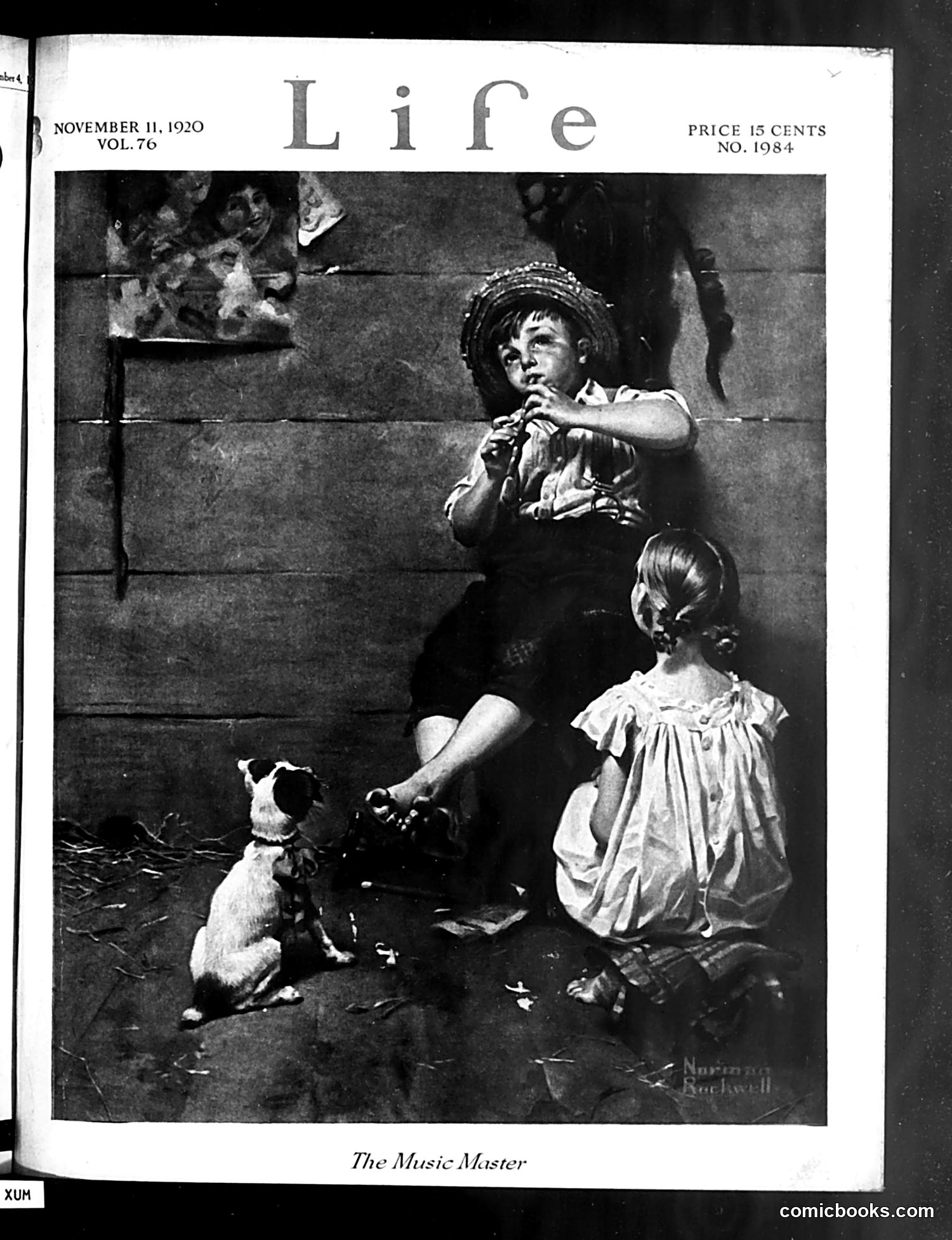
This appears to be a Norman Rockwell illustration (signed lower right) titled "The Music Master." It depicts a domestic scene rather than political satire: an adult (likely a music teacher or parent) instructing two young children, one playing a stringed instrument while the other listens. A small dog sits nearby. The image reflects early 20th-century American cultural values about childhood education, music instruction, and domestic life. Rather than mocking or critiquing figures, it celebrates genteel home education—a subject Life frequently featured for its middle-class readership. The composition emphasizes wholesomeness and moral instruction, typical of Rockwell's sentimental, nostalgic approach to American life.

This is primarily a **United States Rubber Company advertisement** for tires, not satire or political commentary. The ad addresses a genuine 1920s consumer concern: wasteful tire purchasing. The headline asks when tire waste will end, arguing that motorists have been buying tires unnecessarily often due to poor dealer advice and inferior products. The image shows a well-dressed driver beside a car at a garage, illustrating the scenario of seeking tire replacement. The advertisement's pitch: U.S. Rubber Company tires last longer and represent better value, eliminating waste. The company claims to be "the oldest and largest Rubber Organization in the World" with superior quality and experience. This reflects early automotive industry concerns about product reliability and consumer trust during the rapid motorization of America.
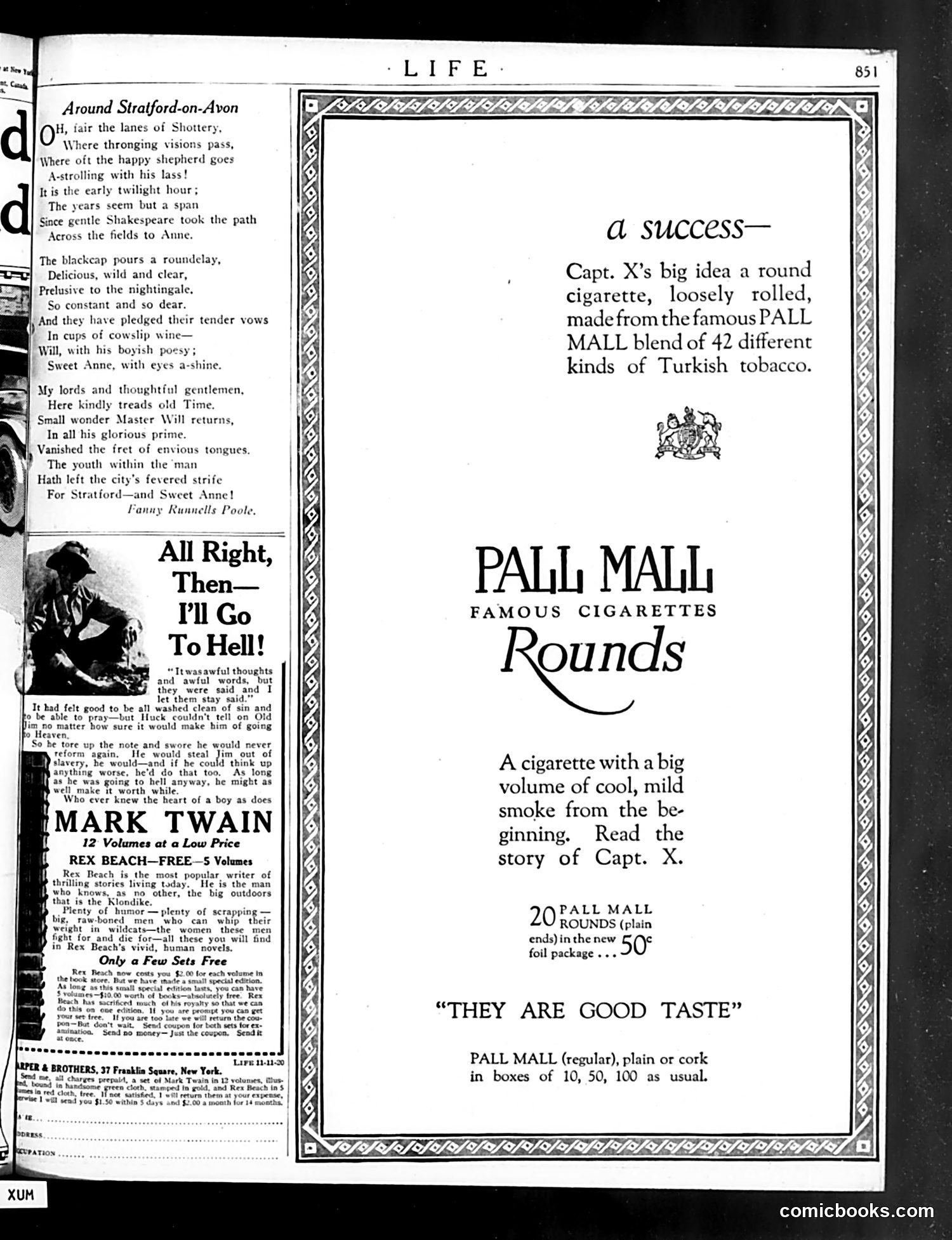
This page from *Life* magazine (page 851) contains primarily **advertising content** rather than political satire or editorial cartoons. The dominant content includes: - A poem titled "Around Stratford-on-Avon" by Fanny Kunnells Poole, referencing Shakespeare - An advertisement for Mark Twain's collected works (12 volumes at low price) - A prominent advertisement for **Pall Mall cigarettes** ("Famous Cigarettes Rounds"), featuring "Capt. X's big idea" for a loosely-rolled cigarette made from Turkish tobacco - A Mark Twain book promotion by Rex Beach There is a small illustration labeled "All Right, Then—I'll Go To Hell!" but it's primarily decorative rather than satirical. The page represents early 20th-century magazine layout mixing editorial content with commercial advertising.
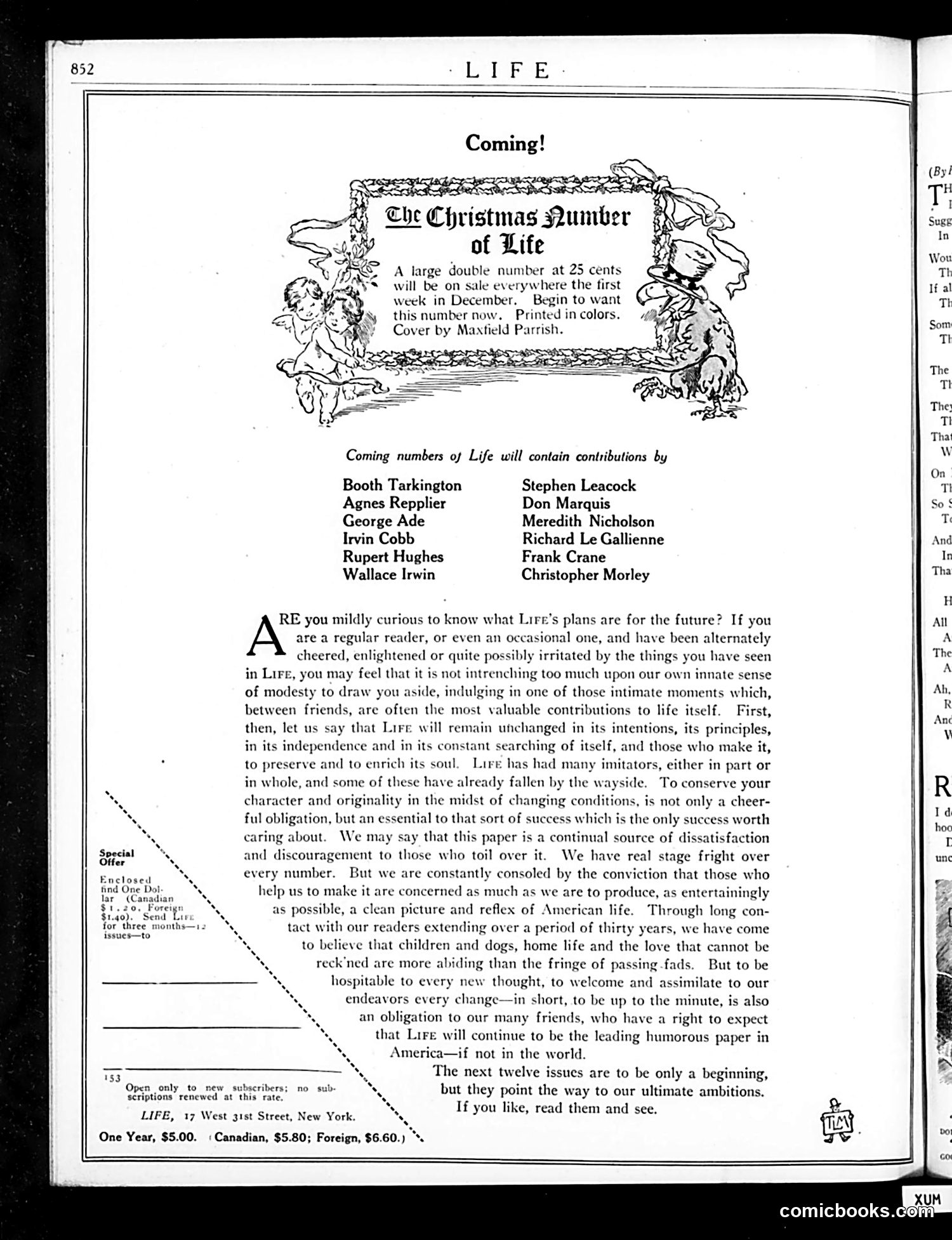
This page is primarily **promotional rather than satirical**. It announces Life magazine's upcoming Christmas Number (a special double issue at 25 cents) with a decorative header featuring cherubs and holly. The main content is **editorial messaging** from Life's publishers explaining their magazine's philosophy and future direction. They emphasize Life will maintain its core principles while remaining open to new ideas and contributions from notable writers (listed: Booth Tarkington, Agnes Repplier, George Ade, and others). The text assures readers that Life aims to provide "a clean picture and reflect of American life" and promises the next twelve issues will represent "only a beginning" toward their "ultimate ambitions." There are **no political cartoons or satirical figures** on this page—it's essentially a statement of editorial intent disguised as an advertisement.
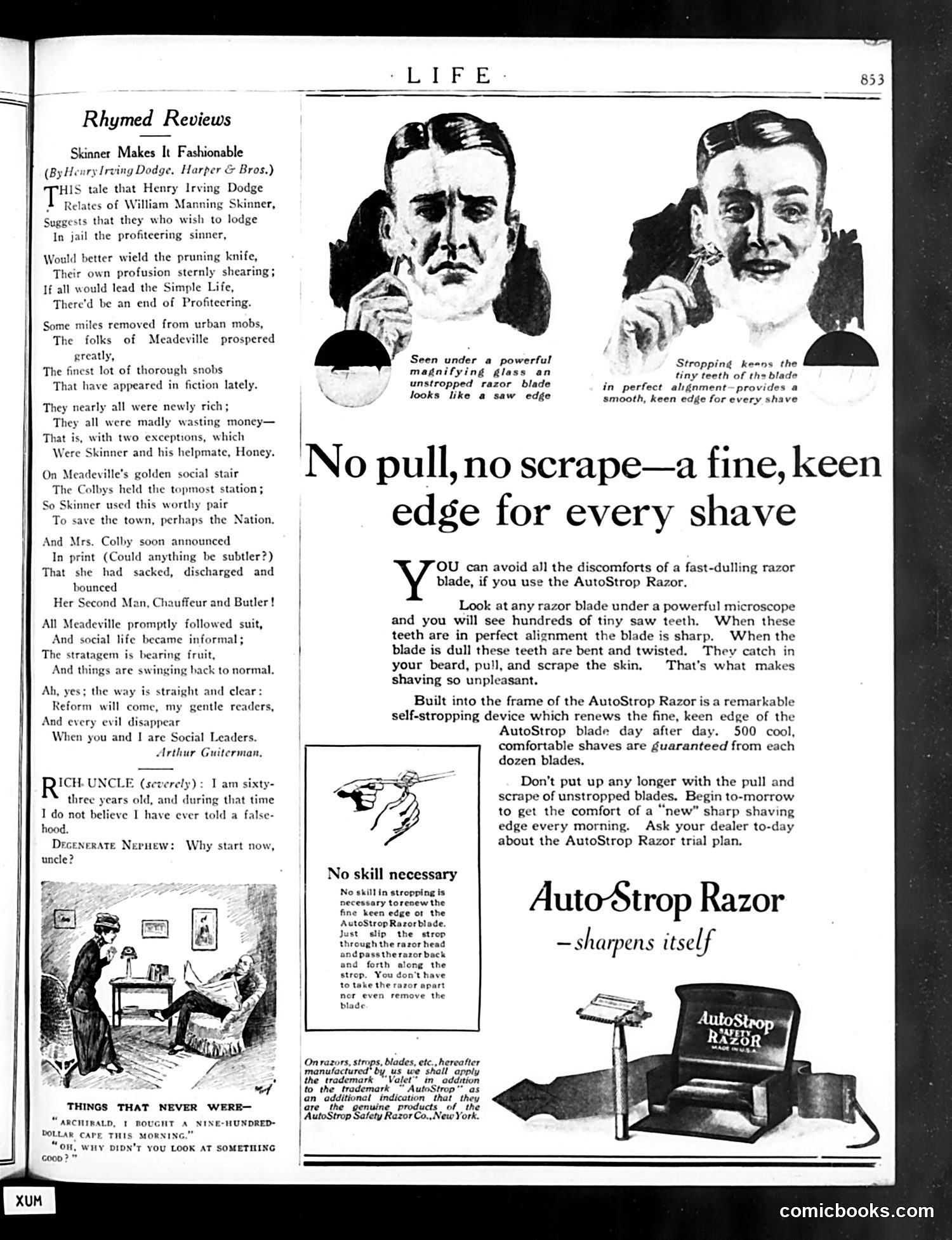
This page is primarily an **advertisement for AutoStrop Razors**, not political satire. The "Rhymed Reviews" section on the left is a humorous poem by Arthur Guiterman about William Manning Skinner, a character from Henry Irving Dodge's fiction who represents a profiteer avoiding social responsibility. The poem satirizes wealthy individuals who hoard resources during prosperous times rather than contribute to community welfare. References to "Meadeville" and characters like "Colby" and "Honey" appear to be fictional examples of social irresponsibility. The main advertisement uses close-up photographs of razor blades under magnification to demonstrate the AutoStrop's superiority—showing sharp edges versus dull, bent teeth that cause pulling and scraping. This is straightforward product marketing emphasizing technological self-sharpening capability, not social or political commentary.
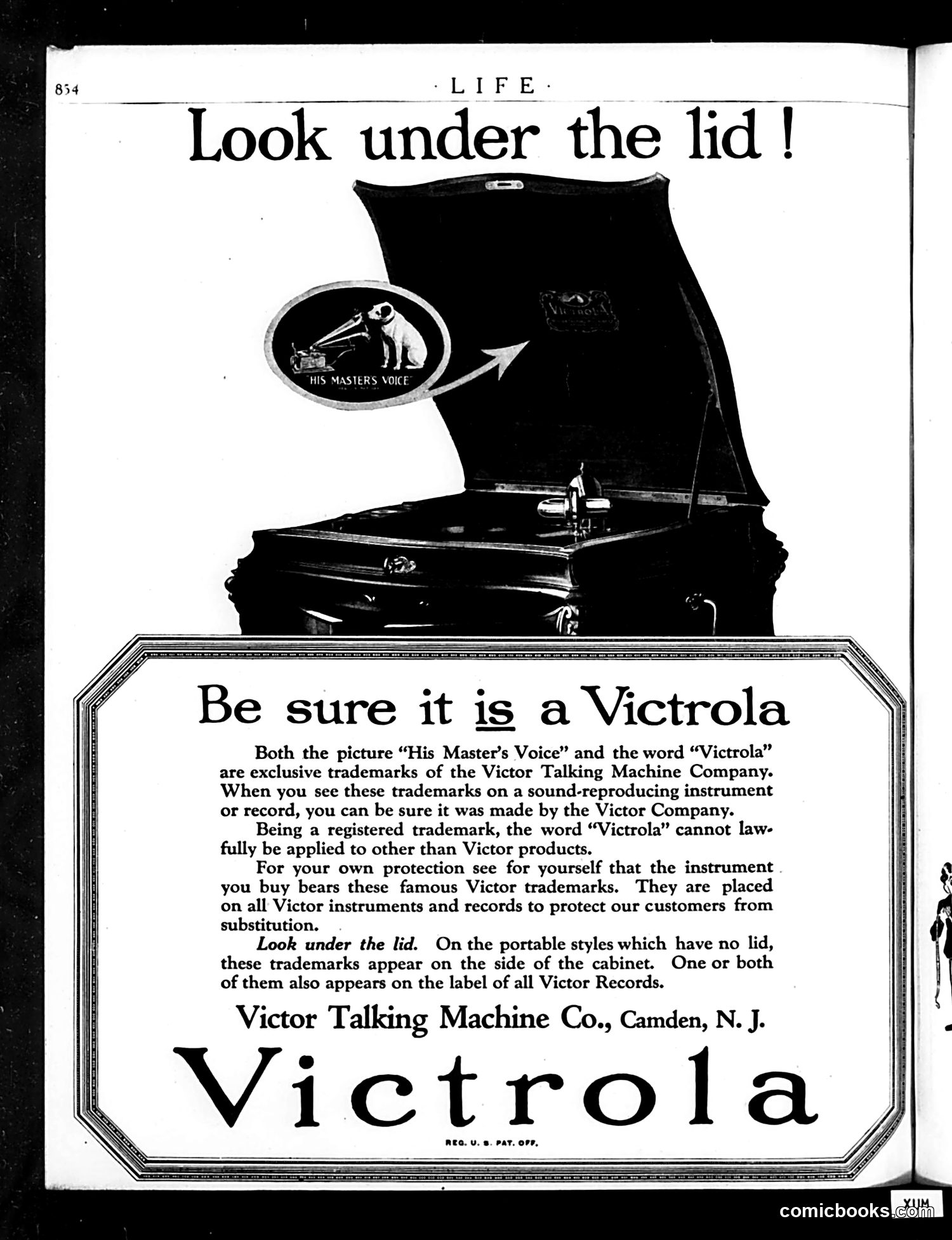
This is **not a political cartoon or satire** — it's a straightforward **advertisement** for Victrola phonographs, placed in Life magazine. The ad uses a playful visual pun: "Look under the lid!" shows a phonograph with its lid open, revealing the famous "His Master's Voice" trademark (the dog and gramophone logo). The text explains that consumers should verify they're buying an authentic Victor product by checking for these exclusive trademarks — both the image and the "Victrola" name — which appear under the lid or on the cabinet sides. The advertisement is essentially a **consumer protection message**, warning against counterfeit sound-reproducing devices and assuring buyers that genuine Victrolas bear these identifying marks. It's a straightforward commercial, not satirical content.
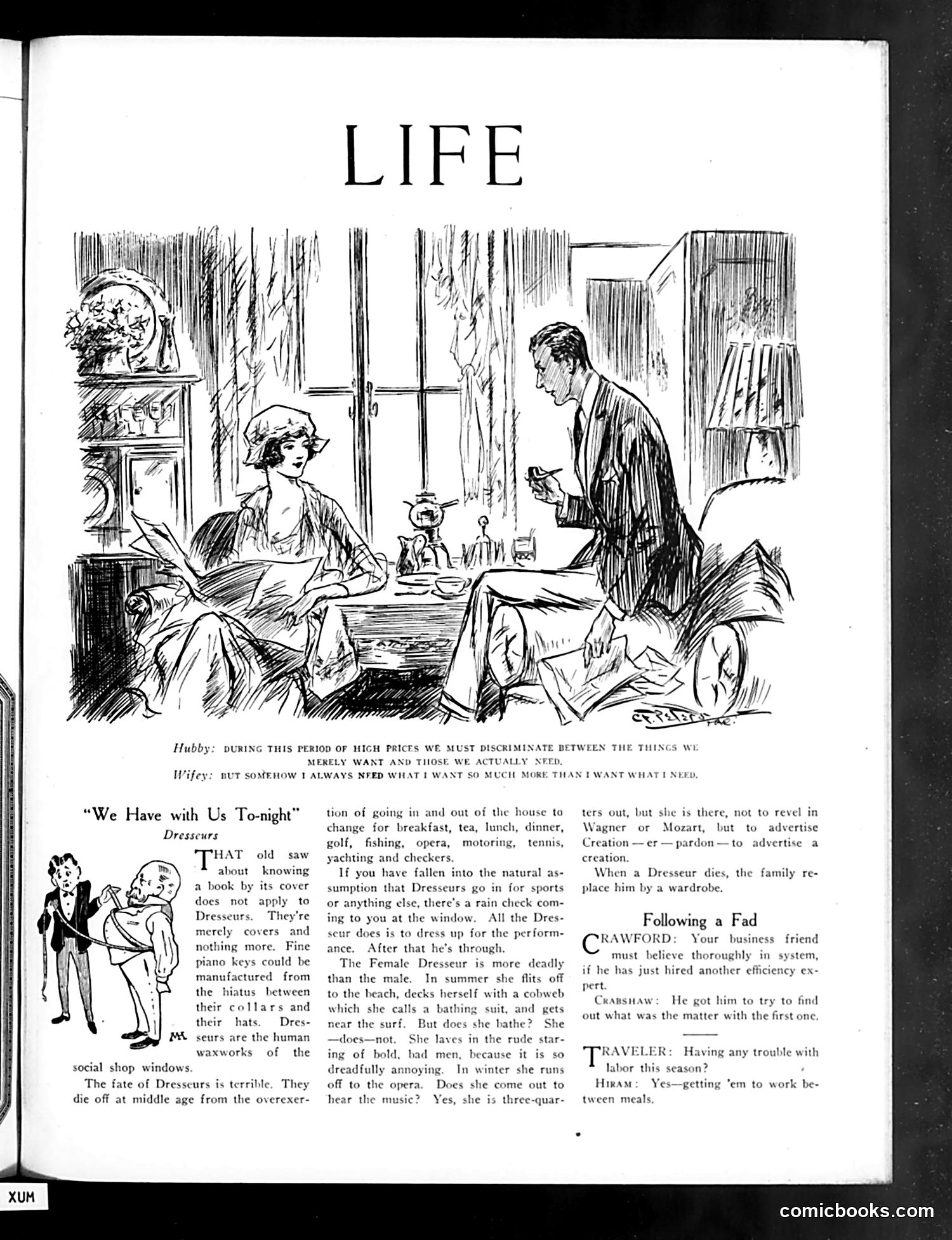
This page satirizes the consumption habits and social anxieties of the upper-middle class during the early 20th century. The main cartoon depicts a couple discussing household expenses, with the husband advocating financial discrimination between wants and needs—a practical stance. The wife counters that she always needs what she wants, highlighting the tension between restraint and desire in affluent households. The accompanying text mocks "Dresseurs"—apparently wealthy individuals who employ personal stylists or wardrobe attendants. The satire suggests these servants are essential social fixtures, their primary function being to enable constant wardrobe changes for opera, sports, and social events. The brief anecdotes that follow ("We Have with Us To-night," "Following a Fad") continue poking fun at upper-class pretension and the absurdities of maintaining fashionable appearances.
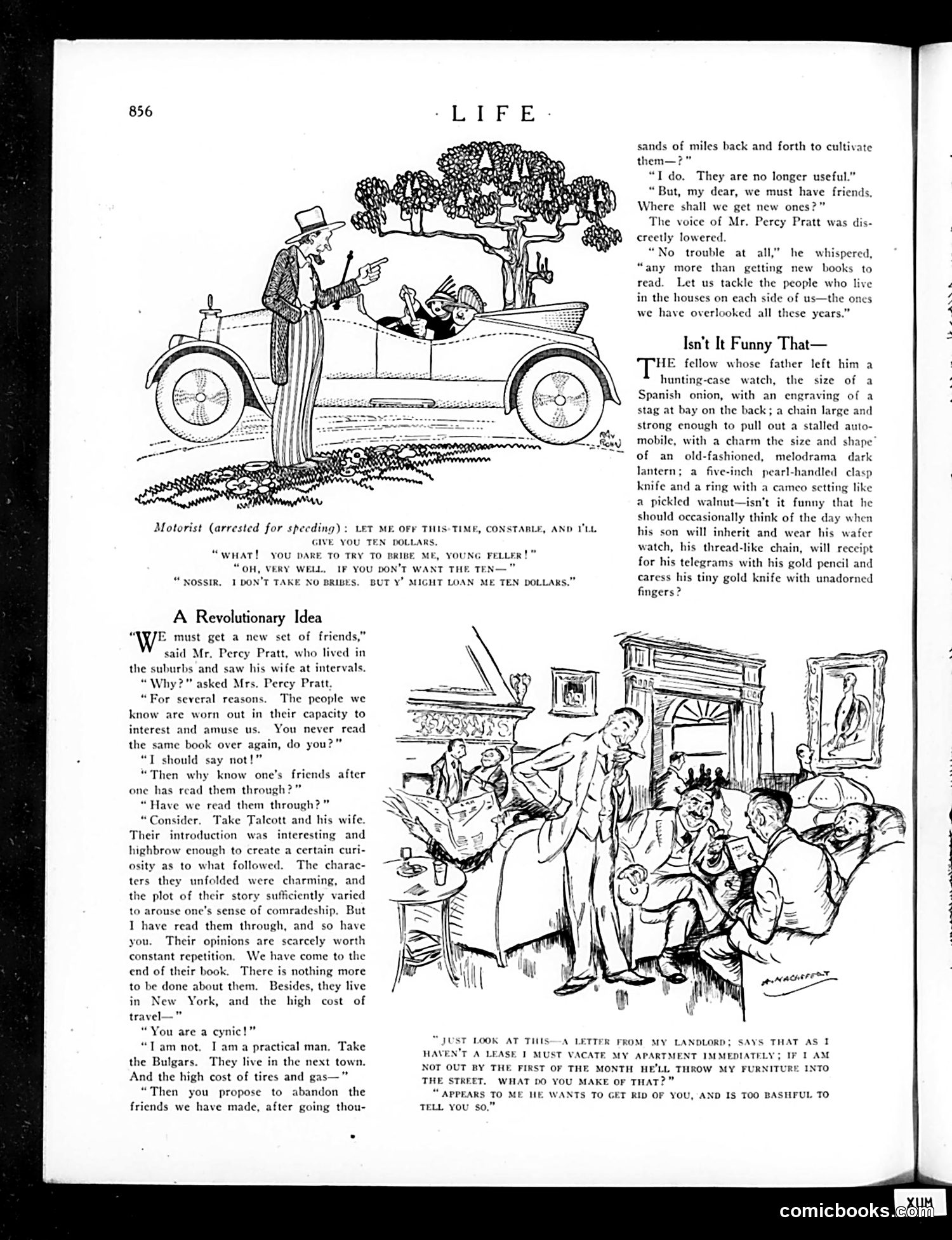
This page contains two satirical pieces about social change and friendship. **Top cartoon**: A motorist stops a constable near a cactus, offering him ten dollars as a bribe. The satire mocks both corruption and the "automobile age" — suggesting that wealthy motorists routinely attempt to bribe police officers. **"A Revolutionary Idea"**: The main article satirizes Mr. Percy Pratt's proposal to abandon old friends and acquire a new social circle. The text mocks this as impractical, using the Bulgarians as an example of neighbors whose "high cost of tires and gas" makes them burdensome. **"Isn't It Funny That"**: A brief humorous piece about inherited pocket-watch memorabilia — poking fun at sentimental attachment to mundane inherited objects. The overall theme critiques social pretension and the disconnection of wealthy Americans from practical reality.
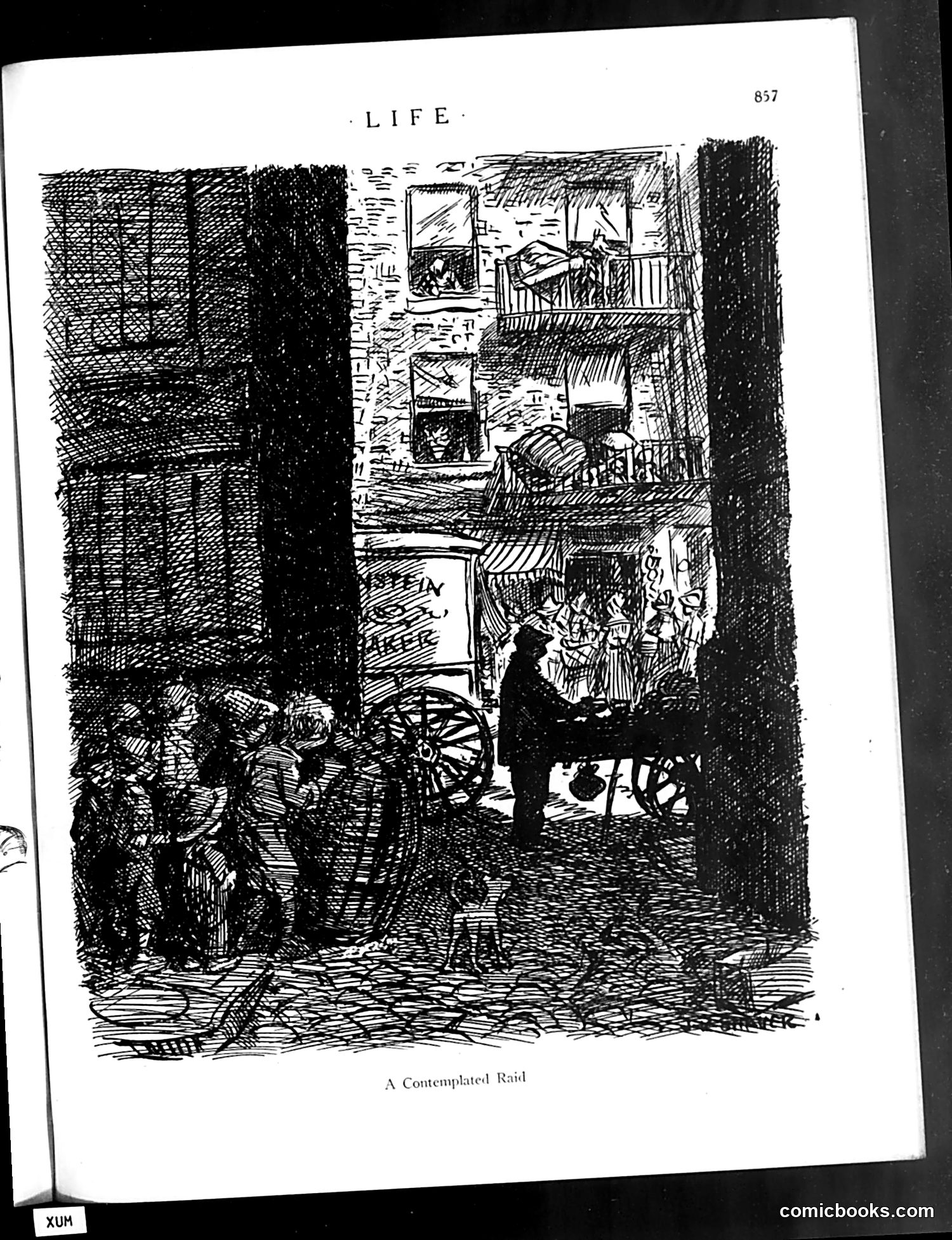
This sketch depicts an urban alleyway scene from what appears to be the late 19th or early 20th century. The cartoon shows a figure in dark clothing (appearing to be a police officer or authority figure) standing near a wagon or cart, with groups of people gathered in the shadowy street below tenement buildings with multiple windows. The title "A Contemplated Raid" suggests this satirizes police enforcement actions in crowded immigrant neighborhoods. The composition—with the officer looming over common residents in a cramped urban space—likely critiques either aggressive policing tactics or raids targeting vulnerable populations in tenement districts, a recurring social concern in Life magazine's satirical commentary on urban conditions and class relations.
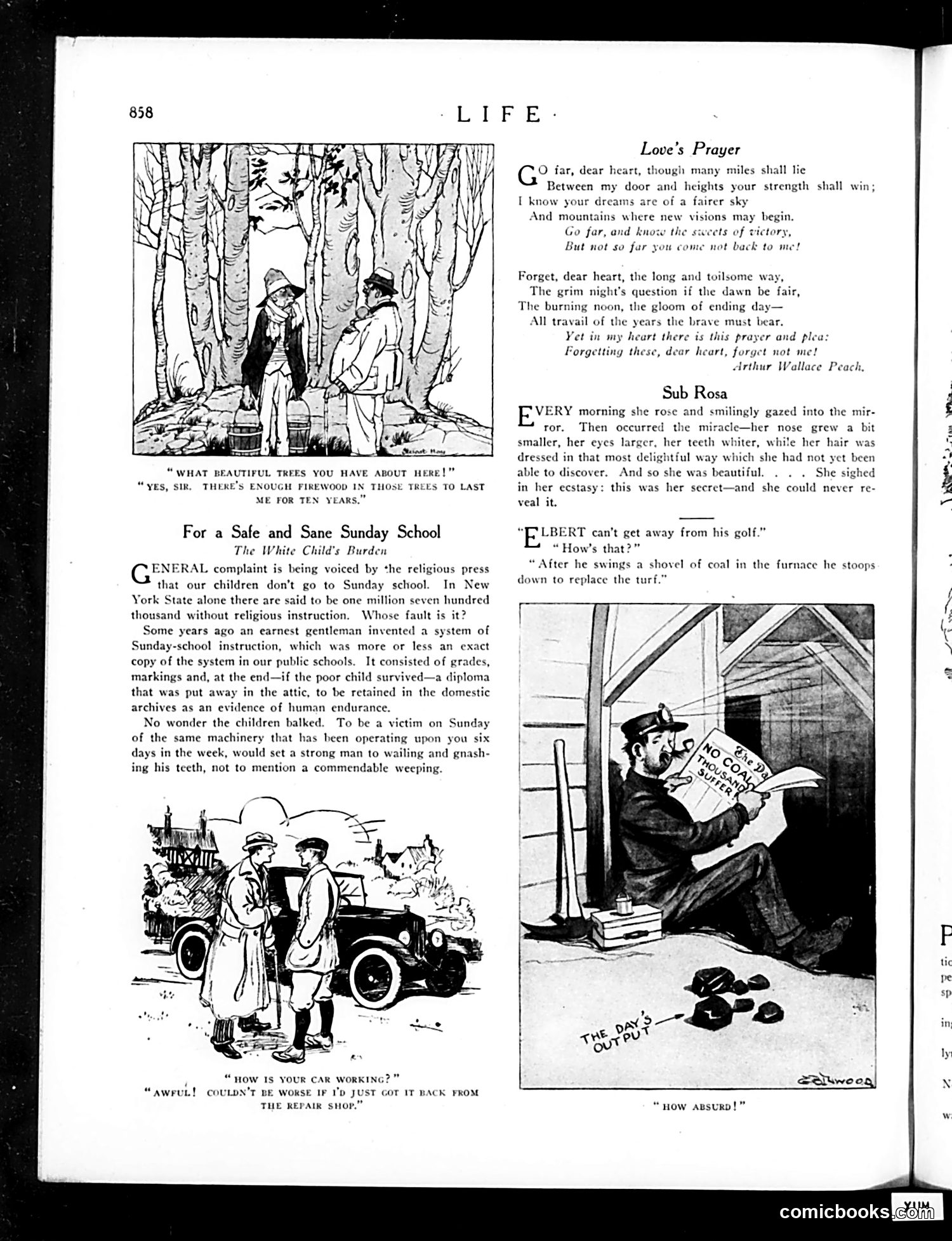
This page contains three distinct sections: **"Love's Prayer"** — A sentimental poem about long-distance love, attributed to Arthur Wallace Peach. **"Sub Rosa"** — A brief romantic story about a woman named Rosa experiencing a miraculous self-improvement. **"For a Safe and Sane Sunday School"** — Social commentary criticizing the lack of religious education in New York schools (reportedly one million children without instruction). The article argues children need rest from weekday institutional machinery. **Two cartoons** satirize Sunday leisure: 1. A couple with a broken-down car: "How is your car working?" / "Awful! Couldn't be worse if it just got it back from the repair shop." 2. A man reading "No Golf Today" newspaper while surrounded by coal: "How absurd!" — mocking the frustration when golf is unavailable. The page emphasizes tension between work, institutional demands, and desired leisure time in early 20th-century American life.
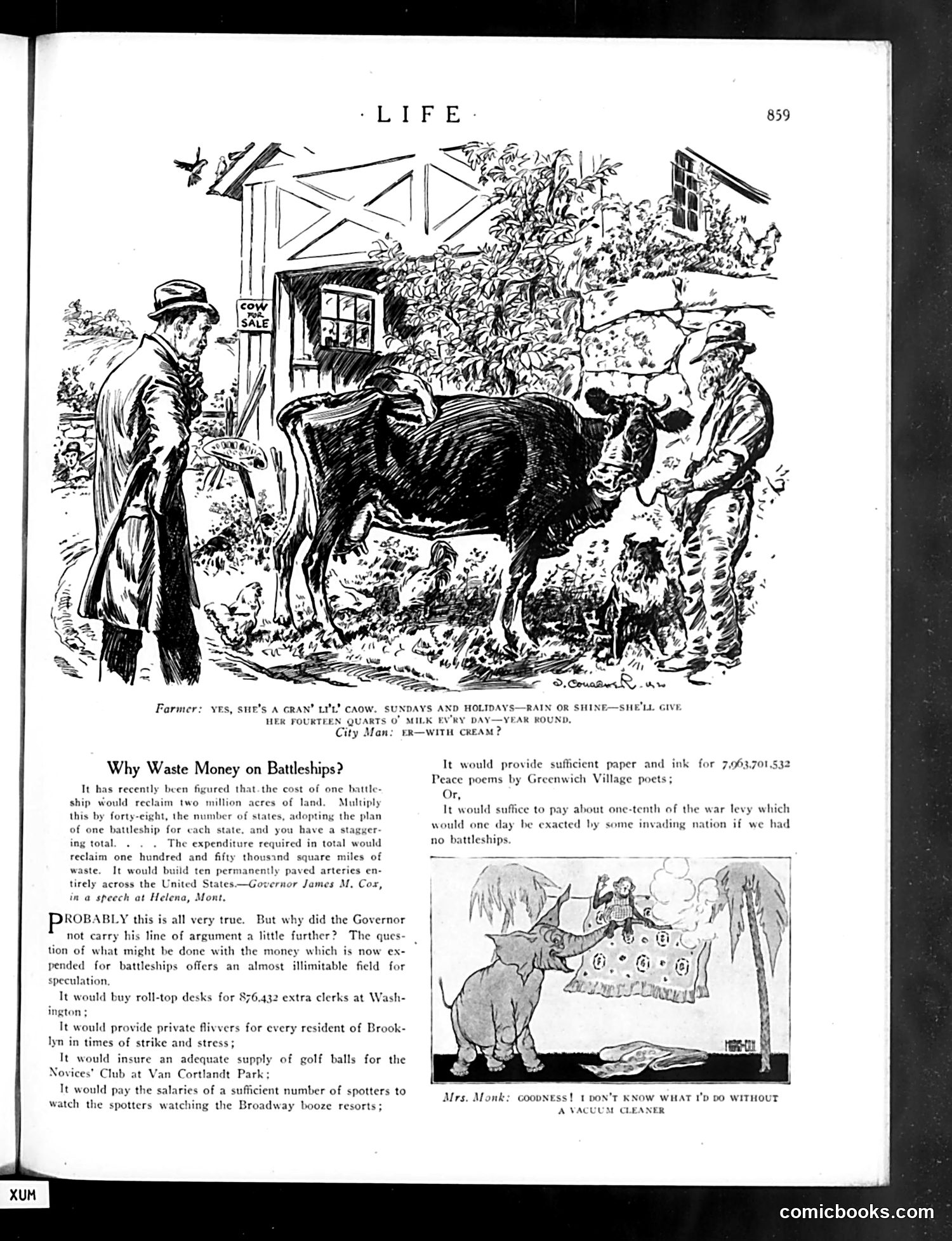
The top cartoon depicts a farmer and city man discussing a cow. The farmer boasts about the cow's productivity ("she's a gran' li'l cow"), while the city man asks "with cream?"—a joke about urban consumers' disconnection from agricultural reality and their assumptions about dairy products. Below, "Why Waste Money on Battleships?" presents a satirical argument that the cost of one battleship (reclaimed from million acres) could fund numerous public goods: poets, roll-top desks, private carriages for Brooklyn residents, golf balls, and "spotters" for Broadway bars. The satire mocks military spending priorities by listing absurdly specific civilian alternatives, critiquing defense budgets during what appears to be an early 20th-century period of naval expansion debates.
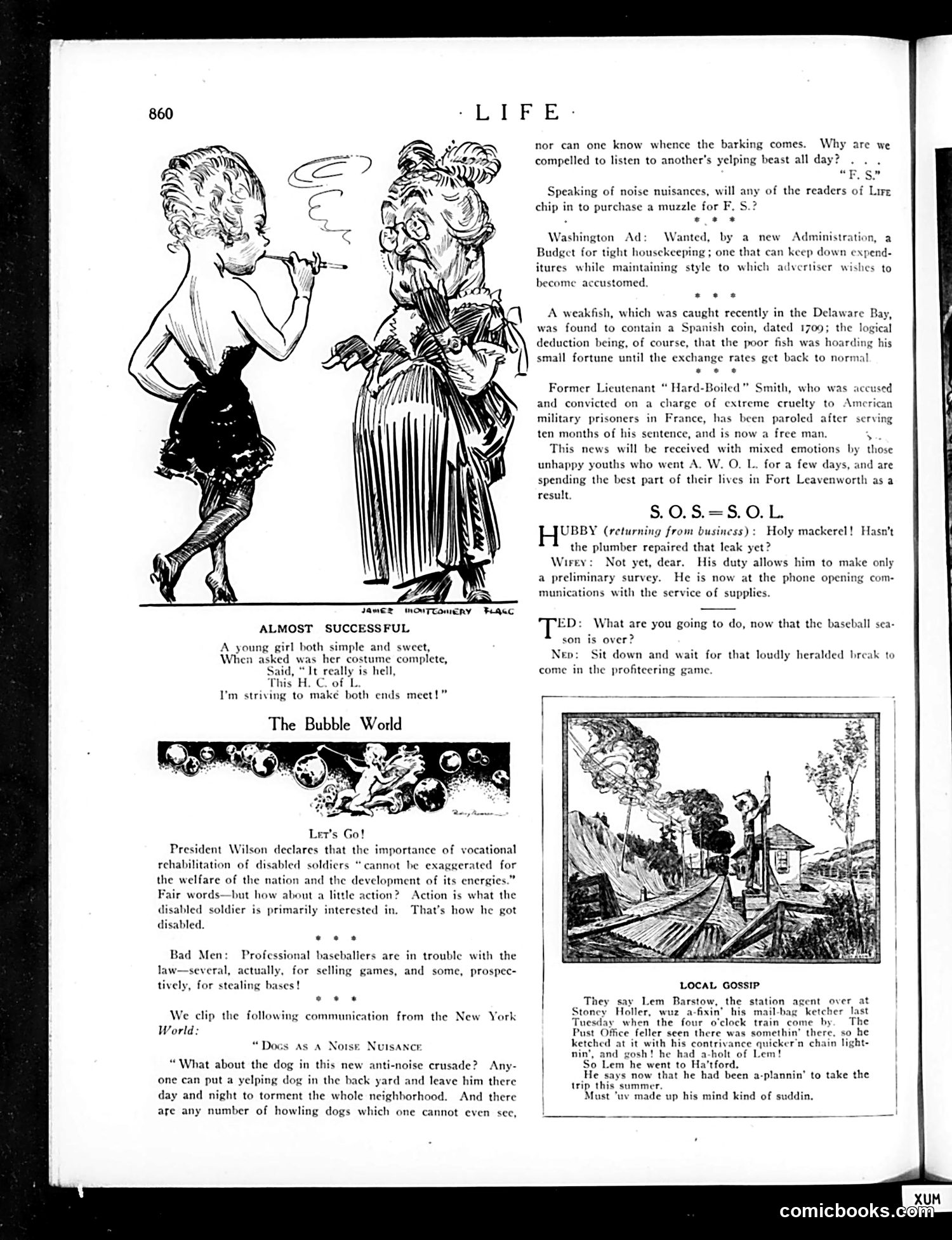
The main cartoon by James Montgomery Flagg depicts a young woman attempting to complete her costume for what appears to be a social event or party. The accompanying verse explains she's trying to "make both ends meet"—a pun on both literally fastening her dress and the financial struggle of living on a limited budget during what appears to be the post-WWI era. The satire targets the economic pressures on working-class women, particularly those seeking to maintain social respectability through proper appearance despite financial constraints. The cartoon's title suggests she "almost" succeeds, implying the constant difficulty of managing expenses while keeping up appearances—a common concern during economically uncertain periods.
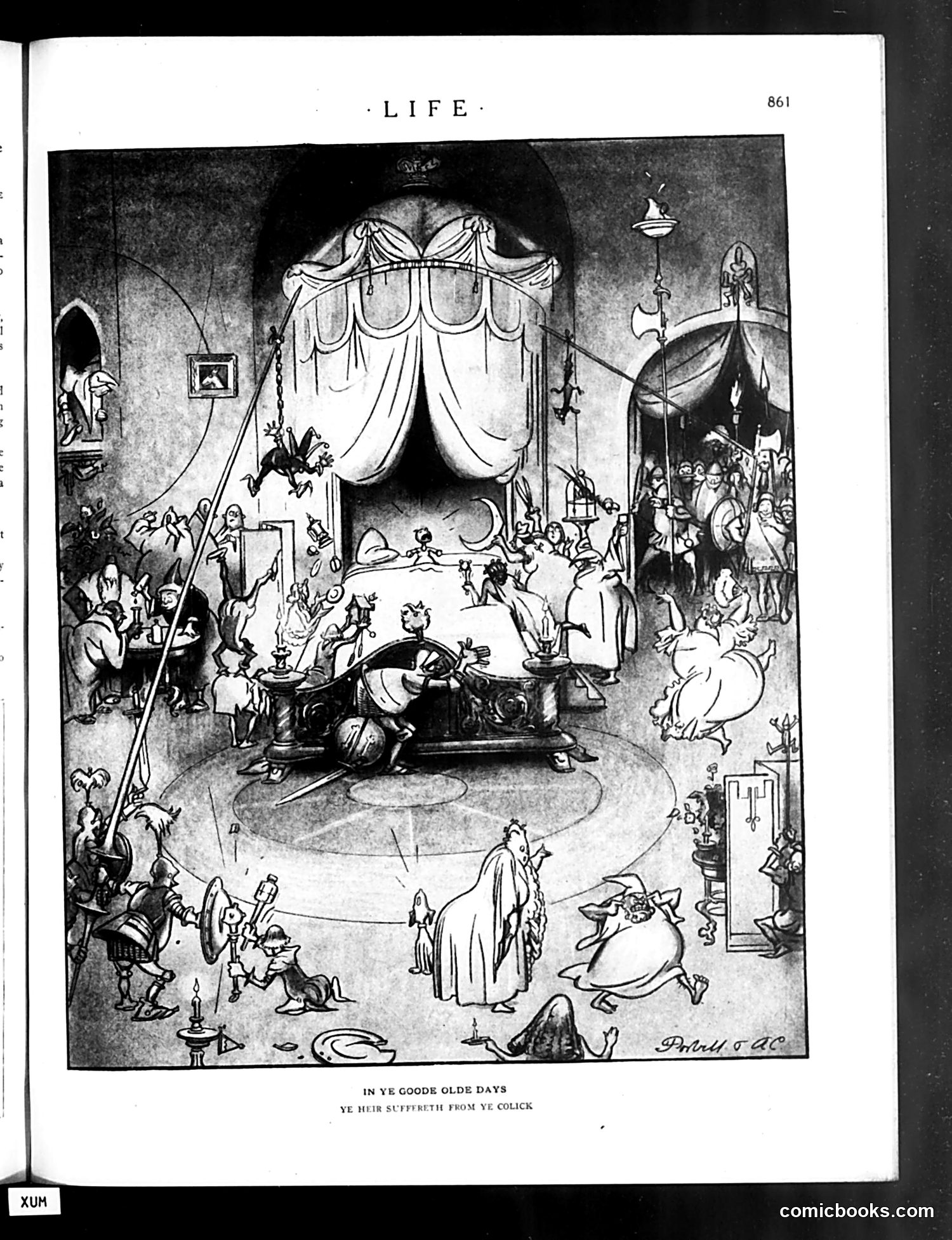
This satirical cartoon depicts a medieval or Renaissance court scene with elaborate pageantry surrounding a suffering infant (the "heir"). The joke appears to target wealthy aristocratic indulgence: despite the child's obvious distress, the court maintains an absurdly elaborate ceremonial spectacle complete with curtained canopy, attendants, musicians, and nobility in formal dress. The satire mocks how the privileged classes prioritize ceremony and show over practical child care. The title's archaic spelling ("Ye Goodly Olde Days") suggests nostalgic romanticization of the past, which the cartoon undercuts by showing that even historical "golden ages" involved neglectful or performative parenting among the elite. The contrast between ornate surroundings and the baby's genuine suffering is the cartoon's central point.
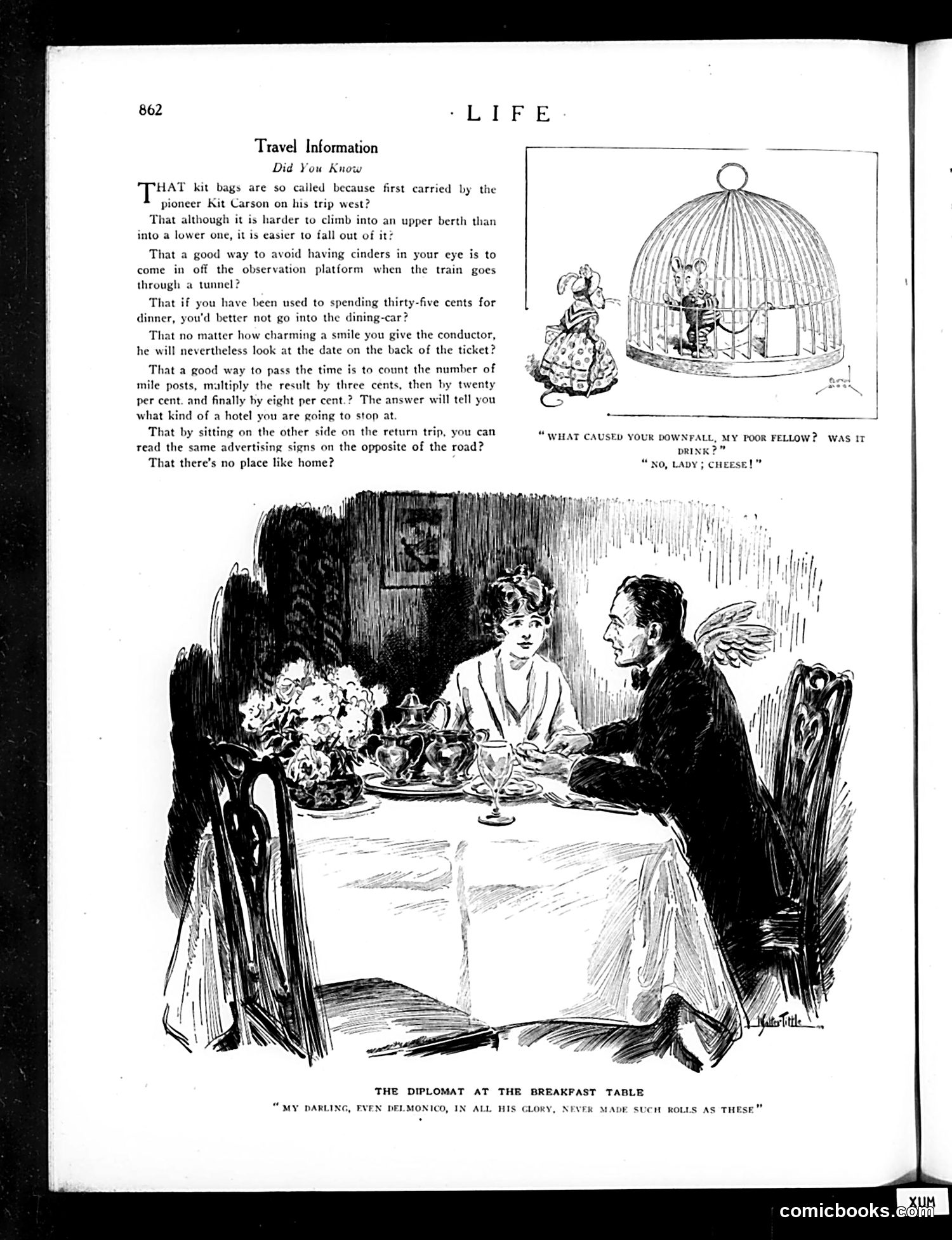
This page contains two distinct sections: **Upper section:** "Travel Information" offering practical tips for train travelers (kit bags, berth climbing, dining car costs, counting posts to estimate distance, reading signs from the opposite side). **Lower cartoon:** Titled "The Diplomat at the Breakfast Table," it depicts a well-dressed man with diplomatic bearing dining with a woman. The caption reads: "My darling, even Helmholtz, in all his glory, never made such rolls as these." The satire appears to mock diplomatic pretension—the man compares his wife's bread rolls to the achievements of a famous figure (likely physicist Hermann von Helmholtz), treating domestic accomplishments with exaggerated, grandiose language typical of diplomatic flattery. The joke satirizes overwrought compliments and the inflated rhetoric of diplomatic society applied to ordinary household matters.
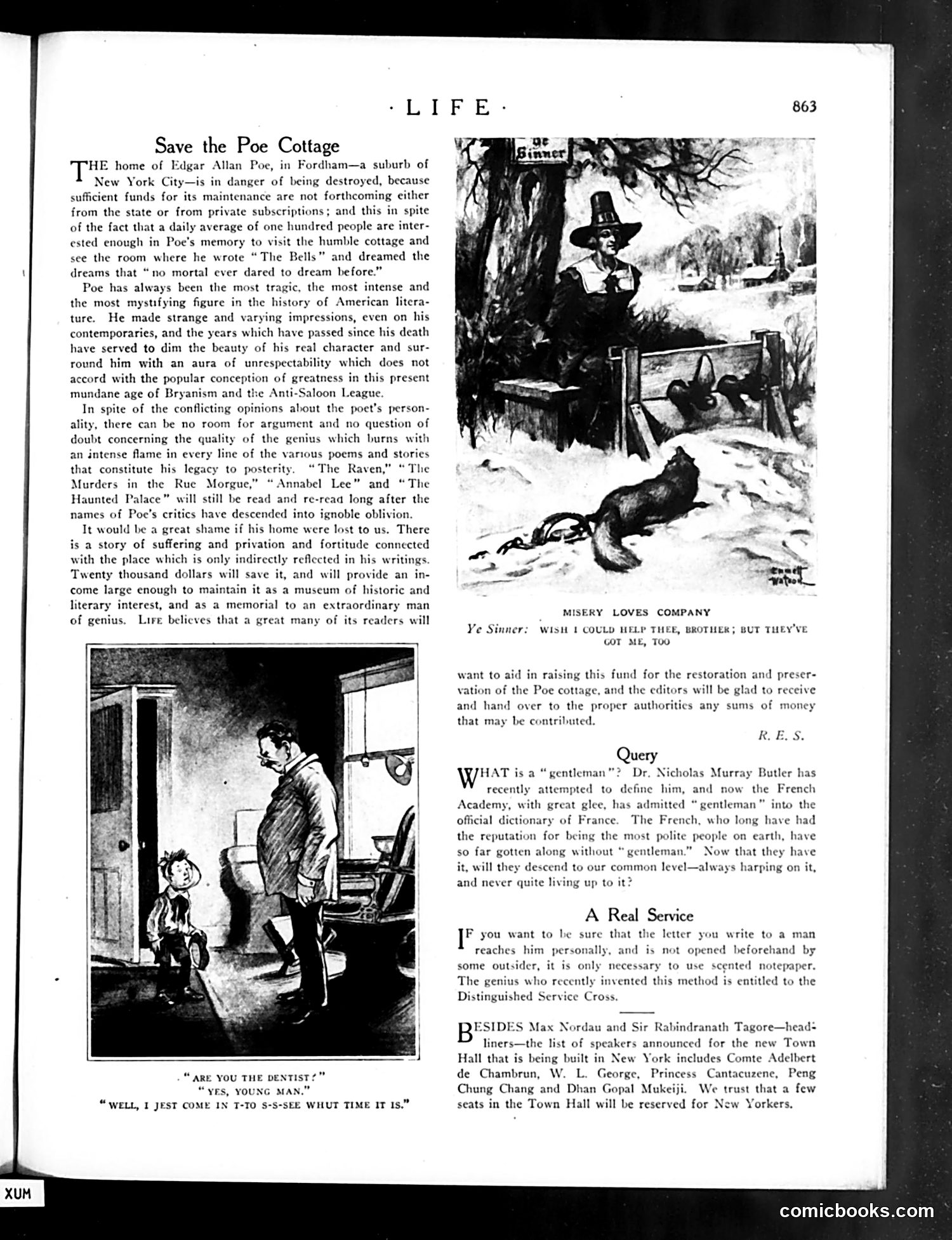
This page contains three distinct sections: 1. **"Save the Poe Cottage"** — An editorial appeal to preserve Edgar Allan Poe's Fordham cottage in New York City, arguing it deserves protection as a literary landmark despite lack of funding. 2. **"Misery Loves Company"** — A cartoon depicting a man and child in winter, with the caption suggesting shared hardship. The sentiment reflects Depression-era themes of mutual suffering. 3. **"Are You the Dentist?" / "Yes, Young Man"** — A brief humorous cartoon about a young boy visiting a dentist, using the joke that the boy arrives during inconvenient timing ("I jest come in t-t-o s-s-see whut time it is"). The page reflects early-to-mid 20th century American magazine humor and cultural concerns: preservation of literary history, economic hardship, and gentle domestic comedy.
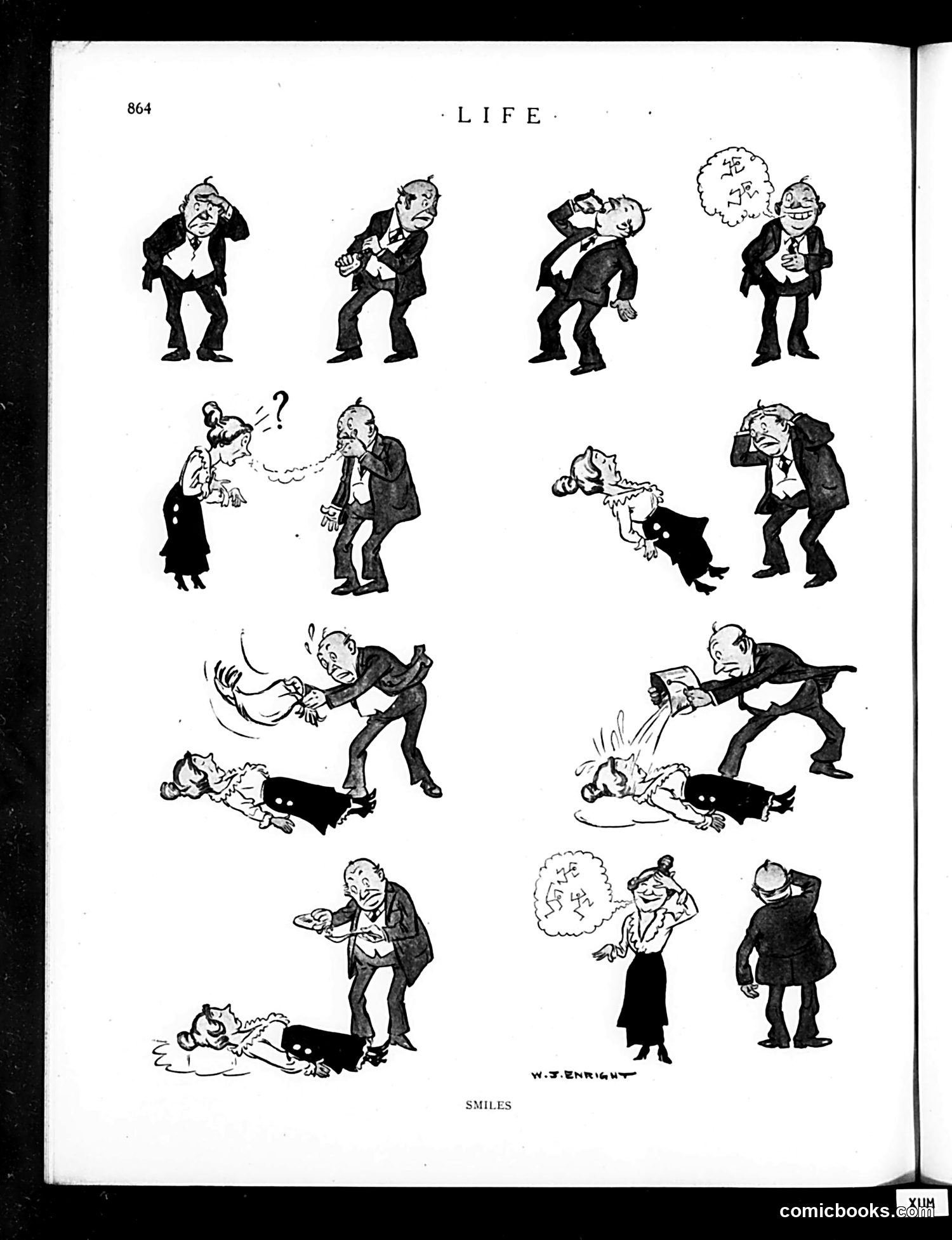
This page titled "SMILES" by W.J. Enright presents a series of character sketches exploring different types of smiles and facial expressions. The cartoons depict men in business suits displaying various emotional states: confusion, suspicion, anxiety, forced cheerfulness, and desperation—often while interacting with women or dealing with apparent misfortune. The humor derives from exaggerating how men's expressions betray their true feelings despite attempts to maintain composure. One figure sports a thought bubble labeled with dollar signs; another appears to be hiding distress. The sketches satirize masculine pretense in early 20th-century society, suggesting that men's carefully constructed public facades of confidence frequently crack under social or financial pressure, revealing underlying worry and insincerity.
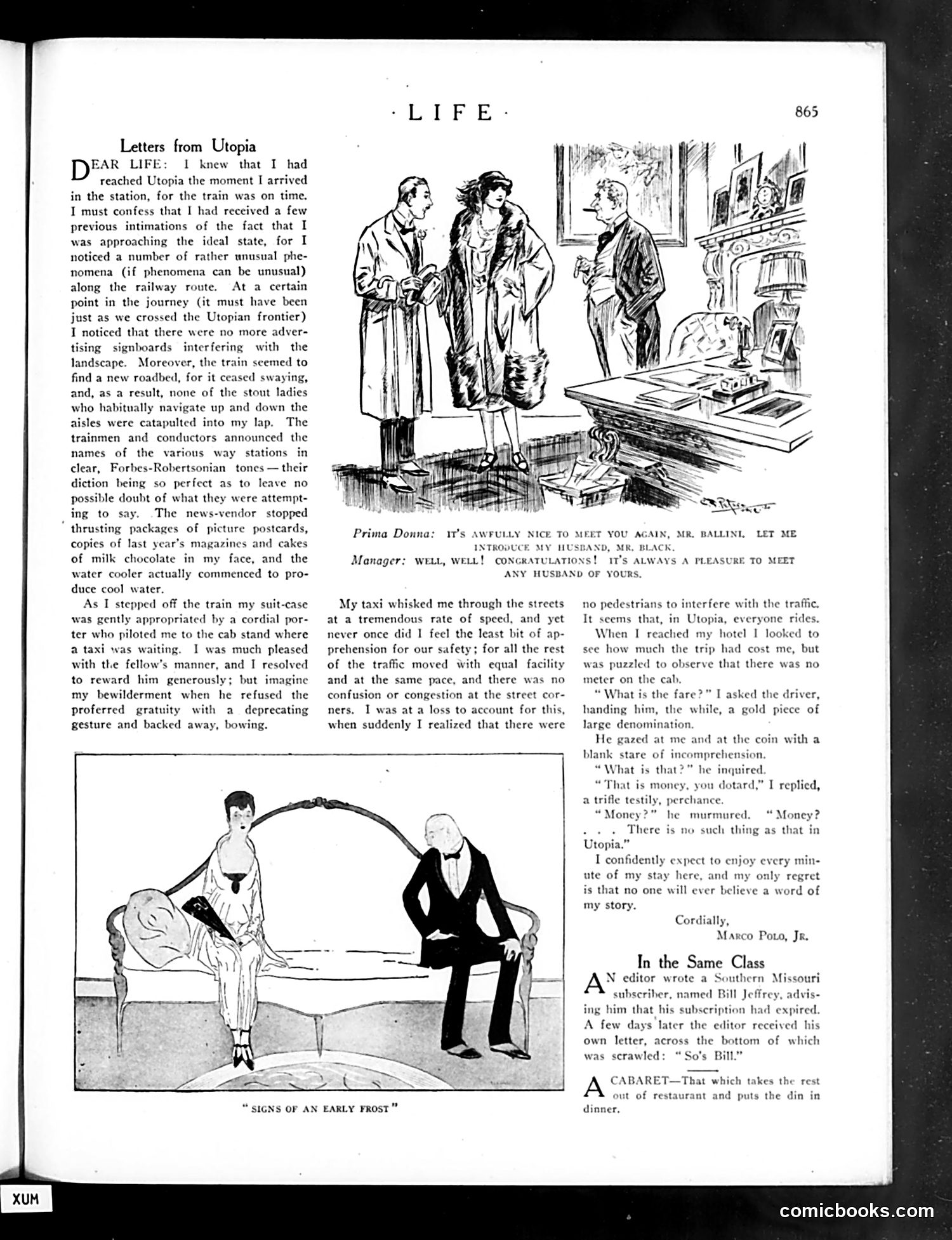
This page contains a satirical letter imagining an ideal society ("Utopia") where everyday annoyances have been eliminated. The writer catalogs absurd improvements: trains run on time, advertising doesn't clutter landscapes, conductors speak clearly, taxi drivers refuse tips, traffic flows perfectly with no pedestrians, and—most pointedly—**money doesn't exist**. The satire targets early 20th-century American life: unreliable trains, aggressive vendors, rude service workers, chaotic traffic, and the money-obsessed culture. By depicting a world where these problems vanish, the author mockingly suggests such improvements are impossibly idealistic. The cartoon "Signs of an Early Frost" (showing two people on a couch) and the brief jokes below add lighter humor unrelated to the main piece. The overall tone is gentle satire about modern inconveniences rather than sharp political commentary.
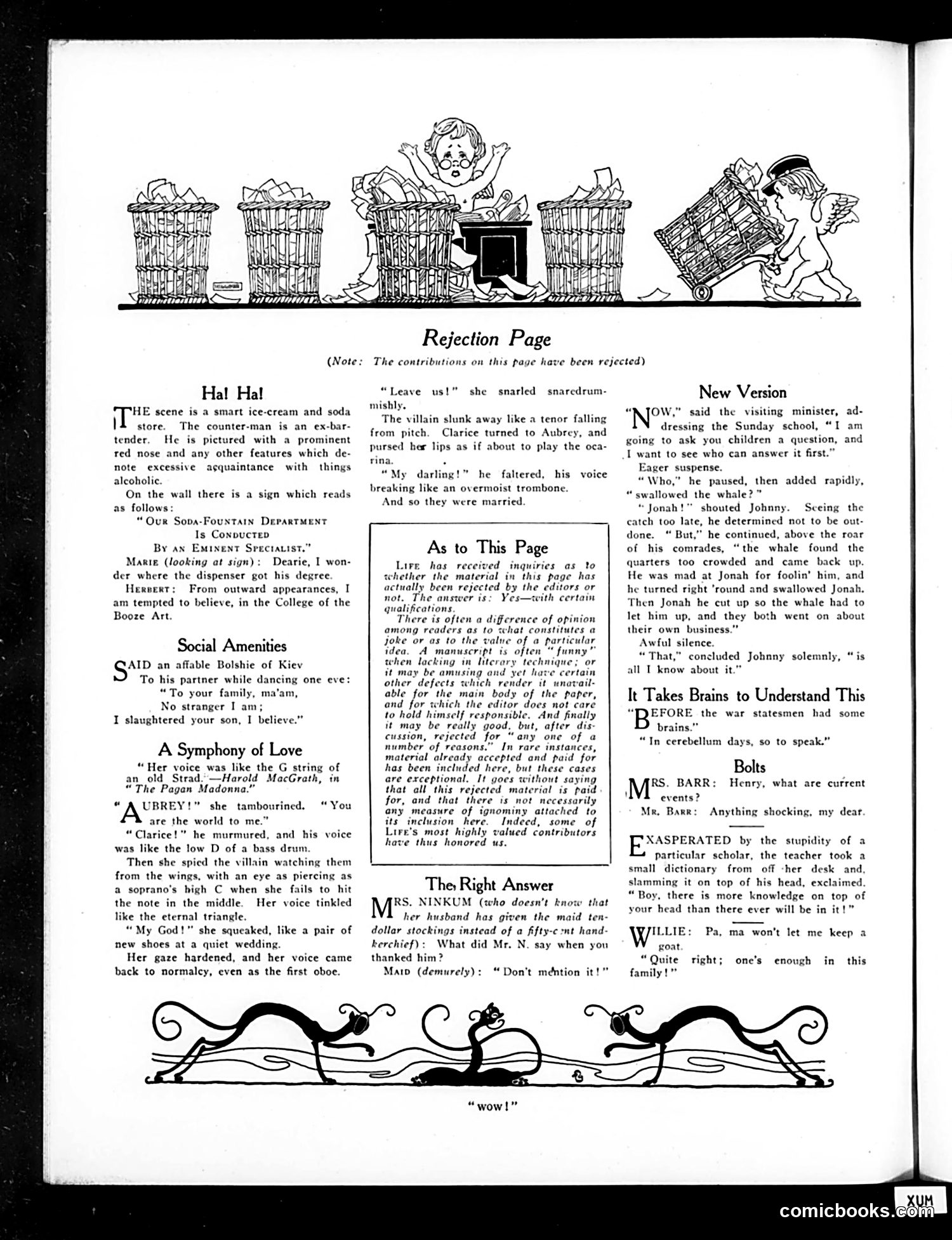
This page showcases material rejected by Life's editors, with a note explaining their selection criteria. The page demonstrates why certain submissions were deemed unsuitable for publication despite containing humor. The content includes several satirical pieces: "Ha! Ha!" mocks Prohibition-era bartenders posing as soda fountains; "Social Amenities" presents darkly comic one-liners (including an uncomfortable joke about Bolshevism); "A Symphony of Love" parodies overwrought romantic prose through musical metaphors. The editorial note clarifies that rejected material isn't necessarily poor quality—editors reject pieces for various reasons: weak literary execution, defects incompatible with the magazine's standards, or simply editorial discretion. Notably, Life paid for rejected submissions and acknowledged that some rejected contributors later became highly valued. The page functioned as both entertainment and editorial transparency, allowing readers insight into magazine gatekeeping while maintaining humorous content standards.
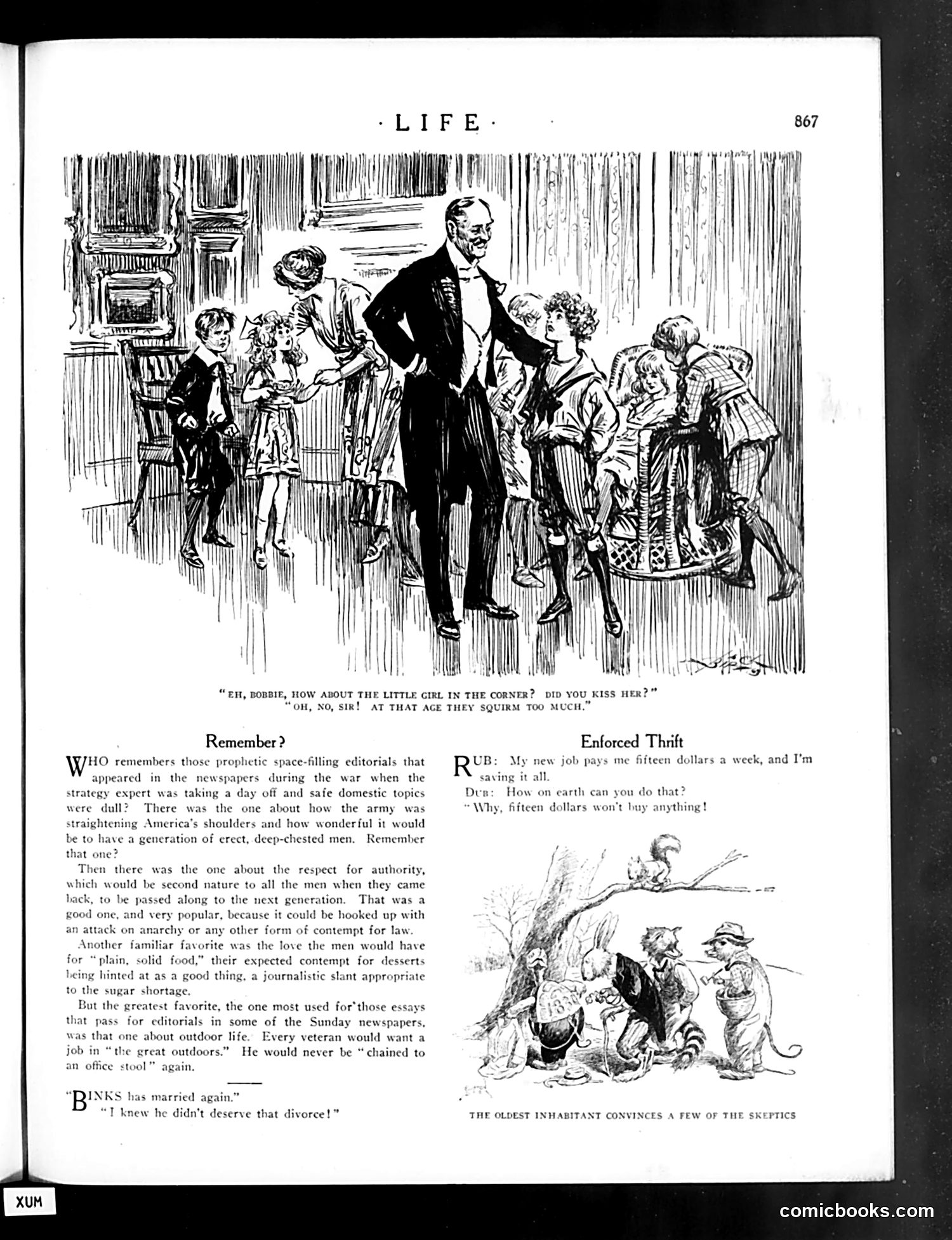
This page contains three separate satirical pieces: 1. **Top cartoon**: A formal adult asks a boy about kissing a girl at a party. The boy's practical response—that young girls "squirm too much"—humorously subverts the adult's implied romantic expectations, mocking sentimental assumptions about childhood innocence. 2. **"Remember?" editorial**: Satirizes wartime newspaper editorials that promoted idealistic visions of soldiers' post-war lives—respect for authority, strong character, outdoor work. The author mocks these as hollow propaganda, noting they were recycled filler content when real editorial topics seemed dull. 3. **"Enforced Thrift" dialogue**: A humorous exchange where one character claims to save his entire $15 weekly wage, while another protests that $15 won't buy anything anyway. The joke critiques both wartime financial restrictions and the absurdity of saving money with such limited purchasing power—likely referencing post-WWI economic conditions or inflation concerns. All three pieces employ irony to deflate contemporary social pretensions and wartime rhetoric.
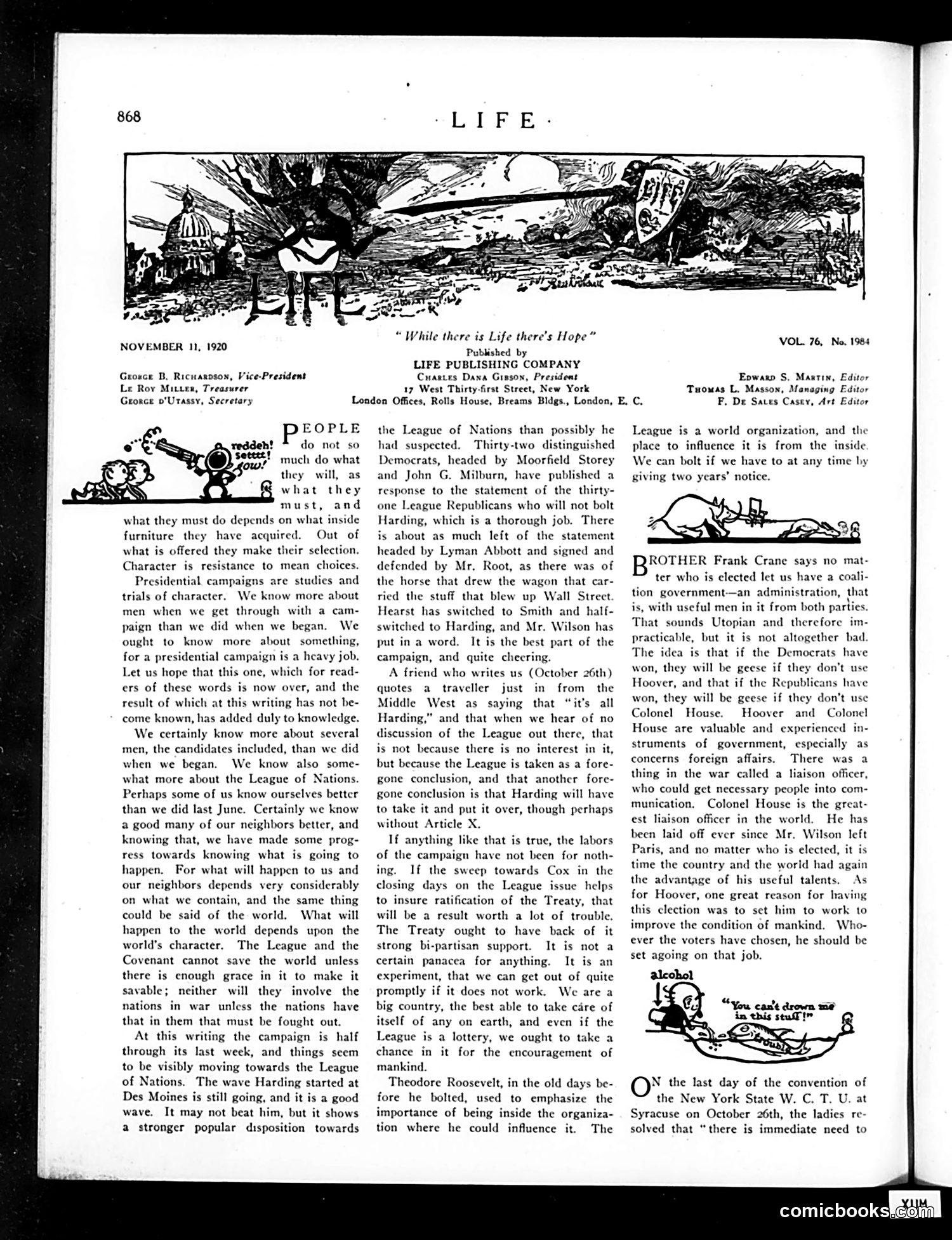
This page is primarily editorial text by Life's editors discussing the 1920 presidential campaign, which was evidently still ongoing when this went to press (the editors note the result "has not become known"). The main subject is the **League of Nations debate**. The editors analyze how the campaign has clarified Americans' positions: they reference statements by distinguished Democrats (Moorfield Storey, John G. Milburn) responding to Republicans (including those signed by Lyman Abbott and Elihu Root) who opposed the League. The text mentions **William Jennings Bryan's "Cox"** (James Cox, the Democratic candidate) gaining ground on the League issue in closing campaign days. The page discusses whether voters actually care about the League in the Midwest, and expresses hope the Treaty will receive bipartisan support for ratification. The small cartoons are difficult to interpret clearly from the image quality, but appear to be generic satirical illustrations accompanying the editorial commentary.
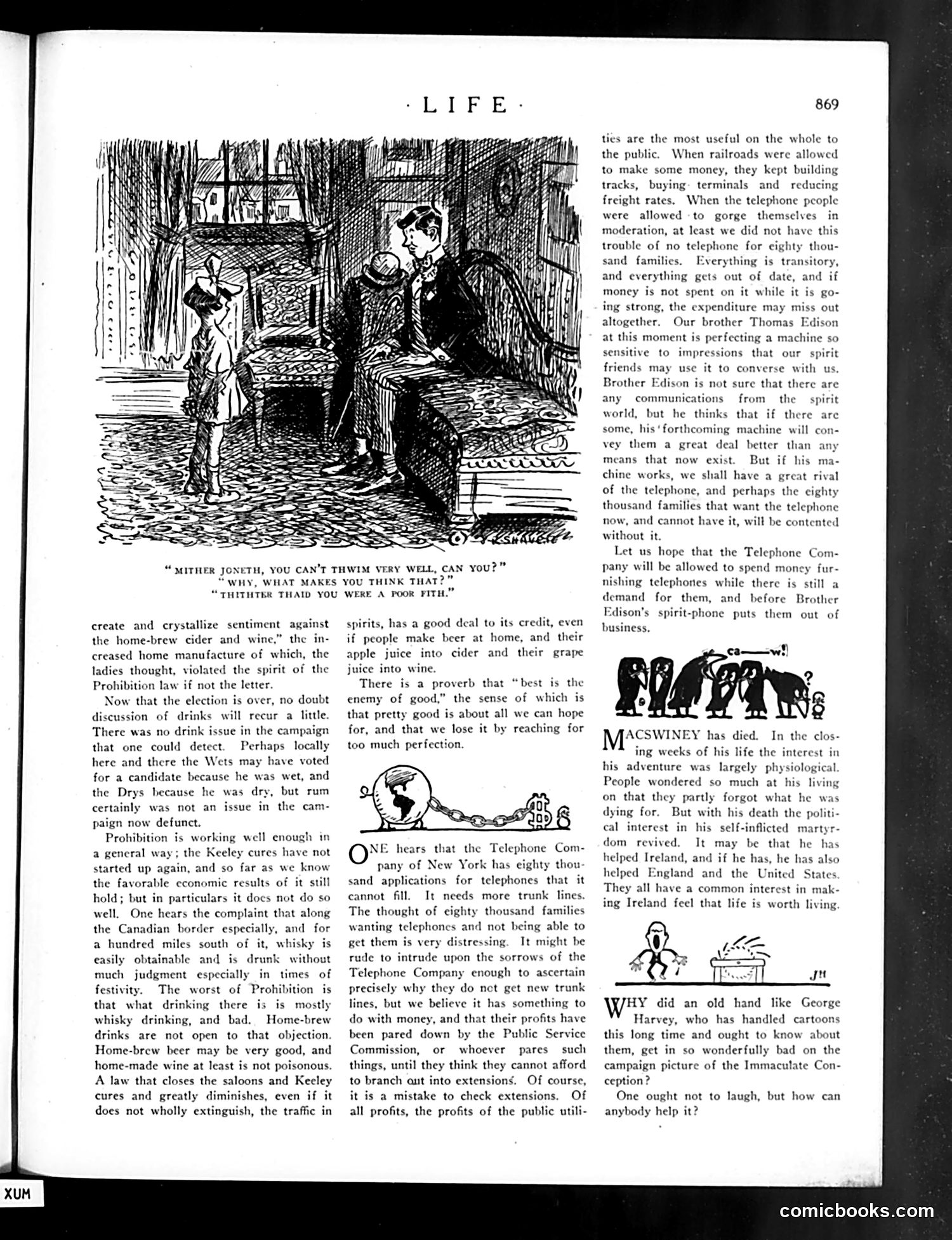
## Main Cartoon The illustration shows a child unable to swim, with the caption playing on dialect humor: "Mother Jones, you can't swim very well, can you?" / "Why, what makes you think that?" / "Sister said you were a poor fish." This is simple, genteel humor about a child's swimming ability—no political content. ## Political Commentary The page contains two substantive essays: **1. Prohibition:** The author argues Prohibition is "working well enough" economically, but acknowledges it's imperfectly enforced (especially near the Canadian border). He defends it while noting unintended consequences: people now drink hard liquor instead of home-brewed beer/wine. The "best is enemy of good" proverb suggests accepting imperfect results. **2. Telephone Service:** The author criticizes the Public Service Commission for limiting telephone company profits, which discourages infrastructure expansion. He notes 80,000 unfilled applications for telephones and argues that allowing utilities reasonable profits incentivizes growth—referencing Edison's ongoing work on spirit-communication devices as a potential competitor. Both essays reflect Progressive-era debates about regulation versus business incentives.
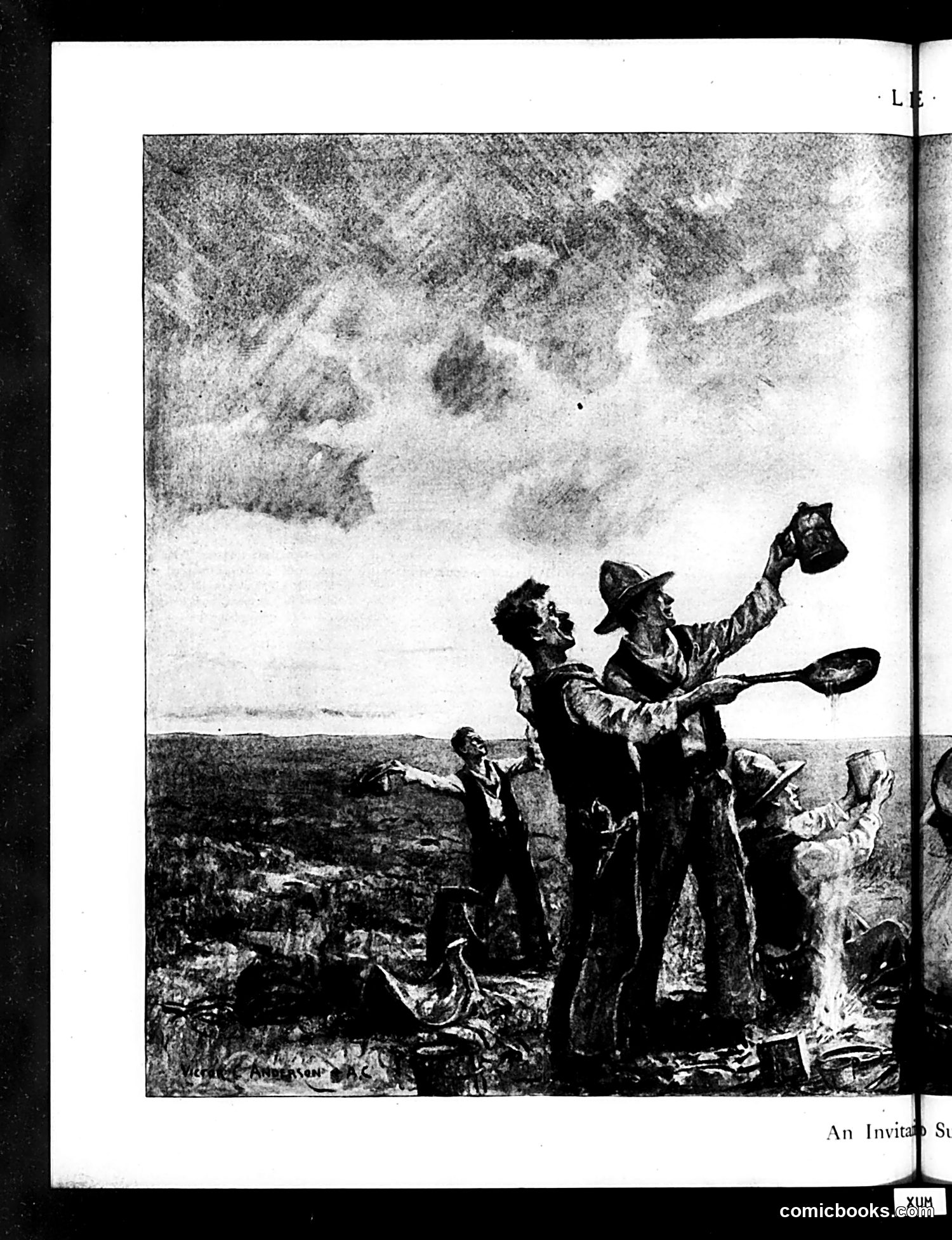
This appears to be a satirical illustration from *Life* magazine showing figures in what seems to be a Western or frontier setting. The image depicts several men around a campfire in an open landscape. One central figure wears a cowboy hat and holds up what appears to be a bottle or flask triumphantly, while others gesture dramatically around him. The partial caption visible reads "An Invita'd Su[...]" (likely "An Invited Supper" or similar), suggesting this depicts a social gathering or celebration in a frontier context. Without the complete caption and publication date, I cannot definitively identify the specific figures or political/social references this satire targets. The style suggests late 19th or early 20th-century American humor, but further context would be needed to explain the specific joke or commentary intended.
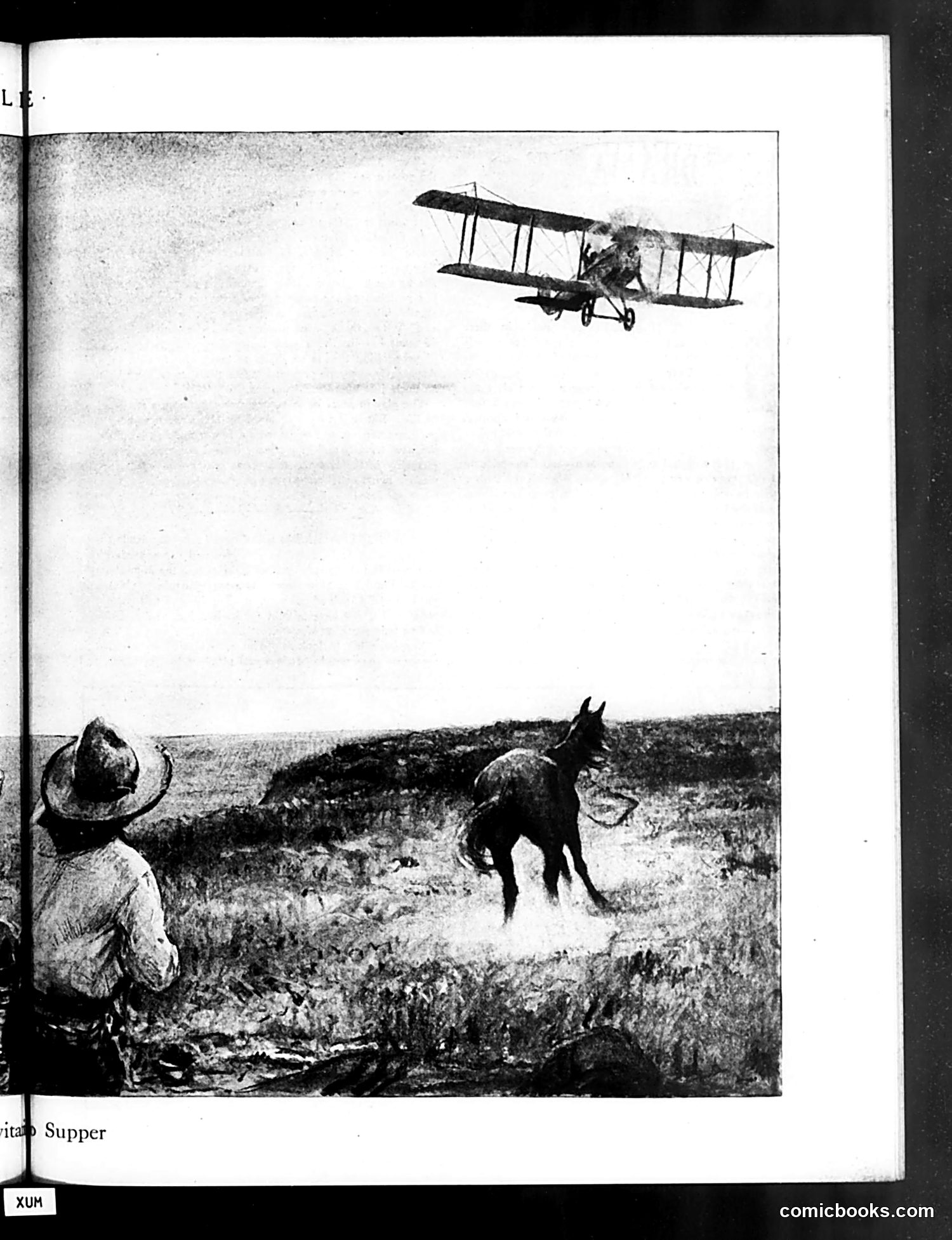
This appears to be a satirical illustration from Life magazine depicting early aviation's impact on rural life. The image shows a cowboy and horse startled by a biplane flying overhead—a striking juxtaposition of the Old West with emerging modern technology. The satire likely comments on how rapidly aviation was transforming American society in the early 20th century. The cowboy's alarm at the aircraft represents traditional frontier culture's displacement by technological progress. The caption "a Supper" is unclear in meaning without additional context. This reflects contemporary anxieties about industrialization and modernization reshaping rural America, presenting the airplane as an intrusive symbol of an inevitable new era that leaves frontier life behind.
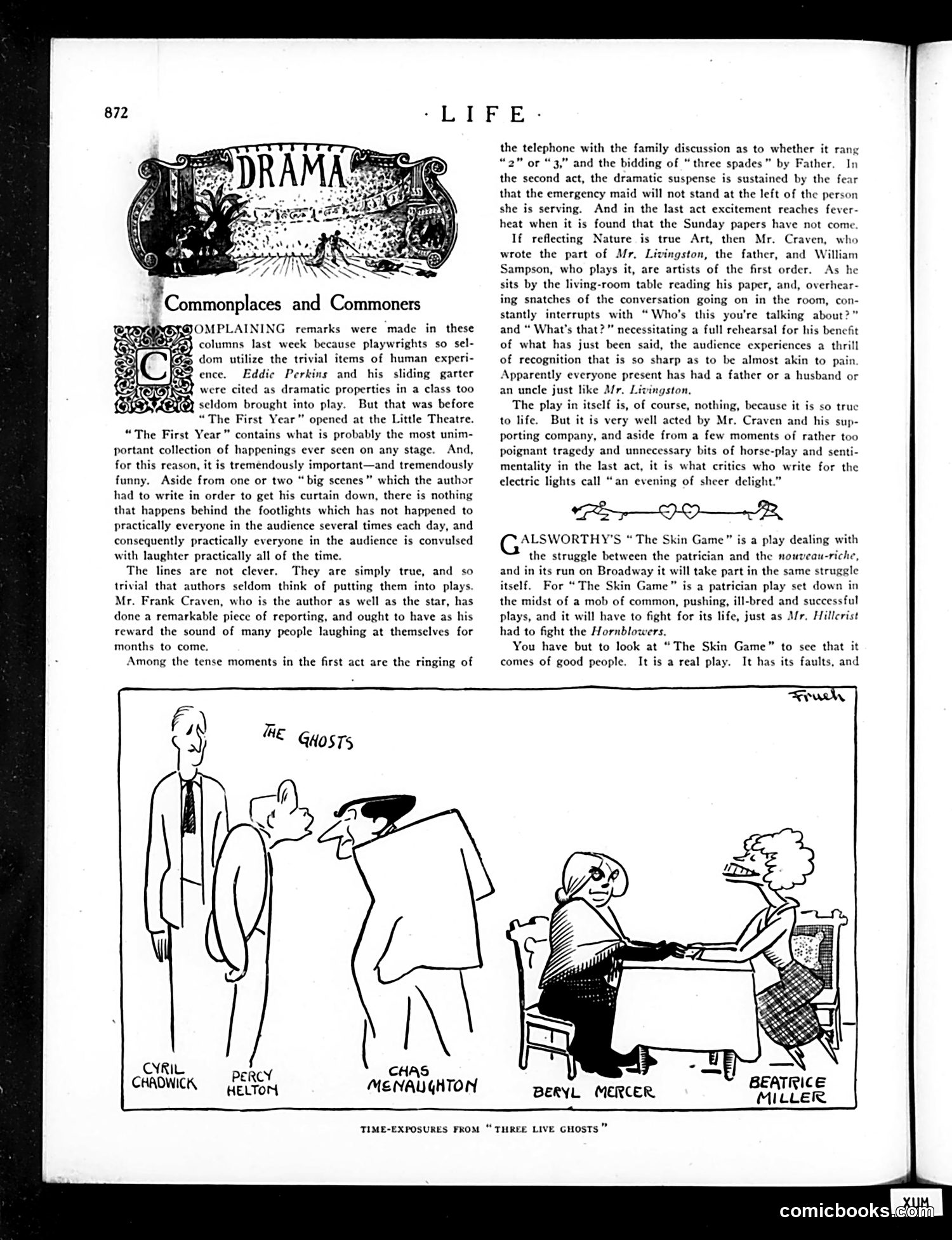
This page reviews theatrical productions from the 1920s era. The main text discusses "The First Year," praising playwright Frank Craven for capturing mundane domestic moments—a ringing telephone, card game bidding, missing newspapers—that resonate universally because audiences recognize their own lives reflected onstage. The satire lies in how the play's *triviality* becomes its greatest strength; critics typically praise "big scenes," but here the humor and pathos emerge from everyday irritations (like a father repeatedly asking "Who's this you're talking about?"). The cartoon titled "The Ghosts" illustrates "Three Live Ghosts," another play, showing five cast members in a simple line drawing. A secondary review discusses Galsworthy's "The Skin Game," a patrician play struggling commercially among lowbrow Broadway productions—positioning the play itself as fighting the same class battle it depicts. The page exemplifies early 20th-century theater criticism valuing naturalism and authentic human experience over melodramatic artifice.
This page is primarily a theatre review column listing Broadway productions. The opening text discusses "The Skin Game," a play that some interpret symbolically as anti-war commentary: the genteel Hillcrists represent England, the Jackmans (evicted farmers) represent Belgium, and Hornblower represents Germany. The reviewer suggests the play's moral is that even a just cause (like defending Belgium) requires ruthless methods to win—a cynical commentary on WWI ethics. The bulk of the page consists of brief, satirical reviews of current Broadway shows, each with acerbic one-line descriptions. These range from conventional comedies to spectacular productions, with the reviewer's wit aimed at both the plays' themes and their execution. The tone is characteristic of Life magazine's irreverent approach to culture.
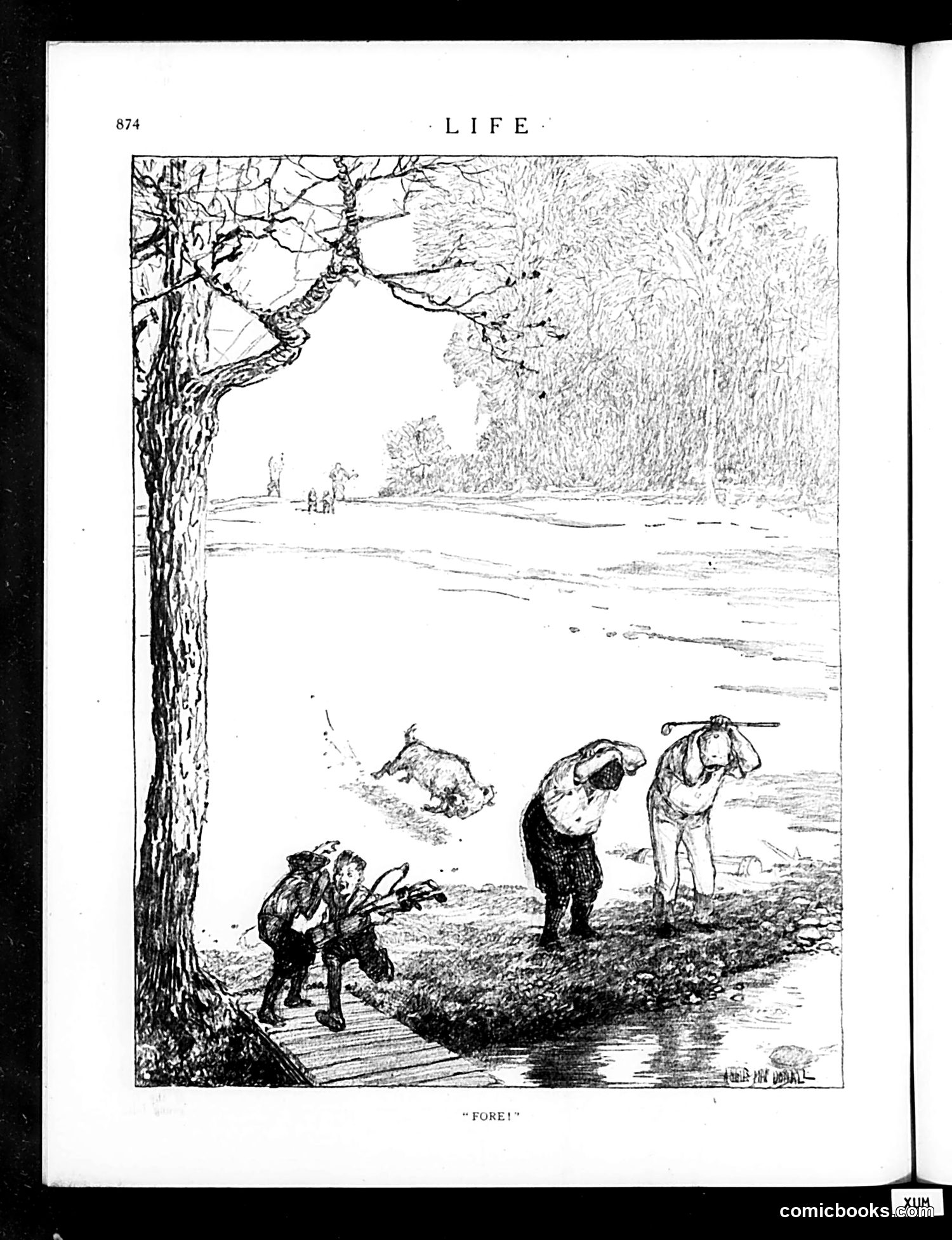
This is a single-panel cartoon from *Life* magazine depicting a golfing accident. The caption "Fore!" is the traditional golf warning cry shouted when a ball heads toward other people on the course. The scene shows three golfers near a riverbank with bare trees. One golfer in the foreground has just hit a wild shot; two others downstream duck or react to the incoming ball. A small figure in the distant background appears unaware of the danger. The humor derives from the classic comedic scenario of a poorly-aimed golf shot creating chaos and near-collisions. This reflects the early-to-mid 20th century popularity of golf as both sport and subject for satirical humor in *Life* magazine.
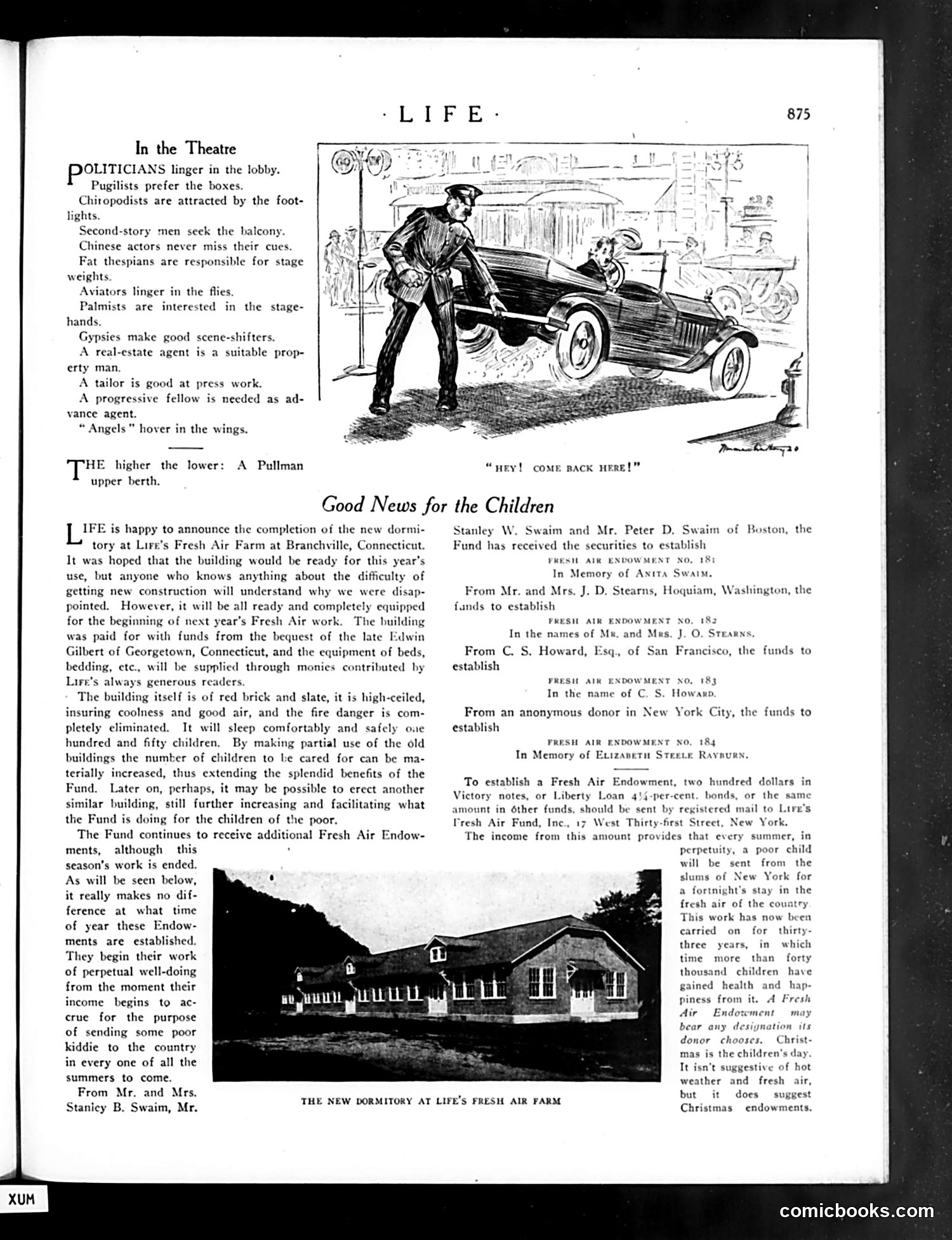
**Top Cartoon:** A humorous illustration shows a man posing dramatically with an automobile, captioned "Hey! Come back here!" The cartoon satirizes theater culture through a series of one-liners observing who attends theaters and their behavior—politicians linger in lobbies, boxers prefer boxes, chiropodists are drawn to footlights, second-story men (burglars) favor balconies. The automobile image appears unrelated to these theater observations, likely serving as a separate comic illustration. **Main Content:** The page primarily announces the completion of a new dormitory at Life magazine's Fresh Air Farm in Connecticut, a charitable facility for poor children. It reports on recent endowments established to fund the program, listing donors and memorial dedications. The text emphasizes the farm's decades-long mission providing country retreats for impoverished urban children, noting over 40,000 children have benefited in thirty-three years. The page blends satirical humor with earnest philanthropy—typical of Life's editorial approach during this era.
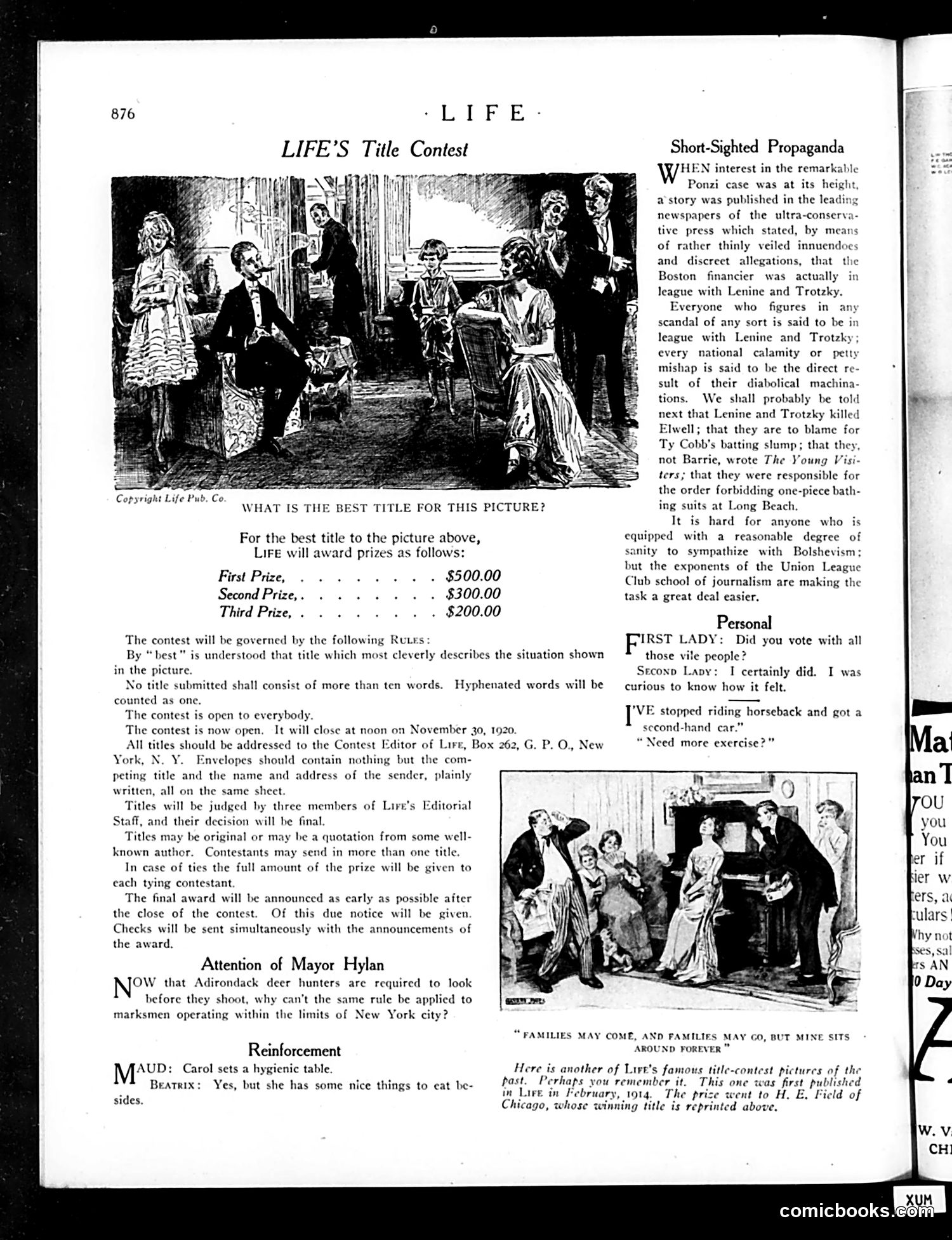
This 1920 *Life* magazine page features a **title-writing contest** where readers submit captions for an illustration showing well-dressed people in what appears to be an elegant interior scene. The contest offers cash prizes ($500, $300, $200), with entries limited to ten words. The page also includes **political commentary** mocking conservative newspapers that blamed Russian Bolsheviks (Lenin and Trotsky) for every American scandal and misfortune—from the Ponzi financial scheme to baseball player Ty Cobb's poor performance. The author ridicules this "short-sighted propaganda" as absurdly overblown. Additional content includes brief humor pieces and a reference to Mayor Hylan regarding hunting regulations in New York City. The overall tone reflects *Life*'s satirical approach to contemporary events, social behavior, and media hysteria surrounding communism during the "Red Scare" era.
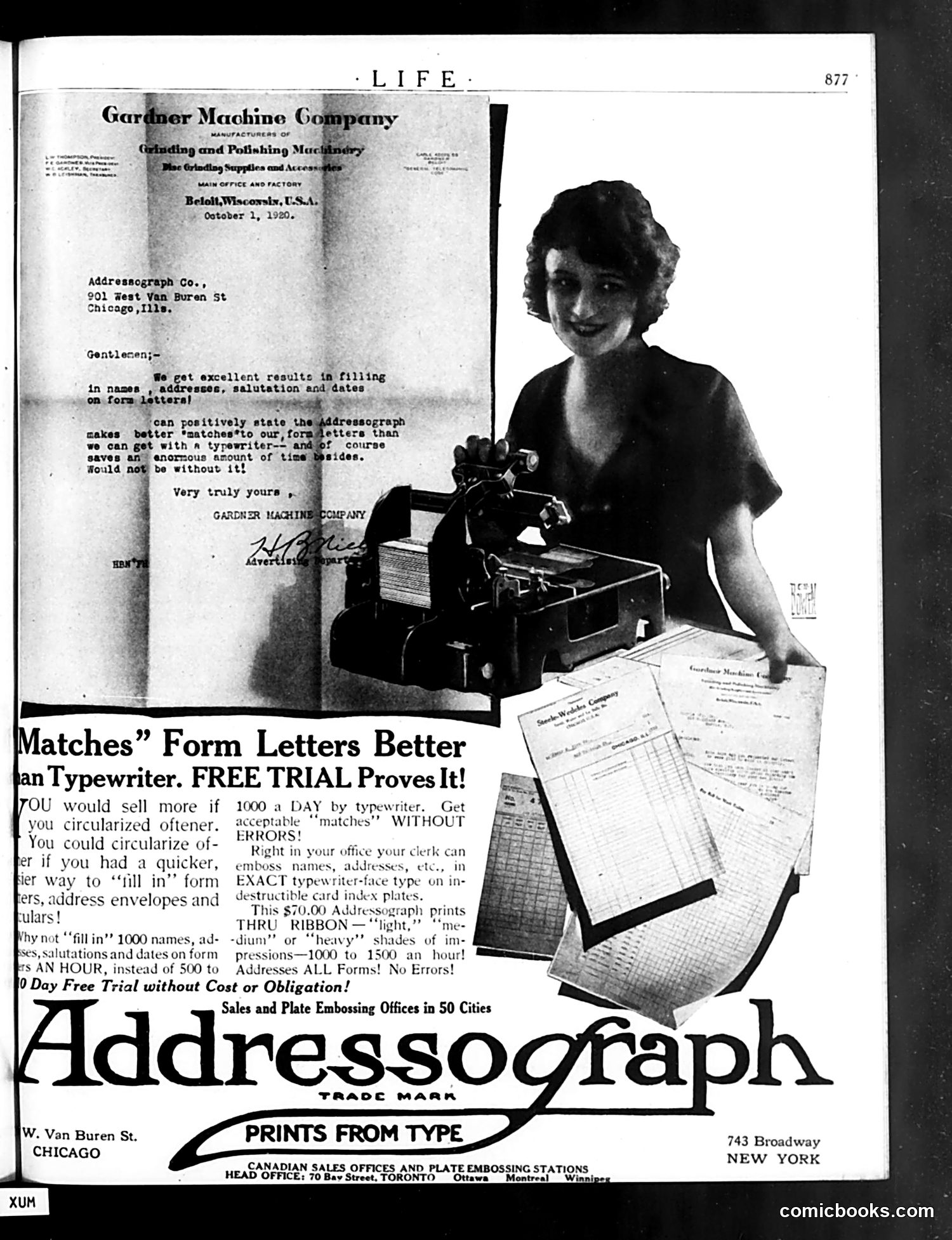
This page is primarily **advertising, not satire or editorial content**. The top half features a testimonial letter from Gardner Machine Company (Beloit, Wisconsin) praising the Addressograph machine for bulk-filling form letters with names, addresses, and dates. The bottom half is a full-page advertisement for the Addressograph itself, showing a woman demonstrating the machine alongside sample form letters. The ad emphasizes speed (1000-1500 addresses per hour versus 500 by typewriter) and accuracy, positioning the device as essential for any office doing mass mailings. **Context for modern readers**: This represents early-20th-century office automation—a predecessor to modern mail-merge software. The advertisement targets businesses doing direct mail campaigns, promising efficiency gains that would have been genuinely revolutionary in 1920. The woman operator was typical imagery for marketing business machines to offices of that era.
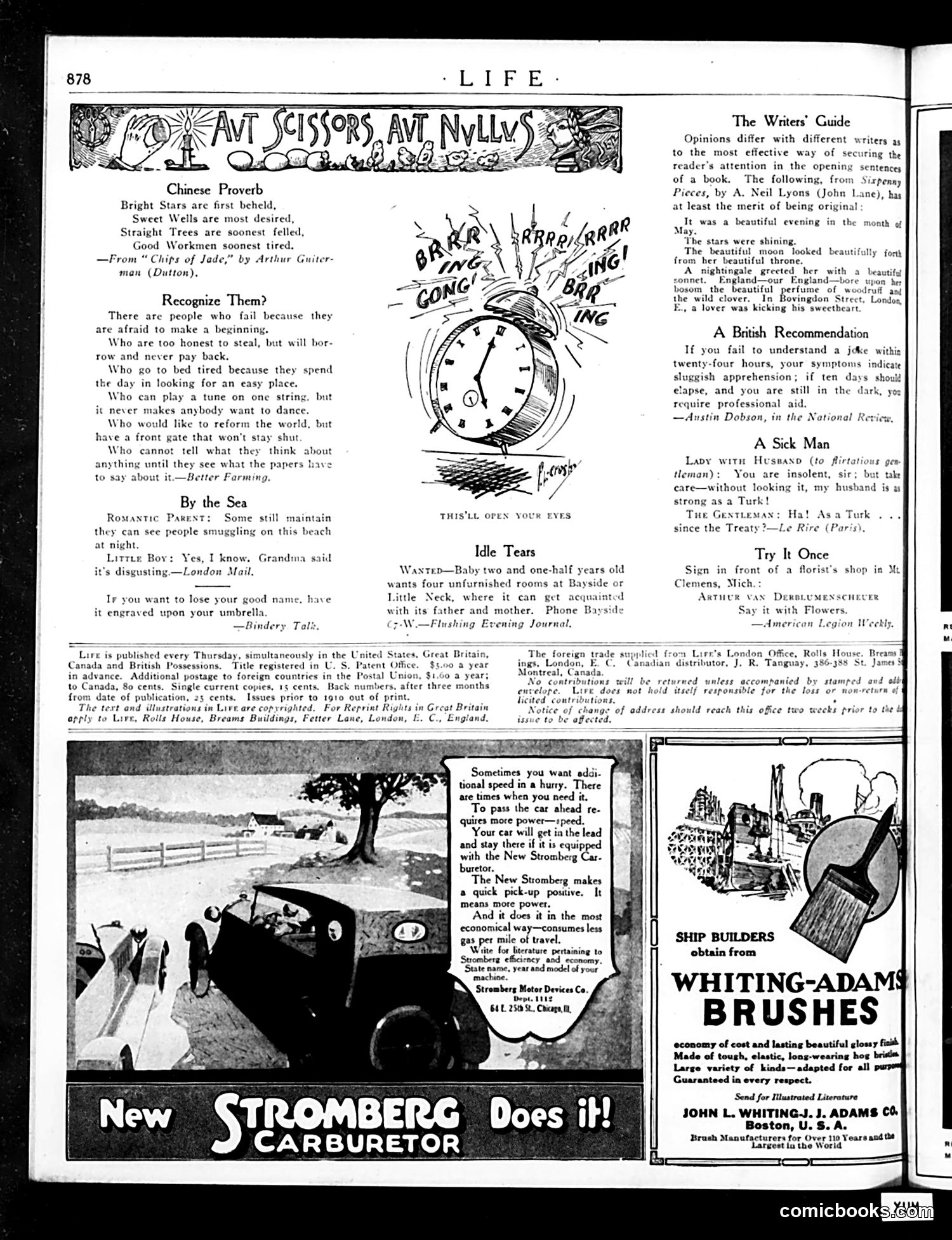
This page from *Life* magazine contains primarily **short humorous pieces and advertisements** rather than political cartoons. The content includes: - **"Recognize Them?"** — satirical character sketches describing common human types (the dishonest person, the lazy person, etc.), a standard *Life* feature mocking recognizable social archetypes. - **"By the Sea"** and **"Idle Tears"** — brief jokes playing on misunderstandings and classified ad absurdities (a baby wanting unfurnished rooms). - **"The Writers' Guide"** — a humorous critique of overwrought prose, specifically mocking an author (*A. Neil Lyons*) whose opening sentences use repetitive, excessive adjectives ("beautiful" repeated multiple times). The page is **largely advertising-driven**, featuring the Stromberg Carburetor and Whiting-Adams Brushes. No significant political satire or caricature appears here—it's typical *Life* fare: light social observation and wordplay aimed at educated readers.
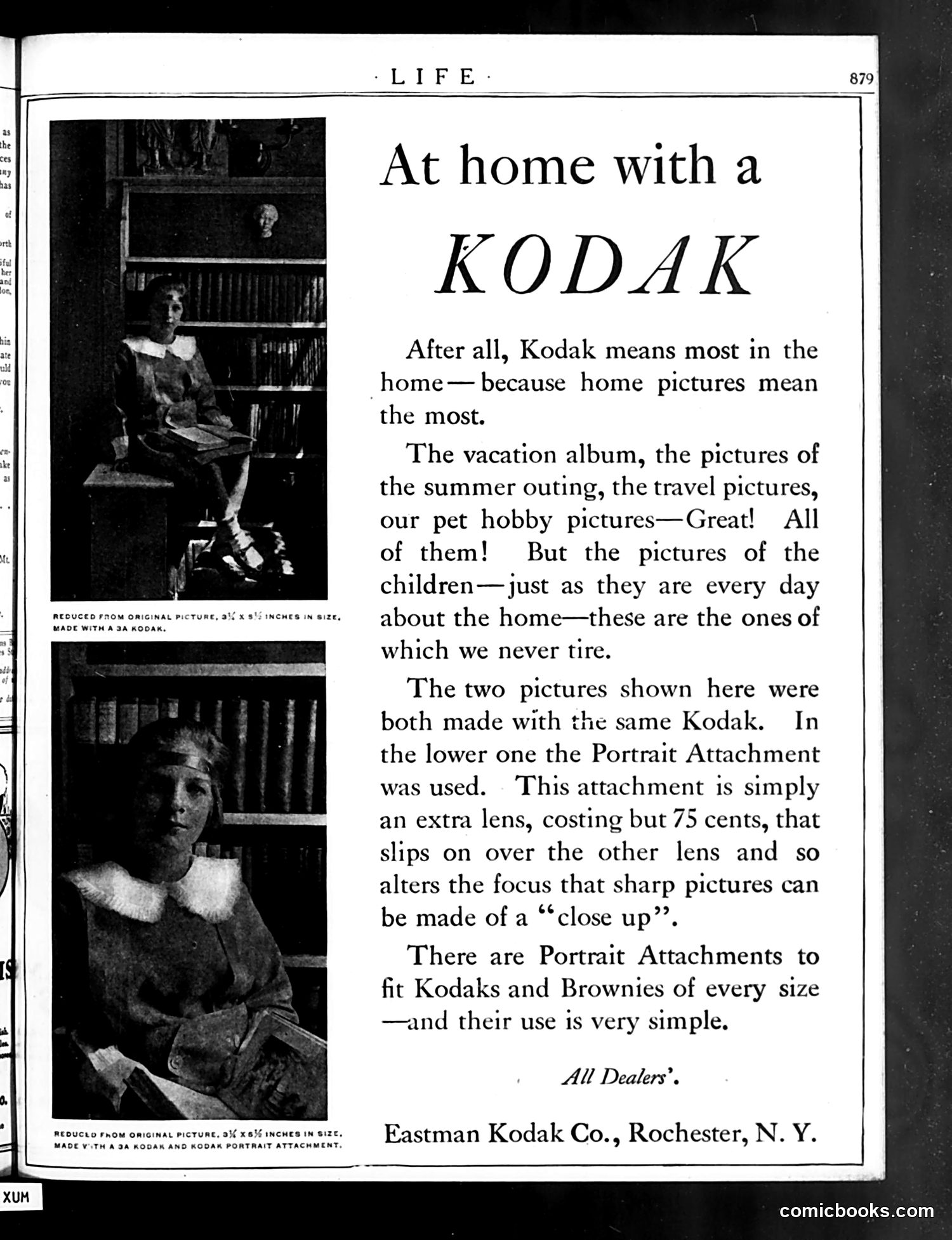
This is a **Kodak camera advertisement**, not satire or political commentary. It appears in *Life* magazine (page 879) and promotes home photography to ordinary families. The ad features two black-and-white photographs of women in domestic settings—one reading by a bookshelf, another in close-up portrait style. The copy emphasizes that Kodak cameras are essential for capturing everyday family moments, particularly children, arguing these domestic pictures are more cherished than vacation photos. The advertisement highlights a specific product: the "Portrait Attachment," a 75-cent lens accessory enabling close-up photography. The ad stresses affordability and ease of use to appeal to middle-class consumers. This reflects early-to-mid 20th century marketing strategy: positioning photography as accessible to ordinary households rather than professionals, while framing home and family documentation as emotionally valuable. The intimate domestic scenes and sentimental language ("never tire") were typical advertising appeals of the era.
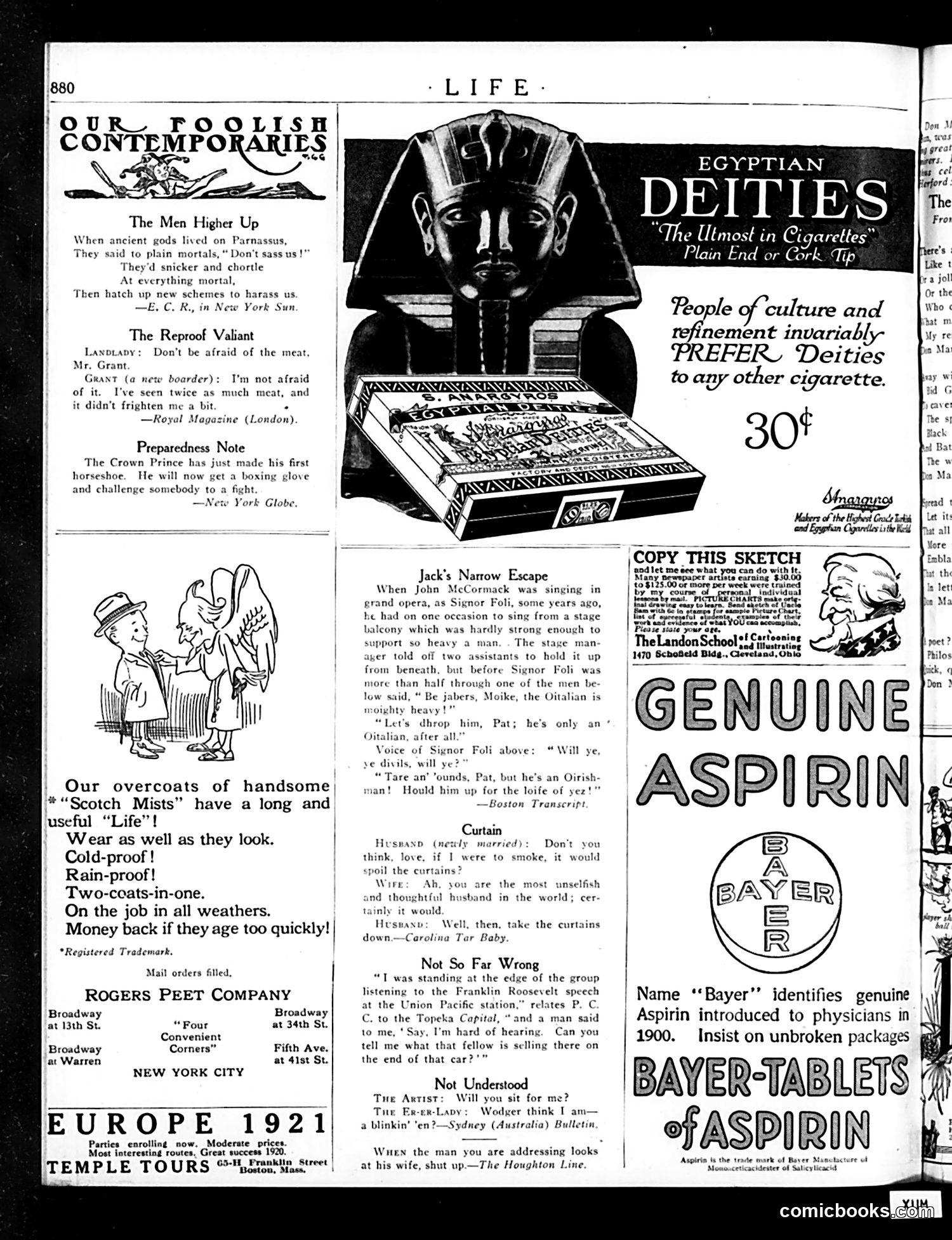
This page mixes humor with advertising, typical of Life's format. The cartoons are brief, satirical vignettes: **"The Men Higher Up"** mocks ancient gods as capricious bullies—a commentary on authority figures who abuse power without consequence. **"The Reproof Valiant"** is a boarding-house joke about sparse meals; the landlady serves minimal meat, and a new boarder claims he's seen worse. **"Preparedness Note"** appears to reference the German Crown Prince, mocking him as so underdeveloped he's just learning basic skills—post-WWI satire. **"Jack's Narrow Escape"** depicts Irish laborers nearly dropping tenor John McCormack during opera, with ethnic dialect humor (common then, offensive now). Other brief jokes involve marital humor and misunderstandings. **Advertisements** dominate: Egyptian Deities cigarettes (30¢), Rogers Peet overcoats, Bayer Aspirin (asserting its genuine trademark), and travel tours. The page reflects 1920s American popular humor: ethnic stereotypes, domestic comedy, and early mass-market advertising targeting "cultured" consumers.
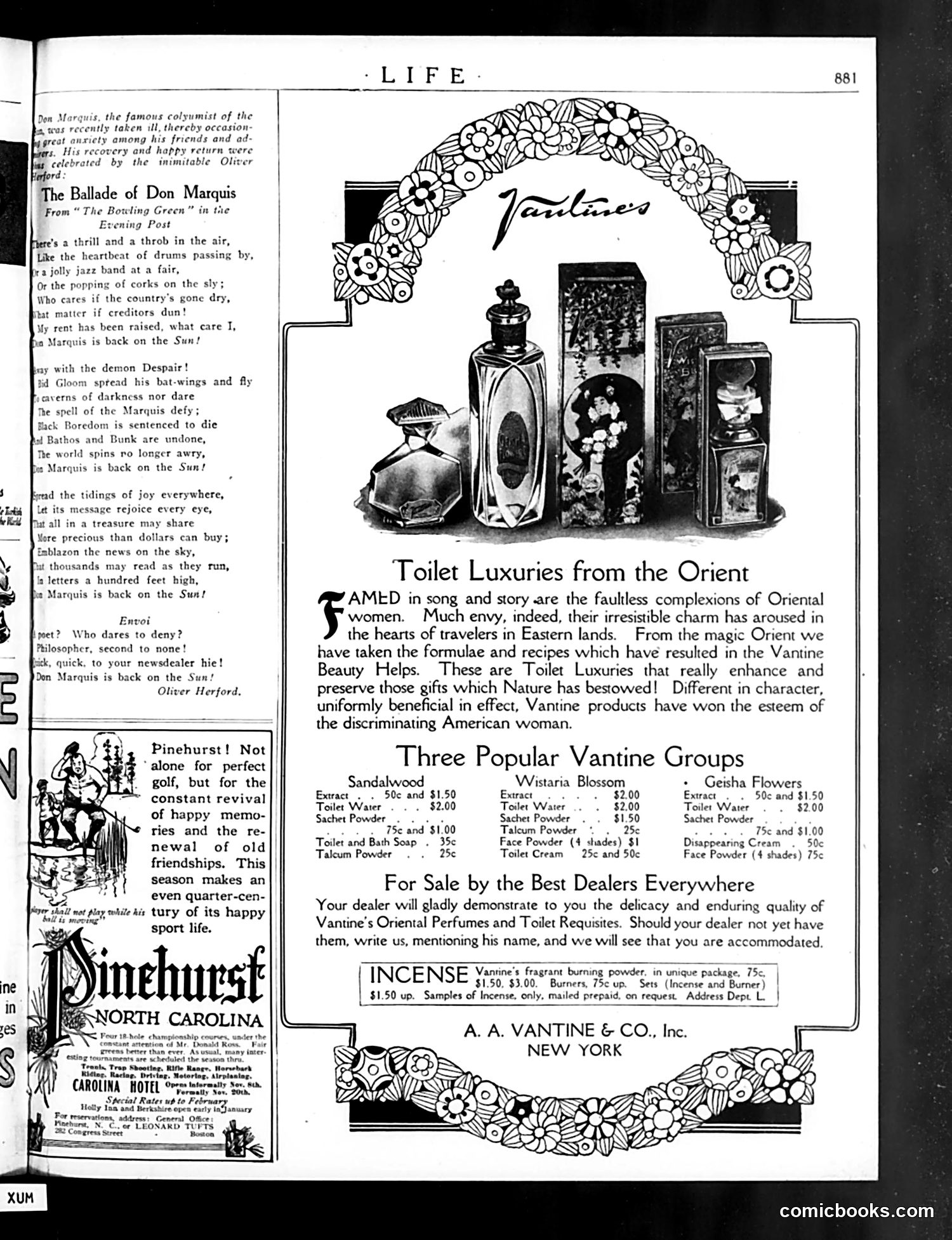
This page combines a **poetry tribute to Don Marquis** (a famous newspaper columnist who had recently recovered from illness) with a **full-page advertisement for Vantine's Oriental beauty products**. ## The Marquis Poem The left side features "The Ballade of Don Marquis" by Oliver Herford, celebrating Marquis's return to his column in the *New York Sun*. The repeated refrain—"Don Marquis is back on the Sun!"—treats his recovery as major news worthy of rejoicing. The poem uses hyperbolic language (Boredom "sentenced to die," the world "spins no longer awry") to humorously express how much readers missed his daily column. ## The Advertisement The right side ironically juxtaposes this with a Vantine's beauty ad marketing "Toilet Luxuries from the Orient." The ad exploits Orientalist stereotypes about "faultless complexions of Oriental women" to sell perfumes, powders, and creams with names like "Sandalwood" and "Geisha Flowers"—playing on early 20th-century fascination with "exotic" Asian beauty standards. The contrast between honoring a celebrated American writer and peddling orientalized beauty products reflects the magazine's dual function as both satirical publication and advertising vehicle.
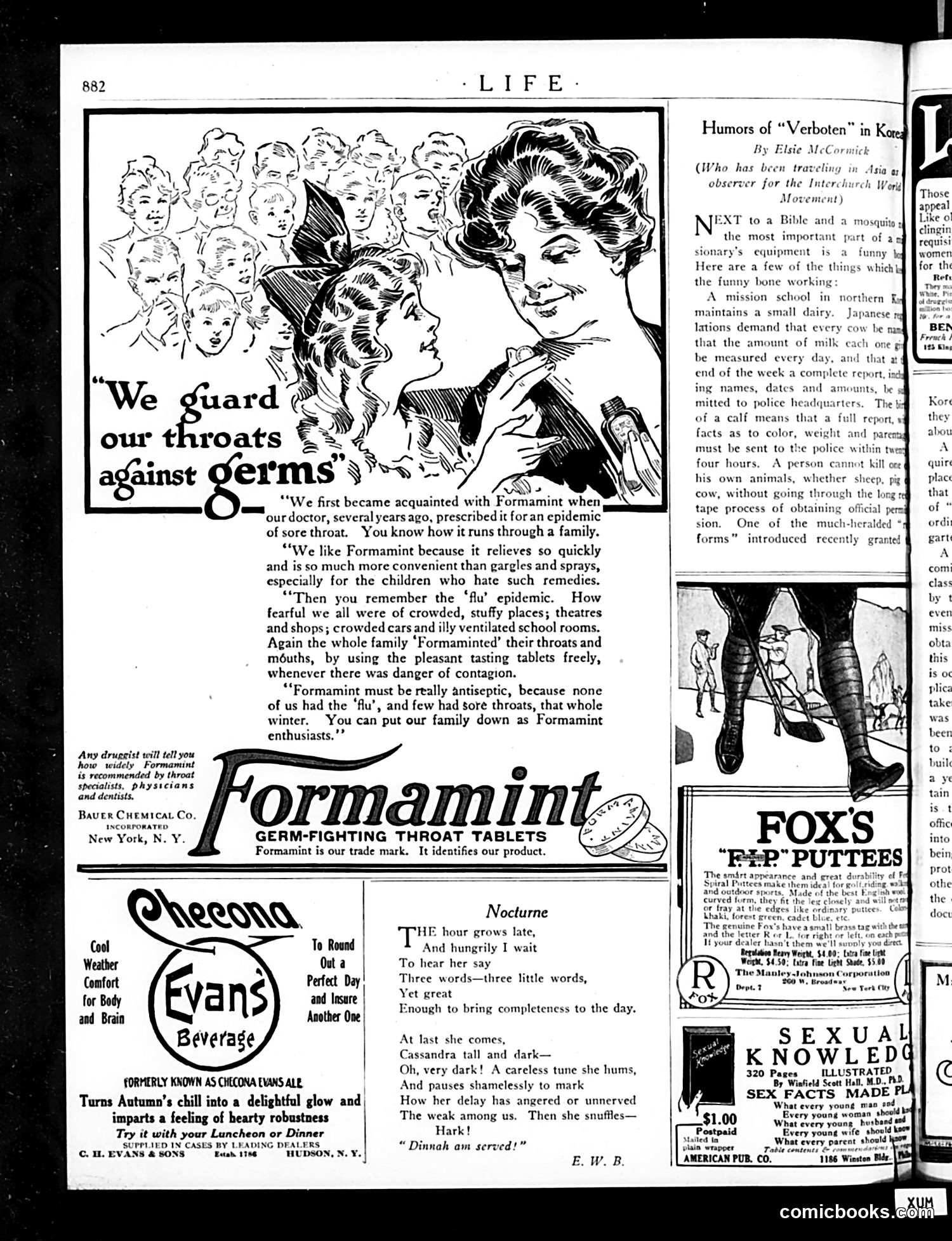
This page contains primarily **advertisements and literary content** rather than political cartoons. The main advertisement features **Formamint throat tablets**, using testimonial copy from a missionary in Asia. The ad emphasizes the product's convenience for families and references the recent "flu epidemic" (likely the 1918-1920 Spanish Flu pandemic), positioning Formamint as protection against contagion. Secondary ads include **Evans Beverage** (a hot chocolate alternative to warm winter days) and **Fox's Puttees** (spiral leg wraps for soldiers or outdoor wear). The literary content includes "Nocturne," a poem about waiting for romantic words, with a humorous twist ending—the awaited speaker is "Dinnah," apparently a servant announcing dinner rather than a romantic partner. **For modern readers**: These ads reveal early 20th-century consumer anxiety about disease transmission and the marketing language used to address health fears during epidemic periods.
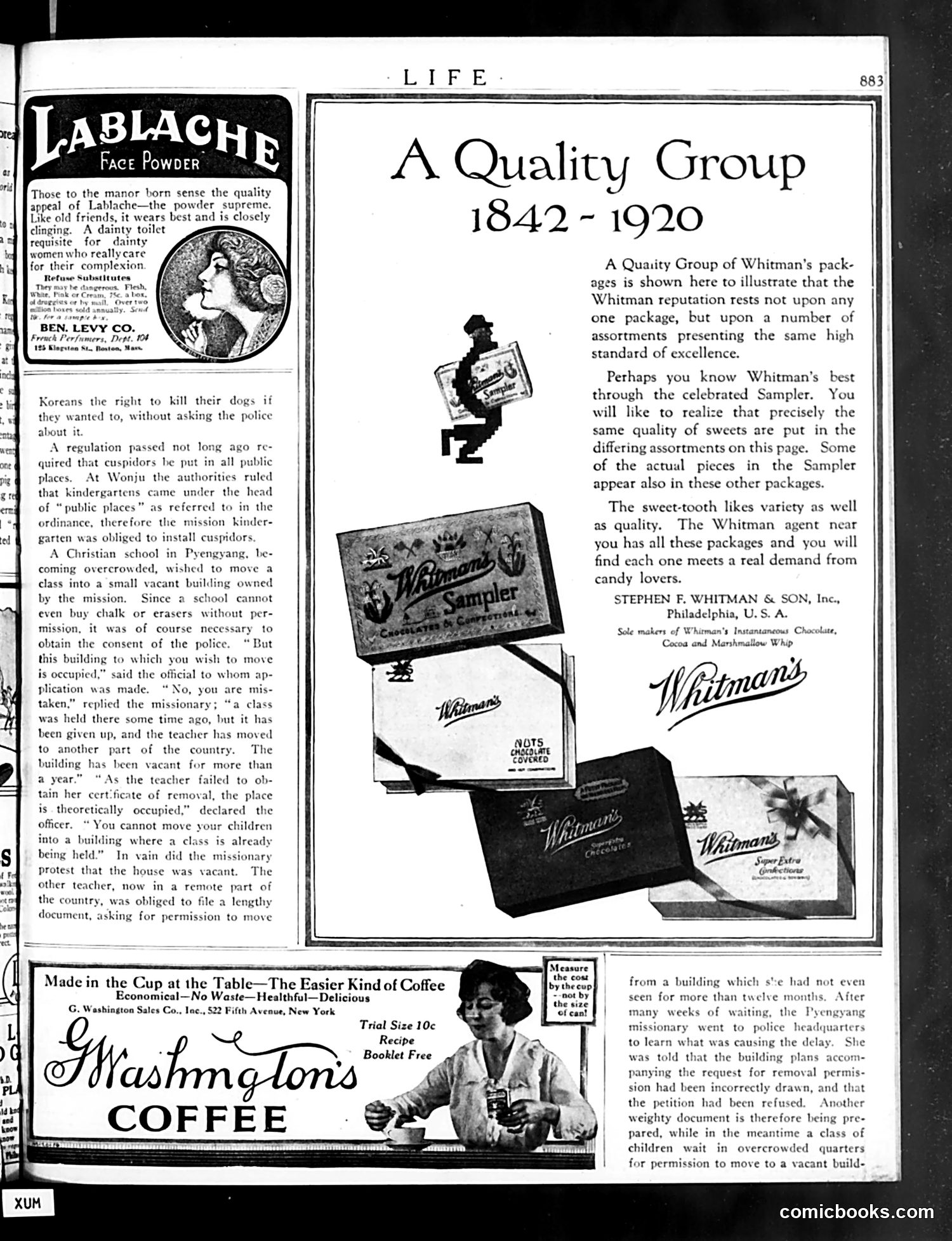
This page mixes advertising with satirical commentary on Korean bureaucracy. The main satire (left column) mocks absurd regulations imposed on Christian missionaries in colonial Korea, particularly at Pyengyang. The story describes how authorities, citing a rule requiring cuspidors in "public places," classified a kindergarten as such and forced the mission to install them. When the school later tried to relocate to a vacant building, officials refused permission because a teacher's removal certificate from the previous class was never filed—despite that teacher being long gone. The joke targets rigid, nonsensical bureaucratic obstruction that prioritizes paperwork over practical reality, leaving schoolchildren waiting in overcrowded conditions. The right side advertises Whitman's chocolates and other products (Lablache powder, Washington coffee), typical of Life's mixed content model. The satire reflects early 20th-century Western frustrations with colonial administrative red tape.
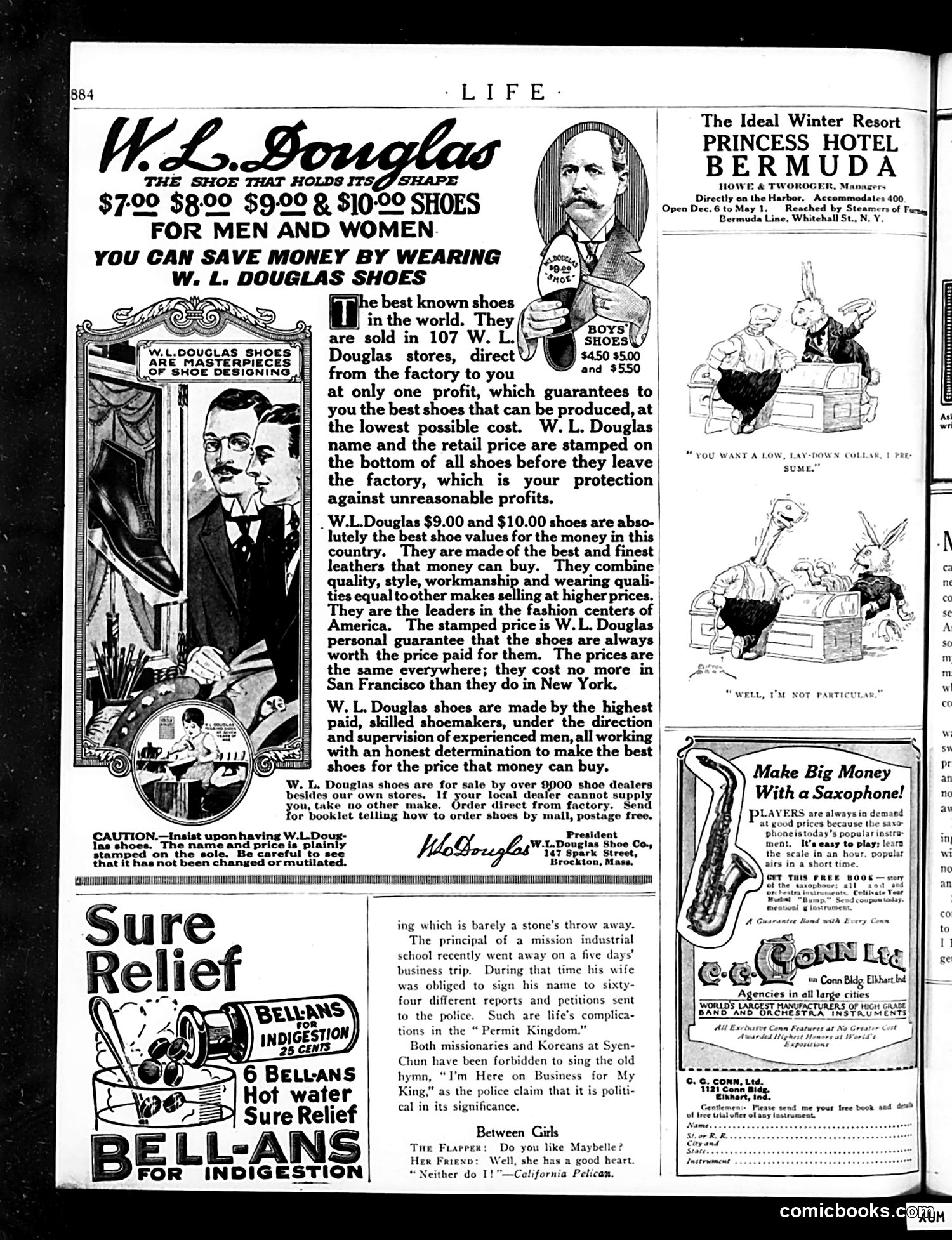
This page is primarily **advertising**, not political satire. The dominant content consists of three major advertisements: **W.L. Douglas Shoes** (left/center): A large ad featuring a man in formal dress holding a shoe, emphasizing affordable quality footwear ($7-$10) sold directly from factory to consumer. The ad targets working/middle-class readers seeking value. **Princess Hotel, Bermuda** (top right): A luxury resort advertisement offering winter accommodations. **Miscellaneous smaller ads**: Including Bell-ans indigestion remedy, saxophone lessons promising income, and Conn musical instruments. **The only humor content** appears at bottom: a brief comic dialogue titled "Between Girls" where one woman asks if her friend likes "Maybelle," receiving the reply "Well, she has a good heart" followed by "Neither do I!"—a mild joke about backhanded compliments. The page reflects early 20th-century consumer culture: practical footwear, luxury travel, and self-improvement through music lessons—with minimal satirical content.
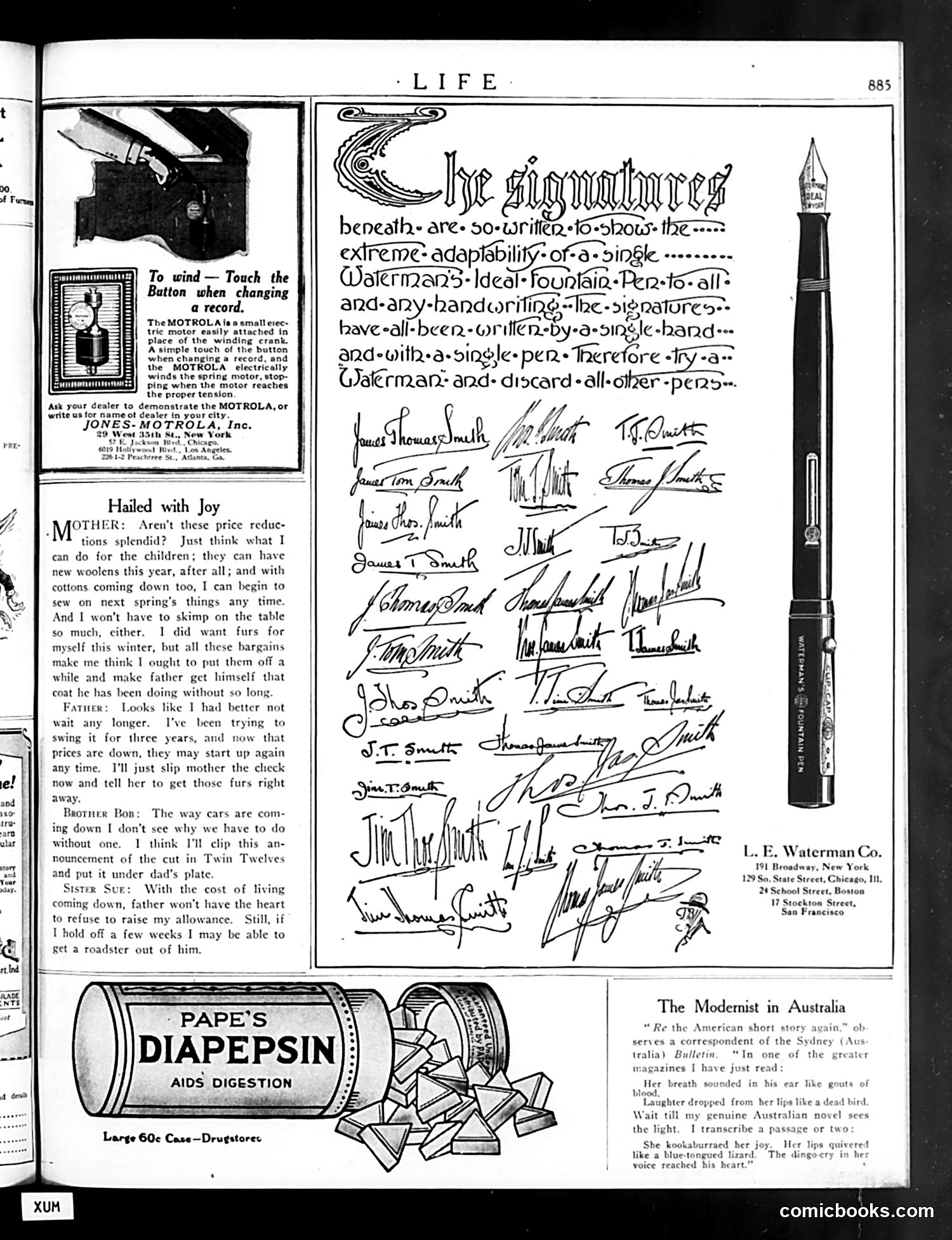
This page contains **primarily advertisements and a humor dialogue**, not a political cartoon. The main content is "Hailed with Joy"—a domestic humor piece depicting a family's competing financial desires triggered by falling prices. Each family member (mother, father, brother, sister) plans to request purchases they've previously denied themselves, each assuming the others' reduced costs justify their own indulgence. The satire targets **consumer behavior during economic downturns**: the assumption that temporary price reductions justify increased spending, creating a self-defeating cycle where savings never materialize. The page also features advertisements for the **Motrola phonograph** (with electrical winding mechanism) and **Pope's Diapepsin** (a digestive aid). A brief mention of "The Modernist in Australia" appears at bottom—an excerpt from an American short story about an Australian correspondent, but lacks sufficient context for analysis. The humor reflects post-WWI American consumer culture and materialistic attitudes, not contemporary political satire.
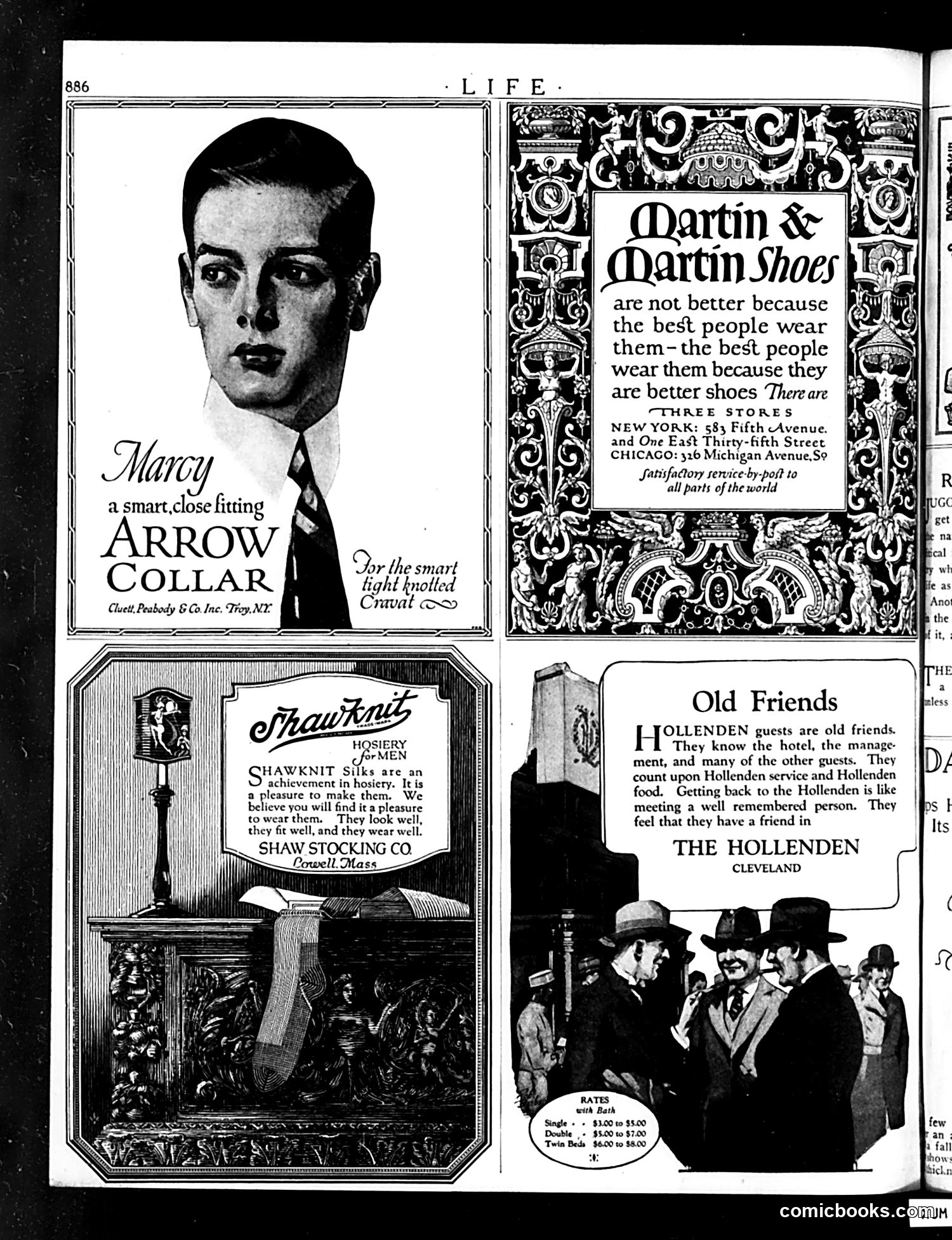
This is primarily an **advertising page** from Life magazine, not a political cartoon. It contains four separate advertisements: 1. **Arrow Collar** (top left): Features a male model advertising "Marcy," a close-fitting collar for men, emphasizing smart appearance and proper fit. 2. **Martin & Dartin Shoes** (top right): Argues that quality shoes sell themselves—the best people wear them *because* they're superior, not the reverse. Lists three store locations. 3. **Shawknit Hosiery** (bottom left): Promotes men's socks, emphasizing durability and comfort with an illustration of stockings draped on furniture. 4. **The Hollenden Hotel** (bottom right): A Cleveland hotel advertisement appealing to returning guests, emphasizing familiarity and service. Includes rate information and a photograph of well-dressed men in period attire. The page reflects **1920s-era advertising** focused on men's fashion and hospitality, using imagery and copy typical of that era's marketing approach.
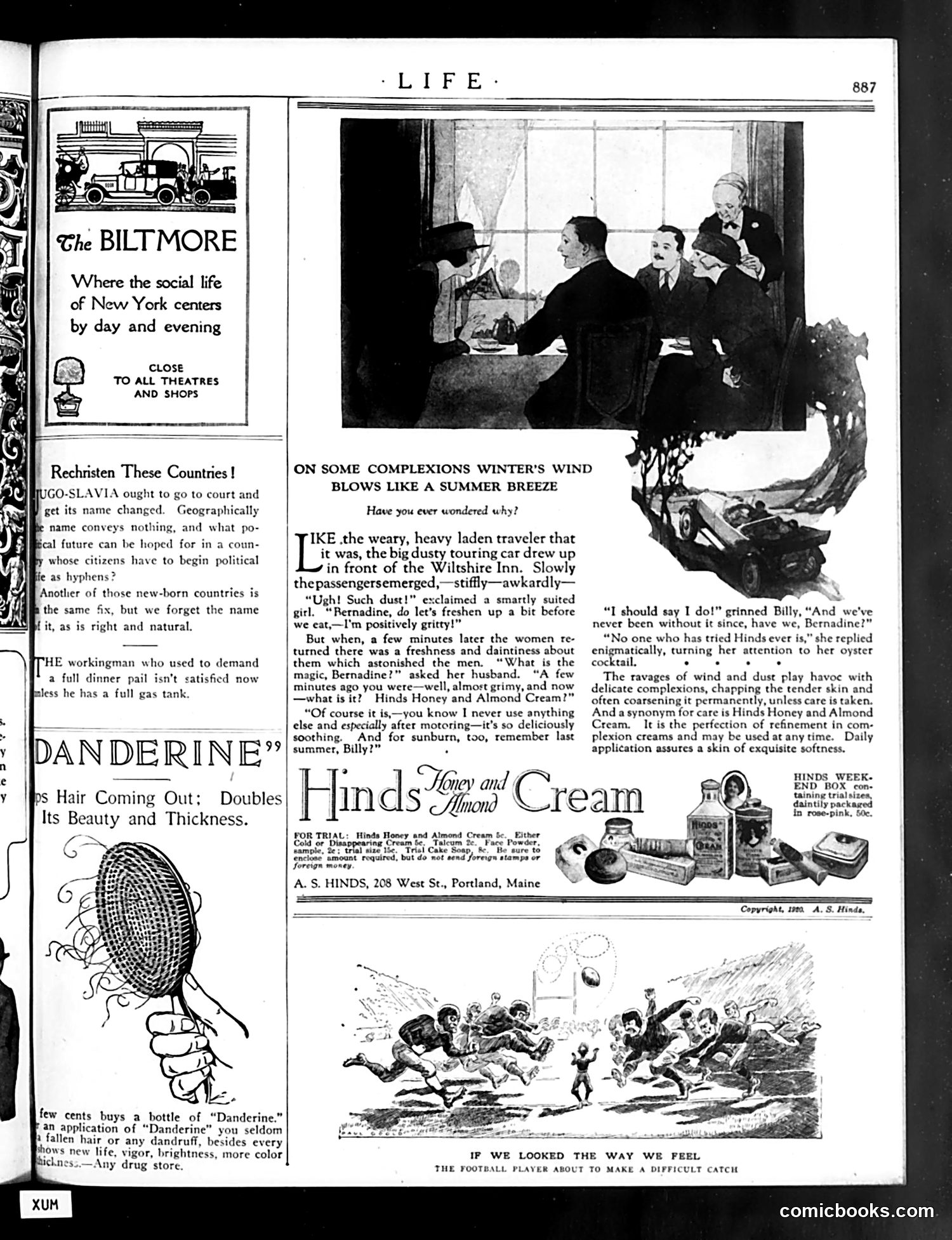
This page combines advertisements with satirical editorial content typical of Life magazine's format. **The Editorial Satire:** The brief political commentary mocks the newly formed nation of "Yugo-Slavia" (Yugoslavia), suggesting its hyphenated name reflects its uncertain political identity. The writer jokes that citizens literally begin their political lives "as hyphens"—a cutting critique of the post-WWI Balkan state's fragility and the difficulty of unifying diverse ethnic groups. A second quip contrasts working-class aspirations: workers once demanded a "full dinner pail" but now want a "full gas tank," satirizing the shift from labor concerns to consumer desires in the modern era. **The Advertisements:** The page is dominated by period product ads—Danderine hair tonic, Hinds Honey and Almond Cream (a cold cream), and the Biltmore Hotel. The Hinds ad features a narrative about travelers dusty from motoring who are restored to freshness by the cream—typical early 20th-century advertising using lifestyle scenarios. **The Cartoon:** The bottom illustration, captioned "If We Looked the Way We Feel," shows football players in exaggerated distress during a difficult catch—a visual joke about the gap between internal experience and external appearance.
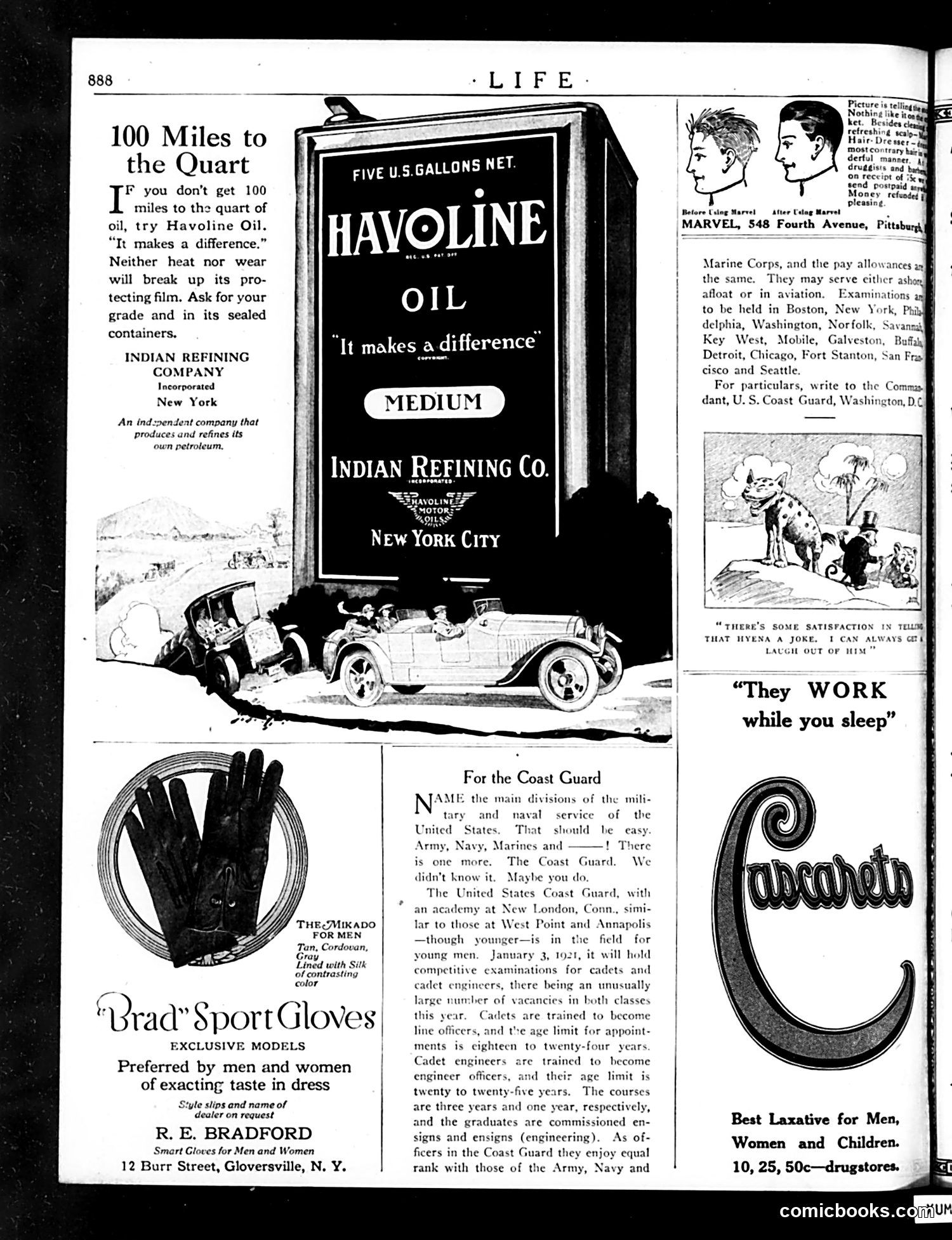
This is primarily a **advertisements page** from an early 1920s issue of Life magazine, with one small satirical cartoon. The main advertisements promote Havoline Oil (Indian Refining Company), Brad Sport Gloves, and Marvel hair treatment—typical commercial content. The **single cartoon** (bottom right) shows a man with a hyena, captioned "There's some satisfaction in telling that hyena a joke. I can always laugh out of him." This is **mild workplace satire**: the joke appears to mock someone (represented as a hyena) who laughs at everything, suggesting forced or insincere laughter—perhaps mocking obsequious behavior toward authority figures or those seeking approval through excessive agreement. The remaining text discusses **U.S. Coast Guard recruitment**, explaining that examinations for cadets and engineers will be held in January 1921 at various cities. This is informational content, not satire. The page reflects 1920s American commercial culture and military recruitment practices, with humor aimed at everyday social dynamics rather than specific political events.
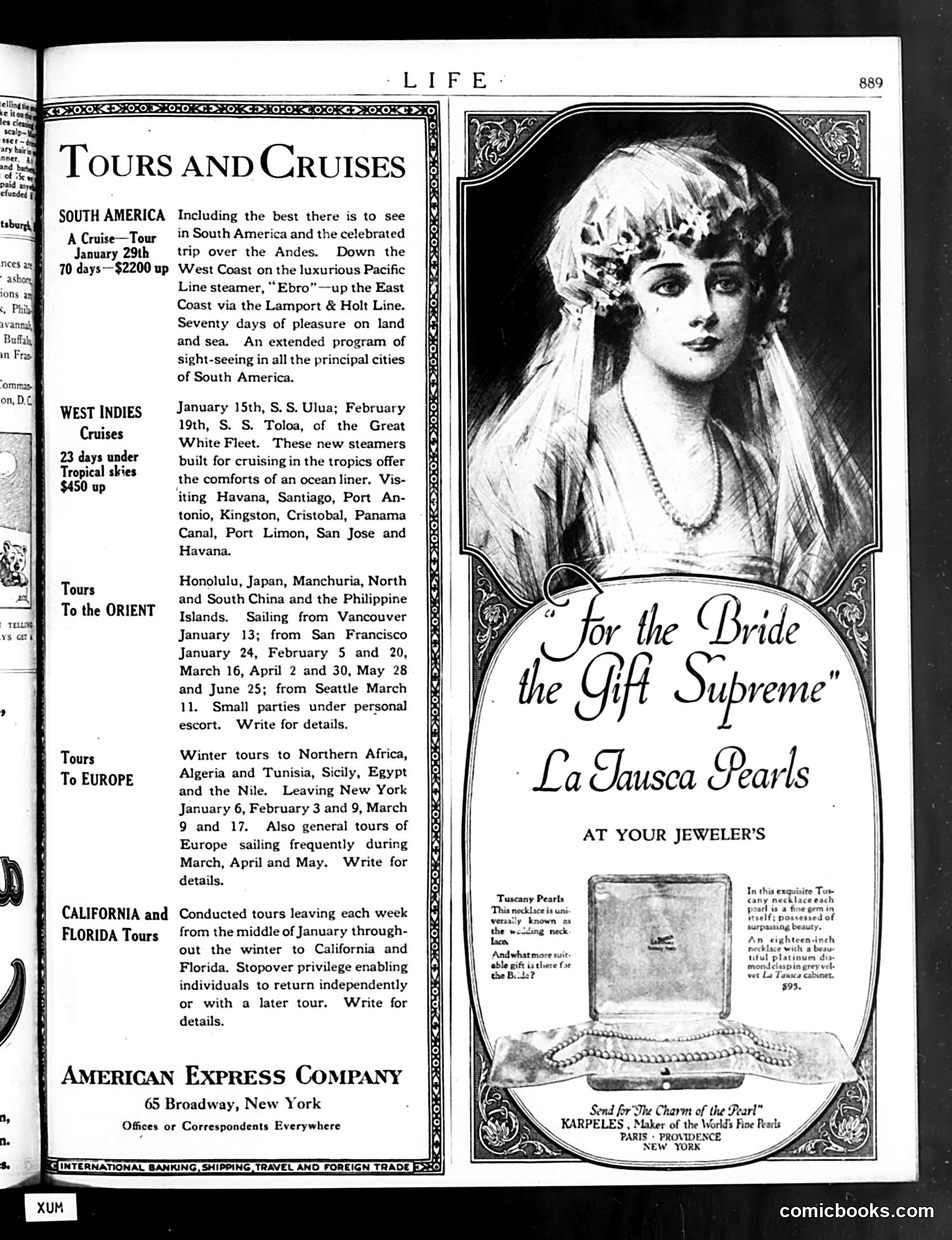
This page is primarily **advertising**, not satire or political commentary. It contains two distinct sections: **Left side:** American Express Company advertisements for luxury travel tours (South America, West Indies, Orient, Europe, California/Florida), typical of early 20th-century tourism marketing. These emphasize leisure, comfort, and exotic destinations for wealthy travelers. **Right side:** A jewelry advertisement for "La Fausca Pearls," featuring a glamorous portrait of a woman wearing a pearl necklace and veil. The ad promotes Tuscan pearls as an ideal wedding gift, with copy emphasizing their beauty and value. The jeweler Karpeles is based in Paris and Providence. Both advertisements reflect **early-1900s consumer culture** targeting affluent readers—travel as status symbol, pearls as luxury bridal gifts. There is no apparent satire or political message; this is straightforward commercial content typical of *Life* magazine's revenue model during this era.
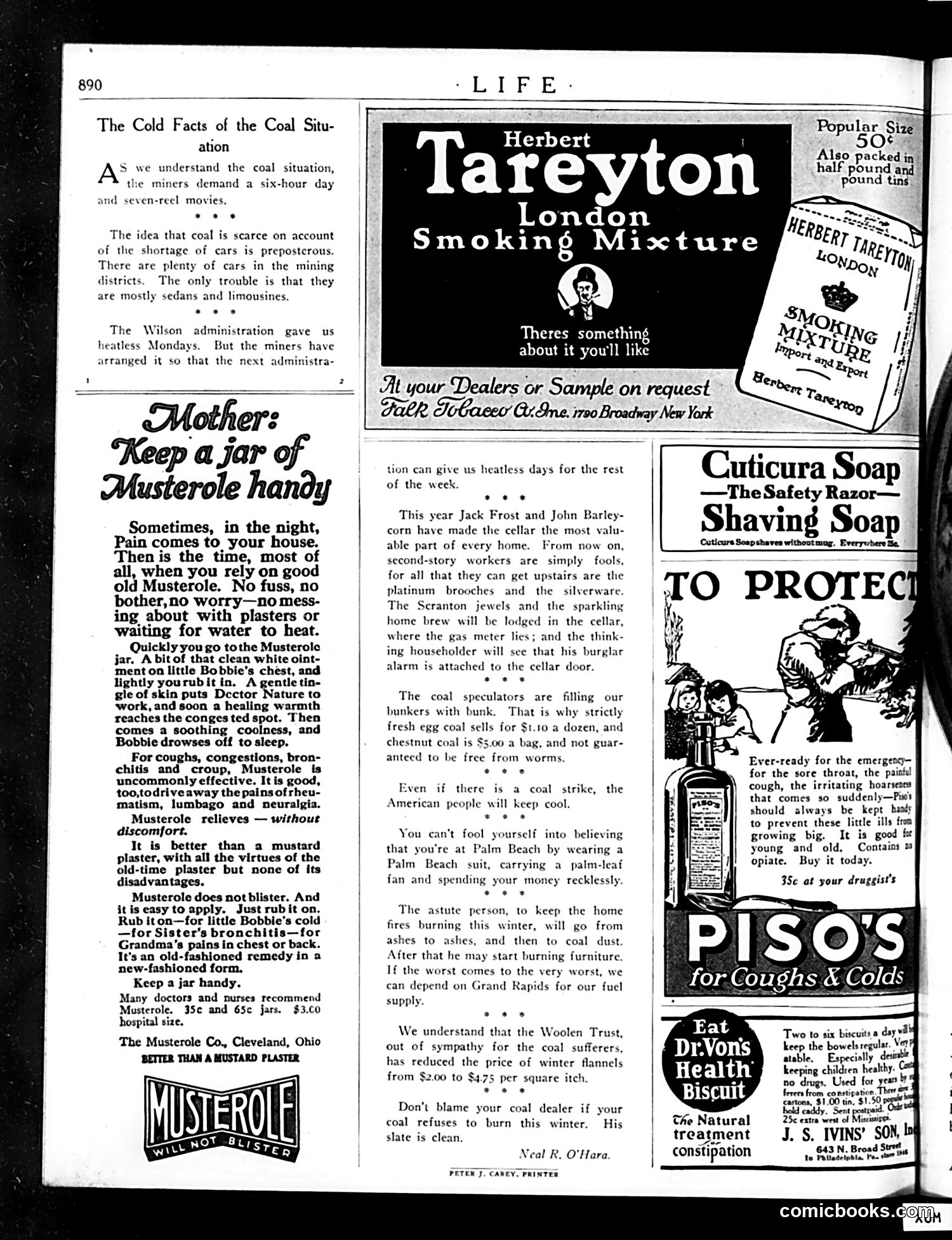
This satirical article mocks the 1920s coal crisis and resulting fuel shortages. The author uses absurdist humor to critique multiple targets: **The Coal Shortage**: References "heatless Mondays" (a Wilson administration rationing measure) and suggests miners have arranged similar hardships for the next administration. **Class Commentary**: Jokes that coal isn't scarce—mining districts have plenty of cars, "mostly sedans and limousines," implying wealthy miners or operators hoard resources while ordinary people freeze. **Price Gouging**: "Egg coal" sells for inflated prices ($1.10/dozen) and is allegedly infested with worms, satirizing profiteering. **Desperation**: Darkly humorous suggestions that people will burn furniture and rely on Grand Rapids (furniture manufacturing hub) for fuel. **Economic Hypocrisy**: The Woolen Trust cynically "reduces" winter flannel prices from $2 to $4.75—still a massive increase, mocking false charity. The piece criticizes government mismanagement, corporate greed, and class inequality during an energy crisis that left working Americans freezing while the wealthy remained comfortable.
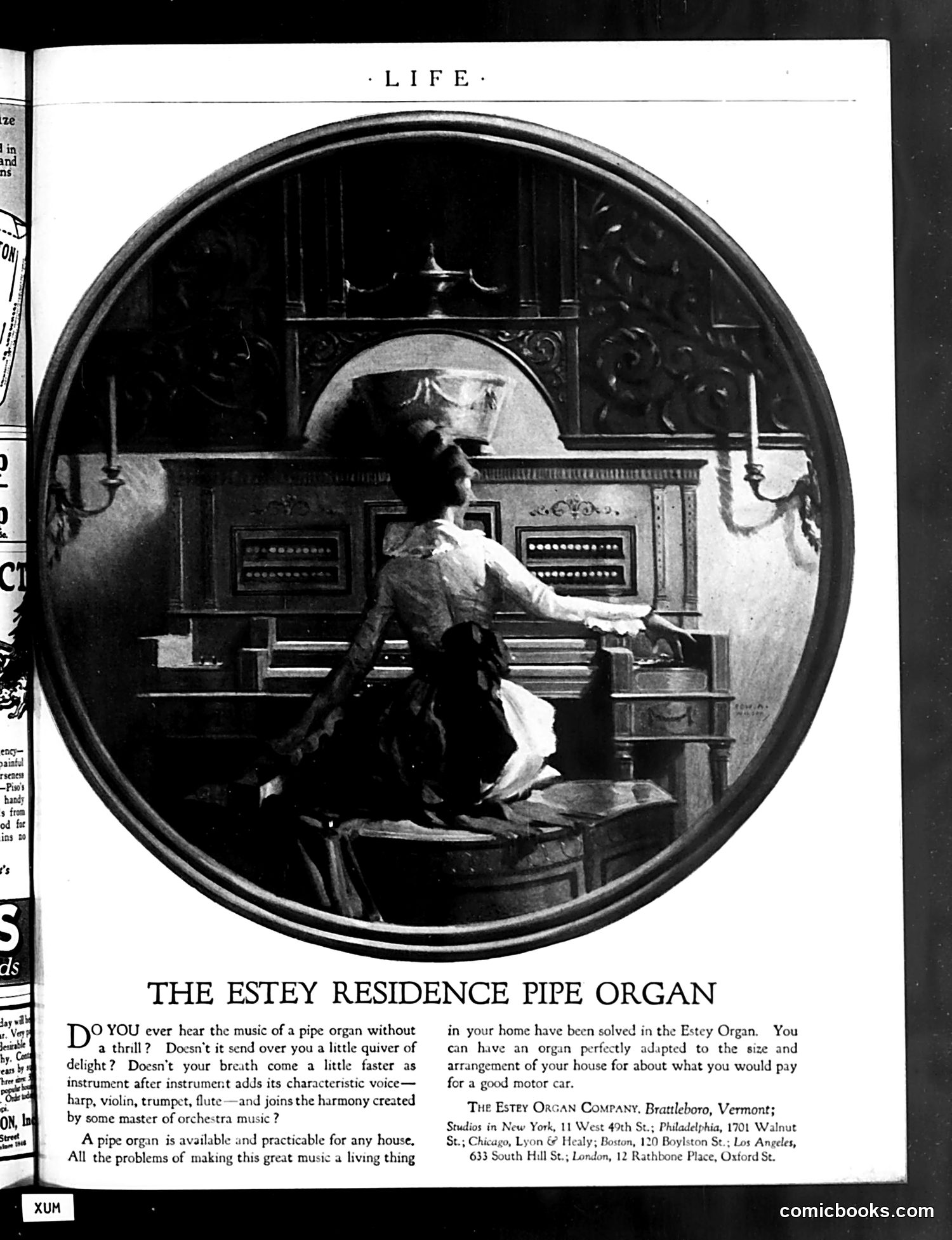
This is not a political cartoon but rather a **full-page advertisement** for the Estey Residence Pipe Organ, published in *Life* magazine. The image shows a woman seated at a residential pipe organ in an elegant interior, positioned within a circular vignette frame. The ad uses emotional, rhetorical language ("Do you ever hear the music of a pipe organ without a thrill?") to appeal to affluent homeowners' desires for culture and refinement. The key sales pitch is that pipe organs—traditionally associated with concert halls and churches—are now "available and practicable for any house" at a cost comparable to "a good motor car." This positions the organ as an aspirational luxury good for the middle-to-upper class. The Estey Organ Company, based in Brattleboro, Vermont, lists multiple studios across major American cities and London, suggesting national and international reach. This reflects early 20th-century consumer culture: the democratization of "high culture" through mass production and marketing.
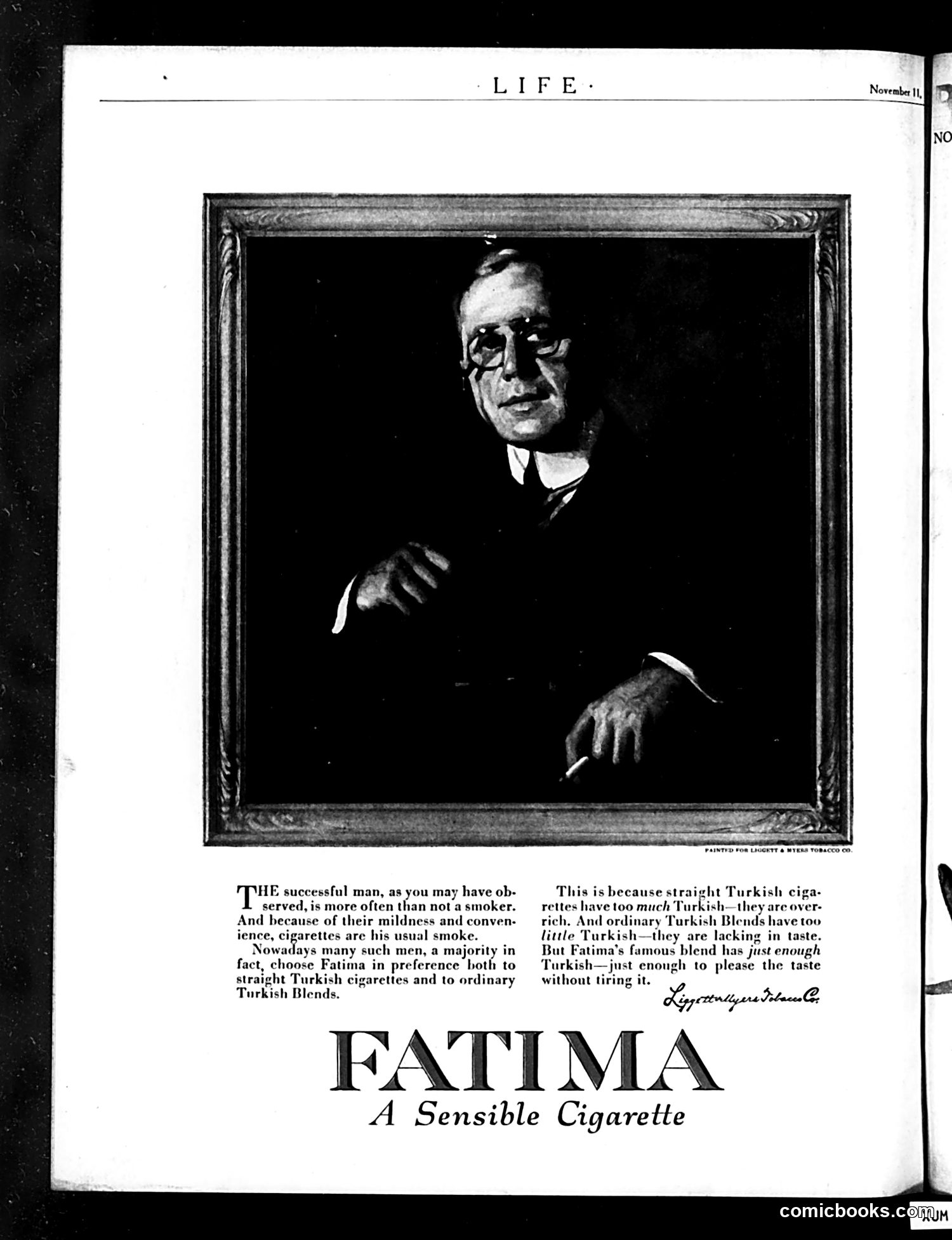
This is a **cigarette advertisement**, not political satire. It appeared in *Life* magazine (likely early 20th century) and promotes Fatima brand cigarettes. The image shows a distinguished older gentleman in formal attire—presented as an exemplary "successful man"—to appeal to aspirational male readers. The advertisement argues that successful men smoke cigarettes, and specifically choose Fatima because it balances Turkish tobacco perfectly: straight Turkish cigarettes are "too much" (over-rich), while ordinary Turkish blends lack sufficient Turkish flavor. Fatima supposedly hits the "sensible" middle ground. The pitch relies on associating the product with success, masculinity, and refined taste. This was standard cigarette marketing before health warnings existed. The "sensible" framing is ironic to modern readers—the ad presents moderation in tobacco consumption as a selling point while promoting smoking itself.