
Life, 1920-11-11 · page 21 of 44
Life — November 11, 1920 — page 21: what you’re looking at
What you’re looking at
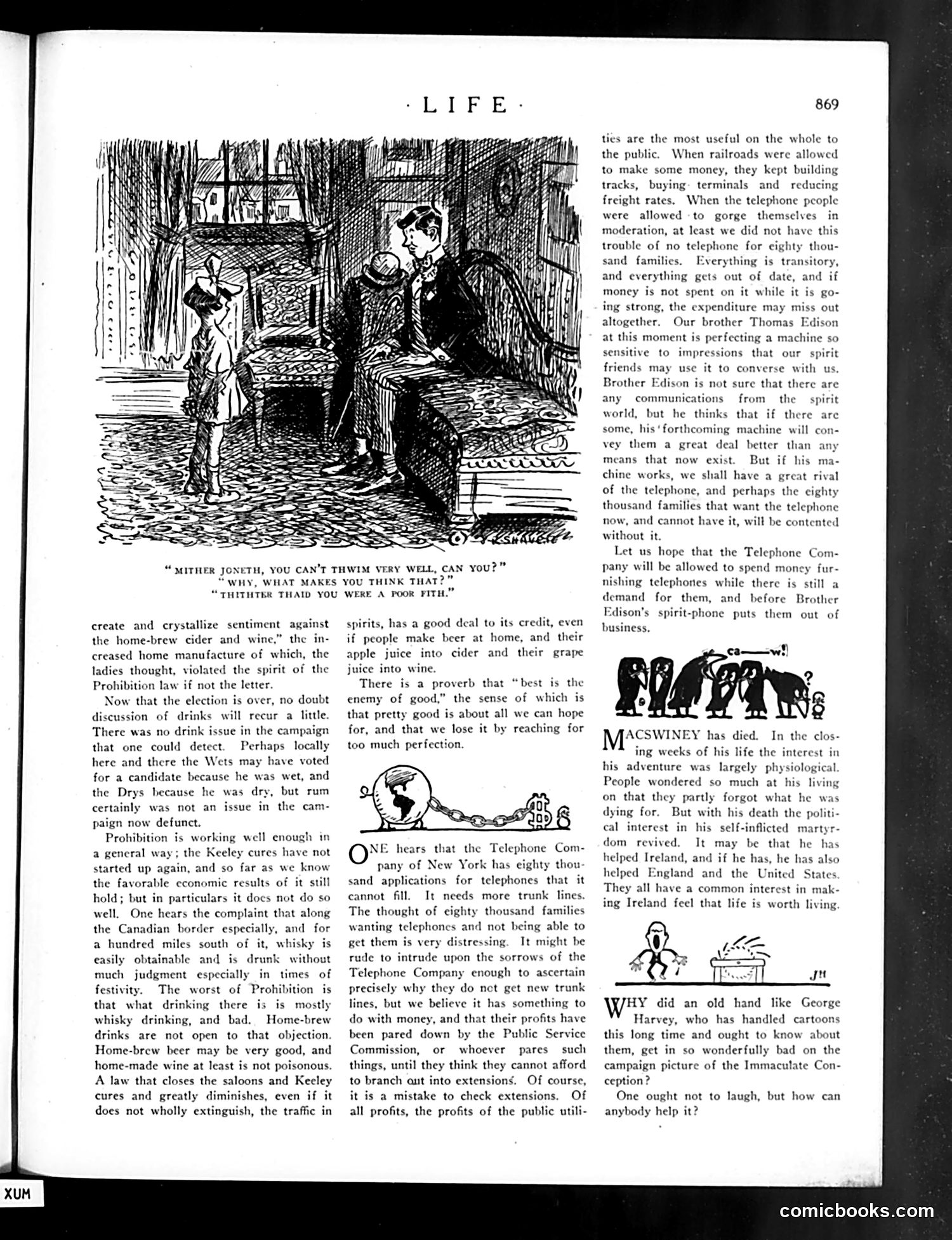
## Main Cartoon The illustration shows a child unable to swim, with the caption playing on dialect humor: "Mother Jones, you can't swim very well, can you?" / "Why, what makes you think that?" / "Sister said you were a poor fish." This is simple, genteel humor about a child's swimming ability—no political content. ## Political Commentary The page contains two substantive essays: **1. Prohibition:** The author argues Prohibition is "working well enough" economically, but acknowledges it's imperfectly enforced (especially near the Canadian border). He defends it while noting unintended consequences: people now drink hard liquor instead of home-brewed beer/wine. The "best is enemy of good" proverb suggests accepting imperfect results. **2. Telephone Service:** The author criticizes the Public Service Commission for limiting telephone company profits, which discourages infrastructure expansion. He notes 80,000 unfilled applications for telephones and argues that allowing utilities reasonable profits incentivizes growth—referencing Edison's ongoing work on spirit-communication devices as a potential competitor. Both essays reflect Progressive-era debates about regulation versus business incentives.
📄 Transcribed text from this page (OCR, searchable)
Machine-transcribed from the original scan — historical spelling and the odd misread are preserved.
NN H i NN i} at 2! “ MITHER JONETH, YOU CAN'T THWIM VERY WELL, CAN You?” “WHY, WHAT MAKE “THITHTBR THAID YOU create and crystallize sentiment against the home-brew cider and wine,” the in- creased home manufacture of which, the ladies thought, violated the spirit of the Prohibition law if not the letter. Now that the election is over, no doubt discussion of drinks will recur a little. There was no drink issue in the campaign that one could detect. Perhaps locally here and there the Wets may have voted for a candidate because he was wet, and the Drys because he was dry, but rum certainly was not an issue in the cam- paign now defunct. Prohibition is working well enough in he Keeley cures have not a general w started up again, and so far as we know the favorable economic results of it still hold; but in particulars it docs not do so well, One hears the complaint that along the Canadian border especially, and for a hundred miles south of it, whisky is easily obtainable and is drunk without times of much judgment especially in festivity. The worst of Prohibition is that what drinking there is is mostly whisky drinking, and bad. Home-brew drinks are not open to that objection. Home-brew beer may be very good, and home-made wine at least is not poisonous. A law that closes the saloons and Keeley cures and greatly diminishes, even if it does not wholly extinguish, the traffic in you THINK THAT?” WERE A POOR FITH.” spirits, has a good deal to its credit, even if people make beer at home, and their apple juice into cider and their grape juice into wine. There is a proverb that “best is the enemy of good,” the sense of which is that pretty good is about all we can hope for, and that we lose it by reaching for too much perfection. NE hears that the Telephone Com- pany of New York has eighty thou- sand applications for telephones that it cannot fill, It needs more trunk lines. The thought of eighty thousand families wanting telephones and not being able to get them is very distressing. It might be rude to intrude upon the sorrows of the Telephone Company enough to ascertain precisely why they do net get new trunk lines, but we believe it has something to do with money, and that their profits have been pared down by the Public Service Commission, or whoever pares such things, until they think they cannot afford to branch aut into extensions. Of course, it is a mistake to check extensions. Of all profits, the profits of the public utili- 869 ties are the most useful on the whole to the public. When railroads were allowed to make some money, they kept building tracks, buying: terminals and reducing freight rates. When the telephone people were allowed -to gorge themselves in moderation, at least we did not have this trouble of no telephone for eighty thou- sand families. and everything gets out of date, and if money is not spent on it while it is go- ing strong, the expenditure may miss out altogether. Our brother Thomas at this moment is perfecting a machine so Everything is transitory, ison sensitive to impressions that our spirit friends may use it to converse with us. Brother Edison is not sure that there are any communications from the world, but thinks that if there some, his ‘forthcoming machine will ¢ vey them a great deal better than any means that now exist. But if his ma- chine works, we shall have a great rival of the telephone, and perhaps the eighty thousand families that want the telephone now, and cannot have it, will be contented without it. Let us hope that the Telephone Com- pany will be allowed to spend money fur- nishing telephones while there is still a demand for them, and before Brother Edison's spirit-phone puts them out of business. spirit he are ca——w!) 2 : 8 ACSWINEY has died. ing weeks of his life the interest in his adventure was largely physiological People wondered so much at his living on that they partly forgot what he was dying for. But with his death the politi- cal interest in his self-inflicted martyr- revived. It may be that helped Ireland, and if he has, he has also helped England and the United S They all have a common interest in mak- ing Ireland feel that life is worth living. In clos- dom he has ates (KE wry did an old hand like George Harvey, who has handled cartoons this long time and ought to know about them, get so wonderfully bad on the campaign picture of the Immaculate Con- ception? One ought not to laugh, but how can anybody help it? comicbooks.com