
Life, 1920-11-11 · page 25 of 44
Life — November 11, 1920 — page 25: what you’re looking at
What you’re looking at
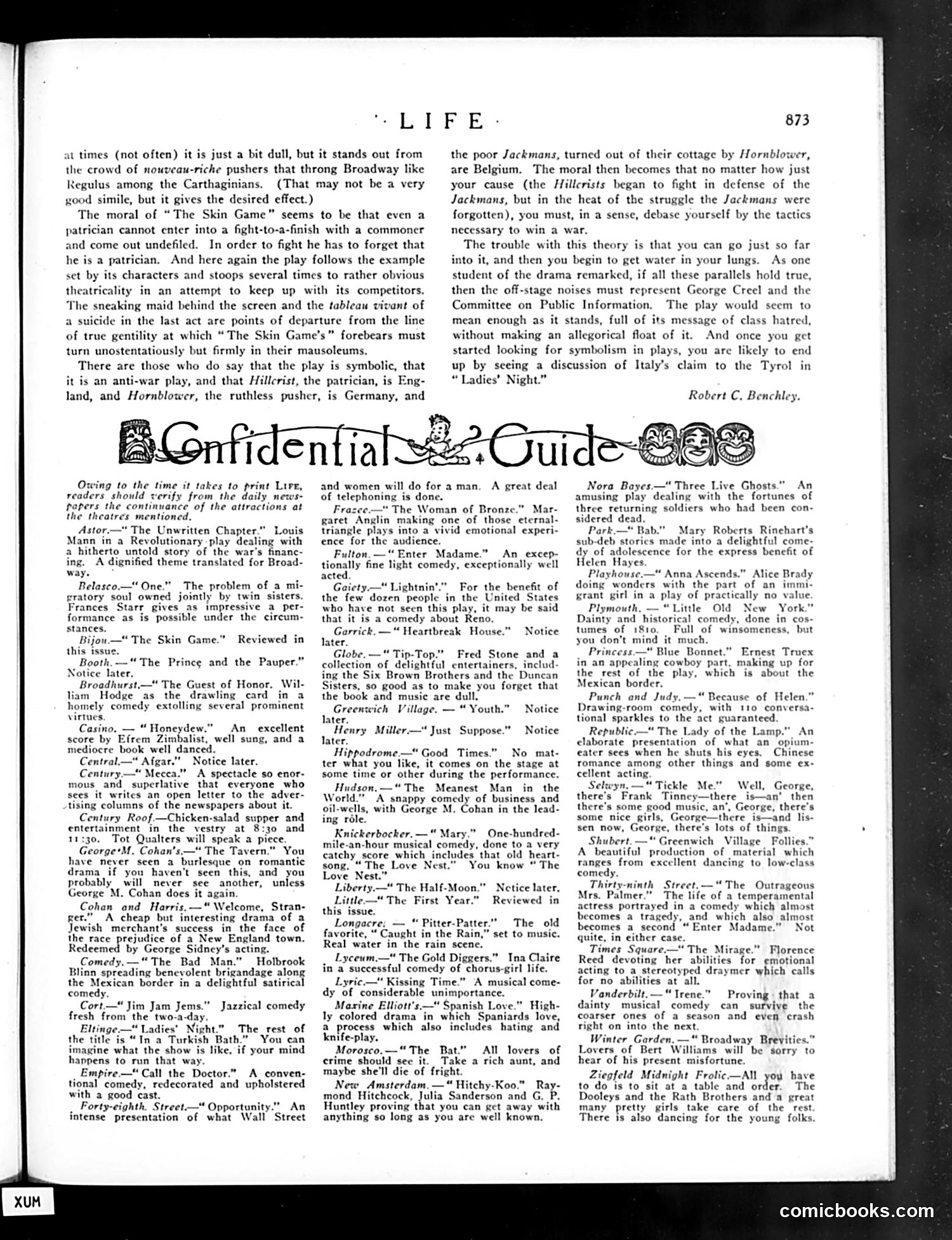
This page is primarily a theatre review column listing Broadway productions. The opening text discusses "The Skin Game," a play that some interpret symbolically as anti-war commentary: the genteel Hillcrists represent England, the Jackmans (evicted farmers) represent Belgium, and Hornblower represents Germany. The reviewer suggests the play's moral is that even a just cause (like defending Belgium) requires ruthless methods to win—a cynical commentary on WWI ethics. The bulk of the page consists of brief, satirical reviews of current Broadway shows, each with acerbic one-line descriptions. These range from conventional comedies to spectacular productions, with the reviewer's wit aimed at both the plays' themes and their execution. The tone is characteristic of Life magazine's irreverent approach to culture.
📄 Transcribed text from this page (OCR, searchable)
Machine-transcribed from the original scan — historical spelling and the odd misread are preserved.
at times (not often) it is just a bit dull, but it stands out from the crowd of nouveau-riche pushers that throng Broadway like (That may not be a very ‘ed effect.) The moral of “The Skin Game” seems to be that even a patrician cannot enter into a fight-to-a-finish with a commoner In order to fight he has to forget that And here again the play follows the example set by its characters and stoops several times to rather obvious theatricality in an attempt to keep up with its competitors. The sneaking maid behind the screen and the tableau vivant of a suicide in the last act are points of departure from the line of true gentility at which “The Skin Game’s” forebears must turn unostentatiously but firmly in their mausoleums. There are those who do say that the play is symbolic, that it is an anti-war play, and that Hillcrist, the patrician, is Eng- Regulus among the Carthaginians, good simile, but it gives the de: and come out undefiled. he is a patrician. “LIFE- 873 the poor Jackmans, turned out of their cottage by Hornblower, are Belgium. The moral then becomes that no matter how just your cause (the Hillcrists be in to fight in defense of the Jackmans, but in the heat of the struggle the Jackmans were “ Ladies’ Night.” land, and Hornblower, the ruthless pusher, is Germany, and Owing to the time it takes to print Lire, readers should verify from the daily new: papers the continuance of the attractions at the theatres mentioned. Astor.— The Unwritten Chapter.” Louis Mann in a Revolutionary play dealing with a hitherto untold story of the war's financ- ing. A dignified theme translated for Broad- way. Belasco.—" One.” The problem of a mi- gratory soul owned jointly by twin sisters. Frances Starr gives as impressive a per- formance as is possible under the circum- stances. Bijou this issue. Booth.—“ The Prince and the Pauper.” Notice later. Broadhurst.—" The Guest of Honor. Wil- liam Hodge as the drawling card in a homely comedy extolling several prominent virtues. Casino. — ‘The Skin Game.” Reviewed in Honeydew.” An excellent score by ‘em Zimbalist, well sung, and a mediocre book well danced. Central—" Afgar.” Notice later. Century—" Mecca.” A spectacle so enor- mous and superlative that everyone who sees it writes an open letter to the adver- tising columns of the newspapers about i Century Roof—Chicken-salad supper and entertainment in the vestry at 8:30 and 11:30. Tot Qualters will speak a piece. George+M. Cohan’s—" The Tavern.” You have never seen a burlesque on romantic drama if you haven't seen this, and you probably will never see another, unless George M. Cohan does it again Cohan and Harris. —“ Welcome, Stran- A cheap but interesting drama of a ish merchant's success in the face of the race prejudice of a New England town, Redeemed by George Sidney's acting. Comedy.—“ The Bad Man.” Holbrook Blinn spreading benevolent brigandage along the Mexican border in a delightful satirical comedy. Cort—* Jim Jam Jems.” Jazzical comedy fresh from’ the two-a-day. Eltinge—" Ladies’ Night.” The rest of the title is “In a Turkish Bath. You can imagine what the show is like, if your mind happens to run that way. Empire. Call the Doctor.” A conven- tional comedy, redecorated and upholstered with a good cast. _ Forty-eighth. Street—* Opportunity.” An intense presentation of what Wall Street and women will do fora man. A great deal of telephoning is done. Frazee—“ The Woman of Bronze.” Mar- garet Anglin making one of those eternal- triangle plays into a vivid emotional experi- ence for the audience. Fulton, —“ Enter Madame.” An excep- tionally fine light comedy, exceptionally well acted Gaiety—" Lightnin’.”. For the benefit of the few dozen people in the United States who have not seen this play, it may be said that it is a comedy about Reno. Garrick. —“ Heartbreak House.” later. Globe. —"Tip-Top.” Fred Stone and a collection of delightful entertainers, includ: ing the Six Brown Brothers and the Duncan Sisters, so good as to make you forget that the book and music are dull Greenwich Village. — later. Henry Mille later. Hippodrome.—" Good Times.” No mat- ter what you like, it comes on the stage at some time or other during the performance. Hudson.—“ The Meanest Man in the World snappy comedy of business and oil-wells, with George M. Cohan in the lead- ing réle. Knickerbocker. —“ Mary.” One-hundred- mile-an-hour musical comedy, done to a very catchy score which includes that old heart- song, “ The Love Nest.” You know “ The Love Nest.” Liberty.— The Half-Moon.”” Little—“ The First Year. this issue. Longacre, — “ Pitter-Patter. favorite, “ Caught in the Rain, Real water in the rain scene. Lyceum.— The Gold Diggers.” Ina Claire in a successful comedy of chorus-girl life. Lyric —" Kissing Time.” A musical come- dy of considerable unimportance. Maxine Elliott's —" Spanish Love.” High- ly colored drama in which Spaniards love, a process which also includes hating and knife-play. Morosco.—“ The Bat.” All lovers of crime should see it. Take a rich aunt, and maybe she'll die of fright. New Amsterdam. —“ Hitchy-Koo.” Ray- mond Hitchcock, Julia Sanderson and G. P. Huntley proving that you can get away with anything so long as you are well known. Notice outh.” Notice Just Suppose.” Notice Netice later, Reviewed in forgotten), you must, in a sense, debase yourself by the tactics necessary to win a war. The trouble with this theory is that you can go just so far into it, and then you begin to get water in your lungs. student of the drama remarked, if all these parallels hold true, then the off-stage noises must represent George Creel and the Committee on Public Information. mean enough as it stands, full of its message of class hatred, without making an allegorical float of it. started looking for symbolism in plays, you are likely to end up by seeing a discussion of Italy’s claim to the Tyrol in As one The play would seem to And once you get Robert C, Benchley. Nora Bayes—" Three Live Ghosts.” An amusing play dealing with the fortunes of three returning soldiers who had been con- sidered dead. Park.—" Bab.” Mary Roberts Rinehart’s sub-deb stories made into a delightful come- dy of adolescence for the express benefit of Helen Hayes. Playhouse.—“ Anna Ascends.” Alice Brady doing wonders with the part of an immi- grant girl in a play of practically no value Plymouth ittle Old New York.” Dainty and ‘historical comedy, done in cos- tumes of 1810. Full of winsomeness, but you don't mind it much. Princess.—" Blue Bonnet.” Ernest Truex in an appealing cowboy part, making up for the rest of the play, which is about the Mexican border. Punch and Judy.—“ Because of Helen.” Drawing-room comedy, with 110 conversa- tional sparkles to the act guaranteed Republic-—" The Lady of the Lamp.” An elaborate presentation of what an opium- eater sees when he shuts his eyes. Chinese romance among other things and some ex- “Tickle Me.” Well, George, F —there is—an' then there's some good music, an’, George, there's some nice girls, George—there is—and lis- sen now, George, there's lots of things. Shubert. —“ Greenwich Village Follies.” A beautiful production of material which ranges from excellent dancing to low-class comedy Thirty-ninth Street, —“ The Outrageous Mrs, Palmer.” The life of a temperamental actress portrayed in a comedy which almost becomes a tragedy, and which also almost becomes a second “Enter Madame.” Not quite, in either case. Times Square.— The Mirag Florence Reed devoting her abilities for emotional acting to a stereotyped draymer which calls for no abil Proving that a dainty musical comedy can survive. the coarser ones of a season and even crash right on into the next. Winter Garden. —“ Broadway Brevit Lovers of Bert Williams will be sorry to hear of his present misfortune. Ziegfeld Midnight Froli All you have to do is to sit at a table and order. The Dooleys and the Rath Brothers and a great many pretty girls take care of the rest There is also dancing for the young folks. comicbooks.com