
Life, 1920-11-11 · page 10 of 44
Life — November 11, 1920 — page 10: what you’re looking at
What you’re looking at
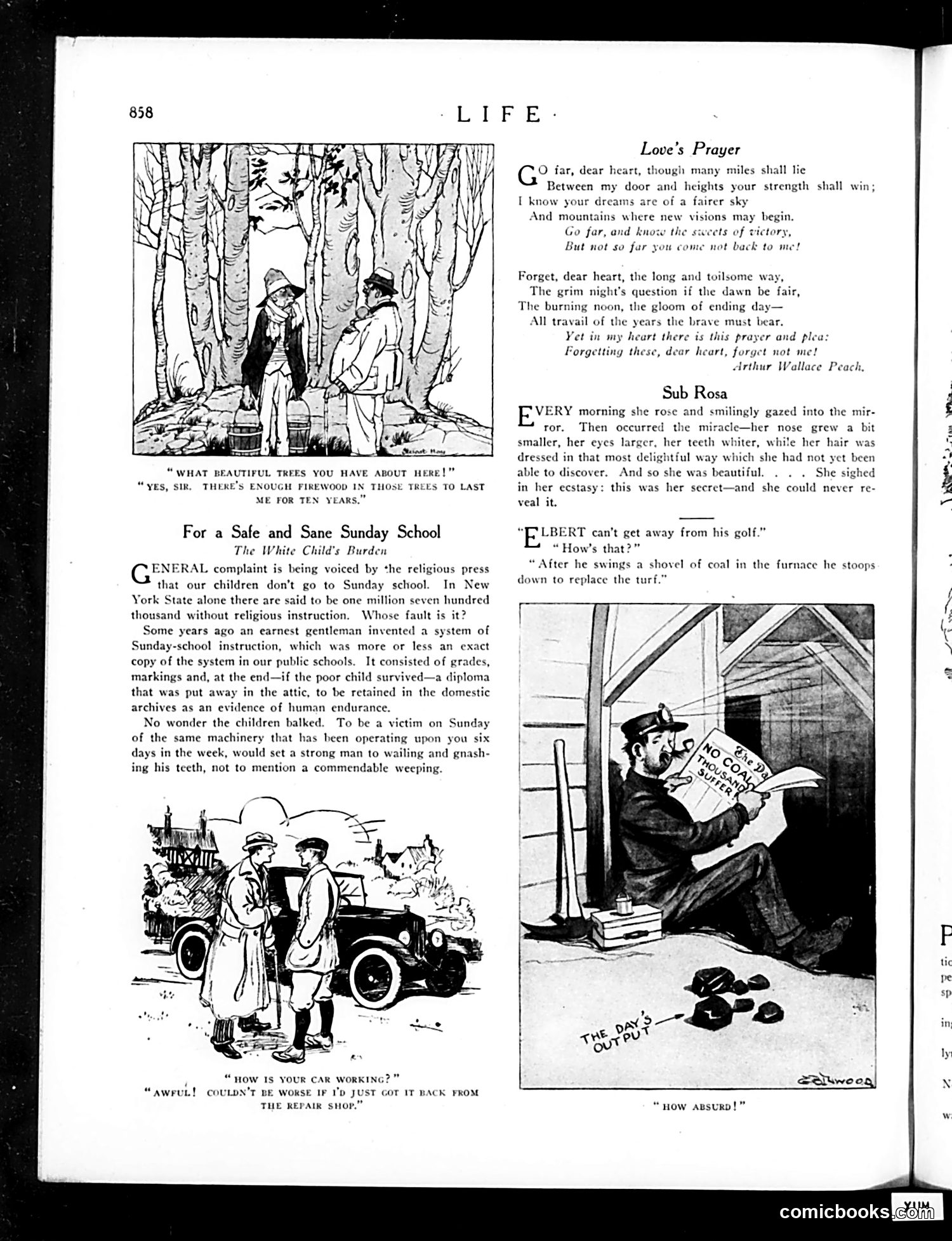
This page contains three distinct sections: **"Love's Prayer"** — A sentimental poem about long-distance love, attributed to Arthur Wallace Peach. **"Sub Rosa"** — A brief romantic story about a woman named Rosa experiencing a miraculous self-improvement. **"For a Safe and Sane Sunday School"** — Social commentary criticizing the lack of religious education in New York schools (reportedly one million children without instruction). The article argues children need rest from weekday institutional machinery. **Two cartoons** satirize Sunday leisure: 1. A couple with a broken-down car: "How is your car working?" / "Awful! Couldn't be worse if it just got it back from the repair shop." 2. A man reading "No Golf Today" newspaper while surrounded by coal: "How absurd!" — mocking the frustration when golf is unavailable. The page emphasizes tension between work, institutional demands, and desired leisure time in early 20th-century American life.
📄 Transcribed text from this page (OCR, searchable)
Machine-transcribed from the original scan — historical spelling and the odd misread are preserved.
“WHAT BEAUTIFUL TREES YOU HAVE ABOUT HERE!” SIR, THERE'S ENOUGH FIREWOOD IN THOSE TREES TO LAST ME FOR TEN YEARS,” For a Safe and Sane Sunday School The White Child’s Burden ENERAL complaint is being voiced by the religious press that our children don’t go to Sunday school. In New York State alone there are said to be one million seven hundred thousand without religious instruction. Whose fault is it? Some years ago an earnest gentleman invented a system of Sunday-school instruction, which was more or less an exact copy of the system in our public schools. It consisted of grades, markings and, at the end—if the poor child survived—a diploma that was put away in the attic, to be retained in the domestic archives as an evidence of human endurance. No wonder the children balked. To be a victim on Sunday of the same machinery that has heen operating upon you six days in the week, would set a strong man to wailing and gnash- ing his teeth, not to mention a commendable weeping. “HOW IS YOUR CAR WORKING?” “AWFUL! COULDN'T BE WORSE IF I'D JUST GOT IT BACK FROM THE REPAIR SHOP.” ’ Love’s Prayer O iar, dear heart, though many miles shall lie Between my door and heights your strength shall win; i know your dreams are‘ol a. fatrer’sky And mountains where new visions may begin. Go far, and know the sweets of But not so far you come not back to me! Forget, dear heart, the long and toilsome way, The grim night's question if the dawn be fair, The burning noon, the gloom of ending day— All travail of the years the brave must bear. Yet in my heart there is this prayer and plea: Forgetting these, dear heart, forget not me! arthur Wallace Pea Sub Rosa EVERY morning she rose and smilingly gazed into the mir- ror. Then occurred the miracle—her nose grew a bit smaller, her eyes lar; her teeth whiter, while her hair was dressed in that most delightful way which she had not yet been able to discover. And so she was beautiful. She sighed in her ecstasy: this was her secret—and she could never re- veal it. “E{LBERT can’t get away from his golf.” “How’s that?” “ After he swings a shovel of coal in the furnace he stoops down to replace the turf. “How ApsuRD!” P wee coc ts, “one comicbooks eon