
Life, 1920-11-11 · page 24 of 44
Life — November 11, 1920 — page 24: what you’re looking at
What you’re looking at
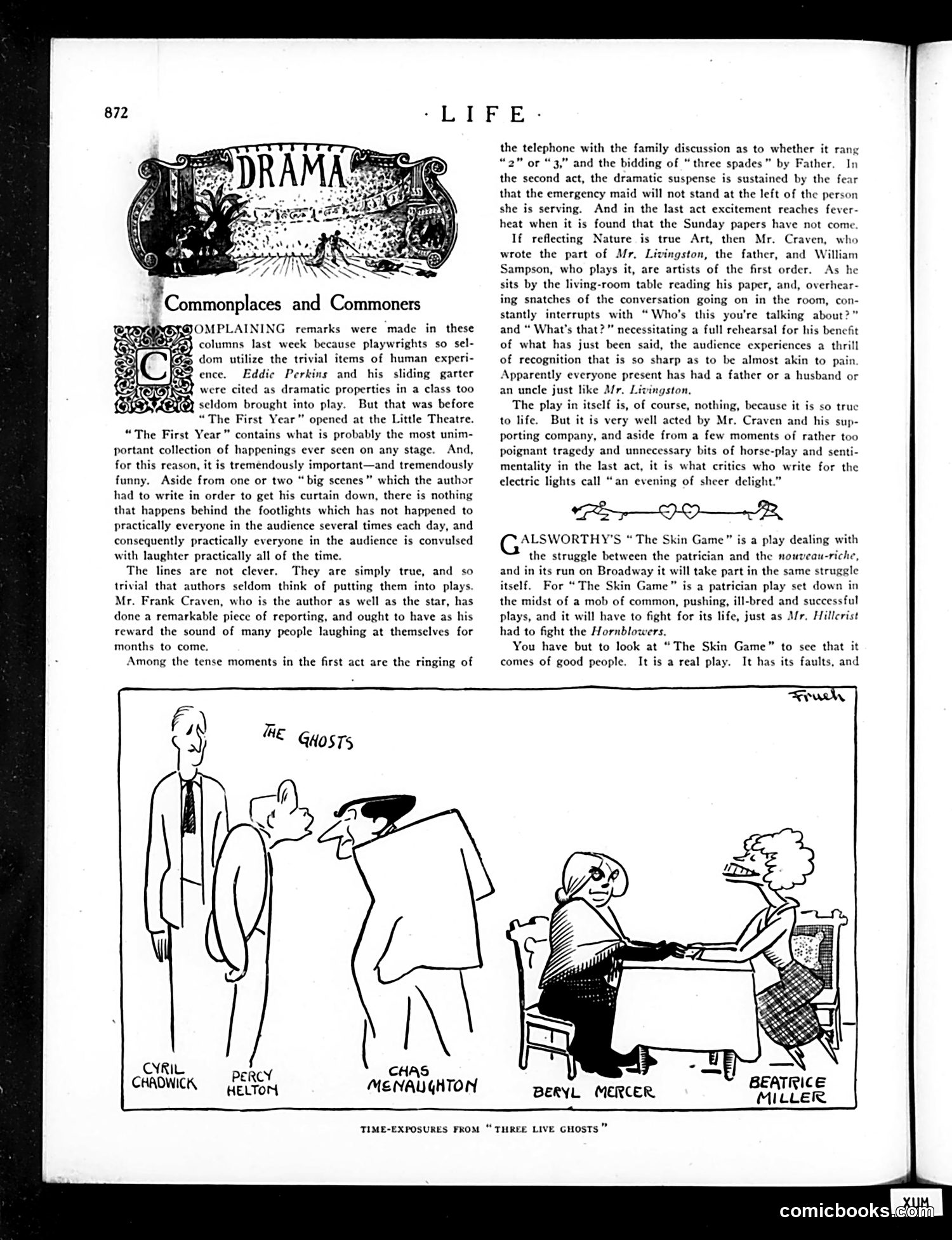
This page reviews theatrical productions from the 1920s era. The main text discusses "The First Year," praising playwright Frank Craven for capturing mundane domestic moments—a ringing telephone, card game bidding, missing newspapers—that resonate universally because audiences recognize their own lives reflected onstage. The satire lies in how the play's *triviality* becomes its greatest strength; critics typically praise "big scenes," but here the humor and pathos emerge from everyday irritations (like a father repeatedly asking "Who's this you're talking about?"). The cartoon titled "The Ghosts" illustrates "Three Live Ghosts," another play, showing five cast members in a simple line drawing. A secondary review discusses Galsworthy's "The Skin Game," a patrician play struggling commercially among lowbrow Broadway productions—positioning the play itself as fighting the same class battle it depicts. The page exemplifies early 20th-century theater criticism valuing naturalism and authentic human experience over melodramatic artifice.
📄 Transcribed text from this page (OCR, searchable)
Machine-transcribed from the original scan — historical spelling and the odd misread are preserved.
-LIFE- © Commonplaces and Commoners OMPLAINING remarks were made in these columns last week because playwrights so sel- dom utilize the trivial items of human experi- Eddie Perkins and his sliding garter were cited as dramatic properties in a class too seldom brought into play. But that was before “The First Year” opened at the Little Theatre. “The First Year” contains what is probably the most unim- portant collection of happenings ever scen on any stage. And, for this reason, it is tremendously important—and tremendously funny. Aside from one or two “big scenes” which the author had to write in order to get his curtain down, there is nothing that happens behind the footlights which has not happened to practically everyone in the audience several times cach day, and consequently practically everyone in the audience is convulsed with laughter practically all of the time. The lines are not clever. They are simply true, and so ence, trivial that authors seldom think of putting them into plays. Mr. Frank Craven, who is the author as well as the star, has done a remarkable piece of reporting, and ought to have as his reward the sound of many people laughing at themselves for months to come. Among the tense moments in the first act are the ringing of CYRIL CHADWICK, PERCY CHAS HELTON MENAUGHTON TIME-EXPOSURES FROM the telephone with the family discussion as to whether it rang “2” or “3,” and the bidding of “three spades” by Father. In the second act, the dramatic suspense is sustained by the fear that the emergency maid will not stand at the left of the person she is serving. And in the last act excitement reaches fever- heat when it is found that the Sunday papers have not come. If reflecting Nature is true Art, then Mr. Craven, who wrote the part of Mr. Livingston, the father, and William Sampson, who plays it, are artists of the first order. As he sits by the living-room table reading his paper, and, overhear- ing snatches of the conversation going on in the room, con- stantly interrupts with “Who's this you're talking about?” and “ What's that?” necessitating a full rehearsal for his benefit of what has just been said, the audience experiences a thrill of recognition that is so sharp as to be almost akin to pain Apparently everyone present has had a father or a husband or an uncle just like Mr. Livingston. The play in itself is, of course, nothing, because it is so truc to life. But it is very well acted by Mr. Craven and his sup- porting company, and aside from a few moments of rather too poignant tragedy and unnecessary bits of horse-play and senti- mentality in the last act, it is what critics who write for the electric lights call “an evening of sheer delight.” Poy —9- ALSWORTHY'S “ The Skin Game” is a play dealing with the struggle between the patrician and the nouveau-riche, and in its run on Broadway it will take part in the same struggle itself. For “The Skin Game” is a patrician play set down in the midst of a mob of common, pushing, ill-bred and successful plays, and it will have to fight for its life, just as Mr. Hillcrist had to fight the Hornblowers. You have but to look at “The Skin Game” to sce that it comes of good people. It is a real play. It has its faults, and BEATRICE BERYL MERCER MILLER. THREE LIVE GHOSTS” comicbookale M,|