
Life, 1920-11-11 · page 17 of 44
Life — November 11, 1920 — page 17: what you’re looking at
What you’re looking at
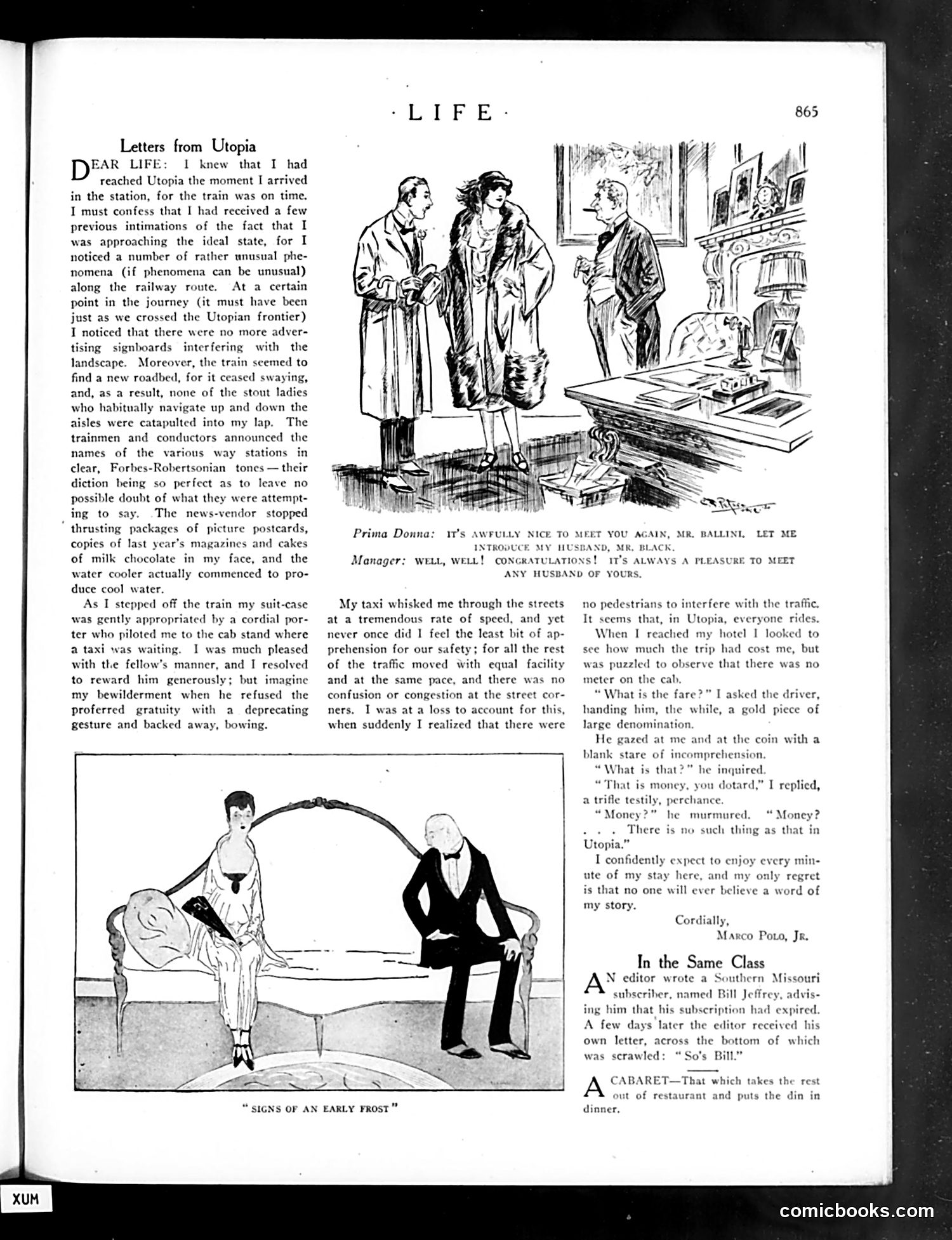
This page contains a satirical letter imagining an ideal society ("Utopia") where everyday annoyances have been eliminated. The writer catalogs absurd improvements: trains run on time, advertising doesn't clutter landscapes, conductors speak clearly, taxi drivers refuse tips, traffic flows perfectly with no pedestrians, and—most pointedly—**money doesn't exist**. The satire targets early 20th-century American life: unreliable trains, aggressive vendors, rude service workers, chaotic traffic, and the money-obsessed culture. By depicting a world where these problems vanish, the author mockingly suggests such improvements are impossibly idealistic. The cartoon "Signs of an Early Frost" (showing two people on a couch) and the brief jokes below add lighter humor unrelated to the main piece. The overall tone is gentle satire about modern inconveniences rather than sharp political commentary.
📄 Transcribed text from this page (OCR, searchable)
Machine-transcribed from the original scan — historical spelling and the odd misread are preserved.
Letters from Utopia AR LIFE 1 knew that I had reached Utopia the moment I arrived in the station, for the train was on time. I must confess that I had received a few previous intimations of the fact that I was approaching the ideal state, for I noticed a number of rather unusual phe- nomena (if phenomena can be unusual) along the railway route. At a certain point in the journey (it must have been just as we crossed the Utopian frontier) I noticed that there were no more adver- tising interfering with the landscape. Moreover, the train seemed to find a new roadbed, for it ceased swaying, and, as a result, none of the stout ladies who habitually navigate up and down the aisles were catapulted into my lap. The trainmen and conductors announced the names of the various way stations in clear, Forbe: signboards Robertsonian tones — their diction being so perfect as to leave no possible doubt of what they were attempt- ing to s: The news-vendor stopped “thrusting packages of picture postcards, copies of last year’s magazines and cakes of milk chocolate in my face, and the water cooler actually commenced to pro- duce cool water. As I stepped off the train my suit-case was gently appropriated by a cordial por- ter who piloted me to the cab stand where a taxi was waiting. I was much pleased with the fellow’s manner, and I resolved to reward him generously; but imagine my bewilderment when he refused the proferred gratuity with a deprecating gesture and backed away, bowing. Prima Donna: INTRODUCE MY Manager: weir, weir! IT’S AWFULLY NICE TO MEET YOU AGAIN, MR. BALLINI, HUSBAND, MR, BLACK. CONGRATULATION 1: LET ME ALWAYS A PLEASURE TO MEET ANY HUSBAND OF YOURS. My taxi whisked me through the streets at a tremendous rate of speed, and yet never once did I feel the least bit of ap- prehension for our safety; for all the rest of the traffic moved with equal facility and at the same pace, and there was no confusion or congestion at the street cor- ners. I was at a loss to account for this, when suddenly I realized that there were “ SIGNS OF AN EARLY FROST” no pedestrians to interfere with the traffic. It seems that, in Utopia, everyone rides. When I reached my hotel I looked to see how much the trip had cost me, but was puzzled to observe that there was no meter on the cab. “What is the fare?” I asked the driver, handing him, the while, a gold piece of large denomination He gazed at me blank sta “What is that?” he inquired. “ d,” I replied, nd at the coin with a ¢ of incomprehension hat is money, you dots a trifle testily, perchance. “Money?” he murmured.“ Money? There is no such thing as that in Utopia. I confidently expect to enjoy every min- ute of my stay here, and my only regret is that no one will ever believe a word of my story. Cordially, Marco Poto, Jr. In the Same Class A N editor wrote a Southern Missouri subscriher, named Bill Jeffrey, advis- ing him that his subscription had expired. A few days later the editor received his own letter, across the bottom of which was scrawled: “So's Bill.” CABARET—That which takes the rest out of restaurant and puts the din in dinner, comicbooks.com