
A complete issue · 45 pages · 1920
Life — June 17, 1920
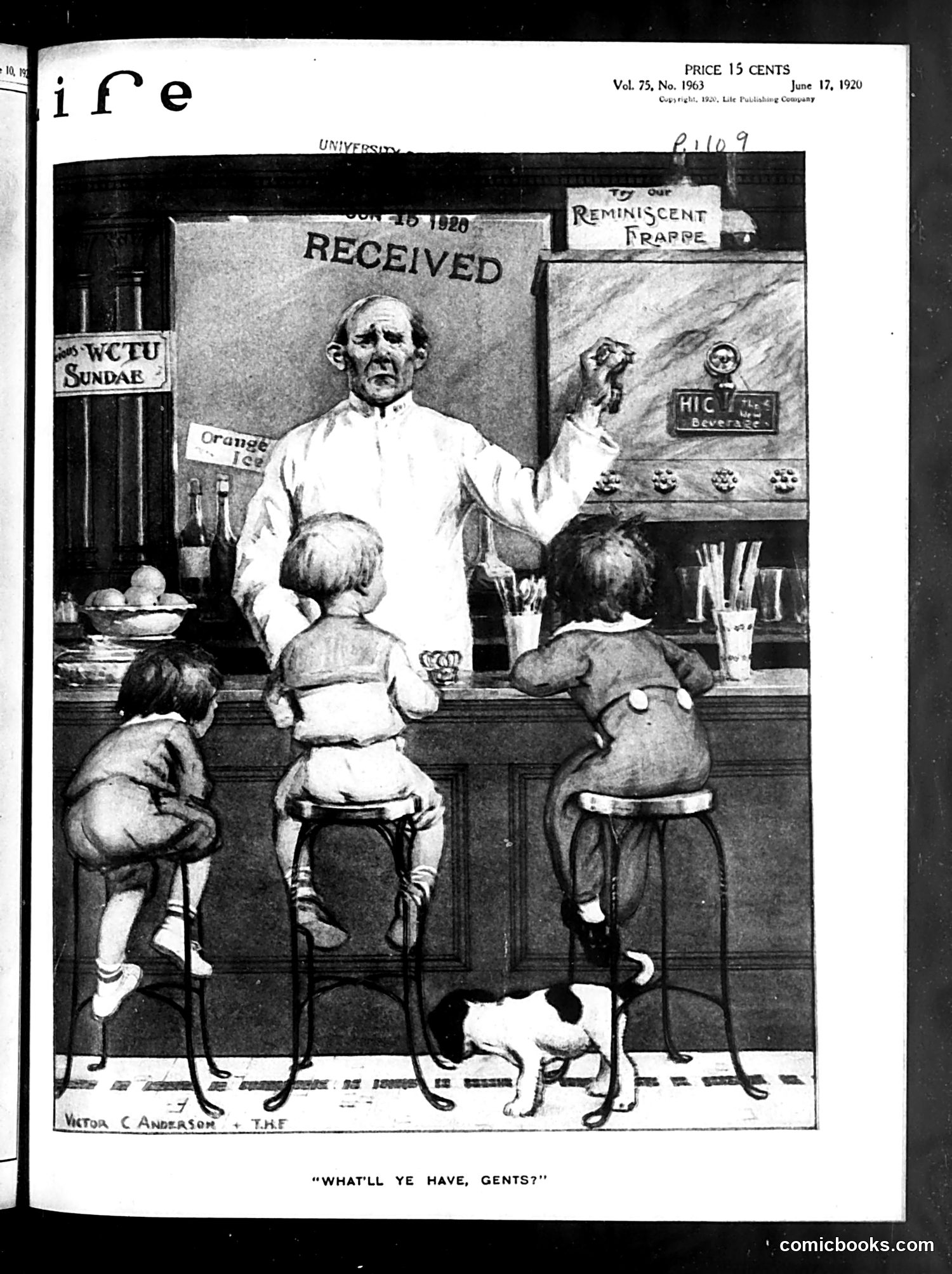
This cartoon satirizes a soda fountain or ice cream parlor scene. An elderly male pharmacist or vendor stands behind the counter offering refreshments to three young children and a dog. The caption reads "What'll ye have, gents?"—a humorous formality addressing the children as "gents." The visible signage references "WCTU Sundae" (Women's Christian Temperance Union), "Cranch Ice," and "Hic Beverage," suggesting this depicts Prohibition-era refreshment options replacing alcoholic drinks. The satire likely mocks the WCTU's advocacy for temperance by showing wholesome ice cream and soft drinks now marketed with mock-serious adult terminology. The artist signature appears to be "Victor C. Anderson."
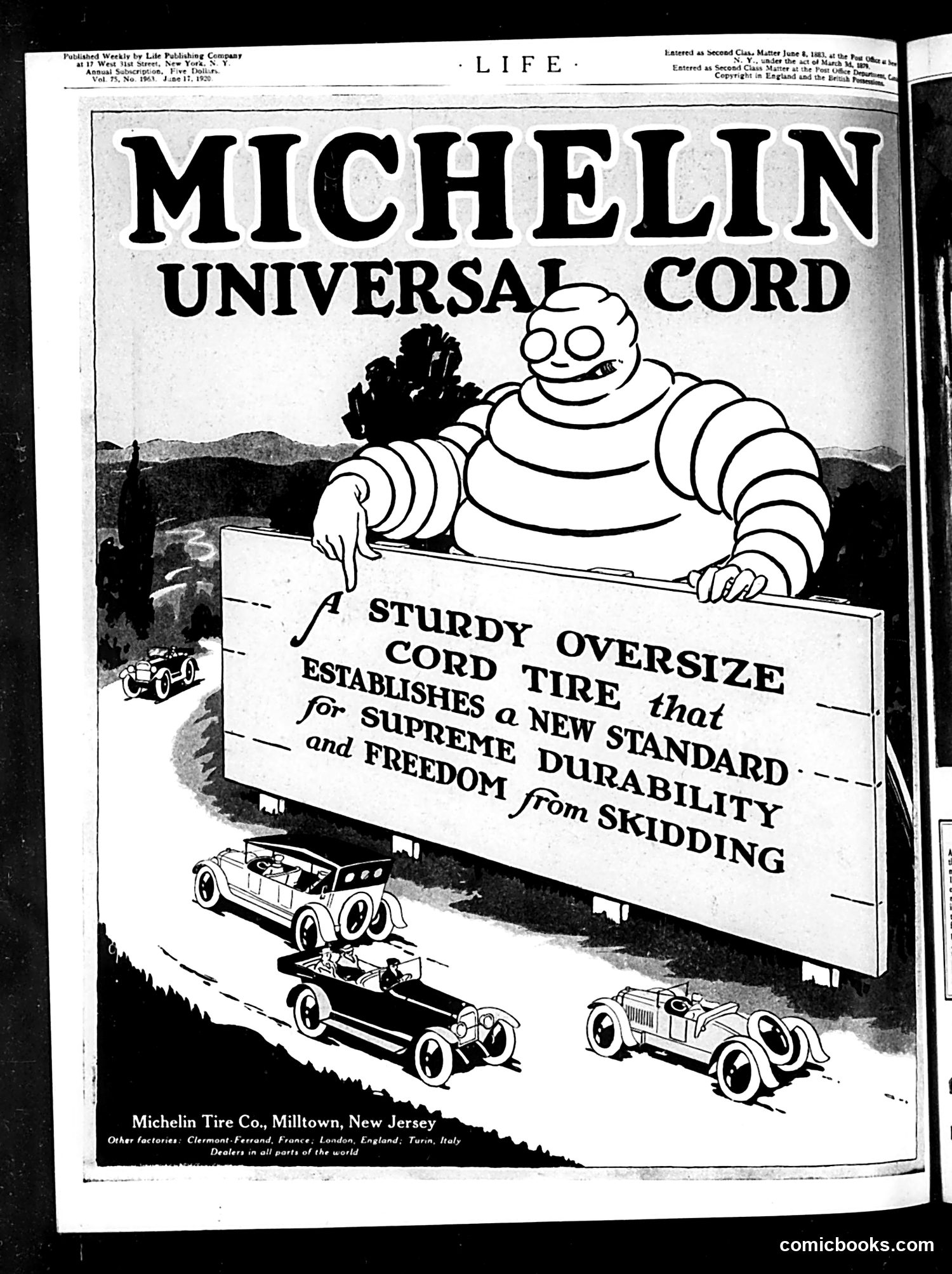
This is a **Michelin tire advertisement**, not political satire. The page features the Michelin Man (Bibendum), the company's mascot—a rotund, smiling character made of tire treads—prominently displaying a large sign. The ad promotes Michelin's "Universal Cord" tire, emphasizing it as a "sturdy oversize cord tire" offering "supreme durability and freedom from skidding." The message targets early automotive consumers concerned about tire reliability and road safety. The vintage cars illustrated below the sign reflect 1920s-era vehicles, establishing the historical period. The landscape and small car in the distance reinforce automotive themes. This represents straightforward commercial advertising rather than editorial commentary—common content in *Life* magazine during the early automobile era.
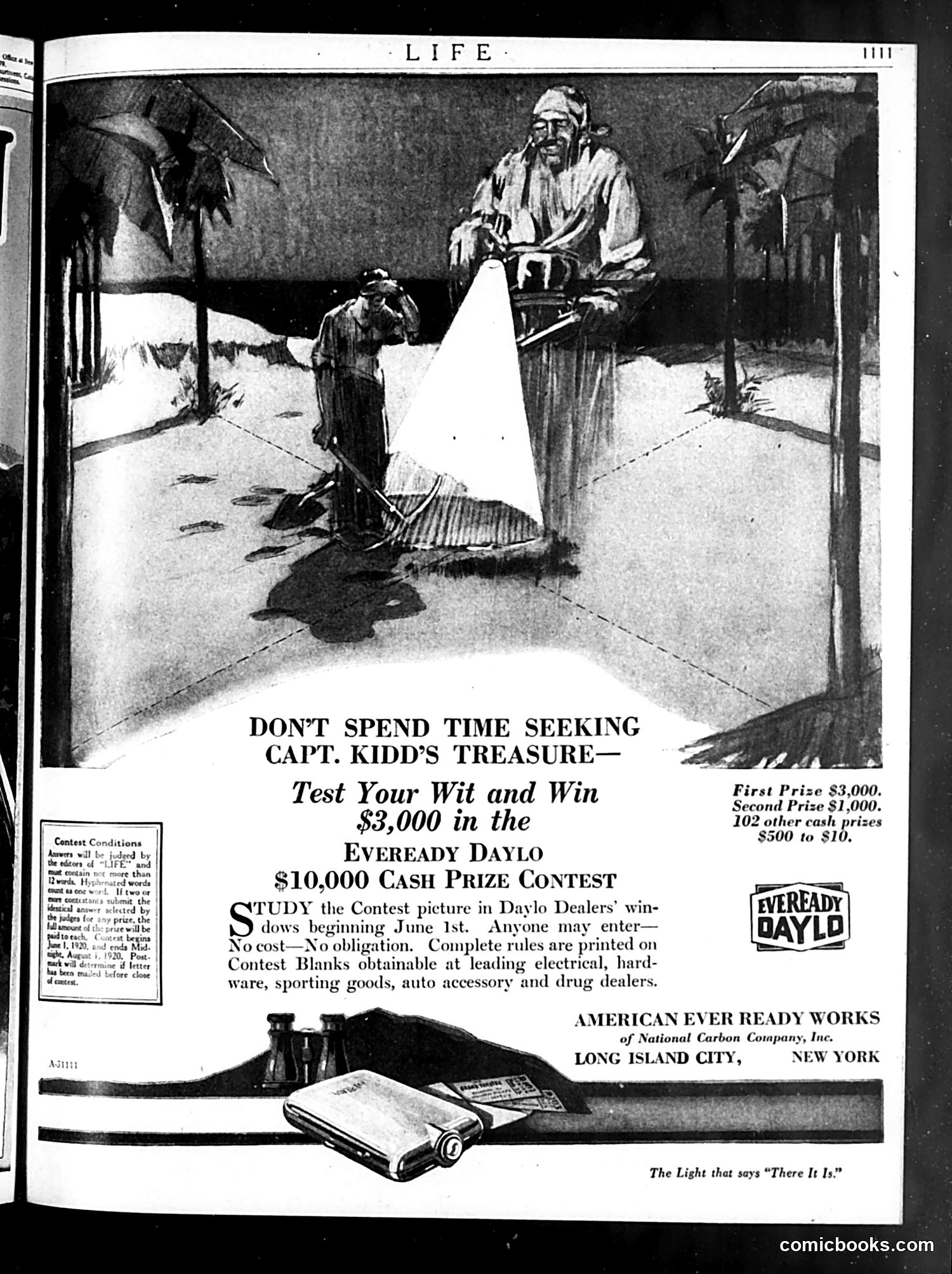
This page is primarily an **advertisement** for an Eveready Daylo flashlight contest, not political satire. The main image shows a pirate-like figure holding a lantern, referencing Captain Kidd's treasure—a popular cultural reference of the era used to make the contest seem adventurous and exciting. The advertisement promises $10,000 in cash prizes ($3,000 first prize) for solving a puzzle picture displayed in Daylo dealers' windows starting June 1st. Contest blanks were available at electrical, hardware, sporting goods, auto accessory, and drug stores. The tagline "The Light that says 'There It Is'" emphasizes the flashlight's utility. American Ever Ready Works (National Carbon Company) published this in Long Island City, New York. The content reflects 1920s consumer marketing and mass-produced battery technology advertising.
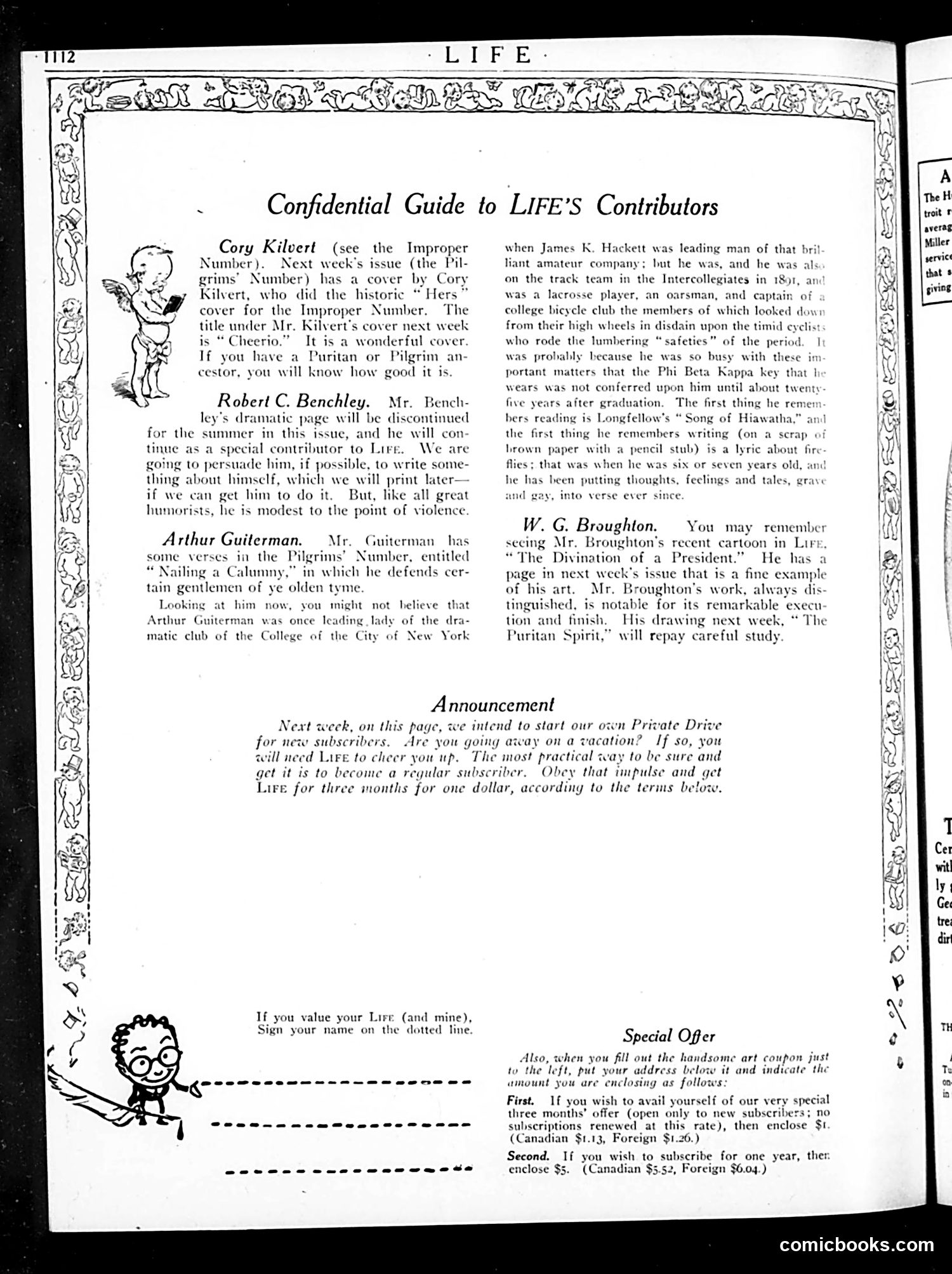
This page is primarily a **"Confidential Guide to LIFE's Contributors"** — a house column introducing the magazine's writers and artists to readers. The page features brief bios of contributors including **Cory Kilbert** (cover artist), **Robert C. Benchley** (humorist whose dramatic page will be discontinued), **Arthur Guiterman** (poet), and **W. G. Broughton** (cartoonist). Small cartoon illustrations accompany the text, including a cherub-like figure and a simple line drawing of a smiling man pointing at a dotted subscription line. The bottom section contains a **subscription offer**: three months of Life for one dollar, with special pricing for renewals and annual subscriptions. This is primarily **self-promotional content** rather than satirical commentary — typical of magazines' internal marketing to boost circulation.
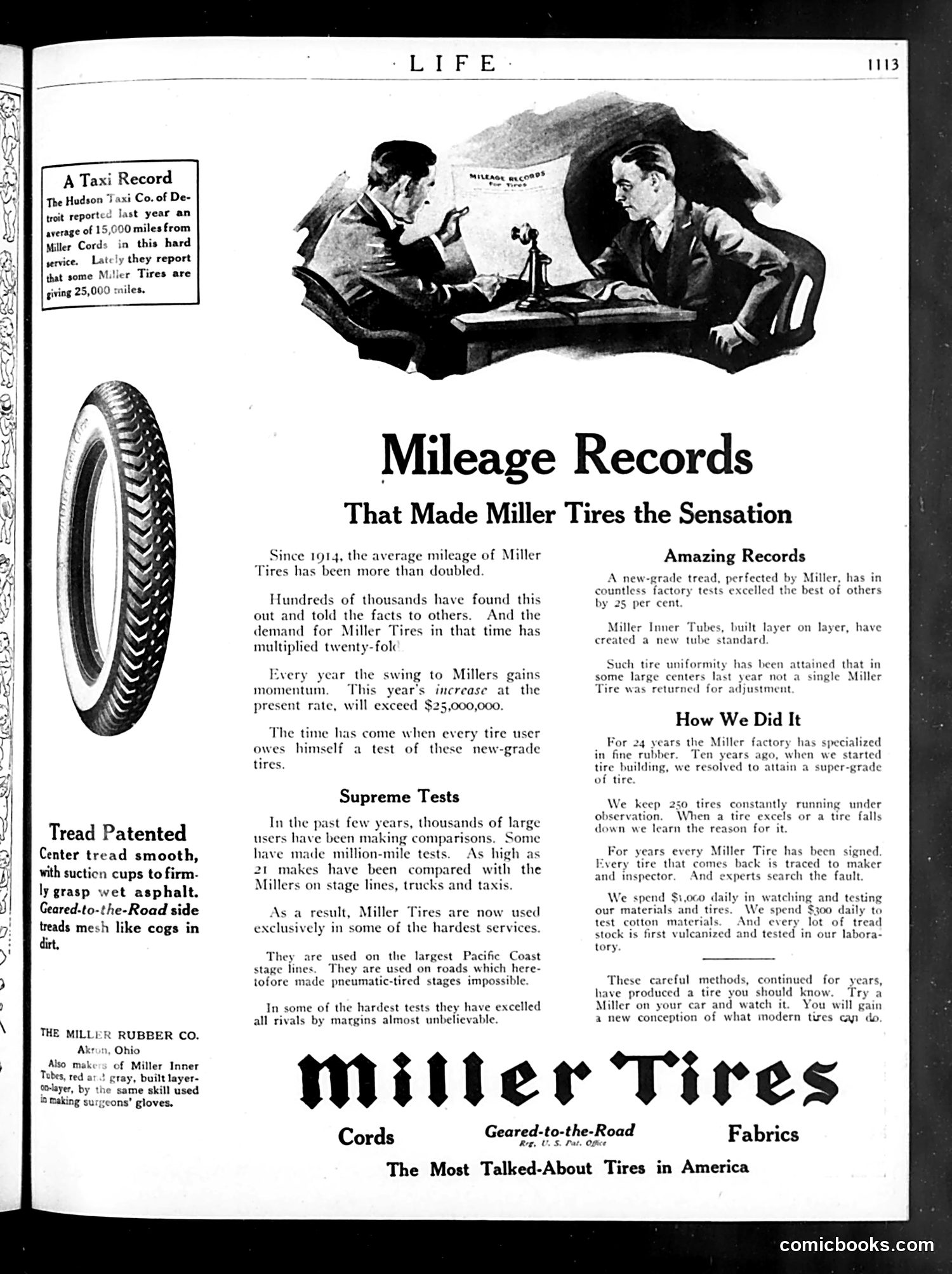
This page is primarily a **commercial advertisement**, not political satire. It promotes Miller Tires as "The Most Talked-About Tires in America." The illustration at top shows two men examining mileage records at a desk—likely representing a tire company official and a customer or inspector verifying the tire's performance claims. The advertisement emphasizes Miller Tires' superior durability, citing: - Doubled mileage since 1914 - Rigorous factory testing (250 tires constantly monitored) - Use by major Pacific Coast shipping lines - Patented center tread design for better grip The left sidebar notes the Hudson Taxi Company's record of 25,000 miles, serving as real-world proof of durability. This reflects early automotive-era marketing emphasizing technical specifications and documented performance over style.
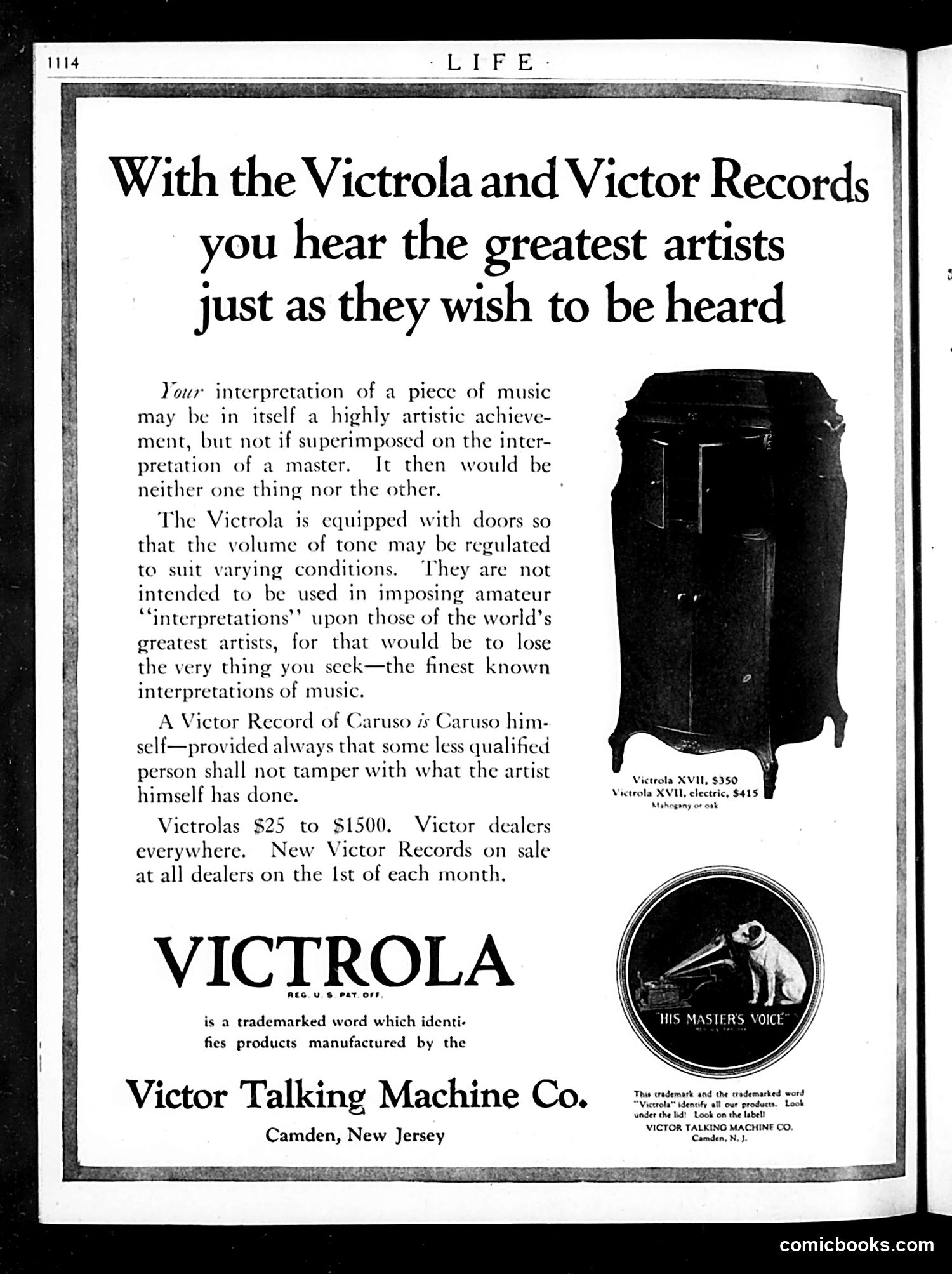
This page is **primarily an advertisement**, not satire or political commentary. It promotes Victrola phonographs and Victor Records, manufactured by the Victor Talking Machine Company in Camden, New Jersey. The ad's argument appeals to music enthusiasts: Victrola machines allow listeners to hear "the greatest artists just as they wish to be heard"—without amateur reinterpretation. The adjustable doors let users control volume for different room conditions, but explicitly *not* to impose personal "interpretations" on master recordings. The page shows a Victrola XVII cabinet model ($350-$415) and the famous "His Master's Voice" logo (dog with phonograph). This reflects early 20th-century attitudes about recorded music authenticity and fidelity—the idea that machines could preserve and faithfully reproduce artists' original performances.
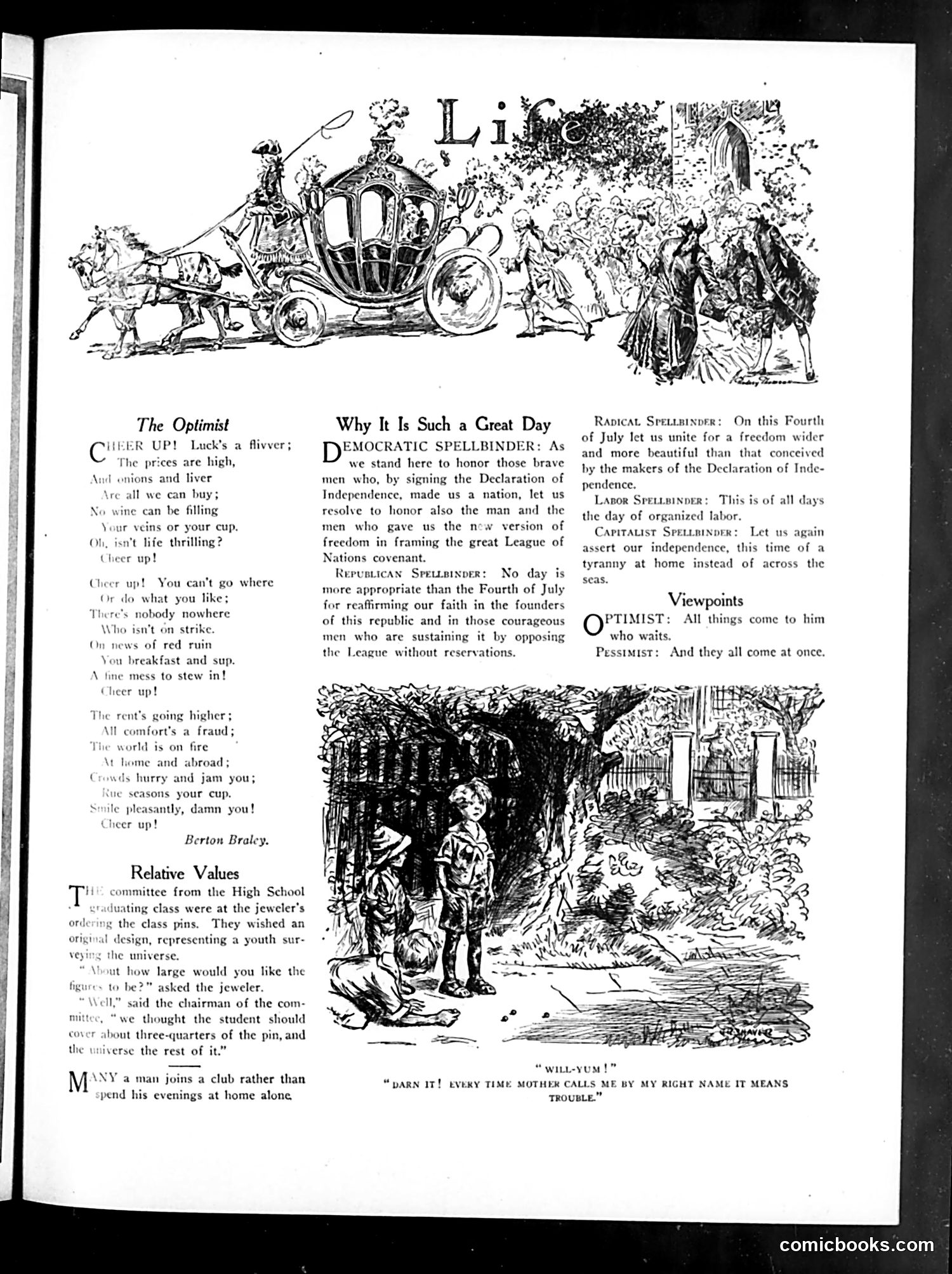
This page features Fourth of July-themed political commentary. "The Optimist" poem by Berton Braley expresses patriotic cheerfulness despite economic hardship ("The rent's going higher; / All comfort's a fraud"). "Why It Is Such a Great Day" presents contrasting perspectives on Independence Day's meaning: a Democratic Spellbinder emphasizes the Declaration and League of Nations; a Republican Spellbinder counters that Fourth of July celebrates opposition to tyranny and domestic (not foreign) freedom. A Radical Spellbinder advocates for labor rights. The "Viewpoints" section offers comic contrast between an Optimist and Pessimist's outlook. The bottom illustration depicts a child calling another by a disparaging nickname, captioned about mothers using children's "right name" when they mean trouble—a relatable domestic joke.
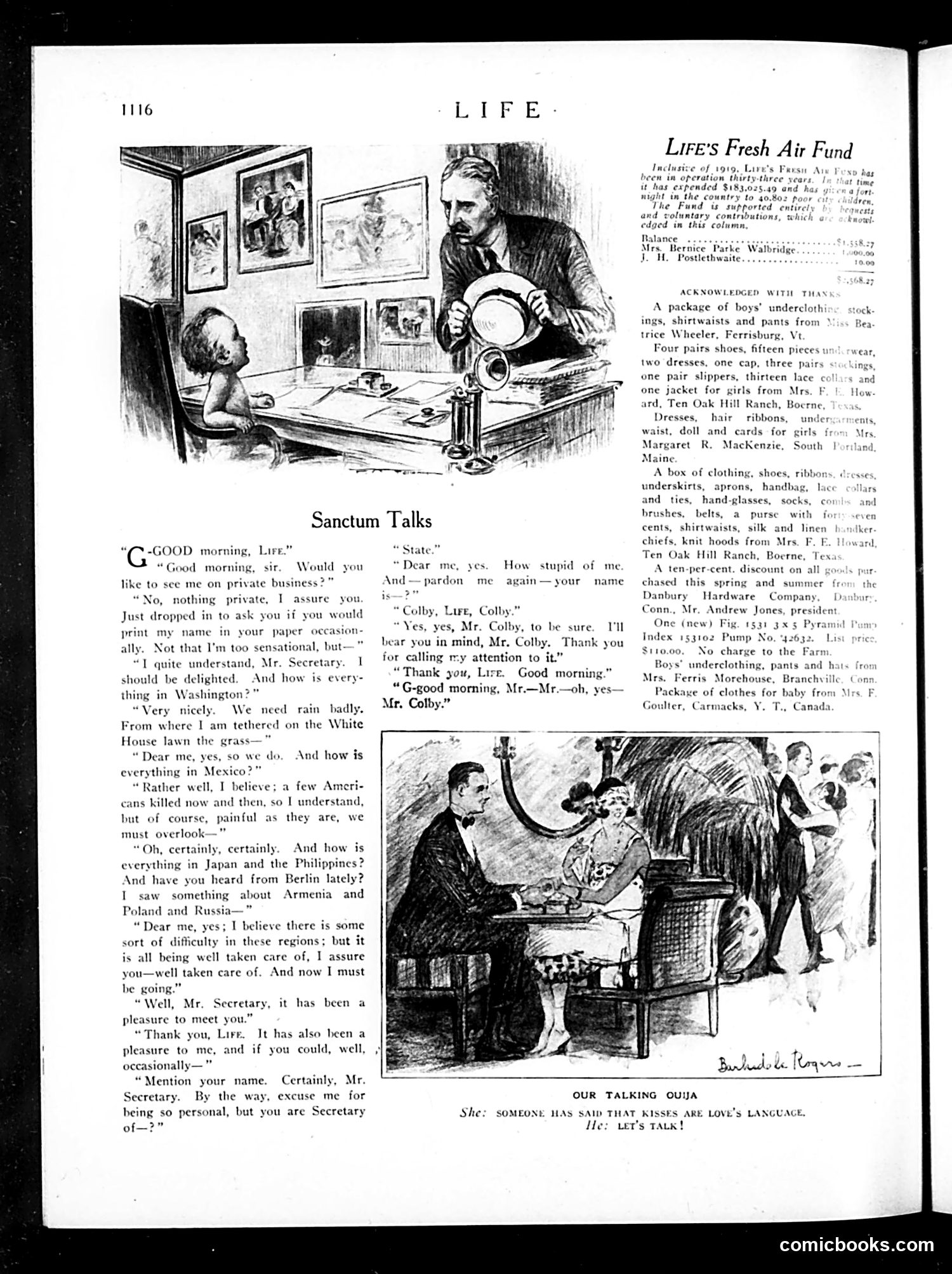
This page contains two distinct sections: **"Sanctum Talks"** is a dialogue between Life's Secretary and a visitor discussing international news—Mexico, Japan, the Philippines, Armenia, Poland, and Russia—suggesting early 20th-century geopolitical concerns. The conversation is cordial and gossipy in tone. **"Life's Fresh Air Fund"** lists charitable donations of clothing and goods for underprivileged children, including contributions from various donors across America. The bottom illustration, captioned "Our Talking Ouija," depicts two figures at what appears to be a séance or Ouija board, with the joke: "She: someone has said that kisses are love's language. He: let's talk!" This is a humorous commentary on romantic communication. The page reflects early 1900s concerns: international affairs, charitable giving, and dating humor.
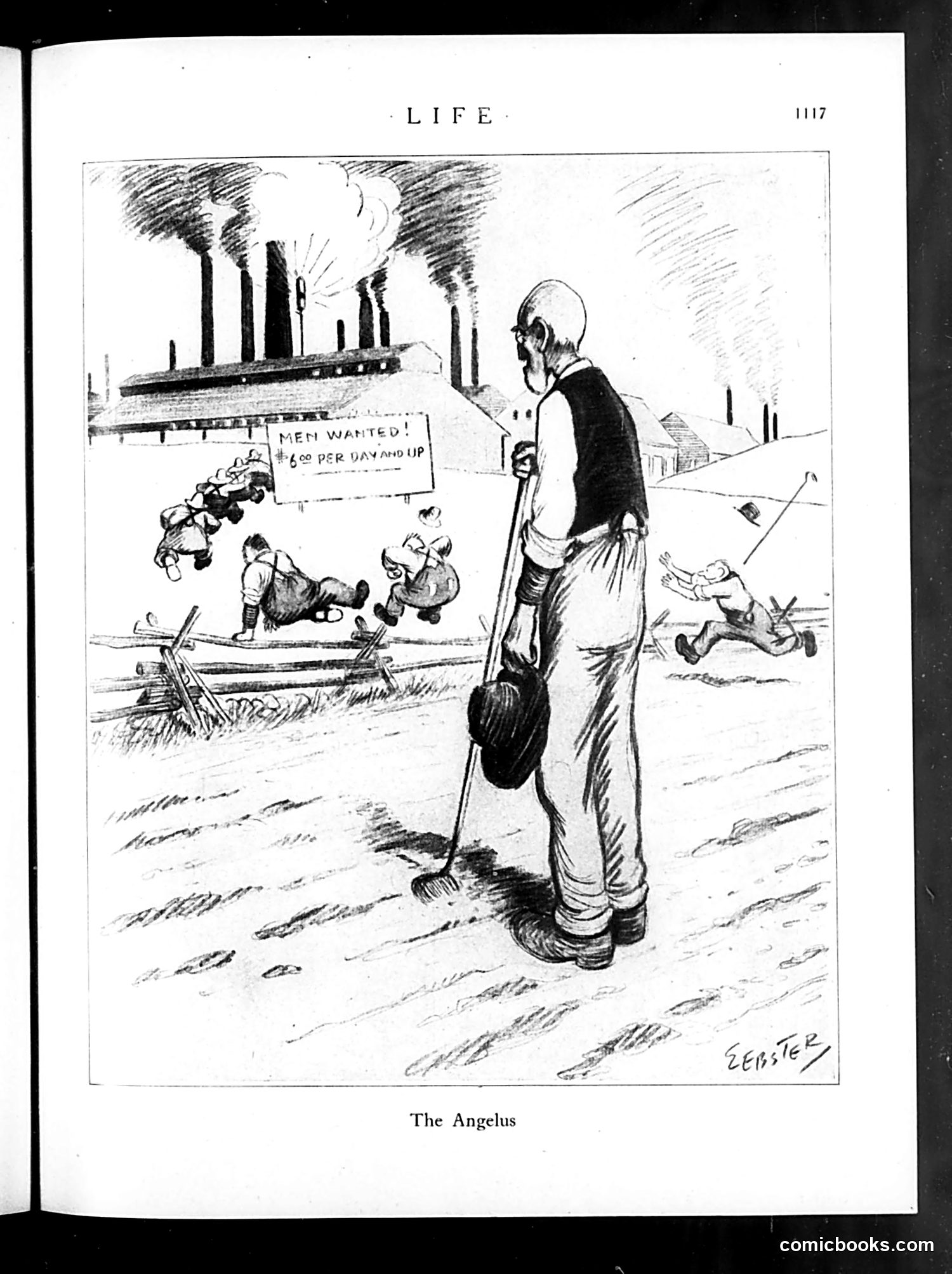
This cartoon by Jenster satirizes labor recruitment during industrial expansion, likely from the early 20th century. A skeletal Death figure (personified as "The Angelus," referencing Millet's famous painting) stands amid an industrial landscape with factory smokestacks, holding a bag of money. The sign reads "MEN WANTED! $6.00 PER DAY AND UP"—seemingly attractive wages. However, the skeleton imagery suggests these jobs carry grave danger: workers are depicted as small, vulnerable figures being lured toward industrial work. The satire critiques how factories recruited laborers with promises of decent pay while concealing the deadly working conditions, poor safety standards, and high mortality rates that characterized early industrial employment. Death literally profits from worker recruitment.
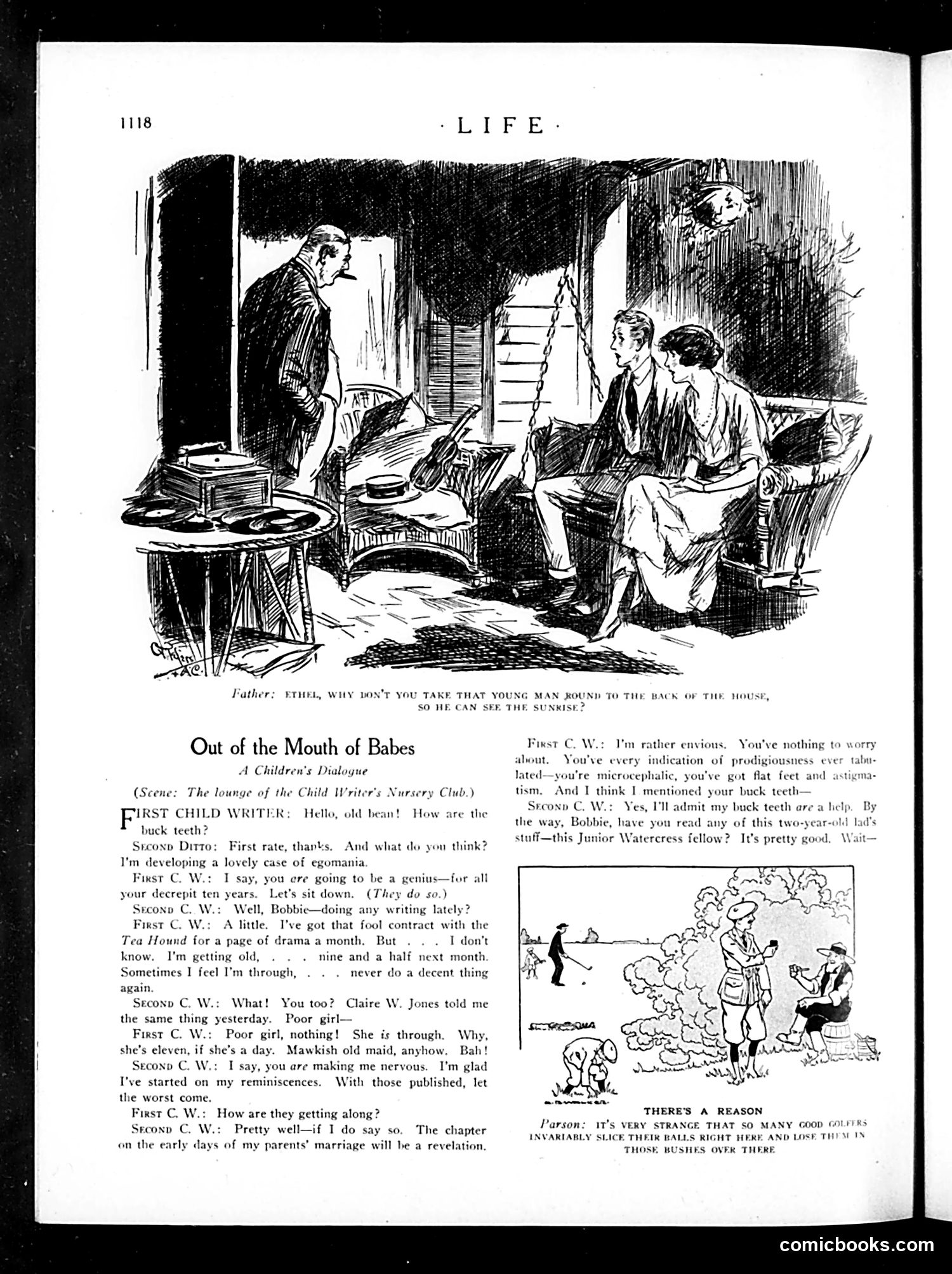
This page contains a satirical children's dialogue titled "Out of the Mouth of Babes" set in a Child Writer's Nursery Club. Two young writers discuss their literary ambitions and progress. The top cartoon illustrates a father asking a child writer to go outside and watch the sunrise for inspiration—a gentle jab at sentimental writing advice. The bottom cartoon, captioned "There's a Reason," depicts a parson puzzled why golfers constantly lose balls in bushes near his property. The joke suggests golfers deliberately aim poorly to avoid the bushes, implying the parson's presence makes the area undesirable—a subtle critique of clergy or organized religion as socially unpleasant. The overall piece satirizes both pretentious children's literary circles and conventional adult hypocrisy through innocent observations.
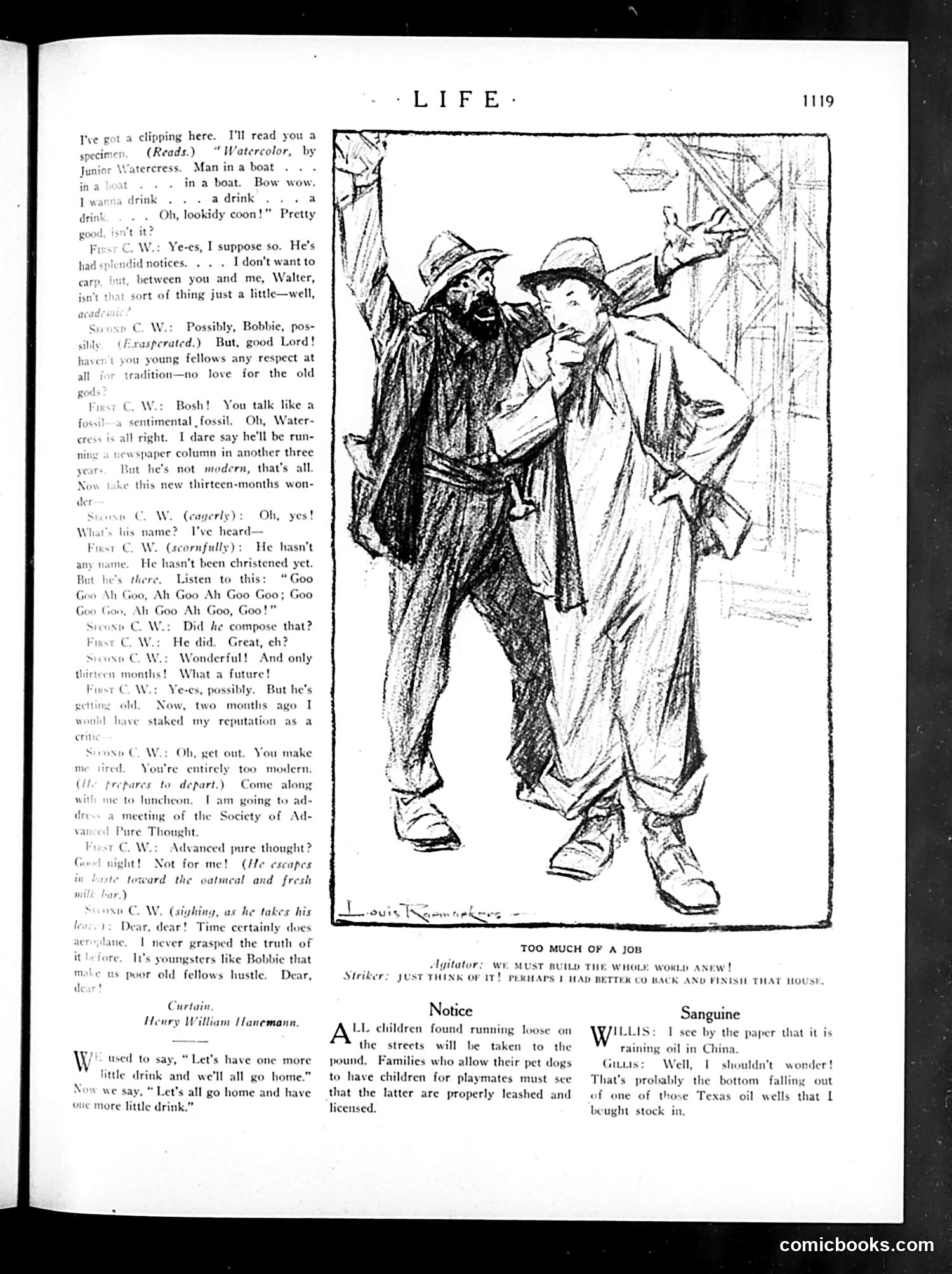
This sketch depicts two working-class men—a "Striker" and an "Agitator"—discussing labor conditions. The Striker complains about his job being overwhelming, while the Agitator responds with revolutionary rhetoric about "building the whole world anew." The satire mocks radical labor organizers who offer grand ideological solutions to workers' immediate, practical problems. The Striker's response—"Just thinks of it! Perhaps I had better go back and finish that house"—suggests workers find such abstract revolutionary talk ridiculous when they have concrete jobs to complete. This reflects early 20th-century Life magazine's skepticism toward socialist and communist agitation among American workers, positioning such activism as disconnected from ordinary laborers' actual concerns and priorities.
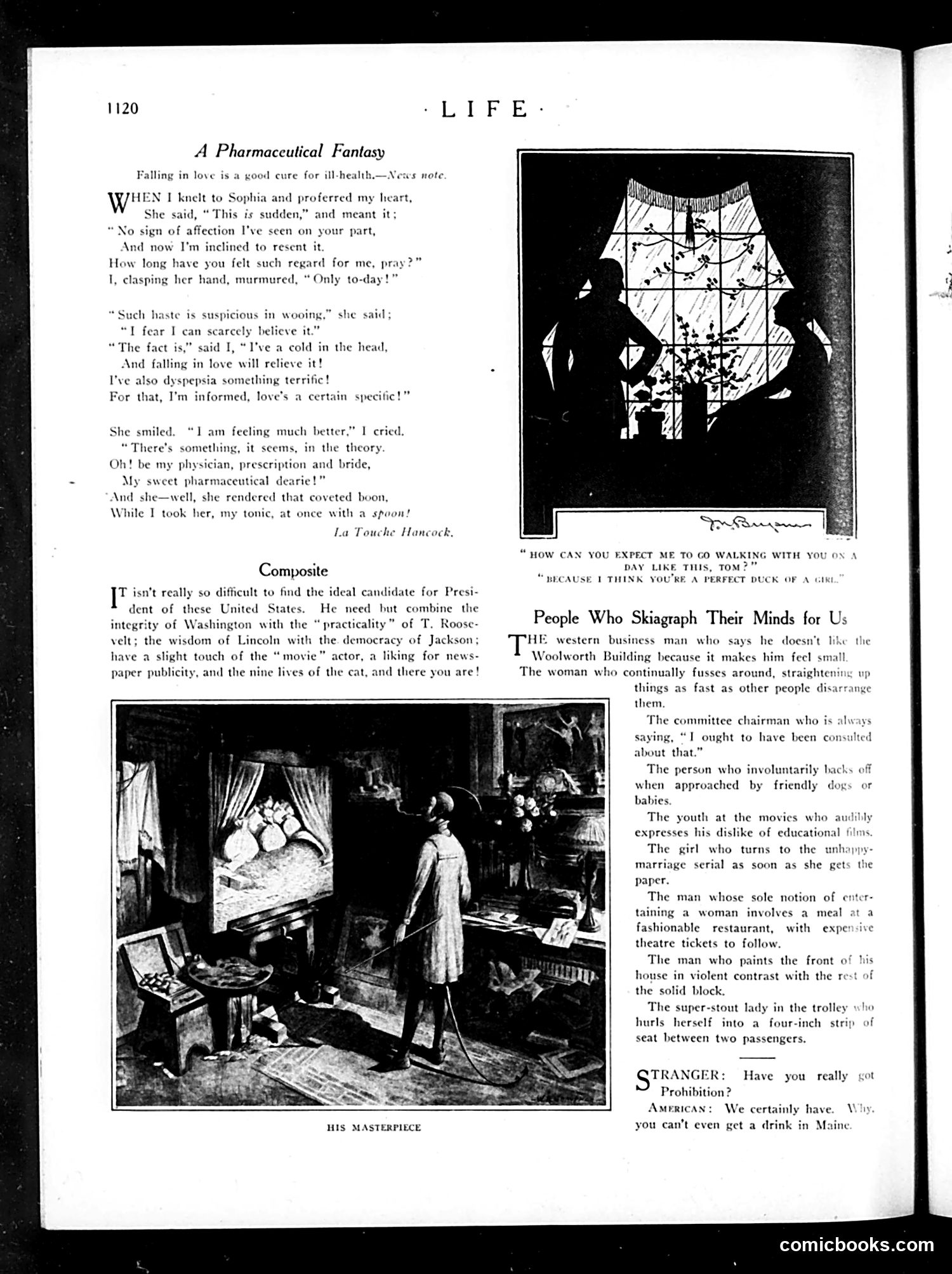
This page contains three distinct pieces of satirical content: 1. **"A Pharmaceutical Fantasy"** (top): A humorous poem about falling in love as a medical cure, where the speaker claims love relieves his cold and dyspepsia. The joke satirizes pseudoscientific medical claims common to the era. 2. **"His Masterpiece"** (large illustration): Shows a painter viewing his bedroom interior. The satire appears to mock overly artistic domestic decoration—suggesting pretentious aesthetics prioritized over practical comfort. 3. **"People Who Skiagraph Their Minds for Us"** (right column): Lists types of annoying people—the overly-consulted committee chair, the woman who fusses constantly, the movie youth who rejects educational films, etc. This is social satire mocking self-important or bothersome personality types in early 20th-century American society. The Prohibition-era dialogue at bottom makes light of alcohol restrictions.
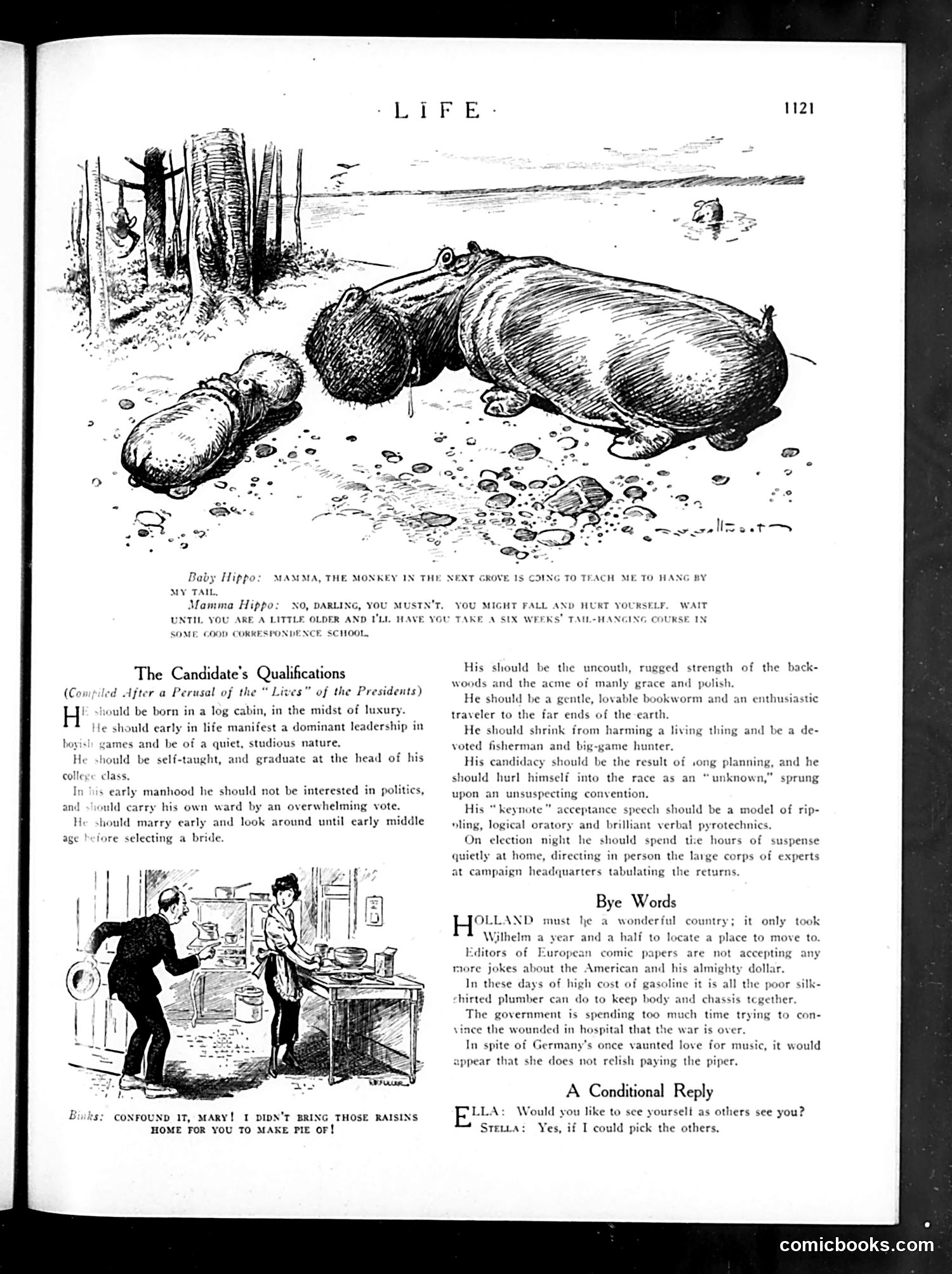
**Top Cartoon (Hippos):** A humorous dialogue between a mother and baby hippopotamus about learning to hang by the tail. This appears to be a gentle animal humor piece rather than political satire—likely just an amusing observation about hippo parenting. **"The Candidate's Qualifications":** A satirical checklist of absurd requirements for a U.S. presidential candidate, mocking the contradictions politicians must embody: born wealthy yet humble, a leadership figure who avoids politics, early marriage to an "unknown" wife, and a campaign centered on polished rhetoric rather than substance. The piece critiques the unrealistic standards and performative nature demanded of candidates. **Bottom Cartoon (Kitchen scene):** A domestic humor piece showing someone defending bringing raisins home, likely a lighthearted domestic disagreement unrelated to politics.
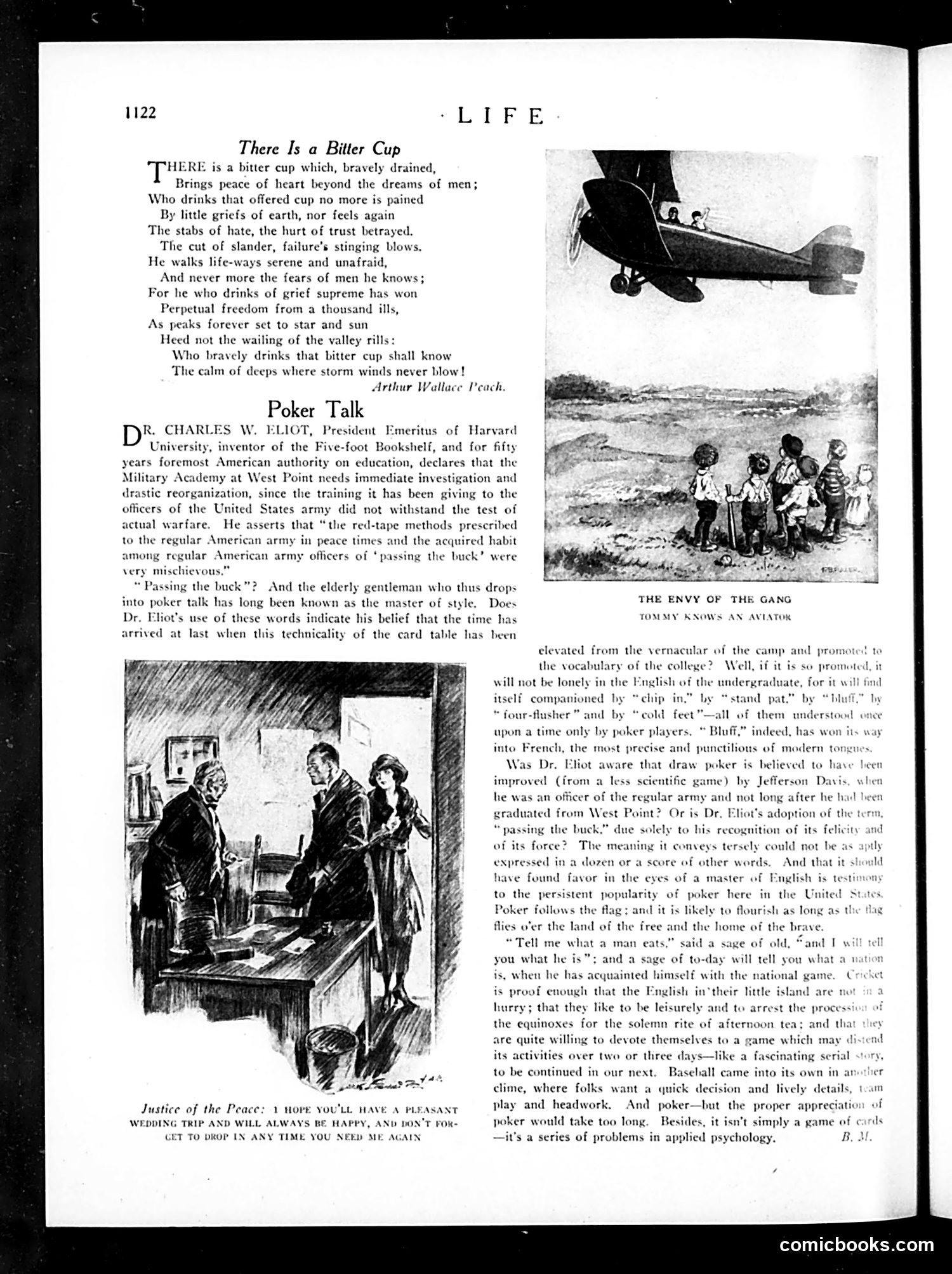
This page combines poetry and commentary on poker culture. "There Is a Bitter Cup" is a poem by Arthur Wallace Peach about spiritual resilience through hardship. The main article, "Poker Talk," discusses Dr. Charles W. Eliot (President Emeritus of Harvard) and his views on poker as a legitimate activity. The piece debates whether poker represents improved strategy or merely reflects American character. The left cartoon depicts what appears to be a justice of the peace performing a wedding ceremony, with the caption suggesting the official reassures the couple about marital happiness and availability for future needs—likely satirizing the transient nature of marriages or cynical views on matrimony. The top photograph shows an aviator with spectators, captioned "The Envy of the Gang."
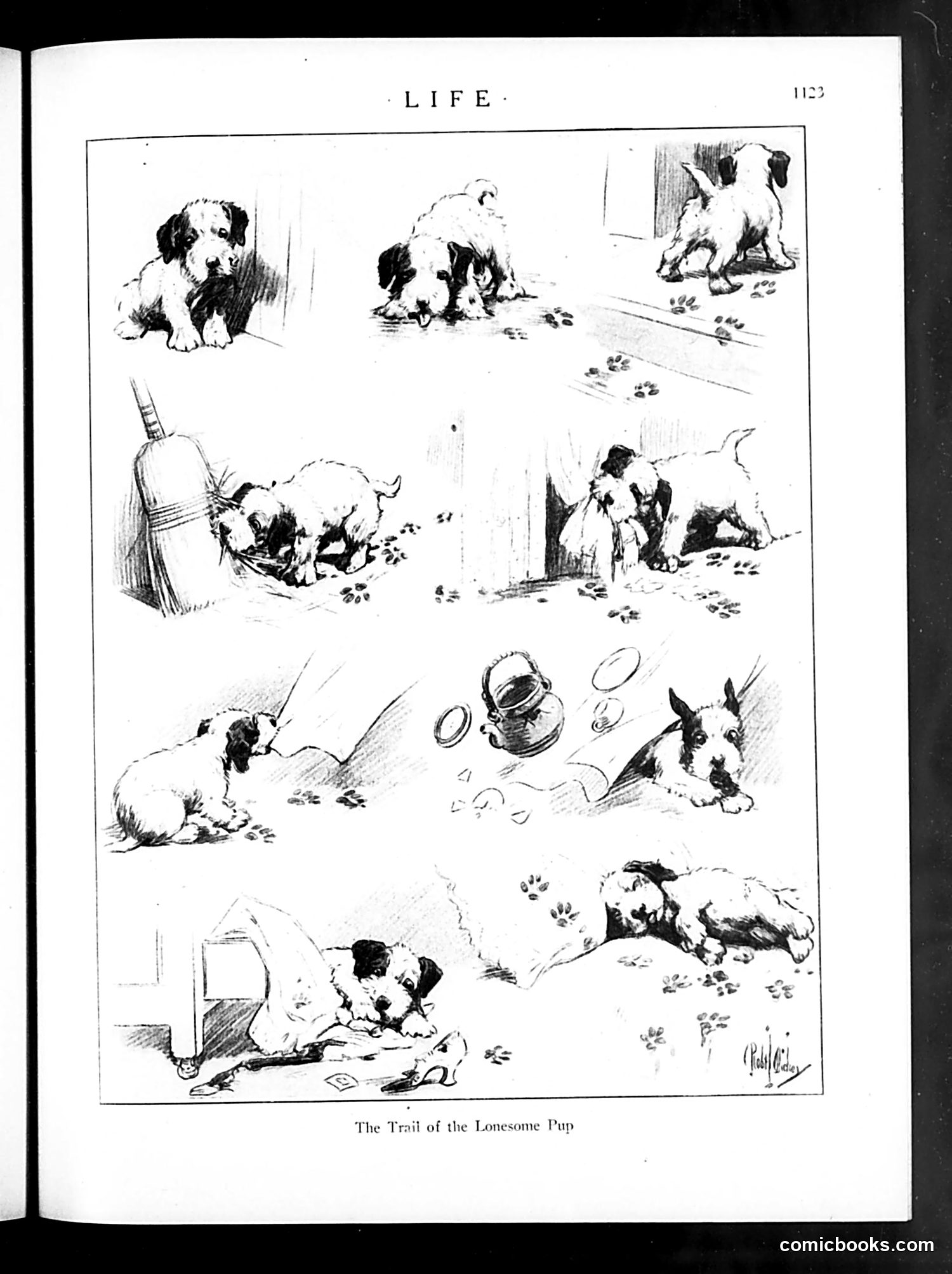
This illustrated feature depicts a small dog (appears to be a terrier or mixed breed) in various situations leaving paw prints. The sequential sketches show the dog: - Standing alone - Sniffing/investigating the ground - Following a trail - Encountering household objects (a bucket, scattered items) - Sleeping or resting in different locations The title "The Trail of the Lonesome Pup" suggests a narrative about a solitary, wandering dog tracking something or exploring its environment. This appears to be a sentimental, observational humor piece rather than political satire—typical of *Life* magazine's lighter content chronicling the everyday adventures and misadventures of animals. The detailed pen-and-ink style captures the dog's personality and natural behaviors.
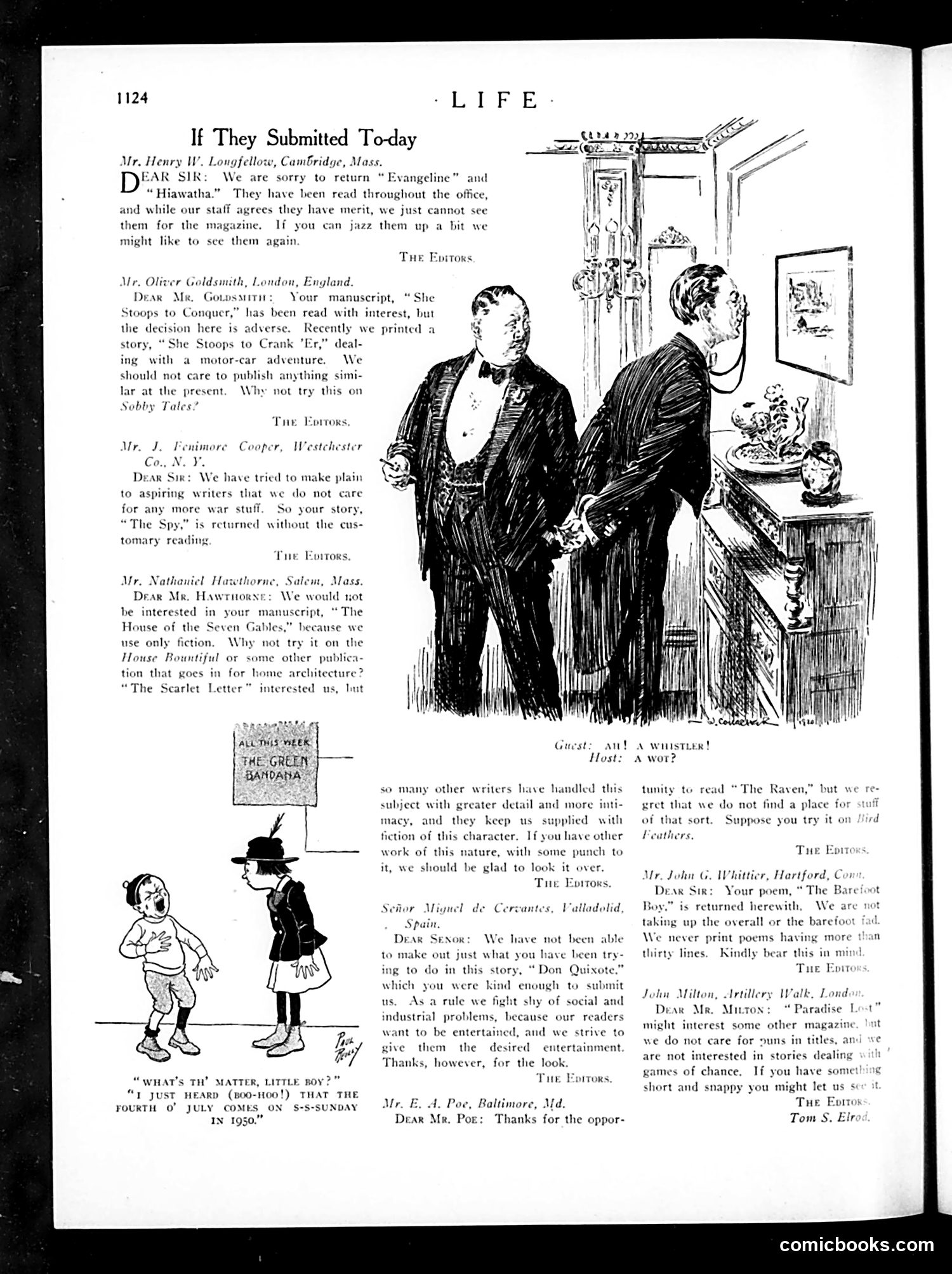
This page comprises **reader letters to the editors**, not political cartoons. The main illustration shows two well-dressed men in formal attire conversing in an elegant interior, with one asking "Guest, ah! A whistler!" and the other responding "Host: A woe?"—a visual pun on the homophone between "whistler" and the host's dismissive reaction. Below is a separate cartoon depicting a child asking an adult about July Fourth celebrations in 1956, with the adult's response apparently referencing Independence Day coming on a Sunday. The page reflects typical early-1950s Life magazine content: reader feedback about recent fiction submissions and editorial decisions regarding what stories to publish. No specific political figures or major historical events are referenced here.
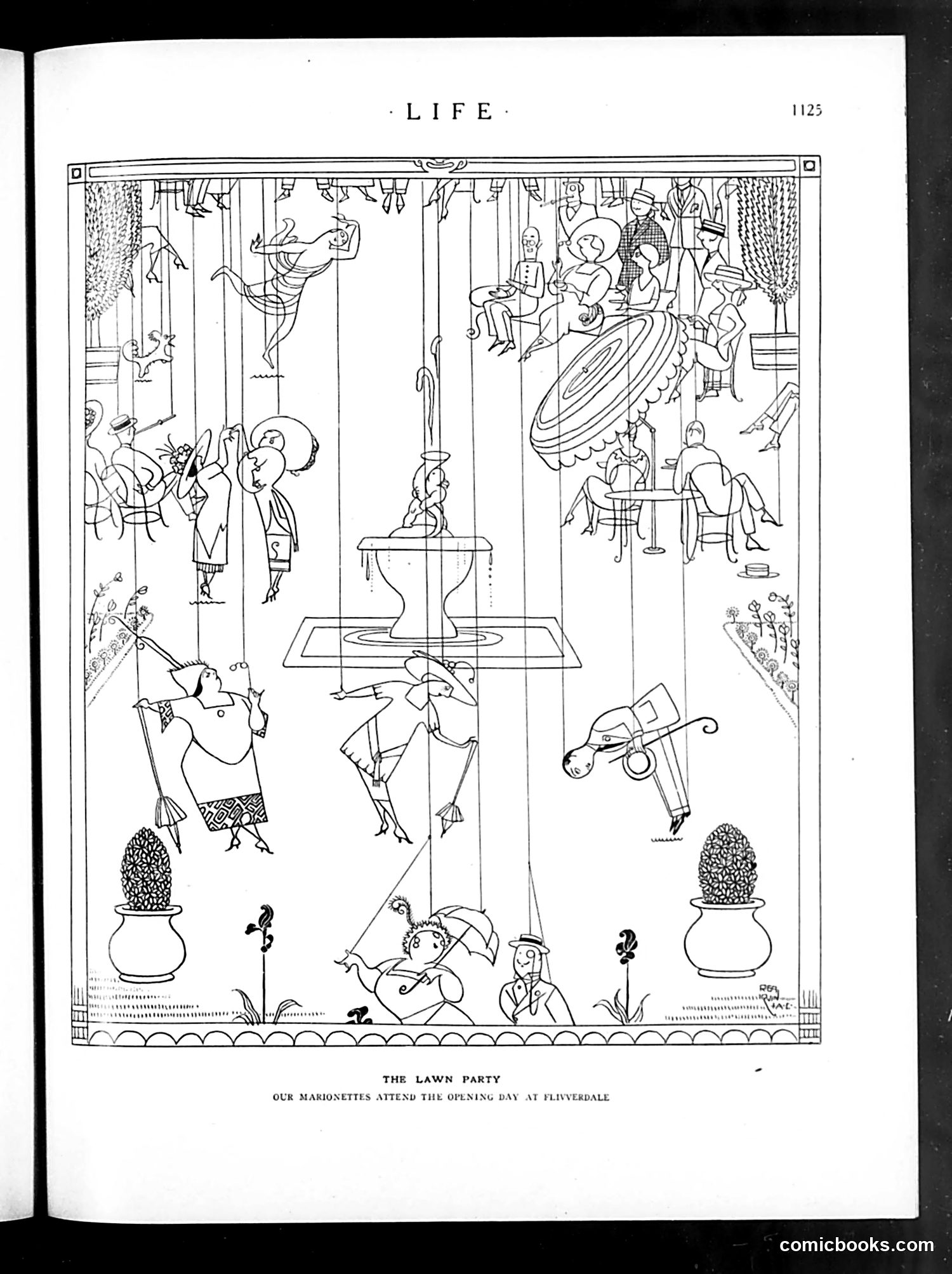
This Life magazine cartoon depicts "Our Marionettes Attend the Opening Day at Flyverdale"—a satirical commentary on early aviation spectacles, likely from the 1920s-1930s when air shows were novelty entertainment events. The image shows marionette-style figures suspended on strings attending an elaborate lawn party centered around aviation. The absurdist humor lies in portraying the attendees as puppet-like, controlled beings rather than autonomous people—suggesting they're mindlessly following fashionable trends at these air-show social gatherings. The surreal composition, with flying figures, suspended parasols, and mechanical-looking guests, mocks both the artificial pretension of high-society lawn parties and the popular mania surrounding early aviation spectacles. The "marionette" metaphor implies these socialites lack genuine agency or critical thinking, merely puppets of fashion and novelty.
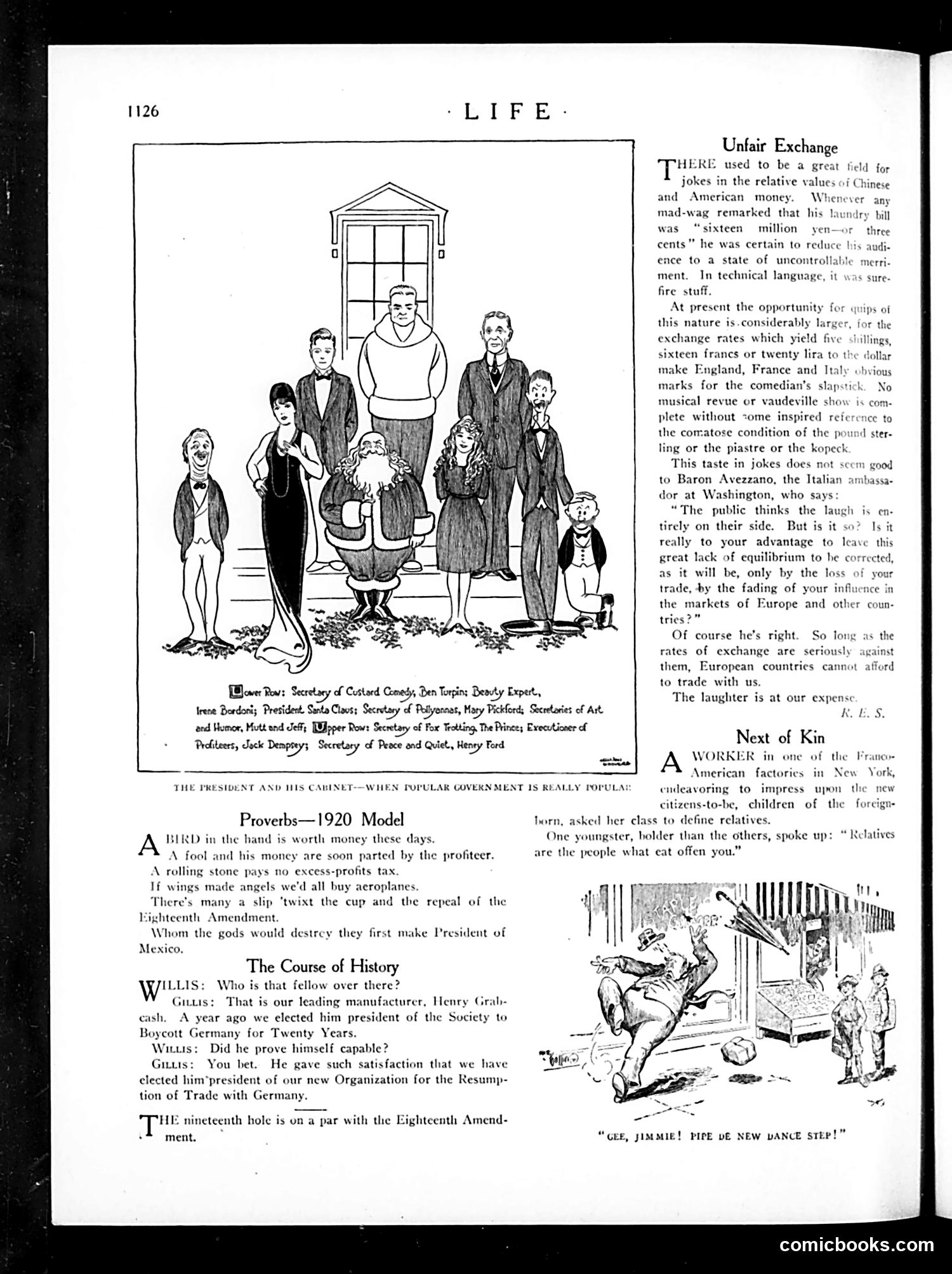
## "The President and His Cabinet" This cartoon mocks "popular government" by depicting the cabinet as a circus of vaudeville performers and celebrities (identifiable names reference silent-film stars like Mary Pickford and Santa Claus), suggesting the Harding administration treated governance as entertainment rather than serious policy. ## "Unfair Exchange" This satirizes American economic smugness post-WWI. European currencies have collapsed relative to the dollar, creating cheap exchange rates that should concern Americans—not amuse them. Baron Avezzano (Italian ambassador) warns that laughing at foreign poverty is foolish; weakened European economies can't buy American goods, ultimately harming U.S. trade and influence. The joke is on America's expense. ## "The Course of History" This ridicules hypocrisy: a manufacturer elected president of a "Boycott Germany for Twenty Years" society performs so well that they immediately elect him president of an organization resuming trade with Germany—exposing that boycotts are abandoned for profit.
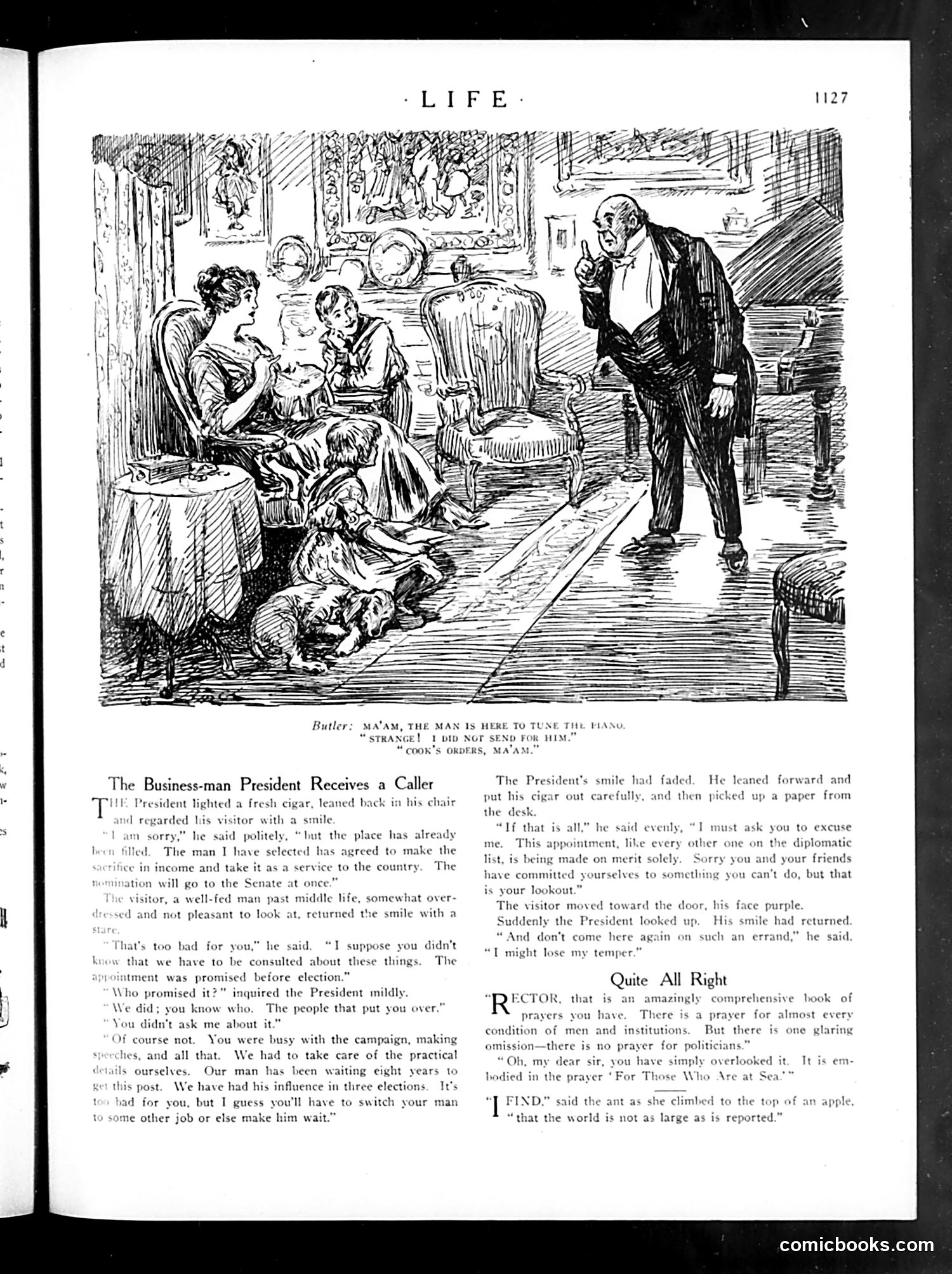
This satirical piece depicts a clash between a "Business-man President" and a political operative demanding a government appointment as payment for campaign support. The visitor, described as "well-fed" and unpleasant, represents the corrupt patronage system where political machines expected quid pro quo appointments in exchange for electoral backing. The president refuses, asserting appointments are made "on merit solely" rather than political obligation. When the operative protests that "the people that put you over" demand the position, the president ejects him, threatening to "lose my temper." The satire targets **machine politics and the spoils system**—the widespread practice of rewarding political allies with government jobs. The cartoon endorses the reformist position that merit, not political debt, should determine appointments. This reflects Progressive Era critiques (likely early 1900s) of entrenched party corruption, presenting the president as an anti-corruption hero refusing backroom deals. The secondary jokes about prayer and ants appear to be filler content typical of Life magazine's format.
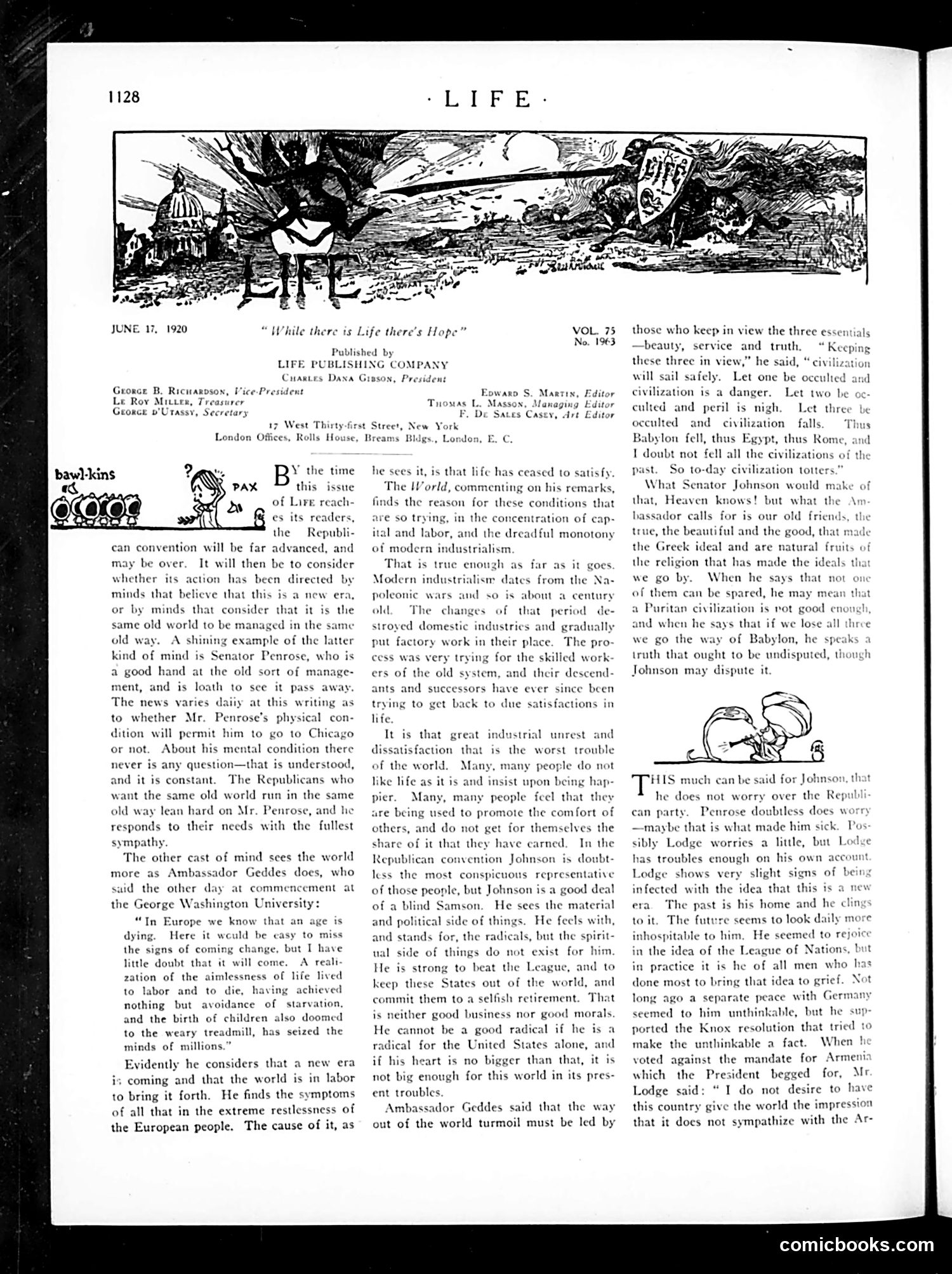
This editorial page discusses the 1920 Republican National Convention, contrasting two philosophical approaches represented by Senator Boies Penrose (an "old guard" conservative seeking continuity) and Ambassador Geddes (representing progressive change). The central debate concerns modern industrialism's effects: factory systems destroyed traditional crafts, leaving workers dissatisfied and fueling labor unrest across Europe. The editorial criticizes those (like convention delegate Johnson, apparently a "blind Samson") who see only material/political dimensions of radicalism without spiritual commitment to genuine reform. Ambassador Geddes's George Washington University speech warned that European civilization faces collapse due to workers' loss of life satisfaction—seeing only "aimless" labor and survival. The editorial frames this as symptomatic of necessary global transformation, implicitly arguing the Republican Party must acknowledge this reality rather than retreat into nationalist isolationism. The cartoon's allegorical figures (partially visible) likely satirize these competing worldviews during this pivotal election year.
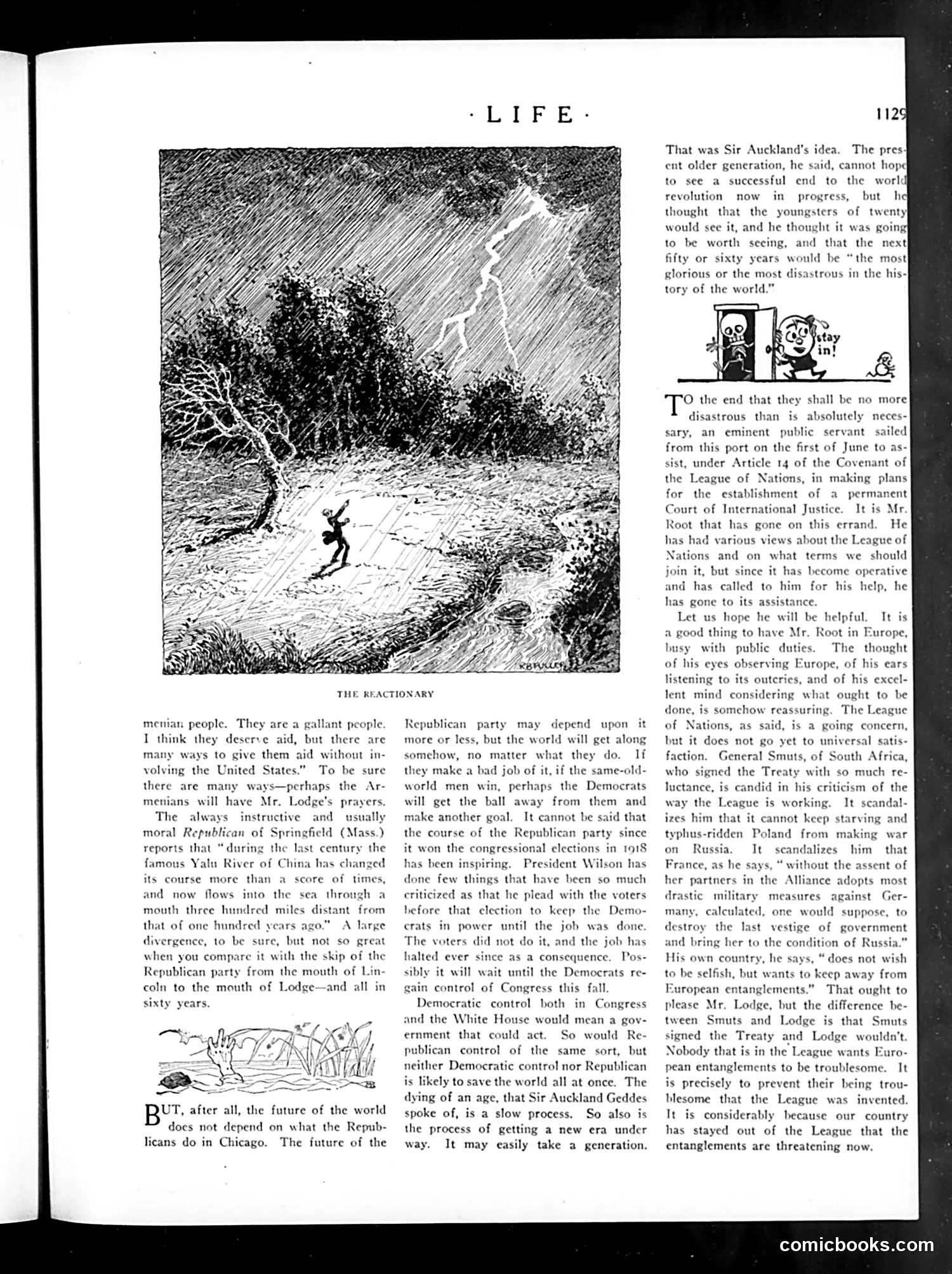
This page satirizes Republican Party inconsistency and inaction, particularly targeting Senator Henry Cabot Lodge. The main cartoon depicts a figure running downhill in a storm, illustrating the editorial's central metaphor: the Republican Party's political "course" has shifted as dramatically as China's Yalu River changed direction—"from the mouth of Lincoln to the mouth of Lodge—and all in sixty years." The text criticizes Republicans for blocking President Wilson's post-WWI agenda, particularly regarding the League of Nations and Armenian aid. It praises diplomat Elihu Root for assisting the League despite his earlier reservations, contrasting principled flexibility with stubborn partisan obstruction. The small cartoon vignette (skull and cheerful figure) appears to be a generic Life magazine mascot or recurring element unrelated to the main political argument. The piece argues that neither party alone can solve world problems; effective governance requires coherent action—something the divided Republican Party fails to provide.
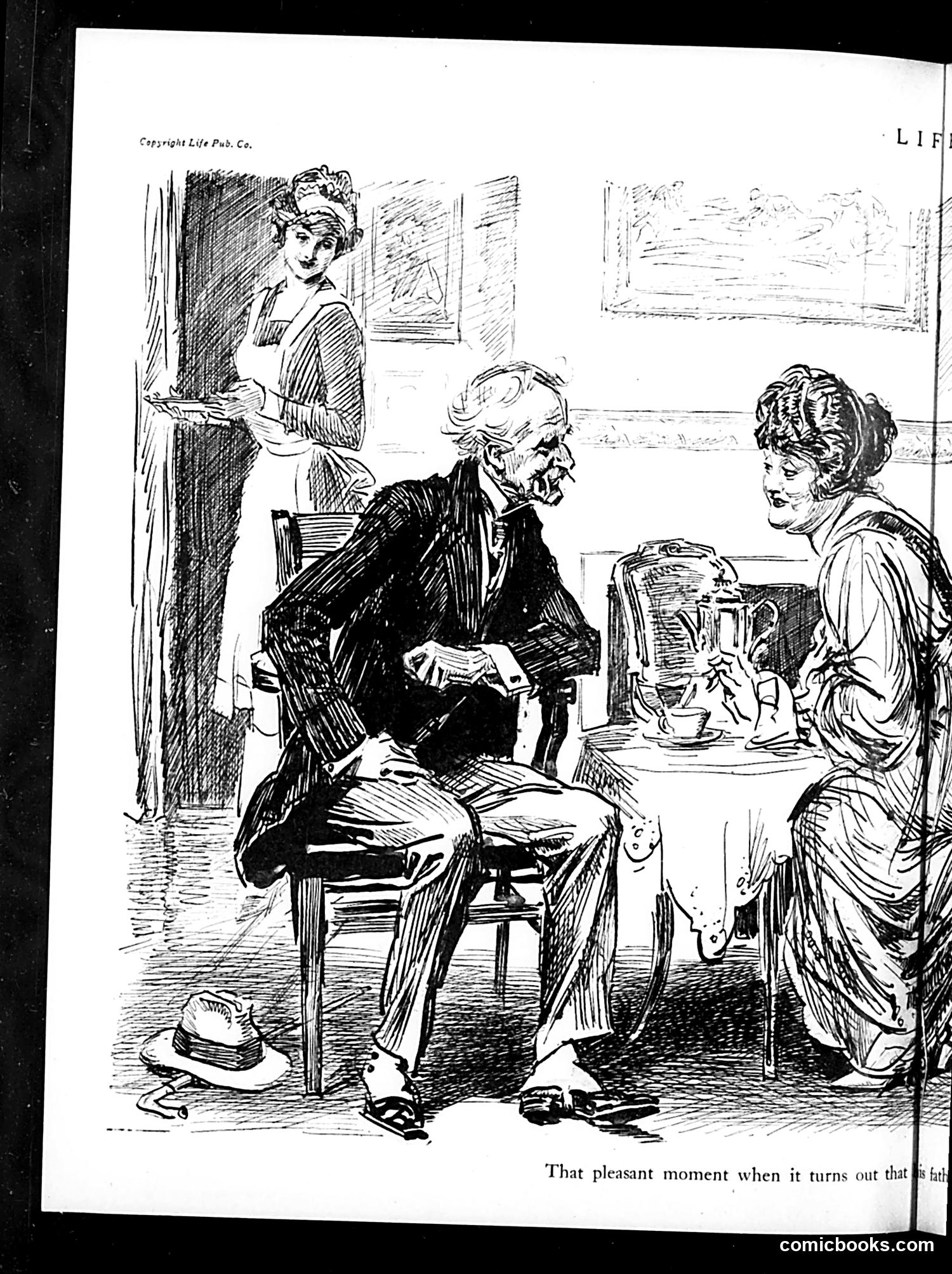
This is a satirical illustration from *Life* magazine depicting a domestic scene. An elderly gentleman sits in a chair holding what appears to be money or documents, while a woman serves tea nearby. A maid stands in the background. The caption reads: "That pleasant moment when it turns out that is fair..." The joke appears to be about marital or domestic financial arrangements—likely satirizing situations where a husband discovers his wife's spending is justified or reasonable ("fair"), or perhaps commenting on inheritance or property settlements. The cartoon mocks the conventional domestic dynamics of the era, where financial matters between spouses were often sources of tension. The composition and the characters' expressions suggest relief or pleasant surprise at an unexpected financial outcome, though the incomplete caption obscures the full satirical point.
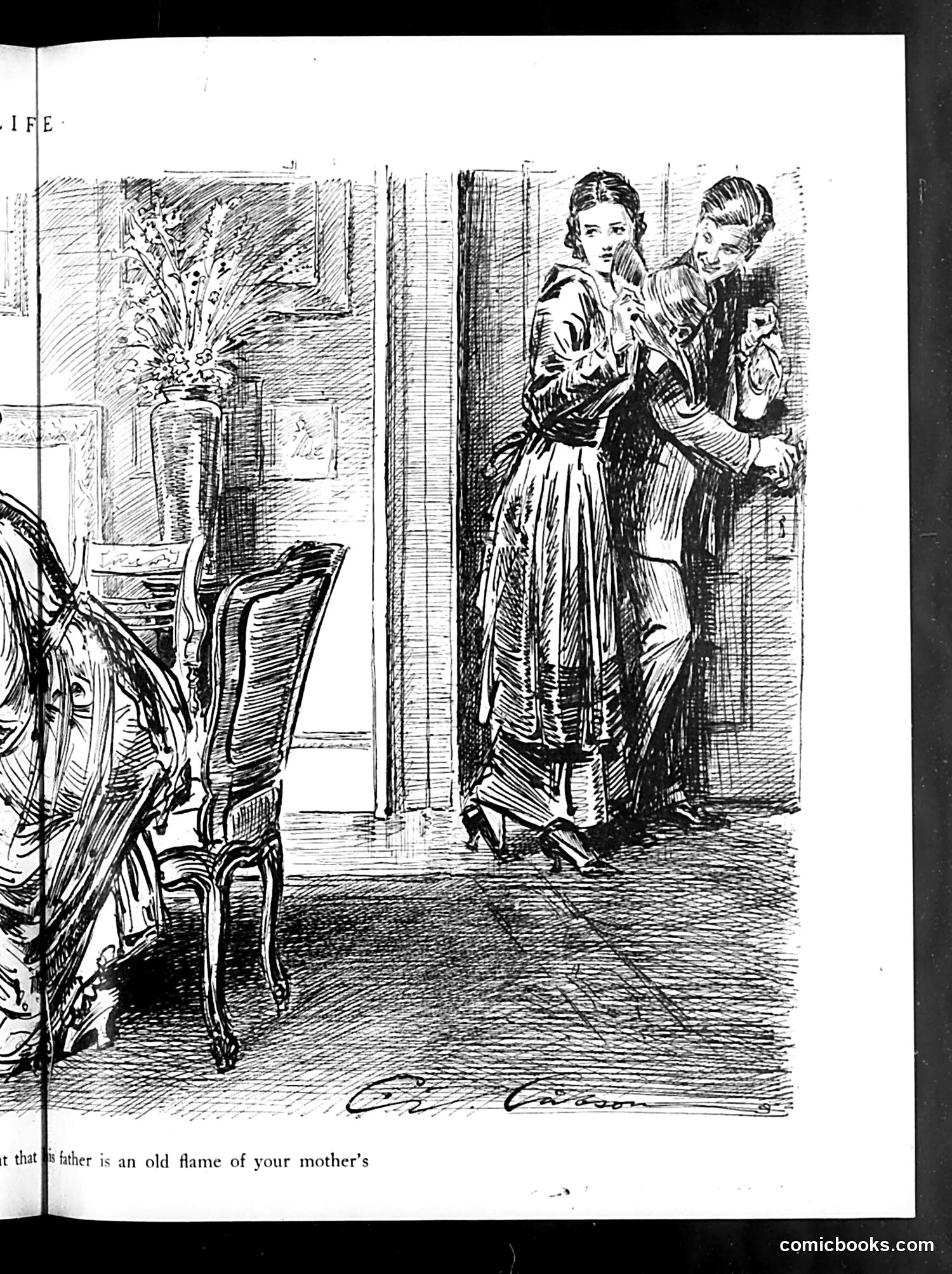
This sketch depicts a domestic social scene from an earlier era. Two women stand together in what appears to be a parlor or drawing room, while a man sits in a chair on the left. The caption reads: "that father is an old flame of your mother's." The humor is a mild domestic joke playing on romantic history—the idea that one's father was literally a past romantic interest of one's mother before they married. This would have been considered mildly risqué or amusing commentary on premarital romance for the era in which *Life* magazine published satirical social observations about courtship, marriage, and family relations. The sketch's style and setting suggest late 19th or early 20th-century American society, where such references to parents' romantic pasts were treated as humorous rather than scandalous.
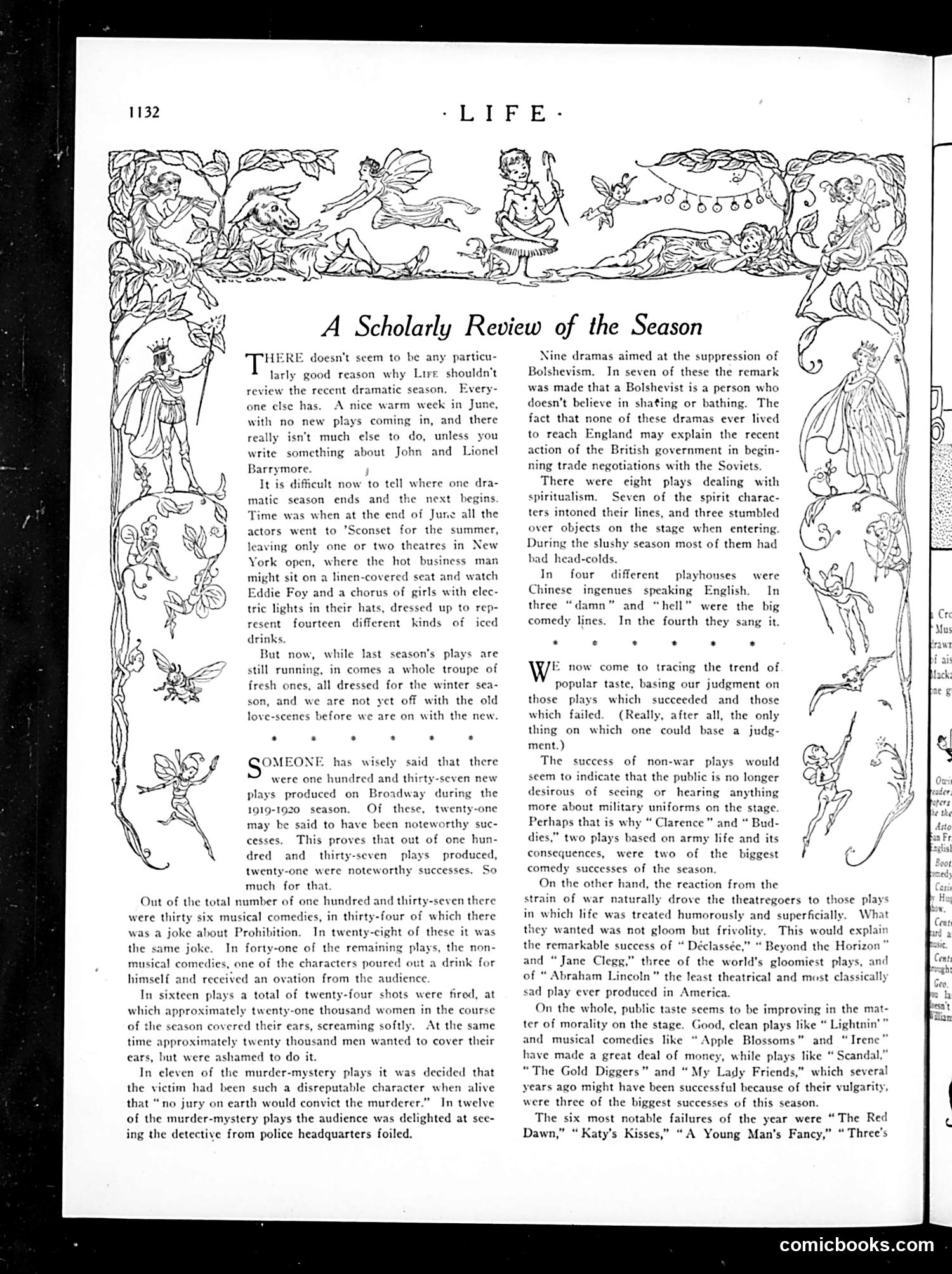
This is a humorous critical essay reviewing Broadway's 1919-1920 dramatic season. The decorative border features cherubs and theatrical figures typical of Life's ornamental style. The author satirizes theatrical trends by presenting absurd statistics: of 137 new plays produced, only 21 were noteworthy successes. Life mocks recurring jokes—36 musical comedies featured Prohibition humor, often the identical gag repeated. The piece ridicules anti-Bolshevik propaganda plays (portraying communists as people "who doesn't believe in shating or bathing"), spiritualist dramas with bumbling ghosts, and Chinese actresses speaking English delivering only "damn" and "hell" as comedy. The satire's core: despite audiences supposedly tiring of military themes after WWI, plays about army life like "Clarence" and "Buddies" were major successes—an obvious contradiction the author highlights to mock both predictable public taste and theatrical producers' inability to read audiences.
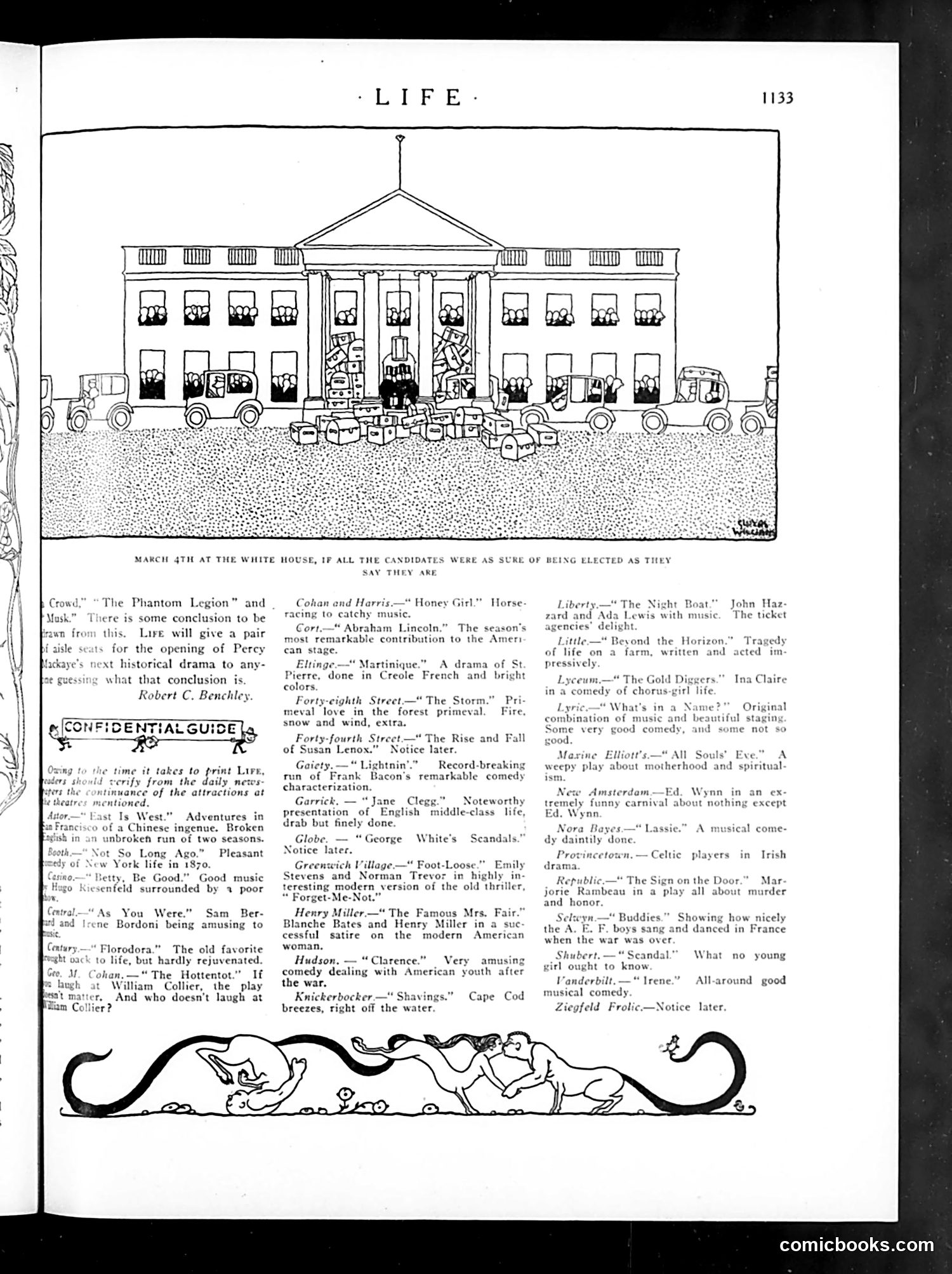
This is a theatrical review page from *Life* magazine dated March 4th (year unclear from image). The large cartoon at the top depicts the White House surrounded by automobiles and crowds of people looking out windows—a satirical commentary on presidential election season. The caption explains the joke: "March 4th at the White House, if all the candidates were as sure of being elected as they say they are." The satire mocks political candidates' overconfidence—if every candidate truly believed they'd win (as their public statements suggested), the White House would be impossibly overcrowded on Inauguration Day. It's a jab at candidates' inflated rhetoric and unrealistic self-assurance during campaign season. The rest of the page lists Broadway theater reviews, discussing various productions and their merits or flaws. This was typical *Life* content: mixing political satire with entertainment coverage.
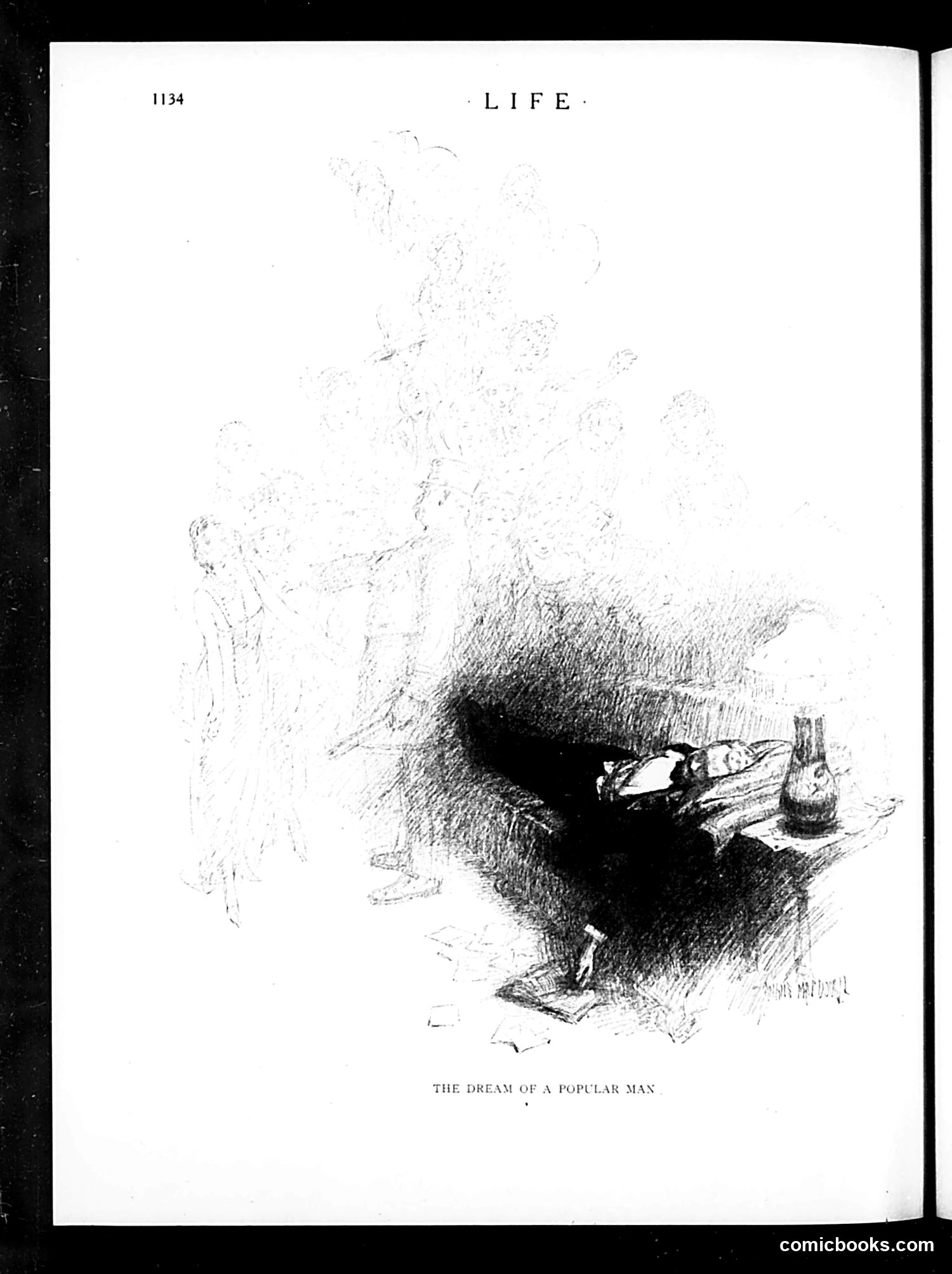
This satirical sketch depicts a man asleep at a desk, dreaming of luxurious abundance. The dream imagery shows bottles (likely wine or spirits), food, and lavish items floating above him in an ethereal cloud. The contrast between his ordinary reality—hunched at a simple desk or table—and his fantastical reverie suggests commentary on working-class aspiration or yearning. The "popular man" likely refers to someone of modest means daydreaming of wealth and indulgence he cannot afford. The sketch mocks either the gap between common people's desires and their actual circumstances, or perhaps satirizes what "popularity" or social success means in materialistic terms. The detailed crosshatching emphasizes the shadowy, ephemeral nature of such dreams versus concrete reality.
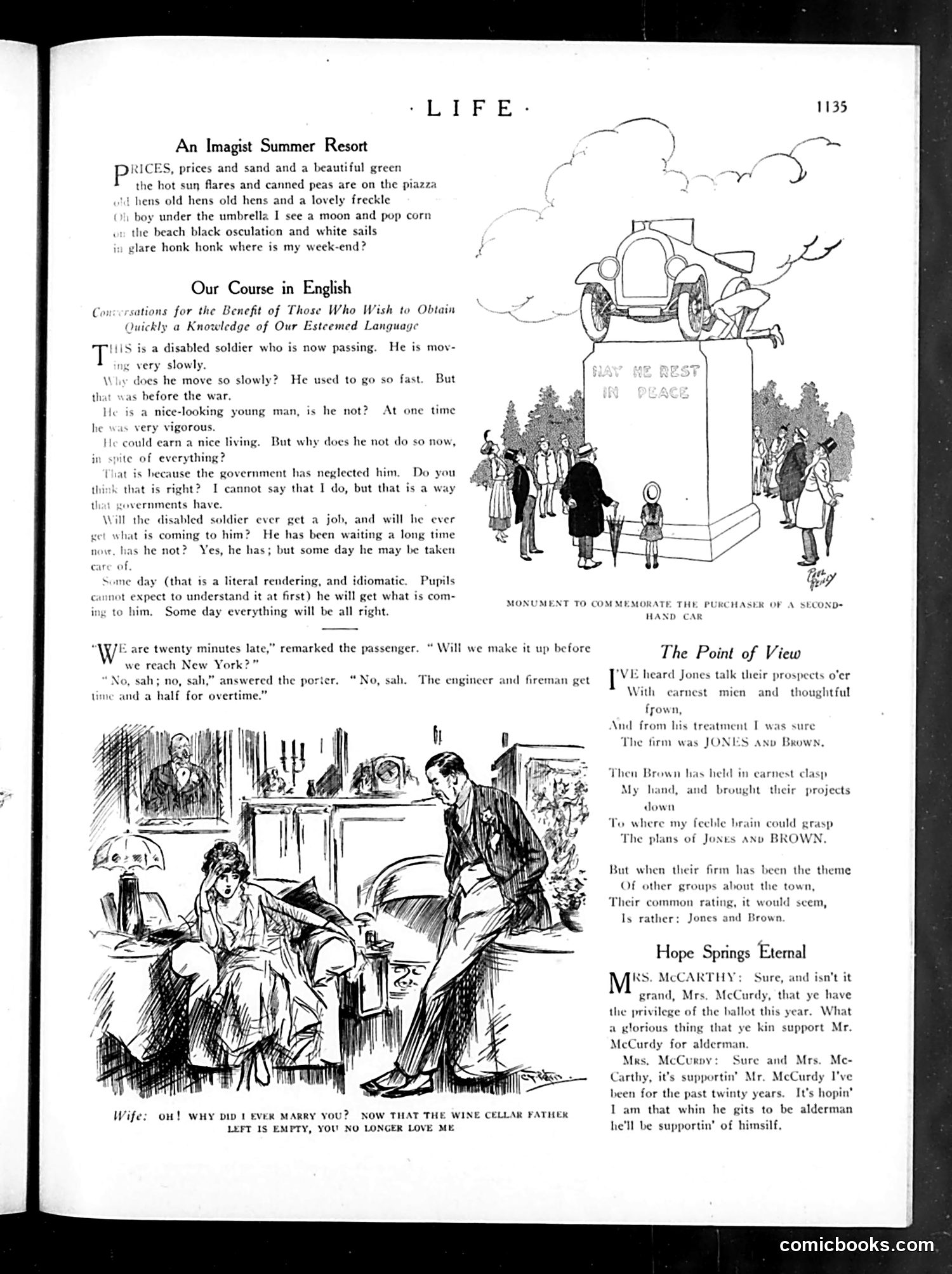
This page contains three satirical pieces typical of Life's early 20th-century social commentary: **"An Imagist Summer Resort"** parodies modernist poetry's fragmented style, mocking the pretentious aestheticism of wealthy vacationers through lists of disconnected images (prices, hens, pop corn, sailboats). **"Our Course in English"** uses a disabled WWI veteran as a teaching example, critiquing government neglect of soldiers. The lesson's awkward grammar mirrors the soldier's stalled life—he waits indefinitely for promised government support that never materializes, satirizing bureaucratic indifference to veterans' welfare. **The cartoon** depicts a husband and wife arguing about an empty wine cellar, suggesting the wife married for wealth/comfort. This reflects post-Prohibition anxieties about changing marriage dynamics and economic hardship. **"The Point of View"** and **"Hope Springs Eternal"** are brief satirical verses about business partnership perception and voting rights—the latter suggesting Irish-American women's new ballot access (likely 1920s). Together, the page critiques privilege, government failure toward veterans, changing social values, and gender politics.
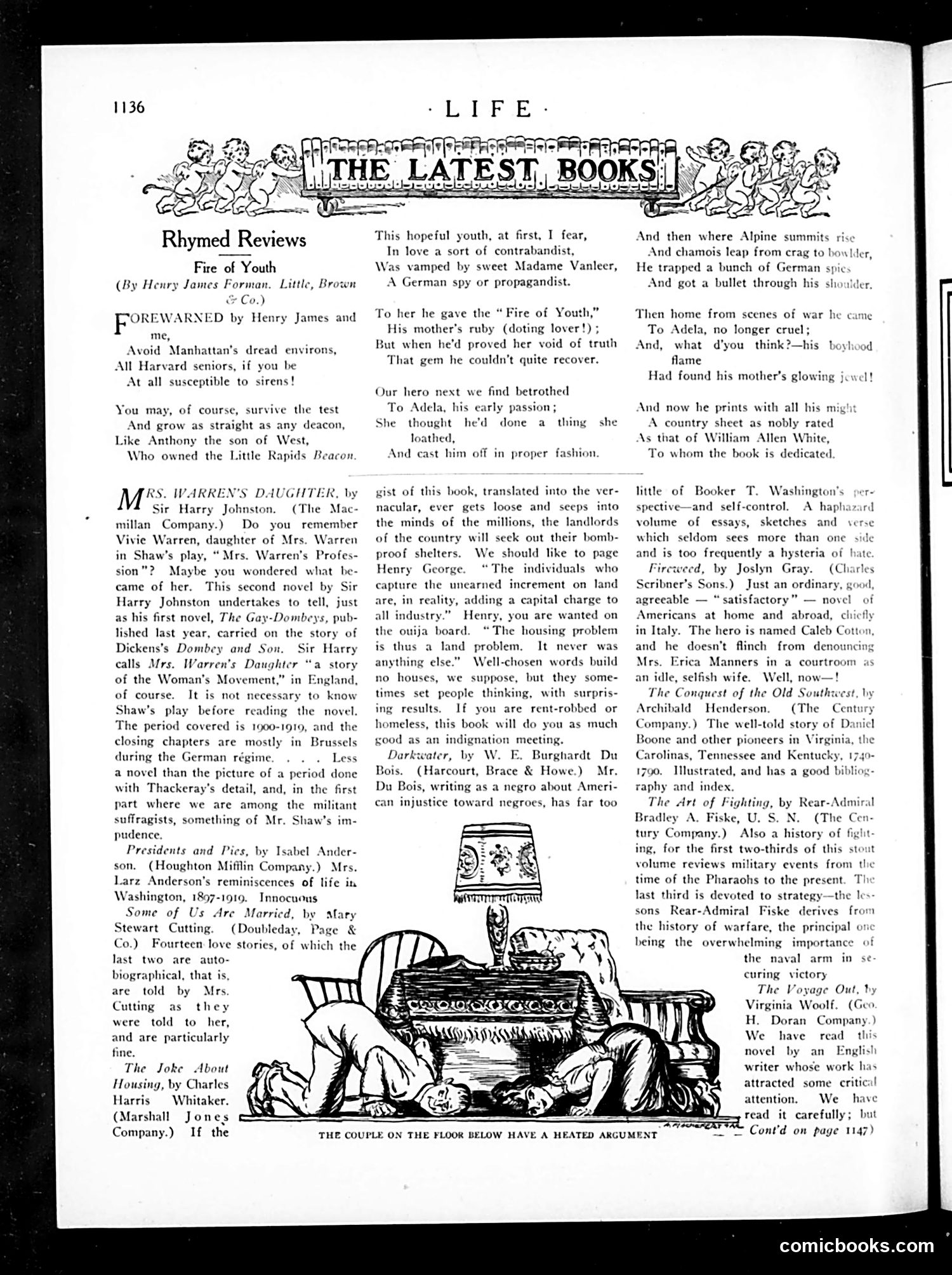
This page contains **book reviews in verse** from Life magazine's "Rhymed Reviews" section. The main cartoon shows a couple arguing on the floor below, illustrating domestic discord—a common Life magazine subject for humor. The reviews mock contemporary novels with satirical summaries: - **"Fire of Youth"**: A cautionary tale warning Harvard seniors about seduction by a German spy posing as a woman ("Madame Vanleer"), who steals a ruby. The hero recovers it after wartime adventures. - **"Mrs. Warren's Daughter"**: A sequel extending Shaw's play, covering 1900-1910 and WWI Brussels. Other reviews discuss housing reform and W.E.B. Du Bois's work on racial injustice. The satire targets both the **sentimental plotting of popular fiction** and occasionally **social issues** (housing problems, racial injustice). The tone is genteel mockery—Life's typical approach for literary criticism aimed at educated, upper-class readers.
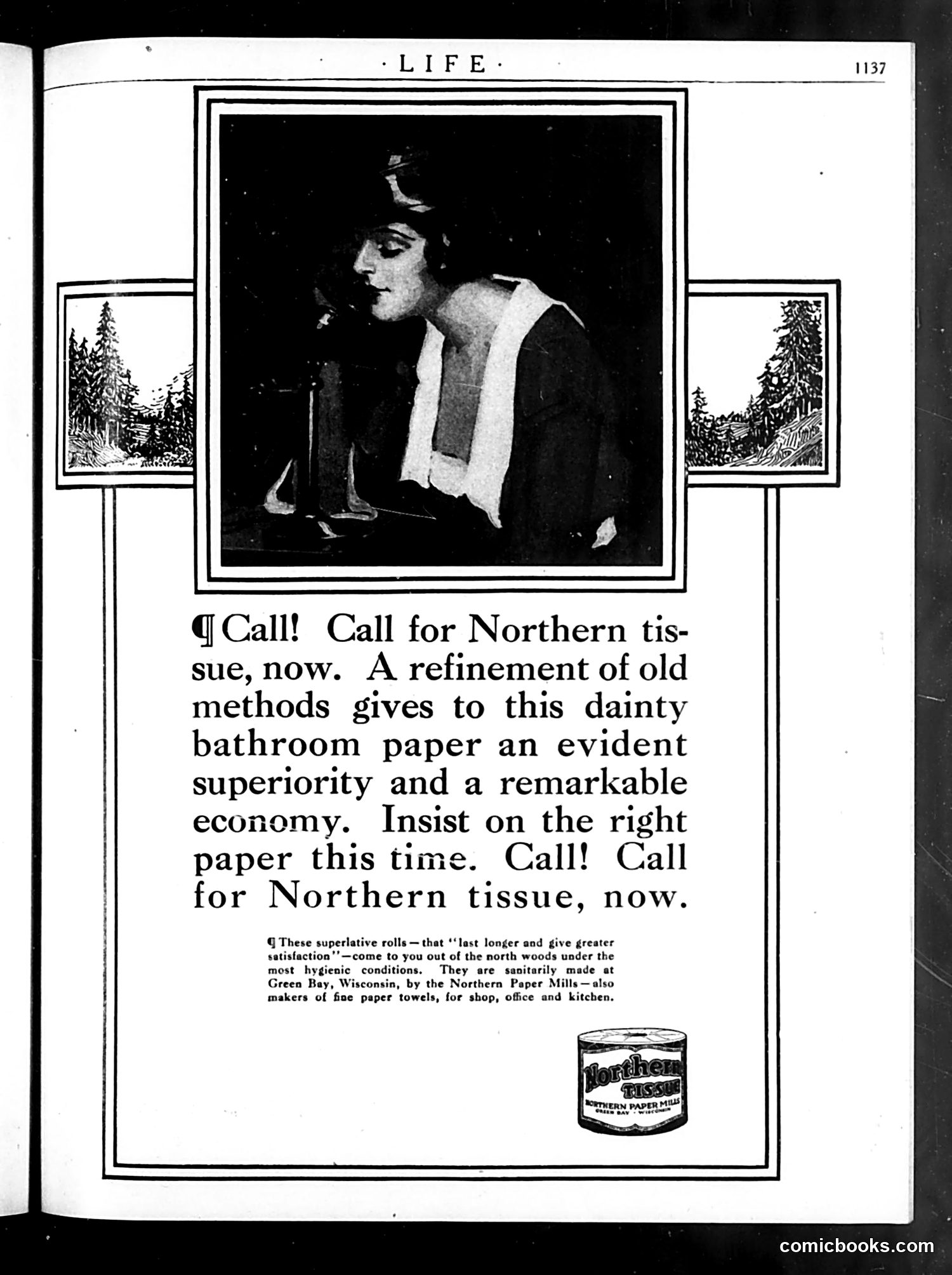
This page is **advertising, not satire or political commentary**. It's a Northern Tissue bathroom paper advertisement from Life magazine. The image shows a woman in 1920s attire (headband, styled hair, dark dress) in an urgent pose, matching the copy's repeated "Call! Call!" imperative. The advertisement emphasizes product superiority through claims of durability ("last longer"), hygiene (made "sanitarily" in Green Bay, Wisconsin), and economy. The decorative forest illustrations flanking the main image reinforce the "north woods" origin story. This reflects early 20th-century marketing strategy: establishing rural/natural manufacturing credentials to suggest purity and quality. The theatrical tone ("Call! Call!") and insistent language were typical advertising conventions of the era. No political or social satire appears present—this is straightforward commercial promotion.
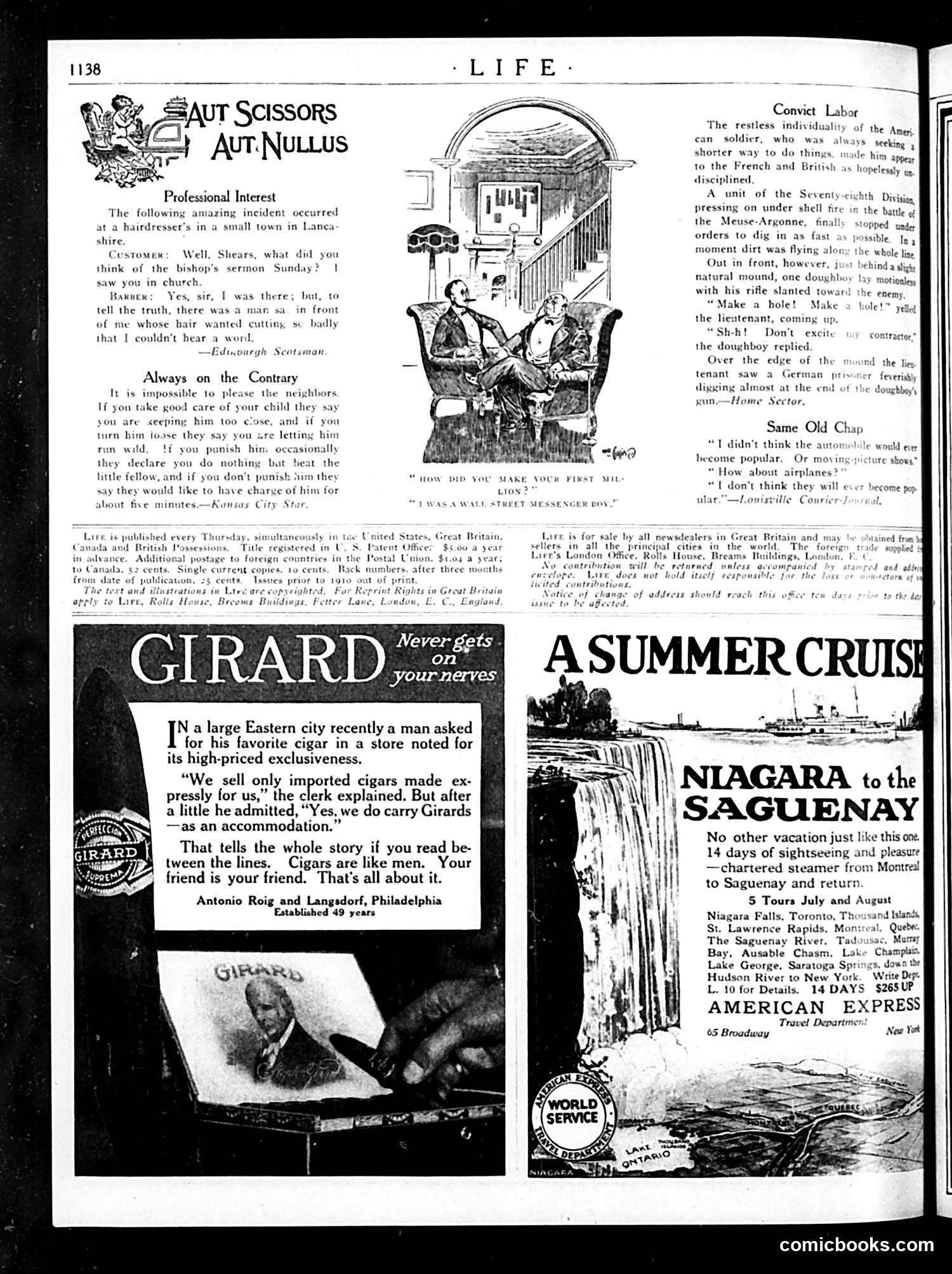
This page contains three distinct humor pieces and advertisements from an American satirical magazine: **"Professional Interest"**: A brief anecdote mocking a barber so distracted by a customer's poor haircut during a church sermon that he cannot concentrate on the bishop's message. The joke relies on occupational obsession. **"Always on the Contrary"**: Social commentary on the impossibility of pleasing neighbors—whatever parenting choice you make (strict or lenient discipline), critics judge you unfairly. **"Same Old Chap"**: A short dialogue joke about changing technologies. One character expresses skepticism that automobiles or airplanes will ever become popular, mocking those unable to recognize transformative innovations. The **Girard cigars advertisement** uses a parable about exclusivity and loyalty: a store clerk initially claims to sell only imported cigars, then admits carrying Girards "as an accommodation," illustrating that quality products don't need pretension. The page also includes war-related humor about American soldiers' pragmatism versus military discipline, and advertisements for summer travel.
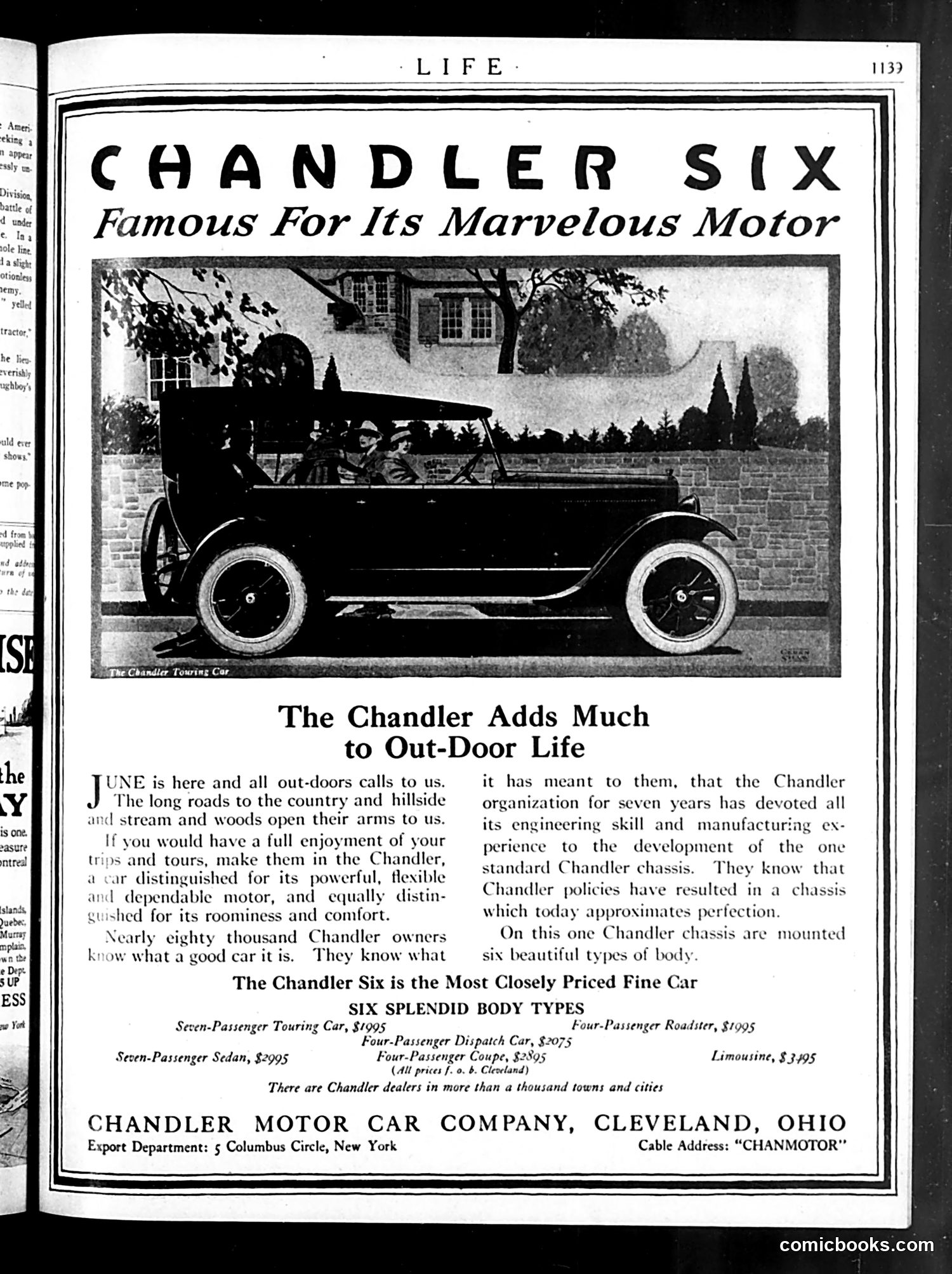
This is **not a cartoon or satire** — it's a straightforward automobile advertisement from Life magazine's advertising section. The page promotes the Chandler Six motorcar, manufactured in Cleveland, Ohio. The ad targets affluent leisure travelers, emphasizing the car's "powerful, flexible and dependable motor" and appeal for summer outings ("June is here and all out-doors calls to us"). It highlights that nearly 80,000 owners trust the brand and notes the company has devoted seven years to perfecting a single chassis, offering six body styles at varying prices ($1,995–$3,995). The image shows the Chandler touring car in profile against a brick building and landscaped grounds, presenting it as a vehicle for comfortable, leisurely travel. This represents typical early-20th-century luxury car marketing targeting the wealthy.
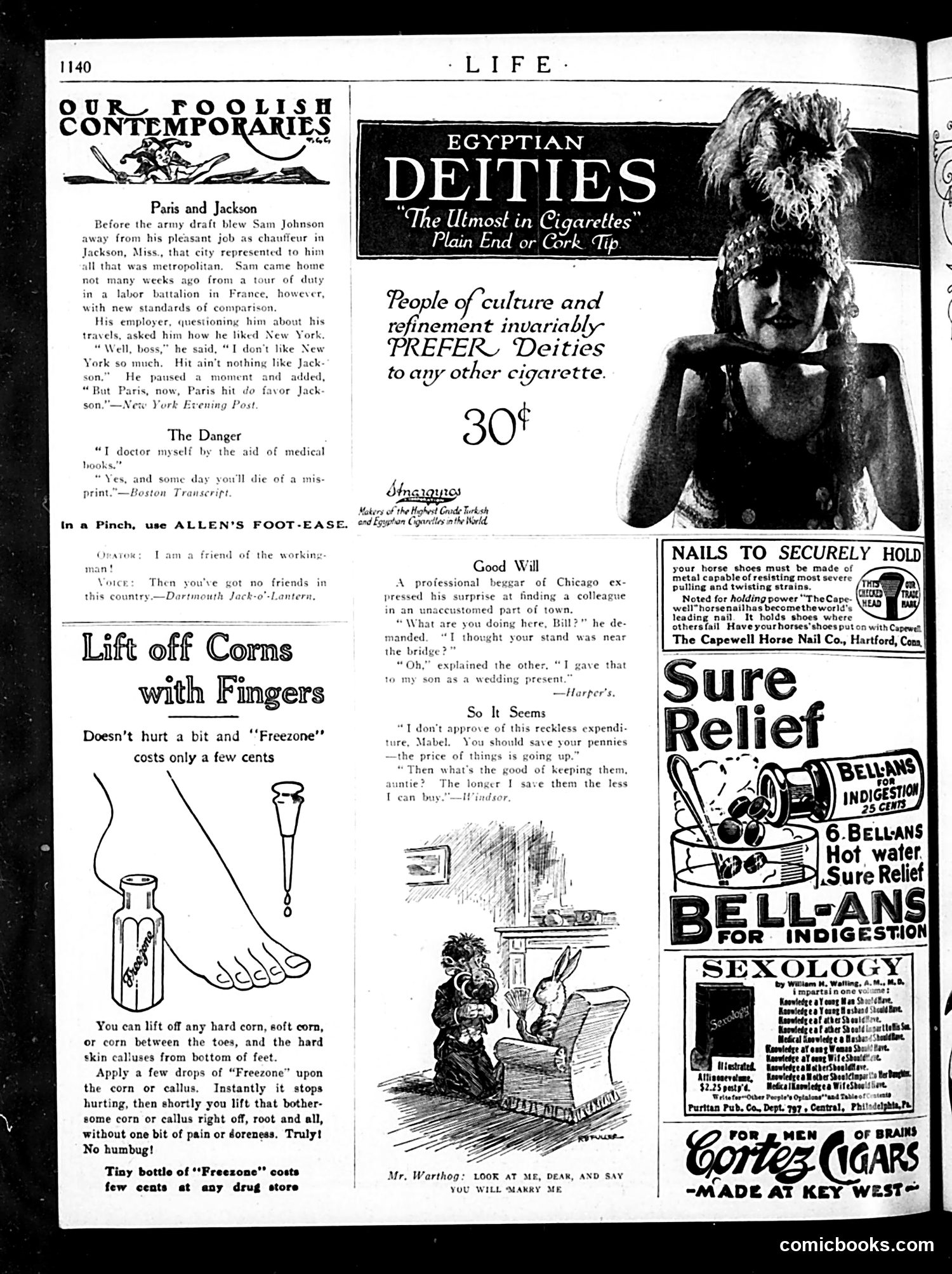
This page contains primarily **advertisements and humor columns** rather than political satire requiring historical context. The main cartoon titled "Egyptian Deities" is a **cigarette ad** featuring an Egyptian mummy figure. The joke plays on the phrase "people of culture and refinement prefer Deities"—positioning the product as sophisticated. The mummy visual is merely decorative/attention-grabbing, not satirical commentary. The "Our Foolish Contemporaries" section contains brief anecdotes mocking everyday people: - A Black chauffeur named Sam Johnson who prefers Paris to New York (likely playing on post-WWI attitudes) - A doctor self-treating via books - A beggar giving his "stand" to his son as a wedding gift The cartoons are **gentle social humor** about human foibles—self-deception, materialism, pretension—not directed at specific political figures or events. The page is dominated by **product advertisements** (corns remedy, horseshoe nails, digestive aids, cigars), typical of Life magazine's revenue model. No specific political references or identifiable caricatures appear.
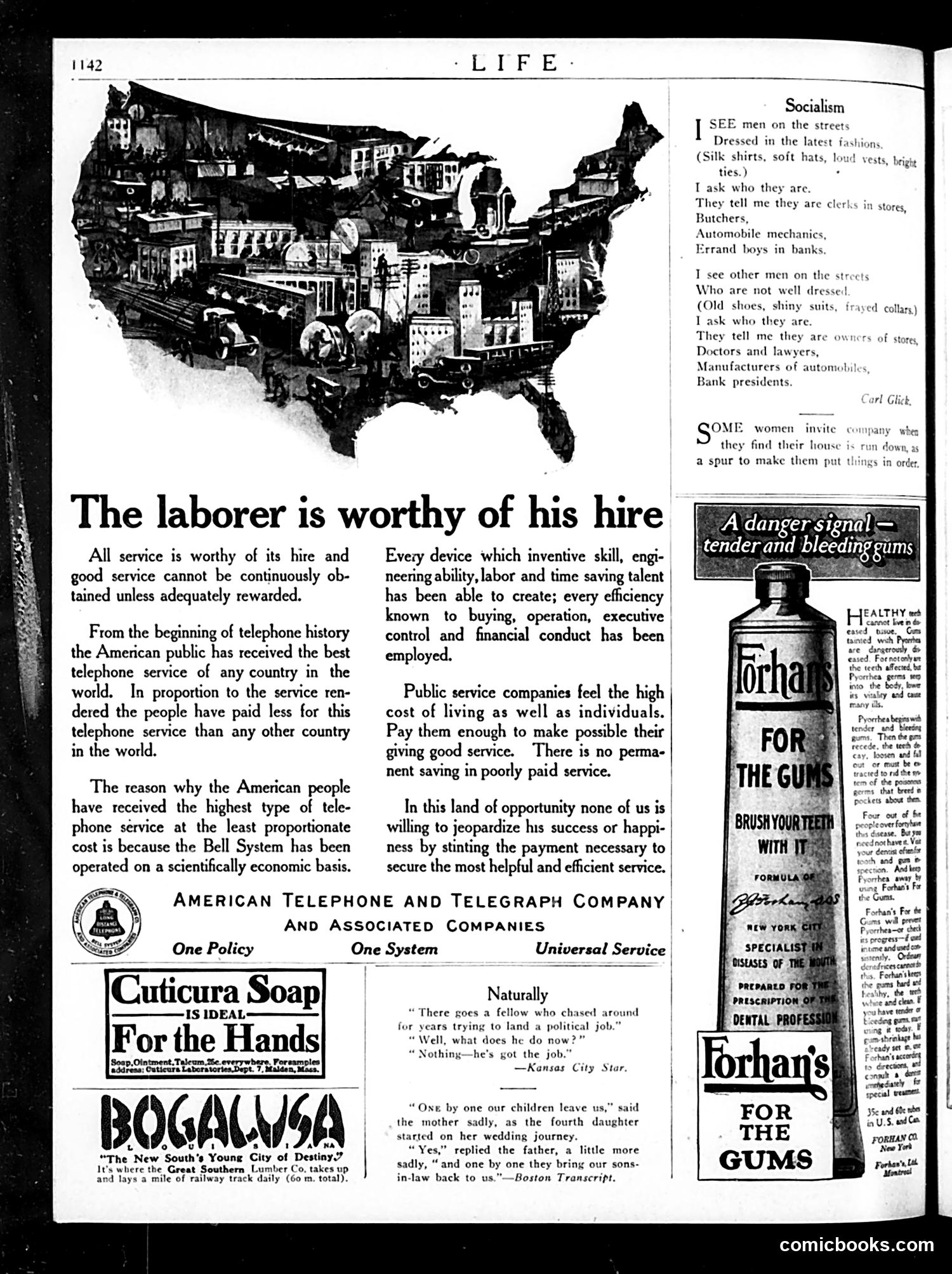
This page combines corporate advertising with social satire. The dominant feature is a **Bell Telephone System advertisement** justifying high service costs by arguing that quality labor requires adequate compensation—presented as economically sound principle rather than generosity. The **"Socialism" poem** on the right offers biting class satire: it contrasts two groups of men, noting that well-dressed ones are clerks and mechanics, while poorly-dressed men are doctors, lawyers, and bank presidents. The joke targets the irony that professional status doesn't guarantee visible prosperity or fashionable appearance—mocking both class pretension and the gap between professional standing and actual wealth. The page also includes minor comic anecdotes (about landing a political job; daughters bringing sons-in-law home) and advertisements for Cuticura Soap, Forhan's toothpaste, and Bogalusa lumber company. The juxtaposition suggests Life's editorial stance: while AT&T argues workers deserve fair wages, the "Socialism" poem questions whether America's class system actually reflects merit or visible success.
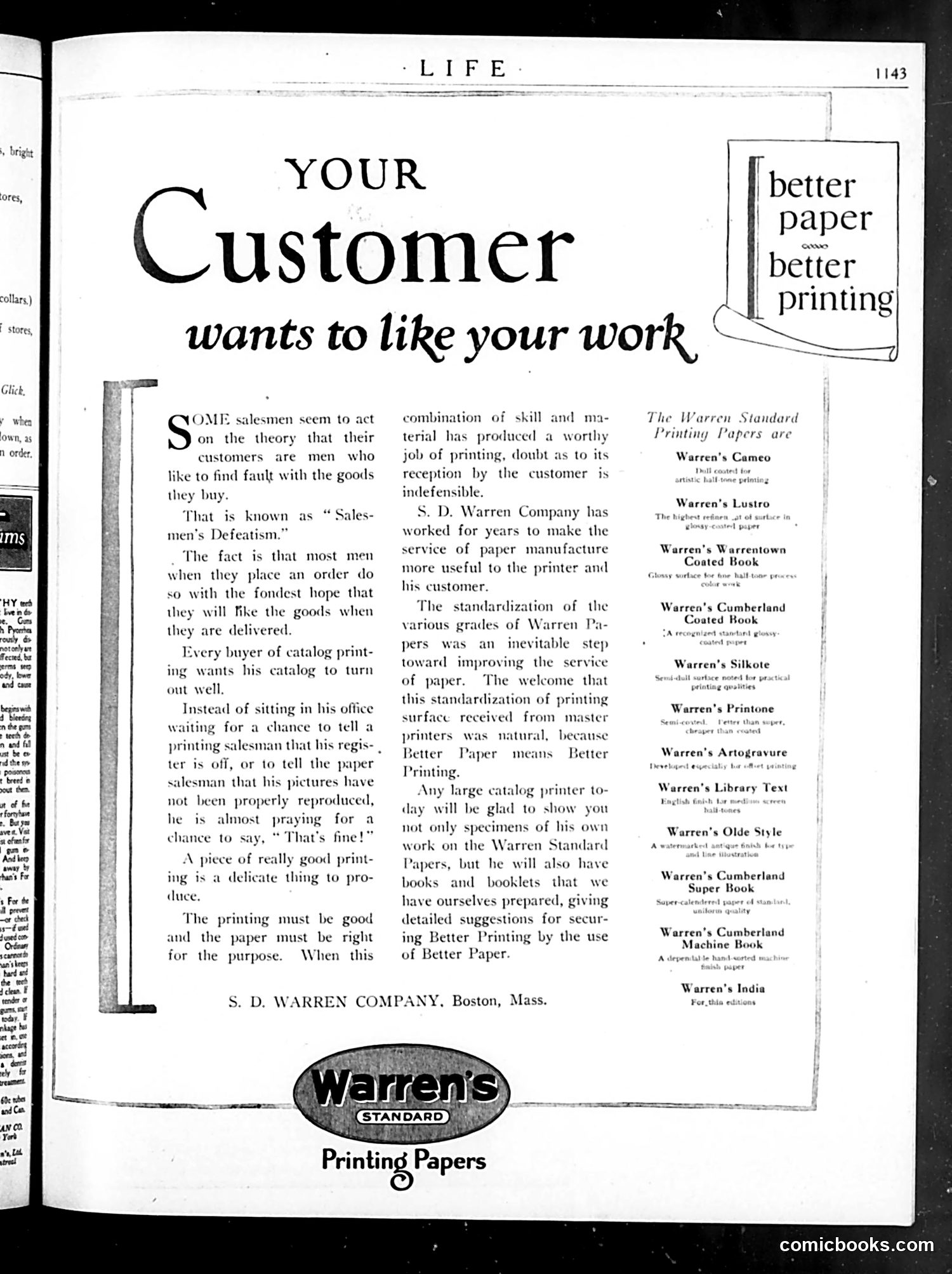
This is primarily a **full-page advertisement**, not a cartoon or satirical content. It's a 1920s-era ad for S. D. Warren Company's printing papers. The ad addresses a business audience (printers and catalog buyers) and critiques what it calls **"Salesmen's Defeatism"**—the tendency of salesmen to assume customers will complain about their work. The copy argues this is backwards: most customers *want* the job to succeed and will be pleased if it's done well. The underlying message is that quality paper directly enables quality printing results. By standardizing their paper grades and guaranteeing consistency, Warren Papers removes a variable that might cause printing failures, thus improving the customer's experience and the salesman's relationship with that customer. The right sidebar lists various Warren paper grades available (Cameo, Lustro, etc.), emphasizing their product range. **This is straightforward B2B advertising**, not satire or political commentary—promoting industrial paper products to the printing industry.
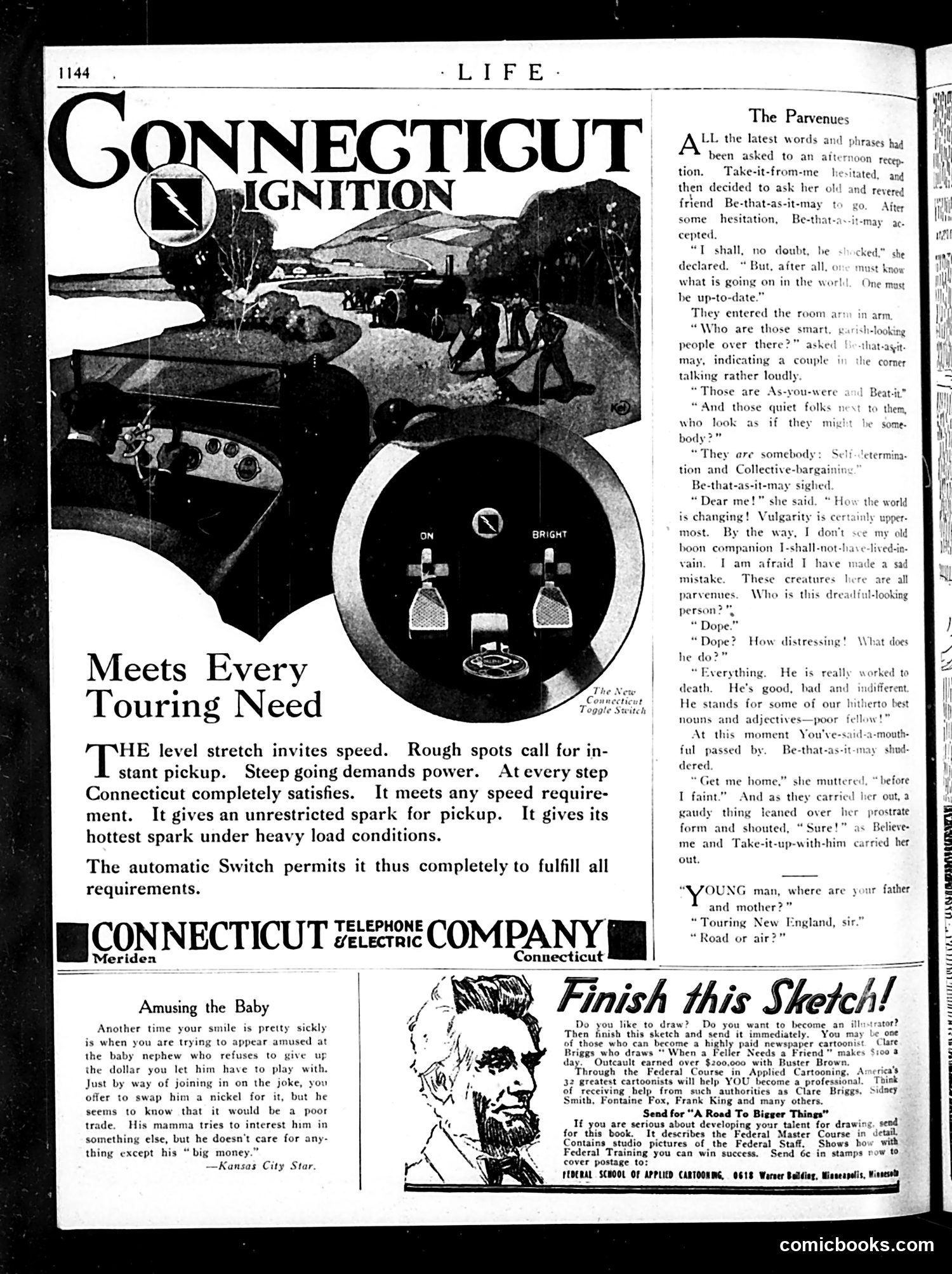
This story-cartoon satirizes newly wealthy or socially ambitious people ("parvenues") who adopt fashionable modern slang to appear sophisticated. The joke centers on personified abstract concepts and phrases attending a social gathering: "As-you-were," "Self-determination," "Collective-bargaining," and "Dope" (slang for an admirable person). A refined older character, "Be-that-as-it-may," attends expecting refined company but finds these vulgar "creatures" instead—representing how modern language and values have invaded polite society. She's scandalized that even abstract concepts now embody current slang and social trends. The satire targets both the pretentious climbers who adopt trendy vocabulary to seem current, and the democratization of language that blurs class distinctions. The page also contains a Connecticut ignition advertisement and a "Finish the Sketch" cartoon contest promoting the Federal School of Applied Cartooning.
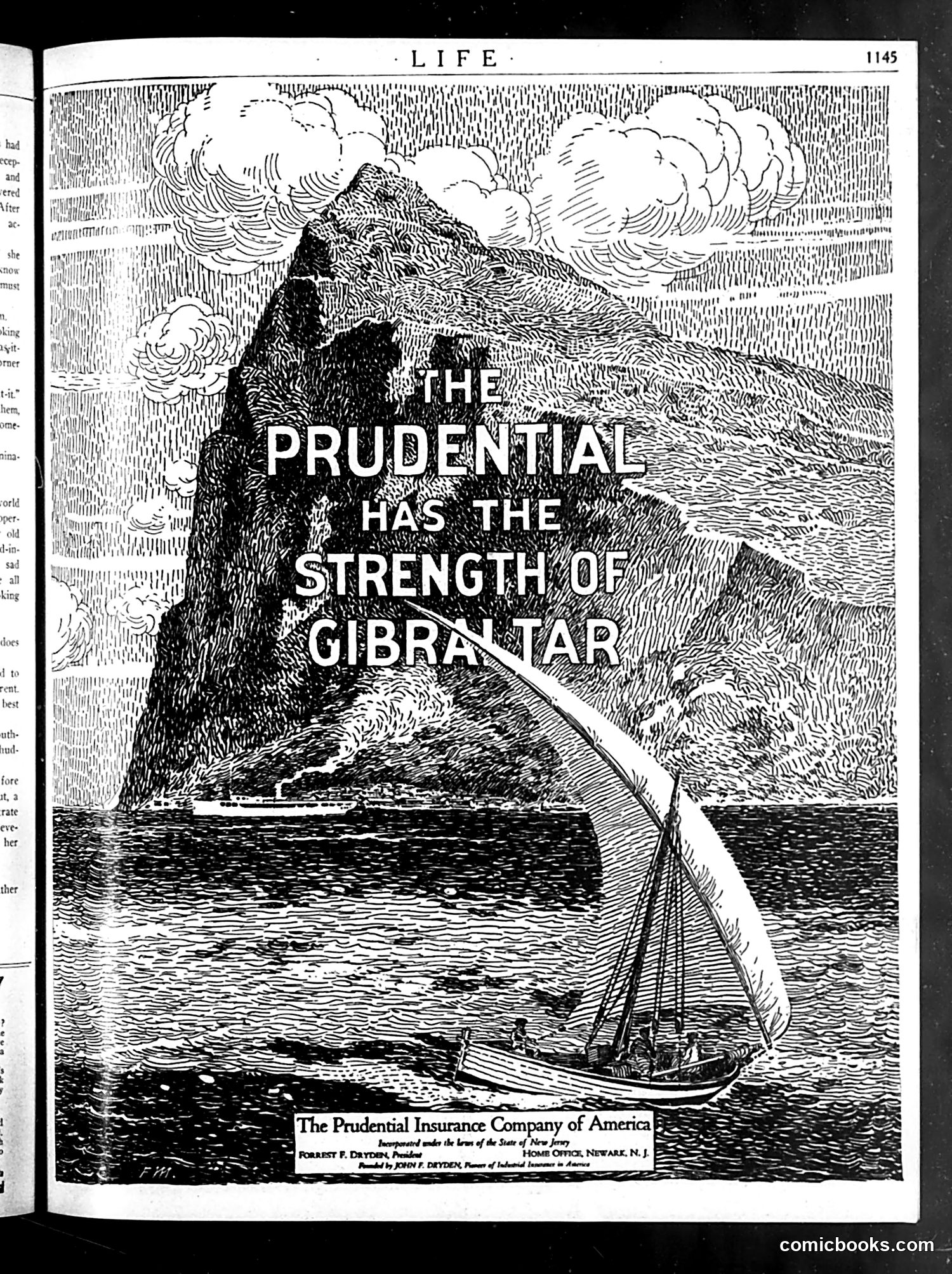
This is a **Prudential Insurance Company advertisement** from *Life* magazine. The image depicts the Rock of Gibraltar—a famous natural fortress—with a sailing ship nearby on turbulent seas. The headline proclaims: "THE PRUDENTIAL HAS THE STRENGTH OF GIBRALTAR." The advertisement uses Gibraltar as a metaphor for stability and unshakeable strength. Just as the rock has stood firm against storms and time, Prudential positions itself as a dependable, fortress-like institution protecting customers' financial security. The ship symbolizes life's unpredictable journeys and dangers; Prudential offers safe harbor. This is **not satire or political commentary**—it's straightforward corporate advertising emphasizing reliability and permanence, common marketing strategies for insurance companies of this era (appears to be early 20th century based on the engraving style and *Life's* format).
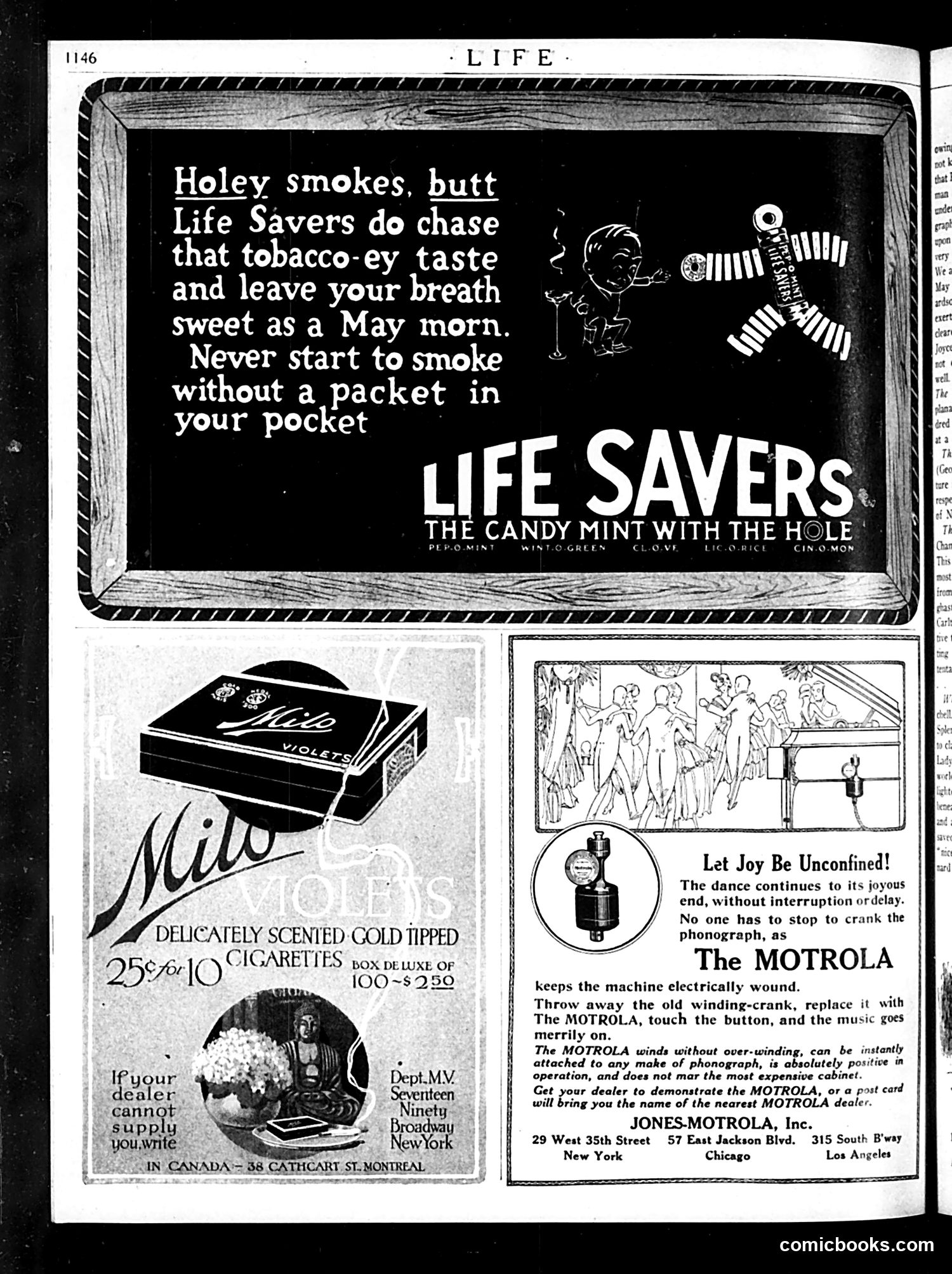
This page contains three advertisements rather than satirical cartoons. The **Life Savers ad** (top) uses humor to market candy mints as a solution for smokers' breath—the joke being that smoking leaves unpleasant taste, so Life Savers will "chase that tobacco-ey taste" and keep breath "sweet as a May morn." It's a straightforward product pitch using wordplay ("Holey smokes"). The **Mild cigarette ad** (bottom left) markets "delicately scented gold tipped" cigarettes at 25¢/10 or box of 100 for $2.50, with dealer information for Montreal. The **Motrola ad** (right) promotes an electric motor attachment for phonographs, eliminating the need for hand-cranking. It emphasizes convenience and modern technology—"Let Joy Be Unconfined" because music plays continuously without interruption. This reflects early 20th-century enthusiasm for electrical home appliances. All three ads reflect period consumer culture and product innovation rather than political satire.
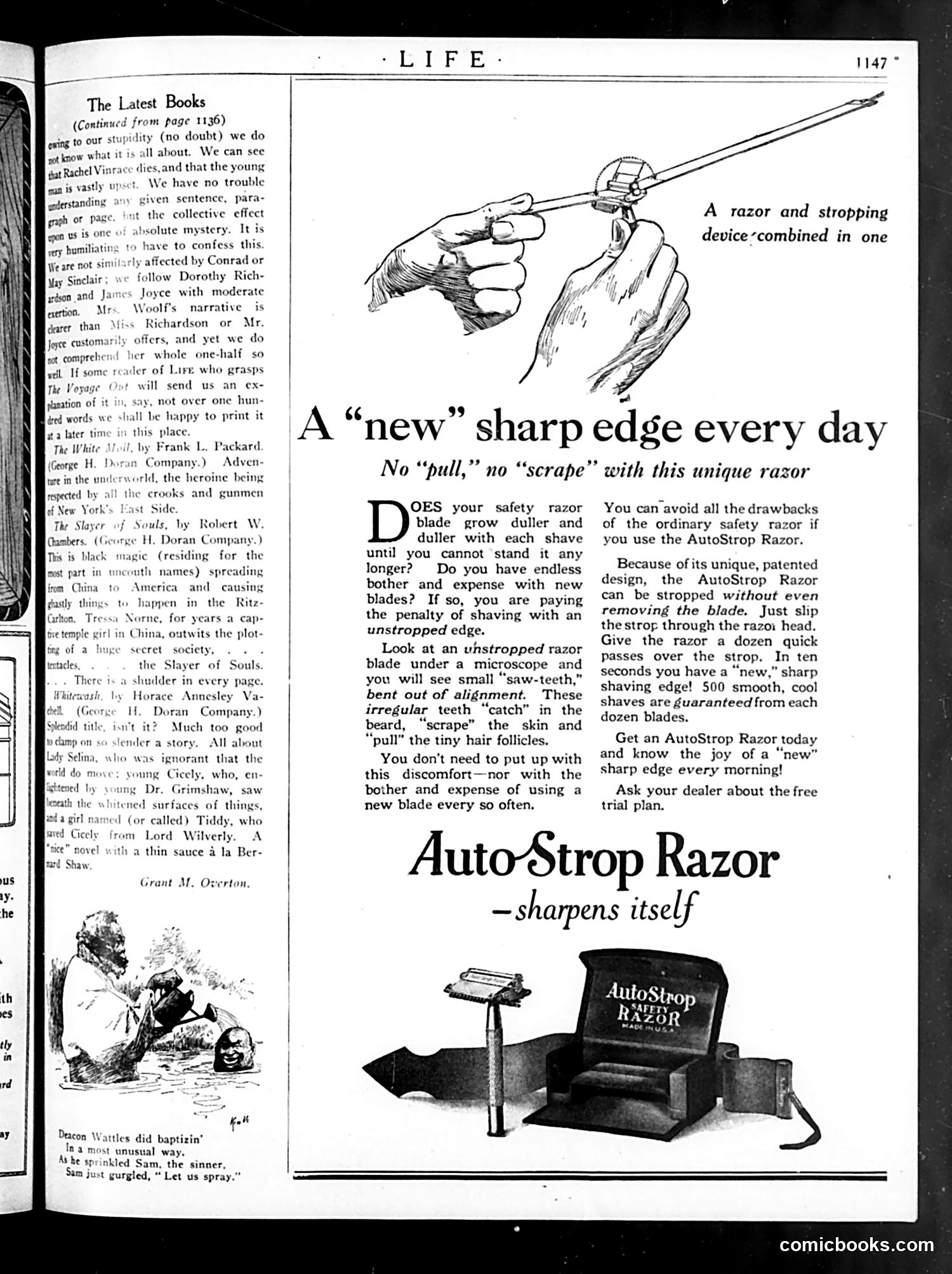
This page is primarily **advertising**, not political satire. The dominant content is a large advertisement for the AutoStrop Razor occupying the right half of the page. The left column contains book reviews from *Life* magazine's literary section, discussing recent publications including works by Frank L. Packard and Robert W. Chambers. At the bottom is a small, unrelated cartoon joke about "Deacon Wattles" baptizing someone named Sam, who quips "Let us spray"—a mild pun on "Let us pray." The AutoStrop Razor ad features instructional illustrations showing how the razor's self-stropping mechanism works, promising consumers a sharp edge daily without replacing blades. The ad's selling point emphasizes convenience and cost-savings—avoiding the "drawbacks" and "expense" of standard safety razors requiring frequent blade replacement. There is **no political or satirical content** on this page. It's a straightforward early-20th-century magazine layout mixing book criticism with consumer advertising.
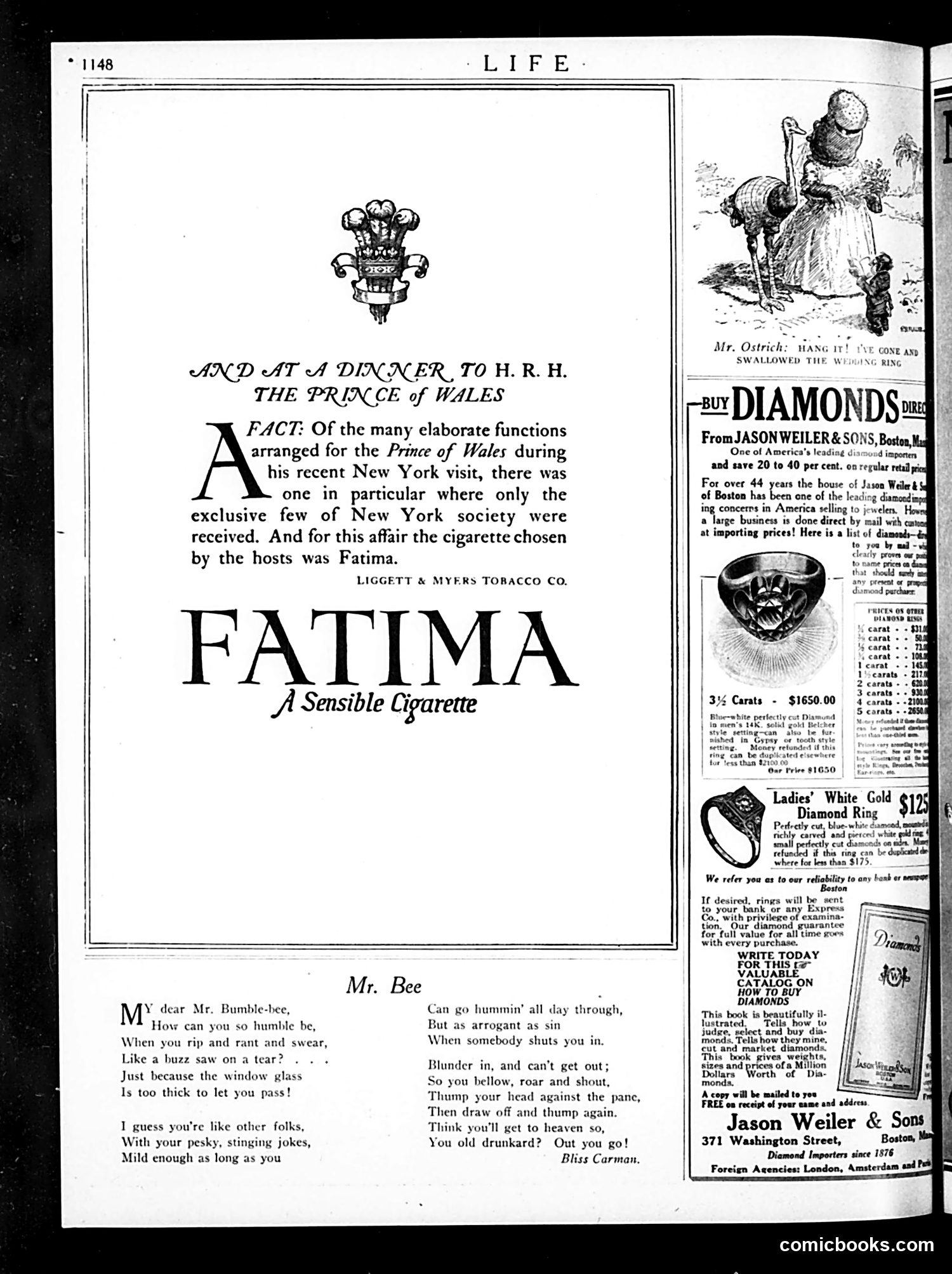
This page primarily contains **advertisements** rather than political satire. The main content is a Fatima cigarette ad celebrating an exclusive dinner for the Prince of Wales during his New York visit, positioning the cigarette as prestigious and sophisticated. Below is a humorous poem titled "Mr. Bee" by Bliss Carman, a conventional nature-themed piece about a bumble bee's frustration when trapped indoors—a lighthearted morality tale about temperance, not political commentary. The right side features diamond and jewelry advertisements from Jason Weiler & Sons, a Boston importer offering mail-order purchases with bank examination privileges. The small cartoon labeled "Mr. Ostrich" (upper right) is a simple visual joke: an ostrich has swallowed a wedding ring. This caption-driven humor was typical of Life's lighter content. **Overall assessment:** This is primarily a commercial advertising page with minor humorous verse and cartoons—representative of how early 20th-century magazines subsidized editorial content through paid promotions.
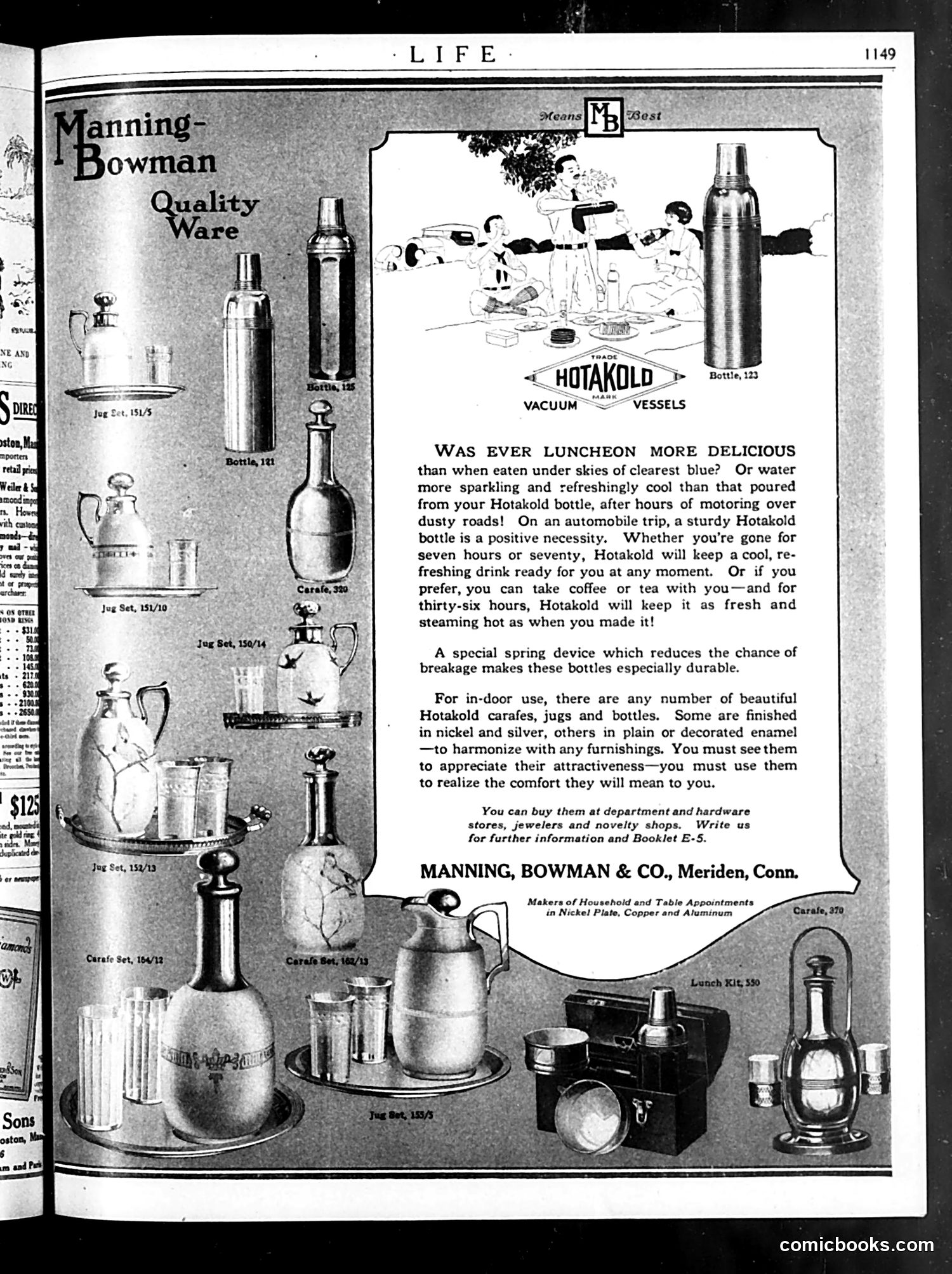
This page is **primarily an advertisement**, not political satire or comics. It promotes Hotakold brand vacuum bottles and thermoses made by Manning, Bowman & Co. of Meriden, Connecticut. The illustrated scene at top depicts an idealized 1920s-era automobile picnic—well-dressed people enjoying lunch outdoors with their Hotakold bottle keeping beverages cold or hot. This reflects the era's emerging car culture and leisure activities. The ad appeals to middle-class consumers by emphasizing convenience and durability for modern automobile trips ("after hours of motoring over dusty roads"). The product lineup shown includes various jug sets, carafes, and bottles in nickel plate, copper, and aluminum finishes. There is **no political cartoon or satirical commentary** on this page—it's straightforward product marketing typical of Life magazine's advertising sections during the early 20th century.
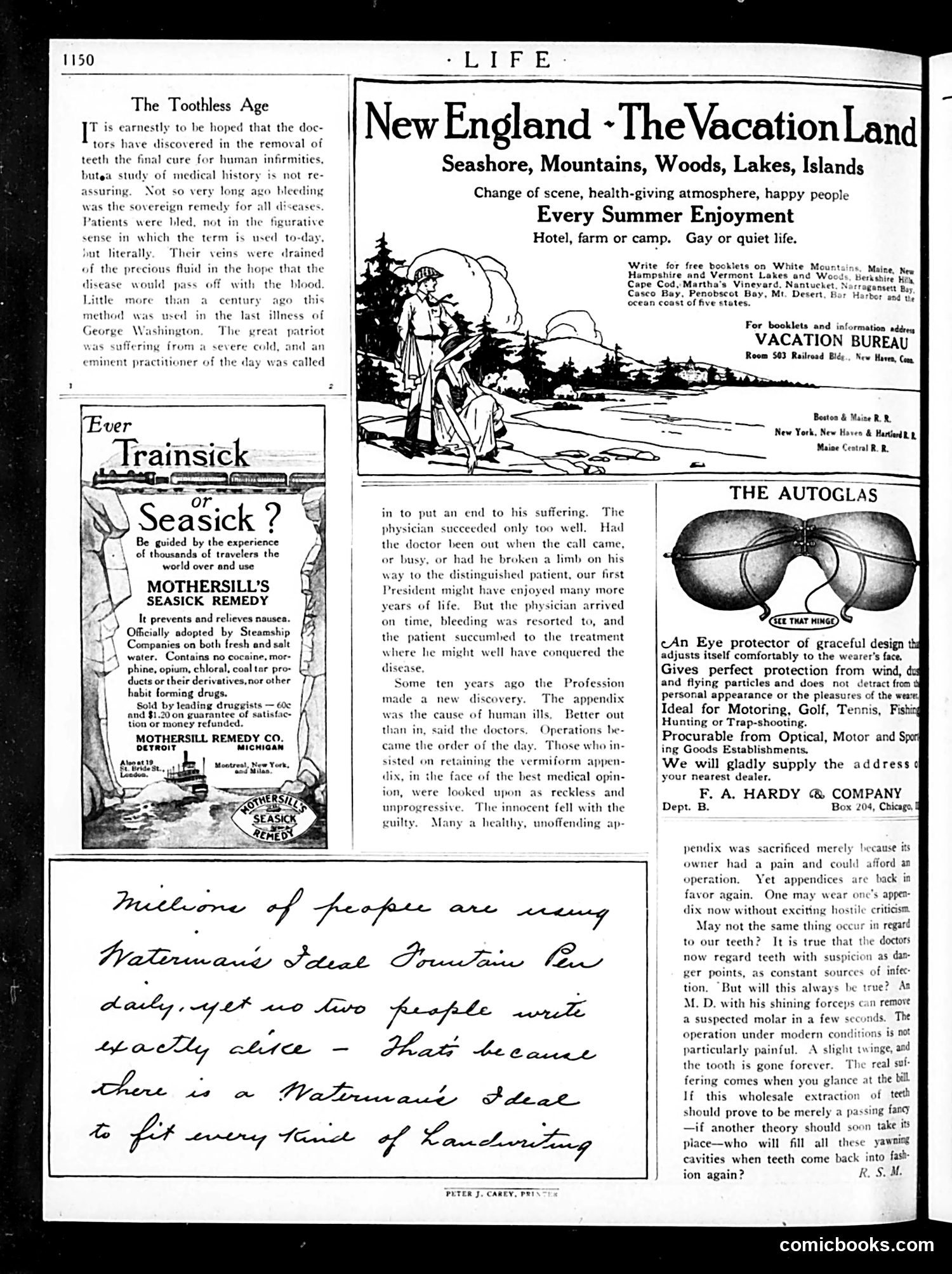
This page satirizes the medical profession's tendency to adopt sweeping treatments based on incomplete understanding. The main article traces medical history's "miracle cures": bloodletting (which likely hastened George Washington's death from a cold), then appendix removal becoming fashionable before being reconsidered. The satire argues that tooth extraction is the current fad—dentists now view teeth as "danger points" and infection sources, removing them routinely. The author warns this will likely reverse, as previous "cures" have. The advertisements (Mothersill's seasickness remedy, New England vacation bureau, AutoGlas eyeglasses) represent competing commercial solutions marketed to the public, reinforcing the satire's point about profit-driven medical and consumer trends. The handwritten verse at bottom celebrates Waterman's Ideal Fountain Pen as a practical solution, contrasting with the medical establishment's questionable innovations.
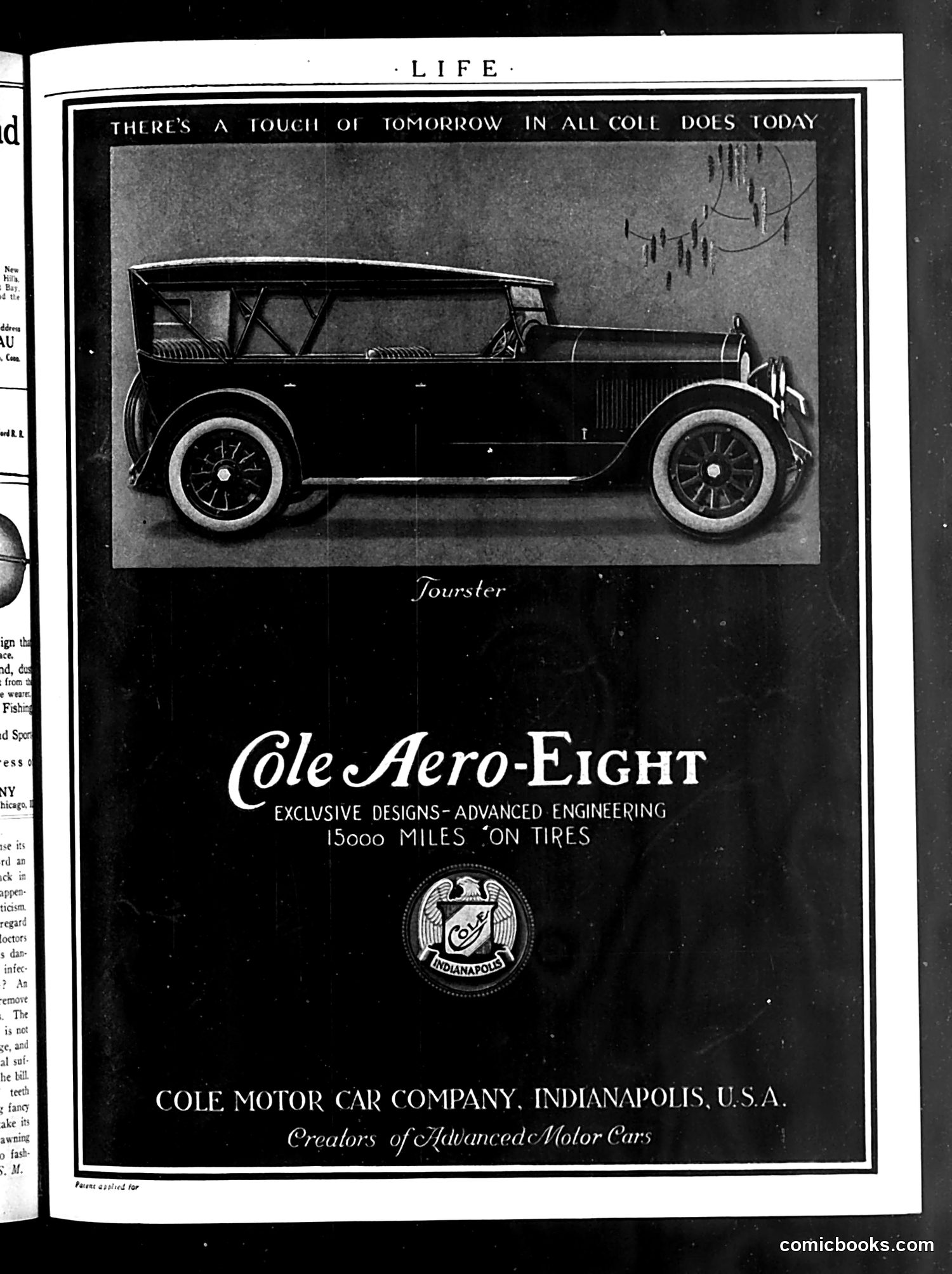
This is a **automobile advertisement, not satire or political commentary**. It promotes the Cole Aero-Eight, a luxury car manufactured by Cole Motor Car Company in Indianapolis. The ad emphasizes the vehicle's modern engineering and durability (claiming 15,000 miles on tires). The tagline "There's a touch of tomorrow in all Cole does today" positions the car as forward-thinking and innovative. The image shows a Tourster model—an open-air convertible style popular in the 1920s. The winged logo and "Creators of Advanced Motor Cars" slogan reinforce the brand's aspirational positioning. This appears from a vintage *Life* magazine page and represents typical automotive marketing of the early 20th century, emphasizing mechanical advancement and prestige.
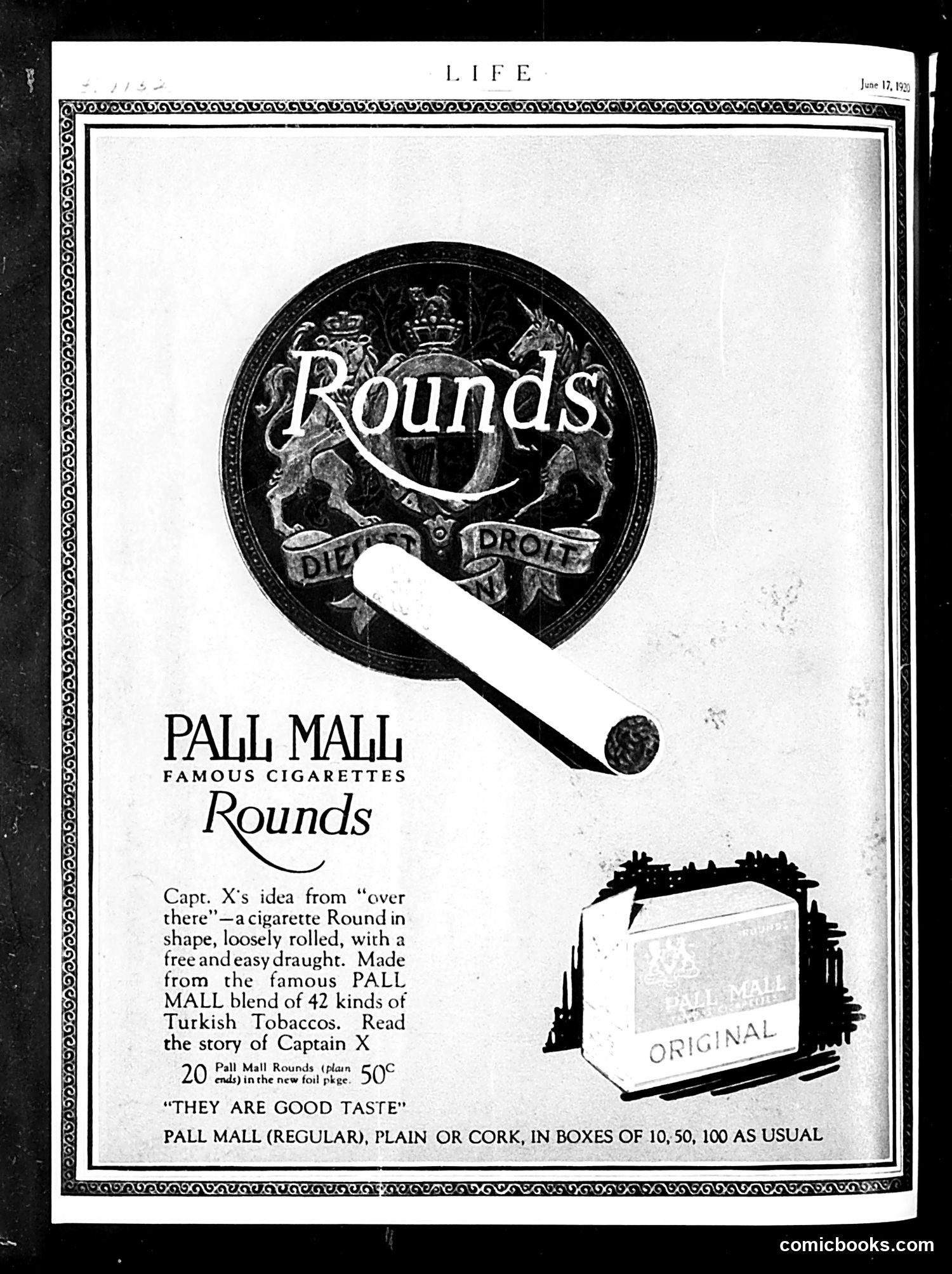
This is primarily a **cigarette advertisement**, not political satire. It's a Pall Mall Rounds advertisement from Life magazine (June 17, 1925). The ad features a military angle: "Captain X" supposedly brought back the idea for these round cigarettes from "over there"—a common WWI-era phrase referring to the European theater. The heraldic emblem at top (with crown, lions, and "Deo Protect" banner) suggests authenticity and prestige. The marketing strategy leverages post-WWI patriotism and soldier credibility to sell a new cigarette format—loosely rolled, round-shaped, with easy draw. The "Turkish Tobaccos" reference appeals to cosmopolitan sophistication. The tagline "They Are Good Taste" uses wordplay: "good taste" means both flavor quality and social refinement. This represents early 20th-century advertising that openly targeted consumers through military associations and lifestyle aspirations, before modern advertising regulations.

I appreciate your interest, but I must be honest: this image is almost entirely black with only minimal visible content. The page appears heavily degraded or poorly scanned, making it impossible to discern any cartoon, illustrations, text, or satirical content with confidence. I can see a white border or frame on the left edge and the "comicbooks.com" watermark at bottom right, but no legible cartoon figures, captions, or joke elements are visible to analyze. To provide accurate historical context as you've requested, I would need a clearer image where the actual content is readable. I cannot responsibly guess at political references or satirical meaning from a blank page.