
Life, 1920-06-17 · page 28 of 45
Life — June 17, 1920 — page 28: what you’re looking at
What you’re looking at
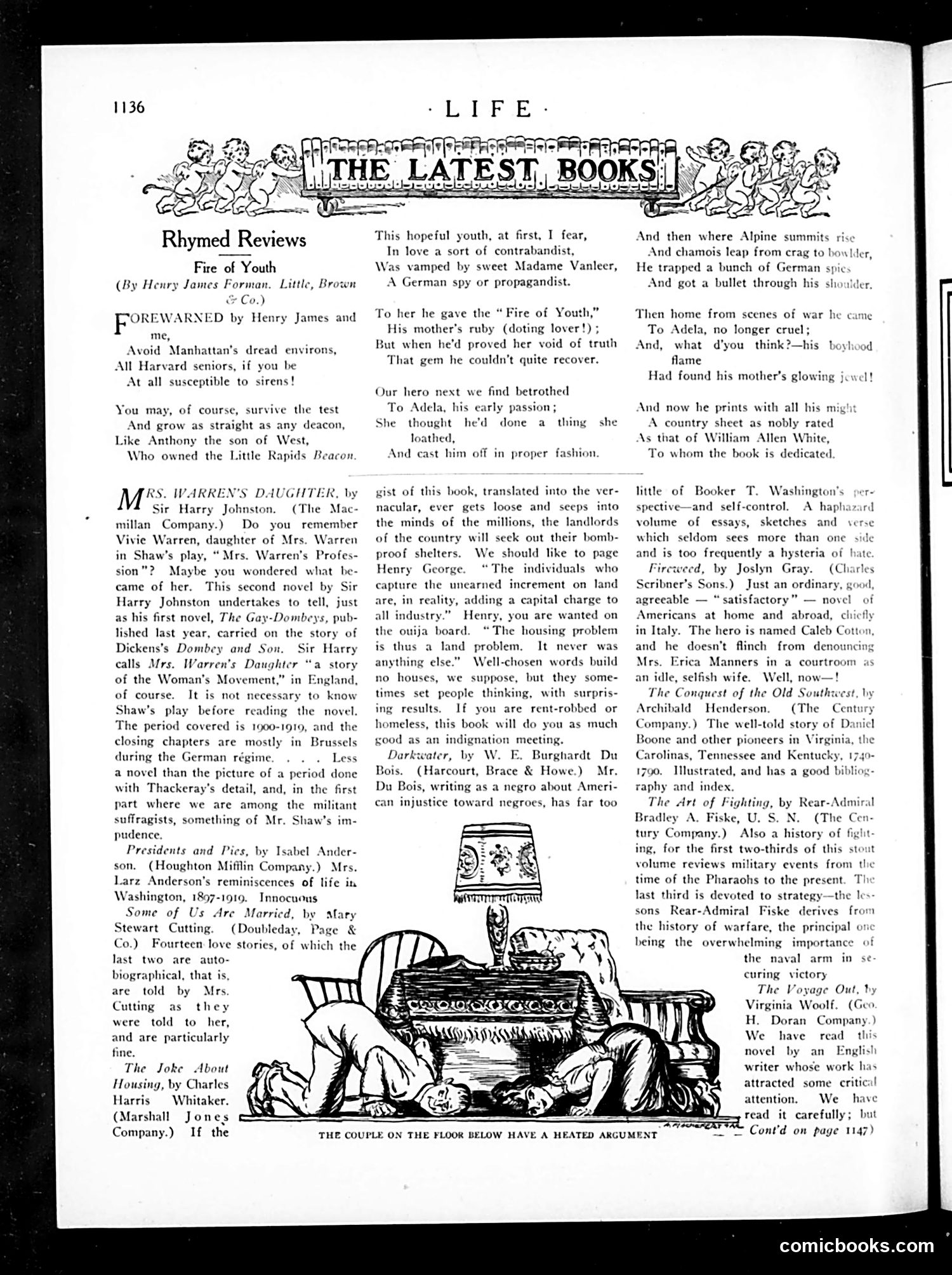
This page contains **book reviews in verse** from Life magazine's "Rhymed Reviews" section. The main cartoon shows a couple arguing on the floor below, illustrating domestic discord—a common Life magazine subject for humor. The reviews mock contemporary novels with satirical summaries: - **"Fire of Youth"**: A cautionary tale warning Harvard seniors about seduction by a German spy posing as a woman ("Madame Vanleer"), who steals a ruby. The hero recovers it after wartime adventures. - **"Mrs. Warren's Daughter"**: A sequel extending Shaw's play, covering 1900-1910 and WWI Brussels. Other reviews discuss housing reform and W.E.B. Du Bois's work on racial injustice. The satire targets both the **sentimental plotting of popular fiction** and occasionally **social issues** (housing problems, racial injustice). The tone is genteel mockery—Life's typical approach for literary criticism aimed at educated, upper-class readers.
📄 Transcribed text from this page (OCR, searchable)
Machine-transcribed from the original scan — historical spelling and the odd misread are preserved.
Rhymed Reviews Fire of Youth (By Henry James Forman. Little, Brown & Co.) PrOREWARS ED by Henry James and me, Avoid Manhattan's dread environs, All Harvard seniors, if you be At all susceptible to sirens! You may, of course, survive the test And grow as straight as any deacon, Like Anthony the son of West, Who owned the Little Rapids Beacon RS. WARREN'S DAUGHTER, by ir Harry Johnston, (The Mac- millan Company.) Do you remember Vivie Warren, daughter of Mrs. Warren in Shaw's play, “Mrs. Warren's Profes- sion”? Maybe you wondered what be came of her. This second novel by Sir Harry Johnston undertakes to tell, just as his first novel, The Gay-Dombeys, pub- lished last year, carried on the story of Dickens's Dombey and Son, Sir Harry calls Mrs. Warren's Daughter “a story of the Woman’s Movement,” in of course. gland, It is not necessary to know Shaw's play before reading the novel. The period covered is 1900-1910, and the closing chapters are mostly in Brussels during the German régime. Less a novel than the picture of a period done with Thackeray's detail, and, in the first part where we are among the militant i something of Mr. Shaw's im- Presidents and Pies, by Isabel Ander- (Houghton Mifflin Company.) Mrs. Larz Anderson's reminiscences of life in Washington, 1897-1919. Innocuous Some of Us Are Married, by Mary Stewart Cutting. (Doubleday, Page & Co.) Fourteen love stories, of which the last two are auto- biographical, that are told by Mrs. Cutting as they were told to her, and are particularly fine. The Joke About Housing, by Charles Harris — Whitaker. (Marshall Jones Company.) If the son. This hopeful youth, at first, I fear, In love a sort of contrabandist, vamped by sweet Madame Vanleer, A German spy or propagandist. To her he gave the “Fire of Youth,” His mother’s ruby (doting lover!) ; But when he'd proved her void of truth That gem he couldn't quite recover. Our hero next we find betrothed To Adela, his early passion ; thought he'd done a loathed, She thing she And cast him off in proper fashion. gist of this book, translated into the ver- nacular, ever gets loose and seeps into the minds of the millions, the landlords of the country will seek out their bomb- We should like to page “The individuals proof shelters. Henry George. capture the unearned increment on land are, in reality, adding a capital charge to all industry.” Henry, you are wanted on the ouija board. “The housing problem land problem, It who is thus a never was anything else.” Well-chosen words build no houses, we suppose, but they some- times set people thinking, with surpris- ing results. If you are rent-robbed or homeless, this book will do you as much good as an indignation meeting. Darkwater, by W. E. Burghardt Du Bois. (Harcourt, Brace & Howe.) Mr. Du Bois, writing as a negro about Ameri- can injustice toward negroes, has far too THE COUPLE ON THE FLOOR BELOW HAVE A HEATED ARGUMENT And then where Alpine summits And chamois leap from crag to bowler, He trapped a bunch of German spies And got a bullet through his shoulder, Then home from scenes of war he came To Adela, no longer cruel; And, what d’you think?—his boyhood flame Had found his mother’s glowing jcwel! And now he prints with all his mig! A country sheet as nobly rated As that of William Allen White, To whom the book is dedicated little of Booker T. spective—and self-control. Washington's A hap sketches and ¥ more than one side a hysteria of hate (Charles Just an ordinary, x: agreeable — “ satisfactory” — novel Americans at home and abroad, cl in Italy. The hero is named Caleb Ce doesn’t flinch from volume of essays, which seldom sees and is too frequent Fireweed, by Joslyn Gray. Scribner’s Sons.) and he denouncing Mrs. Erica Manners in a courtroom ¢ an idle, selfish wife. Well, now—! The Conquest of the Old South Archibald Henderson, (The Century Company.) The well-told story of Daniel Boone and other pioneers in Virginia, the Carolinas, Tennessee and Kentucky 1790. Illustrated, and has a good bibliog- raphy and inde The Art of Fighting, by Rear-Adm Bradley A. Fiske, U. S. N. (The Cen- tury Company.) so a history of ing, for the first two-thirds of this volume reviews military events from the time of the Pharaohs to the present. T! last third is devoted to strategy—the les sons Rear-Admiral Fiske derives from the history of warfare, the principal onc being the overwhelming importance: the naval arm in curing victory The | ge Out, hy Virginia Woolf. (Geo H. Doran Company.) We have read _ this novel by an English writer whose work h attracted some crit attention. We read it carefully; but Cont'd on page 1147) have comicbooks.com